

For the Two Hundred and Fiftieth. July 4, 2026.
The Audio Version… This essay is important, but it is long. Due to its length, many might prefer listening via audio:
The Quiet Death of American Federalism
What Switzerland Kept and the USA Discarded
The argument in brief:
At its two hundred and fiftieth anniversary, the United States lives under a government structurally unlike the one the founders built. The founders did not trust parchment to limit power. They trusted structure: rival sovereign states competing for citizens and capital, each able to check the center, the arrangement the Austrian economists describe as competition disciplining a monopoly. Between 1868 and 1913, that structure was taken apart.
The Fourteenth Amendment let the central government reach down into the internal law of the states.
The Seventeenth Amendment removed the states' voice from the Senate by taking the power to appoint senators away from state legislatures and giving it directly to the voters, fundamentally changing the balance between the states and the federal government.
In 1869, Texas v. White effectively sealed the Union by foreclosing secession as a constitutional option.
Switzerland faced the same centralizing pressures in the nineteenth century after its own civil war, yet it chose a very different path. Rather than concentrating power in the national government, it preserved and later strengthened the institutional checks that still define Swiss federalism today: the cantonal veto, the double majority, and the referendum.
The difference was constitutional design, shaped by the very different character of the two civil wars and, above all, by what each losing side had been fighting to preserve. What constitutional design dismantles, constitutional design can restore. This essay concludes with five practical reforms that could begin rebuilding America's federal balance.
This month, America celebrates the 250th anniversary of the Declaration of Independence.
The men of 1776 built a very specific kind of government. They created a federal government controlled by a leash built by limited, delegated powers, while the states retained sovereignty over nearly everything else. That constitutional balance defined the American experiment.
The government Americans live under in 2026 is not that government. Somewhere between the Declaration and this anniversary, the leash was cut. The question worth asking this Fourth of July is not whether that happened; it did. It is how, when, and by what precise constitutional, judicial, and political instruments this happened, and what can be done to restore the intended balance.
Twenty-five years ago, Jill and I stumbled onto the beginning of an answer in Bern, Switzerland, though we did not recognize it at the time.
For a season, we lived in an apartment across from the Glockenspiel, the medieval clock tower whose gilded figures still emerge each hour, just as they have for six centuries. During the warmer months, our family often jumped from an upstream bridge and floated the Aare, the cold, green river that wraps around the old city in a tight oxbow. The current sweeps you downstream faster than seems wise until you learn to trust it. There were no nanny-state warning signs. Individual responsibility was assumed. Swimmers were expected to understand the risks and accept the consequences of their own decisions.


We walked everywhere, absorbing the extraordinary architecture, history, and culture of this UNESCO World Heritage city. I will never forget the Swiss National Day celebration: a massive bonfire atop the hill overlooking Bern, reached by funicular, while bottle rockets and larger fireworks erupted from rooftops across the city despite its protected historic status. It was exuberant, confident, and refreshingly free. The city left a lasting impression of a different model of constitutional liberty. So did the country around it, though it took me years to understand why

.What struck me most was how little the Swiss federal government seemed to do, and how much authority remained with the cantons. Taxes, schools, policing, and the texture of everyday law all stayed close to home and changed as you crossed a cantonal border. The wealthier cantons deliberately supported the poorer ones, but there were limits. The system softened differences without erasing them. It never reduced the cantons to administrative districts governed from a distant capital. My impression was simple and, I have since concluded, correct: the Swiss had preserved something much closer to what America’s Founders intended than Americans themselves had.
That was no accident of Alpine culture or the advantages of a small country. It was a constitutional design. Both Switzerland and the United States built federal republics in the nineteenth century. One preserved the institutional machinery that keeps central government constrained. The other gradually dismantled it. In America, much of that transformation occurred quietly through constitutional changes that few citizens can explain, and fewer still appreciate.
The Founders Trusted Structure, Not Words
To understand what changed, begin with what the Founders actually built. They did not expect liberty to survive because politicians honored the Constitution. They expected it to survive because the Constitution made it difficult for any one part of government to accumulate too much power.
James Madison explained this most clearly in Federalist No. 51. Liberty would be preserved by constitutional design, not by trusting the virtue of those in office. “Ambition must be made to counteract ambition.” Each part of the system would possess both the authority and the incentive to resist encroachments by the others. The Constitution was never intended to rest on parchment barriers. It rested on competing centers of power
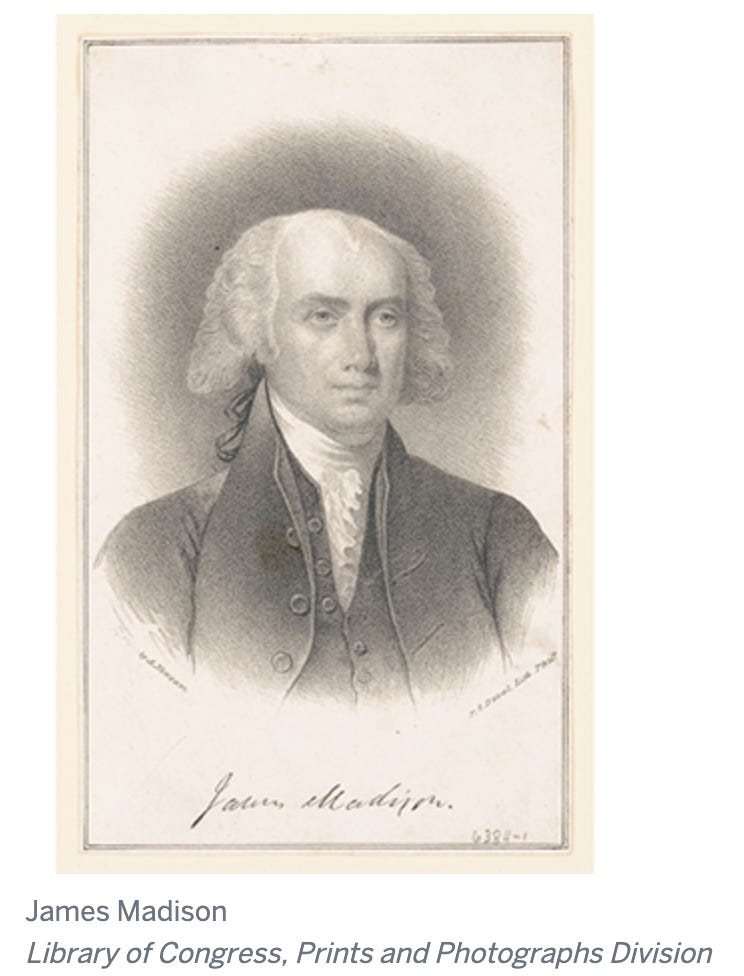
.That competition existed not only among the legislative, executive, and judicial branches, but between the federal government and the states. The states were not administrative subdivisions of Washington. They were sovereign governments that had created the federal union and delegated only limited powers to it. They were expected to guard their own authority with the same determination that Congress guarded its own prerogatives.
In many ways, the states functioned as the Constitution’s immune system. They possessed both the standing and the incentive to resist federal expansion. A constitutional system is only as durable as the number of institutions willing and able to defend its limits. In 1789, there were many. Over the next century, those defenders were steadily weakened until very few remained.
Austrian School economists later explained why this structure mattered. The Government is a monopoly on the legitimate use of force within its territory. Like every monopoly, it expands unless constrained by competition. Federalism supplied that competition. States competed for citizens, businesses, investment, and talent. A state that taxed too heavily or governed too aggressively risked watching people and capital move elsewhere. Just as competition disciplines private markets, competition among the states disciplined government itself.
This is why the Founders relied on constitutional structure rather than moral virtue. They did not assume officeholders would be wise or selfless. They assumed they would pursue their own interests and designed a system in which those interests would often align with the preservation of constitutional limits.
Some scholars would take the story back even further. Murray Rothbard argued that the centralizing impulse appeared at Philadelphia itself, when the Constitution replaced the far looser Articles of Confederation. From that perspective, the Anti-Federalists correctly recognized that the new Constitution strengthened the national government and fought to preserve as much state sovereignty as they could. If that interpretation is correct, then the great constitutional changes of 1868 and 1913 did not create American centralization. They simply removed the strongest remaining barriers to a process already underway.
The story that follows is not the creation of federal power. It is the systematic removal of the constitutional restraints that once kept it in check.
The Original Constitutional Order
Before the Civil War, the constitutional balance looked very different from the one Americans know today.
The Bill of Rights restrained the federal government, not the states. The Supreme Court confirmed that principle in Barron v. Baltimore, holding that the first eight amendments limited only the national government. The protection of individual rights was primarily the responsibility of the states under their own constitutions. Americans looked to their state governments to secure their liberties, and to the federal Constitution to restrain the distant government they trusted least.
The states also exercised direct influence inside the federal government itself. Under the original Constitution, state legislatures chose U.S. senators. The Senate was not simply a second legislative chamber. It was the institutional voice of the states within the federal government. No law could pass, no treaty be ratified, and no presidential appointment confirmed without the approval of senators who answered first to their state legislatures. Madison emphasized in Federalist No. 62 that this arrangement was deliberate. Equal representation in the Senate, coupled with selection by the state legislatures, acknowledged that the states remained sovereign within their own sphere and retained a permanent seat at the federal table.
A third safeguard stood quietly behind the other two. Although rarely discussed and never exercised successfully before the Civil War, many Americans understood that a state ultimately retained the option of leaving the Union if the constitutional compact were fundamentally broken. Whether that belief was legally correct remains debated. What matters is that it existed and shaped the relationship between the states and the federal government.
Between 1865 and 1913, each of these constitutional restraints disappeared. The federal government became the primary guarantor of individual rights. The states lost their direct representation in the Senate when the Seventeenth Amendment transferred the election of senators from state legislatures to the people. And after Texas v. White, unilateral secession was declared constitutionally impossible.
The justification was preserving the Union. The result was something much larger: a fundamental transformation of the American constitutional order. The federal system the Founders designed became one in which the nation was increasingly governed from Washington, D.C., a town Steve Bannon now famously calls “the Imperial Capital of the World”
The Fourteenth Amendment: A New Constitutional Order
The Fourteenth Amendment, ratified in 1868, was born of both necessity and tragedy. After the Civil War, many of the defeated Southern states responded to emancipation with the Black Codes, laws designed to strip newly freed slaves of the rights they had just gained and push them back toward a condition resembling servitude.
Here, the Founders’ original constitutional arrangement failed. Before the Civil War, the states were expected to serve as the primary guardians of liberty. In the South, many became its violators. Protecting individual rights required a power above the states themselves.
The first section of the Fourteenth Amendment answered that need. It established national citizenship and prohibited states from abridging the privileges or immunities of citizens, depriving any person of life, liberty, or property without due process of law, or denying any person the equal protection of the laws. Read in its historical context, the amendment was a shield for a people whose own state governments had abandoned them.
The constitutional transformation lay not in that purpose, but in the mechanism required to achieve it.
For the first time, the federal government acquired broad constitutional authority to review and invalidate state laws that violated federally protected rights. That authority would not remain confined to the circumstances that gave birth to the amendment. Its boundaries would be defined over the next century by the federal courts.
The Supreme Court initially took a narrow view. In the Slaughter-House Cases, it interpreted the Privileges or Immunities Clause so narrowly that it became almost irrelevant. But another provision proved far more expansive. Over the twentieth century, the Court increasingly relied on the Due Process Clause to apply the protections of the Bill of Rights against the states, one guarantee at a time. Lawyers call this process “incorporation.” Freedom of speech followed in 1925, freedom of the press in 1931, with many other rights added over the decades.
The structural consequence deserves to be stated plainly. Before the Civil War, the Bill of Rights primarily restrained the federal government. Today, it also restrains the states, with federal courts serving as the final arbiters of state law. An amendment adopted to protect individuals from abusive state governments also established a permanent constitutional pathway through which the federal government could supervise the internal law of every state.
Whether any particular decision was right or wrong is a separate question. Many corrected genuine injustices and secured fundamental liberties. The structural reality, however, is undeniable. A constitutional channel had been opened from Washington into the internal affairs of every state, and the scope of that authority would thereafter depend largely on the federal judiciary.
The Seventeenth Amendment: The States Lose Their Voice
If the Fourteenth Amendment gave the federal government a new constitutional pathway into the affairs of the states, the Seventeenth Amendment closed off the states’ pathway back into the federal government.
Ratified in 1913, it transferred the election of U.S. senators from state legislatures to the voters. It was presented as a democratic reform, and for good reason. Legislative deadlocks sometimes left Senate seats vacant for months. Corruption and outright bribery had tarnished the process, earning the Senate its reputation as the “millionaires’ club.” The reform addressed real problems.
But it also fundamentally changed the constitutional structure.
Before 1913, senators represented states as political institutions. They answered first to the legislatures that selected them and served as the states’ permanent representatives within the federal government. No major legislation, treaty, or presidential appointment could move forward without the consent of a chamber directly accountable to state governments.
After the Seventeenth Amendment, that institutional connection disappeared. Senators no longer answered to state legislatures. They answered to statewide electorates, the same voters who elected presidents and members of the House. The Senate remained, but its constitutional role changed. The chamber Madison envisioned as the institutional guardian of federalism gradually became a second popularly elected legislative body.
Viewed together, the Fourteenth and Seventeenth Amendments reveal a striking constitutional symmetry. The Fourteenth created a new avenue through which the federal government could supervise the states. The Seventeenth eliminated the states’ direct institutional influence within the federal government.
One strengthened Washington’s reach into the states. The other weakened the states’ reach into Washington.
Together, they fundamentally altered the balance the Founders had designed.
The Last Brake
Behind the states’ constitutional immunity and their institutional voice in the Senate stood one final restraint on federal power: the possibility of exit.
In 1869, the Supreme Court, in Texas v. White, declared the Union “an indestructible Union, composed of indestructible States.” Whatever the constitutional arguments had been before the Civil War, and thoughtful Americans had debated them for decades, the question was now settled. In practice, it had been settled first by force and only afterward by the Court. A state could no longer leave the Union, even as a last resort.
The Framers had never clearly affirmed or denied a right of secession. They left the question unresolved. After Texas v. White, it was resolved permanently.
Within a single lifetime, the states had lost three of the principal structural restraints the Founders had built into the constitutional system.
The Fourteenth Amendment subjected state law to broad federal constitutional review.
The Seventeenth Amendment removed the states’ institutional voice in the Senate.
Texas v. White eliminated the possibility of exit.
To Austrian School economists, this last change was the most significant because exit is the ultimate form of accountability.
Ludwig von Mises argued that the principle of self-determination logically included the right of communities to separate from existing governments. Murray Rothbard carried the argument even further, extending it to the individual.
One need not accept either conclusion to recognize the underlying principle: a government that cannot lose territory, population, or productive citizens faces less pressure to govern well. Competition disciplines governments no less than it disciplines markets.
That is the larger significance of Texas v. White. The decision did more than answer a constitutional question about secession. It removed the last structural check that had once limited the reach of the federal government. A perpetual Union, originally understood as a framework of mutual security among the states, became a Union from which no state could withdraw. Whether one regards that outcome as necessary or regrettable, it marked another decisive step away from the constitutional balance the Founders had created.

Two Civil Wars
The divergence between the United States and Switzerland begins with two remarkably similar events. Both nations emerged from civil wars. Both defeated secessionist movements. Both faced the question of what kind of federal system would survive victory.
Yet they reached very different destinations.
In 1847, Switzerland fought the Sonderbund War, named for the alliance of seven Catholic, conservative cantons that had resisted the liberal majority’s efforts to strengthen the federal government. It was, in plain terms, a war over secession. The centralizing side prevailed, just as it would in America fourteen years later.
On the surface, the parallels are striking. Two confederations. Two secession crises. Two victories for the center. Yet one produced a stable federal republic that remains highly decentralized today. The other became one of the most centralized constitutional systems in the Western world. The difference lies in the wars themselves and, even more importantly, in what the losing side fought to preserve.
The first difference was the character of the fighting.
The Sonderbund War lasted less than a month and claimed only about one hundred lives. General Guillaume Henri Dufour deliberately fought a limited war. He ordered his troops to care for the wounded, protect civilians and churches, and treat the defeated as future countrymen rather than permanent enemies. It is no accident that he later became one of the founders of the International Committee of the Red Cross.
Because the war was brief and relatively bloodless, it left little permanent machinery behind. There was no massive standing army, no crushing national debt, no powerful creditor class whose prosperity depended upon an ever stronger central government.
The American Civil War produced the opposite result. Four years of conflict and roughly three-quarters of a million deaths transformed the federal government itself. Washington imposed the first federal income tax, created a national banking system and national currency, instituted conscription, and accumulated enormous debts that permanently tied financial interests to the strength and stability of the national government. Much of that machinery survived long after the emergency had ended. This is the ratchet effect described by Robert Higgs. Crises expand government, and when the crisis passes, the expansion rarely disappears. Switzerland built almost none of that machinery. America did.
But the deeper difference lay in what the two wars were actually about.
The Swiss Sonderbund fought to preserve Catholic identity and cantonal autonomy. Those were causes that could survive defeat. A Catholic canton could remain Catholic. A defeated canton could remain largely self-governing. Reintegration required compromise, not reconstruction.
The tragedy is that the same constitutional structure designed to preserve liberty from centralized power had, by 1861, become the constitutional protection for slavery in the South.
At the moment Fort Sumter was fired upon, state sovereignty was being invoked to defend the right of one human being to own another. The constitutional autonomy the states had long claimed as a protection against federal overreach had, in the slave states, become the legal shield for the greatest violation of individual liberty in American history.
That reality made American consolidation far more difficult to avoid than Swiss consolidation. A government that had fought a devastating war to end slavery could not simply restore the defeated states to complete control over their own internal laws. Those laws had created and protected the very institution the war had been fought to destroy. Reconstruction, military government, conditional readmission to the Union, and ultimately the Fourteenth Amendment all flowed directly from that reality.
Switzerland faced no comparable dilemma. After victory, the losing cantons paid a modest indemnity, the Jesuits were expelled, and within a year the defeated cantons had resumed their place in the confederation as political equals. No comparable reconstruction was necessary because no comparable evil had existed.
Here lies the tragic knot in the American story.
An honest constitutional analysis cannot pretend slavery would simply have disappeared on its own. The historical evidence does not support that conclusion. Nor can it romanticize a form of federalism that, in 1861, was being used to defend human bondage.
The harder question comes earlier.
One of the most thoughtful advocates of this view is Jeffrey Rogers Hummel, who argues that the decisive constitutional choice was not Reconstruction but the decision to prevent secession by force. Had the South been allowed to leave, the Fugitive Slave Act would have become practically unenforceable. Enslaved people who reached a foreign nation could not simply be reclaimed, and a system built upon human property becomes increasingly unstable when that property can escape across an international border.
Whether one accepts Hummel’s conclusion or not, it highlights the central tragedy. The same decision that preserved the Union also transformed it. The war that ended slavery also dismantled much of the constitutional structure the Founders had designed to restrain centralized power.
Switzerland was not wiser than America. It was fortunate that the losing side had fought for something that could be accommodated within a federal system. America was not. The constitutional choices that followed were shaped by that tragic reality, and they permanently altered the balance the Founders had designed.
What Switzerland kept
What the Swiss did with the peace they had won so cheaply is the second half of the lesson. The 1848 constitution openly copied the American blueprint. It built a bicameral legislature with a lower house apportioned by population and an upper house, the Council of States, seating two members for each full canton and one for each half canton, regardless of size. That is the pre-1913 American Senate; the small units guaranteed an equal voice against the large.
Then the Swiss did what the Americans did not. They kept adding structural vetoes, and they entrenched them so deeply that the center cannot grow without the standing, repeated consent of both the people and the cantons.
The keystone is the double majority. Any change to the federal constitution must win not only a majority of the national popular vote but also a majority of the cantons, the people and the states counted separately, and both must say yes. A numerical majority of citizens cannot amend the constitution over the objection of a majority of cantons. The small cantons hold a permanent veto over the fundamental law, not by custom but by the amendment rule itself. Besides this, the Swiss added the optional referendum in 1874, which lets citizens challenge an ordinary federal statute and put it to a national vote, and the popular initiative in 1891, which lets citizens force a vote on a constitutional change of their own drafting. Consent is not given once, at a founding, and then presumed forever. It is demanded again at every step, through standing machinery that no officeholder can switch off.
America had a state-based supermajority, too, in Article Five of the Constitution, which requires three-quarters of the states to ratify an amendment. On paper, it is a formidable brake. In practice, the growth of federal power has learned to work around it. Once the Fourteenth Amendment’s supervisory power and the commerce power could be enlarged by reinterpretation, the center rarely needed to amend anything. It grew by construction, through the courts, along channels that the amendment rule never touched. The Swiss referendum reaches ordinary legislation, so there is no comparable detour. In America, the standing brake was the states' representation in the Senate, and it was removed. In Switzerland, the standing brake is the people and the cantons voting directly on the laws themselves, and it was multiplied.
The Power of the Purse
The fiscal story follows the same constitutional logic. It also explains the bounded cooperation I saw between rich and poor cantons during our years in Switzerland.
In the end, the size of government is determined by the size of its revenues.
In 1913, the same year the Seventeenth Amendment removed the states’ direct voice from the Senate, the Sixteenth Amendment gave the federal government a permanent claim on individual citizens’ incomes. Together, the two amendments transformed not only who governed but how much government could grow.
Switzerland chose a different path. The cantons retained primary taxing authority, and they continue to compete for residents, businesses, and investment. A canton that taxes too heavily or regulates too aggressively risks watching taxpayers move across the cantonal border. That competition is exactly the discipline the Founders expected federalism to provide. It is a restraint that no written guarantee can replace.
The cooperation is real, and it is the part most outsiders miss. Switzerland operates a fiscal equalization system in which both the confederation and the wealthier cantons help support the poorer ones. But the goal is not to erase differences. It is to ensure that every canton can provide essential public services while preserving meaningful autonomy and healthy tax competition. The stronger cantons help lift the weaker without absorbing them into a single national treasury.
That distinction matters. Equality is not the objective. Balance is. Switzerland has demonstrated that solidarity does not require centralization and that cooperation does not require surrendering sovereignty.
The Founders envisioned much the same relationship among the American states: cooperation where necessary, competition where beneficial, and constitutional limits that prevented either from swallowing the other. Switzerland preserved that balance. America gradually dismantled it.
That is the real lesson. Federalism survives only when it is defended by institutions, not by sentiment. The Founders understood that. The Swiss never forgot it. Americans did.
The Work of Repair
Diagnosis without remedy is only complaint. What deliberate acts dismantled, deliberate acts can rebuild. The work does not wait on the election of better men. That is the whole point. A real structural reform binds whichever party holds the capital. Anything less is just another partisan wish.
None of these measures restores the old republic whole. That world is gone. But each restores one of the brakes described above. Together, they begin to rebuild what America lost: a standing set of actors with both the means and the motive to hold the line.
1: Restore the states’ voice in the Senate. The direct answer to the Seventeenth Amendment is repeal or reform, returning to state legislatures a formal role in the chamber built to represent the states as states. That is a generational project, and it requires a constitutional amendment. Honesty also requires admitting why direct election was adopted in the first place: deadlock, corruption, and public disgust with a Senate that had earned its reputation as the “millionaires’ club.”
But repeal is not the only tool. State legislatures still possess older instruments they have allowed to atrophy. They can instruct their senators. They can pass formal resolutions against federal encroachment. They can put state governments visibly and repeatedly on record. The states’ voice can be partly reclaimed before any amendment is ever ratified.
2: Use the states’ own constitutional lever. Article V gives the states a power that does not pass through Washington. Two-thirds of state legislatures can compel a convention to propose amendments, and three-fourths of the states must ratify whatever emerges. This is the nearest American analog to the Swiss cantonal veto: a collective instrument the states have held since 1789 and have never once used to originate an amendment.
Its natural subjects are fiscal restraints on the federal government, limits on the commerce and spending powers, and term limits. The fear of a runaway convention is real and should be taken seriously. But the ratification threshold is the answer. Nothing becomes law without the assent of thirty-eight states.
3: Reclaim the brake the states already hold. One vertical check has actually been strengthened by the Supreme Court. In cases from New York v. United States in 1992, to Printz v. United States in 1997, to Murphy v. NCAA in 2018, the Court held that the federal government may not commandeer states into administering or enforcing federal programs.
That power exists now. No amendment is needed. States may decline to carry out federal law and may withhold their own officers from federal enforcement. Jurisdictions across the political spectrum already use this tool on immigration, firearms, and cannabis. That is the proof that it is structural, not partisan. It is available, and it is underused.
4: Cut the fiscal leash. Washington often governs the states less by command than by money, attaching conditions to federal grants and calling the arrangement voluntary. In the Medicaid portion of NFIB v. Sebelius in 2012, the Supreme Court recognized that federal conditions can become so heavy that they cease to be inducement and become unconstitutional coercion.
States should litigate coercive conditions under that standard. They should build reserves that reduce dependence on federal transfers. They should press to convert conditional grants into unrestricted block grants. The revenue ceiling removed by the Sixteenth Amendment will not easily be restored. But the leverage federal money buys over the states can still be resisted where the money changes hands.
5: Build in the states the brake that disciplines Bern. The most practical part of the Swiss model already exists in America at the state level. Roughly half the states give citizens some form of initiative or referendum, allowing them to propose laws or strike laws down at the ballot box. This is the ongoing consent mechanism the federal system lacks.
Strengthen it. Extend it to states that lack it. Use it. Defend it against the quiet campaigns to raise signature thresholds beyond practical reach. Federalism will not be rebuilt from Washington. The direct checks that hold Bern in place can be built, one state at a time, from below.
The Machinery of Liberty
None of this depends on the character of the men in office. That is the lesson the anniversary ought to carry.
The Founders did not trust the goodwill of legislators. Goodwill is not a limit. They trusted structure: rival centers of authority, each with the standing and the motive to defend its own ground. A government is limited by the number of such actors, and by little else that lasts.
Between 1868 and 1913, America reduced that number in the vertical dimension toward zero. Switzerland, facing the same centralizing pressures in the same century, multiplied them and locked them in.
The two constitutions still look similar on paper. Both describe a federal republic of self-governing states, an upper chamber that protects the small, and a written charter of limited powers. Read the documents, and one might think the two countries had built the same machine.
Only one of these two countries still operates that machine.
The clearest surviving model of what the American Founders intended is no longer found in America. It is found in a small country in the Alps that copied the American design and then, unlike America, kept the parts that made it work.
The 250th anniversary of the Declaration is an appropriate time not only to celebrate the American founding, but to examine the constitutional structure the Founders built. If that structure has changed, and I believe it has, then understanding how it changed is the first step toward deciding what, if anything, should be restored.
The Swiss kept theirs. The question for the next fifty years is whether Americans can recover ours.
The answer will not be found in better men. It will be found, if it is found at all, in the rebuilding of structure.
A Supporting Bibliography
Foundational texts
Hamilton, Alexander, James Madison, and John Jay. The Federalist. 1788. Numbers 51 and 62. The founders’ own statement that liberty is secured by structure and rival interest rather than by the virtue of officeholders, with Number 62 defending the Senate as the states’ institutional foothold in the national government.
Federal Constitution of the Swiss Confederation of 18 April 1999. Articles 138 through 142, on the popular initiative, the referendum, and the double majority. The living text of the standing consent mechanisms that have no counterpart in the United States Constitution.
Theory and history
Mises, Ludwig von. Liberalism. 1927. Carries the right of secession to its logical end as the ultimate discipline on government, and supplies the theoretical ground beneath this essay’s treatment of exit.
Hayek, F. A. The Constitution of Liberty. University of Chicago Press, 1960. On competition as a discovery and disciplining process, and on the constitutional forms that keep power divided and rivalrous rather than consolidated.
Rothbard, Murray N. Conceived in Liberty. Arlington House, 1975. Locates the first American consolidation not in 1865 but at the Constitutional Convention itself, with the Anti Federalists as the clearest seers of what was coming.
Rothbard, Murray N. A History of Money and Banking in the United States. Ludwig von Mises Institute, 2002. The monetary spine of the consolidation story, running from the wartime banking acts through the creation of the Federal Reserve.
Rothbard, Murray N. The Case Against the Fed. Ludwig von Mises Institute, 1994. The compressed argument for why control of the money completes the centralization that the war and the amendments began.
Higgs, Robert. Crisis and Leviathan: Critical Episodes in the Growth of American Government. Oxford University Press, 1987. The definitive account of the ratchet, the mechanism by which each war and depression leaves the state permanently larger, and the analytic engine behind the periodization used here.
Hummel, Jeffrey Rogers. Emancipating Slaves, Enslaving Free Men: A History of the American Civil War. Open Court, 1996. Second edition, 2014. The indispensable book for this argument. It defends the right of secession while condemning the Confederate cause, and shows that letting the South depart would have collapsed slavery faster than the war did. The way past the Lost Cause trap.
Church, Clive H., and Randolph C. Head. A Concise History of Switzerland. Cambridge University Press, 2013. A reliable modern narrative of the Sonderbund War, General Dufour’s deliberate restraint, and the 1848 settlement that reintegrated the defeated cantons as equals.
Linder, Wolf. Swiss Democracy: Possible Solutions to Conflict in Multicultural Societies. Palgrave Macmillan, 1994. The standard English language account of how Swiss federalism and direct democracy work in practice, including the fiscal equalization that lifts the poorer cantons without dissolving them.
Cases
Barron v. Baltimore, 32 U.S. 243 (1833). Establishes the pre war default, that the Bill of Rights binds only the federal government and not the states.
Texas v. White, 74 U.S. 700 (1869). Declares the union perpetual and secession void, foreclosing exit as the last structural check.
Slaughter-House Cases, 83 U.S. 36 (1873). Guts the privileges or immunities clause, diverting the Fourteenth Amendment’s force into the more elastic channel of due process.
Gitlow v. New York, 268 U.S. 652 (1925). The first application of a Bill of Rights guarantee, free speech, against a state through the Fourteenth Amendment. Incorporation begins.
Near v. Minnesota, 283 U.S. 697 (1931). Extends incorporation to the freedom of the press, continuing the transfer of supervisory power to the federal courts.
South Dakota v. Dole, 483 U.S. 203 (1987). Upholds federal control of the states through conditions attached to spending, the fiscal leash in doctrinal form.
New York v. United States, 505 U.S. 144 (1992). Revives the anti-commandeering principle, that Washington may not compel a state to enact or enforce a federal program.
Printz v. United States, 521 U.S. 898 (1997). Extends anti-commandeering to state executive officers, the strongest of the surviving structural brakes.
National Federation of Independent Business v. Sebelius, 567 U.S. 519 (2012). Holds for the first time that a spending condition can be so coercive as to be unconstitutional, the opening for cutting the fiscal leash.
Murphy v. National Collegiate Athletic Association, 584 U.S. 453 (2018). The most recent and most sweeping anti-commandeering ruling, the lever this essay urges the states to use.
A Republic, IF you can keep it…States Rights, given away- our nation is now awash in lazy citizens who have been “ruled” for so long that they have forfeit their power/authority because for decades they have NOT been taught that our constitution LIMITS government so much more than citizens. It’s so much easier to be taken care of (from the cradle to the grave) than to work (dare I say, fight) for your God given freedoms. Oh wait, what’s that called again? Communism.
Kyrie eleison!
Another thoughtful analysis of fundamental aspects of US society that ought to be incorporated into every US History and Civics class, which themselves ought to be not only in every high school, but every university.
Thanks, Drs Malone!!