


Audio Version:
Agriculture, Homesteading, Policy Analysis
By: Drs. Robert Malone and Jill Glasspool Malone
Executive Summary
Thirty years ago, Monsanto introduced Roundup Ready crops with a promise that sounded almost too good to be true: farmers could spray entire fields with glyphosate, killing weeds while leaving their genetically engineered crops unharmed. It was simple, inexpensive, and enormously profitable. But the weeds adapted, and the chemical industry kept selling more chemicals.
Today, 62 weed species across 31 countries have developed resistance to glyphosate. In America’s corn, soybean, and cotton fields, aggressive weeds such as Palmer amaranth and waterhemp can reach ten feet tall, produce hundreds of thousands of seeds, and devastate crop yields. Worse, some populations now survive the replacement herbicides introduced when Roundup stopped working. In Illinois, waterhemp populations have developed resistance to all seven major herbicide groups historically used to kill emerged weeds in soybeans.
This was a predictable failure, not an unforeseeable biological accident. Repeated spraying selected for resistant weeds, while chemical manufacturers profited from selling both the original herbicides and the genetically engineered seeds and replacement chemicals marketed to overcome resistance. Farmers inherited rising costs, declining effectiveness, and increasingly complicated spraying programs.
And there is a potentially devastating human cost. In 2015, the International Agency for Research on Cancer classified glyphosate as probably carcinogenic to humans. A March 2026 Food & Water Watch analysis found that 82 percent of Iowa counties with high glyphosate use and available cancer data had non-Hodgkin lymphoma rates above the national average. Nationally, 60 percent of counties in the highest fifth of glyphosate use had above-average NHL incidence. These geographic findings reinforce concerns raised by studies of occupational pesticide exposure.
Meanwhile, farmers are being pushed toward additional herbicides, including glufosinate, dicamba, 2,4-D, and, in some weed-control programs, highly toxic paraquat. The long-term consequences of repeated exposure to combinations of these pesticides remain inadequately understood. We are escalating chemical exposure to fight weeds that are increasingly resistant to the chemicals themselves.
The regulatory system raises another troubling question. Much of the safety testing submitted for pesticide approval is conducted or financed by the companies seeking permission to sell the products. The manufacturers profit from chemical sales while supplying much of the evidence regulators use to evaluate their safety. That conflict of interest demands far greater independent scrutiny.
Yet in February 2026, President Trump invoked the Defense Production Act to protect domestic glyphosate production, declaring it essential to national defense and food security. The decision provoked a backlash across the Make America Healthy Again movement. Calley Means, former senior adviser to HHS Secretary Robert F. Kennedy Jr., has challenged the national security justification and alleged that powerful lobbying interests influenced the administration’s decision.
Washington is protecting the production of a chemical that increasingly fails against some of America’s worst weeds. The government can guarantee the supply of glyphosate. It cannot force resistant weeds to start dying again.
There are alternatives. Cover crops, crop rotation, mowing, mechanical weed removal, harvest-time seed destruction, and emerging robotic technologies offer ways to control weeds without escalating chemical dependence. On our own Virginia farm, we have brought approximately 95 percent of our 30 acres of pasture under control from pigweed using mowing, weed whacking, and cover crops, without herbicides.
After thirty years, the fundamental question is no longer why Roundup cannot kill America’s worst weeds. It is why our agricultural policies continue to support a system that profits from chemical dependence while farmers, rural communities, consumers, and the environment bear the consequences.
We cannot keep spraying our way out of a problem that spraying helped create.
Let’s start at the beginning:
In 1996, Monsanto began selling soybean seed engineered to survive being sprayed with its herbicide Roundup. The active ingredient in Roundup is a chemical called glyphosate. A farmer planted the Roundup Ready seed, sprayed the whole field after the crop came up, and everything green died except the soybeans.
Glyphosate’s history began long before Roundup. First synthesized in 1950 by Swiss chemist Henri Martin, the compound was later used to clean industrial equipment. Monsanto subsequently recognized its herbicidal properties and introduced Roundup in 1974.
The first documented case of a weed evolving resistance to glyphosate also dates to 1996. The following year, a paper in the journal Weed Technology concluded that weeds evolving resistance to glyphosate was improbable.
Thirty years on, the rumors about giant weeds that Roundup cannot kill are true. American farmers have fought glyphosate-resistant weeds for roughly two decades. What changed in 2025 and 2026 is that the same weeds also began surviving the backup herbicides farmers switched to after Roundup stopped working. These weeds are naturally fast-growing giants, but there’s another twist: small doses of glyphosate (such as those associated with overspray and drift) can actually stimulate their growth, making some weeds even bigger.
How did a few resistant weeds become a national problem?
For the first two decades of its use, farmers could only spray it before planting or between rows. Roundup Ready crops changed that by letting farmers spray glyphosate directly over the growing crop. Monsanto’s patent expired in 2000, so generic glyphosate became cheap. Within a few years, glyphosate was the most heavily used herbicide in the world.
For millions of corn, soybean, and cotton growers, Roundup Ready made weed control easy. Many of them sprayed glyphosate and nothing else, season after season, on the same ground. Every pass killed the susceptible weeds and left behind the rare plants that happened to survive. Those survivors set seed, and their offspring inherited the resistance traits. After enough seasons, a field’s weeds were mostly descendants of survivors.
One interesting fact: Highway and county mowing crews rapidly spread resistant weeds by carrying seeds from one roadside to another. Routine mowing has introduced large amounts of weeds into previously unaffected areas. So, instead of remaining a regional issue, these weeds are spreading rapidly throughout the USA.
A review published in Pest Management Science in March 2026 marked thirty years of glyphosate-resistant crops. It counts glyphosate resistance in 62 weed species across 31 countries. The worst problems are in the United States, Brazil, and Argentina, where Roundup Ready crops are most widely planted. Many of these weeds also resist other herbicides, which leaves farmers with fewer chemical options.
In the early 2010s, a grower survey by Stratus Agri-Marketing put American cropland infested with glyphosate-resistant weeds at 61.2 million acres. That figure was almost double what the same survey found in 2010. The South was hit hardest. In Georgia, 92 percent of growers surveyed reported glyphosate-resistant weeds on their farms.
Seven weeds are responsible for most of the world’s glyphosate-resistant infestations: horseweed (marestail), Palmer amaranth, sourgrass, waterhemp, giant ragweed, Johnsongrass, and rigid ryegrass. But in American corn, soybean, and cotton fields, two stand out as particularly troublesome: Palmer amaranth and waterhemp.
Both belong to the amaranth family, commonly called pigweeds. Where did that name come from? Farmers have several explanations, but around our farm in Madison County, Virginia, the answer is simple: pigs will eat these weeds when most other livestock won’t.
We have plenty of experience with pigweed ourselves. Our cows and horses will graze young spiny amaranth and even eat the seed heads. Unfortunately, the seeds can pass through their digestive systems and end up in the manure, spreading the weeds to new areas. Once the plants mature and become tough and spiny, even our livestock lose interest.
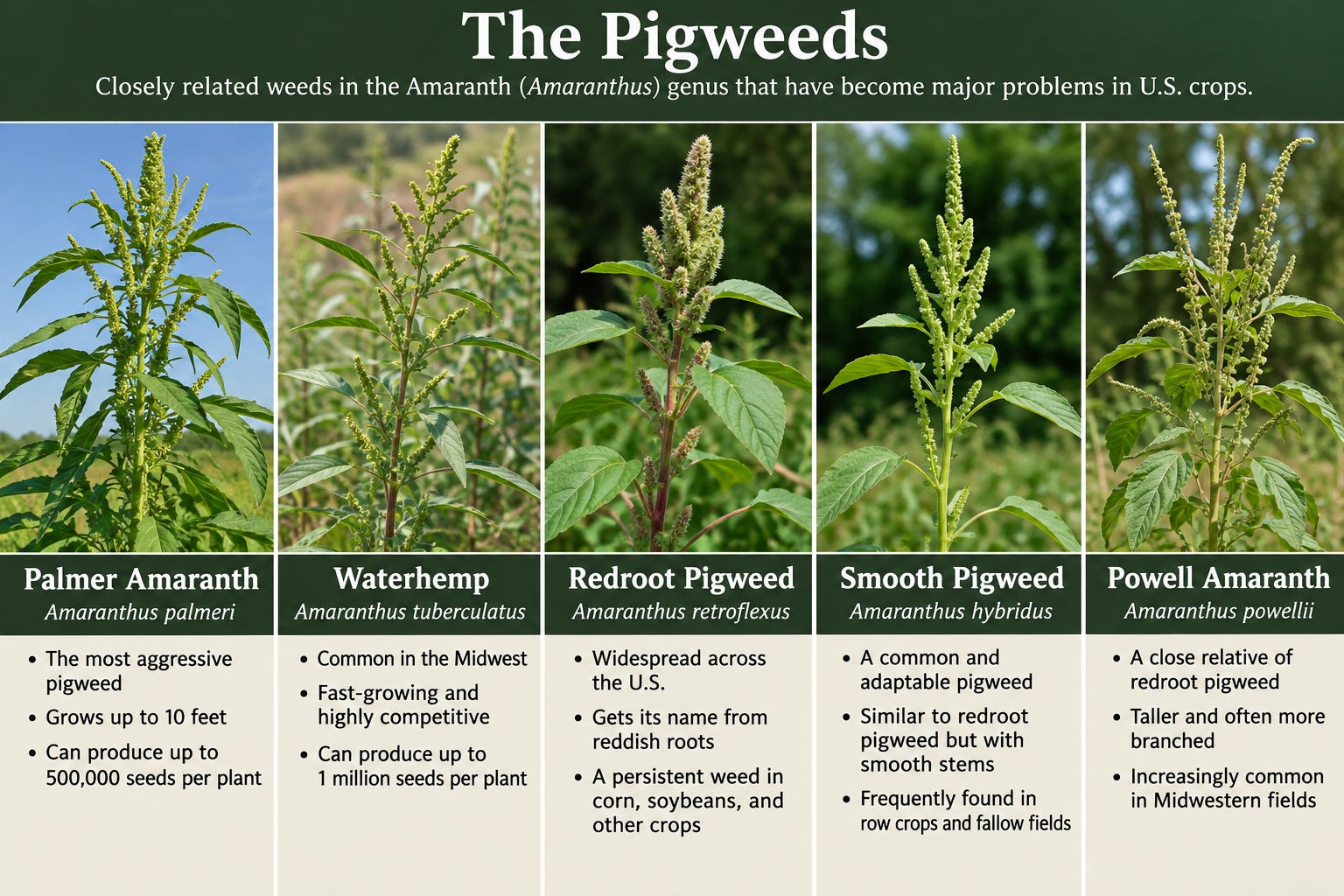
The pigweed family includes Palmer amaranth, waterhemp, redroot pigweed, smooth pigweed, and spiny amaranth. Some are merely persistent nuisances. Others have become agricultural nightmares.
On our small homestead, we have successfully controlled pigweed through mowing, weed whacking, and planting cover crops such as white clover. Our larger horse pastures present more of a challenge. The rocky clay soil makes establishing healthy pasture difficult, and every year some pigweed manages to escape our best efforts. Even so, I estimate that our 30 acres of pasture are now about 95 percent pigweed-free. And here’s the important part: We have accomplished this without using a single herbicide.
As Roundup loses its effectiveness against pigweed, farmers are turning to glufosinate, dicamba, 2,4-D, and many combinations of other herbicides. Some programs also use paraquat, an extraordinarily toxic chemical that the EPA acknowledges can be fatal after a single small swallow. These chemicals raise serious questions about reproductive toxicity, neurological damage, endocrine disruption, and cancer, although the evidence varies by chemical.
But who is paying for the research that determines whether these chemicals are safe? Much of the toxicological evidence submitted for regulatory approval is generated or financed by the very companies seeking permission to sell these products. That is a fundamental conflict of interest, particularly when the underlying studies are not always publicly available for independent scrutiny. The companies profit from selling the herbicides, supply much of the evidence used to evaluate their safety, and then profit again when resistant weeds force farmers to purchase additional chemicals.
Meanwhile, farmers are increasingly being advised to use multiple herbicides to control weeds that once succumbed to glyphosate alone. The chemical arms race is becoming more profitable for manufacturers and more complicated for farmers, while the long-term health consequences of repeated exposure to pesticide mixtures remain inadequately understood. Who is looking out for the public?
How does a weed learn to survive Roundup?
Glyphosate kills plants by blocking an enzyme called EPSPS, which they need to produce three essential amino acids. Without them, the plant effectively starves and dies. Animals lack this pathway, a fact regulators frequently cite when defending glyphosate’s safety.
But plants aren’t the only organisms that depend on this enzyme. Many soil bacteria and fungi use the same pathway. Glyphosate disrupts susceptible soil microorganisms, alters microbial communities, and binds essential minerals, including manganese, iron, and zinc. These effects raise serious concerns about nutrient availability, soil fertility, and the long-term consequences of repeated applications. The chemical designed to kill weeds also interferes with biological processes essential to healthy soil.
Roundup Ready crops survive because Monsanto’s engineers introduced a glyphosate-tolerant version of EPSPS derived from a soil bacterium. Glyphosate cannot effectively block this modified enzyme, allowing the crop to continue growing while susceptible plants die.
Palmer amaranth developed resistance through a different mechanism. Instead of changing the enzyme, resistant plants produce more of it by making extra copies of their EPSPS gene, sometimes a hundred or more. The weed simply produces more of the enzyme than glyphosate can effectively block, allowing it to survive.
A 2026 study of Palmer amaranth that recently arrived in Idaho found extra EPSPS copies in about 74 percent of the plants tested, with as many as 150 copies in a single plant. Some of those populations survived glyphosate doses many times the rate printed on the label.
Other resistant weeds have developed different defenses. Some have genetic mutations that prevent glyphosate from working, while others block its movement through the plant or isolate it where it cannot cause damage. University of Illinois weed scientist Patrick Tranel reports that fifteen years ago, most resistance involved changes to the enzyme targeted by herbicides. Today, researchers are discovering entirely different survival mechanisms. Some weeds can even break down herbicides they have never encountered before.
Why Are These Weeds So Big?
Palmer amaranth was a giant long before Roundup came along. Native to the desert Southwest and northern Mexico, it thrives in summer heat, growing about an inch a day and reaching heights of ten feet. A single female plant can produce up to 500,000 seeds, while waterhemp can produce as many as a million. In heavily infested soybean fields, Palmer amaranth has reduced crop yields by as much as 80 percent.
Those towering weeds rising above soybean fields may have already been sprayed with Roundup. They simply survived and kept growing.
Even more troubling, low doses of glyphosate can actually stimulate plant growth, a phenomenon known as hormesis. A 2008 study in Pest Management Science documented this effect in several plant species. Australian researchers later found that small doses increased seed production in common sowthistle by 154 percent in one experiment and 101 percent in another. Similar studies found increased growth in barnyard grass, including glyphosate-resistant plants. In other words, under low-dose conditions, Roundup doesn’t just fail to kill weeds. It actually helps them grow bigger and reproduce.
This matters because weeds frequently receive low doses of glyphosate through spray drift, uneven applications, and partial coverage. Rather than killing them, these exposures can stimulate growth and seed production, making the problem worse. Roadside spraying and mowing programs compound the problem when surviving weeds produce seeds that mowing equipment spreads to new areas.
What Changed in 2025 and 2026? The Backup Chemicals Are Failing Too.
When Roundup stopped killing resistant weeds, the agricultural chemical industry had an answer: sell farmers new genetically engineered seeds designed to tolerate additional herbicides. Glufosinate (Liberty), dicamba, and 2,4-D became the replacements, often paired with crops engineered to tolerate several chemicals at once. Farmers who once relied on a single herbicide were now buying more expensive seed technology and increasingly complicated chemical programs.
But the weeds are just adapting to the new conditions.
In December 2025, University of Illinois researchers confirmed that waterhemp in Carroll County had developed resistance to glufosinate, one of the industry’s most important backup herbicides. These weeds survived doses two to three times greater than those needed to kill susceptible plants. The discovery marked a troubling milestone: Illinois now has waterhemp populations resistant to all seven major herbicide groups historically used to kill emerged weeds in soybeans. Suspected glufosinate resistance has also been reported in at least six other states.
Arkansas researchers uncovered a similar problem with Palmer amaranth. In Mississippi County, they identified weeds approximately 3.5 times more resistant to glufosinate and 2.9 times more resistant to dicamba than susceptible populations. Reports of glufosinate failures in neighboring Crittenden County stretch back to 2019. Arkansas weed scientist Tom Barber described the discovery as the world’s first documented case of glufosinate resistance in a broadleaf weed.
The results from West Tennessee were equally discouraging. Field trials conducted in 2024 and 2025 found that Palmer amaranth populations with strong dicamba resistance survived treatments that worked against less-resistant weeds. Simply switching chemicals was no longer a dependable solution.
And this is hardly an isolated problem. Resistance is spreading across America’s agricultural heartland:
Kansas: Researchers identified Palmer amaranth resistant to six herbicide groups, including chemicals never applied to the field where it was collected.
Illinois: Dicamba-resistant waterhemp was discovered in a field with no history of dicamba applications.
Missouri: Waterhemp near Moberly was found resistant to six different herbicides, including glyphosate, 2,4-D, and atrazine.
Idaho, Oregon, and Washington: Palmer amaranth has spread into the Pacific Northwest, with many sampled plants already carrying glyphosate resistance.
New York: Palmer amaranth arrived already resistant to several soybean herbicides, while Cornell researchers have also confirmed glyphosate-resistant waterhemp.
By 2025, waterhemp had overtaken Palmer amaranth as the most troublesome weed in broadleaf crops, according to the Weed Science Society of America. Even older adversaries, including cocklebur and common ragweed, were causing renewed problems in corn and soybean fields during 2026.
The chemical industry’s next miracle product isn’t waiting around the corner, either.
University of Illinois weed scientist Aaron Hager warns that no new herbicide capable of controlling waterhemp is expected within the next several growing seasons. Syngenta announced a new herbicide, Virestina, in April 2026, promoting it as a major breakthrough against resistant grasses in soybeans and cotton. But Virestina doesn’t control pigweed.
After thirty years of engineering crops to survive increasingly elaborate chemical treatments, farmers are confronting weeds that survive even some of the most toxic herbicides. The industry keeps inventing new toxic agents, but the underlying problem remains: the more agriculture depends on herbicides, the more it selects for weeds that those herbicides cannot kill.
Meanwhile, the escalating use of these chemicals raises serious concerns about cancer, reproductive harm, livestock health, soil degradation, and environmental contamination. The weeds are surviving, but at what cost to everything else?
Who Is Responsible for the Superweeds?
The superweed crisis was not an accident of nature. It was the predictable consequence of an agricultural system built around selling genetically engineered seeds and the chemicals designed to accompany them. Monsanto and the agricultural chemical industry promoted Roundup Ready crops as a revolution in weed control. Farmers embraced the convenience, regulators approved the technology, and manufacturers collected enormous profits. The risks of herbicide resistance were understood, yet the system encouraged farmers to rely on one chemical across millions of acres.
When resistant weeds began taking over, the industry’s answer was predictable: more genetically engineered crops, more herbicides, and more promises. Farmers were sold seeds engineered to withstand glufosinate, dicamba, 2,4-D, and combinations of chemicals. Now those replacements are failing too.
The conflict of interest is obvious. The same corporations that profit from selling herbicides also profit from selling the next generation of products designed to overcome resistance to those herbicides. Farmers absorb the rising costs, neighboring farms inherit resistant weeds, and the public faces increasing exposure to agricultural chemicals. Meanwhile, manufacturers continue profiting from a problem their business model helped create.
And where was the accountability? Chemical manufacturers understood resistance. Agricultural universities studied it. Federal regulators knew that repeated spraying selected for resistant weeds. Yet the system continued expanding, with little incentive for manufacturers to reduce dependence on their own products.
The accountability problem extends beyond American farms. Imported agricultural products come from countries with different pesticide restrictions and enforcement standards. Although imported foods must meet U.S. residue limits, only a fraction of shipments are tested. American farmers compete against foreign producers operating under different chemical regulations, while consumers have little information about the pesticides used to grow imported food.
Washington Declares Roundup a National Security Asset
On February 18, 2026, President Trump invoked the Defense Production Act to protect domestic production of glyphosate-based herbicides and elemental phosphorus, declaring them essential to national defense and food security. The administration argued that America needed to protect its domestic supply, particularly given its dependence on imported glyphosate from China. Bayer, which acquired Monsanto in 2018, operates the country’s only domestic glyphosate manufacturing facility.
The backlash across the Make America Healthy Again movement was immediate. Grassroots supporters and health advocates who had backed Trump and Robert F. Kennedy Jr. to challenge the chemical industry’s influence were outraged that the administration was now invoking national security powers to protect glyphosate production. Agricultural industry organizations praised the decision. Calley Means, then a senior HHS adviser, publicly criticized the order, and later alleged that lobbying influence, rather than genuine national security needs, was driving administration decisions.
The controversy also raised questions about Bayer’s potential legal protections while the company faced extensive Roundup cancer litigation. The Defense Production Act provides certain liability protections for actions taken in compliance with federal directives.
But the greatest contradiction is agricultural. Washington is protecting the supply of a chemical that increasingly fails against the very weeds it is supposed to kill. A warehouse full of Roundup is worthless against glyphosate-resistant waterhemp. In Illinois, waterhemp populations have developed resistance to every major herbicide group historically used to control emerged weeds in soybeans.
Scientists have warned that herbicide resistance threatens global food security. Yet Washington’s response focuses on protecting chemical production rather than confronting the agricultural dependence that created the problem.
The government can guarantee the production of glyphosate. It cannot order resistant weeds to start dying again.
If food security is truly a national security priority, Washington should focus on controlling the weeds threatening America’s crops, not protecting the chemical companies selling increasingly ineffective and toxic herbicides. That means investing in nonchemical weed control, independent resistance monitoring, removing liability protections for chemical manufacturing, and cooperation among farmers and local extension agents, rather than perpetuating an agricultural system dependent on ever more chemicals.
After thirty years, the chemical industry continues selling solutions to a problem its products helped create. Farmers pay more, the public bears the potential health and environmental costs, and Washington is now treating the industry’s continued production as a national security priority. Who, exactly, is being protected?
What can farmers, homesteaders, and policymakers do?
Nothing below will make pigweed susceptible to glyphosate again. Resistance, once established in a field’s seed bank, stays for years.
Farmers have now watched three herbicides fail: glyphosate first, then glufosinate and dicamba, the products sold to replace it. A fourth and fifth herbicide would most likely go the same way. We argue that farmers need to break this cycle by reducing their chronic dependence on herbicides, and by returning to older methods that kill weeds without selecting for chemical resistance.
Each of those older methods works by keeping pigweed from setting seed, and a pigweed that never sets seed leaves no offspring, resistant or otherwise. On our farm, Jill and I control spiny amaranth in our pastures by mowing it before it goes to seed. Many other livestock farmers do the same.
For farmers growing row crops:
• Mow before seed set, and keep mowing. Penn State Extension reports that pigweeds begin producing mature seed by mid-August in Pennsylvania. One pass is rarely enough. Pigweeds regrow from the base after mowing and send out side branches that flower lower to the ground. Penn State also warns that Palmer amaranth can set seed on a plant less than a foot tall. Mowing, therefore, has to be repeated throughout the season, kept low enough to take off the regrowth.
• Plant cover crops, especially cereal rye. In Arkansas cotton trials, a cereal rye cover crop cut Palmer amaranth emergence by 83 percent compared with bare ground. The rye residue lies on the soil surface and physically blocks the small pigweed seedlings. A multistate study led in part by Mark Loux of Ohio State University found that cereal rye consistently reduced pigweed density in soybeans, even without herbicides. Heavier rye residue gives better suppression, but results are not uniform.
• Rotate crops and narrow the rows. Pigweeds emerge in warm weather on open ground. Rotating in small grains and hay changes when the ground is bare, and a crop canopy that closes early shades out late seedlings. In Michigan, planting soybeans in narrower rows shortened the period when Palmer amaranth emerged.
• Pull escapes by hand before they seed. North Carolina State University weed scientists advise removing every surviving Palmer amaranth plant, roots included, before seed heads form. This is easiest after a rain. University of Delaware extension notes that pulled plants can reroot if their stems stay in contact with the soil, and that cut stem pieces can take root too.
• Clean equipment between fields. Combines carry weed seed from one field to the next, and machinery is a major route for the spread of resistant weeds. Clean the combine before it leaves an infested field, and ask custom harvesters to do the same.
• Destroy weed seed at harvest. Harvest weed seed control machines mount on a combine and destroy weed seeds as they pass through. In one study, a seed destructor killed more than 99 percent of seeds from 11 of the 12 major soybean weeds tested.
• Put robots to work where they fit. Self-driving, camera-guided weeding machines are already in commercial fields. Carbon Robotics, a Seattle company founded in 2018, builds the LaserWeeder. The LaserWeeder uses cameras and artificial intelligence to tell crop from weed, then burns each weed with a laser without touching the crop or disturbing the soil. Carbon Robotics reports its second-generation LaserWeeder working on more than 100 farms in 15 countries, killing thousands of weeds a minute.
The company also sells a kit that converts John Deere 6 and 8 Series tractors to drive themselves. For now the LaserWeeder is built mostly for vegetables and other specialty crops. Carbon Robotics chief executive Paul Mikesell has said the technology could eventually be used against Palmer amaranth and marestail in the Corn Belt and the Mississippi Delta. University researchers are also building robots aimed at Palmer amaranth itself.
And the robotic weed killers are coming on line:
In terms of immigrant labor, and the safety of produce. Robotic pickers are also coming on line. They use precise GPS locators, robotics, and are projected to revolutionize the market.
In June 2026, researchers published their development of a robot capable of identifying and physically pulling Palmer amaranth from cotton fields. Other promising technologies include electric weeders that use high-voltage electricity to kill weeds without herbicides. University of Missouri weed scientist Kevin Bradley has documented their effectiveness in field trials. Together, these innovations offer farmers new ways to control resistant weeds without relying on increasingly toxic chemical treatments.
Where herbicides are still used, they should be one tool among several and never the whole program.
For homesteaders and gardeners:
• Learn to recognize the pigweeds. University of Tennessee Extension describes Palmer amaranth as having smooth, hairless leaves on leaf stalks often longer than the leaf blade. Spiny amaranth carries sharp spines where the leaves join the stem. Your county extension office can confirm an identification and tell you whether Palmer amaranth has been found in your county.
• Mow pastures before the pigweed flowers. The same timing rules apply in a pasture as in a crop field: cut early, and cut the regrowth again. Tennessee Extension also advises against leaving bare soil exposed. A thick grass stand leaves pigweed seedlings little room. Whip weed fence lines.
For home gardens and pigweed control, some of the new tech is very interesting. There are both handheld electric and propane weed killer devices on the market. And various solutions of epson salts, soap, vinegar, etc. work on some of the less resistant weeds.
• Watch what comes onto your place. Tennessee Extension advises against feeding hay that contains pigweed. It also warns against moving cattle directly from an infested pasture to a clean one, because pigweed seeds can survive passage through the digestive tract. Resistant pigweed seed also travels in contaminated seed, grain, feed, and used equipment. Walk the areas where you feed hay or unload machinery for the first season or two.
• Pull, bag, and remove. A pulled pigweed left lying on the ground can reroot or ripen its seed. Bag it and take it off the field, or burn it where burning is allowed. You (or your chickens) will manage the smaller ones. But composting old pigweed will not kill the seeds.
We can’t can’t federal policy, but we can change our own practices.
For policymakers:
Tie federal glyphosate support to resistance management. As we can’t stop glyphosate from being protected as a national security asset, we can try to get the government to tie that commitment to fund the extension labs and county agents who detect and track resistance.
Make registrants pay for monitoring. The companies that sell herbicides earn money on every acre sprayed. We argue that independent resistance monitoring should be a cost of selling the product, paid by the seller rather than by taxpayers or by the neighbors of careless sprayers.
Fund non-chemical control. Cover crops, mowing, crop rotation, harvest weed seed destructors, electrical weeders, and autonomous laser and robotic weeders do not select for herbicide resistance. Public research money and existing conservation cost-share programs should favor these methods over the next herbicide-tolerant crop trait.
Let local groups organize. Resistant weeds cross fence lines, so control works best when neighboring farms coordinate. County-level groups led by farmers and extension agents can agree on mowing schedules, cleaning equipment, and scouting far better than a national label can.
Conclusion: Thirty Years of Roundup. What Have We Learned?
Thirty years ago, Monsanto promised farmers a revolution in weed control. Instead, American agriculture became increasingly dependent on genetically engineered seeds and an escalating arsenal of herbicides, while resistant weeds continued to spread.
The weeds adapted. The chemical industry profited. Farmers inherited the consequences.
And now Washington has declared glyphosate essential to national security, protecting its production while largely ignoring the agricultural and public health consequences of decades of chemical dependence.
The irony is difficult to ignore. In 1997, scientists published a paper suggesting glyphosate resistance was improbable. Thirty years later, the evidence is standing ten feet tall in American farm fields, producing hundreds of thousands of seeds.
We cannot keep spraying our way out of a problem that spraying helped create. And we should not sacrifice the health of our soil, our livestock, our farmers, and our families to keep trying.
It is time to do something different.
Independent journalism isn’t free to produce.
And it shouldn’t be controlled by corporate interests.
Robert and I spend countless hours researching, investigating, writing, and challenging the narratives promoted by powerful industries and government agencies. This article alone required extensive research into agricultural chemicals, scientific studies, corporate interests, and federal policy.
We are making this article available to everyone because we believe the information is too important to put behind a paywall. But that doesn’t mean the work behind it is free.
Malone News is supported by readers, not corporate sponsors or advertisers. Your paid subscription helps us remain independent, pay the people who assist us, and continue asking the questions others would rather avoid.
If you value our work and want to see more of it, please consider becoming a paid subscriber today.
Independent journalism survives because readers decide it matters. Thank you for making that possible.
References
1. Thirty years of glyphosate-resistant crops and weeds: Current situation and future prospects. Pest Management Science 82(7), 2026.
2. Bradshaw LD, Padgette SR, Kimball SL, Wells BH. Perspectives on glyphosate resistance. Weed Technology 11, 1997. Discussed in Duke SO et al., How many ways can weeds evolve resistance to glyphosate? Outlooks on Pest Management, 2021.
3. Heap I. Herbicide-resistant weeds: a global perspective. Top Crop Manager, 2016.
4. Heap I. Global perspective of herbicide-resistant weeds. Pest Management Science 70, 2014.
5. Stratus survey of glyphosate-resistant weed acreage. AgriBusiness Global.
6. Adjesiwor AT et al. Palmer amaranth in the Pacific Northwest: glyphosate-resistance confirmation and efficacy of selected herbicides. Weed Technology, 2026.
7. Pigweed pressure builds in the Pacific Northwest as resistant populations expand. CSA News, June 2026.
8. Herbicide-resistant crops can exacerbate superweeds (excerpt of advocacy commentary on Palmer amaranth growth). Genetic Literacy Project.
9. Two new mechanisms for herbicide resistance found in Palmer amaranth. University of Illinois, 2017.
10. Waterhemp and Palmer amaranth seed production and Kansas and Illinois resistance findings. The Furrow, John Deere, 2024.
11. Velini ED et al. Glyphosate applied at low doses can stimulate plant growth. Pest Management Science 64, 2008.
12. Mobli A, Matloob A, Chauhan BS. Glyphosate-induced hormesis: impact on seedling growth and reproductive potential of common sowthistle. Weed Science 68, 2020.
13. Low-dose herbicide applications can accelerate resistance. WeedSmart.
14. Hager A. Glufosinate-resistant waterhemp confirmed in Illinois. farmdoc, University of Illinois, January 9, 2026.
15. End of an era? Glufosinate’s tight grip on waterhemp finally breaks. AgWeb.
16. Herbicide options dwindle as new resistance emerges in pigweed. Cotton Grower.
17. Fuller C et al. Managing herbicide-resistant Palmer amaranth from West Tennessee with sequential applications of dicamba with and without glufosinate. April 2026.
18. Waterhemp found to be resistant to six herbicides. AgWeb.
19. Managing tough weeds with resistance to multiple herbicides. Soybean Research and Information Network, August 2026.
20. Old weeds return as herbicide resistance raises the stakes in US corn and soybeans. AgroLatam, 2026.
21. In the weeds: glyphosate news roundup (Syngenta Virestina announcement). No-Till Farmer, April 2026.
22. Herbicide-resistant super weeds? Don’t blame GMO crops, study says (summary of USDA analysis). Genetic Literacy Project.
23. Superweeds: the Canadian Prairie experience with herbicide-resistant weeds. SAIFood.
24. Trump signs order protecting glyphosate, phosphorus production. Farm Policy News, University of Illinois, February 2026.
25. Clayton C. Trump directs USDA to prioritize domestic glyphosate, phosphorus production. DTN, February 19, 2026.
26. Borst E. Trump’s pesticide order betrays MAHA, activists say. E&E News, February 19, 2026.
27. Tabuchi H. A Trump order protected a weedkiller. And also a weapon of war. New York Times, March 8, 2026 (via SEJ).
28. Think global (Stephen Powles on herbicide resistance and food security). Australian Herbicide Resistance Initiative.
29. Increasing weed threat now greater than at any point in human history. Rothamsted Research.
30. 2024 status of herbicide-resistant weeds in Michigan. Michigan State University Extension.
31. Weeding out herbicide resistance (harvest weed seed control results). Scientia.
32. Glyphosate-resistant weeds (equipment as a route of spread). Pioneer Agronomy.
33. Weed seeds this fall mean more weeds next spring. Penn State Extension, 2025.
34. Fall weed control in pastures, hay, and other forages. Penn State Extension.
35. Managing Palmer amaranth in conservation plantings. Farm Progress, September 2016.
36. Palhano MG, Norsworthy JK, Barber T. Cover crops suppression of Palmer amaranth in cotton. Weed Technology, 2017.
37. Researchers find cereal rye is effective at reducing Amaranthus spp. density in soybean crops. Lab Manager.
38. Effects of cereal rye residue biomass and preemergence herbicide on the emergence of troublesome southeastern weed species. Frontiers in Agronomy, January 2025.
39. King TA et al. Impact of cover crops on furrow-irrigated rice and Palmer amaranth emergence. Weed Technology, January 2025.
40. Rogers KM. Integrating a cereal rye cover crop and soybean row width with herbicides to manage Palmer amaranth in Michigan. MS thesis, Michigan State University.
41. Collins G, York A. July is the time for hand-weeding. North Carolina State University Extension, 2015.
42. VanGessel M. Palmer amaranth regrowth after pulling and tillage. University of Delaware Weekly Crop Update.
43. Weed control in pastures (W1384). University of Tennessee Extension, 2026.
44. Loria K. AI-powered LaserWeeder scans 150 million images to identify weeds. Fruit Growers News, June 2026.
45. This laser robot kills 8,000 weeds a minute, and it’s already on farms in 15 countries. Interesting Engineering, 2026.
46. Carbon Robotics’ LaserWeeder. Lidar News, March 2026.
47. Lasers, lights and electricity: managing weeds with precision tech. Precision Farming Dealer.
48. Development of a robotic weed puller for precision management of Palmer amaranth in cotton. AgriEngineering 8(6), June 2026.
49. The weed-control revolution has a $70,000 problem. AgWeb.
50. Benfer A. Pigweed. Foods Indigenous to the Western Hemisphere, University of Kansas.
51. Pigweeds. Cornell University Weed Science, weed profiles.
I have learned to use as little as possible chemicals around the home. My weedkiller is 1 Gallon of vinegar and 6 oz of Dove dishwasher detergent. Removes the wax coating from weeds and they loose their water and die. Was reacquainted with a farmer friend I have not seen in 30 years.
Unfortunately, his body is covered with fatty tumors because of exposure to farm chemicals. Determining that glyphosates are protected under national security is a major con job and reflects on the duplicity from DC no matter who is in the Whitehouse.
Dr, Malone, are you going to send this post to President Trump? I think I will send it to my Congressional rep and to one of my state Senator. I will not bother sending it to Thom Tillis because he is an idiot and votes the wrong way on everything. I think he takes a lot of pharma money and probably glyphosphate money, and was one of the ones who prevented us from passing the SAVE act, probably got paid to block that also. But I will send this to Rep. Pat Harrigan and NC Senator Budd, just not the RINO who did not run for re-election so he's almost finished. His term expires very soon though not soon enough for me. But I wish you would make sure the President sees what you wrote. He needs to understand this.