

Audio Version:
By: Drs. Robert Malone and Jill Glasspool Malone ·
Washington, DC · October 8, 2026
Russia’s Plague Story Still Doesn’t Add Up
Russia has declared the Irkutsk public health response complete and resolved, although it still has not publicly identified what killed Darya Shipilova.. Nearly five thousand tests, two biosafety reviews, and a week of official assurances have still not produced a public explanation of what killed its laboratory worker.
On October 6, through the International Health Regulations channel, the Russian Federation informed the World Health Organization that medical observation of all identified contacts had been completed (World Health Organization 2026a).
The following day, at 14:55 Moscow time, Rospotrebnadzor told Interfax that observation had been completed for more than ninety percent of contacts (Interfax 2026a). On October 8, the agency returned to an unequivocal declaration that everyone had completed observation.
The figures are not necessarily contradictory. More than ninety percent can include everyone. But Moscow gave Geneva a definitive statement, its own press a less precise one, and then returned to the original position. If observation was complete on October 6, why did the agency change its wording the following day? Were different groups being counted, was one figure outdated, or had completion been reported prematurely?
Those questions have straightforward answers. Moscow has supplied none.
The larger problem is what Russia has chosen to disclose. Nearly five thousand laboratory tests, two official biosafety reviews, and repeated assurances that no epidemic risk remains have produced no publicly confirmed cause of death. The government says the danger has passed. WHO still lacks the information needed to establish what caused Shipilova’s illness or how she became infected.
Meanwhile, frightened Russians have been buying antibiotics, commentators outside Russia have been promoting claims about engineered biological weapons, and Washington has formally requested additional information.
The preventive response is over. The investigation’s central questions remain unanswered.
In brief
Russia has declared the incident resolved. On October 8, Rospotrebnadzor announced that all contacts had completed observation and preventive measures had ended. The agency still has not publicly established the cause of Shipilova’s death.
A previously undisclosed vaccination. Russian authorities acknowledged that Shipilova had been vaccinated against the dangerous infections she worked with. Russia’s plague vaccine provides incomplete protection, particularly against pneumonic disease, making her vaccination history relevant to the investigation.
WHO remains without essential information. The organization has requested clarification about the causative agent, route of infection, and reports of a second ill employee. It previously told Ukraine that Russia’s information was insufficient for an independent assessment.
Washington has formally intervened. The State Department confirmed delivery of a diplomatic request for additional information. President Trump has said he does not believe the incident involved a biological weapon, while CDC assesses the risk to the United States as extremely low.
This is the fifth installment in our investigation of the Irkutsk laboratory death. The Broken Tube and Five Hospitals and a Denial established the initial chronology. Inside the Irkutsk Plague Institute examined the facility, its work, and its history. Our fourth report compared Russia’s formal communication to WHO with the critical information it omitted.
The latest developments include a new vaccination disclosure, increasingly pointed questions from WHO, an American diplomatic intervention, and a Russian government that has declared the matter closed without publicly explaining what happened.
Russia winds down, and discloses a vaccination
Rospotrebnadzor’s October 7 statement was its most detailed account of the investigation. Nearly five thousand laboratory tests reportedly found no dangerous pathogenic microorganisms. Two commissions examining biological safety at the Irkutsk Anti-Plague Institute reported no emergencies involving pathogens and concluded that established safety procedures had been followed. The agency declared that there was no epidemic risk to Irkutsk or the surrounding region and announced that preventive measures were ending (Interfax 2026a).
What the statement did not provide was a diagnosis.
One important new clinical detail did emerge. Rospotrebnadzor acknowledged that Shipilova had been vaccinated against the dangerous infections she worked with.
That disclosure raises questions rather than settling them. Russia uses EV NIIEG, a live attenuated plague vaccine derived from the EV76 strain, for laboratory personnel and people in plague-endemic regions. Published studies describe protection lasting approximately ten to twelve months, with less certain protection against pneumonic disease. Human efficacy data remain limited, and vaccination does not exclude infection. CDC guidance has also recommended antibiotic prophylaxis following significant laboratory aerosol exposure regardless of vaccination history.
It does, however, make Shipilova’s immunization history relevant. When was she last vaccinated or boosted? Which product did she receive? Was her immune response ever measured? Were blood samples collected for serological testing during her illness?
Former colleagues told Radio Free Europe/Radio Liberty that the institute vaccinates even its interns against plague. If that account is accurate, the institute should possess records documenting Shipilova’s vaccination history, including the dates and products administered. Those records would not establish the cause of death, but they could help investigators interpret her clinical course and evaluate the possibility of a breakthrough infection.
The October 8 statement went further, with Governor Igor Kobzev saying Shipilova had been vaccinated and possessed immunity against the dangerous infections she handled. That assertion raises another question: what evidence established her immunity? A documented vaccination is not the same thing as demonstrated protective immunity.
Geneva stops being diplomatic
Maria Van Kerkhove, who directs WHO’s epidemic and pandemic preparedness and prevention work and served as its technical lead during COVID-19, said WHO did not know the causative agent or how Shipilova became infected. She asked Russia for timely, regular information and answers to questions already submitted (Al Jazeera 2026).
WHO Director-General Tedros Adhanom Ghebreyesus also addressed reports of a second institute employee suffering from pneumonia. He said WHO had received information from two media outlets, including one Russian outlet, and had asked Moscow for clarification. The report remains unconfirmed, and Russian authorities have since denied that a second illness was connected to the institute.
The sharpest assessment emerged through an exchange with Ukraine.
On October 6, Ukraine’s Public Health Center, part of its Ministry of Health, asked WHO whether Russia had supplied official information, what verification had established, and whether WHO had completed a risk assessment.
WHO responded that, as of October 5, the information received from Russia was insufficient to permit an independent assessment of the nature of the event (LIGA.net 2026).
WHO’s own October 7 statement was unusually explicit. Director-General Tedros Adhanom Ghebreyesus acknowledged that the organization lacked sufficient information to conduct a full risk assessment and had requested laboratory findings, an explanation for the public health measures, and clarification of reports involving a second employee. Russia had supplied assurances about the absence of plague but not the clinical evidence WHO needed to evaluate the incident independently.
Two International Treaties… and Crickets
Two separate bodies of international law are relevant to this incident, and much of the coverage has conflated them.
The first is the International Health Regulations, administered by WHO. This is the public health framework through which Russia has been communicating with Geneva. It requires states to detect, assess, and report qualifying disease events and authorizes WHO to seek verification and assess risks. Its enforcement powers are limited. WHO cannot compel Russia to identify a pathogen, inspect the Irkutsk institute, or impose sanctions for withholding information. Public scrutiny is one of its few practical sources of leverage.
The second is the Biological Weapons Convention (BWC), an arms control treaty prohibiting biological weapons development, production, and stockpiling. Article V provides for formal consultations over compliance concerns. Article VI allows a state-party to lodge a complaint with the UN Security Council and request an investigation. Separately, the UN Secretary-General’s Mechanism can investigate alleged use of biological weapons, a narrower mandate that does not extend to ordinary laboratory accidents.
None of these mechanisms has been activated over Irkutsk. No state has publicly requested Article V consultations or filed an Article VI complaint. The Secretary-General’s Mechanism has not been invoked, and no alleged use of a biological weapon has been established to trigger its mandate.
That silence matters. Governments concerned about a possible weapons program have formal channels for raising those concerns, but none has publicly used them. Washington’s response has instead been a bilateral diplomatic démarche seeking additional information under outbreak-reporting obligations. That places its formal intervention within the International Health Regulations framework, not the Biological Weapons Convention.
There is a revealing precedent. In 2022, Russia invoked Article V over allegations that the United States funded biological weapons laboratories in Ukraine. It requested consultations on June 29, and a meeting convened in Geneva that August and September under Hungarian ambassador György Molnár (Arms Control Association 2022). When those consultations failed to resolve the dispute, Russia pursued an Article VI investigation through the Security Council. Its proposal was rejected in November (Arms Control Association 2022b).
The machinery exists, and Russia itself used it four years ago. Now, with a dead laboratory worker and an unidentified pathogen in Irkutsk, no government has formally alleged a BWC violation. That does not exclude a weapons connection, but it distinguishes speculation on social media from allegations governments are prepared to pursue through treaty mechanisms.
President Trump reinforced that distinction on October 7, saying he did not believe the Irkutsk incident involved a biological weapon (CNBC 2026). The statement is notable because his own State Department assesses that Russia maintains an offensive biological warfare program. The administration has not treated that broader assessment as evidence that this particular incident involved a weapon.
Washington quantifies the risk
CDC Director Erica Schwartz assessed the risk to the United States as extremely low and said the agency was coordinating with the Departments of Homeland Security, State, and Defense to monitor travelers from the region. The CDC quarantine station at John F. Kennedy International Airport can screen arriving passengers when warranted (Al Jazeera 2026).
The travel numbers help explain that assessment. Roughly two hundred people annually travel from that part of Siberia to the United States, and direct flights between Russia and the United States have been suspended since 2022.
Trump said on October 6 and again on October 7 that he expected to speak with Putin about the Irkutsk incident, describing the two governments as being in “very deep discussions” (NBC News 2026; Fortune 2026). The Kremlin, however, said no call was scheduled.
As of this writing, neither government has issued a public readout confirming that a conversation took place. Fox News correspondent Peter Doocy reported on October 8 that Trump had been told by Russian counterparts that the situation was under control. That does not establish that Trump spoke personally with Putin.
Washington has also moved beyond preparing a formal diplomatic request. The State Department confirmed that a démarche was delivered to Russian representatives on October 7, seeking additional information about the incident and invoking Russia’s international health-reporting obligations (ABC News, October 8).
Secretary of State Marco Rubio has not publicly advanced a biological weapons allegation. Speaking earlier in the week, he declined to speculate about whether an intentionally modified organism might have been involved and emphasized that the United States lacked sufficient information.
The American position is therefore reasonably clear. Washington considers the immediate domestic risk low, has not formally characterized the event as a biological weapons incident, and has requested information Russia has yet to make public.
The Information Vacuum Has a Price
Moscow’s refusal to identify the pathogen has produced consequences beyond the laboratory. Inside Russia, it has driven public anxiety and antibiotic purchases. Outside Russia, it has created an opportunity to turn an unexplained death into a commercial opportunity.
On October 1, Yandex recorded roughly 14,500 searches for чума, the Russian word for plague. By October 3, that number had reached nearly 685,000, a forty-seven-fold increase. Google Trends showed a similar surge, with residents of Irkutsk Oblast showing particularly intense interest (Echo 2026).
The fear translated into purchases. On October 3, journalists surveying pharmacies in Irkutsk and Shelekhov found residents buying antibiotics used to treat plague. Some pharmacies had exhausted their supplies, while others could not obtain replacements (The Insider 2026). There was no confirmed outbreak, yet people were purchasing antibiotics because their government refused to explain what had happened.
The same uncertainty has been exploited outside Russia. Within days, American commentators were warning about engineered pneumonic plague while commercially sponsored broadcasts promoted prescription antibiotic kits, complete with discount codes. Dr. Peter McCullough’s October 7 commentary raised the possibility of a more pathogenic, weaponized organism despite the absence of a confirmed plague diagnosis, much less evidence of engineering.
We documented the claims, commercial relationships, and advertising campaign in a separate investigation published earlier today, The Plague Grift. The pattern is familiar: a frightening headline creates urgency, uncertainty becomes a selling point, and a commercial product is offered as the solution. The pathogen has not been identified. The sales pitch has.
The scientific distinction remains important. Antibiotic resistance and person-to-person respiratory transmission do not establish biological weapons engineering. Both have occurred naturally in Yersinia pestis. A documented 2013 pneumonic plague outbreak in Madagascar involved a streptomycin-resistant strain carrying a spontaneous chromosomal mutation that had arisen independently in other natural plague strains (Andrianaivoarimanana et al. 2022). None of that evidence establishes what happened in Irkutsk.
The Irkutsk Anti-Plague Institute maintains a documented collection of Yersinia pestis strains and works with virulent organisms under BSL-3 containment. A young employee is dead, reports describe a broken laboratory tube, hospitals were quarantined, and the government still has not identified the pathogen. Those facts warrant a serious biosafety investigation. They do not establish that an engineered biological weapon escaped.
Another claim circulating this week links the incident to Israeli mRNA plague vaccine research. The underlying work predates Shipilova’s death by years, with publications from Dan Peer’s laboratory and the Israel Institute for Biological Research appearing in 2023 and 2025. We examine those allegations in a separate companion report.
Moscow’s secrecy has made legitimate investigation harder and speculation easier. But uncertainty is not evidence, and the absence of a diagnosis does not give anyone license to invent one. Russia owes the public an explanation of what killed Darya Shipilova. Those claiming it was an engineered biological weapon owe the public evidence.
The Photograph Moscow Cannot Explain
One dispute in Irkutsk remains unresolved, and this time there are photographs.
On October 7, the independent outlet Lyudi Baikala published photographs of what it described as a screening form distributed to patients at the Irkutsk City Perinatal Center. A patient identified as Ulyana Gavryunina said she received the form on October 5. The outlet also reported that visitors had been barred from the Irkutsk Regional Clinical Hospital since October 3.
The photographed document bears the Russian heading Чек-лист при подозрении на ООИ «Чума», which translates as “Checklist for suspected particularly dangerous infection: Plague.”
We had an AI find the image and translate it.
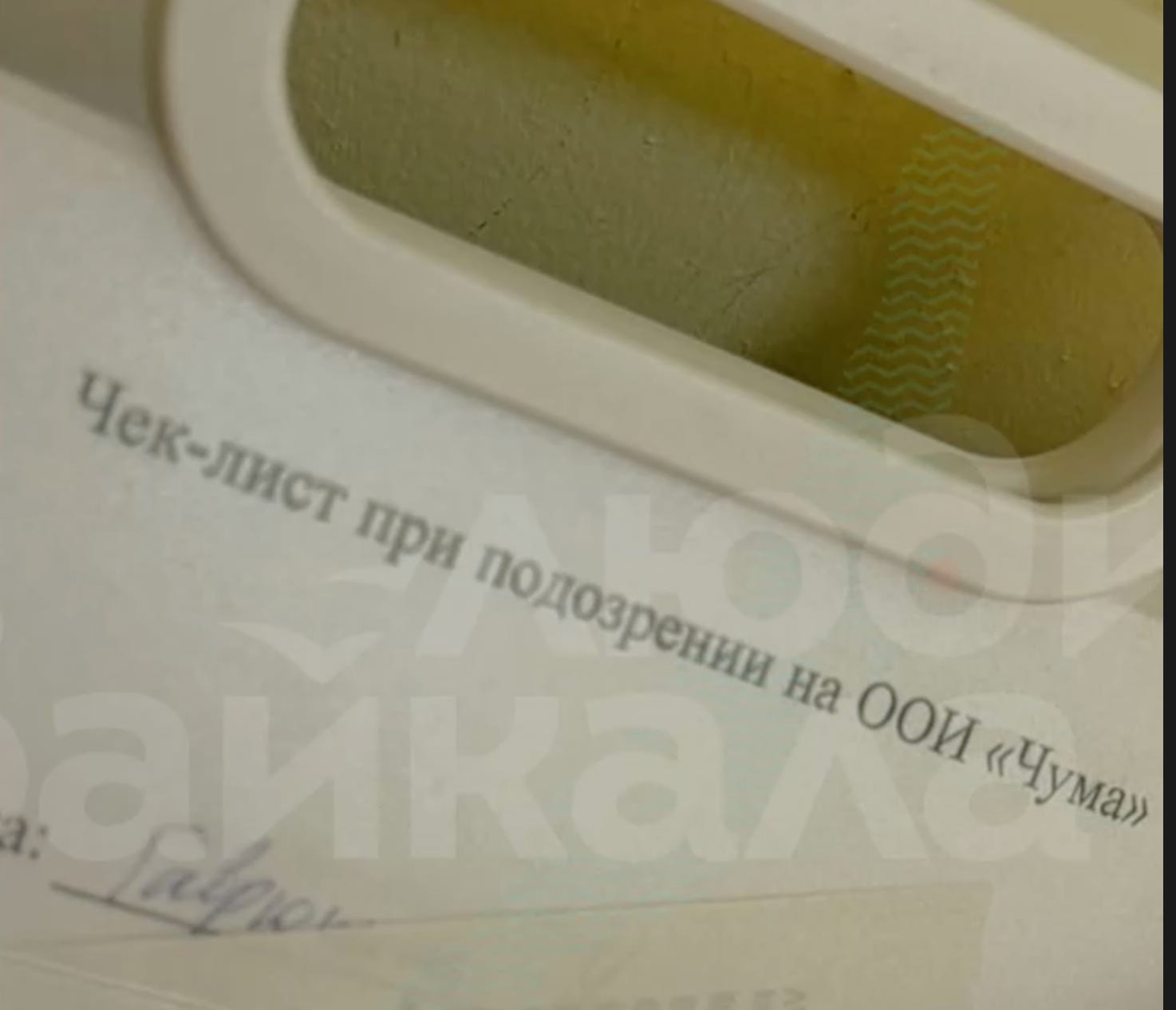
The Russian heading reads:
Чек-лист при подозрении на ООИ «Чума»
Translation: “Checklist for suspected particularly dangerous infection: Plague.”
The wording matches the document described in Lyudi Baikala’s October 7 reporting. The photograph also carries what appears to be the publication’s watermark.
The regional government’s press service denied that plague-specific screening or a new quarantine was underway. Officials said pregnant women were completing standard questionnaires introduced after COVID-19, that masks were required, and that the cancellation of an open day did not indicate a quarantine (IrCity 2026).
After the original photograph was challenged by pro-government fact-checkers, Lyudi Baikala obtained additional photographs from the patient and published them on October 7 (Lyudi Baikala).
But a plague screening checklist in an Irkutsk hospital is not, by itself, evidence of an outbreak. The city houses one of Russia’s principal anti-plague institutes, and regional hospitals have good reason to maintain procedures for particularly dangerous infections. Such a form could have existed long before Shipilova’s death.
The question is whether this was an existing preparedness form or a screening measure activated after the laboratory incident. The document’s date, revision history, and instructions for use could help establish which explanation is correct. A hospital using an established plague screening protocol would be exercising appropriate caution, not necessarily responding to evidence of another infection.
Neither the photographs nor the government’s explanation establishes when the form was introduced or why patients were reportedly receiving it that week. The regional authorities should be able to answer that question without disclosing anything sensitive about the laboratory investigation.
The Bureaucracy of Silence
The Russian government’s response to the Irkutsk incident looks less like a coordinated cover-up than a bureaucracy in which nobody has been authorized to speak plainly.
Consider the chronology. On October 1, news of the Shelekhov hospital quarantine appeared on social media before any official announcement. On October 2, Governor Igor Kobzev convened an emergency commission over a particularly dangerous infection without naming it, while Rospotrebnadzor chief Anna Popova flew in from Moscow. That same day, Alexey Tsydenov, head of neighboring Buryatia, stated on one platform that Shipilova had died of plague and on another that she had possibly died of plague. Both versions remained online. Irk.ru published and then deleted a report linking the quarantine to suspected plague, leaving the word embedded in its web address. Irkutsk canceled its community workday.
On October 3, officials in Baikalsk warned residents to avoid Shelekhov because of unofficial reports of plague, then deleted the warning within two hours. On October 4, Rospotrebnadzor described Shipilova’s illness as pneumonia of unknown etiology. On October 5, it reported that sixty percent of contacts had completed observation. On October 6, Russia told WHO that all contacts had completed observation while publicly dismissing reports of additional restrictions. The following day, Rospotrebnadzor reported completion for more than ninety percent, regional officials disputed the photographed plague screening checklist, and Kremlin spokesman Dmitry Peskov dismissed most media reporting as false.
This is not a coherent official account. It is a succession of conflicting statements, deleted warnings, and denials from different levels of government. Tsydenov cited Rospotrebnadzor while saying something the agency would not confirm. Rospotrebnadzor gave WHO a definitive statement about completed observation, then offered Interfax a less precise figure the next day. The record suggests restricted communication and bureaucratic confusion, although neither excludes deliberate concealment.
The explanation may be simpler than an organized conspiracy. In an authoritarian system, saying the wrong thing can end a career, while saying nothing is generally safer. Regional officials may have lacked authorization to identify the pathogen. A neighboring governor spoke more freely, then qualified his statement. Federal authorities emphasized negative test results and assurances that the situation was under control. Each response reduced the immediate exposure of the official making it. Together they produced a week of public incoherence.
International pressure may have reinforced that behavior. Ukraine questioned WHO, Western governments demanded transparency, and the State Department’s assessment that Russia maintains an offensive biological warfare program entered the coverage. For officials confronting a possible laboratory accident, every admission risked becoming evidence in an international dispute. Silence and minimization offered the safer bureaucratic course.
There is a historical precedent, and it is not reassuring. Following the 1979 Sverdlovsk anthrax outbreak, Soviet authorities blamed contaminated meat for thirteen years. Only in 1992 did Boris Yeltsin acknowledge that the outbreak originated at a military biological facility. The episode demonstrated how an institutional culture of secrecy could preserve a false explanation long after the underlying facts were known.
Sverdlovsk also limits the bureaucratic explanation. Institutional secrecy and a biological weapons program are not mutually exclusive. In 1979, they existed together. That history does not establish a weapons connection in Irkutsk, but it prevents us from treating bureaucratic dysfunction as evidence against one.
The most economical explanation for Moscow’s conflicting statements may be that officials fear the consequences of disclosure more than the consequences of silence. Whether that reflects ordinary bureaucratic self-protection or a deliberate effort to conceal specific facts remains unresolved.
October 8: Moscow Declares the Case Closed
On October 8, Rospotrebnadzor announced that all preventive measures had been completed and every identified contact had finished medical observation. The agency again reported nearly five thousand laboratory tests without detection of dangerous pathogens and explicitly denied reports of a second illness connected to the institute (Interfax, October 8).
Governor Igor Kobzev went further, declaring that the region had successfully weathered the incident. He said Shipilova had been vaccinated and possessed immunity against the dangerous infections she handled, while investigators found no biosafety emergencies at the institute. The governor characterized the episode as a test that the authorities had passed successfully on Oct 8.
Washington, meanwhile, has moved beyond public requests for transparency. The State Department confirmed that a formal diplomatic démarche was delivered to Russian representatives on October 7, requesting additional information under Russia’s international health-reporting obligations.
The Russian government’s position is now unequivocal: the contacts have been cleared, preventive measures have ended, and the institute’s biosafety procedures have been declared satisfactory. Yet none of those findings establishes the cause of Shipilova’s fatal illness. Russia has completed its administrative response without publicly resolving the medical investigation that prompted it.
The Investigation Is Closed. The Questions Are Not.
Seven days into this investigation, the genomic and environmental layers of our assessment framework remain empty. No sequence, isolate, or clinical specimen result has entered the public record. An absence of evidence cannot establish either a laboratory accident or a biological weapons connection. The framework is designed to record what is known, not fill the gaps with speculation.
The behavioral evidence has grown. Russia gave WHO an unequivocal statement that all contacts had completed medical observation, then used less precise language with Interfax the following day. On October 8, it again declared observation complete. The change in reporting remains unexplained. We also learned that Shipilova had been vaccinated against the dangerous infections she handled, a clinically relevant fact disclosed only after days of official assurances that nothing dangerous had been found.
My assessment remains unchanged: moderate biosafety concern, low treaty compliance concern. Nothing released this week establishes weaponization, and those making that allegation have presented no evidence unavailable to the rest of us.
The questions Russia has not answered are straightforward:
What laboratory results were obtained from Darya Shipilova’s own specimens, using which methods, and on what dates?
Which suspected pathogen prompted the hospital quarantines and isolation of approximately two hundred people?
Were exposed contacts given antibiotic prophylaxis? If so, which drugs and for how long?
What is the clinical status of the second institute employee reportedly suffering from pneumonia of undetermined cause? Russia has denied a second case, but what investigation supports that denial?
Why did Russia report complete medical observation to WHO on October 6, use a less definitive figure with Interfax on October 7, and again declare completion on October 8?
When was Shipilova last vaccinated or boosted, with which product, and were antibody measurements obtained?
These are ordinary questions about a fatal occupational illness and the public health response it triggered. They do not require Russia to disclose classified weapons research or national security secrets.
A confirmed pathogen identification, supported by clinical and laboratory records, would resolve much of the uncertainty. Genomic evidence could also help assess claims of unusual resistance or manipulation, although establishing the route of exposure would require additional investigation.
A young scientist died at an institute whose purpose is to identify and contain dangerous pathogens. Seven days later, the Russian government has declared the incident resolved without publicly identifying what killed her.
That is not a completed investigation. It is an unanswered question with an official closing date.
Dr. Malone currently serves as a U.S.-nominated Qualified Expert on the roster of the United Nations Secretary-General’s Mechanism for Investigation of Alleged Use of Chemical and Biological Weapons (UNSGM), whose experts may be called upon to participate in UN investigations of alleged chemical, biological, or toxin weapons use. The views expressed here are his own, and do not necessarily represent those of the US Department of State or the UNSGM.
This is the fifth installment in our investigation of the death of a young scientist at Russia’s Irkutsk Anti-Plague Institute. Over the past week, Jill and I have worked through Russian-language reporting, scientific papers, WHO statements, international treaty obligations, and conflicting government accounts to establish what actually happened, what remains unknown, and which claims are supported by evidence.
This kind of investigative reporting takes time, particularly when the official information is incomplete and much of the original material is in another language. No newsroom assigned us to do this work. We do it because independent scientific analysis and accountability matter, regardless of which government or institution is involved.
Your subscriptions make it possible for us to pursue investigations like this, publish findings that challenge convenient narratives, and keep much of our reporting available to the public.
Not every investigation or analysis we publish is available to free subscribers. Paid subscriptions provide access to our full body of work while helping fund the research behind articles like this one.
If you value independent reporting that follows the evidence rather than the headlines, please consider becoming a paid subscriber. Your support makes this work possible.
References
1. ABC News. (2026, October 7). Reporting on the U.S. diplomatic request to Russia concerning the Irkutsk laboratory death.
2. Al Jazeera. (2026, October 8). “Russia dismisses reports of second plague case as ‘false information.’”
3. Andrianaivoarimanana, V., et al. (2022). Study of naturally occurring streptomycin-resistant Yersinia pestis associated with the 2013 pneumonic plague outbreak in Madagascar. Clinical Infectious Diseases.
4. Arms Control Association. (2022, September). “Russia Calls Meeting on Biological Weapons Convention.” Arms Control Today.
5. Arms Control Association. (2022, December). “Russia Loses Bid for UN Probe of Ukraine, United States.” Arms Control Today.
6. Centers for Disease Control and Prevention. (1996). “Plague Vaccine.” Morbidity and Mortality Weekly Report, 45(RR-14), 1–15.
7. CNBC. (2026, October 7). Reporting on President Trump’s statements concerning Russia and possible biological weapons involvement in the Irkutsk incident.
8. Echo. (2026, October). Russian-language reporting on the increase in Yandex and Google searches concerning plague and Irkutsk.
9. Fortune. (2026, October 7). Reporting on President Trump’s proposed discussion with Vladimir Putin concerning the suspected plague incident.
10. Interfax. (2026, October 7). Russian-language report on Rospotrebnadzor’s investigation, laboratory testing, vaccination disclosure, and contact monitoring.
11. Interfax. (2026, October 8). Russian-language report announcing completion of preventive measures and medical observation of identified contacts.
12. IrCity. (2026, October 7). Russian-language reporting on the disputed plague screening questionnaires and the regional government’s explanation of hospital restrictions.
13. LIGA.net. (2026, October). “Ukraine has appealed to the WHO over a suspected plague outbreak in Russia.”
14. Lyudi Baikala. (2026, October 7). “В больницах ограничения, в роддоме чек-листы про чуму.” [Restrictions in hospitals, plague checklists at the maternity hospital.]
15. Malone News. (2026, October 8). “The Plague Grift.” Investigation of commercial promotions and biological weapons allegations surrounding the Irkutsk incident.
16. Meduza. (2026, October 8). Russian-language reporting on Governor Igor Kobzev’s announcement that the Irkutsk preventive response had been completed.
17. NBC News. (2026, October). Reporting on President Trump’s proposed conversation with Vladimir Putin concerning the suspected plague incident.
18. Reuters. (2026, October 8). Reporting on Russia’s completion of contact monitoring and denial of a second illness connected to the Irkutsk institute.
19. Smiley, S. T. (2008). “Current Challenges in the Development of Vaccines for Pneumonic Plague.” Expert Review of Vaccines, 7(2), 209–221.
20. The Insider. (2026, October). Russian-language reporting on antibiotic shortages and pharmacy availability in Irkutsk and Shelekhov.
21. The Washington Post. (2026, October 6). Reporting on preparation of the U.S. diplomatic request concerning the Irkutsk laboratory death.
22. World Health Organization. (2026, October 7). “WHO Director-General’s Opening Remarks at the Media Briefing – 7 October 2026.” Geneva: WHO.
23. World Health Organization / Tribune India. (2026, October). “WHO Chief Says Russia Reports No Plague Cases in Irkutsk After Lab Worker’s Death.”
24. Yersinia pestis: Retrospective and Perspective. (2016). “Plague Vaccines: Status and Future.” Scientific review of plague vaccines, including the Soviet/Russian EV NIIEG live attenuated vaccine.
25. “Humoral and Cellular Immune Responses to Yersinia pestis Infection in Long-Term Recovered Plague Patients.” (2012). Clinical and Vaccine Immunology.
Just for the,hell of it suppose the reason for non disclosure of the pathogen is that it is one that should not have been there. Not plague but something they are working on and do not want to admit
This is classic fear porn. My take would be that whatever this person died of, it’s of no concern to the rest of us.