

The Transplantation Society Medical Guild (TTS), COVID, and the CCP
What is “The Transplantation Society”?
The Transplantation Society, known as TTS, presents itself as a humanitarian alliance of medical professionals dedicated to advancing the science and ethics of organ transplantation. Founded in 1966, it operates from Montreal but exerts influence far beyond its modest headquarters. It functions as the central nervous system of global transplantation policy. Its mission, on paper, is noble: to spread clinical expertise, to promote fair organ allocation, and to raise ethical standards in donation practices. Yet the structure and relationships that sustain the organization tell a more intricate story; one where medicine, politics, and economics interlock around a single, powerful institution.

At the top of TTS sits a governing council of presidents, treasurers, and regional representatives, formally tasked with setting global policy. Around that nucleus spreads a web of committees devoted to research, education, and ethics. Those groups feed into the society’s two primary arteries of influence: its scientific journal (Transplantation) and its World Congresses, where professional guidance often becomes de facto international policy.
Beneath the pleasant fiction of open deliberation lies a concentrated form of authority. A handful of senior surgeons and bioethicists; mostly Western, increasingly partnered with their Chinese and Middle Eastern counterparts, draft guidelines that ministries of health later adopt wholesale. TTS issues “recommendations.” Because it holds consultative status with the World Health Organization, those recommendations are promptly incorporated into WHO declarations and then disseminated to hospitals as hospital policy. What begins as advice in a conference hall can soon determine who receives a heart, kidney, or liver on the other side of the planet.
The Transplantation Society functions much like a modern scientific guild; an exclusive, self‑governing body that defines legitimacy, enforces orthodoxy, and safeguards the privileges of its members under the banner of ethics. Its council and committees act as gatekeepers, determining which research is deemed credible, who may participate in professional circles, and what qualifies as “ethical” medical practice. Through its partnerships with powerful institutions such as the World Health Organization and major pharmaceutical sponsors, it exerts soft authority that resembles a guild’s monopoly power, controlling access to professional recognition, funding, and even policy influence. Like guilds of old that combined moral mission with economic protectionism, TTS blends humanitarian rhetoric with structural self‑interest, ensuring that dissenting voices are marginalized while institutional consensus is enforced. In essence, it operates less as an open scientific association and more as a closed order of credentialed elites managing global transplantation as both a craft and a domain of influence.
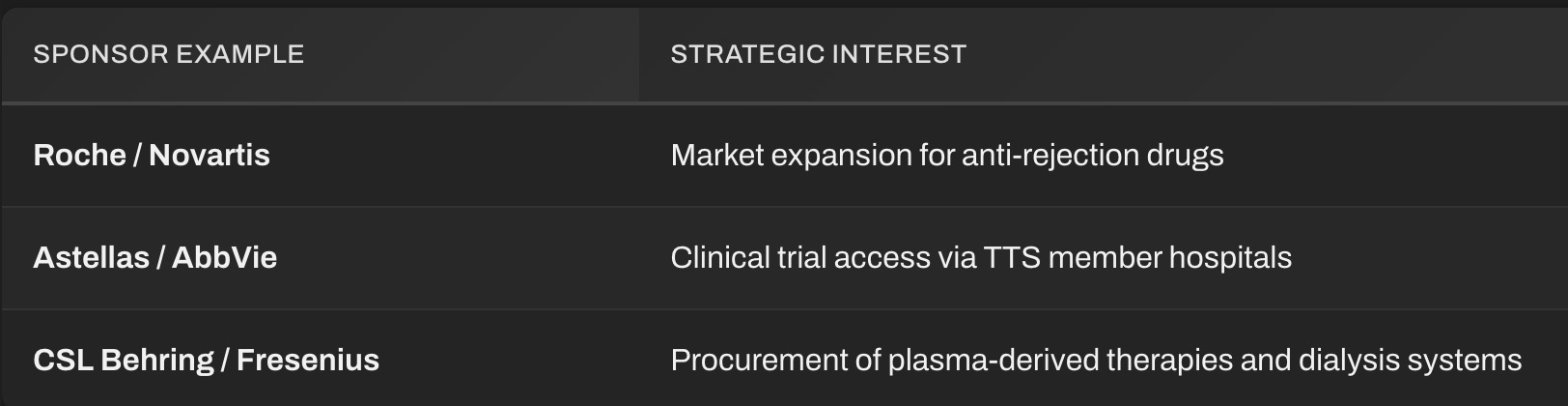
Financing this engine is a familiar combination of membership dues and pharmaceutical sponsorships. Companies manufacturing anti‑rejection drugs, immunosuppressants, and biological therapies: Roche, Novartis, Astellas, and others, fund the society’s congresses and educational initiatives, ensuring that corporate priorities remain embedded in medical discourse. This arrangement gives TTS immense reach but compromises its independence. While officially a nonprofit, it operates more like a clearinghouse for global transplant governance than a charity.
Industry leaders in immunosuppressants and biologics heavily support TTS’s conferences and journal. These same companies also generate significant revenue from sales to the CCP to support its predatory and highly profitable transplantation industry. While listed as “educational grants,” these funds create a structural dependency: TTS cannot displease the companies that underwrite its operations.
Equally consequential are TTS’s governmental relationships, most notably with China’s health authorities. Over the past decade, the Society has served as an intermediary between Western medicine and the Chinese Communist Party’s (CCP’s) transplant establishment. Under the banner of promoting “ethical reform,” TTS co‑hosted conferences, published joint papers, and publicly endorsed China’s claimed transition to voluntary organ donation, all without independent auditing. This cooperation restored Beijing’s credibility in global transplantation circles, even as outside investigators continued to report evidence of coercive organ procurement (from living Chinese Falun Gong, Uyghur Muslim, Tibetan Buddhist, and Christian House Church prisoners). In effect, TTS granted the CCP reputational absolution in exchange for access and political favor.
Through these layers, the council’s elite leadership, the journal’s editorial power, the WHO connection, and the corporate‑state partnerships, TTS has evolved into a transnational regulatory body without formal jurisdiction, yet commanding immense real‑world authority. It defines ethics, determines norms, and quietly shapes policy through influence rather than law. Its public mission speaks of altruism and scientific progress; its structural reality reveals a tightly interwoven network of academic prestige, industry capital, and geopolitical negotiation.
Behind the veneer of neutral science, TTS functions as a transnational regulatory interface:
Science – Curates which research appears “legitimate.”
Ethics – Fabricates global consensus on bioethical questions (e.g., “ethical prerequisites” for vaccination).
Policy – Shapes national transplant laws through WHO influence.
Diplomacy – Acts as a middleman for regimes, such as the CCP seeking credibility.
Commerce – Ensures business continuity for pharmaceutical stakeholders.
It is not a public service organization in the original civic sense; it is a closed network balancing medical, political, and commercial power behind a humanitarian façade.
The Transplantation Society embodies a paradox: it arose to protect the sanctity of donation and prevent abuse, yet its intimate ties to both corporate and state power have eroded its independence and muted whistleblowers.
The Society’s influence is vast. Its guidelines dictate life‑and‑death access to organs in dozens of countries, but its accountability mechanisms remain opaque.
Until its internal funding channels, data relationships, and geopolitical entanglements are made transparent, TTS represents a powerful but unaccountable actor in global medicine.
In sum, the Transplantation Society stands as both the conscience and the control center of modern transplantation. It channels extraordinary expertise and coordination, but also concentrates power in a realm where human life and institutional interest meet, a place where moral ideals are continuously negotiated inside boardrooms and operating theaters alike.
Development of the Symbiotic Relationship Between The Transplant Society and the CCP
The Transplantation Society’s relationship with the Chinese Communist Party (CCP) developed through a carefully managed exchange of legitimacy and access. Beginning in the early 2010s, when China faced mounting accusations of forced organ harvesting, TTS positioned itself as a mediator rather than an investigator. It cultivated ties with the CCP’s National Health Commission and its subordinate China Organ Donation and Transplant Committee, directed by Huang Jiefu, a senior CCP Party official and former vice health minister. Publicly. The collaboration was framed as “ethical reform,” a partnership to guide China from the use of prisoner organs toward voluntary donation. Privately, it functioned as diplomatic rehabilitation for a regime eager to regain credibility and re‑enter scientific forums. TTS hosted joint conferences, accepted CCP‑aligned officials as keynote speakers, and issued statements praising China’s “progress” without independent audits of donor sources. The society’s endorsement of the CCP was then broadcast in state media as proof that international experts recognized China’s system as clean, repeatedly citing praise from international transplant leaders and societies.
As a consequence of this engagement, TTS retained access to China’s vast transplant infrastructure at a time when international scrutiny was intensifying, while continuing to attract pharmaceutical sponsors with commercial interests in transplant medicine, including the Chinese market. Critics argue that this dynamic created a reinforcing cycle: Chinese authorities provided data access and high-profile participation in international forums, while TTS offered public recognition and praise of China’s reported ethical “progress.” The practical effect was mutually beneficial: China regained standing in global transplantation circles, and TTS further consolidated its role as an international arbiter of transplant ethics, despite the absence of independent verification of donor sources.
Multiple credible sources, including the 2019 China Tribunal chaired by Sir Geoffrey Nice, concluded that forced organ harvesting in China continued well after the country’s 2015 pledge to rely solely on voluntary donation. The Tribunal found China’s official transplant figures to be implausible when compared with hospital capacity and activity, indicating the continuation of large-scale organ procurement. It also criticized the failure of international medical institutions and professionals to investigate these practices adequately and for “turning a blind eye,” warning that engagement policies risked enabling abuse by substituting trust for independent verification.
Moreover, TTS representatives have repeatedly cited “trust in the Chinese reforms” despite admitting their inability to access donor databases or independently verify the origins of organs.
That’s diplomatic language for complicity through willful blindness.
Why would TTS cooperate with the CCP in this way?
Financial entanglement: Major pharmaceutical sponsors of immunosuppressant drugs (e.g., Roche, Novartis, Astellas and others) see China as a multibillion‑dollar market. Keeping Chinese transplant programs inside the fold meant continued access to clinical trials and drug protocols.
Academic prestige: Collaborations with large Chinese transplant centers helped boost global publication metrics, conference attendance, and journal impact factors.
Political pressure: Many TTS leaders maintain academic posts jointly with Chinese institutions; criticizing the CCP publicly would terminate those partnerships.
So instead of demanding forensic auditing, TTS embraced China’s “reform narrative,” effectively providing cover for the CCP from international sanctions.
(A detailed timeline on the development of the TTS and CCP Transplant Apparatus can be found at the end of this article).
The Transplantation Society and COVID Policies
During the COVID‑19 era, the Transplantation Society assumed an unusually activist role, crafting and promoting global transplant policies that extended well beyond scientific guidance into behavioral enforcement. It urged transplant centers to prioritize vaccination as a prerequisite for both recipients and living donors, describing compliance as an ethical duty rather than a personal choice. That language, mixing medical caution with moral obligation, quickly translated into hospital protocols that removed unvaccinated patients from transplant waiting lists. TTS further advised that transplant programs could be suspended or postponed during outbreaks, that donors who test positive for SARS‑CoV‑2 be excluded, and that clinical staff adhere to strict immunization mandates.
Although these measures were presented as safeguards for immunosuppressed patients, they effectively created a regime of medical conditionality, in which access to life‑saving surgery hinged on conformity with public‑health directives. By defining vaccination as an “ethical prerequisite,” the Society transformed voluntary compliance into institutional coercion, thereby legitimizing discriminatory policies that lacked long-term outcome data and ignored emerging evidence of the limited efficacy of vaccines in immunosuppressed individuals. Furthermore, the emerging evidence of vaccine-related cardiac damage was ignored, forcing many patients with cardiac disease to get vaccinated despite ample evidence indicating it could worsen their condition. Through its authority and networked influence with regional transplant bodies and the WHO, TTS ensured these standards were adopted globally, embedding pandemic control measures into the fabric of organ‑transplant ethics itself.
The Chinese Communist Party’s role in shaping the Transplantation Society’s COVID policies operated through influence rather than authorship, yet it was unmistakable. By 2020, China had positioned itself as the global model for pandemic containment, promoting centralized control, mass testing, and vaccine dependency as hallmarks of “responsible governance.” Through the China Organ Donation and Transplant Committee and its leadership under Huang Jiefu, who simultaneously served as a senior CCP health official and a long‑standing TTS collaborator, Chinese health authorities fed data, guidance, and rhetorical framing into TTS discussions.
The Society’s webinars and policy statements repeatedly cited China’s swift lockdowns and stringent hospital protocols as exemplary, validating the CCP’s public‑health narrative while adopting its logic of compliance over consent. As TTS translated these lessons into global transplant guidance, its ethics language began to mirror Chinese bio‑political terminology: collective duty, social harmony, and risk minimization, which should supersede individual autonomy. In effect, the CCP’s pandemic governance model became the template for TTS’s transplantation ethics during COVID, demonstrating how Beijing’s political ideology could flow through scientific partnerships to shape international medical and public health protocols that prioritized obedience and centralized authority under the pretext of safety.
In Conclusion
The Transplantation Society has evolved from a professional forum devoted to medical advancement into a powerful transnational medical guild whose influence extends deep into the political and commercial architecture of global health. Its partnerships with corporate sponsors and its intricate alignment with the Chinese Communist Party’s health bureaucracy reveal a pattern of power managed through persuasion rather than accountability.
By exchanging scrutiny for access and ethical independence for political convenience, TTS has allowed itself to become both a participant in and a validator of systems that prioritize control over transparency and human rights. The same organization that once pledged to safeguard human dignity in organ donation has, through its entanglements, blurred the boundary between humanitarian mission and geopolitical instrument. Whether in its quiet endorsement of China’s unverified “reforms” or in its adoption of Beijing’s collectivist logic during the pandemic, The Transplantation Society has shown how easily a noble institution can be captured by the forces it claims to restrain.
To restore credibility, TTS must openly confront its financial and political conflicts of interest. Without radically overhauling its infrastructure, TTS can not reclaim the moral authority it has relinquished. Otherwise, TTS risks remaining a monument to how unexamined institutional power transforms conscience into complicity.
The TTS and CCP TIMELINE: 2013 – 2021
The Transplantation Society & the Chinese Communist Party’s Transplant Apparatus
2013 – The Opening Gambit
Background: Growing external accusations (particularly Kilgour‑Matas reports) documented large‑scale harvesting from prisoners of conscience.
Event: Huang Jiefu (former Chinese vice health minister and lifelong CCP cadre) begins public “reform campaign” to transition from death‑row organs to “voluntary citizens.”
TTS action: Then‑president Francis Delmonico spearheads a “constructive dialogue” approach, inviting Huang to international symposiums rather than ostracizing him.
Significance: This was the critical rehabilitation doorway—instead of demanding audits, TTS presented cooperation as moral progress.
2014 – Policy Alignment & Narrative Synchronization
TTS–Huang meetings held in Guangzhou and Hangzhou jointly announced China’s “intention” to end prisoner organ use by January 1, 2015.
TTS publications in Transplantation journal praised “China’s courageous commitment to reform.”
Omission: No verification mechanism, no donor database review, no prison access.
Result: CCP gains UN and WHO credibility via association with TTS accolades.
2015 – Apparent Reform, with Zero Transparency
January 1: China officially claims to have ended all organ harvesting from executed prisoners.
March: Huang Jiefu addresses the TTS Congress in Hong Kong; TTS leadership applauds “epochal reform.”
Behind‑the‑scenes: Hospitals formerly under the Public Security Bureau continue reporting transplantation volumes inconsistent with any voluntary system.
Global effect: TTS–endorsed reform allows Chinese transplant surgeons back into international conferences and journals.
2016 – Hong Kong Transplant Congress (TTS World Congress)
Organizer: The Transplantation Society, with partial funding and logistical backing from the CCP’s China Organ Donation and Transplantation Committee (CODTC).
Keynote: Huang Jiefu — “A New Era for Organ Donation in China.”
Critics excluded: Independent researchers and witnesses (e.g., Ethan Gutmann, David Matas) were denied participation.
Outcome: TTS issues statements praising “measurable improvement” and “alignment with the Declaration of Istanbul.”
Consequence: CCP propaganda outlets headline that “World Transplantation Society recognizes China’s progress.”
2017 – Institutional Fusion
TTS formalizes cooperation through a Memorandum of Understanding with the China Medical Association Transplantation Committee.
Several TTS officers begin serving as advisors to the Chinese National Organ Donation Management Center.
Collaboration framed as “monitoring ethical compliance” yet without independent auditing rights — essentially volunteering in a CCP‑controlled environment.
Translation: Supervised by those accused of the abuse itself.
2018 – Public Relations And Expansion
Chinese state media celebrates inclusion of its hospitals in TTS database of “ethical centers.”
The Transplantation journal publishes Chinese studies depicting high donor numbers, never questioning the statistical impossibility of purely voluntary sources.
China–TTS Academic Workshops in Kunming and Xi’an feature CCP health officials and PLA medical officers presenting data with no raw‑donor transparency.
2019 – Exposure vs. Endorsement
China Tribunal (UK) publishes findings of ongoing forced organ harvesting.
Rather than endorse investigation, TTS issues a dismissive statement saying evidence is “not verified.”
TTS continues joint conferences; one official claims that “closed cooperation is the only way to promote transparency.”
Effect: CCP could publicly call the Tribunal “biased,” citing TTS as validation that the system is clean.
2020 – The COVID Pivot
Amid the global pandemic, TTS partners virtually with Chinese transplant experts to discuss “ethics during COVID.”
Huang Jiefu headlines TTS webinars as a global expert on resilience in transplant systems.
Ethically tarnished researchers now cast as pandemic heroes.
Simultaneously, new lockdown measures give CCP greater capacity to suppress dissidents—including alleged Falun Gong and Uyghur organ sources—under zero scrutiny.
2021 – Full Re‑Integration and Normalization
TTS lists multiple Chinese hospitals as “recommended collaboration sites” for ongoing transplant research projects.
International registry meetings feature Chinese representation on equal footing with Western centers.
TTS refuses renewed calls from human‑rights investigators to demand open inspection of Chinese donor registries.
Meanwhile, leaked procurement data from Xinjiang surveillance systems show “health‑matching” programs consistent with mass biometric typing — precisely the infrastructure for organ sourcing.
It is long past time to trim the wings of these organizations with outsized influence and malign political agendas.
Both the AMA and ABA memberships hover around 15% of the professions yet exercise outsized influence over the profession. In my own profession of law, the ABA is allowed to control law school accreditation, selection of judges and the canons of professional ethics. Yet it represents only a small slice of the profession and is controlled by a left leaning professional class of entrenched managers. This should be unacceptable yet nothing is done about it.
In 1999 I got a job in the transplant department of a very highly respected teacing hospital. I became friendly with one of the nurses (I was an admin).who confided in me that she was resigning because the head doctor had her fudge the data on a drug he was giving his transplant patients. The other nurse was doctor's wife. That was my first glimpse of the corruption in medicine. This is far worse than I was observing. Shame nobody seems to care.