

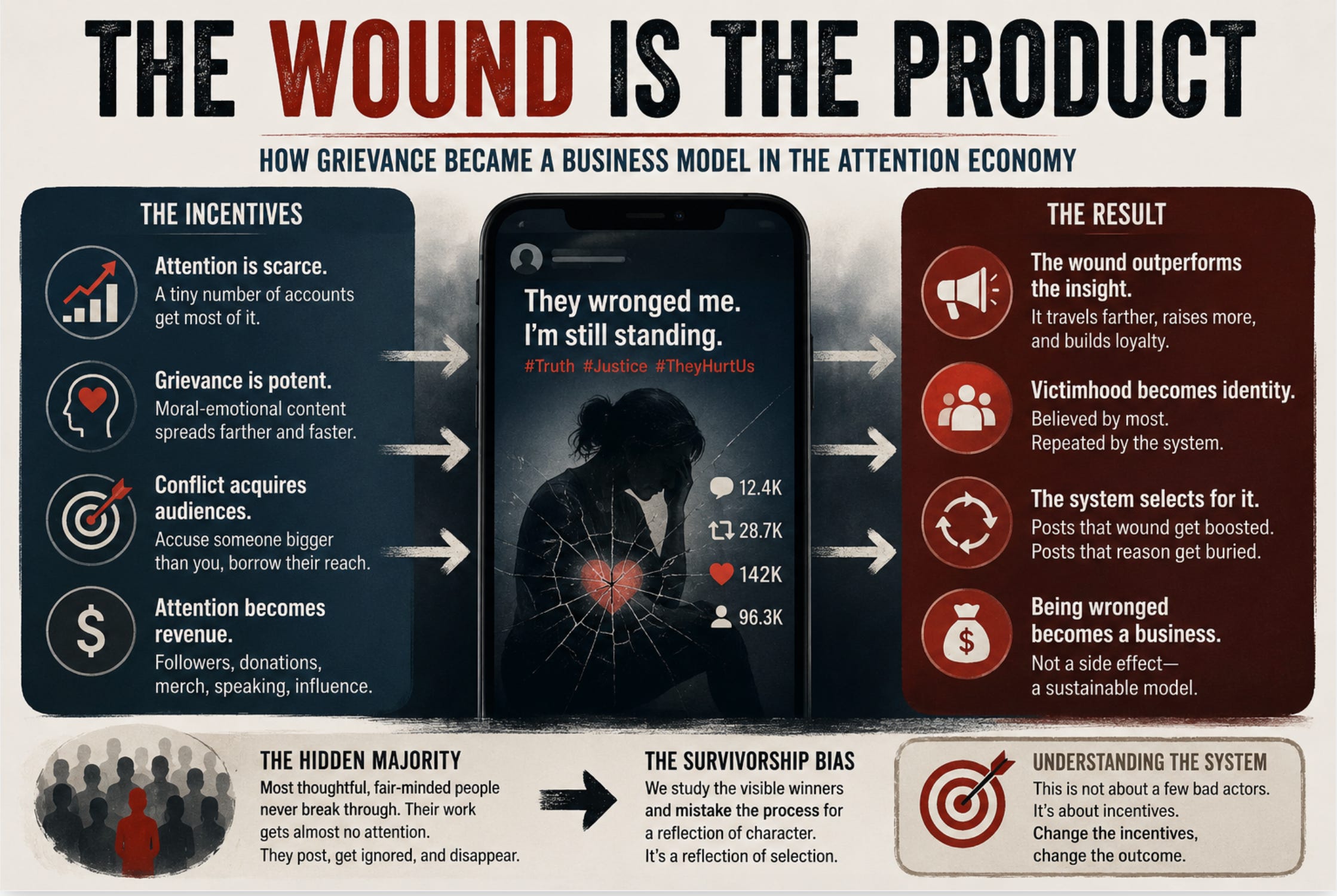
Victimhood is the highest-paying content on the internet. The system rewards it, the reward selects for it, and most of the people participating in the process have no idea it is happening. Including, on plenty of days, me.
Somewhere in the last fifteen years, being wronged became a business model. Not simply a feeling or a misfortune, but a reliable way to generate attention, loyalty, and revenue. If you want reach on any platform that matters, one of the most reliable ways to get it is to show an audience that someone has done you harm and that you are bearing it with dignity. That post will travel farther than your best argument, raise more money than your best work, and bind followers to you more tightly than almost anything you could accomplish by simply being right. The wound outperforms the insight.
This is not a moral failing in the people it happens to. It is the result of incentives built into the system.
I want to take this apart carefully, because the easy version gets it wrong.
The easy version says that people who play the victim are frauds working a grift. A few are. Most are not. Most believe every word, and that is the most interesting part of the story.
Most people are not sitting around plotting how to become professional victims. They are doing what all of us do. They post something, watch what happens, and learn from the response. The posts that get attention get repeated. The posts that disappear do not. After enough repetitions, the process starts selecting for itself.
Nobody has to decide to run the play. The incentives do most of the work.
Breaking Through the Floor
To understand why grievance is so powerful, you have to start with a simple reality. The internet does not distribute attention evenly, or anything close to it. A tiny number of accounts receive most of it while everyone else receives almost none. Much of what gets posted, including thoughtful and accurate work, is seen by very few people and disappears without a trace.
For anyone trying to be heard online, that is the central fact. The hard problem is not producing good content. The internet is already full of good content. The hard problem is getting noticed at all. Most people who try never manage it.
So ask what actually breaks an unknown account through.
It is usually not careful analysis. Careful analysis fills the internet already. What breaks through is emotional and moral charge, and one of the most potent forms of that charge is grievance.
The people who study how messages spread online have a technical term for this. They call it moral-emotional contagion. Words carrying both moral and emotional weight are shared far more often than ordinary language, with each additional moral-emotional word measurably increasing a post’s reach (Brady et al. 2017). Grievance is built almost entirely from those ingredients. Outrage. Betrayal. Courage. Harm.
The important point is not that grievance performs slightly better than a calm post. The important point is that grievance is one of the few things that reliably gives an unknown person a chance to be noticed at all.
This explains something that otherwise looks like an indictment of human nature: nearly every successful influencer appears to run on the same fuel.
But we only see the people who made it through.
Most thoughtful and fair-minded people never break through at all. Their work receives little attention, they eventually stop posting, and they disappear from view. The mistake of studying only the winners while ignoring the much larger number who vanished has a name: survivorship bias.
When you look at successful influencers and notice that many rely on grievance, you are not necessarily learning something dark about the people who become influencers. You are observing a selection process. The people who broke through often did so because grievance worked.
There is a specific mechanism behind it.
To break through, a small account often has to borrow a larger account’s audience. Grievance is one of the most effective tools for doing that. You identify someone bigger than you and argue that they have harmed you, or harmed the people watching. The accused, or the people who rush to defend them, respond. That response carries your name into an audience you could never have reached on your own.
In my own social media universe, I have watched this dynamic play out again and again.
Over the years, I have been called everything from a mass murderer for my role in early mRNA technology development to a government operative, a pharmaceutical shill, and now, apparently, a DARPA and CIA propagandist (despite the fact that I have worked for neither organization).
Just yesterday, Dr. Jack Kruse launched another attack, built on demonstrably false claims. But the specifics are almost beside the point.
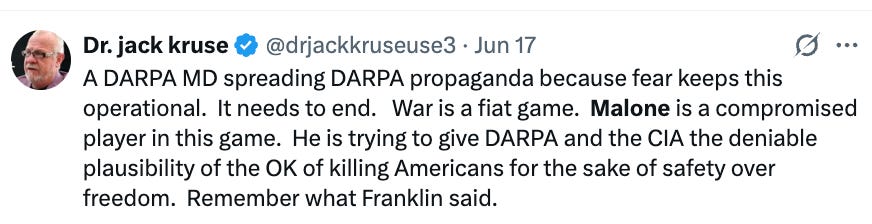
If Jill and I sat down and made a list, we could probably name dozens of individuals who have built substantial audiences around the claims that I personally wronged them or their audience, deceived them, betrayed them, or somehow stand at the center of whatever problem they are trying to explain. Some individuals have written hundreds, even thousands, of posts about me across Substack and X. Some are still at it today.
The interesting question is not whether they are right. They aren’t.
The interesting question is why this pattern keeps repeating.
The answer is that grievance works.
A public feud is audience acquisition. A villain is a growth strategy. The larger and more visible the target, the greater the opportunity. The truth is that responding is counterproductive because every response expands the reach of the attack.
In fact, by mentioning Dr. Kruse here, I am probably helping him gain followers. That is simply how the system operates.
He is not unique. He is merely the latest example to cross my path. One in a long line of attackers.
Conflict becomes the distribution mechanism.
This is why challenging powerful people is often such an effective way to grow an audience. It may or may not be morally justified, but it also works as a form of distribution. The larger the target, the larger the audience available through the resulting conflict.
The same research I cite below found that signals of victimhood also make audiences more willing to view the accused as fair game. In market terms, that is an additional advantage for the person making the claim.
I know this territory because I have stood on both sides of it.
At the end of 2021, within days of each other, Twitter and LinkedIn both acted against me. Twitter removed more than half a million followers in an afternoon. LinkedIn made its ban permanent, and LinkedIn was not a vanity platform. It was a primary channel through which I found consulting clients and maintained a professional reputation built on credentials, scientific work, and experience rather than grievance. That door closed for good.
Days later, I sat down with Joe Rogan for what became the most-watched conversation of my life.
I am not going to claim with certainty that the platforms coordinated their actions, although Congressional evidence suggests that the Biden administration had a hand in what happened. I cannot prove that, and I do not need to. What matters is the result.
One professional channel was effectively destroyed. The grievance channel that emerged in its place reached a much larger audience.
I had started this Substack a few weeks earlier, so the new path was already there. The bans simply slammed one door shut and threw the other one wide open.
At the time, I said publicly that the bans meant I was over the target. I believed that, and there was truth in it. There is another truth as well.
The censorship was real. The injury was real.
It was also the largest single breakthrough in reach and audience growth I have ever experienced on Substack.
The suppression was a real injury and a real act of censorship. It was also the largest breakthrough of my life. The wound became the launch, not the setback.
When the Old Controls Backfire
There is a larger point hidden in my own experience, and it took me a while to see it.
For most of the last century, the people who could injure you and the people who controlled access to an audience were often the same people, or closely aligned. Suppression worked because once they silenced you, there was nowhere else for the audience to go.
That is no longer true.
The thing that can injure you and the thing that distributes you are now different systems. In many cases, the distribution system rewards the conflict created by the first.
As a result, the old tools of narrative control have not merely weakened. In many cases, they have reversed.
A categorical official denial, the flat declaration that “this is false,” was designed for a world in which the institution controlled distribution. Today it often accomplishes the opposite. It signals that the topic is worth discussing, gives the target a fresh grievance to distribute, and exposes the target to the institution’s own audience through the ensuing conflict.
The denial no longer closes the question. It often amplifies it.
An institution still relying on the historic approach to narrative suppression in 2026 (posting statements like “Total BS”, for example) is not demonstrating control. It is demonstrating that it no longer understands the environment in which it operates.
Before anyone on my side of these debates celebrates, however, the same dynamic applies to manufactured grievances. The medium does not distinguish between truth and falsehood. It rewards whatever travels.
A real injury and a manufactured one spread through the system in much the same way. Both are amplified by the same mechanisms.
How Grievance Becomes Power
Once you break through, the wound continues to pay in ways that go beyond reach.
The first was identified by a team of researchers led by Ekin Ok, who described what they called the virtuous victim signal (Ok et al. 2021). It occurs when a claim of injury is paired with a claim of moral goodness.
“I was harmed, and I was harmed because I am one of the good people.”
That combination attracts sympathy, money, trust, and deference.
The second payoff receives less attention. The wound becomes armor.
Criticizing a self-declared victim is costly because it looks like attacking someone who is already down. Most people avoid doing it. Those who do often create a fresh grievance for the next news cycle.
The signal becomes self-reinforcing.
It attracts attention, generates resources, and shields the sender from many of the normal costs of being wrong.
Now follow the money, because all of these benefits eventually become revenue.
Reach becomes subscriptions, donations, advertising revenue, speaking fees, and book sales. The audience built around a victim narrative is one of the most durable revenue streams available, more durable than shared beliefs and often more durable than entertainment, because followers no longer see themselves as customers. They see themselves as participants in a struggle.
People who think they are helping defend a persecuted truth-teller are remarkably loyal.
A subscriber who believes he is helping sustain a persecuted truth-teller is likely to remain subscribed.
Grievance is not adjacent to the business model. It is the business model.
You can watch it operate in plain sight, where a paragraph about censorship or defamation may sit directly above a button asking readers to become paid subscribers.
That juxtaposition is not hypocrisy.
It is the design.
Nobody has to Plan It
This is where the ugly version of the story falls apart.
When a behavior pays this well, nobody has to plan it. This is operant conditioning, the basic principle that governs the behavior of any animal with a nervous system. You do more of what gets rewarded and less of what does not, and you do not need a theory to explain why.
A creator posts twenty things in a month. Five succeed, and fifteen disappear. He has no explanation. He simply notices the response to the five and the silence surrounding the fifteen. Over time, his output drifts toward whatever gets rewarded.
He never consciously decided to become a grievance entrepreneur. He simply learned what worked.
That is why people can tell you, with complete sincerity, that they would never stoop to playing the victim and still be telling the truth as they understand it.
I have said it myself more than once. Be a lion, not a victim.
I meant it when I wrote it, and I mean it now.
Yet the pattern still appears sometimes in my own feed because the part of us that consciously decides what we believe is not always the same part that responds to rewards. My disavowal is not evidence against the system. It is evidence of how the system works.
Victimhood as a Mindset
Psychologists have measured a more durable version of this as a personality trait (Gabay et al. 2020). Some people consistently experience the world as a place where they are being wronged. The pattern has recognizable features: a strong desire for their suffering to be acknowledged, a belief that they occupy the moral high ground, a tendency to revisit old injuries long after the fact, and an asymmetry in which their own pain remains vivid, while the pain of others fades into the background.
The most revealing finding is that the filter tends to operate in only one direction. Present an ambiguous situation, and these individuals reliably assume the worst interpretation rather than the best.
Most influencers are nowhere near the extreme end of that spectrum, and they do not need to be. Modern platforms make it easy to adopt the mindset without fully inhabiting it. The incentives encourage people to interpret events through the lens of grievance because grievance performs.
There is also a status component. Researchers who study public moral conflict describe what they call moral grandstanding (Grubbs et al. 2019), the use of moral language primarily to elevate one’s own status rather than to resolve a disagreement.
It generally takes two forms.
One seeks admiration: the courageous truth-teller who paid a personal price.
The other seeks dominance: shaming opponents until they retreat.
Much grievance content contains elements of both.
Since everyone assumes this is the vice of the other side, it is worth noting that the research found little relationship between political affiliation and the tendency to engage in this behavior. The incentives operate across the political spectrum.
When Grievance Becomes Power
For most influencers, grievance converts into attention and money.
For politicians, it converts into attention, money, and power.
A loyal grievance-based audience is simultaneously a donor list, a voter base, and protection against potential challengers. The same dynamic is operating. The stakes are simply higher.
Look across the political landscape and the ideological differences largely disappear.
Marjorie Taylor Greene built a powerful small-dollar fundraising operation and left Congress with a public narrative centered on betrayal and mistreatment.
Alexandria Ocasio-Cortez built an almost entirely people-funded operation and produced some of the most prominent personal-victim narratives of the January 6 era.
Kari Lake carried a stolen-election narrative through repeated defeats and never abandoned it.
These politicians do not share an ideology or a constituency. What they share is a common set of incentives.
The most useful example, however, is the politician who had one of the strongest claims to victimhood and largely refused to use it.
Thomas Massie endured the most expensive House primary challenge in history while being personally targeted by the President of the United States. Yet his public message remained focused on constitutional questions and fiscal realities rather than on his own grievances.
He lost. Because grievances convert into votes. Issues and logical debate often do not.
But he demonstrated something important.
Genuine victimization does not require victim-signaling.
The signal is a choice the system rewards. It is not something the situation forces upon you.
Our own side is not exempt from any of this, and pretending otherwise would make this essay worthless.
Bobby Kennedy was, in demonstrable fact, deplatformed and savaged in print for years, and his grievances have real foundations under them, the same as mine do. That is exactly why the machine works on (and for) him, and on the movement around him. A real wound is the honest raw material the signal is built from - but an entire ecosystem has been built around those grievances. The question is never whether the injury happened. Mostly it did. The question is what gets built on top of it, and how much of what gets built is the system quietly paying us to keep the wound open.
That is precisely why the dynamic works.
A real injury is often the raw material from which the signal is built.
The question is not whether the injury happened. Much of the time it did.
The question is what gets built on top of it, and how much of that construction is being quietly rewarded by the system.
The Cost of Success
This brings me to the part that should make all of us uncomfortable.
The problem does not disappear once you build an audience. It gets worse.
Moving from ten thousand followers to one hundred thousand, and from one hundred thousand to a million, is often the same challenge repeated at a larger scale. The audience that initial grievance assembled around must continue to receive grievance if it is going to remain engaged.
The incentive does not weaken. It strengthens.
And underneath it sits the ugliest fact in the entire arrangement.
An audience that pays to support a persecuted truth-teller has a vested interest in the persecution continuing.
Not because anyone planned it. Not because anyone wants it. But because that is how the relationship was formed.
The audience gathered around the wound.
The result is a subtle but powerful incentive structure. It rewards the person who discovers a new outrage every week more than the person who solves a problem and reports that it has been solved.
You can see this dynamic across the political spectrum. Once an influencer reaches a certain scale, the challenge is no longer attracting an audience. It is maintaining one.
Consider what happened after Candace Owens left The Daily Wire. Whether her claims about Charlie Kirk, his wife Erika, Brigitte Macron, or anyone else were true is not the point. The point is that the audience's incentive increasingly favored conflict itself. Every new feud generated attention, engagement, discussion, reaction videos, rebuttals, and fresh content for supporters and critics alike. The conflicts became self-sustaining.
That is not unique to Candace Owens. It is simply a highly visible example of a broader phenomenon. Once a large audience has been assembled around controversy and opposition, the pressure to find the next controversy never entirely goes away.
The audience gathered around the conflict. The conflict becomes part of the product.
That incentive quietly rewards the person who finds a new outrage every week over the person who solves a problem and reports that it is solved.
Solutions end stories.
Grievances extend them.
Once you see that dynamic in your own feed, it becomes difficult to ignore.
One of the most striking examples emerged during COVID. Entire audiences formed around resistance to lockdowns, mandates, censorship, and official public health messaging. Many of those grievances were legitimate. That is not the point.
The point is that once those audiences existed, they became economic assets.
Media outlets, publishers, advocacy organizations, conferences, subscription platforms, supplement companies, telemedicine services, and alternative healthcare businesses all emerged to serve them. A large audience of people who believed institutions had failed them became a market. Some organizations sold information. Some sold memberships. Some sold products. Some sold treatments intended to protect against the very threats that had helped build the audience in the first place.
None of this required a conspiracy. It is simply what markets do. Audiences attract entrepreneurs. Demand attracts supply.
The uncomfortable part is that the incentives do not disappear once the crisis passes. An audience assembled around institutional failure, censorship, corruption, persecution, or the corruption of big pharma must continue to hear about the same issues if it is to remain engaged. So now, the company formed to sell ivermectin against COVID-19 has become the company selling ivermectin as an antiparasitic to restore gut balance and vitality. Hint: As a pathologist, I have examined thousands of human biological samples from Americans under the microscope. Generally speaking, parasites are not a significant problem in the United States, despite the attention they often receive on social media. And yes, when I read such claims from our side, it makes my skin crawl.
The institutional side operates according to the same logic. Pharmaceutical advertising influences legacy media. Government agencies defend their budgets and authorities. Public health organizations protect their reputations. The fear product I describe in the book we are currently writing called “The Grift” was monetized by institutions in much the same way grievance is monetized by their critics.
Different products.
Different customers.
Similar incentives.
An analysis that recognizes only one side of that equation is not an analysis. It is advocacy.
The Way Out
There is an easy way out of this argument, and it is also the wrong one.
“The system made me do it.”
That is the easy escape, and it is really just another version of the victim’s argument wearing a lab coat: the system made me do it, so go look somewhere else.
The system selects for behavior. It does not force it. People can recognize the incentives and choose differently. In fact, one of the simplest ways to tell who is sincere and who is merely working the incentives is to explain the mechanism and watch the reaction.
Sincere people usually become uncomfortable. They look at their own feed, their own behavior, and the incentives acting on them. The operators become defensive. For them, the grievance is no longer just a belief or a habit. Grievance has become an asset, and you have just questioned its value and moral integrity.
This is also why the burden now falls on the audience.
The old information order had external checks. Editors, producers, publishers, and gatekeepers could suppress a claim, whether true or false. They often abused that power, but it existed. Today, most of those checks are gone. There are no guardrails to prevent a grievance from spreading, whether it is legitimate or fabricated.
That leaves only one remaining check: your own judgment.
So how do you tell when a legitimate grievance has crossed over into something else?
First, ask whether the injury was real. Most of the injuries discussed in this essay were real. Mine were. Bobby Kennedy’s were. Many others were as well. But some aren’t. That is the first test.
Next, the question to ask is whether the grievance remains tethered to reality, or whether it has become a self-sealing narrative.
One of the warning signs is that nothing is allowed to count as evidence against it.
If people attack you, that proves you are over the target.
If they ignore you, that proves they cannot answer you.
If the prediction fails, then they must have changed their plans because you exposed them.
Every outcome becomes evidence for the same conclusion.
At that point, the grievance is no longer being tested against reality. It is being protected from reality.
That is the moment to be careful.
A real injury does not require a permanent story built around it. A true claim should remain vulnerable to contradictory evidence. It should be possible to imagine what would change your mind.
When you can no longer answer that question, something important has changed. The injury may still be real, but the narrative built on top of it has taken on a life of its own.
That is when the incentives begin doing some of the thinking for you.
I have caught myself doing exactly that more than once while publicly insisting that I would not. I am not offering that observation as a gesture of humility. I am offering it because it may be the most useful fact in this entire essay.
If this pattern can operate in someone who is aware of it, has publicly rejected it and sincerely meant the rejection, it can operate in anyone.
Most of us have been wronged in real ways. That is not the question.
The question is whether what we build on top of those injuries is true, and whether we would still say it, if saying it cost us the audience.
Marshall McLuhan once famously observed that the medium is the message.
In the decentralized media environment of 2026, one can observe a similar dynamic.
The wound is the product.
References
Brady, William J., Julian A. Wills, John T. Jost, Joshua A. Tucker, and Jay J. Van Bavel. 2017. “Emotion Shapes the Diffusion of Moralized Content in Social Networks.” Proceedings of the National Academy of Sciences 114 (28): 7313–7318.
Gabay, Rahav, Boaz Hameiri, Tammy Rubel-Lifschitz, and Arie Nadler. 2020. “The Tendency for Interpersonal Victimhood: The Personality Construct and Its Consequences.” Personality and Individual Differences 165: 110134.
Grubbs, Joshua B., Brandon Warmke, Justin Tosi, A. Shanti James, and W. Keith Campbell. 2019. “Moral Grandstanding in Public Discourse: Status-Seeking Motives as a Potential Explanatory Mechanism in Predicting Conflict.” PLoS ONE 14 (10): e0223749.
Ok, Ekin, Yi Qian, Brendan Strejcek, and Karl Aquino. 2021. “Signaling Virtuous Victimhood as Indicators of Dark Triad Personalities.” Journal of Personality and Social Psychology 120 (6): 1634–1661.
“An audience that pays to support a persecuted truth-teller has a vested interest in the persecution continuing.”
That was some fascinating read, I need to save it and see if I can read it again. I just came here now to tell you that I don’t support you because you were persecuted, I supported you from the very beginning because you are a Truth Teller. And when Covid began, I needed that more than anything else and I haven’t changed my mind, it’s Like a Lion….
Nazi.
Use of the term and related references thereto still figure into daily life, media, and political discussion. 81 years after the Nazi leader took himself out. Isn't that remarkable?
Is there any other war in history that still insinuates itself into our daily lives and conversations?
Might we pause for a moment to consider all the civilizational destruction that has been inflicted unopposed because its defenders were too cowed to endure the insult?
Might we note that advocates for tradition, national pride, the nation-state, etc., are largely losing to globalists who are ever raising the specter?
Is it Nazis roaming the streets who are committing all the heinous street crimes and purported antisemitism in the West? Or is it rather the imports pumped in under the anti-Nazi, anti-fascist banner?
The SPLC is only a more visible recent example of the phenomenon of the weaponization of grievance. And we're being marched toward the UN/WEF/WHO/BIS... vision of the digital gulag, with dissident leadership still too timid to respond with equal ruthlessness.
The spurious racist charge has done more damage to the West than any bomb ever did.