

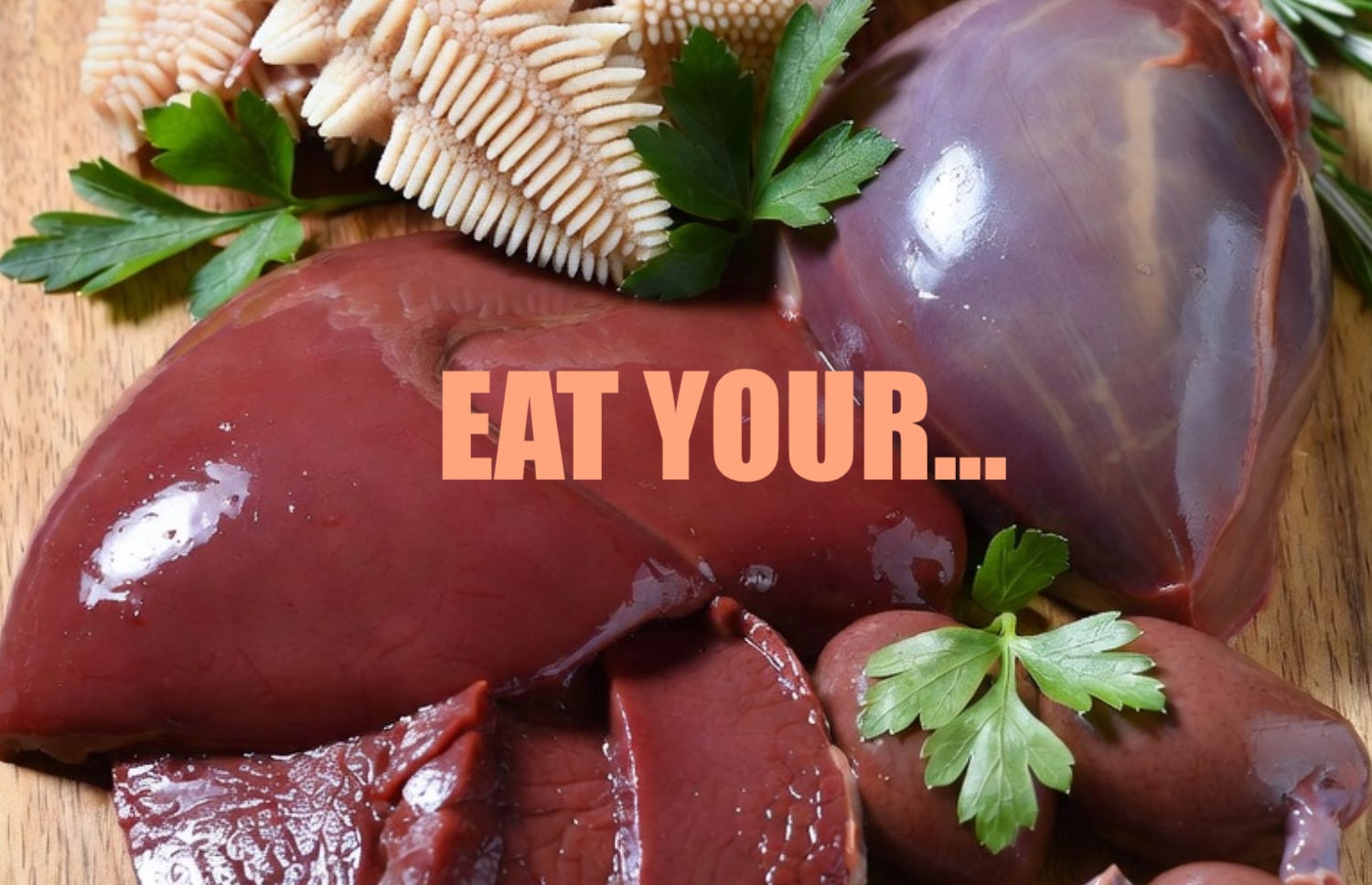
So, last night, we were watching a lovely documentary called Alex Polizzi’s Secret Italy on Amazon. The series has a segment on the island of Sardinia, and one interesting fact is how many centenarians live there. However, another interesting fact is that the islanders still eat a lot of organ meat of all types. Nothing is wasted from the animal, and it is all on display in the local markets, where butchers work on site. A far cry from the centralized, industrialized slaughterhouses, where such delicacies are used for pet food. The truth is that organ meat is good for you, and it is a shame that it has fallen out of favor in our so wealthy, we don’t have to eat that shat, nation.
Organ meats, what we used to simply call offal, are among the most nutrient-dense foods available. Not slightly better than muscle meat, but in many cases an order of magnitude richer in key vitamins, minerals, and biologically active compounds. When used intelligently, they can close nutritional gaps that are otherwise very difficult to address through diet alone.
Let’s start with the obvious objection, because everyone thinks it.
“Yes, but the liver filters toxins.”
True. It is a filtration and processing organ. But that does not mean it stores toxins like a sponge sitting under your sink. The liver’s job is to transform, neutralize, and export toxins. It does not warehouse them. Those compounds are either broken down and excreted through bile or urine, or they circulate and are handled elsewhere.
If you are worried about accumulation, fat is a much more likely place for persistent compounds to reside than liver tissue itself. What the liver does store, very efficiently, are nutrients. That is why predators go for it first.
So no, eating liver is not the dietary equivalent of licking a water filter. It's more like the equivalent of a multi-vitamin.
Why liver deserves a place on the plate
Liver, whether beef or chicken, is arguably the most concentrated nutritional package you can get from an animal.
It delivers:
Vitamin A in the form of retinol, ready to use, not something your body has to convert
Vitamin B12 in levels that make most foods look anemic by comparison
Folate in its natural form, not synthetic folic acid
Copper and choline, both critical and often under-consumed
Beef liver tends to be more concentrated and robust in flavor. Chicken liver is milder, easier for most people to tolerate, and still remarkably dense nutritionally. If you are easing into this, chicken liver is the gateway drug.
Energy, brain, and metabolic throughput
Liver is loaded with B vitamins, especially B12, B2, and B6. These are central to:
Mitochondrial energy production
Neurotransmitter synthesis
Choline, which is abundant in liver, supports:
Brain development and function
Liver health itself
Cell membrane integrity
If you are running a high-demand system, physically or cognitively, these are not optional inputs.
Blood building and oxygen transport
Liver brings together:
Heme iron, which your body absorbs efficiently
Copper, which helps regulate iron metabolism
That combination matters. You can take iron supplements all day long, but without the supporting cofactors, the system does not run properly. Liver supports the whole pathway.
This becomes particularly relevant in:
Iron deficiency anemia
Pregnancy
Growth and recovery
Immune and reproductive health
Vitamin A from liver plays a central role in:
Immune signaling
Maintaining the integrity of gut and lung linings
Add in zinc and selenium from organ meats more broadly, and you are supporting:
Immune function
Hormonal balance
This is systems biology, not isolated nutrients.
A brief word about taste and reality
Now, none of this matters if you cannot get it past your fork.
Liver has a reputation. Some of it deserved. Some of it based on childhood trauma involving overcooked slabs of something that tasted like a boot soaked in iron.
There are ways around this:
Do not overcook it.
Mix small amounts into ground beef. Online “ancestral” meat shops specialize in grass-fed ground organ meat and beef sales. This is an easy way to ease into eating organ meat.
Use, or even better, make, pâté, which is civilization’s way of making liver not only tolerable but actually enjoyable. Chicken livers are cheap and very tasty in pâté. Pâté is easy to make and keeps for several days. It is so tasty, you might even try serving it at a party!
The classic liver and onions (try using calf’s liver) is pretty darn tasty. Especially with ketchup.
Start small. You do not need a plate of it. An ounce or two once or twice a week will move the needle.
The larger point
Muscle meat gives you protein and calories. Liver gives you the cofactors that allow your system to function at a higher level.
And despite what you may have been told, you are not eating a toxin sponge. You are eating the metabolic control center of the animal. The place where the nutrients are stored.
JGM

Brownstone Institute’s second retreat at Polyface Farms is a chance to join us (Robert and I will both be speaking) in an exciting adventure on a real working farm, to learn from the best minds on the subjects of health and food freedom, and discover what a huge difference authenticity can make to rediscover core truths. This event shows the why and the way.
The event begins on Friday morning with an early morning registration and a delicious breakfast and ends Saturday afternoon.
Polyface Farm: On Friday and Saturday, August 28th and 29th, Brownstone will host their annual Polyface Retreat at Polyface Farm in Swoope, Virginia.
RETREAT: REGISTER NOW.
Tickets for the VIP dinner August 28 are still available, but going fast. Eight are left. TICKETS.
Thank you for this info about liver. We Love liver in this family. We get it locally at an organic farm - where we also get our "raw" organic, free range milk, chicken livers, beef and other good stuff.
No! Emphatically No.
What’s left out of this is that organ meats are high in purines which get converted to uric acid once consumed which for too many people leads to gout. Personal experience, flare ups are not fun. Thing is, it’s not just the flare ups - my experience and reading led me to eliminate most sources of elevated purines, even low doses, because even controlling for flare ups there can be a low grade inflammation in the joints.
What’s interesting to me is that the source of purines is equally important: research has shown that purines from plant sources ( asparagus 🤔) do not lead to elevated uric acid and certain critters are safe - 🤤 sardines and salmon/trout
The biggest disappointment, and was almost a killer, was learning that beer, and my beloved dark beers, were a tremendous source of purines ( brewers yeast {sigh} ) and within days of foreswearing beer I noticed a reduction in joint pain, esp knees. On the bright side, while I haven’t done an elimination comparison, my near daily consumption of bread, home made sourdough, doesn’t seem to be a problem. Speaking of yeast, some folk put a lot of stock into nutritious yeast, vegemite, etc., which are also high in purines.
I’ve been off allopurinol for a couple/several years without even a hint of gout related joint pain. Generalized OA, as well as bone on bone in my knees, well that’s a whole ‘nother story.
So, if you can tolerate organ meats, particularly minimizing the amounts, power to you - I won’t be elbowing in to join you.