

Audio Version:
For decades, nutrition advice has tended to focus on what happens today. Eat too much sugar today and blood glucose rises. Eat too many calories and weight goes up. Cut calories and presumably the weight should come back down. But human biology is not nearly that simple. A remarkable series of studies coming out of Britain recently suggests that what children eat during the earliest years of life may leave fingerprints on their metabolism, eating behavior and disease risk that can still be detected more than half a century later. At the same time, a separate line of research is showing something equally important: fat tissue itself appears capable of retaining a biological memory of obesity, even after the weight has been lost.
Put these findings together and a very different picture of metabolic health begins to emerge. The body remembers what happened before. That makes what happens during pregnancy, infancy, childhood and adolescence far more important than most people have been led to believe.
Britain accidentally conducted a 70-year nutrition experiment
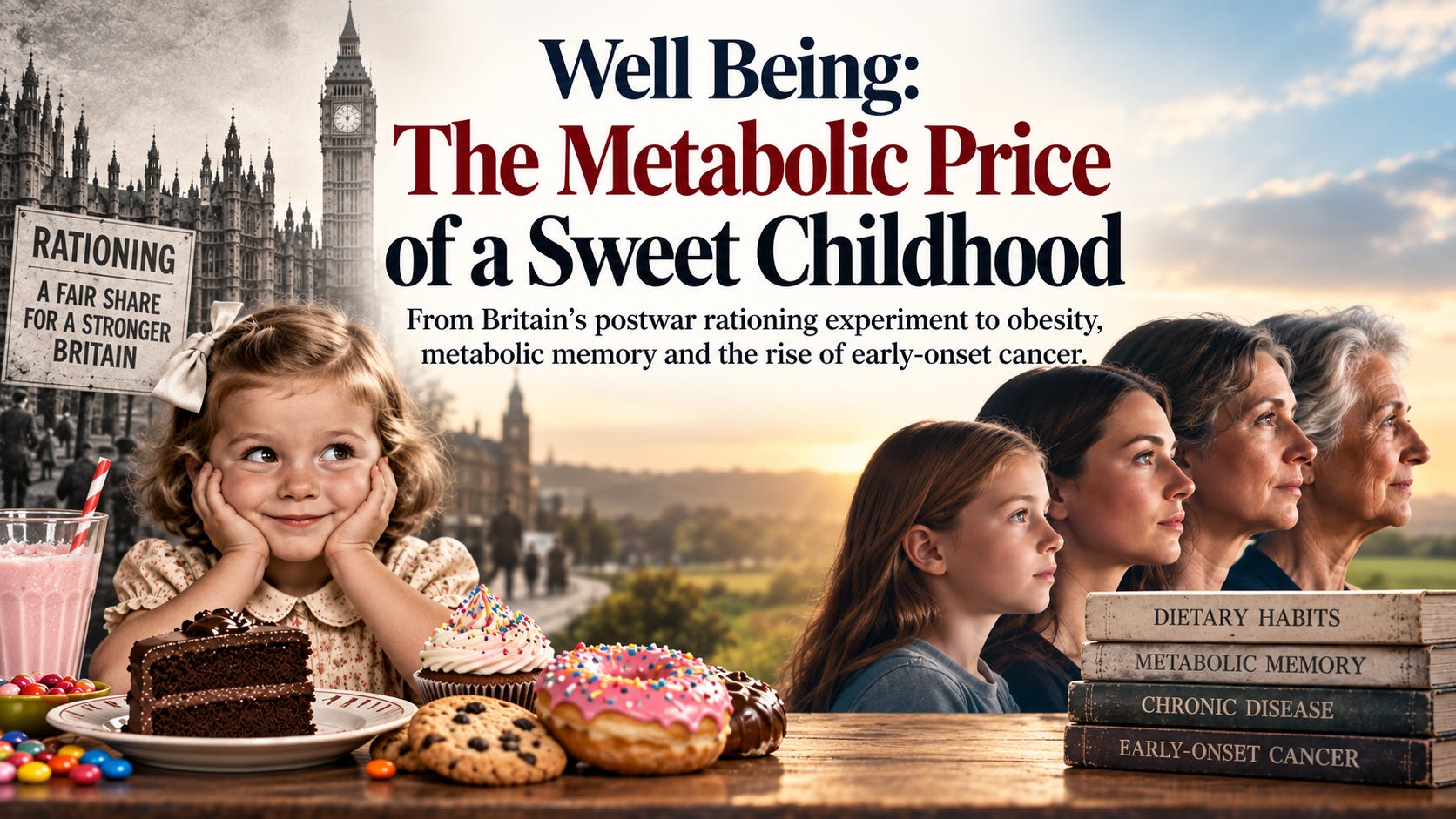
Britain rationed food (including sugar) during and after World War II, and sugar rationing continued until September 1953. That created something scientists almost never get in human nutrition: a natural experiment involving an entire population. Before September 1953, pregnant women, babies, and young children lived in an environment in which sugar was restricted. Then the restriction suddenly disappeared. Sugar consumption nearly doubled, while consumption of many other foods did not change nearly as dramatically.
Decades later, researchers realized that this historical accident provided an extraordinary opportunity. People born just before and just after the end of rationing were genetically similar, lived in the same country, and were separated in age by relatively little. But their exposure to sugar during one of the most important developmental periods of their lives was very different.
The first major results from epidemiology research involving this natural experiment were published in Science in 2024. Researchers examined people exposed to sugar rationing during the first 1,000 days after conception, meaning pregnancy plus roughly the first two years of childhood. Those exposed to rationing had about a 35 percent lower risk of developing type 2 diabetes and about a 20 percent lower risk of hypertension later in life. Diabetes appeared approximately four years later and hypertension about two years later.
Even more interesting was the timing. Exposure during pregnancy mattered, but the benefit became greater when sugar restriction continued after birth, particularly after about six months of age, when babies typically begin eating solid food. In utero exposure alone accounted for about one-third of the risk reduction. Something important happened after these babies began learning how to eat.
Learning what sweet tastes like
That possibility became considerably more interesting in 2026. Researchers writing in Proceedings of the National Academy of Sciences examined 64,761 UK Biobank participants born between 1951 and 1956 and once again used the end of sugar rationing as the dividing line. The people whose first 1,000 days occurred under sugar rationing were eating differently five decades later. They consumed less sugar, ate smaller quantities of food, and had healthier and more diverse diets. The authors concluded that the results were consistent with persistent taste preferences established during this critical developmental period.
The study provides evidence for something very close to the idea that children are often inadvertantly taught to develop a sweet tooth: exposure to less sugar during the period when food preferences are being established was associated with eating less sugar half a century later.
In my own life, my British parents had an extraordinary love of desserts and chocolate. Dessert was served every night, but only after dinner had been eaten, which made dessert both a reward and the ultimate objective of the meal. In fairness, we were lucky. My mother cooked from scratch and put real food on the table. But French bread appeared regularly at lunch, while whole wheat bread was viewed with deep suspicion, and children were expected to remain at the table until their plates were clean. For a mother whose formative years were shaped by poverty and food scarcity, the clean-plate rule probably seemed perfectly sensible. Unfortunately, it also meant learning very early to eat what was in front of me whether I was still hungry or not, with something sweet waiting at the finish line. I developed a lifelong sweet tooth and, as a young child, more cavities than I care to count.
Fortunately, I rebelled early and often against the clean-plate rule and eventually trained my mother to put less food on my plate. The chocolate problem proved considerably more stubborn. I developed a serious chocolate habit very early in life, and my inner chocolate demon and I have been grappling with boundary setting ever since. For most of my adult life, that was pretty much a daily negotiation, and the demon frequently had better counsel. About four years ago, I finally put myself on fairly strict chocolate rationing. Interestingly, it has become much easier with time. These days the demon wins perhaps once a week rather than every day. That is progress, and it also makes me wonder whether the British rationing studies are capturing something very real: the palate can be trained early, but perhaps, with enough persistence, it can also be retrained later.
Think about the implications of that for a moment. A toddler does not arrive in the world demanding sweetened yogurt, breakfast cereal, juice boxes, cookies, sweetened applesauce, fruit snacks, ice cream, and birthday cake. Adults introduce those foods. The child’s palate then develops within that environment. What tastes “normal” is learned, and if intensely sweet food becomes normal at age two, moderately sweet food may eventually taste bland. Conversely, if less-sweet food is normal from the beginning, perhaps that child never needs the same degree of sweetness to make food rewarding. Britain’s postwar children have given researchers an extraordinary opportunity to see what that difference might mean 50 and 60 years later.
The consequences followed these children into old age
The disease findings have continued to accumulate.
A large BMJ study found striking differences in long-term cardiovascular outcomes. Compared with people who were never exposed to sugar rationing, those exposed in utero and for one to two years after birth had a 20 percent lower relative hazard of cardiovascular disease, 25 percent lower for myocardial infarction, 26 percent lower for heart failure, 24 percent lower for atrial fibrillation, 31 percent lower for stroke, and 27 percent lower for cardiovascular mortality. These are relative differences in hazard, not absolute risk reductions.
Compared with those who had not been exposed to rationing. Diabetes and hypertension explained about 31 percent of the cardiovascular association, suggesting that better metabolic health partly explained the cardiovascular findings, butd not entirely.
Then came cancer. The 2026 PNAS study found substantially lower incidence of several cancers among people exposed to early-life sugar rationing: approximately 69 percent lower liver and intrahepatic bile duct cancer, 40 percent lower rectal cancer, 41 percent lower lung cancer, 52 percent lower prostate cancer and 36 percent lower breast cancer. The researchers also found longer leukocyte telomeres, corresponding to roughly 2.2 fewer years of biological aging.
A separate 2026 study examining early-onset cancer, defined as cancer diagnosed by age 50, found that early-life sugar restriction was associated with a 34 percent lower risk of early-onset cancer, again with evidence of a dose-response relationship according to the duration of postnatal exposure to rationing.
Another 2026 study in Nature Communications reported that early-life sugar rationing was associated with a 19 percent lower risk of all-cause mortality, as well as younger estimates of biological and organ aging. Different investigators, different outcomes and different analytical approaches keep returning to the same historical event and pointing in the same direction. Something important happened to children who spent their earliest years eating less sugar.
Fast forward to millennials.
Another uncomfortable question is worth asking, even though the science cannot yet answer it. Beginning in the late 1970s and accelerating through the 1980s and 1990s, Americans were told to fear dietary fat. Manufacturers responded with an explosion of “low-fat” and “fat-free” foods, while carbohydrate and sugar increasingly filled the space left behind. USDA data document the shift: fat fell from about 40 percent of calories in 1977–78 to 34 percent by 1989–91, while carbohydrate consumption moved in the opposite direction. Added sugars in the American food supply continued climbing toward the end of the century.
The transformation of the food supply went well beyond simply adding table sugar. Manufacturers increasingly relied on ingredients such as high-fructose corn syrup and maltodextrin, a rapidly digested starch that may not even register to consumers as “sugar” when they read the ingredient list. These refined carbohydrates can be delivered extraordinarily quickly because industrial processing has essentially done much of the work of digestion before the food reaches the mouth. That speed may matter. Increasing evidence suggests that ultra-processed foods combining rapidly available refined carbohydrates with fat, salt, flavorings and carefully engineered textures can strongly engage the brain’s reward circuitry and, in some people, produce craving, loss of control and other behaviors that can be labeled as addiction. Modern food manufacturers became extraordinarily good at producing foods that people want to eat again and again, often long after hunger should have told them to stop. For children whose brains and palates are still developing, that distinction may be particularly important.
There is an unpleasant historical footnote to all of this. Internal sugar-industry documents later revealed that the Sugar Research Foundation had funded research beginning in the 1960s that emphasized fat and cholesterol as causes of coronary heart disease while downplaying evidence implicating sucrose. Even more remarkably, an internal industry document from 1954 predicted that if Americans adopted lower-fat diets, per-capita sucrose consumption could increase by more than one-third. In other words, the commercial opportunity presented by America’s emerging fear of fat was recognized very early.

Time magazine’s March 26, 1984 cover, titled “Cholesterol: And Now the Bad News…,” is one of the publication’s most iconic images, depicting breakfast staples arranged in a sad-face to declare that “Cholesterol is proved deadly, and our diet may never be the same.” The issue reported on the Framingham Heart Study and other major research concluding that high blood cholesterol directly increases the risk of fatal heart attacks, sparking decades of widespread fat-phobia and the shift toward low-fat, high-carb diets in the U.S.
Thirty years later, Time partially reversed this narrative in a cover story titled “Ending the War on Fat,” which urged readers to “Eat Butter“ and acknowledged that new science suggests saturated fat was not the primary culprit for heart disease as previously believed. This shift came as decades of low-fat dietary advice coincided with rising rates of obesity, diabetes, and heart disease in the population.
Now consider the children raised during the great low-fat experiment. Many grew up in the 1980s and 1990s surrounded by sweetened cereals, low-fat, sugar-added dairy, sodas, cookies, and innumerable ultra-processed foods that could advertise themselves as “low fat” while delivering plenty of refined carbohydrates, sugar, maltodextrin, and high-fructose corn syrup. Those children are now in their twenties, thirties, forties, and early fifties. At the same time, researchers are confronting a troubling increase in the incidence of certain early-onset cancers. A major National Cancer Institute analysis found that 14 cancer types increased among Americans under 50 between 2010 and 2019, including breast and colorectal cancer.
Are these things connected? Nobody knows. It would be irresponsible to conclude that the low-fat, higher-sugar food environment caused the increase in early-onset cancers. The data to support that conclusion have not been developed, although this seems like the sort of thing the CDC should be researching instead of its obsessive focus on spreading infectious disease fear. There are many competing explanations, including obesity, metabolic disease, alcohol, changes in reproductive patterns, environmental exposures, detection, mRNA vaccines, and other dietary changes. But after looking at the British rationing data, the question becomes difficult to dismiss. If sugar exposure during the first 1,000 days of life is associated with differences in cancer incidence many decades later, and if early exposure appears capable of establishing dietary preferences that persist for half a century, then the enormous dietary experiment conducted on American children during the low-fat era deserves considerably more scrutiny.
Perhaps the most serious mistake was, and still is, assuming that childhood nutrition was principally about whether a child was getting enough calories, protein, and vitamins to grow. The emerging evidence suggests that childhood may also be when some of the metabolic machinery governing adult disease is being set. The children of the low-fat era are only now becoming old enough for some of those consequences to become visible.
Fat cells have a memory, too
There is another piece of this story that parents and grandparents should understand because it changes the way obesity itself should be viewed. Fat is not simply an inert storage tank where excess calories wait until they are needed. Adipose tissue is metabolically active tissue. Fat cells communicate with the rest of the body, respond to hormones, participate in inflammatory signaling, and influence metabolism throughout the body.
Fat cells are also surprisingly persistent. A landmark 2008 Nature study used carbon-14 dating to determine the age and turnover of human fat cells and found that approximately 10 percent of adult fat cells are replaced each year. That is where the commonly repeated statement that a fat cell lives about ten years comes from, although the actual biology is more complicated.
More importantly, the number of fat cells appears to be largely established during childhood and adolescence. Once adulthood is reached, losing weight generally makes those fat cells smaller. It does not simply make the expanded population of fat cells disappear. This helps explain why preventing childhood obesity and reversing obesity at age 50 are biologically very different propositions.
Then, in 2024, researchers published an extraordinary paper in Nature titled Adipose tissue retains an epigenetic memory of obesity after weight loss. They examined human adipose tissue before and after major weight loss and found that substantial weight loss did not completely return the tissue to its previous biological state. Fat cells and other cells retained transcriptional changes associated with obesity. In mice, researchers were able to go further and identify persistent obesity-induced epigenetic changes. When those mice were exposed again to a high-fat diet, they regained weight more rapidly. The researchers concluded that this persistent cellular memory may help explain the familiar “yo-yo” phenomenon in which people lose substantial amounts of weight only to regain it.
This matters because obesity is still too often discussed as if it were simply a failure of character. Eat less. Exercise more. Have some self-control. Yet a formerly obese person trying to maintain a healthy weight may not be playing on the same biological field as someone who was never obese. The adipose tissue itself may have changed. The number and characteristics of fat cells may be different. Hunger and satiety signaling can change with weight loss, energy expenditure adaptations, and now there is evidence that adipose tissue retains molecular traces of its previous obese state.
There is an intriguing biological question hiding inside these results. Researchers have now demonstrated that fat cells can retain an epigenetic memory of obesity even after substantial weight loss. Why couldn’t the developing nervous system retain its own memory of an early diet? Sweetness is not simply registered on the tongue and forgotten. Sugar activates an elaborate network involving taste pathways, the gut-brain axis, dopamine reward circuitry, the hypothalamus and learned food memories. Early childhood is also a period of extraordinary neural plasticity. There is not yet evidence in humans demonstrating that childhood sugar exposure creates a specific epigenetic change in neurons that produces a lifelong desire for sweets, and that distinction is important. But the British rationing experiment gives reason to ask the question. Fifty years later, the people exposed to less sugar early in life were still eating less of it. Something remembered. Whether that memory resides primarily in culture, learned behavior, neural circuitry, epigenetic programming, metabolic signaling, or some combination of them may turn out to be one of the more interesting questions raised by this remarkable natural experiment.
None of this means that weight loss is futile. Quite the opposite. Losing excess weight can dramatically improve metabolic health, insulin sensitivity, blood pressure and liver health. But keeping that weight off may require sustained effort because the person may literally be fighting biological mechanisms pushing the body back toward its previous state. Someone who has lost 50 pounds and keeps it off for years may be accomplishing something much more biologically difficult than the naturally thin person sitting beside them who has never had to think seriously about food. That deserves less moral judgment, and a much greater appreciation for how difficult long-term weight loss can actually be.
Prevention is not the same thing as treatment
Modern medicine has become very good at waiting for metabolic disease to magically appear and then treating it. A child becomes overweight and then obese. Years later comes insulin resistance, followed perhaps by hypertension, fatty liver disease, type 2 diabetes or cardiovascular disease. Each stage produces another opportunity for a prescription, another laboratory test and another medical intervention. But the British sugar experiment suggests that one of the most consequential interventions may have occurred decades before any of those diagnoses appeared.
The first 1,000 days matter. Childhood and adolescence matter as well, because this is when food preferences are being learned, metabolic systems are developing and the adult population of fat cells is being established. The metabolic environment in which a child develops may influence not merely what that child weighs next year, but what foods taste normal, how much sugar that person consumes at 50, how adipose tissue develops and ultimately the risk of diseases that may not appear until decades later.
That should change the conversation about feeding children.
For parents and grandparents
Grandparents have a peculiar privilege. They get to spoil grandchildren, and food has always been part of that relationship. But perhaps the definition of “spoiling” deserves reconsideration. Love does not have to arrive in a cookie, and a toddler does not need soda, candy as a reward, or a breakfast that is essentially dessert masquerading as cereal. Yogurt does not need enough added sugar to taste like pudding, every accomplishment does not require a cupcake, and every visit to Grandma’s house does not have to establish an association between affection and sweets.
This isn’t an argument that a child should never eat birthday cake or have an ice cream cone. It is an argument for establishing what normal food tastes like before the processed-food industry gets the opportunity to establish that baseline instead. Eggs, meat, vegetables, berries, whole fruit, cheese, plain or lightly sweetened yogurt, nuts when developmentally appropriate, real bread, butter and foods cooked from recognizable ingredients create a very different sensory environment from sweetened drinks, ultra-processed snacks and foods engineered to deliver intense combinations of sugar, refined starch, fat and flavoring.
Parents are not merely feeding a small body today. They are helping establish the food preferences and metabolic responses of the adult that body will eventually become, and grandparents are very much part of that environment. What happens around the family table can become a biological inheritance every bit as real as some of the things passed through genes.
For those who are already older and have struggled with weight for decades, there is another message in this research that is equally important. Biology is not destiny. Metabolic health can improve enormously. Insulin sensitivity can improve, blood pressure can fall, liver fat can decrease, fat cells can shrink, physical activity can change skeletal muscle metabolism, and dietary changes can profoundly alter glucose and insulin dynamics. People who have been obese can lose substantial amounts of weight and keep it off.
But it may be harder than it would have been if the metabolic problem had never developed, and understanding that difference is important. The body is not a blank slate that resets every Monday morning after a weekend of bad eating. It carries biological history with it.
That is not an excuse to quit. It is an explanation for why turning metabolic disease around can demand extraordinary persistence and willpower, and why preventing it in the first place is so much easier than trying to reverse decades of metabolic adaptation.
Parents and grandparents spend enormous amounts of time thinking about what they will leave their children: a home, land, an education, savings, family traditions, perhaps a farm or business. But another inheritance is being built quietly at the kitchen table. What does breakfast taste like? What does a child drink when thirsty? What food means “reward”? What does Grandma serve when the grandchildren arrive? What tastes normal?
The children raised under Britain’s postwar sugar rationing did not know they were participating in one of the longest and largest nutrition experiments in history. Their parents were not following a wellness trend. Sugar was simply scarce. Seven decades later, that scarcity has become scientifically valuable. Those children grew into adults who developed less diabetes and hypertension, suffered less cardiovascular disease, experienced lower rates of several cancers, and appear to have aged somewhat more slowly. Most intriguing of all, decades after rationing ended, they were still eating less sugar.
Perhaps they learned something before they were old enough to remember learning it. Their palates retained that early lesson, while modern research suggests that metabolism and even fat tissue can carry their own forms of biological memory. The lesson for parents and grandparents is both simple and profound: metabolic health does not suddenly begin with a cholesterol test at 45 or a diabetes diagnosis at 55. It begins at the very beginning of life.
By: JGM/RWM
A Note to Our Readers
This essay is a good example of what independent publishing allows us to do. Start with an intriguing piece of research on British sugar rationing, follow the evidence wherever it leads, connect it to metabolic memory, childhood obesity and the troubling rise of early-onset cancers, and then ask questions that may not yet have neat or comfortable answers. There is no pharmaceutical company, food manufacturer, university communications department or advertising agency deciding which questions are acceptable to ask. Just the literature, the data and a willingness to dig.
That independence only works because readers support it. Researching and writing essays like this takes time, and paid subscriptions make that time possible while allowing us to keep much of our work available to everyone. If you find this kind of deep dive useful, please consider becoming a paid subscriber, upgrading your subscription, or giving a subscription to someone you care about. And if a paid subscription isn’t in the budget, sharing this essay is enormously helpful. Independent media survives one reader at a time, and your support is what keeps this work independent.
References
Gracner T, Boone C, Gertler PJ. Exposure to sugar rationing in the first 1000 days of life protected against chronic disease. Science. 2024;386(6725):1043–1048. doi:10.1126/science.adn5421.
PubMedZheng J, Zhou Z, Huang J, et al. Exposure to sugar rationing in first 1000 days after conception and long term cardiovascular outcomes: natural experiment study. BMJ. 2025;391. doi:10.1136/bmj-2024-083890.
BMJ full textZhu C, Zhang W. Early-life sugar restriction causally reduces adult cancer incidence and slows biological aging. Proceedings of the National Academy of Sciences of the United States of America. 2026;123(32). doi:10.1073/pnas.2610287123.
PubMedSugar rationing during the first 1000 days and early-onset cancer: a natural experiment. American Journal of Clinical Nutrition. 2026. Article 101453. doi:10.1016/j.ajcnut.2026.101453.
Journal articleEarly life sugar rationing and ageing related diseases, biological ageing and mortality. Nature Communications. 2026.
Nature Communications full textSpalding KL, Arner E, Westermark PO, et al. Dynamics of fat cell turnover in humans. Nature. 2008;453:783–787. doi:10.1038/nature06902.
NatureHinte LC, Castellano-Castillo D, Ghosh A, et al. Adipose tissue retains an epigenetic memory of obesity after weight loss. Nature. 2024;636(8042):457–465. doi:10.1038/s41586-024-08165-7.
Nature full textKearns CE, Schmidt LA, Glantz SA. Sugar industry and coronary heart disease research: a historical analysis of internal industry documents. JAMA Internal Medicine. 2016;176(11):1680–1685. doi:10.1001/jamainternmed.2016.5394.
Full text via NIH/PMCGearhardt AN, Bueno NB, DiFeliceantonio AG, Roberto CA, Jiménez-Murcia S, Fernandez-Aranda F. Social, clinical, and policy implications of ultra-processed food addiction. BMJ. 2023;383. doi:10.1136/bmj-2023-075354.
BMJ full textShiels MS, et al. Trends in cancer incidence and mortality rates in early-onset and older-onset age groups in the United States, 2010–2019. Cancer Discovery. 2025.
National Cancer Institute summary and reference
Additional background
National Institutes of Health. Early-life nutrition. NIH Research Matters. Summary of the British sugar-rationing natural experiment and its implications for later-life diabetes and hypertension.
NIHNational Cancer Institute. Incidence rates of some cancer types have risen in people under age 50. May 8, 2025. Reports that incidence increased for 14 of 33 cancer types examined among people under 50 between 2010 and 2019, while 19 cancer types declined and overall cancer incidence did not increase.
National Cancer Institute
So interesting. Thank you for compiling this valuable resource! God bless.
Great article. Which brings me to your Homesteading for Health book; I built a page on my gardening website that links to your book; https://www.vegetable-gardening-online.com/homestead-gardening-for-beginners.html