Well Being: The Processed Meat Problem
Part One: The Death of Virginia Ham
Audio Version
A Series About Ham, Hot Dogs, Science, and What We Lost Along the Way
We are told that processed meat is bad for us.
The World Health Organization says processed meat is linked to colorectal cancer. Many peer-reviewed studies associate it with shorter lifespan, cardiovascular disease, diabetes, and other chronic conditions. Headlines are often blunt: bacon is bad, ham is bad, sausage is bad, hot dogs are bad.
But there is a problem hiding inside that simple warning.
What, exactly, is processed meat?
Is a hot dog the same thing as Prosciutto di Parma? Is bologna the same thing as Jamón Ibérico? Is canned luncheon meat the same thing as a Virginia country ham, dry-cured with salt and aged for months in a smokehouse?
From a regulatory and epidemiological standpoint, these foods are usually grouped together. From a food-science standpoint, they are radically different.
For most of human history, meat preservation was not an industrial trick. It was a survival skill. Curing required salt, smoke, air, time, and beneficial microbes, which allowed families to preserve the harvest, survive winter, and create some of the world’s most beloved foods. Virginia country ham, Italian prosciutto, Spanish jamón, bresaola, salami, and traditional smoked meats all come from this old world of preservation. This is a vastly different process than what passes for cured meats now.
Long aging gave way to rapid “curing.” Whole-muscle meats gave way to emulsified products. Smokehouses gave way to factories. Salt and time were increasingly replaced by injected brines, nitrites, phosphates, binders, fillers, artificial flavorings, and industrial processing.
And yet, in much of the scientific literature, these very different foods are often collapsed into one category: processed meat.
This series is an attempt to take that category apart.
Executive Summary
The central question is simple:
Are all processed meats biologically equivalent, or has nutrition science lumped together foods that should be studied separately?
The evidence linking processed meat to disease is real, but it is also more complicated than the headlines suggest. Much of it comes from observational studies, where correlation does not automatically prove causation. The reported risks are often relative risks, not absolute risks. Understanding the difference is essential because an impressive-sounding relative increase may translate into only a small change in actual lifetime risk. And the exposure category itself is crude.
A 50-gram serving of processed meat could mean a hot dog, a slice of bologna, deli ham, bacon, dry-cured salami, prosciutto, country ham, or jamón. These foods differ in curing chemistry, additives, smoke exposure, fermentation, water content, microbial ecology, and degree of industrial processing.
The Series
Part One: The Death of Virginia Ham
A look at the lost American tradition of country ham, smokehouses, family curing, and how Virginia’s once-famous ham culture faded into industrial pork - now mostly owned and operated by Chinese companies.
Part Two: When Did Ham Become “Processed Meat”?
A food-science primer on the difference between salt curing, dry aging, fermentation, smoking, nitrite curing, pump curing, and modern emulsified meat products.
Part Three: What Does the Science Actually Prove and The Nitrite Question?
A careful look at the WHO/IARC claims, the peer-reviewed literature, relative versus absolute risk, correlation versus causation, and the limits of food-frequency epidemiology.
This includes an examination of curing salts, nitrate, nitrite, nitrosamines, smoke compounds, heme iron, and the plausible mechanisms by which some processed meats may increase risk.
Part Four: The Meat Processing Continuum
A proposed framework that separates traditional preserved meats from modern industrial products, from Prosciutto di Parma and Virginia country ham to hot dogs, bologna, Spam, and ultra-processed deli meats.
Part Five: What Should We Actually Eat?
A practical conclusion: how to think about preserved meats without panic, nostalgia, or public-health oversimplification. What products are traditionally cured, and how to read labels.
Because "processed meat" is not a single food. It is a broad category that encompasses products with profoundly different ingredients, preservation methods, and food chemistry. Before we can understand the science, we first have to understand what is actually being studied.
Part One: The Death of Virginia Ham
Nearly a decade ago, we moved to Madison County, Virginia.
Many of you know the story. We purchased what was essentially abandoned farmland. The house had been empty for years. Most of the fields had long since surrendered to weeds, brush, and trees. There were no gardens, no livestock, and little evidence of the generations of families who had once worked this land. The soil was dirt- worn out and dead. Over the years, we have slowly rebuilt it into the homestead we had imagined: pastures, gardens, horses, cattle, poultry, orchards, living earth, and the rhythms of a working farm.
But the history of the place remained largely hidden.
Who had lived here? What had they grown? How had they farmed? What did life look like on this land before tractors, herbicides, refrigerated trucks, and industrial agriculture? Some clues were scattered across the property, hidden under vines, buried in the dirt, and in outbuildings. To this day, we still find bits and pieces from the old farm and quarry - little treasures of the past. Some, such as the heavy-duty ham hook found under the roof of the ruined barn, are reminders that even happy pigs end up being slaughtered, and for this farm, that was no different. But one major clue was impossible to miss.
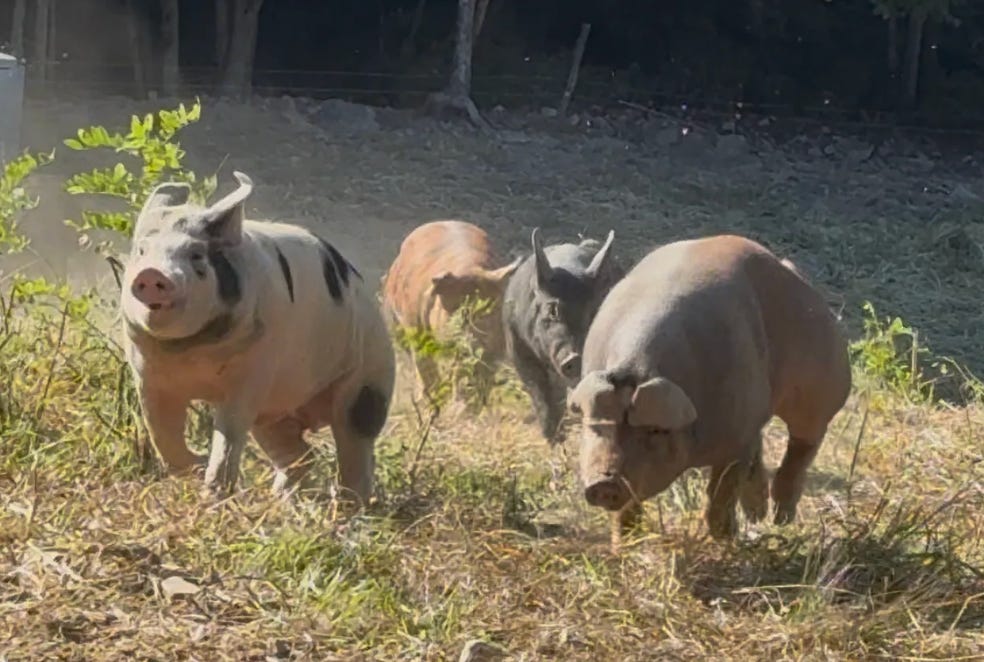
Nearly every old outbuilding, and even parts of the original house, were filled with pig manure. Not fresh manure, of course, but manure so old it had become almost geological and hard as concrete. Removing it required power chisels, demolition hammers, and a great deal of persistence. It had likely been accumulating for generations before the farm was abandoned. At one time, this had clearly been a pig farm.
That discovery led us down an unexpected path. As longtime students of agricultural history, we began reading about farming in Madison County and throughout Virginia before modern agriculture transformed the landscape. What we found was a forgotten world.
For much of Virginia’s history, pigs were among the most valuable animals on the farm. They converted acorns, chestnuts, forest mast, crop waste, and kitchen scraps into meat that could feed a family year-round. Every autumn brought butchering season. Families gathered to salt hams, smoke bacon, render lard, make sausage, and preserve enough pork to last until the following year. The smokehouse was not an accessory. It was as essential to the farm as the barn itself. In fact, on many old farms, those old smokehouses survive: repurposed into storage sheds or chicken coops. Remnants of a past no longer.
As transportation improved and markets expanded, these family traditions grew into a thriving commercial industry. Farmers no longer cured every ham themselves. Many raised hogs and sold them to local curing houses, where the same basic techniques: salt, smoke, air, and time, were simply practiced on a larger scale. Virginia country ham became one of the Commonwealth’s signature products, recognized throughout the United States and abroad. For generations, remarkably little changed. Then, beginning after World War II, the industry entered one of the most profound transformations in its history.
Refrigeration transformed food distribution. Consumers, maybe due to marketing campaigns, increasingly preferred milder, moister hams over the intensely flavored country hams their grandparents had prized. Advances in meat science introduced faster curing methods, controlled refrigeration, injected brines, nitrite curing, phosphates, and new techniques that dramatically shortened production time while improving consistency and shelf life. Universities such as Virginia Tech, Texas A&M, and the University of California, Davis became leaders in the emerging discipline of meat science. With funding from big ag and the chemical industry, these agricultural research stations helped develop technologies that enabled meat to be produced efficiently at an industrial scale.
The result was not simply a larger ham industry. It was an entirely different one.
The slow rhythms of salt, smoke, and aging gradually gave way to rapid curing, centralized processing, and mass production. Small local curing houses disappeared. Family smokehouses were abandoned. Traditional Virginia country ham became a specialty product instead of an everyday staple, and much of the industry’s infrastructure simply vanished.
Today, only a handful of traditional Virginia country ham producers remain. The working smokehouses that once dotted the countryside have largely disappeared. Many local curing houses closed decades ago, unable to compete with industrial processing, changing consumer tastes, and the economics of mass production.
There was another cost as well: the pigs themselves. On the old Virginia farm, pigs were not widgets in a supply chain. They were animals raised outdoors or in small farm lots, fed mast, scraps, corn, garden waste, and whatever the farm could provide. Their lives were seasonal, local, and tied to the land. As pork production industrialized, the pig increasingly disappeared from the pasture and moved into confinement barns, where thousands of animals could be bred, fed, medicated, and brought to market on a controlled schedule.
The center of Virginia hog production shifted heavily toward Southern Virginia, where large production units still remain, although modern hog farms are now scattered across the state. The larger national system, however, is centered far more heavily in North Carolina and the Midwest, where vertically integrated pork companies built the modern confinement model. What vanished was not only the old country ham. The old country pig vanished with it. Pigs in Madison County are now as rare as hen’s teeth.
For much of Virginia’s history, pigs were among the most valuable animals on the farm, and for good reason. Before synthetic fertilizers, refrigerated transportation, and industrial feedlots, pigs were central to a regenerative farming system that wasted almost nothing. They converted what people could not eat: acorns, chestnuts, hickory nuts, fallen fruit, crop residues, dairy byproducts, kitchen scraps, and garden waste, into one of the most nutritious and calorie-dense foods available. Their manure returned fertility to the soil. Their rooting incorporated organic matter, loosened compacted ground, and helped prepare new areas for cultivation. Nearly every part of the animal was used, from the hams and bacon to the lard, organs, skin, and bones. A healthy pig was not simply a source of pork; it was an essential link in the natural cycle that connected forests, fields, gardens, livestock, and people.
The old Virginia pig spent much of its life outdoors. In autumn, farmers often turned their hogs into the forests dominated by large oak trees and, before the chestnut blight, chestnut forests to forage on the annual mast crop; the bounty of acorns, chestnuts, and other tree nuts that blanketed the forest floor every fall. Those woods became nature’s finishing pen. As the pigs rooted through leaves in search of acorns, nuts, roots, fungi, insects, grubs, and other invertebrates, they disturbed the cool, damp leaf litter where ticks and many other pests thrive. They helped recycle nutrients, reduced accumulated forest debris, and converted the bounty of the woodland into food for the farm. Their value extended far beyond the smokehouse. They were engineers of the farm ecosystem, quietly performing work that today is often replaced by machinery, synthetic fertilizers, pesticides, and purchased feed. Looking back, it is remarkable how many jobs one animal once performed simply by being allowed to live as a pig.
The irony is hard to miss.
Virginia gave America one of its most iconic food traditions. Yet today, the largest pork processor in the United States, the company whose very name became synonymous with Virginia ham, is no longer controlled from Virginia, or even from the United States. Smithfield Foods, the successor to much of that once-local industry, is controlled by Hong Kong-listed WH Group, following its acquisition in 2013.
Today, the company that dominates American pork processing is controlled by a Chinese corporation operating under the legal and political authority of the People's Republic of China, the CCP.
At the same time, companies like Boar’s Head remain family-owned and market themselves as premium deli brands built on craftsmanship and tradition. Yet most of their products are manufactured using industrial curing methods that bear little resemblance to the slow, dry-cured hams once hanging in Virginia smokehouses.
Somewhere along the way, “Virginia ham” ceased to describe a centuries-old method of preserving pork and became simply another product on the supermarket shelf.
That transformation raises a much larger question than who owns the companies. It forces us to ask whether we have also lost the language to describe the food itself.
Today, a hot dog, a slice of deli ham, a traditional Virginia country ham, Prosciutto di Parma, and Jamón Ibérico are all commonly placed into the same scientific category: “processed meat.”
That may be convenient for the regulators and epidemiologists at the World Health Organization. But is it scientifically meaningful?
When scientists study “processed meat,” what exactly are they studying?
Are they studying a hot dog manufactured from finely emulsified meat, cured with nitrite, phosphates, and multiple additives? Or are they studying a Virginia country ham aged for a year using little more than salt, smoke, and time? Are those truly the same food simply because both have been “processed”?
Before we can answer what the science says about processed meat, we first have to understand how we got here.
The story begins not in a laboratory, but in places like Madison County, where the old smokehouses have mostly disappeared, but the history they represent still has much to teach us.
For fun: The video below is of sylvan pig farming on Joel Salatin’s farm, which we filmed while at the Brownstone Polyface retreat last year


Thus SPAM was born! The epitome of “processed meat.” I would be useless on a “working farm.” I would want to make all the animals my pets! (Just being honest) ;-)
Not sure if you intend to discuss this in forthcoming parts, but what pigs consume also directly affects the healthfulness of their meat. This is especially true with fatty acid compositions. Unlike ruminants, that convert polyunsaturated fats into monounsaturated and saturated fats via a process called biohydregantion, monogastric livestock (pigs and chicken) more reflect what they consume. So, CAFO pigs fed lots of soybean and corn meal have very different fatty acid compositions than pigs raised on pasture. CAFO pigs have much higher, often nearly twice, levels of PUFAs (approx 25 to 33% vs 18%) and more specifically much higher rates of Omega-6s (23 to 30% vs 12.5%). Monounsaturated fats (namely oleic fatty acid) is also much higher in pastured pork. One of my friends who raised lard pigs (Mangalitsa) tested the fat on his pigs, and it was 60% oleic fatty acid. Olive oil in 70% oleic fatty acid. His pigs forage in the woods and eat tons of acorns before they're harvested.