
Why Substack Hates Malone News
(and me)

Why Substack hates Malone News … and me
There is a simpler explanation than most people want to admit, and it has very little to do with subscriber counts, writing quality, or even real-world influence.
It has everything to do with signaling.
Over the weekend, Substack hosted its high-profile “New Media Party” during White House Correspondents’ Dinner weekend. This was not just another cocktail gathering. It was a carefully curated room. A statement about what “new media” is supposed to look like when presented to Washington, to legacy press, and to power.
And that is where the disconnect begins.
The Malone News subscription base is large by any reasonable metric. Hundreds of thousands of subscribers. Deep engagement. A loyal readership that does not just skim headlines but actually reads, shares, and acts. By the numbers, it sits comfortably in the upper tier of the platform.
But that is not the currency being spent in a room like that.
The real currency is legibility to the system.
The invite list tilted toward a specific type of writer. Former legacy and mostly journalists who migrated to Substack but still speak the language of institutions and don’t advocate too strongly for conservative principles. Who was invited? Policy and tech commentators who circulate comfortably in think tanks, venture circles, and media panels. Creator personalities who bring energy without bringing risk. And, perhaps most importantly, people who are already embedded in the Substack social network, cross-promoting, collaborating, and showing up in the same rooms, over and over again. Promoted substackers that feature a familiar frame of reference over content.
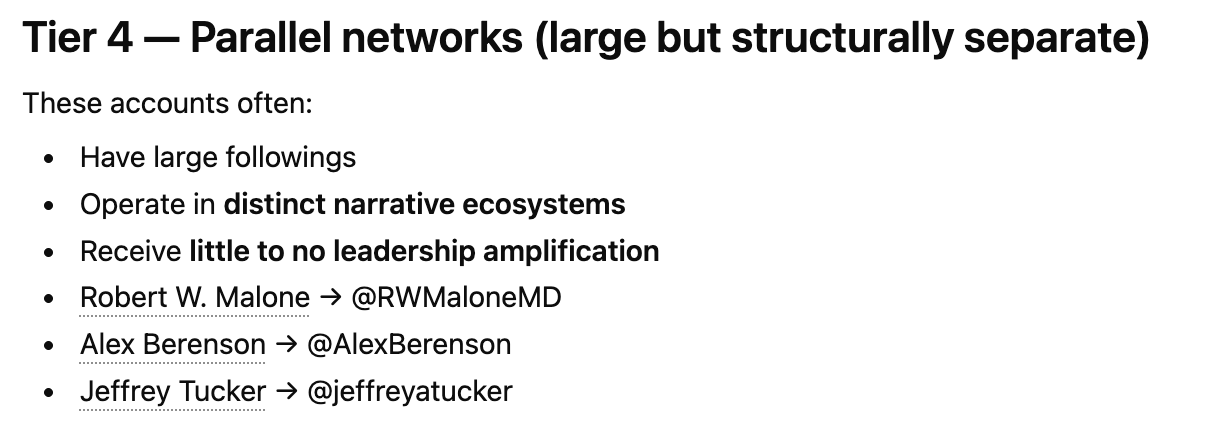
I am not alone in being isolated from Substack promotions. Jeffrey Tucker, Alex Berenson, and I are three accounts that two independent AI analyses identified as outside the inner circle and not receiving amplification from the Substack leadership. This is just another form of shadow-banning of those who speak truth to power. So, what else is new?
This is not accidental. It is brand construction.
Substack is trying to tell a story about itself. Not as a rebellion, but as an evolution. Not as a break from the system, but as its next iteration. The platform wants to be seen as the future of journalism, not its adversary.
That story requires a certain kind of protagonist.
Writers who challenge institutions in controlled, acceptable ways can be featured. Writers who question assumptions while remaining inside the bounds of polite discourse can be elevated. Even contrarians are welcome, as long as they remain within a range that does not disrupt the room.
But there is a line.
And Malone News sits on the other side of it.
The publication is not just “heterodox.” It is openly adversarial to major public health narratives, to pharmaceutical industry practices, and to the institutional frameworks that dominated the COVID era. Whether one agrees with those positions or not is almost beside the point. What matters is how they are perceived in a high-visibility, mixed-audience environment.
In that context, the issue is not reach. It is risk.
A curated event tied to the White House Correspondents’ Dinner is not the place where organizers experiment with reputational ambiguity. The goal is a room that feels coherent, controlled, and aligned with the image being projected outward. That means minimizing the chance of friction, controversy, or uncomfortable conversations that could spill beyond the venue’s walls.
So the filtering happens quietly.
Not through public criteria. Not through transparent standards. But through network pathways, personal connections, and an unspoken understanding of who fits the narrative and who does not.
There is another factor that matters more than most people realize. The social graph.
Substack is not just a publishing platform. It is a network. Invitations tend to flow through that network. Writers who collaborate, who appear on each other’s podcasts and broadcasts, who share audiences and relationships, naturally end up in the same physical spaces. Those who operate outside that web, even if they are larger or more influential in absolute terms, often remain invisible when lists are made.
Malone.News has a large audience, but it is not deeply interwoven with the Substack-to-Substack ecosystem or the Washington media circuit. It operates in a parallel lane. That independence is a strength in one sense, but it comes with a cost in environments that are driven by proximity and familiarity. In other words, the insider club.
Put all of that together, and the outcome is predictable.
It is not that Substack “hates” malone.news in any literal sense (they apparently just hate their politics). That framing is emotionally satisfying, but analytically incomplete. What is really happening is more structural.
The platform is curating a version of “new media” that is:
Connected to existing power centers
Acceptable within institutional frameworks
Networked within its own internal ecosystem
Safe enough to showcase in front of Washington
Basically, they are recreating the old media, just on a newer, more hip social networking platform.
Malone News does not check those boxes. Not because it lacks influence, but because it represents a different kind of influence. One that is less dependent on institutional validation and less interested in maintaining alignment with it.
And that kind of independence does not translate well into curated rooms designed for signaling.
The irony is that exclusion from that room does not indicate weakness. It indicates the opposite. A different audience. A different network. A different center of gravity.
In the end, the question is not why Malone News was not invited, we all know why.
The question is what kind of media ecosystem requires that kind of filtering in the first place?
The new media ecosystem. Same as the old media ecosystem.
Did you expect anything different?
RWM/JGM
Thank you Dr. Malone for reinforcing my decision to subscribe to Malone News. I'm in exactly the right place.
We want to hear the truth. No slant, and that's what you give us. Thank you