

Audio Version:
By: Dr. Jill G. Malone
Executive Summary
For nearly five years, Wikipedia has systematically diminished Dr. Robert W. Malone’s scientific achievements and professional reputation, elevating allegations of COVID-19 misinformation while marginalizing four decades of original inventions, medical research, pharmaceutical development, and subsequent professional accomplishments.
Our examination of Wikipedia’s revision history, archived editorial discussions, and page-protection records reveals a disturbing pattern:
Scientific achievements deliberately erased. Editors removed selected publications and patents documenting Robert’s foundational inventions in RNA and DNA delivery and genetic vaccination.
Damaging allegations defended and preserved. Established editors repeatedly upheld negative characterizations, even after contributors challenged the accuracy of the language and its supporting citations.
Corrections obstructed through editorial restrictions. Wikipedia imposed successive editing restrictions, culminating in indefinite semi-protection, while established editors retained control over disputed content.
Reputational damage amplified far beyond Wikipedia. Google prominently displays the biography, while AI systems can reproduce its characterizations, extending the potential damage to Robert’s reputation across the digital information ecosystem.
Wikipedia’s own records expose serious failures of neutrality, editorial accountability, and the fair treatment of a living person. They also raise substantial questions about potential legal liability when false or misleading allegations are preserved despite documented objections.
This investigation asks a fundamental question: When does selective editing cease to be an editorial disagreement and become deliberate reputational destruction?
Introduction
Wikipedia has a Robert Malone problem.
And after examining nearly five years of its editing history with the help of AI, we believe that problem extends far beyond one scientist’s biography. It raises fundamental questions about who controls the world’s most influential online encyclopedia, how reputations are shaped through selective sourcing, and whether Wikipedia’s much-advertised commitment to neutrality is anything more than a convenient slogan when the subject challenges an approved narrative.
For almost five years, Wikipedia has maintained a biography of Dr. Robert W. Malone that prominently characterizes him as someone who promoted COVID-19 misinformation. Although the article acknowledges some of his early scientific accomplishments, it devotes far more attention to controversial statements, criticism, and allegations drawn from a narrow collection of liberal (progressive) media accounts.
What it does not provide is anything approaching a comprehensive account of his professional career.
Robert’s career spans more than four decades of scientific discovery, medical research, pharmaceutical development, and biodefense. He originated the concept of using RNA as a pharmaceutical agent and invented foundational technologies for RNA and DNA delivery and genetic vaccination. His original discoveries and inventions helped establish the scientific foundation upon which subsequent generations of researchers developed modern genetic vaccines and RNA-based therapeutics.
His professional record includes 15 patents, approximately 100 scientific publications and abstracts, and extensive experience developing drugs, vaccines, and medical countermeasures.
He has participated in the development and management of dozens of Phase I and Phase II clinical trials, as well as several Phase III trials. His work encompasses university research and teaching, infectious-disease research, pharmaceutical consulting, and government-sponsored biodefense programs. He has also authored three books: Lies My Government Told Me, PsyWar, and Homesteading for Health.
These are not incidental credentials. They represent decades of scientific and medical accomplishments that established his professional reputation long before COVID-19 entered the public vocabulary.
Yet Wikipedia provides no selected bibliography of his scientific publications or books. His patents receive little meaningful attention, and his extensive clinical development and biodefense experience is largely overshadowed by allegations surrounding his public statements during the pandemic.
This was not simply an oversight. Wikipedia’s own editing records document the deliberate removal of scientific material; objections to the article’s negative framing were ignored almost from its inception; and established editors repeatedly defended disputed language while administrators restricted who could change it.
The Inventions Wikipedia Would Rather Reduce to a Footnote
Before examining Wikipedia’s treatment of Robert Malone, readers need to understand something fundamental about his scientific history. Robert was not simply a researcher who happened to participate in early mRNA experiments. He originated and documented the concept of using RNA as a pharmaceutical agent, conducted pioneering experiments demonstrating RNA delivery into cells, single-handedly wrote the initial invention disclosures for mRNA and DNA vaccination, and was a named inventor on foundational patents involving RNA and DNA delivery and genetic vaccination.
This history is not based solely on Robert’s recollections. It is supported by contemporaneous laboratory records, scientific publications, patent filings, patent disclosure filings, and independent historical reporting.
In September 2021, Nature published science journalist Elie Dolgin’s detailed history of mRNA technology. The article opened with Robert’s landmark experiments at the Salk Institute in late 1987, when he combined messenger RNA with lipid-based delivery materials and demonstrated that cells could take up the RNA and produce proteins. This was a critical proof of principle: genetic instructions could be delivered into cells, which would then manufacture the encoded protein.
But the original article failed to adequately address another foundational contribution: Robert’s early invention disclosures and experiments involving mRNA vaccination. I challenged that omission. On October 22, 2021, Nature updated the article, acknowledging in its published correction notice that it had added material concerning mRNA vaccine experiments in early patent filings.
The distinction matters. Demonstrating that RNA can enter cells and produce proteins is one discovery. Originating and documenting the use of RNA as a vaccine is another. Both belong in the historical record of mRNA technology.
On January 11, 1988, Robert documented the pharmaceutical implications of that discovery in signed, dated laboratory notes. He proposed that it might be possible to “treat RNA as a drug.”
That was a revolutionary concept. Rather than administering a conventional pharmaceutical compound or manufactured protein, a physician could potentially administer RNA containing instructions directing the patient’s own cells to produce a therapeutic protein. The RNA itself would become the administered medicine. Nearly forty years later, scientists and pharmaceutical developers are finally realizing the potential of Robert’s original vision.
Robert subsequently developed this concept through his research at the Salk Institute, including original invention disclosures concerning lipid-mediated RNA and DNA delivery. Although the Salk patent application was ultimately abandoned, the laboratory records and subsequent patent history document the development of these inventions. In 1989, Robert also originated the concept and wrote the original patent disclosures for using DNA and mRNA as vaccines.
In 1989, Robert, Philip Felgner, and Inder Verma published Cationic Liposome-Mediated RNA Transfection in the Proceedings of the National Academy of Sciences. Their research demonstrated a method for introducing RNA into cells and achieving protein expression, establishing an important foundation for subsequent RNA-based therapeutics.
In 1990, Robert and his collaborators published Direct Gene Transfer into Mouse Muscle In Vivo in Science, demonstrating that introduced genetic material could direct protein production in living animal tissue. These experiments helped establish the feasibility of genetic vaccination, in which nucleic acids are administered to induce the production of proteins that stimulate an immune response.
This research was followed by a family of patents addressing DNA and RNA delivery, protein expression in living organisms, and the induction of immune responses through genetic material. Robert was a named inventor on patents tracing their priority to March 21, 1989, including inventions directed toward genetic vaccination.
There is another invention conspicuously absent from Robert’s Wikipedia biography.
In 1996, Robert and I filed a patent application covering mucosal immunization using DNA or RNA, an approach designed to stimulate immune responses at mucosal surfaces rather than relying exclusively on conventional injected vaccines. The resulting U.S. Patent 6,110,898, DNA Vaccines for Eliciting a Mucosal Immune Response, was issued on August 29, 2000, naming both of us as inventors.
This is not a disputed claim about scientific credit. It is a matter of public patent record, documented decades before COVID-19. Yet this invention, like so much of Robert’s other patented work, receives virtually no attention in mainstream accounts of his scientific career.
Wikipedia finds space for individual controversial interviews but not for a documented invention involving DNA and RNA mucosal vaccination. That is a revealing editorial choice.
These patents are not merely Robert’s personal assertions about his accomplishments. They are public legal documents identifying inventors and describing specific claimed technologies. They establish his role in foundational inventions, even though the eventual development of commercial mRNA vaccines involved additional discoveries, refinements, and contributions from numerous scientists.
Robert has consistently maintained that he originated the early RNA and DNA vaccination concepts and designed the research that led to these inventions. The precise allocation of credit among collaborators remains a subject of historical debate, but the contemporaneous documentation, published research, and named inventorship are matters of record.
This is what makes Wikipedia’s treatment of Robert so extraordinary.
An encyclopedia that devotes substantial space to questioning his inventor status provides remarkably little explanation of the original Salk invention disclosures, the 1988 RNA-as-a-drug concept, or the foundational patent family that followed. Instead, it prominently features journalists and critics disputing his role in the development of mRNA vaccines.
There is an important distinction between inventing foundational RNA and DNA delivery and vaccination technologies and developing the final commercial COVID-19 vaccines. Robert did not single-handedly invent subsequent modifications that led to the current technologies being used. But that does not justify reducing his original inventions to a passing acknowledgment that he participated in early research.
The patents exist. The laboratory records exist. The scientific publications exist. The original invention disclosures exist. And Nature independently documented the significance of the early discoveries.
Wikipedia could easily document Robert’s original inventions, patents, and scientific accomplishments in a few well-researched paragraphs. After all, this is Robert Malone’s biography, not a history of mRNA vaccine development.
Instead, readers receive a far more extensive account of the controversy surrounding Robert’s claims than of the discoveries that gave rise to those claims.
That is the central problem with Wikipedia’s biography. It is not merely what its editors have written about Robert. It is what they have chosen to emphasize, what they have removed, and what they have left out.
An encyclopedia can distort a person’s history without inventing a single fact. All it has to do is select which facts readers are allowed to see.
What Wikipedia’s Own Records Reveal
We examined Wikipedia’s original revision history, all four archived Talk-page discussions, the article’s protection logs, archival pages, and the current biography. Together, these records document the deliberate removal of scientific material, the repeated defense of negative characterizations, and editing restrictions that helped preserve a biography whose neutrality was non-existent almost from its inception.
These are not allegations based on speculation. They are editorial decisions documented in Wikipedia’s own records, available for anyone to examine.
And the story begins just two days after Robert’s Wikipedia biography was created.
A Biography Born Into Controversy
Robert’s Wikipedia biography was created on July 29, 2021, by an editor using the name Chetsford. Within two days, its original author was already expressing concern about the direction the article was taking.
On July 31, Chetsford observed that approximately half the biography concerned just nine months in the life of a scientist then in his early sixties. The editor warned that a biography of a living person should not become a catalog of everything objectionable someone had allegedly said or done. Criticism, Chetsford argued, should be proportionate and integrated into the larger account of the subject’s life rather than allowed to dominate it.
Think about that. The editor who created Robert’s biography recognized almost immediately that it was becoming disproportionately focused on controversy rather than his scientific career.
The warning was largely ignored.
Within days, editors began removing sections documenting Robert’s patents and scientific publications. On August 2, an editor using the name Bon courage removed the selected patents and publications, characterizing them as promotional or insufficiently notable. Chetsford restored the material, arguing that publication lists were customary in biographies of scientists.
On August 6, RandomCanadian again challenged the publication list and removed the patent section. Chetsford objected to applying different standards to scientists simply because their public positions had become controversial. The editor pointed to other scientists whose biographies included selected publications and argued that selectively excluding such material could itself violate Wikipedia’s neutrality policy.
Nevertheless, the scientific material continued to disappear.
On January 2, 2022, another editor, Drmies, removed a substantial section of selected publications, explaining that Wikipedia was not a résumé and that individual scientific papers required independent secondary-source coverage before inclusion.
The result was a biography with no selected bibliography of Robert’s scientific publications, even though his foundational 1989 and 1990 papers had received substantial recognition in independent scientific histories, including Nature’s account of the development of mRNA vaccines.
The publications disappeared. The controversies and the defamation remained.
These editorial decisions shaped how readers and search engines would perceive Robert. His documented scientific accomplishments were minimized, while disputed COVID-era allegations became the dominant feature of his biography. The issue was not simply whether individual statements were accurately sourced, but whether the biography as a whole presented a fair account of his life and work
Wikipedia Locks Down the Biography
While editors were arguing over Robert’s scientific record, Wikipedia administrators were repeatedly restricting access to his biography.
The protection logs document seven separate actions between July 2021 and August 2023. The first occurred on July 31, 2021, just two days after the article was created. Additional restrictions followed in August, September, and December 2021. In July 2022, at the height of the COVID controversy, Wikipedia imposed a year-long restriction on Robert’s biography, effectively limiting who could challenge the article’s negative characterizations and omissions of his scientific accomplishments.
Was this simply Wikipedia protecting its preferred narrative, or was there outside pressure, potentially from the Biden administration, to restrict changes to the biography? The public record does not establish White House involvement, but the question of external influence deserves examination. On August 4, 2023, administrator Favonian went even further, imposing indefinite semi-protection under Wikipedia’s COVID-19 arbitration enforcement procedures. What began as a temporary restriction just two days after the biography was created had become an indefinite barrier to direct editing by other contributors.
Wikipedia’s semi-protection system allows “established” accounts, that is, senior editors, to continue editing while preventing anonymous and newer accounts from making direct changes. The distinction is important because many of the established editors defending the article’s disputed language retained their ability to modify it.
People who wanted to correct Robert’s biography but lacked the necessary editing privileges could not simply make the changes themselves. Wikipedia required them to submit requests on the article’s Talk page, where established editors decided whether the proposed corrections would be accepted. The archived discussions show repeated attempts to challenge the article’s negative characterizations, particularly its categorical use of the word “misinformation.”
Requests were rejected, deferred pending consensus, or dismissed on the grounds that Wikipedia followed its approved reliable sources.
The historical record contains numerous such requests. Contributors questioned the use of words such as “falsely,” “misinformation,” and “disinformation.” Others challenged the accuracy of specific citations, proposed restoring scientific publications, or objected to the disproportionate attention devoted to pandemic-era controversy.
These requests for changes to the record were rejected. Sometimes the response was that the existing wording was supported by reliable sources. Sometimes contributors were told to establish consensus before seeking changes. Sometimes their concerns were dismissed as fringe arguments or disruptive behavior.
On July 17, 2022, editor Slatersteven, who had repeatedly defended the disputed biography, requested page protection, citing suspected single-purpose and sockpuppet accounts. Administrator Favonian imposed a one-year restriction that same day.
The timing deserves scrutiny. In July 2022, the Biden administration was pressuring major technology platforms over COVID-related information, as subsequent litigation and congressional investigations documented. Was Wikipedia acting independently, or were its editorial practices influenced by the same government-backed efforts to control COVID narratives? The public record does not establish White House involvement in Robert’s biography, but the possibility of outside influence deserves investigation.
Wikipedia repeatedly justified restrictions on Robert’s biography by citing “persistent disruptive editing.” Yet the July 17, 2022 protection request raises more questions than it answers. Editor Slatersteven alleged sockpuppetry, single-purpose accounts, and edit warring. Approximately six minutes later, administrator Favonian imposed an entire year of semi-protection. The public request and pages identify no specific offending edits or accounts and offer no substantive explanation for the duration of the restriction.
Was Wikipedia protecting the article from genuine vandalism, or protecting its established editors and their preferred narrative from legitimate challenges? The public protection record establishes that a year-long restriction was imposed without a documented review of the biography’s disputed allegations, questionable citations, or substantial omissions of Robert’s scientific accomplishments. Wikipedia moved quickly to restrict who could edit the biography, without sufficient documented evidence of disruption.
The same problem appears in the August 2023 indefinite protection. The archived request concerned suspected block evasion. The resulting administrative action restricted editing indefinitely, but the public discussion did not examine Robert’s patents, publications, professional qualifications, or the accuracy of the disputed characterizations.
Wikipedia was protecting the editing process. It was not demonstrating that the biography being protected was accurate or fair.
And those are two very different things.
The practical result was an article whose disputed framing remained in place while established editors retained considerable influence over what could be changed.
The Atlantic: When a Magazine Article Becomes an Encyclopedic Verdict
One of the most influential sources used in Robert’s Wikipedia biography is Tom Bartlett’s August 12, 2021 article in The Atlantic, titled Robert Malone: Vaccine Scientist, Vaccine Skeptic.
Bartlett examined Robert’s early mRNA research, disagreements with other scientists, and public criticism of COVID vaccination policies. The article questioned his scientific claims and presented critical assessments from other researchers.
There is nothing inherently improper about an encyclopedia citing critical journalism. The problem arises when a journalist’s interpretation becomes a categorical judgment that goes beyond what the original source establishes.
That is precisely what Wikipedia did, and what was challenged.
In January 2022, a dispute developed over Wikipedia’s statement that Robert had falsely claimed Pfizer and Moderna COVID vaccines could worsen COVID-19 infections. The Atlantic described Robert as suggesting that the vaccines might worsen infections and characterized the surrounding discussion as premised on misinformation.
Editor Bleepenvoy challenged Wikipedia’s stronger wording, arguing that the magazine had not established the categorical falsehood Wikipedia was asserting.
MrOllie defended the language as a reasonable paraphrase, arguing that Wikipedia did not require reliable sources to provide all their underlying scientific reasoning.
That statement exposes a fundamental problem with Wikipedia’s editorial approach.
A journalist can report that a scientist expressed concern about a possible biological mechanism, criticize that concern, or describe it as unsupported. But when Wikipedia transforms that reporting into a categorical declaration that the scientist made a false claim, it assumes responsibility for the accuracy of that stronger statement.
The words “could,” “might,” and “does” have different meanings. In science, those distinctions matter. A hypothetical mechanism is not an established clinical outcome, and an unproven concern is not necessarily a demonstrably false assertion.
Determining whether Robert’s statement was correct, incorrect, or unsupported at the time requires examining the underlying scientific evidence, not simply relying on The Atlantic’s status as an approved Wikipedia source.
Yet the archived discussion shows editors defending Wikipedia’s wording primarily through the authority of the source, even when the accuracy of the paraphrase was being challenged.
The Nobel Prize Warning Wikipedia Would Rather Not Discuss
There is another extraordinary detail in The Atlantic’s August 2021 article, one that makes Wikipedia’s selective use of that publication particularly revealing.
Tom Bartlett interviewed Stan Gromkowski, a cellular immunologist who had worked on early mRNA vaccine research and knew Robert’s scientific contributions firsthand. Gromkowski regarded Robert as an underappreciated pioneer. He also understood the potential professional consequences of Robert’s increasingly public criticism of COVID vaccination policy.
His assessment was memorable:
“He’s fucking up his chances for a Nobel Prize.”
Consider what that means. In the very article Wikipedia used to support damaging characterizations of Robert, a scientist familiar with his foundational research was discussing him as someone whose work could merit Nobel recognition.
Nor was this the first time Robert’s name had been discussed in connection with the Nobel Prize. In 1995, during a visit to the Karolinska Institute in Sweden, a member of the Nobel Committee told Robert that his pioneering work in genetic vaccination had placed him on a Nobel shortlist. I know this conversation took place because I was there and witnessed it firsthand. This was not a claim Robert invented decades later, during the COVID controversy. The possibility of Nobel recognition was being discussed with him more than 25 years before COVID-19 entered the picture.
Gromkowski’s warning came in 2021. Two years later, the 2023 Nobel Prize in Physiology or Medicine went to Katalin Karikó and Drew Weissman.
The Nobel Prize has traditionally emphasized discoveries of exceptional originality rather than incremental advances or lifetime achievement. The Nobel Foundation itself describes the Medicine Prize as recognizing scientific breakthroughs of high originality.
Yet the 2023 award recognized discoveries involving nucleoside modifications to an mRNA technology whose foundational concepts had been established decades earlier. Indeed, the Nobel Committee’s own scientific background acknowledged that mRNA vaccination and therapeutic protein delivery had been proposed more than 30 years before the award.
This raises an important historical question: Why has the original invention of RNA-based genetic vaccination received so little recognition in the public narrative surrounding the Nobel Prize, while subsequent advances have become almost synonymous with the invention itself? Could Wikipedia’s repeated attacks on Robert Malone’s scientific credibility have influenced perceptions of his original discoveries and inventions, including among those responsible for awarding the Nobel Prize?
And why does Wikipedia, which relies so heavily on prestigious scientific institutions and publications, devote more attention to disputing Robert’s inventor status than to documenting the original research and patents establishing his role in that history?
Gromkowski’s warning takes on particular significance in light of what followed. Whether Wikipedia influenced the Nobel Committee is an unanswered question, but the consequences of reputational damage are difficult to ignore.
The historical irony is impossible to miss. Wikipedia found room for The Atlantic’s criticism of Robert while omitting its acknowledgment that an early mRNA researcher considered him an underappreciated pioneer and a potential Nobel contender.
And this is the problem with selective sourcing. It becomes the raw material for the wrap-up smear, where damaging allegations are repeated, recycled, and eventually presented as established fact.
The New York Times: Making a Pioneering Scientist Disappear Into the Footnotes
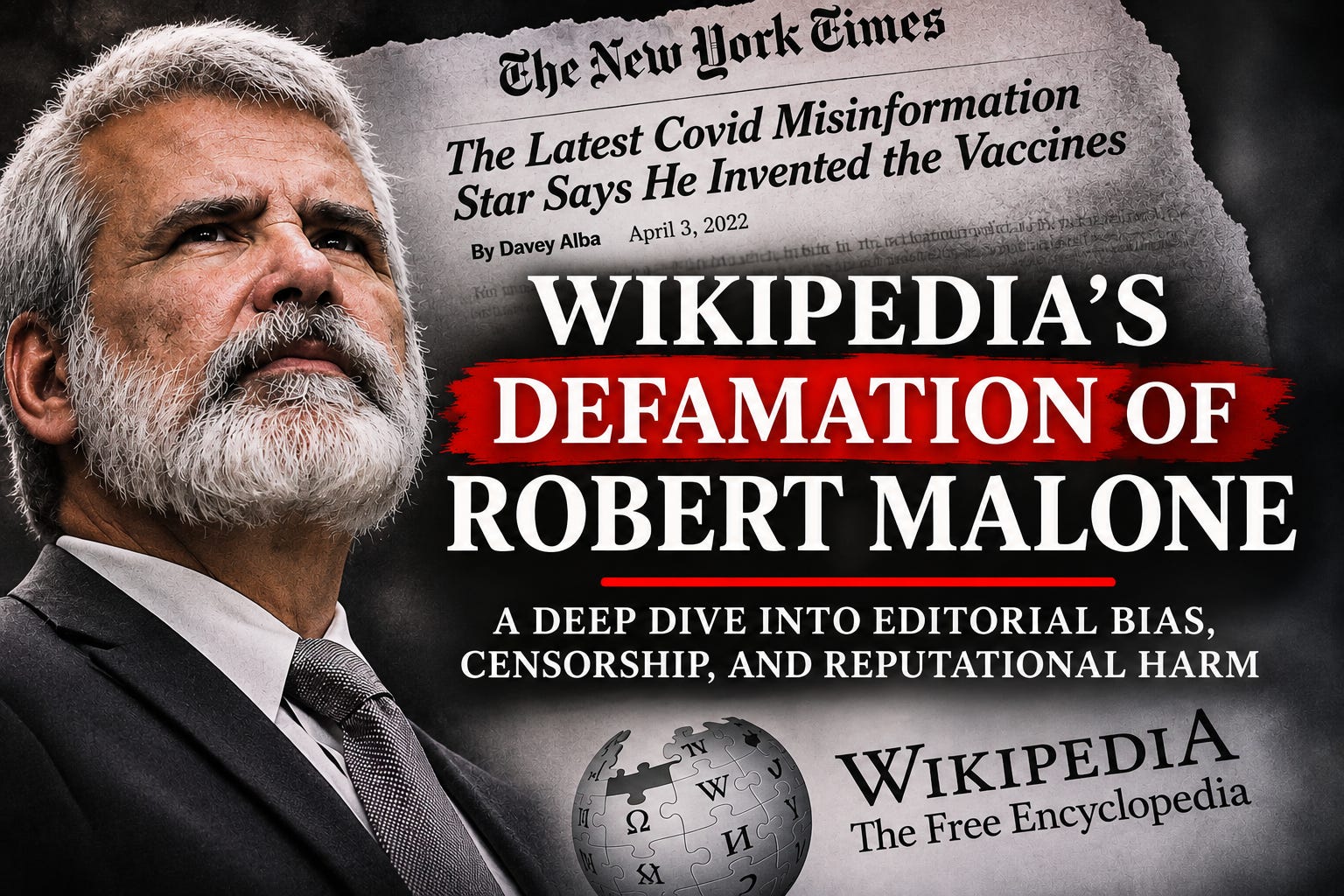
The April 3, 2022 New York Times article by Davey Alba, The Latest Covid Misinformation Star Says He Invented the Vaccines, became another influential source in Wikipedia’s treatment of Robert.
The article questioned his role in developing mRNA technology, citing researchers who characterized his contributions as minimal. Wikipedia subsequently incorporated that assessment into its biography.
Yet Robert’s foundational 1989 PNAS and 1990 Science publications, along with the original patents documenting his RNA and DNA delivery inventions, are part of the historical scientific record.
Why does Wikipedia prominently repeat a newspaper’s negative assessment of his scientific importance while failing to provide readers with the original research and patent history necessary to understand his contributions?
On April 6, 2022, Robert’s attorney sent the New York Times a formal letter challenging its reporting and alleging defamation. The letter documented a contemporaneous legal objection, although it did not constitute a judicial finding of defamation.
Wikipedia’s treatment of the Times article illustrates a recurring pattern: critical media interpretations receive prominent placement, while the underlying scientific record receives comparatively little attention.
The AIDS Allegation: How Scientific Language Becomes a Media Headline
Another example concerns an April 2022 interview in which Robert discussed T-cell responses, acquired immune dysfunction, and possible consequences of COVID vaccination.
The Associated Press subsequently published a fact-check characterizing his statements as an unfounded claim that COVID vaccines caused a form of AIDS. Wikipedia incorporated that characterization into its biography, where the allegation remained years after the original interview.
The terminology matters enormously.
Acquired immunodeficiency is a recognized medical concept describing an immune deficiency that develops after birth rather than being inherited. Such conditions can arise from infections, malignancies, medications, and other causes. HIV-associated AIDS is a specific clinical syndrome and should not be conflated with every form of acquired immune dysfunction.
Robert was discussing immune responses and what he believed might be happening in a particular clinical context. The AP report itself quoted him distinguishing the phenomenon he was describing from HIV infection.
Yet the resulting characterization emphasized AIDS, a term that carries an entirely different meaning for most readers. The AP account also attributed to Robert a causal assertion about vaccination and acquired immune deficiency, implying a connection to HIV-related AIDS. In doing so, it shifted the goalposts, transforming a discussion of immune dysfunction into a substantially different and far more inflammatory allegation.
What we can document is the sequence: a technical discussion of immune dysfunction was characterized by AP as an AIDS-related claim, and Wikipedia incorporated that characterization into a permanent biographical narrative about misinformation.
This is how reputational framing, otherwise known as the wrap-up smear, accumulates. A complex scientific statement is reduced to a provocative characterization. The characterization becomes a fact-check. The fact-check becomes an encyclopedia citation. And years later, the episode remains part of the subject’s public biography.
Wikipedia deliberately chose the most damaging narrative available.
The Citation That Even Wikipedia’s Own Editors Questioned
One of the most revealing episodes occurred in December 2023, when a contributor challenged Wikipedia’s use of a France 24 report to support its characterization of Robert as someone who promoted misinformation.
The report concerned a scientific paper Robert had shared before it was subsequently retracted. The contributor argued that the report did not establish the allegation Wikipedia was using it to support.
Hob Gadling, an established editor who had repeatedly defended the biography’s negative language, acknowledged that the connection was questionable. He recognized that Robert had shared the paper before its retraction and suggested that the citation probably should be removed as support for the broader allegation.
But it wasn’t. The questionable citation remained, and the allegation continues to be presented as fact.
Consider what happened. Wikipedia used a news report about a subsequently retracted scientific paper to help discredit Robert, despite the fact that he had shared the research before its retraction. When the weakness of that citation was brought to the editors’ attention, even an established defender of the biography acknowledged the problem.
Yet Wikipedia failed to correct it.
This was no longer simply a case of an editor overlooking a questionable source. The problem had been identified, acknowledged, and left uncorrected. At what point does knowingly preserving a misleading allegation cease to be an innocent editorial mistake and become a deliberate act of reputational damage or reputational sabotage?
The implications extend beyond this single citation. Wikipedia’s editing history documents repeated objections to misleading wording, questionable sources, and allegations that exceeded what the cited material actually established. Yet the senior editors continued defending disputed characterizations, often invoking Wikipedia’s reliable-source policies as justification.
This is how selective sourcing becomes reputational damage. Journalistic allegations are incorporated into Wikipedia, repeated through additional citations, and presented with the appearance of independent verification, even when those sources fail to substantiate the stronger accusations being made.
The archived discussions demonstrate that Wikipedia’s editors were repeatedly alerted to problems with wording, context, and sourcing. In documented instances, they made conscious decisions to preserve disputed language after specific objections had been raised and verified. Whether those decisions constitute defamation or actual malice is a legal question, but the editorial record warrants serious scrutiny.
Wikipedia’s editors were not merely passive recipients of questionable journalism. They actively selected which allegations to publish, which interpretations to defend, and which objections to reject. Wikipedia cannot claim editorial authority while disclaiming responsibility for the resulting damage to a living person’s reputation.
The Editors Behind the Biography
The revision history identifies a relatively small group of established accounts that repeatedly participated in disputes over Robert’s biography. Among them were Bon courage, RandomCanadian, MrOllie, Slatersteven, Alexbrn, and Hob Gadling.
Their activities are publicly documented. Some removed scientific material. Others defended negative characterizations, reverted proposed changes, challenged the reliability of sources offered by other contributors, or invoked Wikipedia policies to reject corrections.
These were not all identical positions. Some established editors, including Chetsford and Animalparty, repeatedly argued for greater precision, historical context, and proportionality - but generally, they were overruled.
But it also documents how persistent editors can shape an article through repeated participation, source-selection arguments, and the enforcement of consensus requirements.
The Wikipedia account Philip Cross also made three documented edits to Robert’s biography in 2021. Cross has previously attracted public controversy over political editing activity.
Organized advocacy groups have openly acknowledged efforts to influence what the public reads about vaccines. Guerrilla Skepticism on Wikipedia (GSoW) has recruited and trained volunteers to edit Wikipedia articles, including those involving vaccines and medical controversies. Meanwhile, Shots Heard Round the World, operating through the Public Good Projects, has organized coordinated online responses to vaccine critics and supported broader campaigns against what it identifies as misinformation.
These are documented activities, not speculation. The existence of organized campaigns to influence vaccine-related information raises an obvious question: How can Wikipedia assure readers that its articles reflect independent editorial judgment rather than the priorities of organized advocacy networks? Given the documented history of Robert’s biography, that question deserves investigation, not dismissal.
Wikipedia gives persistent, senior contributors enormous practical influence over the biographies of controversial living people. When those contributors defend a particular framing, the combination of editorial consensus, source-selection rules, and page protection can make that framing extremely difficult to change.
The resulting article may appear to readers as the product of neutral, collective knowledge. The revision history reveals a much more complicated process of argument, deletion, reversion, and selective inclusion.
The public rarely sees that process.
It sees the finished biography, accompanied by footnotes that lend it an appearance of authority.
What Wikipedia Deliberately Chose Not to Tell Readers
Perhaps the most damning aspect of Robert’s Wikipedia biography is not what it says, but what its editors deliberately chose to leave out. As documented earlier, editors repeatedly removed scientific publications and patents while preserving negative allegations from COVID-era media coverage.
Yet the omissions extend well beyond Robert’s original inventions. Wikipedia largely ignores his decades of clinical development and biodefense work, as well as his subsequent career as an author, commentator, and broadcaster. His Epoch Times series, broadcasting work with OAN and Real America’s Voice (RAV), and published commentary in The Washington Times, RealClearPolitics, and TrialSite News receive little or no meaningful attention.
And what about the countless favorable articles, interviews, broadcasts, and podcasts documenting his ongoing work as a physician-scientist, author, medical ethicist, and public-policy commentator? Those perspectives are largely absent. Apparently, positive coverage rarely qualifies as noteworthy, while negative reporting earns a permanent place in his biography.
Then there is MALONE.NEWS, Robert’s independent publishing platform on Substack. Today, MALONE.NEWS has approximately 350,000 subscribers, 450,000 followers, a 30% email open rate, and roughly 9 million monthly views, according to our publishing analytics.
Yet Wikipedia does not even mention the publication by name. Instead, it cites a critical New York Times article reporting that Robert had more than 134,000 newsletter subscribers in April 2022. That four-year-old statistic appears, predictably, under the heading “COVID-19 misinformation, 2021–present.”
Apparently, a publishing enterprise reaching millions of readers every month is noteworthy enough to mention in connection with alleged misinformation, but not important enough to recognize as a substantial part of Robert’s professional career. Wikipedia acknowledges his audience while virtually erasing the publication that built it.
Wikipedia’s Negative Framing of Robert’s ACIP Appointment
Wikipedia’s treatment of Robert’s appointment to the Advisory Committee on Immunization Practices (ACIP) provides another example of how negative framing can overshadow professional accomplishments.
Rather than presenting the appointment primarily as a milestone in Robert’s scientific and public-service career, Wikipedia emphasizes controversy surrounding the committee and its members. Its separate ACIP article repeats vaccine expert Paul Offit’s characterization of Robert as an “anti-vaccine activist,” linking his name to a politically charged description rather than providing readers with a substantive account of his scientific qualifications.
Robert’s own biography likewise emphasizes legal controversy surrounding the committee’s appointments, including a judicial assessment questioning his qualifications. Yet it fails to identify his role as vice chair, a leadership designation reported elsewhere.
The distinction matters. Robert’s appointment and leadership responsibilities are biographical facts. Criticism of those appointments should not become a substitute for documenting the position he held or the professional experience he brought to it.
Once again, Wikipedia’s editorial choices raise the same question: Why does negative commentary receive prominent attention while significant professional accomplishments and responsibilities receive so little?
A System Designed to Defend Its Own Errors
Apparently, foundational scientific inventions are insufficiently notable for inclusion, but controversial podcast appearances deserve permanent preservation.
Wikipedia hides behind its sourcing rules as though citing an approved publication automatically guarantees accuracy. It does not. An editorial policy is not a substitute for intellectual honesty.
Consider the double standard. Robert’s scientific publications, patents, and professional accomplishments were subjected to demands for independent verification and notability. Yet damaging allegations drawn from hostile media coverage were repeatedly accepted, amplified, and preserved. Scientific achievements were dismissed as promotional, while controversial interviews became permanent features of his biography.
When contributors challenged misleading language, questioned citations, or attempted to restore documented accomplishments, established editors repeatedly invoked Wikipedia’s reliable-source policies and consensus requirements.
The archived discussions reveal a system in which editors defending the existing narrative could reject corrections while claiming the authority of Wikipedia’s own rules. The people responsible for maintaining the disputed content were effectively empowered to decide whether challenges to that content deserved consideration.
This is the fundamental flaw. Wikipedia’s policies, supposedly designed to protect accuracy and neutrality, can also shield questionable editorial decisions from accountability. Once a negative characterization becomes established, those seeking to correct it face procedural obstacles that the original allegations may never have encountered.
The result is an editorial system capable of laundering selective journalism into encyclopedic fact, then using its own rules to protect the finished product from meaningful challenge.
Wikipedia calls this consensus. But consensus among a small group of persistent editors is not the same as truth, and protecting an article from criticism does not make it accurate.
A biography does not need to contain outright falsehoods to be profoundly misleading. Selectively removing accomplishments while preserving damaging allegations can accomplish the same result.
Wikipedia presents the finished product as neutral, authoritative, and thoroughly sourced. Yet readers are rarely aware of the editorial decisions that determined what they would see and, just as importantly, what they would not.
Five years later, a few years of controversy continue to overshadow decades of scientific achievement. At what point does deliberate editorial selectivity become reputational destruction?
When an encyclopedia repeatedly dismisses documented achievements, preserves contested allegations, and uses procedural rules to resist correction, the problem is no longer simply an inaccurate biography. It is an institutional failure of accountability.
Should Wikipedia Be Sued?
After examining five years of Wikipedia’s editing history, we believe there are compelling reasons for an experienced defamation attorney to investigate the conduct of the editors responsible for Robert’s biography, as well as the potential liability of the Wikimedia Foundation.
Because Robert is a prominent public figure, a successful defamation claim would generally require proof of actual malice. Contrary to what the term suggests, this does not require proving personal hatred or a conspiracy. Under established Supreme Court precedent, actual malice means publishing a false statement of fact while knowing it is false or acting with reckless disregard for its truth. Deliberately avoiding evidence that could establish the truth may also be relevant.
And this is where Wikipedia’s extensive editing history becomes particularly important.
We are not dealing with a single mistaken article or an isolated editorial decision. The public record documents years of disputes, repeated objections to specific allegations, challenges to questionable citations, and decisions to preserve contested language. In some instances, editors even acknowledged weaknesses in the sourcing itself.
That does not automatically establish actual malice. But it creates an evidentiary record that deserves close legal examination. The critical question is whether particular editors continued publishing false and defamatory statements despite having serious reasons to doubt their accuracy.
Then there is Section 230 of the Communications Decency Act, which generally protects online platforms from liability for material created by third parties. The Wikimedia Foundation would have substantial legal defenses.
But Section 230 is not a universal license to defame.
The statute distinguishes between hosting third-party content and creating or developing the challenged material. Individual editors who personally author defamatory statements cannot simply assume that Wikipedia’s platform protections shield them from responsibility. Whether the Wikimedia Foundation itself participated sufficiently in developing particular content to incur liability would require a separate, fact-specific legal analysis.
That distinction matters when established editors repeatedly write, revise, defend, and restore contentious allegations about a living person. Wikipedia’s public revision histories document who published particular statements, what objections they received, and how they responded.
Wikipedia’s anonymous editing system should not be confused with legal immunity, and its internal consensus rules cannot override the law of defamation.
The strongest potential case would not rest simply on proving political bias or editorial unfairness. It would identify specific false and defamatory statements, establish responsibility for their publication, and determine whether the evidence supports knowing falsity or reckless disregard for the truth.
The Supreme Court has recognized that purposeful avoidance of the truth can support a finding of actual malice. That principle deserves careful consideration in light of the documented disputes surrounding Robert’s biography.
Wikipedia’s editors may believe that citing an approved publication and invoking editorial consensus protects their decisions from challenge. But a citation is not a legal defense to knowingly publishing a falsehood, and consensus does not transform a defamatory statement into truth.
After five years of disputed allegations, documented objections, and repeated editorial decisions, the question of legal accountability deserves far more than a dismissive reference to Section 230.
The time has come for a serious legal examination of who wrote these allegations, what they knew, when they knew it, and why particular statements remained in Robert’s biography despite repeated challenges to their accuracy.
The Larger Problem: Who Writes History?
Wikipedia occupies an extraordinary position in modern information culture. Its articles routinely appear near the top of Google search results, giving the encyclopedia enormous influence over public reputations. Search for Robert Malone, and Wikipedia remains among the most prominent results, presenting readers with a biography that emphasizes allegations of misinformation while minimizing decades of scientific invention, pharmaceutical development, and professional achievement.
There is another, potentially even more consequential dimension to Wikipedia’s influence: artificial intelligence.
Wikipedia has been widely used as training data for large language models, and its content is retrieved and cited by AI-powered search engines and assistants. Consequently, Wikipedia’s editorial decisions do not remain confined to an encyclopedia or a Google search result. They can become part of the information AI systems use to generate answers about living people.
A distorted Wikipedia biography can therefore become a source of AI-generated reputational damage, repeated across platforms and presented to users who may never visit Wikipedia or examine its original citations.
The danger is an information feedback loop: Wikipedia publishes a selective characterization, AI systems absorb or retrieve it, and subsequent answers repeat that characterization with the apparent authority of independently generated information. Although AI systems vary in how they use Wikipedia, the underlying problem is substantial. When biased or inaccurate information enters widely used AI data sources, the resulting reputational harm can spread far beyond the original publication.
Wikipedia is not a court, a scientific academy, or a professional historical society. It is a crowdsourced publication shaped by volunteer editors operating under rules governing sourcing, consensus, and administrative restrictions. Yet its articles are routinely treated as authoritative accounts of people’s lives, often without readers examining the underlying sources or the editorial disputes that produced them.
Robert’s biography demonstrates the danger. Scientific publications and patents were deliberately removed, negative characterizations repeatedly defended, and editing restrictions imposed while contributors continued challenging the article’s accuracy and neutrality. These decisions helped shape a public narrative that extends far beyond Wikipedia itself.
When Google prominently displays a selective biography and AI systems reproduce its characterizations, the potential reputational damage is magnified. Wikipedia’s editorial decisions can become part of the digital record through which the world judges a living person, potentially persisting long after the original controversies have faded.
This also raises questions about the treatment of other scientists who challenged COVID-era policies. If multiple researchers can document false and damaging statements, repeated objections, and editorial decisions preserving those allegations despite credible evidence of inaccuracies, the potential for broader legal scrutiny deserves consideration.
Wikipedia’s treatment of Robert Malone cannot be understood simply by reading the current article. It must be understood through the editorial decisions that determined what readers would see, what they would never see, and which allegations would be preserved despite repeated challenges.
That is why the revision history matters. That is why the Talk archives matter. And that is why the deliberate removal of scientific publications matters just as much as the inclusion of negative media accounts.
Wikipedia cannot claim the authority of an encyclopedia while evading scrutiny of the editorial decisions that give its articles that authority. When those decisions produce false and damaging statements, the people responsible should be subject to meaningful accountability.
Conclusion: Wikipedia Must Be Held Accountable
Robert Malone deserves what every living person deserves: an accurate biography that documents his accomplishments, represents his statements fairly, and does not elevate disputed allegations into established fact.
That is not a special privilege. It is the minimum standard Wikipedia claims to uphold. And in Robert’s case, its own editing history documents how that standard has been compromised.
The evidence is difficult to dismiss. Concerns about the biography’s negative framing arose within days of its creation. Scientific publications and patents were deliberately removed. Editors defended questionable citations and disputed characterizations, while administrators imposed increasingly lengthy editing restrictions, culminating in indefinite semi-protection.
These were not isolated editorial decisions. They formed a documented pattern that preserved a biography dominated by controversy while leaving substantial portions of Robert’s professional life unexplored.
Wikipedia should commission a genuinely independent investigation into Robert’s biography and the decisions made by its established editors. The documented editing history also warrants serious examination by legal counsel experienced in defamation and the liability of online publishers and individual contributors.
Wikipedia cannot claim the authority of a neutral encyclopedia while refusing accountability for the editorial decisions that shape its biographies.
An encyclopedia that finds endless room to question a scientist’s credibility but little room to document the inventions, patents, publications, and professional accomplishments that established his reputation has a serious credibility problem of its own.
The issue extends beyond Robert Malone. The same editorial mechanisms can affect other researchers, physicians, journalists, and public figures whose views fall outside prevailing institutional opinion. That should concern everyone, regardless of what they think about Robert or his positions on COVID-19.
Wikipedia does not merely report history. Through its extraordinary reach, it helps determine which version of history millions of people encounter. And with search engines and artificial intelligence amplifying its content, the consequences of a distorted biography may persist for generations.
The most dangerous misinformation is not always an outright lie. Sometimes it is a carefully constructed narrative built from selected facts, omitted accomplishments, disputed allegations, and authoritative citations that create the appearance of impartial truth.
Wikipedia has spent nearly five years systematically undermining Dr. Robert Malone’s scientific credibility and professional reputation. It is long past time for Wikipedia’s own credibility, editorial practices, and accountability to face the same scrutiny
And if its editors cannot defend their decisions with evidence rather than appeals to their own authority, they should be prepared to answer for those decisions outside Wikipedia’s protected editorial environment.
What Readers Can Do
You do not have to become a Wikipedia editor to raise concerns about the accuracy and fairness of a biography.
If you believe Robert Malone’s Wikipedia biography contains misleading statements, questionable citations, or significant omissions, you can contact Wikipedia’s volunteer response team at info@wikimedia.org. Include the article’s URL, identify the specific problem, and provide supporting documentation.
Wikipedia also maintains a Biographies of Living Persons Noticeboard, where concerns about the treatment of living people can be brought to the attention of other editors.
And because Google prominently displays Wikipedia content, readers can submit feedback about inaccurate information appearing in Google’s search features and Knowledge Panels.
We encourage readers to examine the evidence presented in this investigation, compare it with Wikipedia’s published biography, and raise specific, documented concerns wherever they find them.
Wikipedia claims to be an encyclopedia that anyone can improve. Its willingness to consider well-supported corrections to Robert Malone’s biography is a test of that commitment.
Help Us Expose Wikipedia’s Editorial Practices.
Share, Republish, and Support Independent Journalism.
Wikipedia has spent nearly five years shaping Robert Malone’s reputation harm; while its own editing history documents the removal of scientific accomplishments, repeated defense of damaging allegations, and restrictions on those attempting to challenge the narrative.
And because Wikipedia dominates search results and supplies information used by AI systems, the consequences extend far beyond a single encyclopedia page.
This is not just about Robert Malone. It is about who gets to write history, who decides which facts the public sees, and who holds those gatekeepers accountable.
Investigations like this take time. We spent hours examining Wikipedia’s revision history, archived discussions, editorial decisions, and original scientific records. Unlike Wikipedia’s anonymous editors, we put our names on our work and stand behind what we publish.
And unlike Wikipedia, MALONE.NEWS does not have a foundation collecting donations to support its operations. We depend on our readers.
If you value independent journalism that challenges powerful institutions, please consider becoming a paid subscriber. Your subscription helps us continue investigating the people and organizations that shape public narratives, suppress inconvenient information, and too often escape meaningful scrutiny.
But whether you can afford a subscription or not, you can help.
Please share this investigation widely. Post it on X, Facebook, and other social media platforms. Send it to journalists, scientists, physicians, attorneys, and anyone concerned about censorship, scientific integrity, and the manipulation of public reputations.
Help us get that record into the hands of people who would otherwise see only Wikipedia’s version.
Become a paid subscriber if you can. Share and republish whether you subscribe or not.
Because when powerful institutions and government control the narrative, independent journalism is how we hold them accountable. And that only works when readers are willing to support it.
References and Primary Documents
Wikipedia contributors. Robert W. Malone. Wikipedia, current biography. View article.
Wikipedia contributors. Robert W. Malone: Revision History. Wikipedia. View complete revision history.
Wikipedia contributors. Robert W. Malone: Page Protection Log. Wikipedia. View protection log.
Wikipedia contributors. Talk: Robert W. Malone, Archive 1. Original editorial disputes, 2021. View archive.
Wikipedia contributors. Talk: Robert W. Malone, Archive 2. Editorial discussions, January 2022. View archive.
Wikipedia contributors. Talk: Robert W. Malone, Archive 3. Editorial disputes and protection requests, 2022–2023. View archive.
Wikipedia contributors. Talk: Robert W. Malone, Archive 4. Continued editorial disputes, 2023–2026. View archive.
Wikipedia contributors. Wikipedia: Biographies of Living Persons. Wikipedia editorial policy. View policy.
Wikipedia contributors. Wikipedia: Neutral Point of View. Wikipedia editorial policy. View policy.
Malone, Robert W. Patents and Papers on the mRNA and DNA Vaccine Discoveries and Using mRNA as a Drug. Robert W. Malone, MD, official website. Collection of original laboratory records, patent disclosures, issued patents, experimental data, and scientific publications concerning RNA transfection, genetic vaccination, and RNA-based therapeutics. View primary documents.
Malone, Robert W. Robert W. Malone, MD, MS: Curriculum Vitae. Updated public edition. Professional record documenting scientific research, patents, academic appointments, clinical development, biodefense projects, publications, government advisory work, and media activities. View updated curriculum vitae (PDF).
Bartlett, Tom. “Robert Malone: Vaccine Scientist, Vaccine Skeptic.” The Atlantic, August 12, 2021. Read article.
Alba, Davey. “The Latest Covid Misinformation Star Says He Invented the Vaccines.” The New York Times, April 3, 2022. Read article.
Malone, Robert W., Philip L. Felgner, and Inder M. Verma. “Cationic Liposome-Mediated RNA Transfection.” Proceedings of the National Academy of Sciences 86, no. 16 (1989): 6077–6081. https://doi.org/10.1073/pnas.86.16.6077.
Wolff, Jon A., Robert W. Malone, Phillip Williams, et al. “Direct Gene Transfer into Mouse Muscle In Vivo.” Science 247, no. 4949 (1990): 1465–1468. https://doi.org/10.1126/science.1690918.
Dolgin, Elie. “The Tangled History of mRNA Vaccines.” Nature 597 (2021): 318–324. https://doi.org/10.1038/d41586-021-02483-w.
Associated Press. “Not Real News: A Look at What Didn’t Happen This Week.” April 8, 2022. Read republished AP report.
CHAT-GPT was used to analyze the Wikipedia revision, archives, talk, and editorial pages.
Wikipedia has lost its relevance. My daughter’s school board specifically advises that student need to be taught that it is an example of a non-credible source of information that is politically biased and manipulative.
Over a year ago I looked up Robert Malone MRNA inventor on Wikipedia and I was appalled at the hit job they did to you. The next time they sent a request for donation I replied that they should fix this character assassination first before I gave them any more money. They replied that they don't write the biographies, that they are independently written by third parties. I wrote back BS, they have an obligation to properly fact check. I have not donated to them since.