

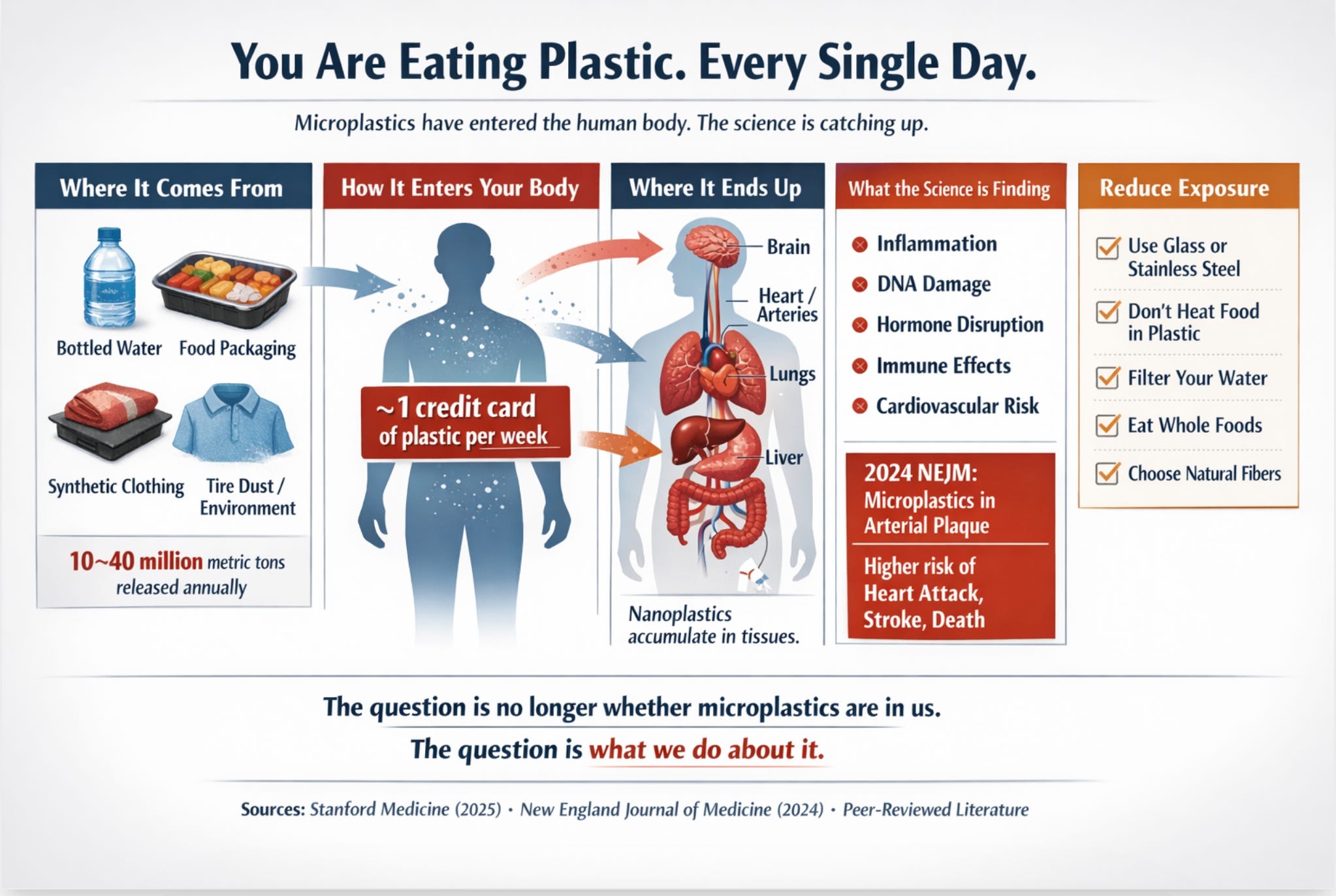
Something has quietly entered your body that was never meant to be there. It’s in your blood. It’s in your lungs. Scientists have now found it in human brain tissue, in the placenta, in the hearts of patients who just had strokes. It’s plastic. Microscopic plastic particles. And the emerging science suggests we should all be paying very close attention.
This is not a fringe concern or a conspiracy theory. In just the past two years, a wave of peer-reviewed research has moved microplastics from an environmental footnote to a serious public health conversation. And for those of us who have been asking hard questions about what is in our food, our water, and our environment, the findings are sobering. Not surprising, but sobering.
“Although data is still quite limited, maybe all these epidemics that we have (obesity, cardiovascular disease, everybody getting cancer) are related.” – Dr. Desiree LaBeaud, Stanford Medicine
What Are Microplastics, and Where Do They Come From?
Microplastics are plastic fragments smaller than 5 millimeters, many invisible to the naked eye. They shed from larger plastic items as they degrade: water bottles, food packaging, synthetic clothing, car tires, paint. Others are manufactured tiny from the start, added to toothpastes, cleansers, and cosmetics as “microbeads.”
An estimated 10 to 40 million metric tons of these particles are released into the environment every year. They are now in every ecosystem on Earth, from Antarctic ice to coral reefs, from mountain peaks to ocean trenches. And they are, without question, in us.
Scientists estimate that the average adult ingests the equivalent of one credit card’s worth of plastic every week, through food, water, and the air we breathe. Bottled water is a particularly concentrated source: recyclable plastic bottles contain up to 118 particles per liter. Shellfish eaters ingest roughly 11,000 microplastic particles per year. Salt, sugar, tea bags, and canned goods are all contaminated. If you are eating processed food out of plastic packaging, you are eating plastic.
Where They Go in the Body
Once inside, microplastics don’t simply pass through. The smallest particles, called nanoplastics, are absorbed into tissues and organs. Researchers have now detected microplastics in:
• The brain and brain tissue
• The heart and arterial plaque
• The lungs
• The liver
• The bloodstream
• The placenta (meaning fetuses are exposed before birth)
• Bone marrow and urine
A landmark 2025 animal study used real-time imaging to show microplastics physically moving through the brain and blocking blood vessels. The researchers were careful to note it would be “premature” to assume the same happens in humans, but they called the potential neurological effects “concerning.” That is the language of scientists being cautious. Read between the lines.
The Health Risks: What the Science Is Finding
The most alarming study to date was published in the New England Journal of Medicine in early 2024. Researchers studied patients undergoing surgery to remove plaque from their arteries. Those who had microplastics embedded in their plaque were significantly more likely to suffer a heart attack, stroke, or death in the following two years compared to those who didn’t. This is not a rodent study. This is direct human evidence of harm.
Patients with microplastics in their arterial plaque had a significantly higher risk of heart attack, stroke, and death. (New England Journal of Medicine, 2024)
Beyond cardiovascular disease, the research points to a troubling array of potential harms:
• Chronic inflammation, the root driver of most modern disease
• Oxidative stress and DNA damage at the cellular level
• Disruption of the gut microbiome
• Hormonal and endocrine disruption, linked to reproductive disorders
• Immune system suppression and dysregulation
• Elevated cancer risk, particularly colon and lung cancer
• Possible neurotoxicity and contribution to neurological conditions
Stanford researchers have found that microplastics get inside the cells that line blood vessels and cause “major changes in gene expression,” meaning these particles are altering how our genes behave, not just sitting inertly in our tissues. They also carry toxic chemical additives (phthalates, bisphenols, flame retardants) that leach out once inside the body, compounding the harm.
Children are at particular risk. Their organs are still developing, their exposure relative to body weight is higher, and they are more likely to crawl on plastic-covered floors, mouth plastic toys, and drink from plastic bottles and sippy cups.
Why This Matters for the MAHA Movement
For years, parents, physicians, and independent researchers who raised questions about the safety of plastics in food packaging, baby products, and water supplies were dismissed as alarmists. The mainstream narrative was that regulatory agencies had it covered. They did not.
The FDA still allows an enormous range of plastics in food contact materials. Industry lobbied successfully for decades to keep microbeads in consumer products, and the Microbead-Free Waters Act of 2015 only addressed one narrow category. The plastics that shed from your water bottle, your to-go container, your coffee cup lid? Those remain unregulated.
This is a Make America Healthy Again issue at its core. The chronic disease epidemic (rising rates of heart disease, cancer, infertility, autoimmune conditions, metabolic disorders) did not come from nowhere. Environmental toxins, including plastics, are part of the picture. The research is now catching up to what many have long suspected.
The question is no longer whether microplastics are in our bodies. They are. The question is what we do about it.
What You Can Do Right Now
Avoiding microplastics entirely is not realistic. But you can meaningfully reduce your family’s exposure with deliberate choices:
• Switch to glass, stainless steel, or ceramic for food storage and water bottles
• Never heat food in plastic containers, as heat accelerates plastic breakdown and particle release
• Filter your tap water (which typically has fewer microplastics than bottled water)
• Reduce packaged and processed foods; buy whole foods and cook at home
• Limit shellfish consumption if microplastic exposure is a concern for your family
• Choose natural fiber clothing (wool, cotton, linen) over synthetic fabrics
• Vacuum and ventilate your home regularly, as household dust is a significant indoor source
• For infants: use glass bottles, minimize plastic teats, and avoid plastic teething toys
The bigger fight is systemic. We need regulatory agencies that prioritize human health over industry convenience. We need transparent labeling of plastics in food-contact materials. We need independent, publicly funded research not beholden to the plastics industry. And we need policymakers willing to follow the science wherever it leads, even when it implicates ubiquitous, profitable products.
The science on microplastics is still developing. Researchers are the first to acknowledge that direct causal evidence in humans is limited because such studies are hard to conduct and take time. But the weight of evidence is building rapidly, and the precautionary principle (the idea that we should not wait for absolute proof of harm before acting when the signals are this consistent) is exactly the framework a health-conscious movement should demand.
We did not wait for the full body of evidence before removing lead from paint and gasoline. We should not wait here either.
Sources: Stanford Medicine (January 2025) • New England Journal of Medicine (March 2024) • Frontiers in Environmental Science (2025) • Journal of Environmental Chemical Engineering (2025) • World Economic Forum Global Risks Report (2025) • PubMed / NIH peer-reviewed literature
Pretty sure I microwaved everything in plastic until a few years ago. I should be the wife in the Incredibles by now.
I was amused at the recent article I read on how researchers were finding "microplastics" in all the experimental tissues they were analyzing - because their gloves were coated with it!!