


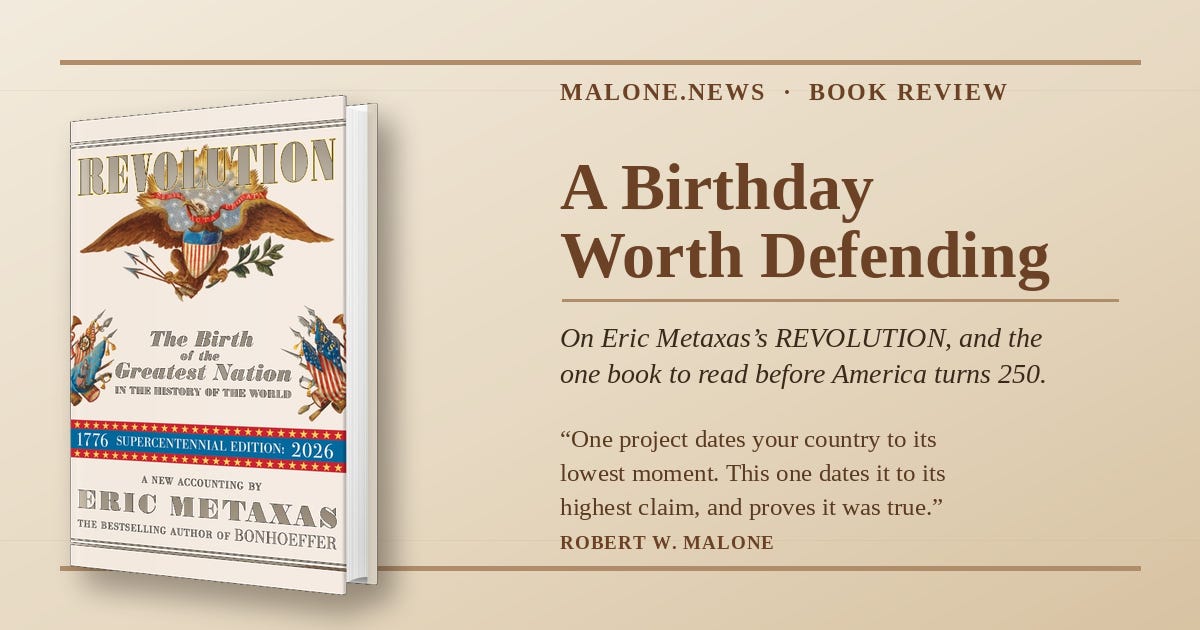
For a generation, Americans have been taught to approach their own country’s birthday as a dark day in history. The founding, we are told, was irredeemably compromised. The men who created the nation were hypocrites who spoke of liberty while tolerating slavery, and the proper response to 1776 is not gratitude or admiration, but discomfort.
Eric Metaxas rejects that view, and thank God for that.
Revolution: The Birth of the Greatest Nation in the History of the World arrives at exactly the right moment, as the nation approaches its 250th anniversary. It does something that much of our educational, cultural, and political establishment has spent decades discouraging. It celebrates the American founding.
Metaxas argues that what emerged in 1776 was not merely a successful rebellion against British rule. It was a genuinely revolutionary event that changed the course of human history. Unlike the French, Russian, Chinese, and countless other revolutions that promised liberty and delivered tyranny, the American Revolution produced a constitutional republic built on individual rights, self-government, and the radical idea that legitimate power comes from the consent of the governed.
Very little in our culture today encourages Americans to understand what was achieved in 1776, much less take pride in it. Metaxas reminds readers that the American story is not one of perfection. It is the story of an imperfect people who created something extraordinary. A nation that forgets how it was founded will eventually lose what made it worth preserving in the first place.
At its heart, this book is a reminder that our inheritance is real, that it is worth defending, and that Americans should not be ashamed of it.
The New York Times moved the date on purpose
A few years ago, The New York Times advanced the argument that America’s true founding was not 1776, but 1619, the year the first enslaved Africans arrived in Virginia. This was not simply a dispute over dates. It was an attempt to redefine the nation’s origin story.
If the country begins with slavery rather than liberty, then the Declaration, the Constitution, the Founders, and the principles of self-government become secondary at best and fraudulent at worst. The founding ideals are transformed from aspirations into excuses.
The problem was that many of the project’s central historical claims did not withstand scrutiny. Criticism came not only from conservatives but from prominent historians on the political left, several of whom publicly challenged key assertions. In response, The New York Times quietly revised portions of its presentation. Yet by then, the objective had largely been achieved. The debate was no longer about whether the founding principles were true. It was about whether they deserved to remain at the center of America’s inception. They put the idea in the minds of everyday Americans that the founding was based on maintaining slavery and not on freedom, democracy, and a constitutional republic.
That is the challenge Metaxas takes on directly.
The title alone makes the case. Revolution requires no qualifier because, in Metaxas’s telling, the American Revolution stands apart from every other event that has claimed the name. The French Revolution descended into terror. The Russian Revolution produced totalitarianism. Again and again, revolutions have promised freedom and delivered concentrated power.
The American Revolution was different because it began with a radically different premise: that rights do not originate with governments, kings, legislatures, or political movements. They are inherent to the individual, endowed by God, and therefore beyond the legitimate reach of any ruler to grant, redefine, or revoke. Everything else follows from that proposition. It is the foundation of the Declaration of Independence, the Constitution, and the American experiment itself.
This is also why the debate over 1619 matters. At its core, the argument was never about chronology. It was about whether America’s defining principle should be liberty or oppression, whether the nation’s story should be understood through its highest ideals or its greatest failures.
The two visions cannot occupy the same place in the national narrative.
Metaxas unapologetically places the American founding and the principles that animated it back at the center of the story. More importantly, he spends more than six hundred fascinating pages demonstrating why they belong there.
A storyteller, not a lecturer
What saves this from being a sermon is that Metaxas can actually tell a story. The author understands something many historians do not. People learn through stories. Ideas matter, but ideas become real when they are attached to events and the men and women who lived them.
Rather than treating the American Revolution as a collection of dates and documents, Metaxas tells it as a story.
He begins before the shooting starts, with what John Adams called the “revolution before the Revolution.” The story unfolds through the legal and political battles that preceded open conflict: the challenge to British authority, the Stamp Act, the Townshend duties, the growing military presence in Boston, the Boston Massacre, and the Boston Tea Party. By the time Lexington and Concord arrive, the reader understands that war did not emerge from a single incident. It was the culmination of years of escalating conflict between a people who increasingly saw themselves as free and a government determined to treat them as subjects.
From there come the moments every American recognizes, even if many no longer know them well. Henry Knox hauling artillery from Fort Ticonderoga through winter conditions that few thought navigable. Washington crossing the Delaware and launching the Trenton campaign when the cause appeared close to collapse. Saratoga. Valley Forge. Benedict Arnold’s betrayal. Yorktown.
Metaxas tells these stories with energy and detail, but the storytelling serves a larger purpose. He is not asking the reader to admire a set of abstract principles. He is showing how those principles survived because ordinary and extraordinary individuals chose sacrifice, risk, and perseverance when failure would have been easier and surrender more comfortable.
That is ultimately why the book works. The American founding emerges not as mythology, but as the product of real people making difficult choices under extraordinary circumstances. The ideas matter because the people who carried them forward were willing to pay the price required to make them real.
The warning: A republic, if you can keep it
The most important part of the book may be the epilogue.
There, Metaxas turns to a question that modern Americans often avoid: What made the American experiment possible in the first place? His answer, drawn from the words of the founders themselves, is that the Revolution and the republic it produced rested on a moral and religious foundation.
He points to John Adams’s warning that the Constitution was made only for a moral and religious people and was wholly inadequate for any other. He recalls George Washington’s caution in his Farewell Address that religion and morality were indispensable supports of political prosperity and national character.
This is not an argument for theocracy. It is an argument about the limits of government.
Metaxas, drawing in part on the work of Os Guinness, argues that freedom requires virtue, virtue requires moral formation, and moral formation depends on institutions and beliefs that exist outside the state. A free society can sustain limited government only if enough citizens possess the character and self-restraint necessary to govern themselves. The government cannot create those qualities by decree.
That insight lies at the heart of the American constitutional system. The founders did not believe that liberty would survive automatically. They understood that self-government ultimately depends on a culture capable of sustaining it.
Which brings the reader back to Benjamin Franklin’s famous response after the Constitutional Convention. Asked what form of government had been created, he answered: “A republic, if you can keep it.”
That is the question hanging over America’s 250th anniversary.
The celebration of America's founding is deserved. The achievements are real. But anniversaries are not merely occasions for remembrance. They are opportunities for self-examination. The generation that inherited this republic is now responsible for preserving it.
"Freedom is never more than one generation away from extinction." -Ronald Reagan
Metaxas’s concern is that many Americans no longer understand the principles that created the country, the sacrifices that sustained it, or the civic character required to keep it free. Whether one agrees with that conclusion or not, it is the question that runs beneath the entire book, and it is the question the nation will carry into its third century.
Be clear about what Metaxas has written.
This is not a conventional academic history. It is not detached, ironic, or hesitant. It is written by an author who believes the American founding was one of the most consequential events in human history and who is willing to defend that proposition without apology.
That alone will make many liberal readers uncomfortable.
For decades, much of America’s historical and cultural establishment has approached the founding primarily through the lens of its failures and contradictions. Of course, the United States is not perfect, and the past deserves honest examination. But a nation cannot endure if it remembers only its sins and forgets its achievements. A people taught to be ashamed of their inheritance will not preserve it for long.
Metaxas takes a different approach. He does not ask readers to ignore the imperfections of the founders. He asks them to understand what those founders accomplished, why it mattered, and why the principles they articulated changed the course of history.
Whether one agrees with every argument in the book is almost beside the point. The larger contribution is that Metaxas is willing to state plainly what many modern writers seem reluctant to acknowledge: the American experiment was extraordinary, its success was far from inevitable, and its continuation is not guaranteed.
That is why this book arrives at exactly the right moment.
As the United States approaches its 250th anniversary, Americans face a choice. We can teach the next generation that our history is little more than a catalog of grievances, or we can teach them that free people built something remarkable, flawed but worthy, and that its preservation now rests in their hands.
Read this book before Independence Day.
Then give it to your children, your grandchildren, or someone young enough to inherit the country we leave behind. The American Revolution created a republic. Every generation since has been responsible for keeping it.
Revolution: The Birth of the Greatest Nation in the History of the World is published by Odysseus Books.
Available from Amazon at this link, and from all good booksellers.
TURN: Washington’s Spies and the America We Have Forgotten
If you have not watched TURN: Washington’s Spies, you should.
Based on the story of the Culper Ring, George Washington’s intelligence network during the Revolutionary War, TURN follows farmers, merchants, sailors, and families caught between loyalty to the Crown and loyalty to a revolutionary cause. It portrays the American founding not as an inevitable march of progress, but as a dangerous gamble undertaken by imperfect people who believed liberty was worth fighting for.
That alone makes it unusual television. The show is also edge of the seat suspenseful and it is hard not to binge watch all the the way through. It is that good.
Much of today’s historical programming approaches America through a different lens. The dominant theme is failure. Every story becomes an indictment. Slavery. Racism. Imperialism. Economic inequality. The nation is presented less as an extraordinary political experiment and more as a catalog of its sins. The audience is taught to view American history primarily through oppression rather than aspiration. The message is familiar to anyone who followed the debates surrounding the 1619 Project: America is not a remarkable achievement with flaws, but a flawed enterprise whose achievements are largely incidental.
TURN offers a needed corrective.
The series treats the struggle for independence as something noble. It assumes that creating a constitutional republic was a remarkable achievement rather than an embarrassment to be explained away. The men and women in the story are flawed, frightened, and often conflicted, but they are also brave. They risk their lives, their families, and their livelihoods for an idea. That perspective has become surprisingly rare.
Now, historians will undoubtedly object. They will point out that the series compresses timelines, combines characters, invents conversations, and occasionally takes liberties with the historical record. Fair enough. But those criticisms miss the larger point. TURN succeeds where most modern historical programming fails. It captures the spirit of the Revolution. It helps viewers understand why ordinary people would risk everything to create a new nation.
That said, TURN contains a great deal of violence. It does not shy away from battle scenes, executions, injury, torture, or the brutal realities of eighteenth-century warfare. This is most definitely not a show for children.
A healthy nation should be capable of acknowledging its failures without becoming obsessed with them. History should tell us what was wrong, but it should also remind us what was right. Americans do not need more documentaries explaining why they should be ashamed of their inheritance. Americans need stories that help them understand why previous generations believed the country was worth building in the first place and why they should to.
For that reason alone, TURN is worth your time. It reminds viewers that the American Revolution was not merely a collection of grievances and contradictions. It was also an act of courage, sacrifice, and conviction. A country that forgets that part of its story risks forgetting why it exists at all.
Imagine if you knew someone that hated themselves so much they wouldn’t celebrate their own birthday. They thought of themselves as an evil, racist, horribly bigoted person. When they hit milestone birthdays like 40, 50, 60 they not only wouldn’t celebrate them they wanted others to hate that day and be miserable.
For me, I wouldn’t want to be around a person like that, certainly not live with them. It’s a kind of suicidal sadomasochist existence. When you hate yourself with such a passion you actually thrive on others misery as well.
Imagine hating your own country this way. These self loathing suicidal sociopaths are saying America and Americans are not worthy of celebrating our founding. No country on earth has 40% of its citizens detest its history the way democrats do. This historically is what communist revolutionaries do, erase a countries history. If this proves one thing it’s that “Liberalism is a Mental Disorder”, (Michael Savage).
When I enlisted I swore an oath that, now decades later, still holds true. Uphold, support and defend the constitution against ALL enemies both foreign and domestic! There are only two options folks. You’re either for or against. There’s no third.