

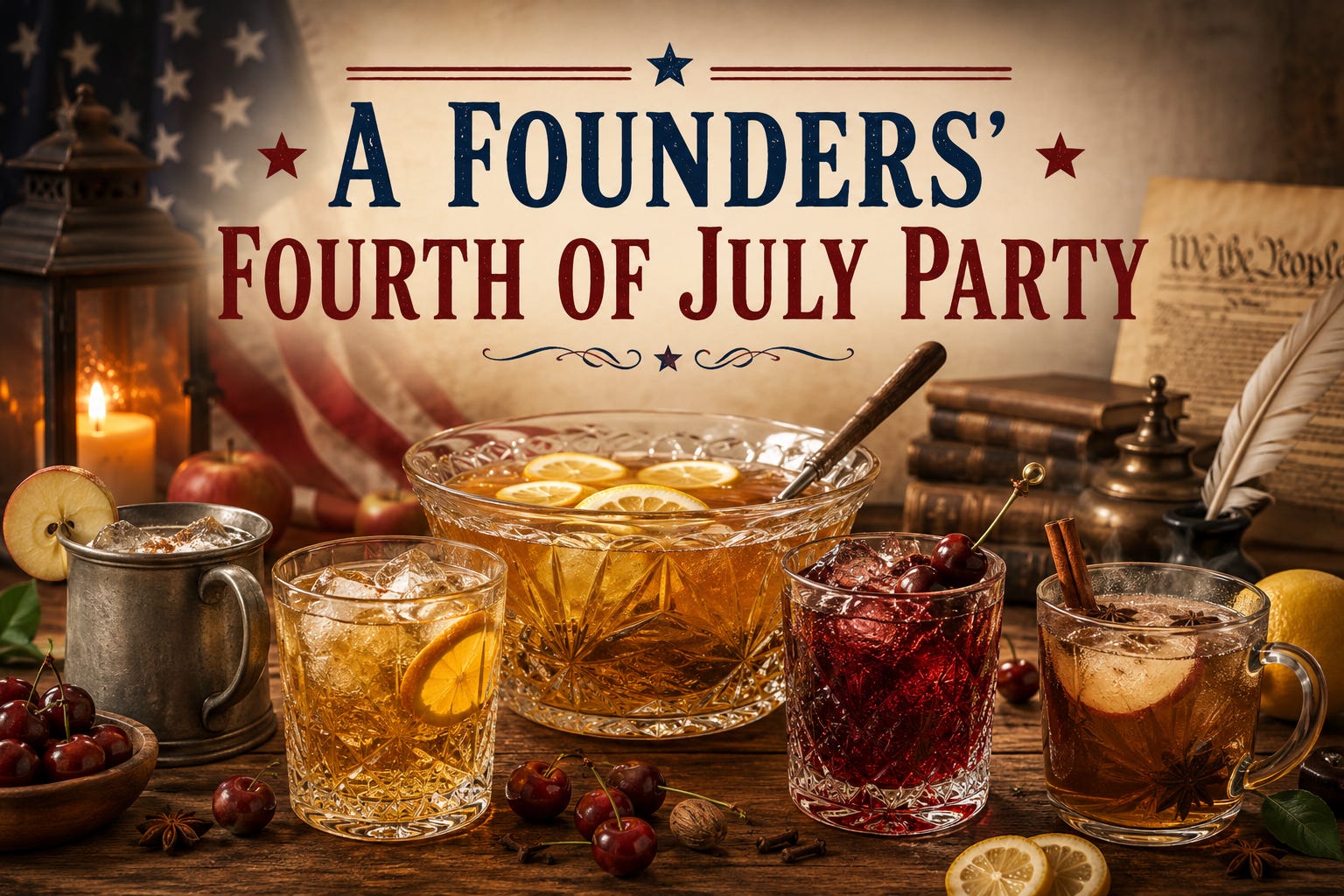
So it’s finally here: the big kahuna, the 250th anniversary of the signing of the Declaration of Independence. Fireworks are a given. The cookout is mandatory. But if you’re looking to celebrate like the Founders themselves, what would be on the menu?
Probably not hamburgers or hot dogs. Think roast beef or smoked ham, oysters if you lived near the coast, roast chicken, fresh summer vegetables, corn, beans, biscuits, cheeses, pickles, berry pies, and whatever had just come out of the orchard or garden.
And in the glass? Not light beer or hard seltzer, but hard cider, applejack, rum punch, and perhaps a bowl of Cherry Bounce sitting on the sideboard. In other words, a celebration that looked a lot more like a harvest feast than a backyard barbecue.
Can we talk booze?
The Fourth of July tends to bring out red, white, and blue cocktails involving vodka, blue curaçao, and enough sugar to power a small city. They are festive. They are colorful. They are also completely foreign to the men who signed the Declaration of Independence.
Colonial Americans drank what they grew, what they distilled, and what survived the trip across the Atlantic. Hard cider was often safer than water. Rum arrived by the barrel. Applejack was America’s native spirit.
Punch bowls were the centerpiece of political gatherings, military celebrations, and long evenings spent solving the world’s problems.
If you want to toast America’s 250th in something the Founders would actually recognize, start here.
1. Stone Fence
If America had an unofficial national cocktail before bourbon, this was probably it. A Stone Fence is simply hard cider fortified with rum or applejack. It is uncomplicated, sturdy, and entirely appropriate for a country built by farmers who had chores waiting the next morning.
Ingredients
2 ounces dark rum (or applejack)
5–6 ounces dry hard cider
Freshly grated nutmeg
Pour the rum into a mug, top with chilled hard cider, and grate fresh nutmeg over the top.
2. Fish House Punch
Colonial America took its punch seriously. Fish House Punch originated near Philadelphia decades before the Revolution, and became famous for two characteristics: it tasted wonderfully refreshing and had an unfortunate tendency to convince respectable gentlemen they were considerably smarter than they actually were.
Ingredients
1½ ounces Jamaican rum
¾ ounce Cognac or brandy
½ ounce applejack
1¼ ounces lemon shrub (or fresh lemon juice with simple syrup).
Shake with ice and strain into a chilled glass.
One serving is delightful. Four servings have altered the course of many political conversations.
(What the heck is shrub? The history of shrub and a recipe can be found at the end of this Substack.)
3. Colonial Applejack Toddy
Applejack is one of America’s oldest distilled spirits, produced by concentrating hard cider during the winter. A warm toddy made with applejack is about as close to colonial comfort food as one can pour into a mug.
Ingredients
2 ounces applejack
Hot water
1 teaspoon honey or maple syrup
Lemon slice
Fresh nutmeg
Combine everything in a mug and stir gently.
Best enjoyed after fireworks, preferably while arguing about whether Jefferson or Adams was the better writer.
***Buy: Laird's Applejack or, even better, Laird's Straight Apple Brandy if your liquor store carries it. Either would have been immediately familiar to America's Founders, although today's versions are distilled rather than freeze-concentrated as many colonial farmers once made them.
4. Cherry Bounce
George Washington was fond of Cherry Bounce, a sweet cordial made by steeping cherries in brandy. Traditionally, it was prepared with fresh tart cherries and aged for several months, but unless you planned your Independence Day celebration sometime around Presidents’ Day, frozen tart cherries make an excellent substitute. In fact, they often release their juice more readily than fresh fruit.
Ingredients
2 pounds frozen tart cherries (thawed)
1 cup sugar
1 bottle good brandy
1 cinnamon stick
4 whole cloves
Small piece of nutmeg
Combine everything in a glass jar, seal tightly, and store in a cool, dark place for at least one month. Three months is better. Six months is ideal.
If patience is not among your virtues, make enough now for Thanksgiving and pretend that was the plan all along.
Didn't think about Cherry Bounce until the Fourth of July? You're in good company. Mix equal parts unsweetened tart cherry juice and brandy, then sweeten to taste with simple syrup (or sugar, stirred until dissolved). Add a cinnamon stick and a little freshly grated nutmeg, chill well, and serve over ice. It won't be a true-aged Cherry Bounce, but it captures the spirit of the original without waiting until Thanksgiving.
5. Wassail Hard Cider
Long before craft breweries discovered cinnamon sticks, colonial families were warming cider with spices around hearth fires. This is less a cocktail than an invitation to sit down, stay awhile, and have another conversation.
Ingredients
1 quart dry hard cider
2 cinnamon sticks
6 whole cloves
1 sliced orange
1 sliced apple
Optional splash of apple brandy
Warm gently without boiling for about twenty minutes.
Serve in mugs.
For Those Skipping the Spirits
Not everyone wants alcohol, and colonial America had plenty of alternatives that deserve a place on the table.
Switchel (Haymakers Punch)
Before sports drinks came in fluorescent colors and mysterious ingredients, there was switchel. Farmers drank it while working hay fields because it was refreshing and inexpensive.
Ingredients
2 cups cold water
2 tablespoons apple cider vinegar
1 tablespoon molasses or honey
1 teaspoon grated fresh ginger
Stir until dissolved and serve over ice.
Think of it as the original electrolyte drink, developed before marketing departments discovered neon dyes.
Ginger Lemon Shrub
Shrubs were one of colonial America’s favorite ways to preserve fruit and make refreshing drinks. Mixed simply with sparkling water, they are bright, crisp, and remarkably modern-tasting despite being more than two centuries old.
Ingredients
2 ounces lemon shrub (or equal parts lemon juice and simple syrup with a splash of apple cider vinegar)
Sparkling water
Fresh lemon slice
Pour over ice and top with sparkling water.
It looks sophisticated, tastes wonderful, and lets you stay awake long enough to watch and listen to everyone else tell the same Revolutionary War stories for the third time.
There is something fitting about raising a glass filled with apples, rum, ginger, or brandy on the nation’s 250th birthday. These weren’t novelty drinks invented for social media. They were the beverages that accompanied harvests, debates, celebrations, victories, defeats, and the remarkable experiment that became the United States.
Here’s to another 250 years. Cheers.
A Brief History of Shrub
Long before refrigeration, people had to become remarkably creative about preserving fruit. One solution was the shrub, a concentrated syrup made by combining fruit, sugar, and vinegar. The sugar drew out the juices, while the vinegar acted as a natural preservative, allowing the flavors of summer to last well beyond harvest.
Mixed with cool water, sparkling water, or spirits, shrubs became one of the most popular beverages in Britain and the American colonies. Colonial households made them from lemons, raspberries, cherries, peaches, currants, and just about anything growing in the garden or orchard. Every family had its own recipe, and every good hostess was expected to have a bottle or two waiting in the pantry.
The name “shrub” comes from the Arabic word sharāb, meaning “to drink,” the same linguistic root that eventually gave us sherbet and syrup. The Founding Fathers would have known shrubs well, both as refreshing summer drinks and as the foundation for many of the punches served at dinners and political gatherings. Today, they’re making a well-deserved comeback, though they’re often marketed as an expensive craft cocktail ingredient. But to our colonial ansestors, shrub was simply a practical way to preserve fruit, avoid waste, and make plain water a little more interesting.
Simple Colonial Lemon Shrub
Peel and juice 4 lemons.
Combine the peels with 1 cup sugar. Let sit overnight until the sugar draws out the citrus oils.
Stir in 1 cup fresh lemon juice.
Add ½ to ¾ cup apple cider vinegar (to taste).
Refrigerate for two days
Strain and bottle.
Keeps for weeks in the refrigerator.
To serve:
1–2 ounces shrub
Sparkling water
Ice
Or substitute the sparkling water with rum, brandy, or applejack for an authentic colonial cocktail.
Note: Shrub can be bought at specialty shops.
Quick Colonial Lemon Shrub
This isn’t the weeks-old pantry shrub a colonial housewife would have kept on the shelf, but it makes a wonderfully refreshing stand-in.
Ingredients
1 cup fresh lemon juice (about 4–6 lemons)
1 cup simple syrup (equal parts sugar and water, heated just until the sugar dissolves and then cooled)
¼ cup apple cider vinegar
Combine the lemon juice, simple syrup, and apple cider vinegar in a pitcher or jar and stir well. Refrigerate until chilled.
To Serve
Non-alcoholic: Pour 2–3 ounces over ice and top with sparkling water.
Colonial cocktail: Combine 2 ounces of shrub with 2 ounces of dark rum or applejack and top with sparkling water, or use it as the citrus component in Fish House Punch.
The vinegar should add just enough brightness that people wonder what makes it taste so refreshing without immediately realizing what the secret ingredient is.
JGM
Yes!! Finally Doc! I used to hay at my uncles house in upstate NY ( real upstate by Seneca Lake). My Aunt would make Swichel for us and I never got the recipe. Thank you! I love that stuff. I will finally be able to make something that I haven’t had in 40 years! You just made my day! I have made watermelon sangria for today. It’s red and has blueberries in it so I feel it’s patriotic and it has chunks of watermelon plus orange and lime too but you can hardly see them In the container. I’ll be sipping that all day myself. Happy 4th to every American and to you too Doc! Let Freedom Ring!
You Drs Malone never cease to amaze me with your posts. God bless America and God bless Jill and Robert Malone. ❤️