

Executive Summary
This national survey of 1,000 likely voters (performed by Rosetta Stone) explores public opinion on vaccine policy reforms, political agendas, and the job performance of President Donald Trump and Health Secretary Robert F. Kennedy Jr. The survey finds :
Majority approval for the “Make America Healthy Again” agenda (59.1%).
Majority approval for the “America First” agenda (54.4%).
Majority approval for ending COVID vaccine manufacturer immunity (51.4%)
Majority approval for reducing the CDC childhood vaccine schedule (50.8%).
The “Make America Great Again” agenda had 45.8% approve vs. 43.0% disapprove.
Reducing mandatory childhood vaccines were 45.8% for vs. 39.2% against.
Approval for the Trump and RFK Jr. children’s health efforts (44.1% vs. 40.6%).
Trump’s overall job approval stands at 48.1% vs. 47.3% disapproval.
RFK Jr.’s overall job approval stands at 46.4% vs. 43.1%.
Gender, race, age, and partisan affiliation produce significant variation across all nine questions.
National Health Survey — Analysis of Key Findings
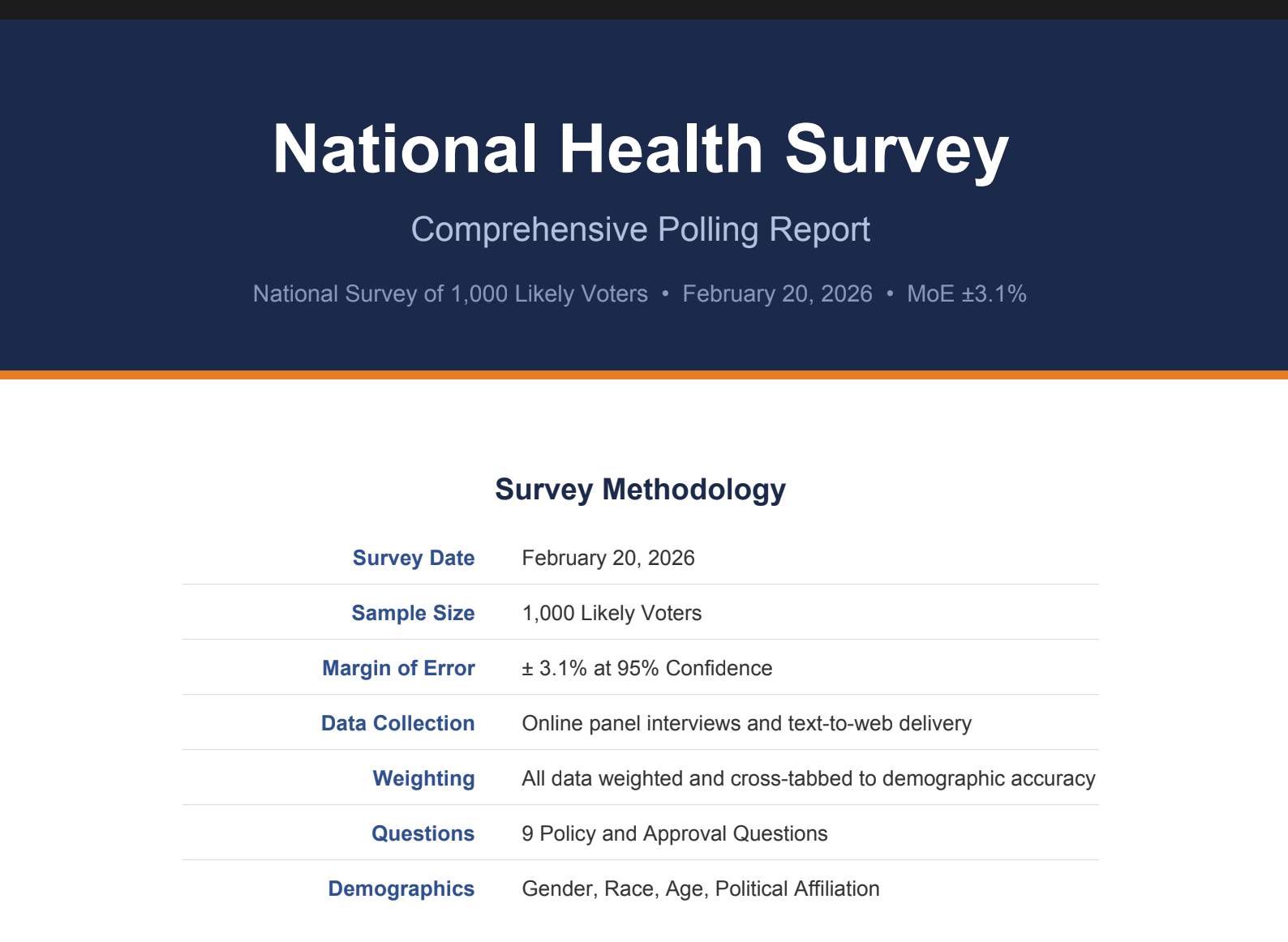
1,000 Likely Voters | February 20, 2026 | MoE ±3.1%
Survey results available at this link.
Overview
This survey captures a politically divided but surprisingly nuanced electorate. While partisan lines dominate most results, the data reveal meaningful cross-cutting patterns, particularly around health messaging, generational gaps, and the distinction voters draw between policy agendas and individual leaders.
The February 20, 2026, national survey of 1,000 likely voters offers more than a snapshot of public opinion. Read carefully, it reveals a country that is not nearly as polarized on substance as it is on branding, and one that increasingly favors reform-oriented, sovereignty-focused, and accountability-driven policies traditionally associated with conservative governance.
At first glance, the topline numbers tell a clear story: voters support reform. A majority approve of reducing the CDC childhood vaccine schedule (50.8%), ending COVID-era vaccine manufacturer immunity (51.4%), supporting the “Make America Healthy Again” agenda (59.1%), and backing the “America First” agenda (54.4%). Even more controversial proposals, such as reducing mandatory childhood vaccines, approach majority support (45.8% approve vs. 39.2% disapprove). These are not fringe positions. They are competitive or majority positions nationally.
The most important takeaway is that voters are showing a measurable appetite for institutional recalibration. Specifically, the data suggest that Americans are increasingly skeptical of centralized public health bureaucracies. A strong majority supports reducing the childhood vaccine schedule from more than 70 doses to 31. Younger voters (18–39) show especially strong approval at 64.9%, signaling generational shifts in trust toward federal health agencies. This is precisely the cohort that the Republican Party hopes will turn out to support them in the upcoming midterms and 2028 presidential election. Republicans predictably support these reforms at high levels (68.1%), but the story does not end there. African Americans and Hispanics approve at higher rates than White voters. This challenges the narrative that public health policy reform is purely partisan or racially homogeneous. Instead, it reflects broader populist skepticism toward the overreach of public health and its ties to the pharmaceutical industry.
Ending COVID vaccine manufacturer immunity commands majority support (51.4%), with the highest undecided rate in the survey. That uncertainty is politically important. It indicates that voters are open to arguments about accountability. Conservatives and health advocates have long argued that liability protections should not shield corporations indefinitely. The fact that Republicans and Independents strongly favor ending immunity suggests that accountability is an important issue, especially when framed as fairness rather than anti-science.
The divide between the “Make America Great Again” brand and the “Make America Healthy Again” agenda is especially revealing. While MAGA is nearly evenly split nationally (45.8% approve vs. 43.0% disapprove), MAHA receives 59.1% approval and exceeds 50% across every racial category. Even Independents support it by more than two-to-one. This gap demonstrates a strategic lesson: policy framing matters. When reform is framed around health, children, and restoration rather than partisan identity, support expands significantly.
Similarly, the “America First” agenda receives majority approval at 54.4%. Every racial group shows plurality support. Democrats disapprove overall, but nearly one-third still approve. This reinforces a long-standing conservative claim: national sovereignty, prioritizing domestic interests over foreign ones, and border enforcement are not extremist positions. They are broadly resonant themes when stripped of caricature.
Leadership approval numbers tell a parallel story of polarization with underlying competitiveness. President Trump’s job approval sits at 48.1% approve vs. 47.3% disapprove, essentially even, with only 4.5% undecided. That low uncertainty reflects hardened partisan alignment. Republicans overwhelmingly approve (84.1%), Democrats overwhelmingly disapprove (77.7%), and Independents lean toward disapproval. In a deeply divided electorate, near parity suggests political durability.
RFK Jr.’s numbers are instructive as well. At 46.4% approval vs. 43.1% disapproval, he is essentially even in the polls, and the public still strongly supports him overall.
Both Trump and RFK Jr. trail the MAHA agenda approval by a wide margin. Voters acrossthe aisle strongly support the concept. This is evidence that the MAHA coalitions are stronger than personality coalitions. Reform of federal health institutions is more popular than any one reformer.
Demographic splits offer additional insight. Men consistently approve of reform agendas at higher rates than women. Voters over 65 tend to disapprove of vaccine reductions and show higher skepticism toward changes in long-standing policy structures.
Younger voters, by contrast, are driving support for institutional reform. For conservatives and Republicans looking to build long-term coalitions, this generational dynamic is significant. Skepticism of centralized authority is increasingly cross-ideological among younger Americans.
Perhaps the most striking pattern is that racial minority groups do not uniformly oppose these agendas. Hispanics show especially strong approval of MAHA (61.7%) and solid approval of America First (53.0%). African American voters show majority approval for reducing the vaccine schedule (55.5%). These numbers complicate traditional partisan assumptions. These findings suggest that institutional distrust, health reform, and economic nationalism may have broader cross-racial appeal than conventional political commentary admits.
The survey suggests three major conclusions:
First, accountability and reform resonate more strongly than partisan labels. When proposals are framed around restoring balance, protecting children, and increasing corporate accountability, support grows.
Second, institutional skepticism is no longer confined to the political right. Younger voters and minority communities show meaningful openness to recalibrating federal authority.
Third, the electorate remains deeply polarized on personalities, but less so on policy substance. Trump and RFK Jr. generate closer divisions than the agendas they advance. That implies future conservative success may depend more on disciplined policy messaging than on rhetorical intensity.
In sum, this survey does not describe a country rejecting conservative principles. It describes a country negotiating how reform should occur. Majority support for sovereignty-focused, accountability-driven, and health-centered reform indicates that the foundational themes of modern conservatism remain viable. The political battlefield may be loud, but beneath it lies a measurable appetite for institutional restraint, national prioritization, and systemic recalibration.
That is not marginal support. It is majority support. And in a closely divided nation, this level of support is power. The republican party disregards MAHA at its peril.
Survey Data and Response Analysis
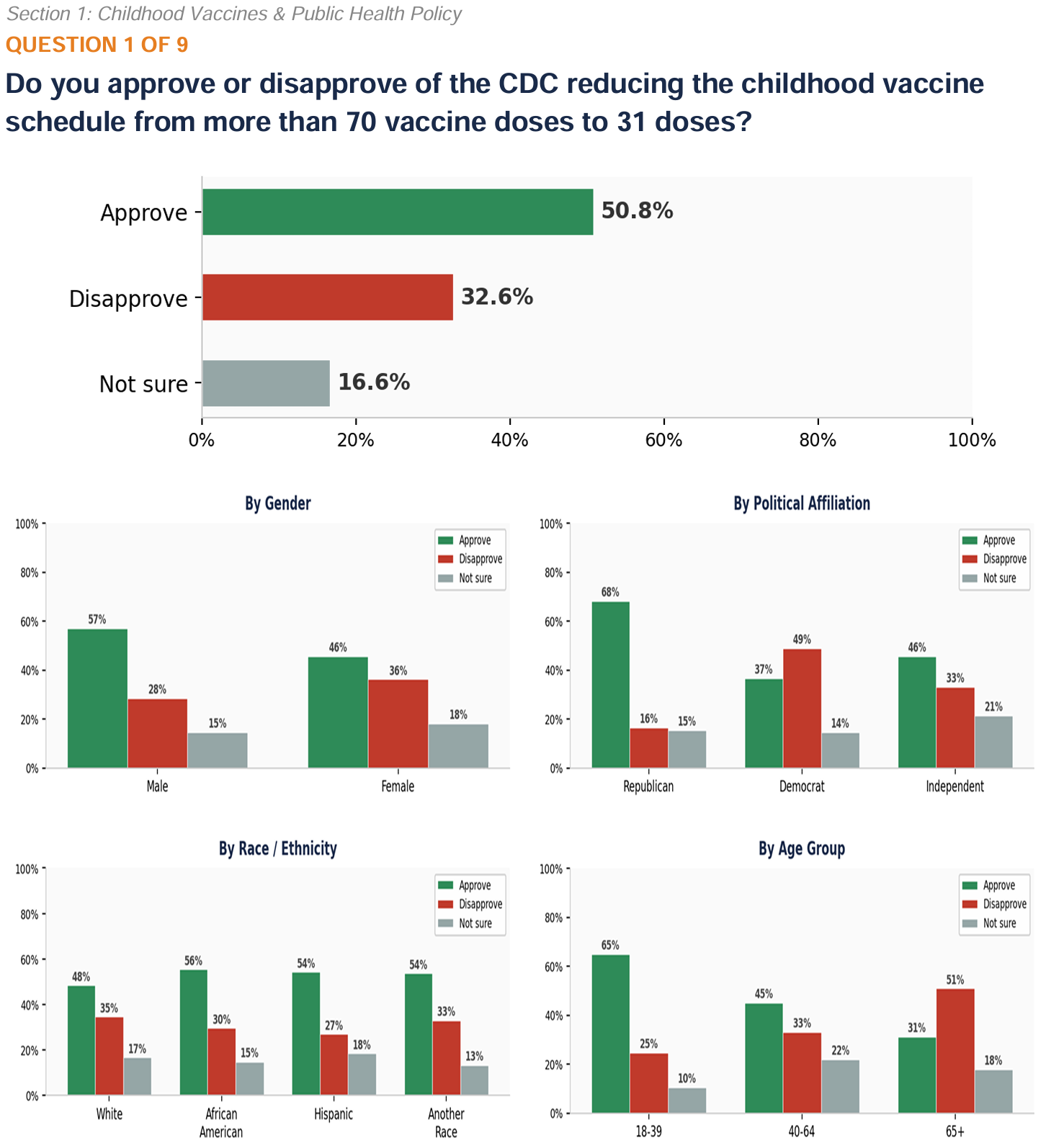
ANALYSIS: A majority of voters (50.8%) approve of reducing the childhood vaccine schedule, while 32.6% disapprove and 16.6% are unsure. Approval is higher among men (56.9%) than women (45.6%). Bu age, 18-39-year-olds show the highest approval (64.9%) while voters 65+ show the highest disapproval (50.9%). By race, African Americans (55.5%) and Hispanics (54.4%) approve at higher rates than White voters (48.5%). Republicans approve at 68.1%. Democrats approve at 48.9%, and Independents approve at 45.5%.
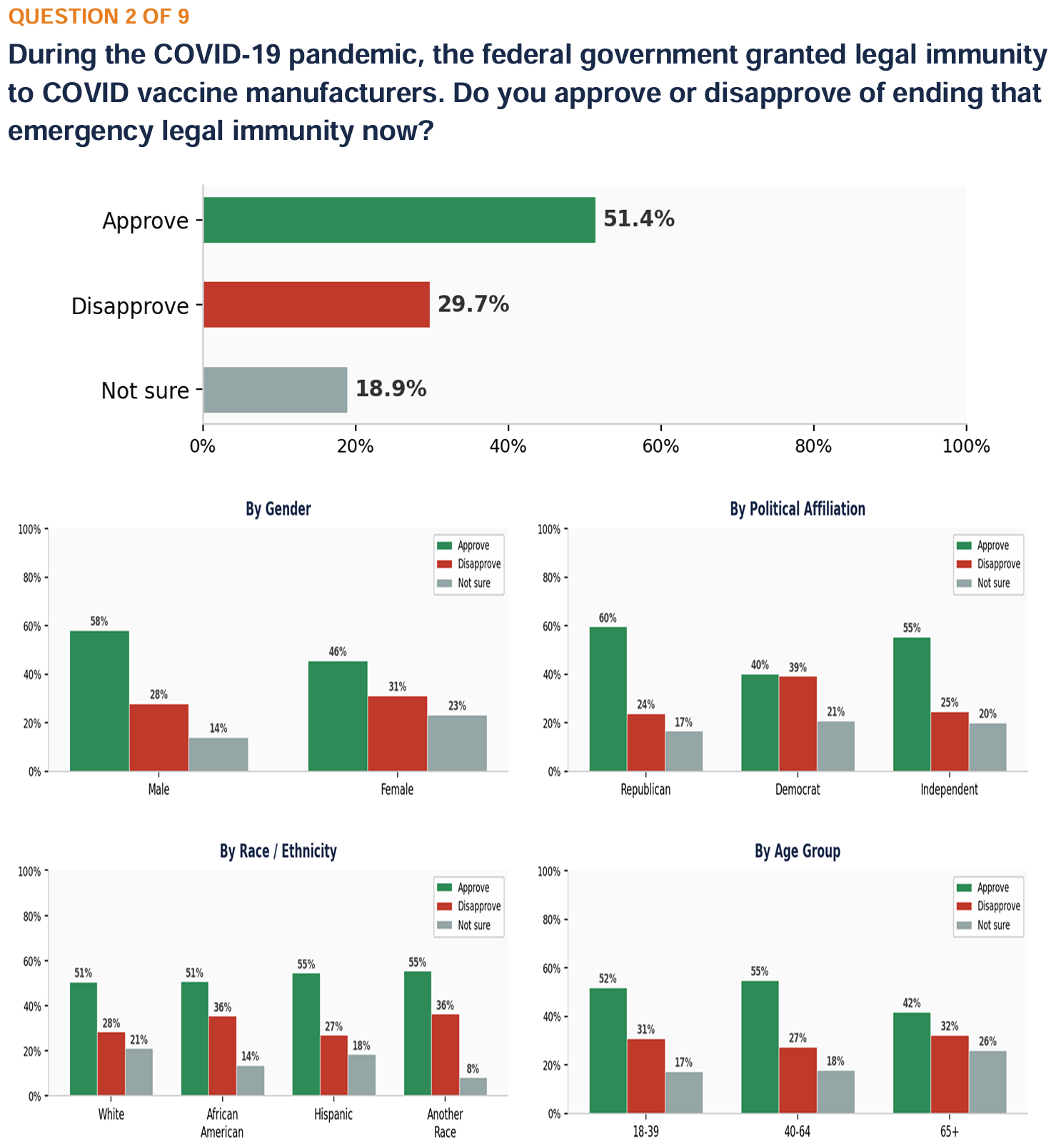
ANALYSIS: A majority (51.4%) approve of ending COVID vaccine manufacturer immunity, with 29.7% opposed and 18.9% unsure — the highest undecided rate of any question. Men approve at 58.2% compared to 45.6% for women. Approval is consistent across racial groups, ranging from 50.6% (White) to 55.4% (Another Race). By party, Republicans (59.6%) and Independents (55.4%) both favor ending immunity, while Democrats are more closely divided at 40.2% approve vs. 39.2% disapprove. Voters 65+ show the most uncertainty at 25.9%.
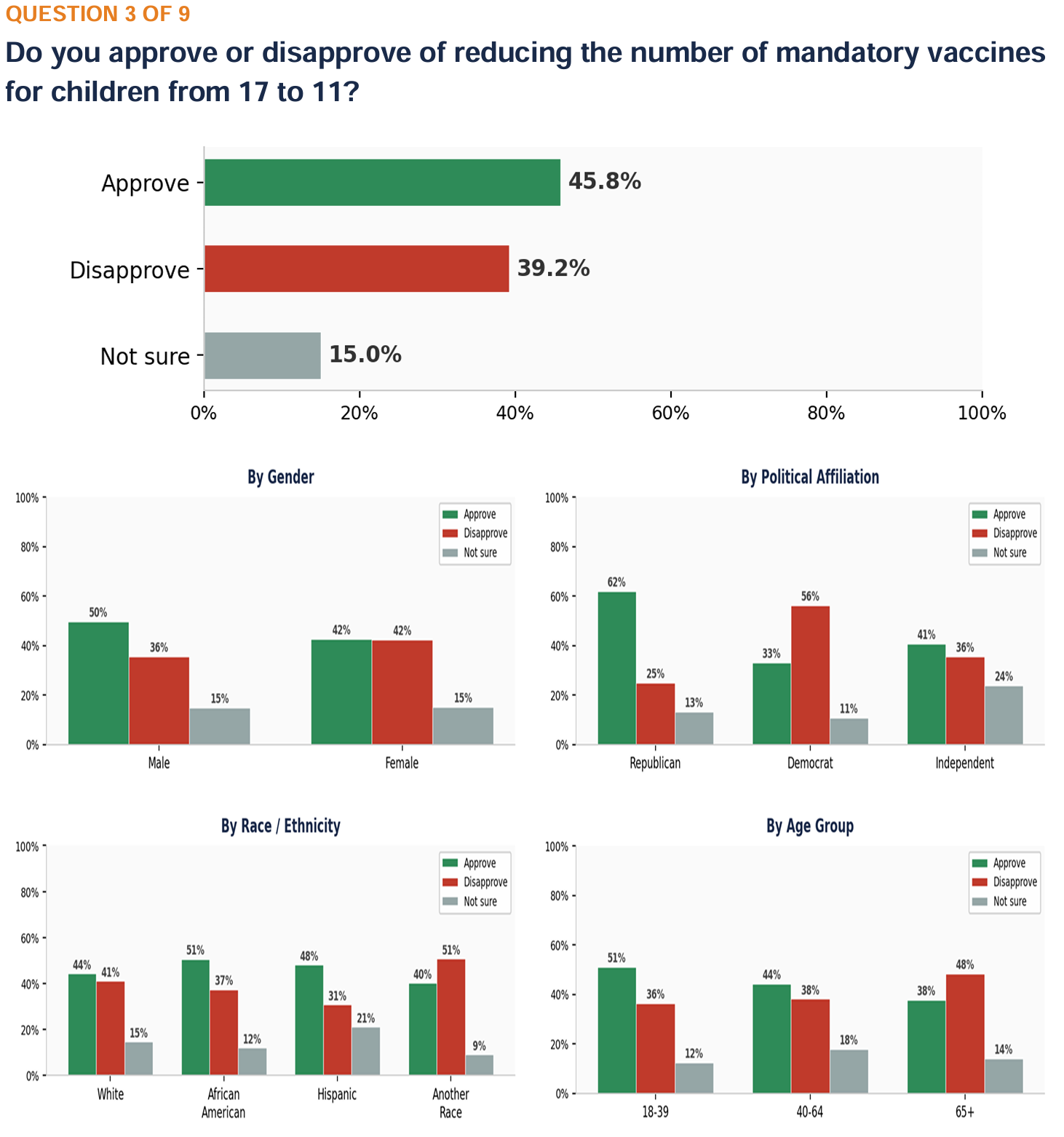
ANALYSIS: A majority - 45.8% approve vs. 39.2% disapprove, with 15.0% unsure. Women are nearly evenly divided (42.5% approve vs. 42.3% disapprove). By race, African Americans show the highest approval (50.6%) while “Another Race” shows the highest disapproval (50.7%). Voters 65+ disapprove at 48.3%. The partisan divide is wide: 61.8% of Republicans approve while 56.2% of Democrats disapprove. Independents show the highest uncertainty at 23.8%.
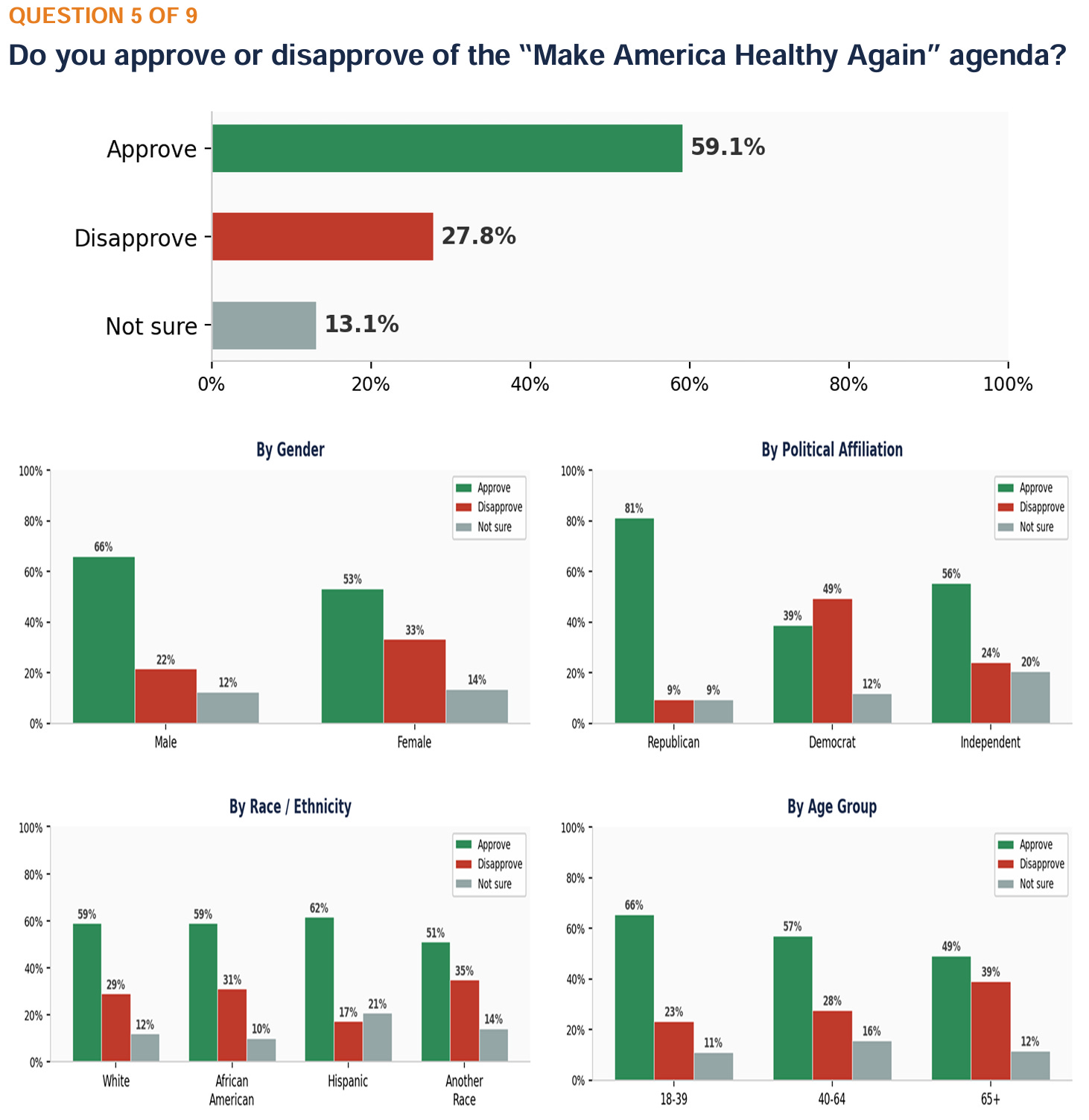
ANALYSIS: The MAHA agenda receives the highest approval in the survey at 59.1%, with 27.8% disapproving and 13.1% unsure. It outperforms the MAGA brand by 13.3 points. Approval exceeds 50% across all racial groups: Hispanics (61.7%), White voters (59.0%), African Americans (58.9%), and Another Race (51.0%). Hispanics show notably low disapproval (17.4%) but higher uncertainty (20.9%). Independents favor the MAHA agenda 55.5% to 24.0%.
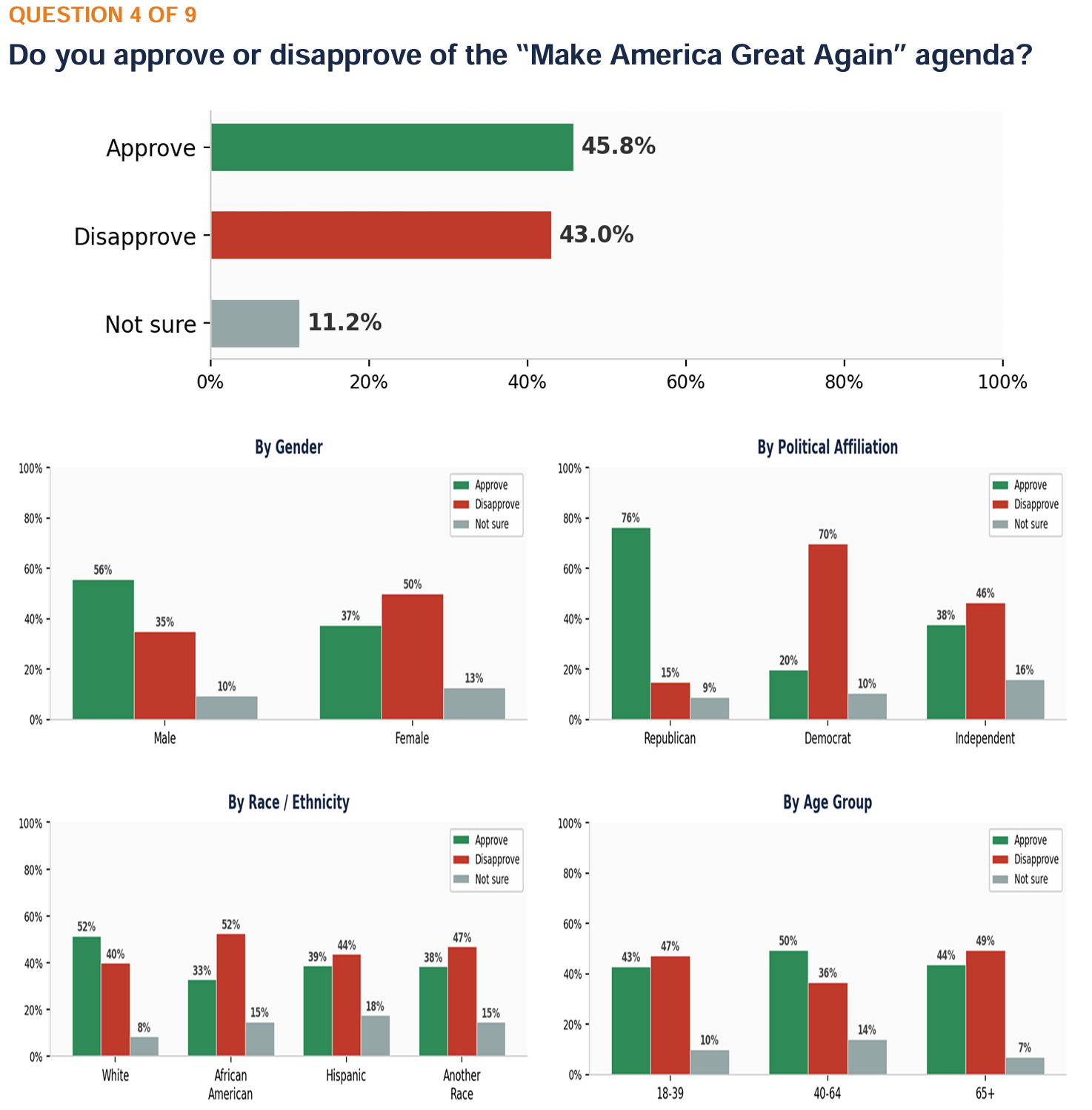
ANALYSIS: The MAGA agenda produces a near-even national split: 45.8% approve (the majority) vs. 43.0% disapprove, with only 11.2% unsure. There is a notable gender difference: men approve at 55.6% while women disapprove at 49.9%. White voters approve at 51.5%, while African Americans (52.4%), Hispanics (43.8%), and voters of Another Race (47.0%) lean disapprove. By party, 76.4% of Republicans approve, 69.8% of Democrats disapprove, and Independents lean disapprove 46.4% to 37.7%.
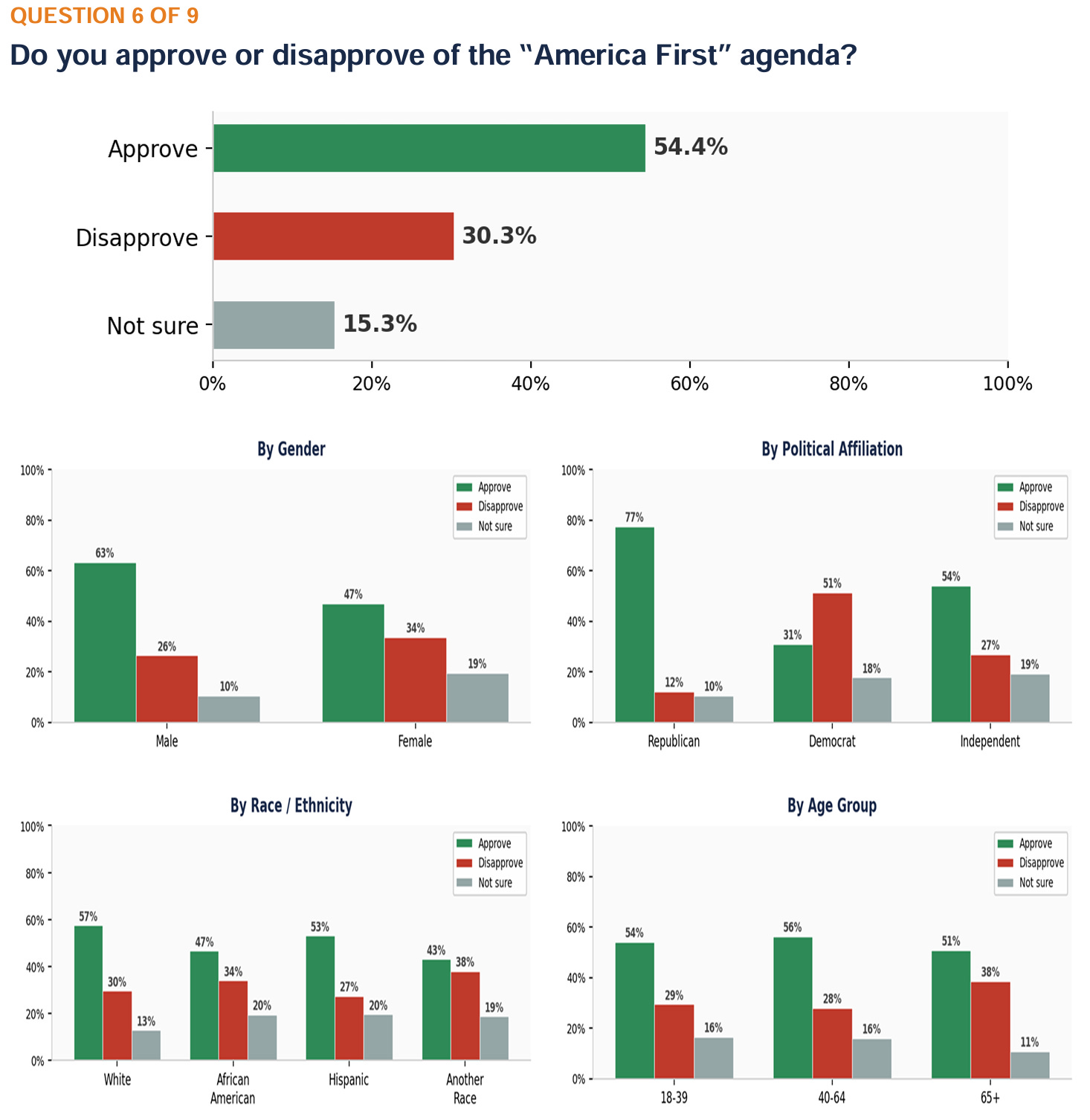
ANALYSIS: “America First” receives majority approval at 54.4%, with 30.3% disapproving and 15.3% unsure. All racial groups show plurality approval, led by White voters (57.4%) and Hispanics (53.0%). African Americans approve at 46.6% with 33.9% disapproving. Men approve at 63.2% compared to 46.9% for women. Republicans approve at 77.4%, Independents at 54.0%, and Democrats disapprove at 51.4% while 30.9% of Democrats approve.
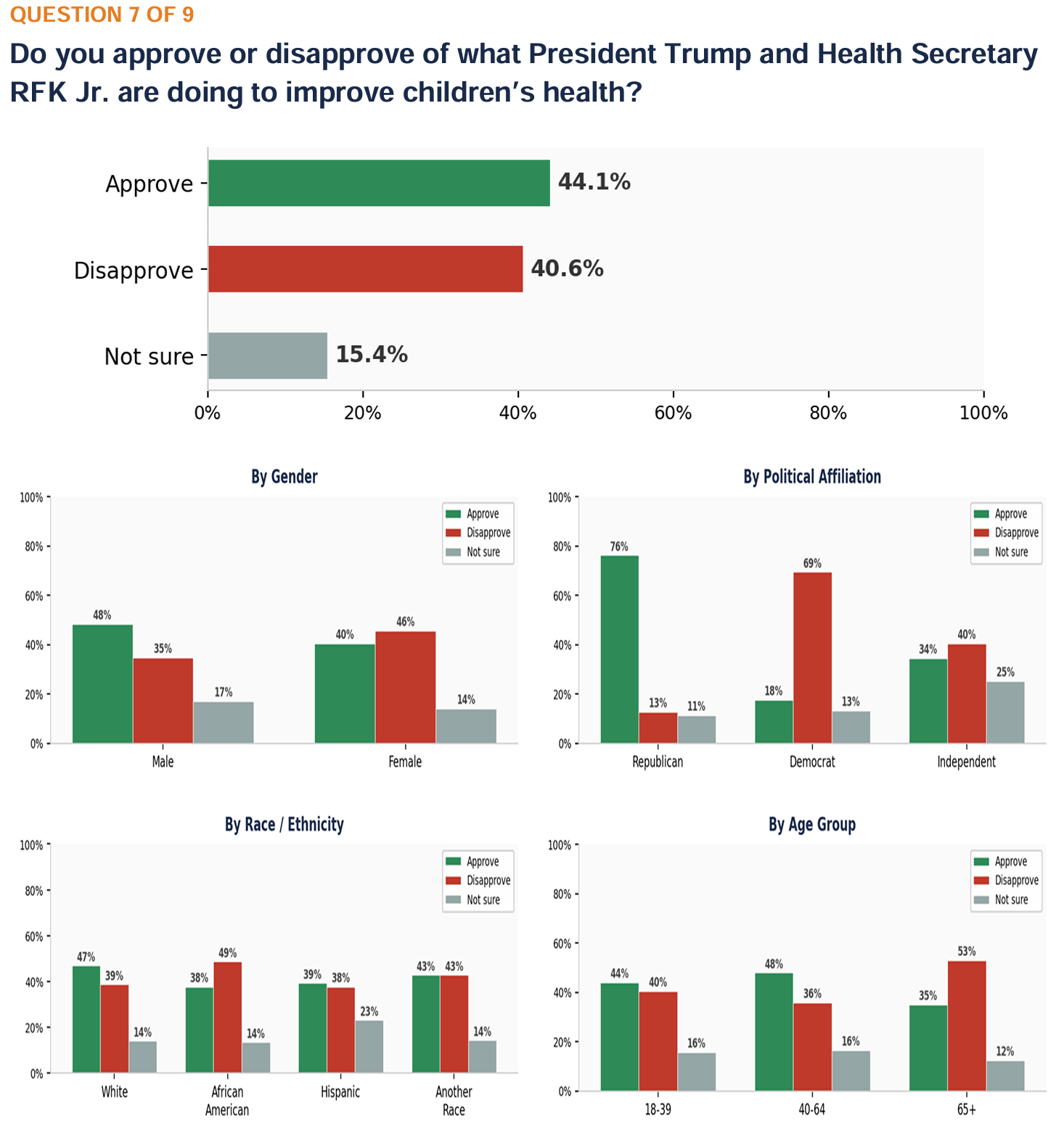
ANALYSIS: Voters narrowly approve (44.1% to 40.6%) of what Trump and RFK Jr. are doing on children’s health, with 15.4% unsure. This trails the broader MAHA agenda approval (59.1%) by 15 points. White voters approve at 47.0%, while African Americans disapprove at 48.8%. Hispanics show the highest uncertainty at 23.1%. Voters 65+ disapprove at 52.9%. Independents show the widest uncertainty at 25.1%, with 34.5% approving and 40.4% disapproving.
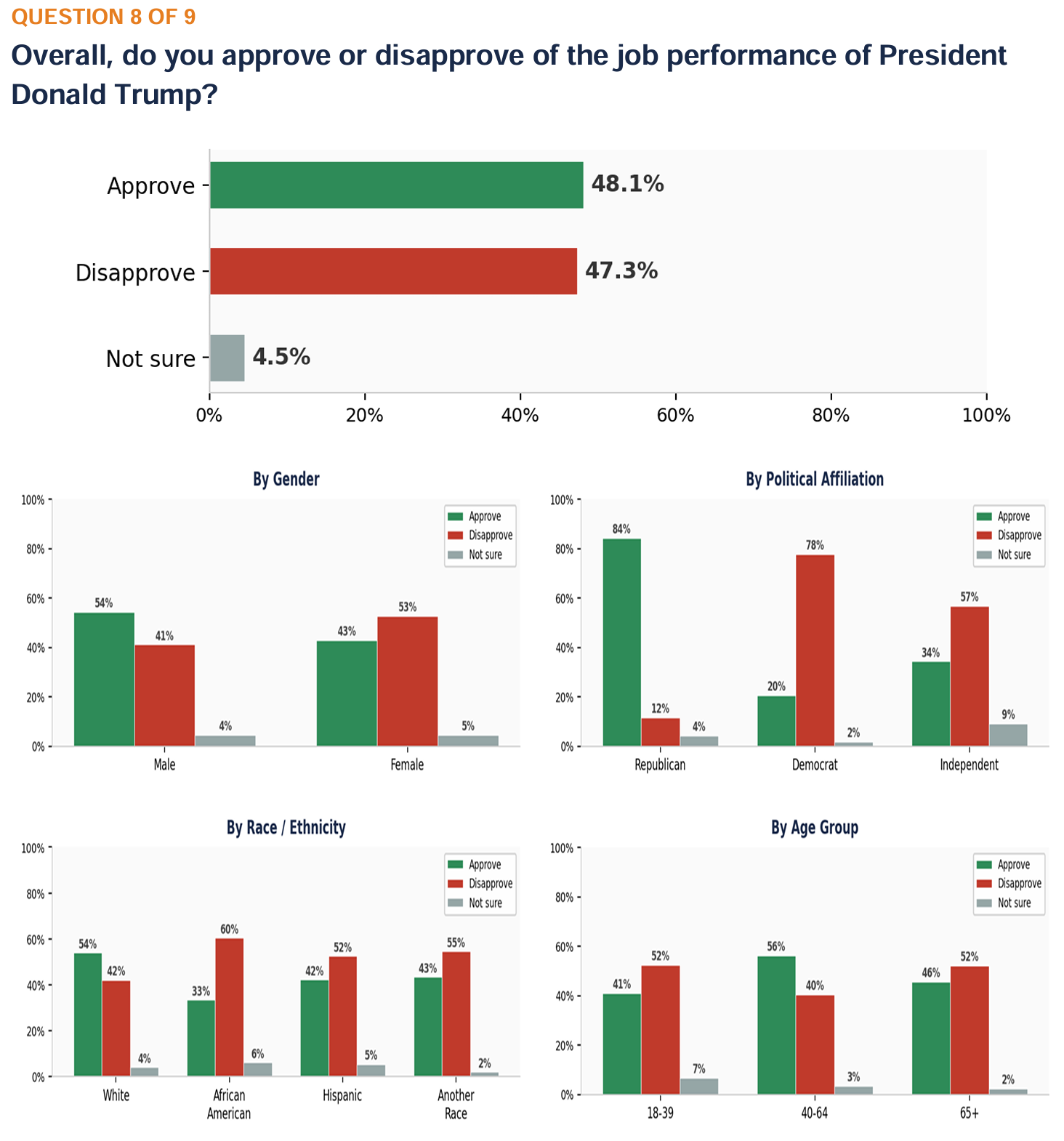
ANALYSIS: Trump’s job approval stands at 48.1% approve vs. 47.3% disapprove, with only 4.5% unsure; the lowest undecided rate on any question. White voters approve at 53.9%, while African Americans (60.5%), Hispanics (52.4%), and Another Race (54.6%) disapprove. Men approve at 54.4% while women disapprove at 52.6%. Voters 40–64 are his strongest age group (56.3% approve). Republicans approve at 84.1%, Democrats disapprove at 77.7%, and Independents disapprove at 56.7%
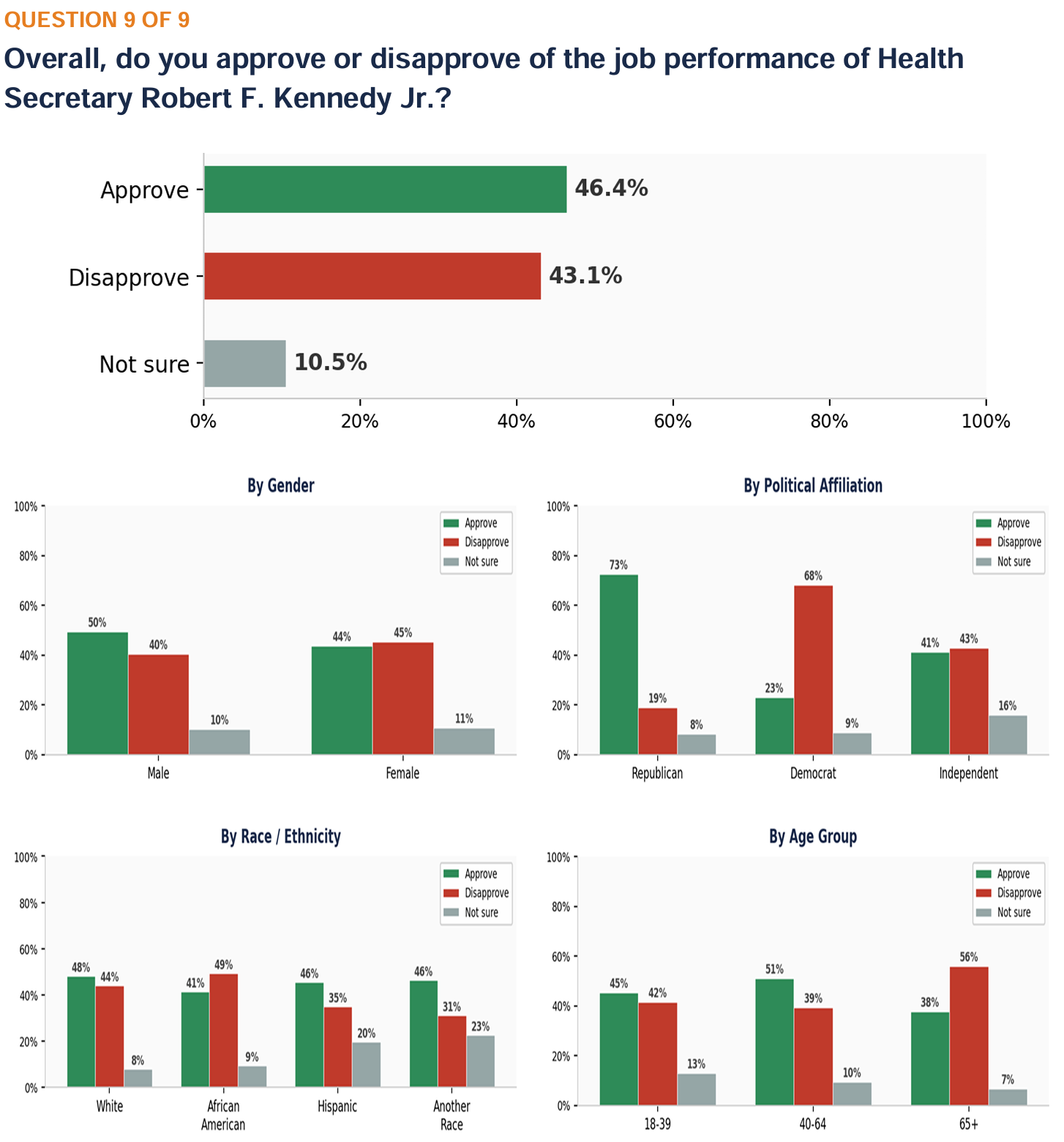
ANALYSIS: RFK Jr.’s job approval is 46.4% approve vs. 43.1% disapprove, with 10.5% unsure. White voters approve at 48.0%, African Americans disapprove at 49.2%, and Hispanics approve at 45.6%, with notable uncertainty (19.6%). “Another Race” voters also show high uncertainty (22.6%). Voters 40–64 show the highest approval (51.0%), while voters 65+ show the highest disapproval (55.8%). Republicans approve at 72.6%, Democrats disapprove at 68.1%, and Independents are closely divided (41.3% approve vs. 42.8% disapprove).
The PREP Act: Unchecked Power, Zero Accountability, and a Path Forward

“The PREP Act and COVID-19, Part 2: The PREP Act Declaration for COVID-19 Countermeasures Updated January 3, 2025” can be found here.
National Survey Shows Majority Support for MAHA and America-First Policies
A new national survey of 1,000 likely voters finds a clear majority supports the Make America Healthy Again (MAHA) agenda and particularly policies that prioritize American interests at home. The results indicate strong support for restoring confidence in America and empowering families to make their own health decisions.
Key Findings:
A strong majority approve of the “Make America Healthy Again” agenda (59.1%) and the “America First” agenda (54.5%).
Majority approval of ending COVID vaccine manufacturer immunity (51.4%) and reducing the CDC childhood vaccine schedule (50.8%).
President Donald J. Trump’s overall job approval stands at 48.1%.
Health Secretary Robert F. Kennedy Jr.’s overall job approval stands at 46.4%.
“What this data shows is that Americans are less interested in political branding and more interested in results,” said Joe Gebbia Sr., Founder and CEO of State Shield Action. “Americans want freedom, and they want to see their country strong again. President Donald J. Trump has done an incredible job protecting families and strengthening the nation’s long-term resilience.”
The survey of 1,000 likely voters was conducted on February 20, 2026 via online panel interviews and text-to-web delivery with a margin of error ± 3.1% at 95% confidence. The survey was conducted exclusively by Rosetta Stone Communications in Atlanta, Georgia on behalf of State Shield Action. The full survey can be found at this link.
###
State Shield Action is the 501(c)(4) advocacy arm of State Shield, advancing state-level solutions to defend Americans from hostile foreign adversaries like the Chinese Communist Party.
As I look at the % closeness, it indicates to me the effectiveness of mainstream news propaganda and the lack of public interest to delve deeper into these issues of policy. I can speak from personal experience, and this is changing as the health of our country has declined. Thank you for the info!
Thanks again Drs Malone. Where else can we find so much public information so well summarized!👏👏