


Audio Version:
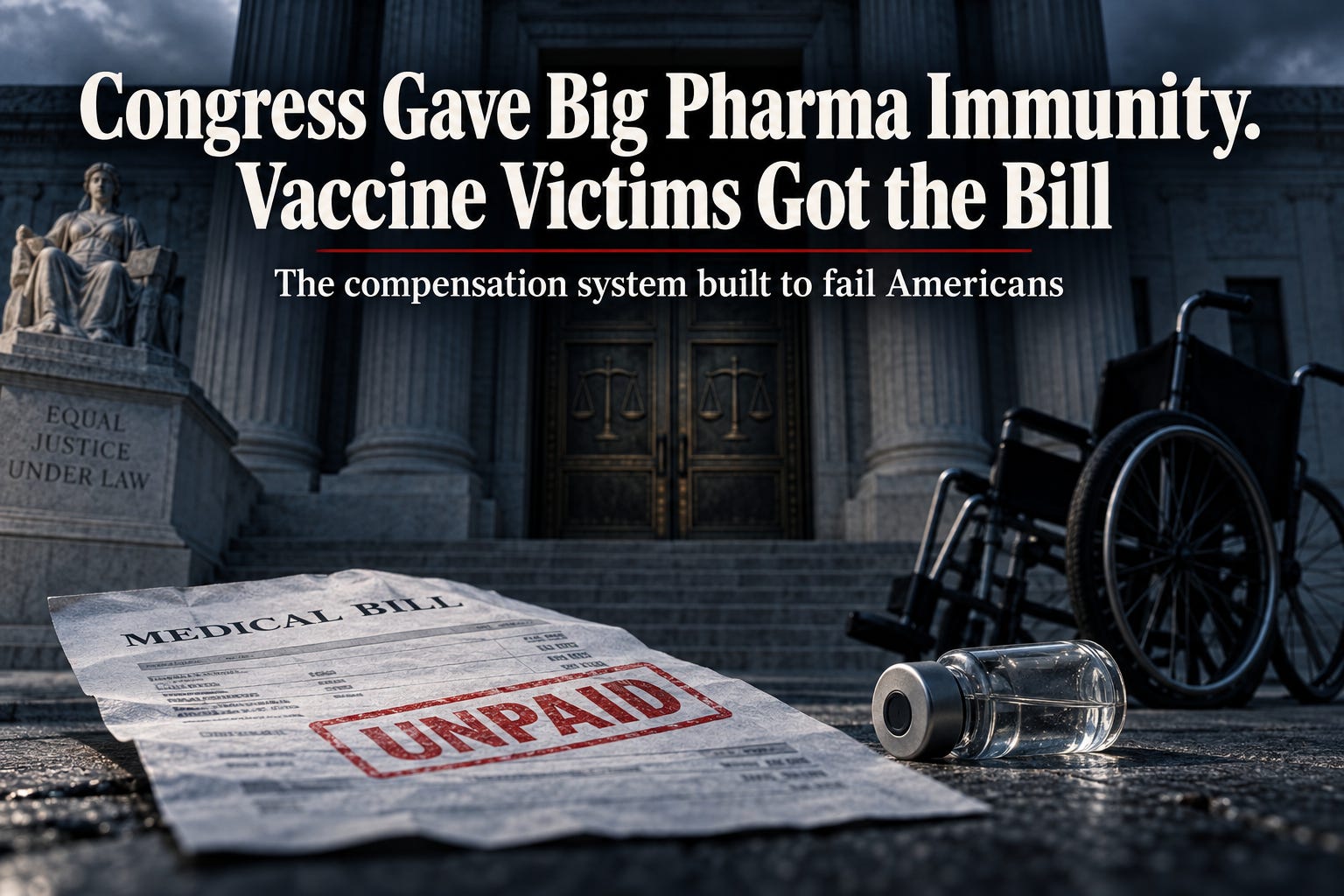
Two Americans can suffer serious injuries after receiving federally protected vaccines and find themselves in two entirely different systems of justice. One may enter a compensation program that has paid roughly half of the petitions it has adjudicated. The other may enter a program that has compensated fewer than one in a hundred decided COVID-19 vaccine claims. Neither person chose the system. Neither person was likely told there were two very different systems for vaccine injuries before rolling up a sleeve. Congress chose what compensation they would encounter if injured, years before either was injured. But neither are they told during the informed consent process that they would not be able to sue for damages in a regular court of law.
Those percentages are not abstract. Behind every petition is a person whose life may have divided into a before and an after: before the neurological injury, before the cardiac damage, before the chronic pain, before the inability to work, before a spouse became a full-time caregiver or parents began wondering who would care for their disabled child after they died. These people do not disappear because an agency rejects their claims. Their medical bills continue. Their lost income remains lost. Their marriages and families absorb the strain. The government merely moves them from a column labeled “pending” into one labeled “denied,” and Washington congratulates itself on having provided a remedy.
This is the story of a bargain Congress made with the American people in 1986 and quietly gutted in 2005. The original bargain was not perfect, but it recognized a basic moral fact: if government protects an industry by taking away an injured person’s ordinary right to sue, government assumes a corresponding duty to provide a fair and meaningful alternative. In 2005, Congress retained sweeping immunity for big pharma, while substituting a narrower, harsher, less transparent program effectively beyond the reach of any court. The manufacturers kept the protection. The injured were left to bear the loss.
The Two Numbers
The National Vaccine Injury Compensation Program, or VICP, has received more than 29,000 petitions since 1988. It has adjudicated 25,652 and compensated 12,588, with total compensation of roughly $5.5 billion. That results in a compensation rate of near 49 percent for adjudicated petitions (HRSA 2026).
The arrival of COVID-19 did not automatically place the new vaccines within the established National Vaccine Injury Compensation Program. Instead, the federal government treated them as emergency “covered countermeasures” under the Public Readiness and Emergency Preparedness Act. In March 2020, the Secretary of Health and Human Services issued a PREP Act declaration granting broad liability protection to the manufacturers, distributors, administrators, and planners involved in the federal COVID-19 response. That declaration directed people injured by COVID-19 vaccines away from the ordinary courts and into a little-known program created for medical countermeasures used during public-health emergencies: the Countermeasures Injury Compensation Program, or CICP.
The consequences were extraordinary. CICP has received more than 14,000 COVID-19 vaccine injury claims. Yet fewer than 1 percent of decided claims had been compensated, according to federal data current as of July 1, 2026 and cited by MCTLaw, a firm representing claimants and advising on pending reform legislation (Medical Daily 2026). The government had promoted and even mandated the vaccines, while placing those injured by them into a compensation program that rejects more than 99 percent of the claims it decides.
These figures use the same basic denominator: claims that reached a decision measured against claims that were paid. Pending petitions are excluded from both. The two programs cover different products under different statutes. The numbers of claims approved versus denied establish that these systems behave radically differently. When one program compensates roughly half of the petitions it decides, and another compensates fewer than one in a hundred, the discrepancy is minor; it is an injustice of the highest order. It is the predictable result of how Congress designed the programs.
A person covered by VICP, the established compensation program for routinely recommended vaccines, has three years from the first symptom or manifestation of injury to file. An attorney may take the case knowing that reasonable fees can be paid even if the petition ultimately fails, provided it was filed in good faith and had a reasonable basis. A qualifying injury listed on the Vaccine Injury Table may carry a presumption of causation. A special master hears the case, and the decision can be reviewed by the Court of Federal Claims and then appealed.
The person sent to CICP (COVID vaccine injuries) has 1 year from the date of administration of the countermeasure. There is no comparable injury-table presumption for COVID-19 vaccine claims, no attorney-fee provision, no compensation for pain and suffering, and no independent judicial review of a denial. The claimant must produce compelling, reliable, valid medical and scientific evidence while frequently ill, financially strained, and unable to hire counsel on economically realistic terms. If CICP denies the claim, the claimant may request reconsideration by the same program. After that, the decision is final. There is no independent appeal and no court authorized to review the denial. A “no” from CICP is, for all practical purposes, the end of the line for compensation.
This is the same country and the same federal government, invoking the same public principle that “rare” vaccine injuries may be the price society pays for access to protected medical products. Yet it has created two radically different concepts of justice.
The Bargain Congress Made
Congress passed the National Childhood Vaccine Injury Act in 1986 because litigation over the DTP vaccine had driven manufacturers from the American market and destabilized supply. The problem was real. Congress confronted a collision between two legitimate concerns: preserving access to vaccines and preserving the right of people injured by a product to seek compensation. It concluded that the existing tort system could not serve both goals on the existing terms.
What Congress built was an exchange. Manufacturers received substantial protection from ordinary civil litigation. An injured person generally could not proceed directly with a civil claim exceeding $1,000 against a covered manufacturer without first filing a petition under VICP and allowing judgment to enter (CRS 2026a). In return, the injured received something of value: an administrative forum, special masters in the Court of Federal Claims, an injury table that could create a presumption of causation, attorney fees for qualifying petitions, and a dedicated funding mechanism.
Congress financed the program through an excise tax imposed on vaccine manufacturers, producers, and importers. The original tax varied by vaccine, but in 1997 Congress replaced those rates with a flat charge of 75 cents for each disease a vaccine prevents. An MMR dose therefore carries a $2.25 tax, while an influenza dose carries a 75-cent tax. Congress has not increased or indexed that amount since 1997, allowing inflation to cut its real value roughly in half. The tax acknowledged that injuries were not imaginary merely because liability had been redirected away from the manufacturers.
In 1986, Congress took away part of the ordinary legal remedy and established an alternative system outside normal court processes, and there is no question that the one who benefited most was big pharma.
The People the Bargain Failed
Even the more generous of these two programs has never made every injured family whole. A payment statistic cannot measure the years spent fighting the government, the deterioration of a patient while a claim crawls through the system, or the difference between an administrative award and what a jury might have awarded after hearing the full story. VICP caps compensation for pain and suffering and for vaccine-related death at $250,000. That figure has not kept pace with nearly four decades of inflation, much less with the actual cost of catastrophic disability. A family facing lifelong nursing care, inaccessible housing, lost earnings, and the destruction of an ordinary family life quickly learns that a statutory remedy and full compensation are not the same thing.
The autism cases are among the most painful examples. Autism was not categorically excluded from the statute, and families were permitted to file petitions. Thousands did. In the Omnibus Autism Proceeding, six test cases were selected to evaluate three general theories: that MMR combined with thimerosal caused autism, that thimerosal alone caused autism, and that MMR alone caused autism. The special masters rejected those theories, effectively closing the principal VICP pathway for more than 5,000 families alleging vaccine-induced autism.
But at least part of the scientific record used by government counsel was seriously tainted. The government relied upon Danish epidemiological studies produced through a CDC-funded research program led by Poul Thorsen, who has now pleaded guilty to stealing more than $1 million from that program. The CDC scientist who helped construct the sole-source funding opportunity was in an undisclosed romantic relationship with Thorsen, accepted gifts from him, and co-authored research produced under the award. The legally required Danish human-subjects approvals were never obtained. When CDC officials discovered the problem in 2009, after two papers had already been published and while the autism litigation was underway, they helped obtain retroactive ethical coverage rather than notifying the journals or the special masters.
So, the studies used by the government to defeat vaccine-autism claims emerged from a research program compromised by theft, undisclosed conflicts of interest, missing ethical approvals, and an extraordinary lack of institutional accountability. CDC never appears to have commissioned a serious independent reanalysis of the study designs, data, statistics, or conclusions after those facts became known. The vaccine court moved on. The government moved on. The children remained disabled, and their families were left to carry the cost for the rest of their lives. The full documentary history is examined in “Stolen Money, Missing Approvals.”
This is where sterile discussions of “claims” become morally evasive. A denied claim is still attached to a human being. Some claimants were unable to prove causation, and some may have been mistaken about the cause of an injury. Others faced the nearly impossible task of proving a complex biological event with incomplete clinical records, limited research, and no access to the internal evidence that ordinary litigation discovery might have produced. Some were too poor or didn’t know how to obtain legal counsel. When government and industry insist that only a very small number of injuries are genuinely attributable to vaccines, they should be willing to operate a system capable of identifying and generously compensating those individuals. Instead, the same institutional apparatus that describes serious injury as rare often makes proof of a rare injury prohibitively difficult.
Had these cases proceeded in ordinary civil court, manufacturers would have faced discovery, depositions, expert testimony before juries, and the possibility of damages reflecting pain, suffering, lost earning capacity, lifetime care, and punitive conduct where warranted. Not every claimant would have won. But successful catastrophic-injury cases could have produced awards many times larger than the capped or tightly calculated amounts available under federal programs. Compared with that potential exposure, the billions paid by VICP over nearly four decades amount to pennies on the dollar for an industry granted extraordinary protection from the ordinary consequences of selling a defective product.
Nor were those billions paid directly out of pharmaceutical-company profits. They came from an excise tax attached to vaccine sales, embedded in the product's price and spread across the market. And we as taxpayers get to pay for it all. The public underwrites the vaccination program, assumes the risk of injury, finances the compensation system, and then watches government lawyers contest the claims of the injured. Manufacturers have largely walked away from the courtroom exposure that every other major industry regards as a cost of doing business.
The Bargain Congress Broke
The Public Readiness and Emergency Preparedness Act of 2005, enacted within Public Law 109-148, added sections 319F-3 and 319F-4 to the Public Health Service Act. Section 319F-3 grants immunity for covered countermeasures. Section 319F-4 created CICP, which COVID vaccine injuries are adjudicated. On paper, Congress again paired immunity with compensation. In substance, it preserved the part that protects manufacturers and eliminated the part meant to protect injured people.
The 2005 PREP Act shield is broad in every direction. It covers manufacture, distribution, administration, and use, and it protects manufacturers, distributors, program planners, qualified persons who administer the products, and the United States itself. It reaches claims caused by, arising out of, relating to, or resulting from the use of a covered countermeasure. The nominal exception is willful misconduct, pursued through an exclusive federal cause of action in the United States District Court for the District of Columbia under a standard that has never been met in a reported vaccine case.
Congress designed CICP differently from the beginning. The PREP Act, enacted on December 30, 2005, limited compensation to serious physical injury or death, demanded proof of direct causation based on “compelling, reliable, valid, medical and scientific evidence,” excluded pain and suffering, and placed the process under the control of the Secretary of Health and Human Services. When HHS issued the program’s implementing regulations in 2010, it added the one-year filing deadline, detailed the internal reconsideration process, and made clear that the agency’s final eligibility decision was not subject to judicial review. CICP was not a generous program that later became restrictive. It was built that way.
Again, the deadline is one year from administration rather than VICP’s three years from the first manifestation of injury. That alone can defeat someone who spends months seeking a diagnosis, being passed from specialist to specialist, or being told that the symptoms are coincidental, psychological, or unrelated
Most physicians were discouraged or even reprimanded by employers and health-care institutions during the pandemic from documenting a possible vaccine injury in the medical record, leaving patients without the very evidence the government would later demand as proof.
There is no comparable injury table for those who are COVID-19 vaccine-injured. The claimant must produce compelling, reliable, valid medical and scientific evidence without the ability to pay attorney fees from the award. Compensation is secondary to other payment sources, lost employment income is capped, and pain and suffering are excluded altogether.
Then comes the feature that should offend people across the political spectrum: a denial cannot be reviewed by a court. An unsuccessful VICP claimant may seek review by the Court of Federal Claims and then the Federal Circuit. A CICP claimant may not appeal. Government has closed the courthouse door, designed the replacement process, set the evidentiary burden, decided the claim, and insulated its denial from independent judicial scrutiny. Calling that compensation for a vaccine injury is a farce.
In 2005, Congress kept the protection for manufacturers and abandoned the promise it had made to the injured.It preserved the half of the 1986 bargain that benefits manufacturers and reduced the half intended for injured people to an administrative gesture. The consequences remained obscure until COVID-19 transformed a little-known countermeasures program into the only legal recourse for injuries arising from an unprecedented national vaccination campaign.
And Then COVID Happened
During the pandemic, Americans were repeatedly told that vaccination was not merely a private medical choice but a civic obligation. Federal agencies promoted the products. State and local governments imposed requirements in many settings. The federal government, universities, hospitals, corporations, and the military made vaccination a condition of education, participation, or employment. People lost their jobs, careers, schooling, military status, or ability to enter public life if they refused.
When serious injuries occurred, those same people discovered that the system for justice was non-existent. The authorities that had insisted upon vaccination did not build a transparent, accessible, adequately funded system prepared to care for the injured. Manufacturers were protected under the PREP Act. Employers and administrators operated under emergency policy. The injured person was left with CICP, its one-year deadline, its formidable causation standard, no paid lawyer, no damages for pain and suffering, and no judge empowered to review a denial.
This is why the fewer-than-1-percent figure matters. A program rejecting more than 99 percent of decided claims while concealing much of its case-specific reasoning should have to demonstrate that it is separating valid claims from invalid ones rather than merely separating injured people from compensation. The government demands evidence from claimants while providing remarkably little evidence that its own adjudication is fair.
For people who lost their health after doing what government, employers, physicians, and public campaigns urged or required, the abandonment is especially bitter. Many did not oppose vaccination. They trusted the system. Some participated precisely because they believed they were protecting others. Once injured, they encountered a bureaucracy far more certain of its reasons for denial than many physicians had ever been about diagnosis or treatment. They became inconvenient witnesses to a policy success story that had no room for damaged lives.
Who Really Pays for the Liability?
A liability shield does not eliminate the cost of injury. It transfers it. A manufacturer avoids unpredictable tort exposure while the injured person absorbs medical expenses, lost income, disability, and pain the compensation system does not cover. Families provide unpaid nursing care. Private insurance, Medicare, Medicaid, disability programs, charities, churches, and local communities absorb other portions. The injury disappears from the manufacturer’s balance sheet and reappears everywhere else in society.
Litigation also does more than transfer money. Discovery can reveal what a manufacturer knew, when it knew it, how safety signals were evaluated, what was excluded from a trial, and how risks were described internally compared with how they were described to the public. Jury trials place those facts in an adversarial forum outside the agencies that approved, purchased, recommended, or promoted the product. When immunity prevents litigation, it suppresses not only damages but one of the principal mechanisms by which information about defective products reaches the public.
The excise tax in the 1986 system was intended to place some of the financial burden back on the product. Yet that tax has remained $0.75 per antigen since 1986 and has lost roughly two-thirds of its real value. Congress has increased the rate vaccine manufacturers must pay. Manufacturer protection remained extraordinarily valuable while the monies allocated to help the vaccine injured steadily shrank.
No Immunity Without a Real Remedy
Reform should begin with a principle simple enough for any member of Congress to understand: no immunity without meaningful compensation. If government eliminates the ordinary right to sue, the replacement cannot be an office that rejects more than 99 percent of decided claims, pays no attorney fees, excludes pain and suffering, and answers to no court. An administrative system may be faster and more predictable than tort litigation, but only if it is designed to deliver justice rather than simulate it. Only if the process and discovery is as transparent as the court system it is designed to replace.
Every PREP Act declaration should therefore be conditioned on a compensation system meeting minimum standards: at least three years to file, reasonable attorney fees for claims brought in good faith with a reasonable basis, a transparent presumption mechanism comparable to an injury table, compensation reflecting actual economic loss and catastrophic disability, and independent judicial review. CICP denials should be reviewable in the Court of Federal Claims under ordinary administrative-law standards. The program should also publish deidentified decisions explaining the evidence, reasoning, and standard applied to every denial. If its work is fair, transparency will vindicate it. If it is not, injured people should not have to guess how the government failed them.
VICP also requires repair. The excise tax should be adjusted and indexed to inflation, and compensation caps should reflect present-day losses rather than the value Congress assigned to death and suffering four decades ago. Department of Justice attorneys should stop treating the program as though its principal purpose were to defeat claimants. Congress promised a humane alternative to civil litigation, not years of publicly financed warfare against sick people and exhausted families.
The PREP Act contains one supposed escape from manufacturer immunity: “willful misconduct.” But this does not mean ordinary negligence, inadequate testing, failure to investigate a safety signal, or even reckless conduct. A claimant must prove an intentional act or omission taken knowingly, without legal or factual justification, and in disregard of a known or obvious risk so great that the harm was highly probable.
The claim may be filed only in the United States District Court for the District of Columbia, must satisfy special pleading requirements, and is subject to an unusually demanding evidentiary standard. The exception has never succeeded in a reported vaccine case.
Congress should either create a standard that a person with credible evidence of deliberately concealed harm can realistically meet or admit that manufacturer immunity is effectively absolute. What we have now is public relations written into law. If credible evidence shows that a manufacturer deliberately concealed material harm, an injured person should have a practical route to court.
None of these reforms requires Americans to agree about vaccine efficacy, autism, COVID policy, mandates, or the wisdom of any particular recommendation. One can believe vaccines have prevented disease and still insist that a society benefiting from them owes a profound debt to those seriously injured by them.
Indeed, the stronger one’s belief in vaccination as a public good, the stronger the obligation should be. A public-health program cannot ask individuals to accept a small risk for everyone else and then treat the unlucky few as collateral damage when that risk becomes their life or death.
The Government Cannot Take Away a Right and Call It Justice
State legislatures require certain vaccines for school attendance and sometimes for employment. Federal agencies recommend and promote them; they even buy them in bulk for free distribution for school-aged children. During emergencies, public officials may pressure nearly every institution in the country to require them.
Congress then closes the courthouse door to people injured by vaccines and substitutes a remedy of its own design. Each of these acts is an exercise of public power over a private person, and each creates an obligation on the part of the state toward the sovereign individual.
That obligation does not vanish because causation is scientifically complicated, because acknowledging an injury is politically inconvenient, or because a claimant has received a diagnosis the compensation program does not recognize as vaccine-caused. A child with lifelong disability still needs lifelong care. A previously healthy adult who can no longer work still has a mortgage, a family, and a body that no longer functions as it did. People who did what authorities asked of them should not have to beg those same authorities to acknowledge their existence and their injuries.
The government cannot have this both ways. It cannot describe vaccination as a collective duty when demanding compliance and then redefine injury as a purely private misfortune when compensation is due. It cannot tell the public that serious injuries are exceedingly rare while constructing a claims process seemingly designed to ensure that exceedingly few are recognized. It cannot shield manufacturers from discovery, jury verdicts, reputational damage, and punitive exposure while pretending that a minuscule administrative payment leaves an injured family made whole, when it isn’t.
The 1986 Congress decided that big pharma needed protecting from lawsuits. It protected vaccine supply, protected manufacturers, and created a funded remedy for those who paid the human price. The 2005 Congress's program to address vaccine damage was flawed. COVID exposed what that choice meant on a national scale: manufacturers received extraordinary protection while injured Americans encountered a program that compensated fewer than one in a hundred decided claims.
These are not anti-vaccine statistics or pro-vaccine statistics. They measure whether the United States keeps faith with its own citizens. Big Pharma received something worth incalculable sums: protection from the civil-justice system and from verdicts that might have forced companies to pay the full price of the injuries their products caused.
The victims received deadlines, caps, closed records, hostile burdens of proof, and far too often, rejection. Many were damaged for life. Some have spent years without meaningful compensation. Families caring for profoundly disabled children, including families who believed a vaccine contributed to an autism diagnosis or regression, were left to carry costs that no government ruling could make disappear. And frankly, people died from their vaccine injuries.
The bargain is not complicated. If the state takes away a citizen’s right to seek justice, the state assumes the duty to provide it. If industry wants immunity, it must bear the full and honest cost of the injuries caused by its products. Anything less is not public health. It is the privatization of profit and the profiteering of human suffering. Congress did not merely forget the injured. It built a system in which their losses could be denied, discounted, and ultimately ignored while one of the most powerful industries in America walked away protected.
This failure did not end with COVID. The liability shield now intersects with a federal strategy built around adaptable medical platforms, raising a new question: what happens when a manufacturer changes the genetic payload but retains much of the regulatory and legal architecture of the original product?
That is the subject of the next essay.
RWM/JGM
Investigations like this require time, document review, legal research, and a willingness to follow the evidence into places that powerful institutions would prefer remain unexplored. Malone News does not depend upon pharmaceutical advertising, government grants, or corporate sponsors. We depend upon our readers.
If you believe the vaccine-injured deserve more than bureaucratic rejection and public silence, please consider becoming a paid subscriber. Your support allows us to continue documenting what happened, identifying who benefited, and giving a voice to the people our government and medical establishment would rather forget. Paid subscriptions keep this work independent, and they make investigations like this one possible.
This makes me angry. I know parents whose normal children became autistic right after a vaccination. What the government has done is like herding cattle into the slaughterhouse. This is especially egregious after the criminal activity of people like Thorsen and Fauci. And they wonder why the increase in “vaccine hesitancy?” As more people become aware of this I suspect that we will see huge drops in vaccine compliance, and more people seeking safe ways to stay healthy instead of injections of poison. The government is to blame.
In my letter to President Trump of 30 September 2025 I make the following request (Page 25 of 43): "Please issue an Executive Order that revokes the LIABILITY IMMUNITY that was granted for the modRNA technology (COVID-19 “vaccine”) ; retroactive to the FDA EUA date of 11 December 2020." Cover letter available here: https://www.pvsheridan.com/sheridan2trump-9-30september2025_cover-letter.pdf
Full letter (attachments) here: https://www.pvsheridan.com/sheridan2trump-9-30september2025/
My interview on LIABILITY IMMUNITY from twenty-twenty-ONE here : https://www.youtube.com/watch?v=CIkfeIQwEKg