

Audio Version:
Editorial
By: Dr.s Jill and Robert Malone
How the cultural police turned centuries of human exchange into another excuse for racial division.
For most of human history, borrowing from other cultures was called learning and evolving. People exchanged clothing, hairstyles, foods, music, agricultural practices, technologies, and traditions. Civilizations advanced because people observed what others were doing, celebrated the new ideas, adopted what worked, and made it their own.
But apparently, those rules have changed. Cultural exchange is now celebrated when it flows from supposedly privileged cultures to supposedly oppressed ones. Reverse the direction, and suddenly it’s cultural theft.
A white woman wearing cornrows? Cultural appropriation.
A non-Japanese woman wearing a kimono? Offensive.
A child wearing a Native American costume for Halloween? Racist.
But a Japanese teenager wearing blue jeans, an African musician playing an electric guitar, or a European dressing like an American cowboy? Perfectly acceptable.
Who made these rules, and why does anyone take them seriously?
Blue Jeans: America’s Gift to the World
Consider the humble pair of blue jeans.
On May 20, 1873, Levi Strauss and Jacob Davis, two immigrants to America, received a patent for reinforcing work pants with metal rivets. Davis, a Latvian-born tailor, developed the idea, while Strauss, a German-born businessman, helped finance and commercialize it.
Their invention became one of the most recognizable garments in American history, even world history. Originally associated with miners, ranchers, cowboys, and working men of the American West, blue jeans eventually became symbols of American independence, rebellion, and popular culture.
Then the rest of the world adopted them.
Today, people wear jeans in Tokyo, Paris, Nairobi, Mumbai, and virtually everywhere else on Earth. International fashion designers have made fortunes transforming American denim into luxury clothing and designer accessories.
Are they stealing American culture? Should the descendants of American miners demand reparations every time someone overseas puts on a pair of Levi’s?
Of course not.
And here’s the irony. The words jeans and denim have European roots, while the modern riveted garment was developed in America by two immigrants.
That is how culture works. People borrow ideas, improve them, adapt them, and pass them along. Nobody loses their culture because someone else appreciates it.
When the Japanese Defended Americans Wearing Kimonos
In 2015, the Museum of Fine Arts in Boston invited visitors to try on a replica of the kimono featured in Claude Monet’s painting La Japonaise.
The cultural-appropriation police in America were outraged.
Activists protested, accusing the museum of racism and cultural insensitivity. The museum eventually stopped allowing visitors to try on the garment.
Even better, the outraged protesters were themselves dressed in Western clothing, including jeans, collared shirts, and tank tops. Apparently, cultural appropriation is only offensive when someone else is doing it.


But then the story took an embarrassing turn for the perpetually offended.
Actual Japanese people showed up to defend the event. Japanese counterprotesters argued that sharing their traditional clothing was something to celebrate, not condemn. Even Japan’s deputy consul general in Boston questioned the controversy.
Think about the absurdity. American activists, dressed in Western clothing, were lecturing other Americans about the supposed crime of wearing Japanese clothing, while Japanese people were defending the practice.
Apparently, the self-appointed cultural police knew more about what should offend the Japanese than the Japanese themselves.
Meanwhile, Japanese citizens have enthusiastically adopted American jeans, business suits, sneakers, baseball, rock music, and countless other Western cultural exports.
And good for them.
Culture isn’t a museum exhibit that must remain frozen in time. It belongs to the living, not to self-appointed political gatekeepers.
Who Owns Braided Hair?
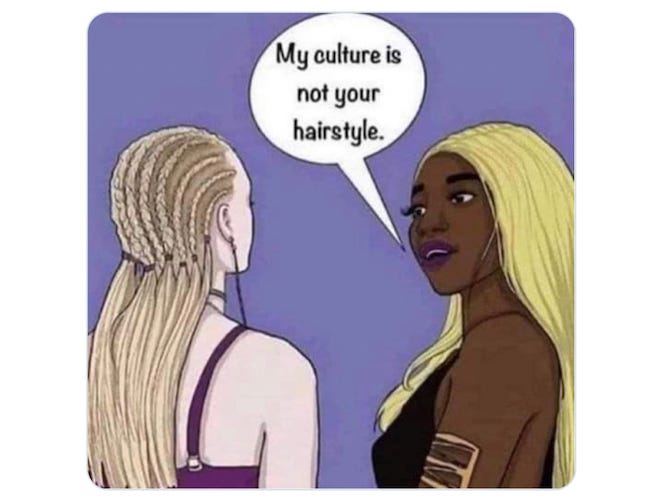
Braiding is an ancient human practice documented across Africa, Europe, Asia, the Middle East, and the Americas. Ancient Egyptian artifacts depict elaborate braided hairstyles. Greek Caryatid sculptures from the fifth century BCE feature intricately carved braids, while Roman portraits show women wearing braided coils and elaborate arrangements of plaited hair.


Braiding was never the exclusive invention of one racial group.
Likewise, blonde hair is a naturally occurring human characteristic, not something Europeans own. People have been coloring, straightening, curling, and otherwise modifying their hair for thousands of years.
Yet we are supposed to believe that a white woman wearing cornrows is committing cultural theft, while a Black woman wearing straightened or dyed blonde hair is simply expressing herself.
Here’s a radical idea: Both women should be free to wear their hair however they please.
Neither owes the other an explanation, an apology, or a history lesson. And neither needs permission from an activist with a sociology degree.
The American Cowboy: Cultural Appropriation on Horseback?
Western riding, cowboy boots, broad-brimmed hats, saddles, and cattle-handling traditions evolved from centuries of Spanish, Portuguese, Mexican, Indigenous, Black, and Anglo-American influences.
The American cowboy didn’t emerge from a cultural vacuum. Even the Western saddle and curb bit evolved from Iberian equestrian traditions brought across the Atlantic by Spanish and Portuguese horsemen. Those traditions, in turn, drew upon centuries of European and Mediterranean horsemanship.
Today, Western riding and cowboy culture have spread around the world. Europeans compete in Western equestrian events. Japanese enthusiasts wear cowboy boots and hats. Country music has international audiences. American-style cattle roping competitions have even made their way to Europe.
Are these people stealing American culture? And if cultural borrowing is so objectionable, shouldn’t American ranchers abandon the saddles, bits, riding techniques, and cattle-handling practices inherited from Spanish and Mexican vaqueros?
Follow that logic far enough, and virtually every culture on Earth becomes guilty of stealing from every other culture.
But here’s where the absurdity becomes personal.
In Portugal, some equestrian activists are arguing that riders of the Portuguese horse should not use certain traditional tack or attire, even when participating in equestrian disciplines associated with those traditions that the Portuguese have marketed globally.
We are talking about saddles, bridles, and riding equipment whose ancestry stretches back through centuries of Iberian horsemanship, with influences reaching into Roman antiquity and beyond. Traditional Portuguese riding attire likewise reflects generations of European military dress, rural working clothing, aristocratic fashion, and equestrian traditions.
None of these things sprang fully formed from a single nation or riding discipline. Yet activists in Europe are attempting to dictate who may use them, as though they hold exclusive ownership over centuries of shared equestrian history.
Apparently, even the horses are now expected to observe cultural-appropriation rules.
The irony is extraordinary. The very traditions these activists want to protect exist because earlier generations borrowed, adapted, and improved upon the traditions of others.
By that reasoning, perhaps the Portuguese should return their Roman-influenced tack, Americans should surrender their Iberian saddles, and Europeans should stop riding Western. As to the sport of dressage, maybe only members of the military should participate.
Or perhaps everyone could simply get on their horses and ride.
Who Appointed the Cultural Police?
The entire ideology of cultural appropriation rests on an absurd premise: that certain racial or ethnic groups own particular traditions, hairstyles, clothing, and customs, and that outsiders need permission to use them.
Permission from whom, exactly?
Does an entire nation get to vote on whether foreigners can wear its traditional clothing? Does one offended activist get to speak for millions of people who happen to share an ancestry? And what happens when the people supposedly being protected actually welcome outsiders?
We saw precisely that in Boston. Japanese participants welcomed Americans wearing kimonos, while activists insisted the practice was offensive.
Even religion gets dragged into the argument, particularly with Native American traditions. Sacred ceremonies and religious regalia deserve respect, just as the religious practices of Christians, Jews, Muslims, and others do. But that doesn’t mean every feather, bead, hairstyle, or article of clothing associated with Native American culture becomes religious property that outsiders are forbidden to imitate.
There is a profound difference between respecting someone’s beliefs and granting them authority over everyone else’s cultural expression.
And that brings us to the real problem. In the progressive interpretation of cultural appropriation, the offense often isn’t what someone does. It’s who does it.
The same cultural borrowing can be celebrated as diversity when performed by one person and condemned as exploitation when performed by another. Race becomes the deciding factor, filtered through an ideological ranking of historical privilege and oppression.
Calling this cultural sensitivity doesn’t change the underlying contradiction. This is just another form of racism.
When Social Justice and DEI Become Cultural Policing
This is where cultural appropriation intersects with the broader ideology of social justice and Diversity, Equity, and Inclusion.
DEI programs emphasize racial identity, historical power relationships, privilege, and systemic inequality. Rather than bringing people together, this framework divides society into two opposing camps: victims and oppressors. Instead of healing old divisions, it reinforces them, creating resentment and deepening the very tensions it claims to resolve. Cultural-appropriation ideology follows the same playbook, assigning people to categories of privilege and oppression based on their ancestry, then deciding who is entitled to borrow from whom.
That isn’t inclusion. It’s racial division dressed up as social justice.
Under this interpretation, cultural borrowing is judged not simply by the act itself but by the racial identity of the person doing it. Borrowing from a supposedly dominant culture is acceptable. Borrowing from what has been determined to be a historically marginalized culture can be condemned as exploitation.
In effect, cultural exchange is expected to flow in one direction: from the supposedly privileged to the supposedly oppressed, with activists deciding who belongs in which category.
A white woman wearing braids can be accused of racism. A Black woman wearing blonde hair is expressing herself. Yet women of different ancestries have been braiding, coloring, and styling their hair for thousands of years.
A white American wearing a kimono can be accused of cultural insensitivity. A Japanese person wearing blue jeans is simply participating in global fashion.
An American child dressed in a Native American-inspired Halloween costume can be accused of racism, while dressing as a cowboy is perfectly acceptable. Apparently, dressing a child as the devil or a horror-movie monster is less controversial than dressing one in clothing inspired by another culture.
Meanwhile, Western and American cultural traditions are freely adopted, commercialized, and reinvented around the world.
The double standard is impossible to miss.
Social justice does not bring people together. It divides society into victims and oppressors, assigns blame and moral authority according to race and ancestry, and perpetuates grievances rather than resolving them. Cultural appropriation is simply another extension of this thinking, turning ordinary cultural exchange into a racial offense. Rather than eliminating discrimination, this approach institutionalizes different standards for different people, deepening resentment and division under the banner of equity and inclusion.
We spent generations fighting the idea that people should be treated differently because of their skin color and rightly so. Now academics, activists, and corporate diversity consultants are promoting frameworks that reintroduce racial distinctions under the fashionable language of equity.
They call it progress. We call it moving backward.
Human civilization was built on cultural exchange. The foods we eat, the clothes we wear, the music we enjoy, and the technologies we use are the products of countless generations borrowing, adapting, and improving upon one another’s ideas.
That is something to celebrate, not condemn.
No race owns a hairstyle. No ethnicity owns a fashion trend. No political movement gets to decide which cultures the rest of us are allowed to appreciate, imitate, or embrace.
Culture is meant to be shared, not owned. Cultural exchange is not theft. And racial discrimination doesn’t become acceptable simply because someone puts the letters DEI in front of it.
Apparently, cultural appropriation is a terrible offense. Unless, of course, you’re appropriating our articles for free.
Fortunately, we don’t believe in cultural policing, and we certainly don’t mind sharing our work. But researching, writing, and publishing independent journalism takes time, effort, and money.
If you’ve been enjoying Malone.News without paying a dime, perhaps it’s time to embrace a little cultural exchange of your own: We provide the research, commentary, and occasional sarcasm. You provide a paid subscription.
No guilt, no DEI training, and absolutely no permission slip required.
Become a paid subscriber today. Help us keep the articles coming, the questions uncomfortable, and the cultural police thoroughly annoyed.
And please share this article. Cultural exchange is, after all, something we enthusiastically encourage!
Share This Article. Republish It. Spread It Far and Wide.
For centuries, civilizations have grown by sharing ideas, traditions, and knowledge. We’re not about to start demanding permission slips now.
If this article resonates with you, please share it on social media, send it to friends, crosspost it on Substack, or republish it on your own website or newsletter- just link back to the original article.
The cultural police have had plenty of opportunities to make their case. It’s time for a little cultural exchange of our own.
No permission required. No DEI certification necessary. And absolutely no apologies for sharing.
What happened to “Copying is the sincerest form of flattery”? Once a “style” is out in the open market to be appreciated by millions, exclusive ownership disappears…… Get over it!
People need to quit being so small and petty. There are enough real problems in this world that need our attention and not this pathetic drivel.
Thanks so much. I live in Florida where most of the year it is HOT. I wear dashikis most of the time. They are native to Africa and are very lose and cool. Mine are 100% cotton so are breathable. In the last 20 years no one has noticed, until one day in a parking lot I was told by a black man that I was not native to Africa so I should not wear their clothing.