


For the past week, Americans have been treated to another familiar media spectacle. Donald Trump was supposedly threatening democracy. His Justice Department was interfering with an election. Republicans were preparing to reject the will of the voters before a single ballot had been counted.
The controversy centers on Alaska’s U.S. Senate race, where Democratic operatives recruited a second candidate named same as the first, Dan Sullivan, to confuse voters into selecting him instead of the Republican incumbent. Trump’s Justice Department sued to delay certification if the incumbent narrowly loses, triggering headlines accusing the administration of attempting to overturn an election before the votes were even cast.
The headlines were breathless, the accusations predictable, and the villain was, as always, Donald Trump.
Then, on October 28, the New York Times published an investigation that turned the narrative upside down.
Democratic operatives associated with the Senate candidate Mary Peltola had spent months recruiting spoiler candidates, specifically looking for citizens with the name Dan Sullivan. then, in fact, they found such a man named Dan Sullivan, to run against Republican incumbent Senator Dan Sullivan.
The apparent strategy was breathtakingly cynical: Find someone with the Republican senator’s name, put him on the ballot, and hope enough voters accidentally select the wrong man to influence the election.
The New York Times investigation puts Mary Peltola’s personal knowledge squarely under scrutiny. Her former campaign manager reportedly acknowledged that Peltola knew about the effort to recruit spoiler candidates, while documented communications link senior campaign aides and national Democratic officials to the operation. These are not allegations that can be brushed aside with another campaign denial. If Peltola knew that operatives were deliberately recruiting candidates to confuse voters, the public deserves to know whether she approved, encouraged, or helped conceal the scheme. Constitutional qualifications for Senate office may limit the grounds for disqualification, but they provide no immunity from investigation or prosecution for violations of election law. The next step should be a thorough examination of the communications, financing, and decisions behind this operation, including Peltola’s own role.
And these are the people who lecture America about protecting democracy.
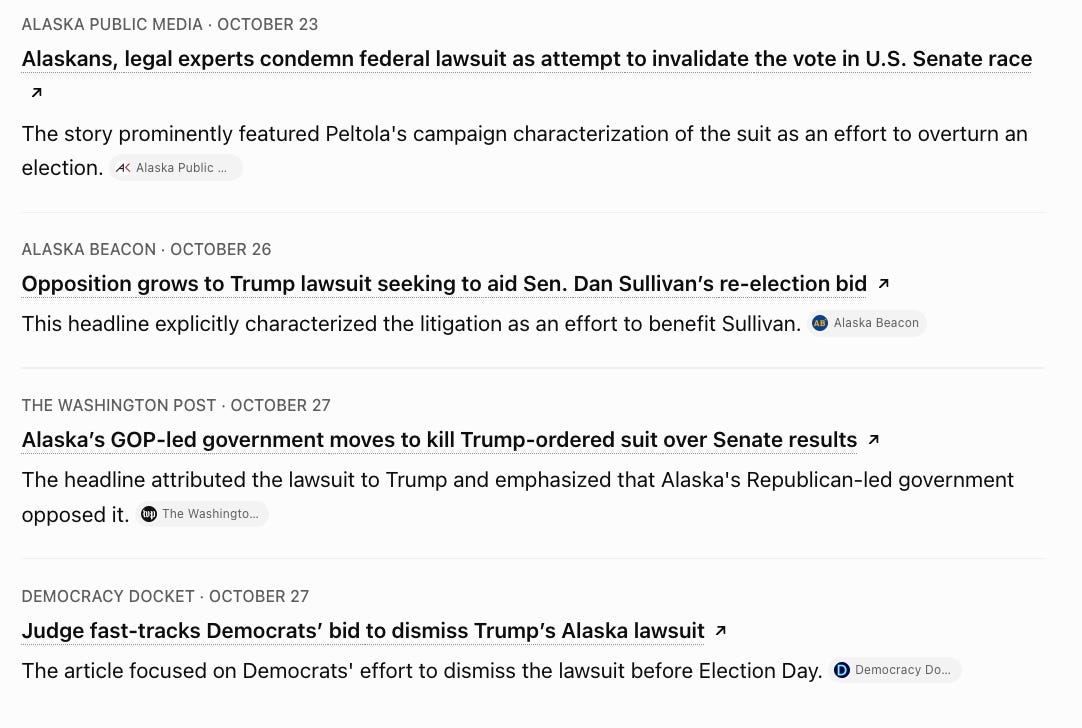
Consider how the mainstream press framed the controversy just days earlier. ABC News declared, “Trump told DOJ to sue to block Alaska Senate results if Republican narrowly loses.” The Washington Post announced, “DOJ seeks to block Alaska Senate result if Republican incumbent narrowly loses.” Reuters characterized the lawsuit as an attempt to block the possible election of a Democrat. Roll Call reduced the entire controversy to “DOJ sues to prevent Sullivan loss in Alaska.”
Notice the framing. Trump was the aggressor. His Justice Department was the threat. The underlying allegations of deliberate voter deception were relegated to secondary details, if they received attention at all.
Readers were encouraged to believe this was another attempt by Trump to overturn an election because he disliked the likely outcome. There was just one inconvenient problem.
The election-integrity concerns were not invented by Trump. And the alleged manipulation began long before his Justice Department intervened.
According to the October 28 New York Times investigation by Kellen Browning, the effort began in summer 2025, when a staffer associated with Peltola’s political operation was reportedly instructed to identify people throughout Alaska named Dan Sullivan.
The investigation, based on interviews, text messages, and other documentation, described involvement by Peltola campaign aides and individuals connected to the Democratic Senatorial Campaign Committee. The operation reportedly extended beyond recruiting a namesake candidate to finding other potential spoilers who might siphon votes from the Republican incumbent.
This was not simply an independent candidate who happened to share a common name. The reporting describes a coordinated effort to exploit that coincidence for political advantage.
And the alleged scheme required no ballot stuffing, hacked machines, or falsified vote totals. It required an ordinary voter to enter a polling place, recognize the name Dan Sullivan, and mistakenly select the wrong candidate.
The ballot would be counted accurately. The voter, however, would have supported someone he never intended to elect.
Alaska election officials had already raised concerns about the second Sullivan’s candidacy. His actual middle initial is J., yet he initially sought to appear on the ballot as “Dan S. Sullivan,” matching the Republican incumbent’s name and middle initial. His campaign presentation raised additional concerns about deliberately misleading voters. The Alaska Supreme Court ultimately allowed him to remain on the ballot, but that ruling did not resolve who recruited him, who financed his campaign, or whether the apparent attempt to confuse voters was part of a coordinated political operation.
The Justice Department subsequently filed suit seeking to delay certification under certain circumstances if the Republican incumbent narrowly loses. Whether federal law authorizes that remedy remains for the courts to decide.
But the Times investigation gives the underlying allegations a significance the early headlines largely obscured.
For years, Democratic politicians and their media allies have proclaimed themselves the guardians of election integrity. They have condemned voter suppression, warned about electoral interference, and insisted that democracy depends on public confidence in the voting process.
Yet in Alaska, political operatives associated with a major Democratic Senate campaign and the candidate herself pursued a corrupt scheme that sought to trick voters into making mistakes when voting.
The reported involvement of individuals connected to the Democratic Senatorial Campaign Committee makes this more than a local political stunt. It raises questions about the national party apparatus, campaign financing, and the extent of coordination behind the effort.
The New York Times has already identified some of the people behind this operation. Peltola’s former campaign manager, Elisa Rios, said Peltola was “definitely aware” of the scheme, although not personally directing it. Senior campaign aides exchanged messages with Democratic Senatorial Campaign Committee officials, including campaign director Andrew Piatt, about strategies to siphon conservative votes. Democratic operative Jerid Kurtz reportedly traveled through Alaska under an assumed name to recruit potential spoiler candidates.
The question is no longer simply whether Democratic operatives participated. The documented communications establish their involvement in planning ballot strategies. What remains unresolved is who authorized the namesake recruitment, who financed it, and whether senior officials approved the operation.
These questions demand answers, not another carefully crafted press statement.
The liberal mainstream media fell down again
On October 23, the dominant storyline was that Trump was attempting to block an election result. Five days later, the New York Times reported that Democratic operatives had been working behind the scenes to influence the ballot itself.
Credit belongs to Browning and the Times for publishing the investigation. But the contrast with the earlier coverage is revealing.
The press was quick to present Trump’s intervention as a threat to democracy. It was considerably less eager to make the alleged Democratic manipulation the centerpiece of the story.
How many Americans saw the alarming headlines about Trump but never understood the voter-confusion allegations behind the lawsuit? How many were left believing the controversy was simply another Republican attempt to reject an election? How many missed the below-the-fold headlines of Democrat involvement in this corrupt scheme?
And will the same outlets now devote comparable attention to the reported Democratic operation?
This is where the media’s credibility is on trial. Journalism is supposed to investigate abuses of power, not merely amplify accusations against whichever political figure its editors find most objectionable.
The election has not yet occurred. No one knows whether voters will actually be confused, and no court has established that the reported recruitment operation violated federal election law. In fact, it may be impossible to ever tease out the answers.
The issue is straightforward. Political parties should compete for votes by persuading citizens, not by exploiting mistakes in candidate identification. The people who claim to be saving democracy should not be engineering ways to confuse the voters they claim to protect.
And the journalists who spent the week portraying Trump as the threat to Alaska’s election owe their readers the rest of the story.
Because the real scandal alleged here is not that someone challenged an election procedure. It is that political operatives reportedly tried to turn voter confusion into an electoral weapon. And much of the national press seemed more interested in attacking the man who objected than examining the operation itself.
But in the end, voters will be confused - to what extent is impossible to gauge. Which is why the DoJ is correct.
If the Republican candidate loses, the election must not be certified. Frankly, Peltola is unfit to serve as a US Senator.
Enough with the cheating.
Independent journalism doesn’t survive on good intentions. It survives because readers are willing to support it.
While corporate media outlets shape headlines, protect favored narratives, and too often leave critical facts buried, we work to follow the evidence, ask uncomfortable questions, and hold powerful institutions accountable, regardless of political affiliation. We don’t have billionaire benefactors underwriting our work. We have you.
If you value independent reporting that challenges the official narrative rather than repeating it, please consider becoming a paid subscriber to Malone News. Your support keeps this work independent, accessible, and uncompromising.
“The apparent strategy was breathtakingly cynical: Find someone with the Republican senator’s name, put him on the ballot, and hope enough voters accidentally select the wrong man to influence the election.
The New York Times investigation puts Mary Peltola’s personal knowledge squarely under scrutiny. Her former campaign manager reportedly acknowledged that Peltola knew about the effort to recruit spoiler candidates, while documented communications link senior campaign aides and national Democratic officials to the operation. These are not allegations that can be brushed aside with another campaign denial.”
THE MEDIA BLAMED TRUMP. WOW. SHARE THIS ALL OVER.
The ny slimes IS part of the lamestream media, and they actually ran this story. I'm kinda surprised they did.
I would have expected them to run it AFTER the election, like the big article that was run (By politico? Can't remember exactly) after the 2020 election entitled, "How we saved the 2020 Election," and which was a fairly detailed description of the illegal acts and dirty tricks demoncrats and msm outlets did to suppress Trump's chances. They are all on the same team.
BTW - an "interesting" late-breaking item re: this AK election-rigging drill with the fake sullivan is that the main source for the story, who is a person fired from the campaign a while ago, has just come out saying, "I retract everything I said about this, and I am no longer a source." Obviously the peltola campaign came to him/her with a big settlement after they found out he/she was doing this story.
Again, surprisingly, the ny slimes has apparently said, "Sorry, charlie. Too late"
Is there some "progressive" unhappiness with peltola?