


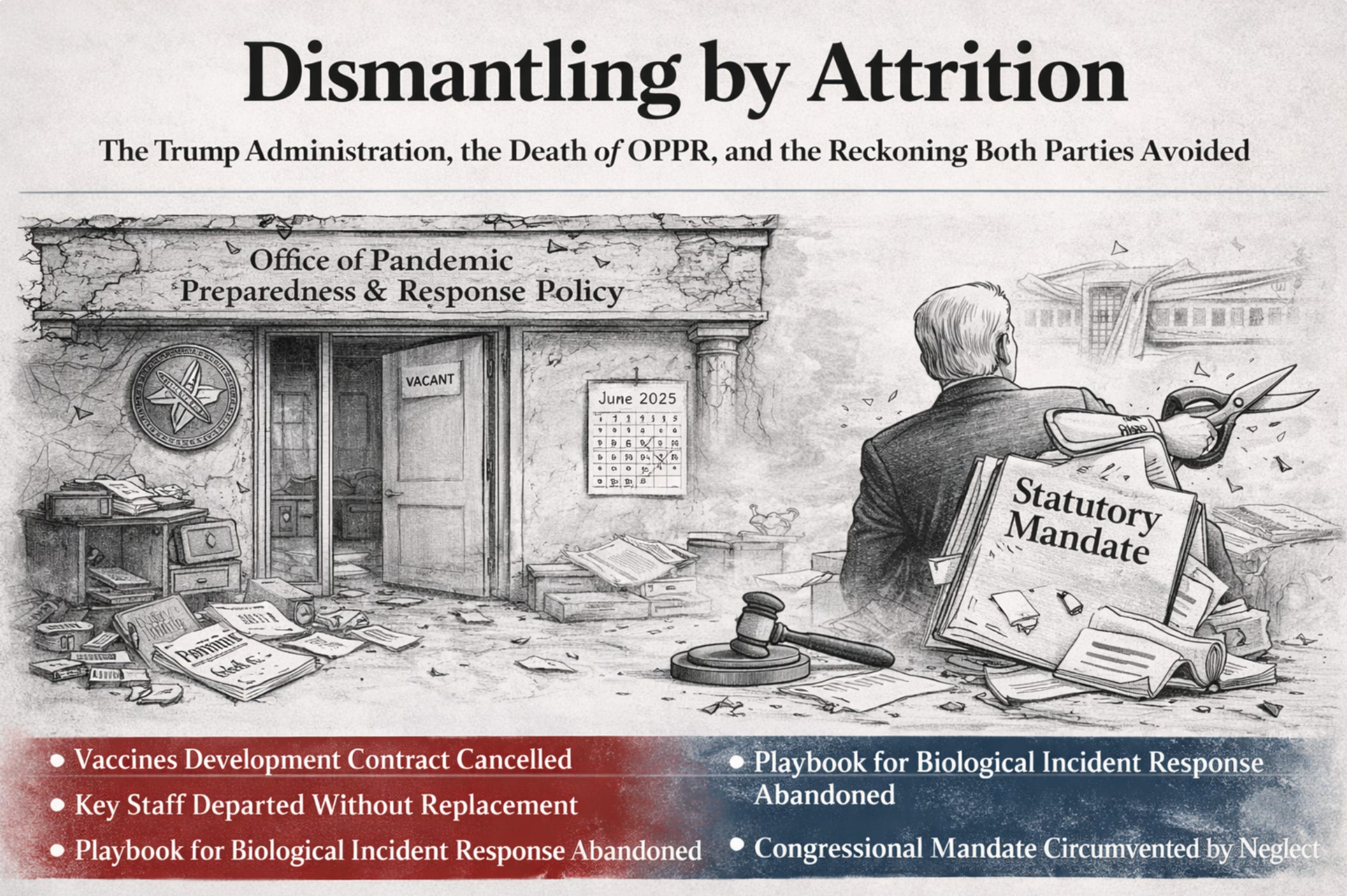
The Trump administration inherited a functioning, congressionally mandated pandemic planning organization in January 2025. The Office of Pandemic Preparedness and Response Policy had a director, a deputy, more than twenty professional staff, an active interagency coordination structure across seven federal agencies, a $766 million vaccine development program in mid-execution, a completed Biological Incident Response Playbook, and a statutory reporting obligation to Congress. By the end of June 2025, the office was empty. The Moderna contract had been cancelled. The interagency calls had stopped. The playbook sat in a drawer with no institution left to implement it.
This installment documents how that happened, evaluates the administration’s stated rationale against the legal and actuarial record, and asks what a principled conservative analysis of both parties’ pandemic governance failures requires. The answer is uncomfortable. The Biden administration’s censorship campaign was a genuine abuse of executive power, documented in detail and insulated from legal accountability by a Supreme Court majority that rendered it procedurally non-accountable. That said, the Trump administration’s attrition of a congressionally mandated statutory institution is not conservatism. It is the administrative state behaving exactly as conservatives have always said it behaves: unaccountable, non-transparent, and indifferent to law when the law is inconvenient. Both things are true. Sorting them out requires taking both seriously.
This installment also addresses the specific threat landscape with the precision it requires. H5N1, in its current form, is poorly infectious in humans, and evidence of human-to-human transmission remains negligible. The current outbreak is an agricultural and animal health problem, not an imminent pandemic. The point is not that H5N1 is the next COVID-19. The point is that the institutional infrastructure capable of monitoring whether it becomes more dangerous, coordinating surveillance across USDA, FDA, and CDC, and maintaining the countermeasure programs that would be needed if the virus adapts, is the same infrastructure the current administration has allowed to go dark. Dismantling that capacity, even though the current threat profile is manageable, is the institutional equivalent of canceling flood insurance after a dry summer.
PART THREE
The Trump Administration and OPPR: Legal Constraints and Policy Choices
The Stated Intent and the Legal Reality
Donald Trump had been explicit during the 2024 campaign about his view of OPPR. He described it as an “expensive solution to something that won’t work” and a “way of giving out pork.” This skepticism is consistent with a broader conservative critique of administrative state expansion: that Congress too readily creates new offices, staffed with unelected bureaucrats, that accumulate authority without accountability and tend to expand their mandates beyond their original justifications.
The problem with applying that critique to OPPR is that the legal constraint is real and does not disappear because a president finds an office philosophically objectionable. As Georgetown law professor Lawrence Gostin observed, “if Congress has set up an agency, he can’t dismantle it or transform it into another.” The executive branch has substantial discretion in how it implements statutory mandates: it can staff an office minimally, deprioritize its work, and resist expanding its budget. What it cannot do, without congressional action, is simply abolish a congressionally mandated institution.
This legal reality shaped the administration’s approach. Rather than a formal abolition, what occurred was a gradual attrition: the refusal to appoint a director, the failure to replace departing staff, the migration of pandemic preparedness functions to the NSC where they are shielded from public transparency, and the implicit institutional abandonment of a statutory office that the administration lacked the legal authority to formally close.
Gerald Parker and the NSC Migration
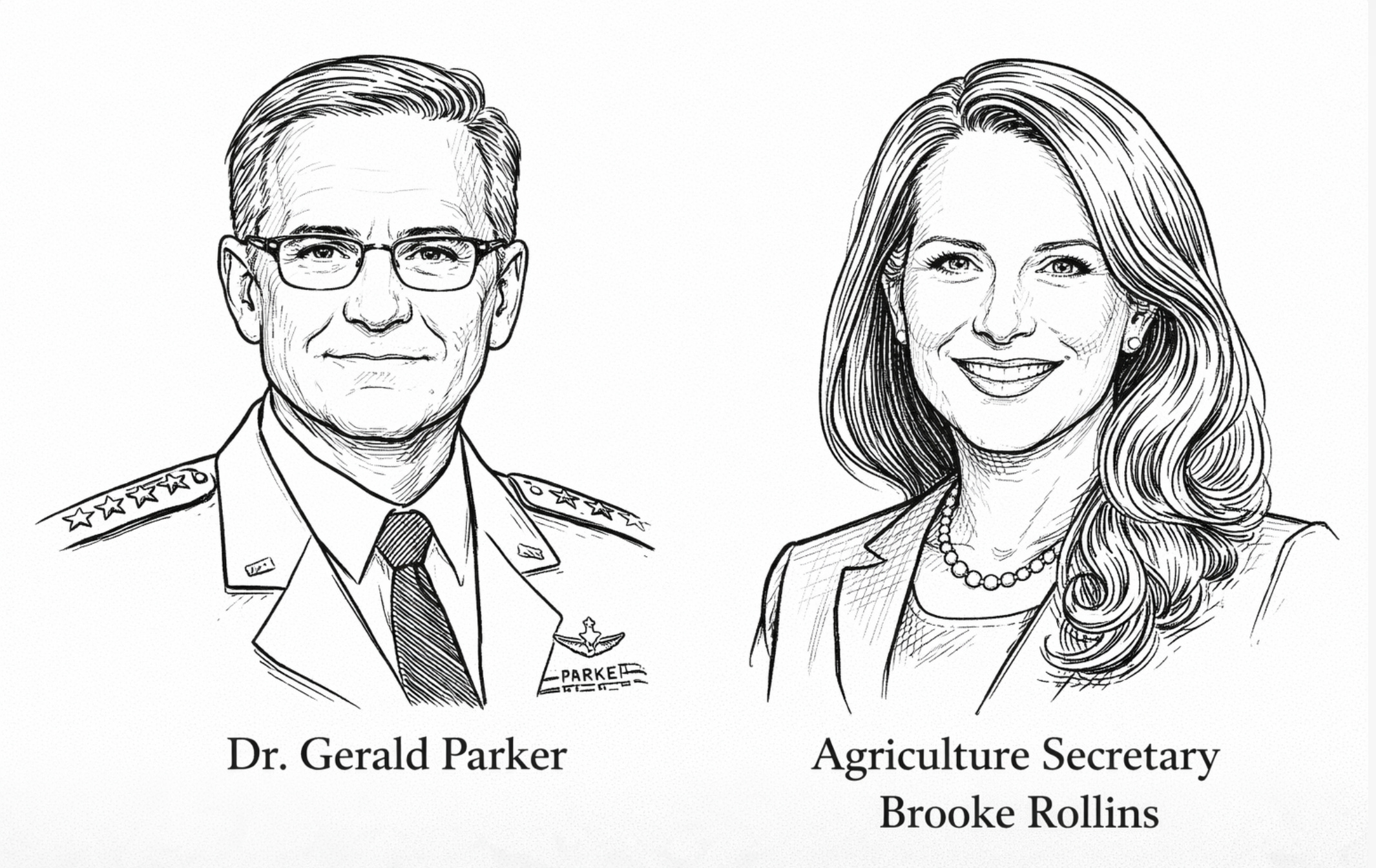
Shortly after inauguration, the White House quietly hired Dr. Gerald Parker, a veterinarian with 26 years of Army service and deep expertise in zoonotic diseases. Parker had served as commander of the U.S. Army Medical Research Institute of Infectious Diseases and had chaired the National Science Advisory Board for Biosecurity under Biden. His background in One Health, the integrated study of human, animal, and environmental health interactions, made him a credible choice for managing the H5N1 challenge.
But Parker was placed at the NSC as Senior Director for Biosecurity and Pandemic Response, not installed as OPPR’s director. He was never formally appointed to the statutory position the PREVENT Pandemics Act requires be filled. His work was done within the NSC, whose records are shielded from FOIA requests under the Presidential Records Act. The practical effect was to move pandemic preparedness coordination from a transparent, congressionally accountable statutory office into an executive office that operates largely outside public view.
Parker resigned in July 2025 after approximately six months. Reports indicated he had received little institutional support from his superiors. His departure left both the nominal OPPR and the NSC’s biosecurity directorate without senior leadership simultaneously
The Shift in H5N1 Policy: Economics Over Epidemiology
The change in OPPR’s operational posture was visible most clearly in the H5N1 response. OPPR under Biden had prioritized infection surveillance, protection of agricultural workers at the human-animal interface, and maintaining readiness to scale up the medical countermeasure response if the virus showed signs of adapting toward human-to-human transmission. The scientific rationale was straightforward: H5N1’s current low risk to the general public depends on its current inability to transmit efficiently between humans. That could change. Preparation for that potential change is the entire point of pandemic preparedness.
The Trump administration reorganized the H5N1 response around a different priority: egg prices. Agriculture Secretary Brooke Rollins announced a $1 billion strategy to combat avian flu, framed explicitly around “delivering affordable eggs” rather than containing a pathogen with pandemic potential. The $590 million contract for Moderna's mRNA vaccine came under review. The interagency coordination calls that Friedrichs had established stopped.
The Demise: By Attrition
The Trump administration had inherited six OPPR staff members who had not departed with the transition of political appointees. One by one, without replacement, they left. The last career official in the office departed in late June 2025. By summer 2025, OPPR was empty, the NSC’s biosecurity directorate was empty, and the $766 million Moderna contract had been cancelled. The Playbook for Biological Incident Response sat unused. The interagency coordination infrastructure built during four years of H5N1 response had dissolved.
The pattern has a historical precedent that should give conservatives pause. In 2018, the first Trump administration disbanded the NSC’s Global Health Security and Biodefense directorate, the predecessor coordination function. COVID-19 arrived two years later. The connection between those two events is disputed, but the temporal proximity is uncomfortable. Congress responded to that experience by mandating OPPR. The second Trump administration is repeating the same institutional abandonment that preceded the first administration’s most significant pandemic governance failures.
The Constitutional and Statutory Questions
The legal situation created by the administration’s approach to OPPR is genuinely complex and deserves serious attention from conservatives who care about the separation of powers. The executive branch is defying a statutory mandate not through a formal legal challenge or a request for congressional repeal but through the bureaucratic equivalent of malicious compliance: maintaining the nominal existence of the office while ensuring it cannot function.
Congress has tools available. It could condition appropriations on OPPR staffing levels. It could require quarterly reports from OPPR that cannot be produced if the office is empty, triggering automatic reporting of non-compliance. It could hold confirmation proceedings that force the administration to either nominate a director or publicly explain why it is refusing to comply with the statute. It has not used any of these tools. The blame for the current situation is not the executive branch’s alone.
The failure of Congress to enforce its own statutory mandate raises a broader institutional question that conservatives have long identified: oversight mechanisms only work if the institution empowered to use them has the political will to do so. The PREVENT Pandemics Act created the oversight architecture. Congress has allowed that architecture to sit dormant while the executive branch hollows out the institution it was designed to oversee.
CONCLUSION
Restraint, Accountability, and the Conservative Reckoning
Let’s start with what is not in dispute. The Biden White House ran a sustained, documented campaign to pressure the largest technology platforms in the world into suppressing speech its political operatives found inconvenient. That campaign was run day-to-day by people whose qualifications were in Democratic Party digital fundraising, not public health. Its targets were disproportionately conservative: scientists who questioned lockdown orthodoxy, commentators who challenged vaccine messaging, a hypothesis about the virus’s origins that federal intelligence agencies would later assess as most probably correct. The government outsourced censorship to private companies, insulated itself from direct constitutional liability through that intermediary structure, and then watched a 6-3 Supreme Court majority dismiss the resulting lawsuit on standing grounds without reaching the merits. Murray Rothbard would have recognized every move.
The Dobbs decision, handed down the same year the censorship lawsuit was filed, provided the constitutional vocabulary for understanding what was structurally wrong with the Biden approach to pandemic governance. The federal government has no general police power over health. Direct control of medical practice in the states is beyond its authority. The decisions made during COVID-19 about what citizens could read, what scientists could publish, and what hypotheses social media platforms were permitted to host were precisely the kind of medical and informational governance that Dobbs, NFIB v. OSHA, and the deeper logic of the Tenth Amendment place outside the federal government’s legitimate reach. The censorship campaign was not merely an ethical failure. It was a constitutional one. The machinery of the executive branch was deployed to control the national information environment in a domain where the executive branch had no business asserting control.
The case against that conduct is clear-cut. The case regarding OPPR is harder, and conservatives who want to be taken seriously on the first question must be honest about the second. OPPR was created by a bipartisan act of Congress. It was given a specific statutory mandate. It was staffed by credentialed professionals, and it performed real work: coordinating the H5N1 response across seven federal agencies when no individual agency had the authority to do so; managing a $766 million Moderna mRNA vaccine development program; building the Bio-5 Alliance to address the supply chain fragilities that COVID-19 had exposed; completing the Biological Incident Response Playbook that now sits in a drawer with no institution left to implement it. These were not bureaucratic make-work projects. They were the kind of pre-crisis preparation that has no visible constituency until the crisis arrives.
The Trump administration allowed OPPR to go dark not through a formal legal challenge or legislative repeal but through administrative attrition. It never appointed a director. It never submitted a budget. The six inherited staff departed by the end of June 2025. The interagency coordination calls stopped. The Moderna contract was cancelled. The office is, by every functional measure, empty. The president who made this choice is the same president who disbanded the NSC’s Global Health Security directorate in 2018, after which COVID-19 arrived in 2020. Congress responded to that episode by passing the PREVENT Pandemics Act in 2022. The pattern is not ambiguous. The institutional memory is being discarded in the same way it was discarded before, by the same administration, with the same confidence that the next emergency will not come before the political costs of preparedness exceed the political costs of unreadiness.
Conservatives who believe in constitutional governance should find this troubling. Pandemic preparedness is not a liberal cause. It is a readiness function, like a standing army or flood control infrastructure. The question is not whether the government should perform it. The question is whether it will.
Rothbard’s analysis of the state’s institutional tendency toward self-perpetuation and legitimization applies here with unsettling force, though not in the direction his libertarian framework usually points. The administrative state’s characteristic vice is expansion: the accumulation of authority, the multiplication of mandate, the permanent bureaucratic class that cultivates dependence on its own continued existence. But the administrative state has a second characteristic failure mode that receives less attention: the selective abandonment of functions that have powerful constituencies inside the government but weak ones outside it. Pandemic preparedness has no lobby. There is no industry that profits from the existence of an empty White House office. There is no vocal constituency demanding that the Biological Incident Response Playbook be staffed and exercised. The political economy of preparedness is therefore structurally disadvantaged relative to the political economy of response: the money flows after the emergency, not before it, which means the institutions that exist to prevent the emergency from being catastrophic are perpetually underfunded, understaffed, and vulnerable to the next administration’s indifference.
Congress built a mechanism to counteract exactly this tendency. The statutory reporting requirements in the PREVENT Pandemics Act were designed to make the consequences of neglect visible and aviodable before the next infectious disease outbreak. An OPPR that delivered biennial preparedness reviews and five-year outlook reports to Congress was an OPPR that created a public record of gaps, vulnerabilities, and risks, a record that elected officials could be held accountable for ignoring. An empty OPPR produces no such record. The reporting obligation is set out in the statute. The office that would fulfill it does not exist in practice. Congress is being denied information that an Act of Congress requires to be provided. The executive branch is not being challenged on this failure by a Congress that created the mechanism and then forgot to enforce it.
The remedies are available and not particularly exotic. Congress can condition appropriations on OPPR staffing levels. It can require quarterly reports that trigger automatic non-compliance findings when they are not produced. It can hold confirmation proceedings that force the administration to either nominate a director or publicly explain its refusal. Senator Burr’s successors on the Senate Health Committee have the same tools he used to create the office. They have not used them. The blame for the current situation belongs to both ends of Pennsylvania Avenue.
The reckoning this moment requires is not comfortable. It demands acknowledging that the Biden administration’s censorship campaign represented a genuine abuse of executive power, one that was insulated from legal accountability by the same structural capture of judicial institutions that Rothbard diagnosed and that the Murthy majority demonstrated. It demands acknowledging, simultaneously, that the Trump administration’s approach to a congressionally mandated preparedness institution represents not conservative governance but the same administrative indifference to law that conservatives have spent decades criticizing when the left practices it. And it demands acknowledging that pandemic preparedness properly understood, properly limited to the federal government’s legitimate constitutional role, disciplined against the mission creep that the Biden experience illustrates, is not big government. It is the basic obligation of a government that claims to take national security seriously.
The specific threat landscape matters, and precision requires acknowledging it. H5N1 in its current form is poorly infectious for humans, and the evidence for human-to-human transmission remains negligible. The current outbreak is an agricultural and animal health problem of genuine concern, not an imminent pandemic. The point is not that H5N1 is the next COVID-19. The point is that the institutional infrastructure capable of making that determination authoritatively, monitoring viral evolution, coordinating surveillance across USDA, FDA, and CDC, maintaining the supply chain and countermeasure programs that would be needed if the virus did adapt, is the same infrastructure the current administration has allowed to go dark.
The value of preparedness institutions is not that they predict the specific threat. It is that they maintain the capacity to respond to threats that cannot be predicted. Dismantling that capacity, even though the current threat profile is manageable, is the institutional equivalent of canceling flood insurance after a dry summer.
How was cancelling another mRNA vaccine project not a good thing? Rather than depending on jabs to fight respiratory viruses which mutate faster that jab updates why not emphasize development of more,effective,antivirals?
The evidence is that the individual actions of the states was more effective at innovating solutions than the centralized control over the Covid pandemic. Central governments in all western countries abused their citizens. Trust is lost. OPPR in bed with Moderna is unpalatable.