


Many are aware of the mRNA vaccine product DNA fragment adulteration issue that Kevin McKernan has identified and characterized. I covered this extensively when it was first revealed, including the risks associated with cationic lipid nanoparticle formulation and delivery of these DNA fragments into cells concurrently with the modified mRNA “active drug” ingredient.
Kevin has also discovered and highlighted that the structure of the bacterial plasmid DNA includes Simian Virus 40-derived sequences. The base plasmid that Kevin has is similar or identical to common gene therapy/shuttle vector research plasmid, designed to be used in both bacterial and mammalian cell research and development systems. The SV40 sequences in this type of “shuttle vector” are present for multiple reasons. The SV40 promoter/enhancer sequences function to enable the plasmid to produce mRNA (subsequently translated to protein) when introduced into animal cells.
The SV40 origin of replication sequences have a dual function. They serve to signal to animal cell machinery to pull this plasmid into the nucleus of the cell. They also function to cause the circular plasmid to replicate once introduced into a mammalian cell.
To be clear, this is not the same as a full SV40 virus sequence. The predominant cancer-causing (oncogenic) element of the actual SV40 virus is a protein called “Large T antigen”. The coding sequences for SV40 large T antigen are not present in these shuttle vectors. However, when the (Pfizer) plasmid template used for manufacturing the modified mRNA is degraded during the mod mRNA manufacturing process, some of the resulting short DNA fragments will include the SV40 promoter/enhancer sequence and the SV40 origin of replication.
If such fragments are delivered into cells of a vaccine recipient, and happen to integrate into the genome of that cell, they are likely to alter both the production of proteins coded by the region near the integration event, and might also impact on replication of that particular chromosome. Suffice to say, this is not good.
Naked DNA and RNA delivery
During 1990, it was discovered that one could inject both “naked DNA” and “naked RNA” (meaning you did not need cationic lipids or other delivery formulations) and a small fraction of the “naked” DNA or RNA would enter cells in the injected tissue and produce protein. This immediately gave rise to the use of this simple method to express foreign proteins for vaccination purposes. DNA and RNA vaccination using “naked” DNA or RNA.
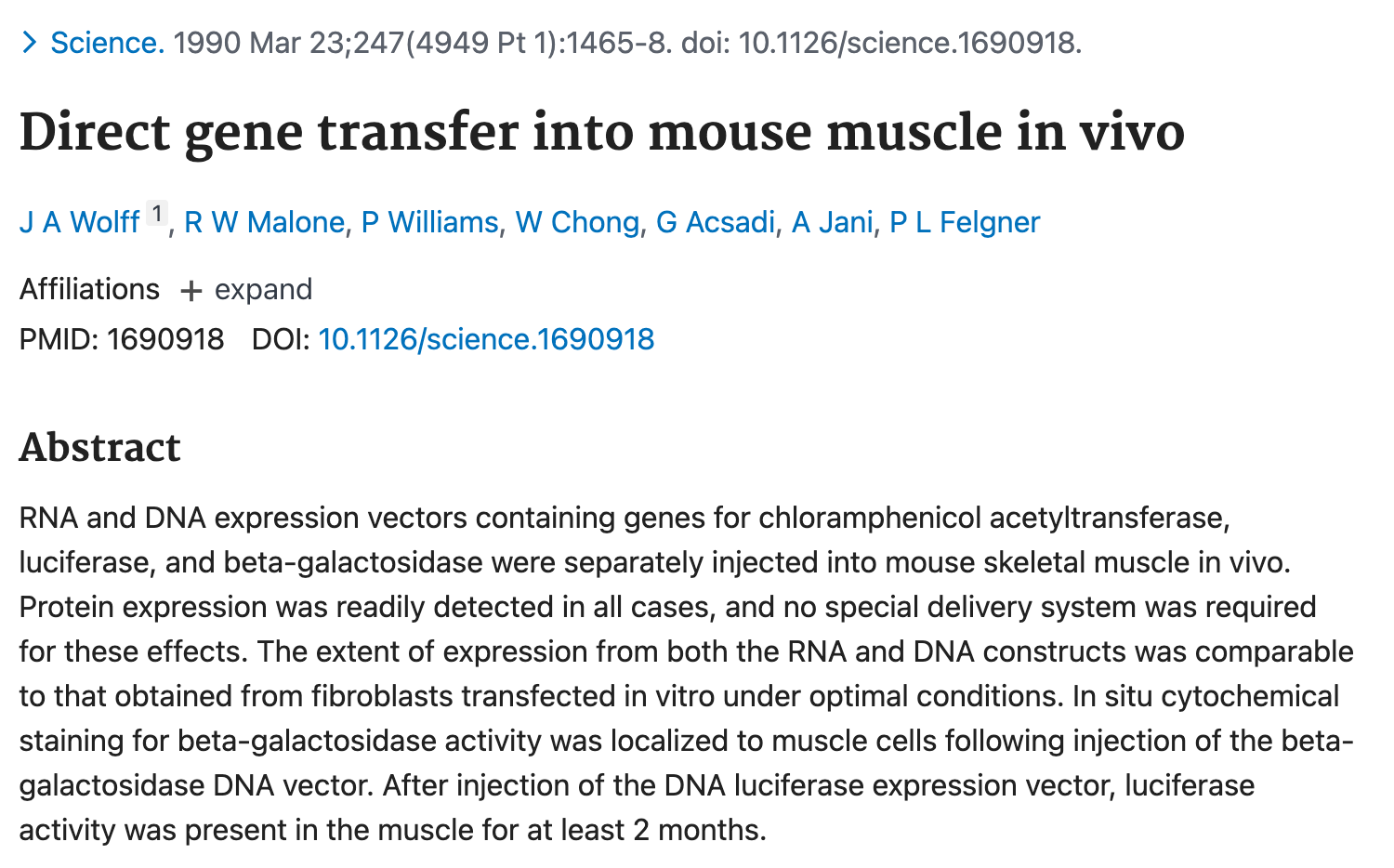
Those scientists and mainstream press reporters who seek to delegitimize my role in the discoveries relating to the use of mRNA as a drug or for vaccination purposes never mention this paper, which was considered both revolutionary and highly controversial at the time. The findings have been reproduced by scientists all over the world, and the paper has been cited 6,291 times in other peer-reviewed publications according to Google Scholar. The implications remain profound - DNA and mRNA can be readily taken up by a wide variety of cells in the body, leading to “transgene” expression in animals (including humans). This is relevant to the issue of “shedding” and exosome production as methods for transfer of genetic information (potentially including mRNA vaccines, whether mod mRNA or self-replicating RNA-based).
Discovery of the Adjuvant activity of CpG oligodeoxynucleotides
As news of this discovery rapidly circulated within the La Jolla, CA biotech and academic research community, and then the news that this could be used for vaccination purposes, skilled academic immunologists began asking questions about why this method was working, and what could be done to make DNA (in particular) vaccines work better. One of the key downstream discoveries (Dr. Eyal Raz was the first to discover that I was aware of) was that there were certain sequences in DNA plasmids that acted as natural adjuvants (agents that enhance immune responses). Eyal and others discovered that DNA sequences rich in repeated CpG acted as adjuvants in this system. Other research groups that eventually gave rise to the company DynaVax found that these sequences could even act as adjuvants for more standard vaccines (such as for Hepatitis B), which gave rise to various patents and eventually the biotech company DynaVax (current market capitalization 1.344 Billion US Dollars).
For those interested in reviewing the peer-reviewed literature on this topic, follow this link, which will pull up a list of over 5,000 peer-reviewed papers discussing the topic.
CpG oligodeoxynucleotides (ODNs) (short DNA fragments) are synthetic DNA molecules containing unmethylated cytosine-guanine (CpG) motifs that act as Toll-like receptor 9 (TLR9) agonists. They enhance vaccine immunogenicity by promoting Th1-biased immune responses, including cytokine production (e.g., IFN-α, IL-12) and activation of plasmacytoid dendritic cells and B cells. CpG adjuvants (e.g., CpG 1018, CpG 7909) have been evaluated in over 100 clinical trials for vaccines targeting infectious diseases, cancer, and allergies, with the only FDA-approved example being Heplisav-B (hepatitis B vaccine with CpG 1018). Overall, clinical data indicate a favorable safety profile, with most adverse events (AEs) being mild to moderate and transient, primarily due to innate immune activation. Serious AEs are rare and comparable to non-adjuvanted vaccines.
Here is a summary of the safety profile of CpG - based adjuvants-
Safety Profile Across Contexts
Infectious Disease Vaccines: In trials for HBV (Heplisav-B), anthrax, influenza, and SARS-CoV-2, AEs were similar to or slightly higher than alum-adjuvanted controls, with >90% seroprotection and no new safety signals. No systemic toxicity in phase I/II studies (doses 5–150 µg).
Cancer Vaccines: Phase I trials (e.g., lung cancer with CpG K3) reported no dose-limiting toxicities or grade 4 events; mild cytokine elevations but no immunosuppression.
Allergy Immunotherapy: In ragweed/cat trials, low reactogenicity at 0.5–1.5 mg/kg doses; no autoimmune flares (e.g., anti-dsDNA antibodies).
Special Populations: Safe in immunocompromised (e.g., HIV patients), elderly, and children (preclinical/early trials); no increased autoimmune risk (e.g., arthritis, SLE) despite theoretical concerns from rodent models.
Preclinical Insights: Rodent/non-human primate studies showed transient lymphocyte decreases or biochemical changes (e.g., albumin reduction) at high doses, but no gross pathology.
Which brings me to the final point of this essay.
Many of the DNA fragments produced from degradation of the plasmid DNA template used for manufacturing modified mRNA vaccines will be enriched in CpG sequences. These “contaminant/adulterants” will act as adjuvants for the modified mRNA vaccine products. Pfizer is definitely aware that CpG sequences act as adjuvants.
When considering what possible reason could exist for Pfizer to tolerate the presence of high levels of DNA fragment adulteration in the modified mRNA COVID vaccines, it may be that the manufacturer is aware that these residual DNA fragments will enhance the Th1 profile response of their COVID-19 vaccine products, but did not want to acknowledge this because it would have required additional testing to analyze the safety and biological activity of these surreptitious adjuvants.
This also raises the question of whether Pfizer is seeking to circumvent DynaVax's patents covering the use of CpG sequences as adjuvants.
Just another hypothesis relating to the “why do this” question. Maybe Pfizer is fully aware of what went down here, even if FDA/CBER’s Peter Marks was clueless.
I have a paper under review for several months now exactly on that topic. It's about 12k words long. After a substantial amount of work and revision, it was endorsed by the required number of reviewers ten days ago. Since then .... nothing. It fulfills the official acceptance criteria by that journal....
If such fragments are delivered into cells of a vaccine recipient, and happen to integrate into the genome of that cell, they are likely to alter both the production of proteins coded by the region near the integration event, and might also impact on replication of that particular chromosome.
Is this paragraph saying it can cause cancer? Or is it creating other problems?