

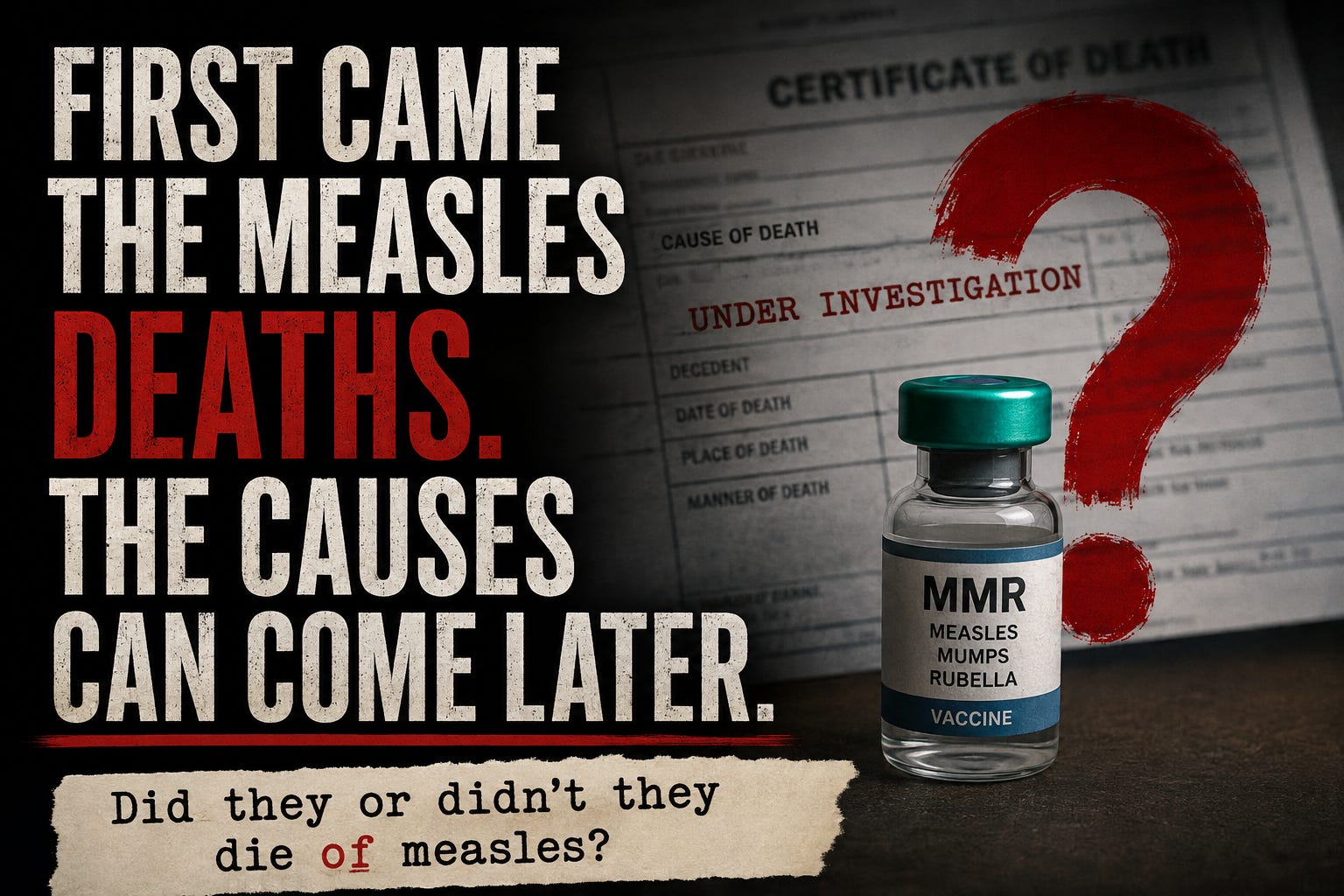
Pennsylvania announced this week what it called the first two “measles-associated deaths” in the Commonwealth in 35 years. Within hours, those carefully chosen words were disappearing. NBC News told readers that two unvaccinated people had “die[d] of measles.” Other news organizations similarly reported that people had died “from” or “of” measles. Governor Josh Shapiro quickly turned the deaths into an attack on Health and Human Services Secretary Robert F. Kennedy Jr., accusing Kennedy and the Trump administration of spreading misinformation with “real-life consequences.” There was just one rather important problem with this extraordinarily convenient narrative: Pennsylvania itself had not established that either person died from measles.
That is not my interpretation of some obscure epidemiological distinction. It comes directly from the Pennsylvania Department of Health. Department press secretary Neil Ruhland explained that the state uses the term “measles-associated” when laboratory or epidemiological evidence of measles is present, but the official cause of death remains under investigation. In other words, at the time Pennsylvania announced two historic measles-associated deaths, the official causes of those deaths had apparently not yet been determined.
That changes this story considerably. Measles can kill. It can cause pneumonia, encephalitis, and other serious complications, particularly among vulnerable people. There is nothing controversial about acknowledging that. But that is entirely different from announcing two deaths whose causes remain under investigation and watching “measles-associated” rapidly become “died of measles” in the national press. The former is a provisional public-health classification. The latter is a causal assertion. Somewhere between the Pennsylvania Department of Health and the headlines delivered to millions of Americans, that distinction largely disappeared.
Pennsylvania could resolve much of the confusion by releasing a modest amount of anonymized clinical information. Instead, the Department has declined to provide the ages of the deceased, their places of death, relevant medical histories, comorbidities, clinical courses, or the complications that supposedly connect measles to their deaths. Governor Shapiro and Health Secretary Debra Bogen would not even say whether either person was an infant (or elderly), whether either was pregnant, or whether they belonged to one of Lancaster County’s Plain communities. None of that requires publishing names or addresses. Age ranges, relevant comorbidities and causes of death are routinely reported without identifying individual patients.
There is also something rather selective about Pennsylvania’s newfound devotion to medical privacy. The Department says it cannot tell us the ages or medical backgrounds of the dead because doing so might identify them. Yet it had no apparent difficulty releasing one particular piece of private medical information: both were unvaccinated. Lancaster County Commissioner Josh Parsons noticed the same contradiction. Vaccination status is medical information too. By remarkable coincidence, it was also the one piece of medical information most useful for converting two unresolved deaths into a vaccination message.
Then There Is the Coroner
The story becomes considerably stranger when one turns from Harrisburg to Lancaster County itself. Lancaster County Coroner Dr. Stephen Diamantoni told LancasterOnline that his office had handled no measles deaths. Parsons subsequently contacted the coroner’s office and reported that it had “zero” cases in which measles was the immediate cause of death and one case involving someone who died with measles but not from it.
That does not prove Pennsylvania fabricated two deaths. Not every death is handled by a county coroner. A person who dies in a hospital under physician care from an established disease process may have a death certificate completed without the local coroner ever handling the case. Coroner Diamantoni himself offered perfectly plausible explanations, including the possibility that his office had not yet received the information or that a critically ill Lancaster County patient had been transferred to Hershey, Philadelphia, or another specialized facility outside the county, in which case the death could have been certified elsewhere.
But that reasonable explanation actually makes Pennsylvania’s silence more peculiar, not less. If one or both people died outside Lancaster County after being transferred for treatment, simply say so. If their deaths were certified by attending physicians rather than the Lancaster County coroner, say that. If another county’s coroner handled them, say that. Instead, Pennsylvania announced deaths that are both historically significant and politically explosive in Lancaster County, so the Lancaster County coroner said his office had no measles deaths, and the Department of Health declined to provide enough information to reconcile the two accounts. The public (and internet warriors) are left trying to assemble the facts while the governor is already delivering the political conclusion.
There is also a real infant death in this story, but it illustrates why the state’s opacity is so dangerous. Coroner Diamantoni confirmed that his office is investigating the death of an infant who tested positive for measles and died after suffering a ruptured spleen. His office does not currently classify that case as a measles death, and the investigation remains open. Most importantly, there is presently no evidence establishing that this infant is one of the two people Pennsylvania announced as its “measles-associated deaths.” No one should make that connection when the authorities themselves have not made it.
But think about how extraordinary the situation has become. We know that an infant with measles died in Lancaster County from a ruptured spleen; the coroner does not count that infant as a measles death; the state announces two other or possibly overlapping “measles-associated deaths,” refuses to provide their ages or causes of death, and then lectures the public about misinformation. Perhaps the first step in fighting misinformation is to provide information?
Seventeen Percent Hospitalized? Look at the Denominator
The same problem appears in Pennsylvania’s presentation of the outbreak itself. The Commonwealth reports 393 confirmed measles cases and 70 hospitalizations, producing a hospitalization rate of 17.8 percent. Nationally, the hospitalization rate among confirmed cases this year is approximately 7 percent. Pennsylvania therefore appears to have a hospitalization rate roughly two and a half times the national figure. Those numbers deserve attention. They do not, however, necessarily mean that nearly one in five Pennsylvanians who contract measles requires hospitalization. The denominator is not everyone infected with measles. It is everyone whose infection was detected, confirmed, and entered into the surveillance system.
That distinction becomes particularly important in Lancaster County. Physicians there have warned that the actual number of infections may be considerably higher than the confirmed case count because people with relatively uncomplicated measles may never seek conventional medical care or undergo testing. That possibility is especially relevant in parts of Lancaster’s Plain communities, where healthcare utilization patterns can differ substantially from the population at large. This should not be caricatured as “the Amish aren’t reporting measles.” The point is simpler. A seriously ill patient who arrives at a hospital is highly likely to be tested, diagnosed and counted. A person who develops fever and rash, remains home and recovers without seeking medical care will never enter Pennsylvania’s database at all.
That produces a classic ascertainment problem. Hospitalizations are difficult to miss. Mild infections are easy to miss, particularly in populations that almost universally avoid physicians for routine care and do not subscribe to health insurance. If the surveillance system captures a much larger percentage of severe cases than mild ones, the reported hospitalization percentage necessarily rises even though the biological severity of the disease has not changed. Pennsylvania may indeed be experiencing an unusually severe outbreak. Its case population may skew toward age groups more likely to require hospitalization. The Commonwealth may simply collect hospitalization information more completely than some other states. Or a substantial number of mild infections may be missing from the denominator. All are plausible explanations. What the existing numbers do not establish is that 17.8 percent of everyone infected with measles in Pennsylvania required hospitalization.
Yet the Department’s public messaging blurs precisely that distinction. Saying that nearly 20 percent of confirmed reported cases have been hospitalized is accurate. Saying that nearly 20 percent of “people who contract measles” are hospitalized implies something much broader: that the denominator represents everyone who contracted the disease. It does not. Once again, a qualified epidemiological statistic becomes a simpler and considerably more frightening public message. People are not stupid. They know what measles is and isn’t. This is precisely the type of propaganda that makes the public well aware that once again, they are being manipulated by public health officials.
For Perspective: What Measles Looked Like Before the Vaccine
Another piece of historical context is almost entirely absent from the current coverage. Before the measles vaccine was introduced in 1963, measles was extraordinarily common in the United States, but by that point it was rarely fatal. CDC estimates that during the decade before vaccination became available, 3 to 4 million Americans contracted measles each year, approximately 48,000 were hospitalized, and 400 to 500 died. Using those estimates, roughly 1.2 to 1.6 percent of infections resulted in hospitalization, while approximately 0.01 to 0.017 percent resulted in death. Put into more understandable terms, approximately one person died for every 6,000 to 10,000 people infected, while roughly one in 60 to 80 was hospitalized.
Those historical numbers make Pennsylvania’s current hospitalization figure particularly striking. A hospitalization rate approaching 18 percent among confirmed cases is more than ten times the estimated hospitalization rate among measles infections in the decade immediately preceding vaccination. That does not mean Pennsylvania’s 17.8 percent figure is false. Seventy people were hospitalized, and 393 cases were confirmed. The arithmetic is straightforward. What it means is that the denominator deserves considerably more scrutiny than it is receiving.
Either measles has somehow become dramatically more likely to require hospitalization (and in general, measles virus is genetically stable), Pennsylvania’s current case population differs profoundly from the millions of Americans infected before 1963, modern hospitalization practices account for a substantial part of the difference, or, as Lancaster physicians have suggested, surveillance is capturing the sick people who seek medical care while missing a considerable number who become ill and recover at home. Some combination of these factors may be operating. Simply presenting 17.8 percent as the risk faced by someone who contracts measles is not justified by the available denominator. Again, propaganda.
For another comparison, consider influenza. During the severe 2024–25 influenza season, CDC estimates that approximately 51 million Americans became ill, 710,000 were hospitalized, and 45,000 died. That produces an estimated hospitalization rate of about 1.39 percent, strikingly close to the roughly 1.2 to 1.6 percent calculated from CDC’s pre-vaccine measles estimates. But the estimated mortality rate for that flu season was approximately 0.088 percent, compared with roughly 0.01 to 0.017 percent for measles in the decade before vaccination. On those estimates, the risk of death per illness during the severe 2024–25 flu season was roughly five to nine times higher than the risk of death per measles infection in pre-vaccine America.
This is not a perfect apples-to-apples comparison. Influenza mortality is heavily concentrated among older Americans, while measles before vaccination was overwhelmingly a disease of childhood (although we don’t know which age cohorts were dying prior to vaccination). What we have learned is that healthy, normal children are the least likely to die. Children and the elderly with co-morbidities are more likely.
The historical measles numbers are estimates from an era with very different hospitalization practices, while contemporary influenza burden estimates are generated using modern surveillance and statistical modeling. But those limitations do not make the comparison meaningless. They provide scale. In the decade immediately before vaccination, the estimated risk of hospitalization from measles was roughly comparable to the risk from influenza during a severe modern flu season, while the estimated risk of death per measles illness was substantially lower.
That historical perspective does not establish what Pennsylvania’s true hospitalization rate is today. It does tell us that a reported rate of nearly 18 percent is so extraordinary that it demands explanation. Where are the mild cases? Who is being tested? Who is staying home? What are the ages and underlying conditions of the hospitalized patients? Why is Pennsylvania’s reported hospitalization percentage roughly two and a half times the current national rate and more than ten times the estimated pre-vaccine infection hospitalization rate? Those are not questions asked to minimize measles. They are exactly the questions epidemiologists should be asking when a modern surveillance statistic differs this dramatically from both historical experience and the current national rate.
And this is becoming a pattern. “Measles-associated deaths” becomes “died of measles.” “Seventy hospitalizations among 393 confirmed cases” becomes nearly 20 percent of people who “contract measles” being hospitalized. In both instances, the underlying data contain an important qualification, and that qualification makes the public-health message less dramatic. Somehow, as the information moves toward the public, the qualification gets lost.
We saw this same trick during COVID. “Died with COVID” became “died of COVID,” even when COVID was not the primary reason for hospitalization. Hospitals also received a 20% Medicare payment increase for qualifying COVID-19 hospitalizations. The distinction between with and from mattered then, and it matters now. “Measles-associated” does not mean “died of measles.”
Then Governor Shapiro Found His Villain
Governor Shapiro did not wait for the official causes of death to be determined before finding a political lesson in them. He announced that he had spoken personally with Kennedy and had been “very, very blunt” with him. Shapiro accused Kennedy and the Trump administration of confusing parents and argued that their rhetoric was negatively affecting communities in Pennsylvania, with “real-life consequences.” National news organizations then supplied a particularly useful piece of political context: Kennedy had appeared in Lancaster County in 2021.
There is also the inconvenient fact that Kennedy has repeatedly encouraged measles vaccination while serving as HHS Secretary. During the 2025 Texas outbreak, he wrote that the MMR vaccine was the “most effective way to prevent the spread of measles,” deployed CDC teams to Texas, supplied state clinics and pharmacies with MMR vaccine, and said vaccination protects both individuals and the broader community. HHS continues to state plainly that “getting vaccinated is the best way to prevent measles.” Kennedy has insisted that vaccination remain a personal choice, but portraying his tenure at HHS as a campaign to discourage measles vaccination simply does not square with the record.
That story has a problem, too. Pennsylvania’s own vaccination records do not support the simplistic causal narrative being constructed around Kennedy.
Lancaster County’s two-dose MMR coverage among kindergarten students was already only 93.6 percent in the 2020-21 school year. It fell to 91.0 percent in 2022-23, 88.5 percent in 2024-25, and 87.6 percent in 2025-26. That is a substantial decline, and it matters epidemiologically. But it is also a decline over the years, rather than a sudden collapse caused by some recent Kennedy policy. In fact, most recently, that decline happened during Biden’s administration. Indeed, the decline is remarkably steady, averaging roughly 1.2 percentage points per year, and the most recent year shows under Trump, if anything, a smaller annualized decline than the preceding period.
More damaging to Shapiro’s implication is what happened elsewhere in Pennsylvania. Religious exemptions among Lancaster kindergarten students rose from 113 in 2020-21 to 260 in 2022-23 (again, under Biden), the period encompassing Kennedy’s Lancaster appearance. Taken alone, that looks suggestive. But Lancaster was not remotely unique. Luzerne County increased from 21 to 91, more than a fourfold increase. Cumberland went from 17 to 64, Westmoreland from 40 to 104, York from 53 to 130, Butler from 16 to 40, Berks from 43 to 89, Montgomery from 86 to 178 and Erie from 41 to 85. Several counties in which Kennedy made no comparable Lancaster appearance experienced proportionately larger increases. Of course, many of the exceptions were in response to the COVID-19 vaccine mandates, and had nothing to do with the MMR vaccine. Public mistrust of public health policies will drive vaccine hesitancy, and for good reason during COVID.
There was plainly a large pandemic-era shift in public attitudes toward vaccination mandates and public-health authorities, driven by many people and events. But the geography undermines Shapiro’s neat Lancaster narrative. Kennedy’s 2021 appearance did not produce a uniquely Lancaster phenomenon. Lancaster does not stand out when compared with counties where he did not appear. The increase was part of a much broader statewide pattern.
The attempt to connect the outbreak to the current Trump administration is even more absurd. The federal executive order invoked in some of the coverage was signed on August 10, 2026, just 15 days before Pennsylvania announced the deaths. By then, nearly all of Lancaster’s measured five-year decline in kindergarten MMR coverage had already occurred. The vaccination trend spans multiple administrations and shows no sudden 2026 inflection. The policy now being dragged into the story cannot have traveled backward through time and produced a vaccination decline that was already almost complete before the policy existed.
The Problem Is Not That Measles Is Harmless
When confronted with this kind of government messaging, there is a temptation to argue the opposite extreme. That would also be a mistake. Measles is not harmless. Pennsylvania has documented 70 hospitalizations, and those hospitalizations are real regardless of what the true infection denominator ultimately proves to be. Both people Pennsylvania has classified as measles-associated deaths were reportedly unvaccinated (still not confirmed). No confirmed Pennsylvania case has been reported in someone who received both MMR doses. Those facts belong in this story too. Recall that, if these were elderly and not children, the elderly generally were not vaccinated because they had developed superior natural immunity from childhood measles infections. If they were in the age range where they received the early-1960s single-dose measles vaccine, then this would become a story supporting the measles risks associated with this cohort as they age. Again, we need the actual data details to interpret the overall public health meaning.
But acknowledging those facts makes the government’s behavior harder to defend, not easier. There is no legitimate public-health reason to exaggerate a disease that is genuinely capable of causing serious illness. If measles is dangerous, report its risks accurately. If two people died from measles, establish that and tell the public what happened. If 17.8 percent of confirmed cases were hospitalized, say 17.8 percent of confirmed cases were hospitalized. The moment officials begin sanding away inconvenient qualifications because the simplified version produces a more frightening headline, they cease educating the public and begin managing it.
And that is what makes Shapiro’s attack on Kennedy particularly offensive. Pennsylvania had not released the ages of the deceased. It had not released their medical histories. It had not described their clinical courses. Its own spokesman acknowledged that their official causes of death remained under investigation. The local coroner said his office had no deaths in which measles was the immediate cause. The state had not explained that discrepancy. Yet the governor already knew whom Americans should blame.
Think about that sequence. The medical conclusion was still unresolved, but the political conclusion was ready for television.
If you enjoy our work, please share or republish our articles!
From Public Health to Propaganda
This is how public-health institutions destroy their own credibility and then blame the public for no longer trusting them. The problem is not that every statement Pennsylvania made is false. That would actually be easier to deal with. The problem is the careful selection and compression of facts. The state gives us the frightening fact but not the qualifying information. It gives us vaccination status but not age or comorbidities. It announces “measles-associated deaths” but does not tell us how the people died. It has weaponized this partial information to advance a predetermined political narrative.
Instead, Pennsylvania appears to have reversed the process. The political conclusion came first. The frightening headline came second. The press amplification followed. The evidence disappeared behind claims of privacy. Then the governor lectured everyone else about misinformation.
That is not public health. It is propaganda dressed in a white coat.
Perhaps Pennsylvania will eventually release enough information to demonstrate clearly that both people died as a direct consequence of measles. If it does, then that is what the evidence will show, and the facts should be reported accordingly. But that is not what the Commonwealth has given us so far. What we have instead are two vaguely defined “measles-associated deaths,” virtually no clinical information, conflicting accounts about who died, an apparent disconnect with the Lancaster County Coroner’s Office, and a governor who managed to transform two barely described deaths into an attack on Robert F. Kennedy Jr. almost immediately.
If Pennsylvania wants the public to believe that these deaths demonstrate the danger of measles, there is a remarkably easy way to begin.
Tell us how they died.
People ask how we can be so productive. The truth is that we work long and hard. Robert and I got up at five this morning and soon began writing. It's post 11 AM EST, not even noon yet, and between the two of us, we have put in 10 hours of work.
Independent journalism means asking the questions government officials would rather not answer, checking the numbers behind the headlines, and refusing to confuse a politically useful narrative with established fact.
Frankly, at times, it even means pissing off our friends in the Trump administration and industry. Telling truth to power takes guts.
This all takes time, research, and increasingly, a willingness to challenge stories that much of the media simply repeats. If you value this kind of work, please consider becoming a paid subscriber. Your support keeps Malone News independent and allows us to keep digging when the official story does not add up.
References:
Centers for Disease Control and Prevention. “Measles Cases and Outbreaks.” CDC, updated August 20, 2026.
Centers for Disease Control and Prevention. “Measles History.” CDC. Historical estimates for the decade before measles vaccination: approximately 3–4 million infections, 48,000 hospitalizations, and 400–500 deaths annually.
Centers for Disease Control and Prevention. “2024–2025 Estimated Influenza Illnesses, Medical Visits, Hospitalizations, and Deaths in the United States.” CDC. Estimates approximately 51 million illnesses, 710,000 hospitalizations, and 45,000 deaths.
Christensen, Jen. “Two Unvaccinated People in Pennsylvania Are First Measles-Related Deaths in US This Year.” CNN, August 25, 2026.
Edwards, Erika. “Two Unvaccinated People Die of Measles in Pennsylvania Outbreak, Health Officials Say.” NBC News, August 25, 2026.
Garber, Anne, and Dan Nephin. “Lancaster County Coroner’s Records Don’t Add Clarity to 2 Pa. Deaths Tied to Measles.” LNP | LancasterOnline, August 25, 2026.
Leonard, Nicole. “2 Unvaccinated Pennsylvanians Die after Contracting Measles as Cases Grow.” WHYY, August 25, 2026.
Pennsylvania Department of Health. “Pennsylvania Department of Health Confirms Two Measles-Associated Deaths.” August 25, 2026.
Pennsylvania Department of Health. “Shapiro Administration Expands Measles Response Efforts Following Pennsylvania’s First Measles-Associated Deaths in 35 Years.” August 25, 2026.
Pennsylvania Department of Health. “Shapiro Administration Launches Measles Dashboard to Keep Parents, Public Informed of Ongoing Cases.” July 14, 2026.
Pennsylvania Department of Health. “School Immunization Rates.” 2026.
Pennsylvania Department of Health. “School Immunization Survey Summary by County, 2020–2021.” November 10, 2021.
Pennsylvania Department of Health. “School Immunization Survey Summary by County, 2022–2023.” November 16, 2023.
Pennsylvania Department of Health. “School Immunization Survey Summary by County, 2024–2025.” July 29, 2025.
Pennsylvania Department of Health. “School Immunization Survey Summary by County, 2025–2026.” July 30, 2026.
Lancaster County Coroner’s Office. “Frequently Asked Questions: Coroner.” Lancaster County, Pennsylvania. Accessed August 26, 2026.
Parsons, Josh. Statement concerning Lancaster County measles deaths and communication with the Lancaster County Coroner’s Office. X, August 25, 2026.
Van Beusekom, Mary. “Measles-Related Deaths in Pennsylvania Mark First 2 US Fatalities This Year.” CIDRAP, University of Minnesota, August 25, 2026.
Whelan, Aubrey. “Pennsylvania Reports Two Measles Deaths in Lancaster County, State’s First in Three Decades.” The Philadelphia Inquirer, August 25, 2026.
Centers for Medicare & Medicaid Services. “Acute Inpatient PPS.” CMS. CARES Act COVID-19 inpatient payment provisions, including the 20 percent increase in the weighting factor for qualifying COVID-19 inpatient discharges.
"Propaganda dressed in a white coat". I get so infuriated by the same old slight of hand, what is the underlying purpose for all the double-speak? Fear? Poor protocol followed? Cover your butt just in case? Incorrect procedures? Without your help in identifying these subtle and not so subtle announcements many years ago, I wouldn't be so astute in seeing and hearing these inaccuracies. Thank you for all the hours spent, and I think it is a good idea to keep reminding people how much time and effort you spend, this is not magic.
This is a busy morning, so I only had time to read a part of the article. But I wondered if they were unvaccinated illegal aliens? During the Biden administration's open borders little attention was given to the fact that a significant amount of these illegal aliens came in with little health care in their backgrounds. It was at that time that measures once again became an issue
By the way, I'm 84 and at that time we weren't vaccinated against the measles (or much of anything.) All of us had a severe case of the measles and survived.