


By: Wendy McElroy
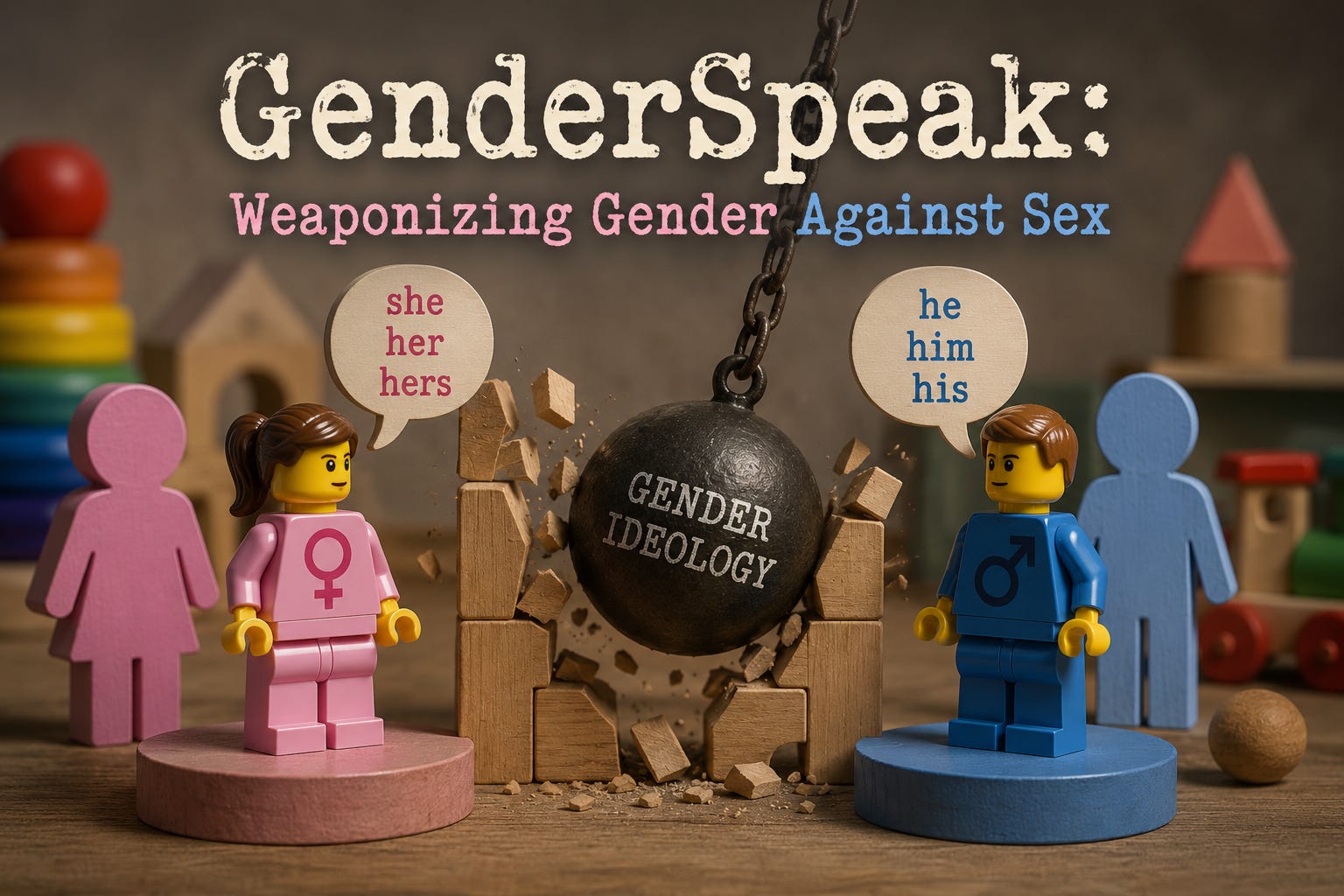
When and why did the word “gender” displace the word “sex?” “Gender” refers to a person’s socially constructed identity of being male, female, or some other category, while “sex” refers to physical characteristics of male or female, such as chromosomes. Gender is a matter of a person’s self-perception; sex is a circumstance of birth.
When did sex get pushed to the curb by gender? In his book The Man Who Invented Gender, Terry Goldie claims that the sexologist John Money of Johns Hopkins Medical Center (Baltimore) first used the word “gender” in its modern meaning in 1955. Money pioneered the word to describe his famous John/Joan experiment that was conducted on a young boy named Bruce who’d lost his penis in an accident. To ‘prove’ Money’s theory that sexual identity was learned and not biological, Bruce’s parents raised him as a girl, complete with a surgically constructed vagina. The experiment failed. Bruce ultimately insisted on living as male, but he did not recover from the ordeal Money imposed on him, which he called torture. Bruce committed suicide in his 30s.
By then, however, Money had declared for decades that John/Joan was a complete success; discussions of “gender identity” abounded in ‘60s medical journals and academia. By the ‘70s and ‘80s, feminists brought the term to the streets, with “gender” describing a person’s self-defined sociocultural identity and “sex” meaning biology. Then, the word wedged its way into government. In 1993, for instance, the Food and Drug Administration (FDA) replaced “sex” with “gender” in its literature. In 2011, “sex” returned to the FDA to mean biology while “gender” meant “a person’s self-representation.” The term went global. Also in 1993, the United Nations Declaration on the Elimination of Violence Against Women (DEVAW) vaguely defined this aggression as “any act of gender-based violence that results in, or is likely to result in, physical, sexual or psychological harm or suffering to women.”
Genderspeak became the language of elites, social justice activists, and the government, while average people still spoke of “sex”. But more than elitism lies behind the difference in words. By swapping in their own terms, elitists—especially professional feminists—grabbed the narrative on sexuality and politicized it to dismiss anyone who disagrees. Since the average male generally still uses biology to define his sexuality, he is an opponent; the average male is a living, breathing disagreement.
The ideology of gender faces an obstacle, however. If people can argue effectively against gender, then the narrative is difficult to manage. Those who dissent must be intimidated into silence or otherwise marginalized. The main strategy is to condemn dissenters as hate-filled. If some people cannot be silenced, then their words or opinions can become hate crimes punishable by law. George Orwell’s novel Nineteen-Eighty-Four is about a dystopian society of social control, which is maintained largely through restricting language. Since words are the foundation of thought, this means people cannot form thoughts, let alone articulate them. The villain of Nineteen-Eighty-Four proclaims, “The whole aim of Newspeak is to narrow the range of thought.” He concludes, “The Revolution will be complete when the language is perfect.”
Men’s health researcher James L. Nuzzo highlights an attempt to perfect the language. “In recent years, use of the phrase “gender-based violence” (or “gendered violence”) in the titles and abstracts of papers indexed in PubMed has increased noticeably. Between 2019 and 2025, the phrase “gender-based violence” (or “gendered violence”) appeared in the titles or abstracts of 2,784 articles indexed in PubMed.” [Chart available here.]
A typical definition of gender-related violence or gendered violence is “any form of physical or non-physical violence or abuse against a person or group of people because of biased or harmful beliefs about gender. It can include things that happen online and that use digital technology.” This definition is typical because it includes non-physical violence (discrimination) and abuse (words) that are motivated by non-specific ”biased or harmful beliefs about gender.” Nineteen-Eighty-Four would refer to such non-physical violence as “crimethink,” with thought itself being an assault.
Just as “sex” is displaced by “gender,” well-researched and comparatively clear terms such as “domestic violence” are displaced by less-defined ones such as “gender-related violence.” This achieves several goals. For one thing, the confusing definition becomes elastic. Almost any word or act can be stretched to qualify as “gender-related violence,” especially since virtually everything in the politicized feminist universe is gender-related.
But the most important purpose of swapping in the word “gender” is to introduce a subtle but powerful bias that controls the narrative; it creates Genderspeak.
The concept of gender comes directly from the twin ideologies of Social Constructionism and Gender Feminism. Social Constructionism tells us that male and female are learned forms of behavior (gender) rather than biology (sex).
To this, Gender Feminism adds an ideological layer. Male and female are patriarchal learned behaviors; they are social concepts derived from white male capitalistic culture. Thus, approaching violence in a correctly gendered way means rejecting white male capitalism—the economic system that is said to vest power and wealth in the hands of white men at the expense of everyone else. To embrace gender is to reject white male culture and capitalism, with ‘the free market’ usually viewed as a synonym.
Genderspeak is similar to Orwell’s Newspeak. Both are ambiguous speech that embeds ideology into the language so that every word perpetuates correcthink—officially approved thought. In Orwell’s dystopian world, Newspeak serves the ideological goals of Ingsoc – an abbreviation for English Socialism. It gradually replaces Oldspeak and becomes pivotal in defining politics and culture. Genderspeak has the same ideological goal. If you embed gender ideology into words, then you control how people think and how culture develops.
The process goes something like this:
Embed new ideologically-driven language when possible. For example, substitute the term “gendered violence” for the more research-driven term “domestic violence.”
Eliminate “wrong” words. In Nineteen-Eighty-Four, salvageable literature was rewritten in Newspeak so that authors either disappeared or were reinterpreted to serve Ingsoc. Today, school texts are commonly reviewed to eliminate wrong words. ‘Improper’ ones like “Founding Fathers” are changed to proper ones like “Framers.”
Change the meaning of words. In Nineteen-Eighty-Four, the word “free” is used only in the simple form of ‘my sweater is free of lint.’ The concept of freedom does not exist. The current usage of “diversity” in Genderspeak is similar. It is a diversity that tolerates no deviation. Its conclusions are or can be mandated by law.
Introduce doublethink. Doublethink is when someone accepts two contradictory ideas as being true. A modern example is students who attend “sensitivity training,” which includes publicly ridiculing and humiliating whites and males because of their race and sex. This is sensitivity?
Last of all, decry anyone who objects as a hater and oppressor; punish them.
Precise wording provides the incredible benefit of letting people know what they are talking about. It is time to reclaim the richness of precise English…verb by verb, adjective by adjective. Words should not be propaganda that blocks thought; disagreement is no crime. And sex is reality, while gender is not. The concept and the word “gender” should be abandoned by people who respect either accuracy or truth.
End.
This article was originally published at Brownstone Institute.
If you appreciate this kind of original research, primary source analysis, and the time it takes to dig through thousands of pages of documents so you don't have to, please consider becoming a paid subscriber. Your support makes this work possible, keeps us independent, and allows us to continue following stories long after everyone else has moved on. Thank you for helping us keep asking difficult questions.
Executive Summary: Anthony Fauci’s Private Journal
Senator Rand Paul has now released more than 1,100 pages of what amounts to Dr. Anthony Fauci’s private working journal, daily notes, emails, schedules, and supporting documents from the COVID era. Far from being a conventional diary, the collection provides a rare window into how one of the world’s most influential public health officials viewed events as they unfolded.
This document provides something arguably more valuable: contemporaneous records that allow readers to compare what was being discussed privately with what was later communicated publicly.
Among the most significant themes are:
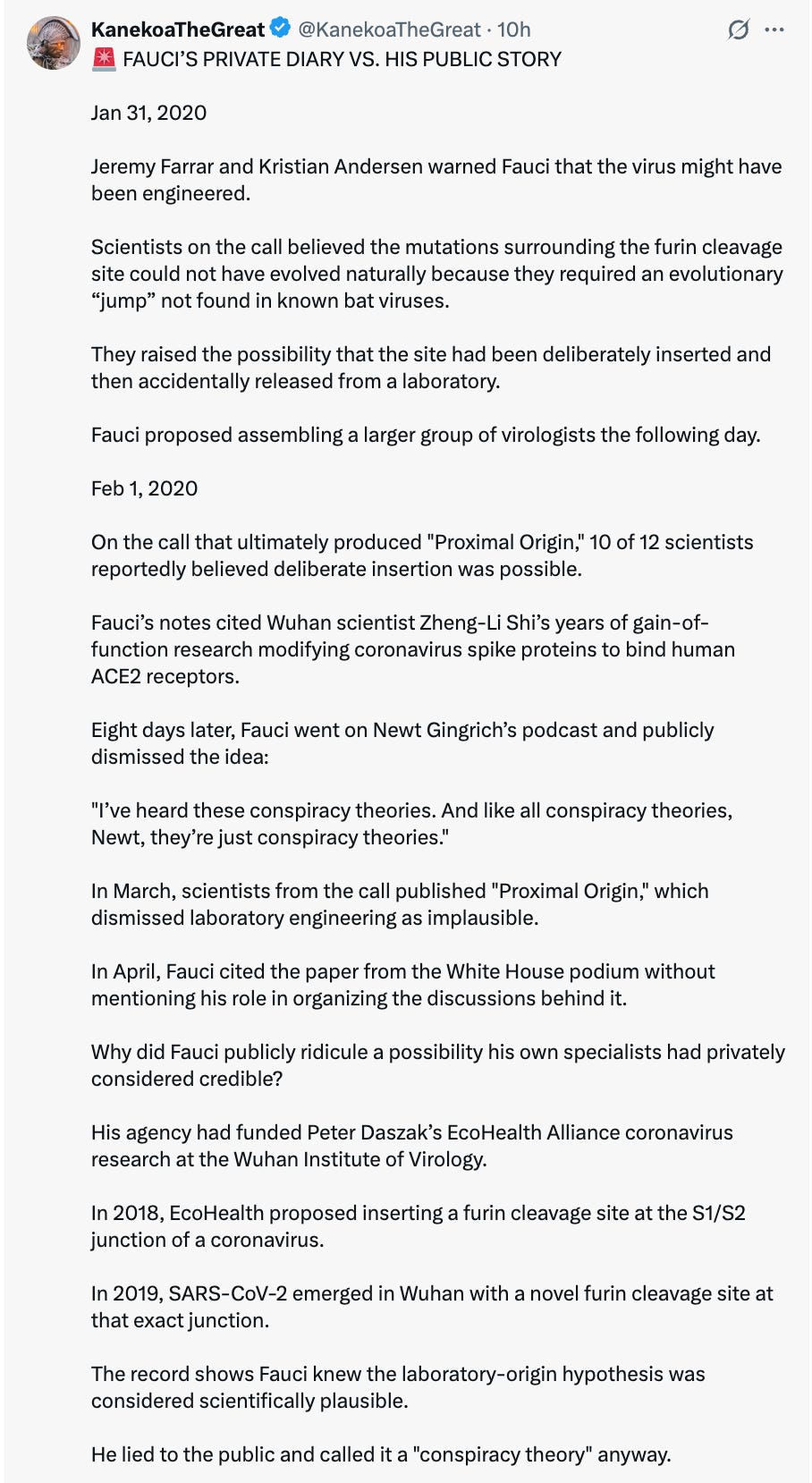
The laboratory-origin hypothesis was taken seriously by senior scientific advisers during the earliest weeks of the pandemic. The journal documents Fauci’s efforts to organize scientific discussions as concerns emerged, demonstrating that a laboratory accident was viewed as a plausible possibility before the public narrative rapidly shifted toward natural emergence.
The records reveal substantial scientific uncertainty during January and February 2020. Contrary to later claims that “the science was settled,” the documents show ongoing debate, disagreement, and evaluation of competing hypotheses before a consensus was publicly presented.
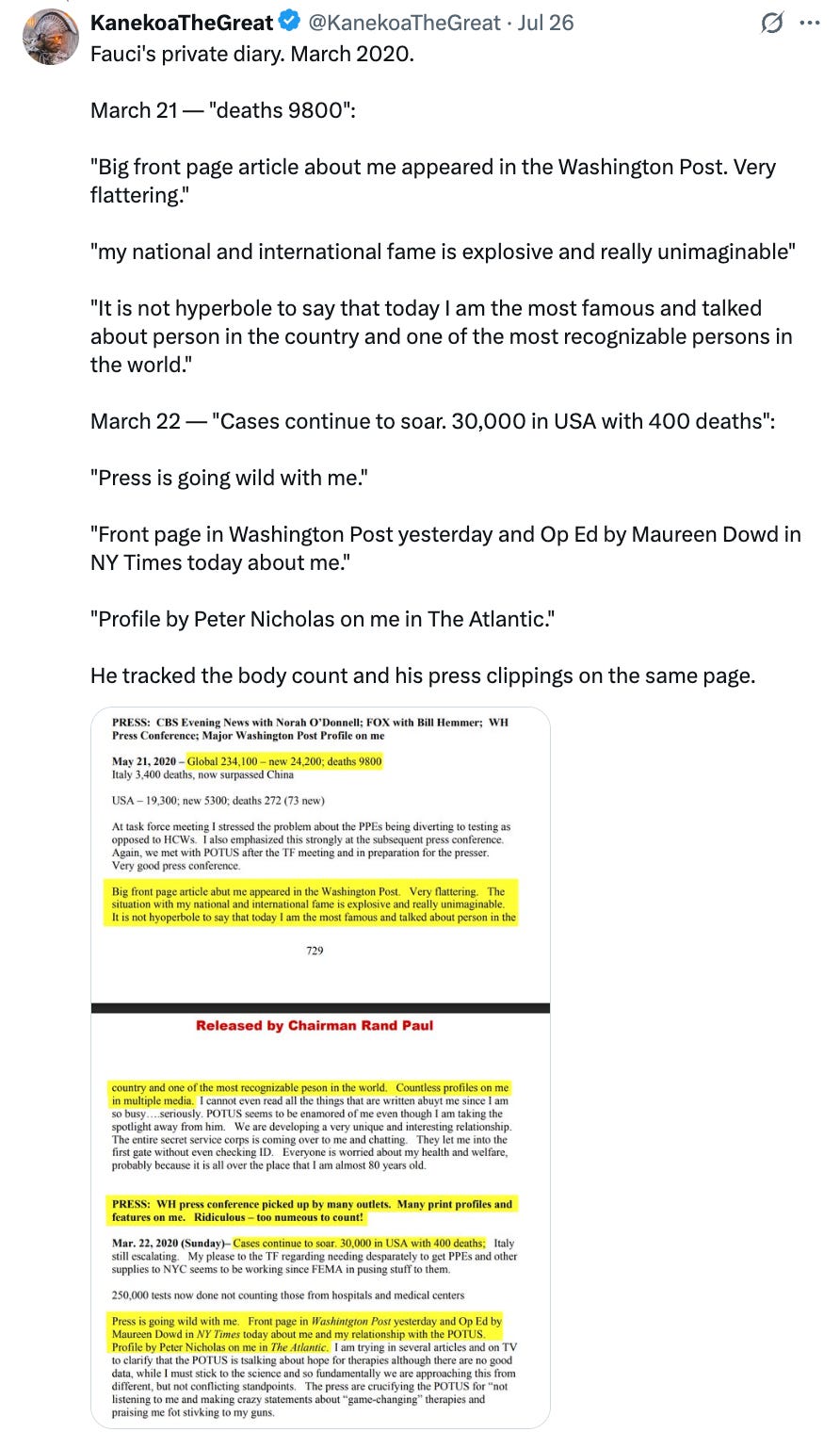
Fauci’s daily entries illustrate the extraordinary degree to which he became involved in media strategy, public messaging, and political communications. The journal chronicles an almost relentless schedule of television appearances, interviews, briefings, and messaging decisions throughout the pandemic.
The journal also captures Fauci’s awareness that he had become a celebrity and a political symbol rather than simply a scientific adviser. He comments repeatedly on media coverage, public criticism, praise, celebrity status, threats against himself and his family, and the increasingly polarized political environment surrounding COVID-19.
Throughout the pandemic, Fauci consistently advocated for aggressive mitigation measures and expressed concern that political leaders were moving too quickly toward reopening. The entries document repeated frustration that public health recommendations were being diluted or ignored. He did this without an awareness that the science around lockdowns and masking was not settled.
The collection also sheds light on internal discussions surrounding boosters, updated vaccines, pandemic preparedness, and relationships among NIH, FDA, industry, and outside stakeholders as the response evolved into 2022.
The documents do not, by themselves, prove that Dr. Fauci knew SARS-CoV-2 was engineered, that he knowingly participated in a cover-up, or that he possessed definitive evidence of a laboratory origin. Readers looking for a single incriminating document will not find one.
For that evidence, the February 2020 emails, the Proximal Origin drafting history, the FOIA releases, NIH funding records, congressional testimony, and Baric's more recent admissions support the conclusion that senior officials and scientists regarded a laboratory origin as a credible possibility very early in the pandemic are bigger smoking guns. They also show coordinated efforts to evaluate and communicate about that possibility.
Instead, the value of this release lies in its historical record. It demonstrates that many issues later portrayed as settled were, in fact, actively debated behind closed doors. It shows the evolution of scientific thinking in real time, the interaction between science, politics, and public messaging, and the immense pressures under which pandemic policy was developed.
For historians of COVID-19, this collection is likely to become one of the most important primary source documents yet released. Anyone seeking to understand how the official narrative evolved should read the original materials rather than relying on selective excerpts or commentary from either supporters or critics.
When I think of all things an enemy might do to gradually corrode and subvert a civilization, I see that they're doing them, and for a very long time. The pace is quickening; perhaps they're trying to make a 2030 deadline.
PS: Hat tip to Paul Harvey.
Dr. Money was a psychopath putting his own fame ahead of his patient's well being. My guess is Money was deemed the 'expert', much like Hitler's Dr. Josef Mengele.