

Policy Analysis
Drs. Robert Malone and Jill Glasspool Malone · Washington, DC · Nov 3, 2026
Audio Version:
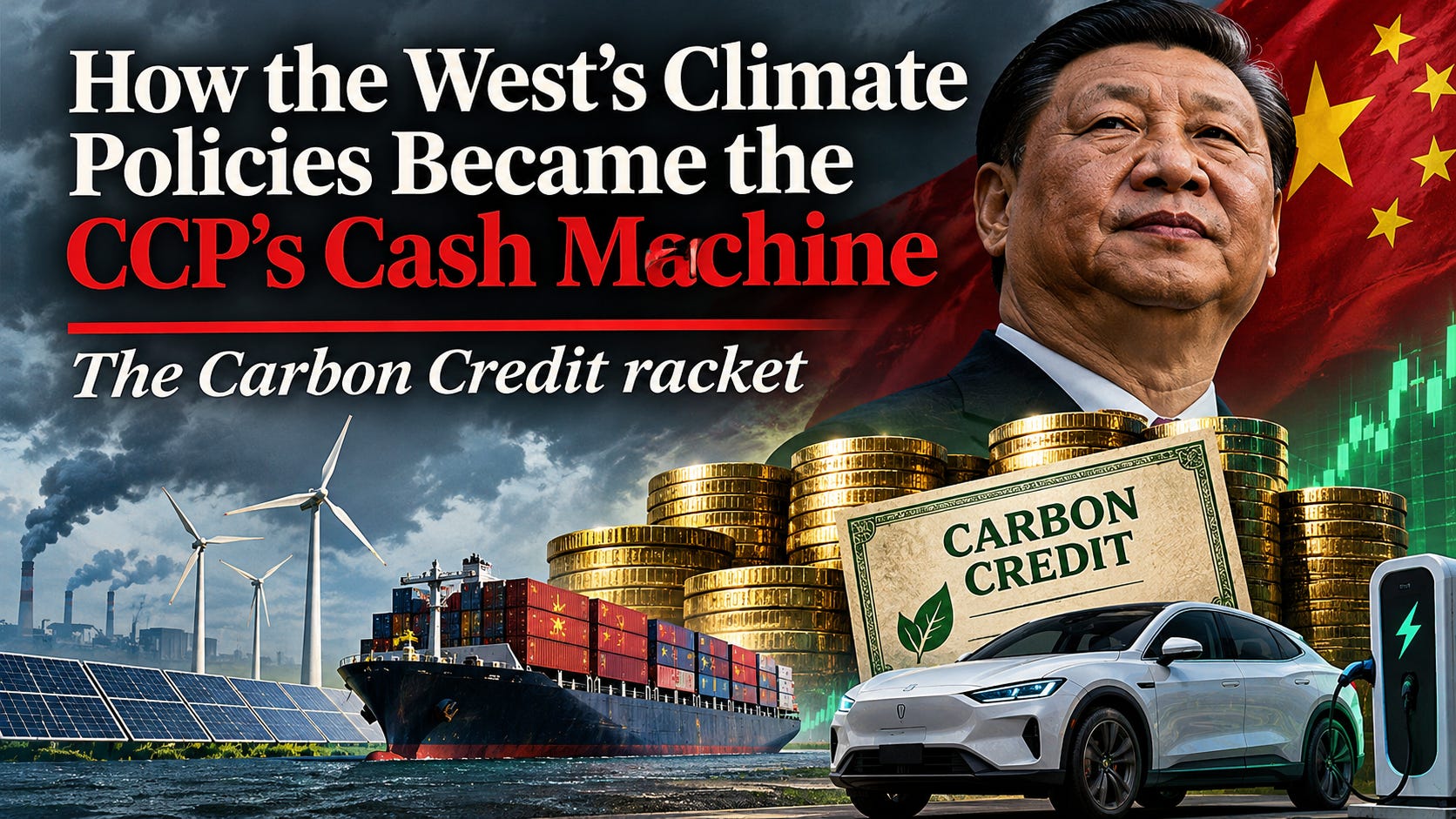
The Curious Case of 1,600 Chinese Cars
Jamberoo Action Park sits in the hills south of Sydney, Australia. During the winter months, its parking lots are normally empty. But in August 2025, hundreds of brand-new Chinese vehicles began appearing in neat rows. By October, more than 1,600 vehicles manufactured by BYD, China’s leading electric-vehicle manufacturer, were parked there. Local officials objected because the water park was not licensed to operate as a commercial vehicle storage facility.
The more interesting question was why so many vehicles were being stored there. Australia’s New Vehicle Efficiency Standard, introduced in January 2025, created a financial incentive that most consumers probably never considered. Under the program, manufacturers can earn emissions credits when qualifying vehicles are imported, rather than when they are sold. According to reporting by the Australian Financial Review, a single electric BYD Sealion 7 could generate approximately A$7,050 in credits. Those credits have value because manufacturers selling higher-emission vehicles must either meet government targets, purchase credits from competitors, or face financial penalties.
The stockpile does not prove that BYD imported these particular vehicles to collect credits. But it illustrates a much larger economic phenomenon unfolding across the Western world. Governments have created emissions regulations that reward certain technologies, penalize others, and transfer money between competing manufacturers. China has spent decades developing the industrial capacity to benefit from these policies, while Western companies increasingly struggle with the costs of compliance.
To understand how this happened, we need to examine the relationship between environmental modeling, government intervention, corporate financial interests, and China’s industrial strategy.
How Government Created a Market for Emissions
The intellectual foundations of emissions trading originated with economists Ronald Coase and John Dales. Coase argued that clearly defined property rights could allow parties to negotiate solutions to environmental problems. Dales subsequently proposed that governments establish limits on pollution and allow companies to trade permits representing the right to emit.
The idea was that companies capable of reducing pollution inexpensively could sell their unused permits to companies facing higher compliance costs. The total emissions limit would remain in place, but the market would determine how reductions were distributed.
Early American programs applied variations of this approach to lead in gasoline and sulfur dioxide emissions from power plants. These pollutants caused measurable health and environmental damage, and trading mechanisms helped reduce emissions at lower costs than some traditional regulatory approaches.
Carbon dioxide presented a different challenge. At ordinary atmospheric concentrations, it is not directly toxic, and it is essential for plant growth. Its environmental significance comes from its greenhouse effect and contribution to global warming. Consequently, the justification for restricting carbon dioxide depended heavily on projections of future temperature changes and their consequences.
Those projections relied on computer models containing substantial uncertainties. The 1979 Charney report estimated that doubling atmospheric carbon dioxide could increase global temperatures by 1.5 to 4.5 degrees Celsius. The Intergovernmental Panel on Climate Change retained essentially that same likely range through 2013, narrowing it to 2.5 to 4 degrees in 2021.
Other modeling problems emerged. The high-emissions scenario known as RCP8.5 was frequently described as business as usual, implying that its projected outcomes represented the likely future without additional government intervention. In 2020, climate researchers Zeke Hausfather and Glen Peters warned in Nature that this characterization was misleading. In 2022, another group of climate scientists, including NASA’s Gavin Schmidt, reported that approximately one-quarter of the newest generation of climate models produced unusually high warming estimates.
These findings do not invalidate climate science. They demonstrate why uncertainty matters when governments use projections extending decades into the future to justify major economic interventions.
When Computer Models Become Government Policy
We have seen this pattern before, most dramatically during COVID-19.
On March 16, 2020, Neil Ferguson’s team at Imperial College London published projections suggesting that an uncontrolled epidemic could cause approximately 510,000 deaths in Britain and 2.2 million deaths in the United States. These figures represented a hypothetical epidemic without control measures or spontaneous behavioral changes, not inevitable outcomes. Nevertheless, the alarming numbers received enormous publicity and helped drive decisions to impose unprecedented restrictions on businesses, schools, travel, and ordinary social life.
The political response demonstrated how quickly frightening model projections could become the justification for extraordinary government powers. Policymakers faced genuine uncertainty, but the public was rarely given a satisfactory explanation of the assumptions underlying the most alarming scenarios, the limitations of the models, or the long-term economic and social consequences of the proposed interventions.
The economic consequences were staggering. In April 2020, the International Monetary Fund described the resulting crisis as the Great Lockdown. By October, the IMF projected that cumulative global economic output losses relative to pre-pandemic expectations could reach $28 trillion through 2025. Those losses reflected the combined effects of the pandemic and the response, and cannot be attributed exclusively to lockdown policies. Nevertheless, the scale of the disruption was extraordinary.
Climate policy presents a comparable problem, although the scientific questions and timescales are different. Models project future risks, those projections influence public perceptions of urgency, and governments establish regulations intended to prevent the predicted outcomes. Those regulations then reshape economic activity, creating financial winners and losers whose interests may have little to do with the original environmental objective.
The concern is not that governments should never use models. It is that uncertain projections can become the basis for expensive mandates without sufficient scrutiny of their assumptions, costs, or unintended consequences. Once those mandates are established, powerful economic interests develop around preserving them.
The Environmental Movement and Its Corporate Beneficiaries
Economist Bruce Yandle described this political phenomenon in 1983 with his theory of “bootleggers and Baptists.” Baptist preachers supported restrictions on Sunday alcohol sales for moral reasons, while bootleggers supported the same restrictions because they eliminated legitimate competition. Groups with different motivations could therefore promote identical government policies.
International carbon trading provides a revealing example.
Maurice Strong, a Canadian businessman with extensive experience in energy and finance, became a central figure in international environmental governance. He organized the 1972 United Nations Conference on the Human Environment, became the first head of the UN Environment Programme, and later organized the 1992 Rio Earth Summit. These efforts helped establish the institutional foundations for international climate agreements.
Meanwhile, powerful corporations recognized that emissions restrictions could create profitable new markets. Enron was among the most enthusiastic early supporters of carbon trading. The Houston-based energy company had experience trading sulfur dioxide allowances and recognized that restrictions on carbon dioxide could favor natural gas, one of its principal businesses, over coal.
Enron chairman Ken Lay actively promoted climate regulation, and company representatives participated in discussions surrounding the 1997 Kyoto Protocol. Following those negotiations, Enron lobbyist John Palmisano celebrated the agreement in an internal memorandum, writing: “This agreement will be good for Enron stock!!”
Enron collapsed in 2001, but the international emissions-trading architecture it supported survived. The Kyoto Protocol established mechanisms for international carbon-credit transactions, while subsequent national and regional regulations expanded the role of emissions credits across multiple industries.
Environmental organizations supplied the public justification, governments established the regulatory framework, and corporations positioned to benefit helped promote the system. Their motivations were not necessarily identical, but their economic and political objectives frequently aligned.
How Western Automobile Regulations Created New Winners
The automobile industry developed its own emissions-credit systems, beginning with California’s zero-emission vehicle program in 1990. Federal fuel-economy regulations subsequently incorporated credit trading, while the European Union established fleet emissions targets that allowed manufacturers to combine their vehicles into compliance pools.
The mechanism is straightforward. Manufacturers producing vehicles with emissions below regulatory targets accumulate credits or other compliance advantages. Manufacturers whose fleets exceed those targets may need to purchase credits, enter pooling arrangements, or face penalties. These transactions exist because governments have assigned financial value to meeting particular regulatory formulas.
Tesla became one of the largest beneficiaries. The company reported approximately $1.79 billion in regulatory credit revenue in 2023, $2.76 billion in 2024, and nearly $2 billion in 2025. Because these credits do not require Tesla to manufacture additional vehicles, the revenue can be extraordinarily profitable.
Europe provides an especially important example of how the system affects international competition. European Union emissions targets impose substantial financial pressure on manufacturers whose fleets exceed regulatory limits. Companies including Ford, Toyota, Stellantis, Mazda, and Subaru entered pooling arrangements involving Tesla. Nissan joined a similar arrangement with China’s BYD.
The result is a remarkable competitive situation. Established Western and Japanese automakers can find themselves paying electric-vehicle competitors for the regulatory privilege of continuing to sell gasoline-powered vehicles. Those costs affect profitability, investment, employment, and ultimately consumer prices.
Meanwhile, European governments have encouraged electric-vehicle adoption through emissions requirements and various national incentives, creating demand for technologies that Chinese manufacturers have spent years developing. European policymakers subsequently imposed additional tariffs on Chinese electric vehicles after investigating Chinese government subsidies, illustrating the contradiction between encouraging electrification and protecting domestic manufacturers from subsidized foreign competition.
The United States developed similar credit mechanisms, although tariffs and other trade restrictions have largely prevented Chinese electric-vehicle manufacturers from entering the American market directly. China therefore benefits from Western climate policies through different channels, depending on the country and its regulatory system.
California’s Partnership with China
California’s influence over American automobile manufacturing extended well beyond its borders. Under the Clean Air Act, California could obtain EPA approval to establish vehicle-emissions standards stricter than federal requirements, and other states could adopt those standards. President George W. Bush’s EPA rejected California’s greenhouse-gas waiver in 2008, but President Obama’s EPA reversed that decision in 2009 and approved additional requirements in 2013. The Obama administration also coordinated federal vehicle standards with California’s regulations, extending their influence nationwide. By 2025, California and other states adopting its vehicle standards represented approximately 40 percent of the American new-vehicle market.
What is less widely understood is that California was simultaneously developing formal partnerships with China on electric vehicles and climate regulation. In 2014, during Governor Jerry Brown’s administration, UC Davis established the China-U.S. Zero-Emission Vehicle Policy Lab with China’s Automotive Technology and Research Center, an institution involved in the regulation of China’s automobile industry.
The California Air Resources Board and China’s National Development and Reform Commission supported the partnership and were designated to co-chair its advisory board. In June 2017, Brown traveled to Beijing, met with President Xi Jinping, and signed an agreement to expand cooperation on electric vehicles, batteries, renewable energy, and emissions trading systems. California officials also met directly with Chinese manufacturers.
The cooperation continued in 2019 with the establishment of the California-China Climate Institute at UC Berkeley, working with China’s Tsinghua University. Its activities included joint research and policy development on climate and clean-energy regulation. In May 2026, the National Association of Scholars published an investigation alleging that these institutional relationships helped advance policies benefiting Chinese green-technology manufacturers. The agreements establish substantial cooperation, although they do not establish that Beijing directed California’s regulatory decisions.
Meanwhile, California continued pursuing increasingly restrictive vehicle-emissions requirements. Its Advanced Clean Cars II program sought to require that all new passenger vehicles sold in the state qualify as zero-emission by 2035, with limited allowances for plug-in hybrids.
Under Governor Gavin Newsom, California went further in 2023, adopting its Advanced Clean Fleets regulation to phase out diesel-powered semi-trucks and other heavy-duty vehicles, despite serious concerns about battery weight, reduced cargo capacity, charging infrastructure, and operating costs.
In January 2025, just seven days before Donald Trump’s inauguration, California withdrew its request for federal approval of the truck mandate, acknowledging that the incoming Trump administration was unlikely to approve it. Trump had previously withdrawn California’s greenhouse-gas and zero-emission vehicle waiver in 2019, Biden restored the earlier waiver in 2022 and approved the new passenger-vehicle requirements in December 2024, and Trump signed legislation disapproving the latter waiver in June 2025.
The national implications were significant. California was pursuing vehicle mandates that could influence manufacturing decisions throughout the United States while cooperating directly with CCP regulatory institutions and manufacturers. The documented partnerships do not prove improper Chinese influence, but they raise an important question:
Why were federal and California officials working directly with CCP government institutions and manufacturers to advance electric-vehicle policies that threatened American industrial competitiveness?
While California pushed mandates that would have reshaped the entire U.S. automobile market, it was simultaneously sharing regulatory expertise with institutions tied to the Chinese Communist Party and setting up manufacturing partnerships - impacting the entire US market.
Who evaluated the national-security risks, who stood to profit, and why were American policymakers helping a strategic rival develop the tools to compete against American industry?
China Read the Rulebook
China did not formally write the West’s climate regulations, but it was hardly a passive observer. California’s partnerships with Chinese government institutions demonstrate that Beijing had direct access to discussions about regulatory policies from which its manufacturers would later benefit. The Chinese Communist Party then leveraged these opportunities through an aggressive industrial strategy. California was not an isolated example, but part of a broader pattern of Chinese engagement with international climate policymaking, raising serious questions about how much influence Beijing has exercised over the rules governing Western industries.
International climate agreements have historically treated China as a developing country, granting it different obligations than those imposed on industrialized Western nations. Under the Kyoto Protocol, China had no binding national emissions-reduction target, but Chinese projects could generate credits that developed countries purchased to meet their own commitments.
One particularly revealing example involved HFC-23, an industrial waste gas with an extremely powerful greenhouse effect. Under Kyoto’s Clean Development Mechanism, destroying HFC-23 generated valuable carbon credits. The incentives became so distorted that destroying the waste gas could be substantially more profitable than producing the refrigerant associated with it.
Investigators raised concerns that some facilities were effectively being rewarded for generating additional waste gas that could subsequently be destroyed for credits. China hosted 11 of the 19 approved HFC-23 projects and collected substantial tax revenue from the proceeds. When the European Union moved to prohibit these credits, Chinese officials warned that facilities might release the gas rather than destroy it without compensation.
A program intended to reduce pollution had created financial incentives that could encourage the production of additional pollutants. This was a consequence of government-created rewards that were poorly aligned with the intended environmental outcome.
China subsequently developed its own vehicle-credit system, influenced in part by California’s regulations. Under the dual-credit policy adopted in 2017, automakers that failed to meet government targets needed credits from manufacturers producing qualifying vehicles. By 2019, nine of the ten automakers with the largest credit deficits were joint ventures involving foreign manufacturers, including General Motors, Ford, and Toyota. None of the ten largest credit earners were foreign manufacturers.
Foreign automakers operating in China were therefore helping finance the growth of their Chinese competitors through a regulatory system established by Beijing.
At the same time, China invested heavily in its domestic electric-vehicle industry. According to the Center for Strategic and International Studies, Chinese government support for electric vehicles totaled at least $230.9 billion between 2009 and 2023. This support helped build enormous manufacturing capacity, battery production, supply chains, and internationally competitive companies.
Chinese manufacturers also developed genuine technological and manufacturing strengths, including battery innovation, vertical integration, and economies of scale. These advantages cannot be explained entirely by subsidies, but government industrial policy played a substantial role in creating the conditions for their growth.
Western governments were establishing policies that encouraged electric-vehicle adoption. China was building the industrial capacity to supply those vehicles.
Globalism and the Unequal Rulebook
For decades, multinational corporations and international institutions have promoted regulatory harmonization, arguing that common standards make international commerce more efficient. There are legitimate advantages to predictable international rules, particularly for companies operating in dozens of countries.
But harmonization also creates opportunities for businesses with the financial resources, political connections, and global manufacturing capacity to navigate complex regulatory systems.
The world’s vehicle-credit programs are not a single unified market. California, Europe, China, and Australia maintain different rules. Nevertheless, they share a common feature: government policy assigns financial value to particular technologies and imposes costs on competitors that do not satisfy preferred standards.
China recognized the commercial implications of this regulatory convergence and pursued an industrial strategy designed to benefit from it.
Western governments committed themselves to increasingly restrictive emissions targets, often without adequately considering whether domestic manufacturers could compete against heavily subsidized Chinese producers. Beijing invested in manufacturing capacity, secured critical supply chains, and established domestic policies that favored Chinese companies.
The resulting competitive pressures extend beyond automobiles. Batteries, critical minerals, renewable-energy equipment, and other strategically important industries are increasingly shaped by government mandates and subsidies. Losing domestic manufacturing capacity in these sectors creates economic vulnerabilities that extend far beyond the price of a new vehicle.
Economist Friedrich Hayek argued that central planners cannot gather the dispersed information reflected in market prices. Government-created emissions-credit systems illustrate part of that problem. Although credits may be traded between private companies, their value ultimately depends on regulatory limits, compliance requirements, and penalties established by government.
These are not prices emerging solely from consumer preferences and voluntary exchanges. They are financial signals created and shaped by political decisions.
China, which continues to organize much of its industrial policy through centralized planning, recognized the opportunity to compete in markets increasingly shaped by government mandates. It used its own industrial strategy to develop manufacturers capable of benefiting from regulatory decisions made in Western capitals.
What Happens When Government Changes the Rules?
The United States has recently begun reversing portions of its vehicle emissions-credit system.
In July 2025, federal legislation eliminated monetary penalties for violations of corporate average fuel-economy standards. In February 2026, the Environmental Protection Agency rescinded its 2009 greenhouse-gas endangerment finding for motor vehicles and repealed federal vehicle greenhouse-gas standards, including associated credit-trading provisions.
Tesla’s regulatory credit revenue fell to $146 million in the second quarter of 2026, compared with $439 million during the same period in 2025. Although other factors also influence these revenues, the decline illustrates how dependent the market is on government policy.
A regulatory credit has financial value because the government creates an obligation that makes someone need it. Reduce or eliminate that obligation, and the market for the credit can contract dramatically.
Australia continues to operate its emissions-credit program, although officials have considered changing the rules so credits are earned when vehicles are sold rather than imported. Such a reform could address the particular incentive illustrated by the BYD vehicles stored at Jamberoo, but it would not eliminate the broader financial transfers created by the emissions-credit system.
The Consequences of Government-Directed Markets
There is an important distinction between protecting the environment and creating elaborate regulatory markets that redistribute wealth, reshape entire industries, and alter the balance of economic power between nations based on nothing more than some modeling data and longtermerism. What began as a mechanism for reducing identifiable pollutants has evolved into a carbon credit system and a system of government mandates, financial penalties, and tradable credits that increasingly determines which manufacturers prosper and which struggle to survive.
The underlying problem is that governments are making enormous economic decisions based on computer models that necessarily contain uncertainty. The experience of COVID-19 should have taught policymakers the dangers of treating projections as certainties. Climate policy operates on a much longer timescale, but it raises the same fundamental questions about uncertainty, accountability, and the unintended consequences of government intervention.
There is also a national-security dimension that cannot be ignored. The Chinese Communist Party governs America’s principal strategic and economic competitor. Beijing has made industrial leadership, technological development, and control over critical supply chains central objectives of its national strategy. Its electric-vehicle industry is not simply the product of independent entrepreneurs responding to consumer demand. It has benefited from extensive state subsidies, coordinated industrial planning, and government policies designed to strengthen domestic manufacturers.
Meanwhile, Western governments have imposed emissions requirements that create additional costs for their own automobile industries while providing financial opportunities for CCP-aligned manufacturers positioned to satisfy those mandates. California’s documented cooperation with Chinese regulatory institutions and manufacturers makes this history particularly troubling.
American officials were sharing expertise and pursuing joint policy development and partnerships with the CCP and its affiliates, even as California sought to establish vehicle requirements to influence manufacturing decisions nationwide. Whether those partnerships and financial conflicts of interest materially shaped specific regulations remains an important unanswered question.
The consequences extend far beyond electric vehicles. Automobile manufacturing supports domestic employment, technological innovation, steel production, advanced electronics, battery development, and national industrial capacity. Policies that weaken domestic manufacturers while increasing dependence on Chinese and other foreign supply chains can have implications for economic resilience and national security. These concerns are especially significant when the foreign competitor is a government-directed economy pursuing its own strategic interests.
The irony is that Western governments, supposedly committed to free markets, have increasingly relied on centrally determined economic incentives. Basically, installing the beginnings of a command economy. China, openly committed to industrial planning, has developed the manufacturing capacity to benefit from those incentives. The result is a competitive environment shaped as much by government decisions as by technological innovation, manufacturing efficiency, or consumer preferences.
The Chinese vehicles parked at an Australian water park are therefore more than an unusual example of regulatory incentives. They illustrate how emissions policies can create financial opportunities that extend across national borders, sometimes benefiting companies supported by governments whose strategic interests conflict with those of the countries imposing the regulations.
The issue is not whether environmental risks deserve serious consideration. They do. The issue is whether governments have adequately evaluated the economic, industrial, and national-security consequences of the policies adopted in response.
The central question for American policymakers is whether regulations strengthened a strategic competitor at the expense of American industry, and whether the officials who promoted them understood, examined, and disclosed those consequences.
That question deserves a public accounting, particularly where American regulatory agencies and universities worked directly with Chinese government institutions during the development of these policies.
Independent Journalism Isn’t Free
Uncovering the connections between government policies, powerful corporations, international institutions, and the Chinese Communist Party takes time, research, and a willingness to ask questions that much of the mainstream media would rather ignore.
At Malone News, we dig into the history, follow the money, examine the evidence, and connect the dots. We do this because we believe readers deserve more than government talking points and carefully packaged narratives.
But this work isn’t free. Research, writing, editing, and publishing require substantial time and resources. We have a small team, and we pay the people who help us produce this work.
If you value our independent reporting, please consider becoming a paid subscriber. Your support allows us to continue investigating the issues that affect our freedoms, our economy, and our future, without relying on corporate sponsors or government funding.
If you’re already a paid subscriber, thank you. You’re helping make this work possible.
Support independent journalism. Become a paid subscriber to Malone News today.
References
Selected sources supporting the historical, economic, regulatory, and national-security analysis.
1. Coase, Ronald H. (1960). “The Problem of Social Cost.” Journal of Law and Economics, Vol. 3, pp. 1–44.
2. Dales, J. H. (1968). Pollution, Property and Prices. University of Toronto Press.
3. Hausfather, Zeke, and Glen Peters (2020). “Emissions: The ‘Business as Usual’ Story Is Misleading.” Nature, Vol. 577, pp. 618–620. Original article.
4. Ferguson, Neil M., et al. (March 16, 2020). “Impact of Non-Pharmaceutical Interventions (NPIs) to Reduce COVID-19 Mortality and Healthcare Demand.” Imperial College London, Report 9.
5. International Monetary Fund (October 13, 2020). “A Long, Uneven and Uncertain Ascent.” IMF World Economic Outlook analysis. Source of the projected $28 trillion cumulative global output loss through 2025. IMF analysis.
6. Yandle, Bruce (1983). “Bootleggers and Baptists: The Education of a Regulatory Economist.” Regulation, Vol. 7, No. 3.
7. Business History Conference. “Enron and the Kyoto Protocol: U.S. Climate Change Policymaking in the 1990s.” Historical research.
8. CarExpert (2025). “Australian Emissions Loophole Sees BYD Import Excess Stock to Get Credits: Report,” and “Stockpiled BYD Cars Declared Illegal as Council Rejects Application.” Emissions-credit reporting.
9. Tesla, Inc. (2025–2026). Annual and quarterly reports, regulatory-credit revenue. U.S. Securities and Exchange Commission. Q2 2026 filing.
10. Center for Strategic and International Studies (2024). “The Chinese EV Dilemma: Subsidized Yet Striking.” Analysis of Chinese government support for electric-vehicle manufacturing. CSIS analysis.
11. University of California, Davis (September 8, 2014). “China and UC Davis Partner to Put Zero Emission Vehicles on a Faster Track.” Establishment of the China-U.S. Zero-Emission Vehicle Policy Lab with Chinese regulatory participation. UC Davis announcement. UC Davis
12. Office of Governor Jerry Brown (June 6, 2017). “Governor Brown Meets with President Xi of the People’s Republic of China, Signs Agreement with National Government to Boost Green Technology.” Official California government record, including the cooperation agreement. Governor’s announcement and agreement. Governor Edmund G. Brown Jr.
13. University of California, Berkeley (September 23, 2019). “UC Berkeley, Former Gov. Jerry Brown Partner with China to Spur Climate Action.” Establishment of the California-China Climate Institute and partnership with Tsinghua University. UC Berkeley announcement. Berkeley News
14. National Association of Scholars (May 18, 2026). Behind the Climate Curtain: China’s Hidden Role in California’s Energy Mandates and University Partnerships. Investigation of California-China institutional relationships and alleged policy influence. Full report. National Association of Scholars
15. Congressional Research Service. California’s Vehicle Emissions Standards and Federal Waivers. Legislative and regulatory history of EPA approvals, withdrawals, and congressional actions. CRS report
I've never seen a thorough study on environmental costs of EV production.
From the equipment to mine rare earth minerals, costs for processing, costs for battery disposal, etc.
There must not an environmental advantage for EV's.... otherwise we'd have studies proving that EV's "save" the environment.
Climate change; The Club of Rome targeted fear porn of a new ice age in the 60's. Then they realized, the climate will warm naturally... coming out of an ice age from ~12,000 years ago - when Chicago had a mile of ice on top of it. In a 500 million year study, we're still in a cool period. The planet is greening by 20-30% v 40 years ago. CO2 is a life builder for Ag/nature. Why the hell does anyone take the climate ho's seriously.
Getting very sick and tired of the continued psyops. The WEF influence has buried the EU. Rather refreshing to see admin Trump flip the middle finger to the WHO, scaring the U.N. with a potential withdrawal of U.S. financial support for the U.N.
Over the last 50+ years, the US has surrendered much of its manufacturing sector, intellectual property, and economic advantage to an ideological enemy. It's too stupid to be stupid. And I imagine that the CCP would have always been on the lookout for those on the inside who will undermine to advance their own personal self interest. The elite captains of industry have told us we will own nothing, and be happy, which sounds a lot like Marx's abolition of property, right? It seems the Chinese figured out that capitalists are readily seduced by the prospect of low labor costs and higher profit margins, and in that respect they showed themselves to be more clever than Marx.