

Israel Is Trying to Stop Taking Our Money
The wolf at the door, part four: notes from the Israeli frontier
Before getting into part four, a quick word to those of you who have stayed with me through this series. I know that six essays examining Israel, its security problems, its history, and its relationship with the United States are not going to be everyone’s cup of tea. This has turned into a deeper examination than I originally anticipated, and I appreciate your patience with it. There are two more installments after this one, and then I promise we will move on to other subjects.
But having spent time in Israel, Judea and Samaria, and along the Gaza border, I wanted to follow the questions wherever they led rather than reduce what I saw to another argument about whether one is “pro-Israel” or “anti-Israel.” The answers have often been more complicated than I expected. This installment is about one of those complications: the widespread belief that Israel wants, needs, and intends to remain dependent on American military aid.
It may be that Israel increasingly wants exactly the opposite.
*The short version, for readers who do not spend their days on Capitol Hill.*
In May 2024, the United States paused a weapons shipment to Israel in an effort to change an Israeli military decision.
That is what leverage is for. And it worked exactly the way leverage works.
It also taught Israel something that will not easily be forgotten: American military aid has an off switch, and an American president can throw it.
Israel is now negotiating its way out of that arrangement.
The current U.S.-Israel military assistance agreement expires in 2028. Rather than simply asking Washington for another decade of checks, Israel is proposing something quite different: gradually reduce American grant aid and replace at least part of it with joint investment in weapons research, development, and production.
Both countries put money in. Both countries get something out.
That may sound like a technical change in defense procurement.
It isn’t.
It is a transfer of power.
Aid carries conditions. Congress can attach them. Administrations can interpret them. Committees can investigate them. Presidents can delay weapons already approved in order to influence what Israel does next.
A jointly funded weapons program, particularly one containing substantial Israeli money, sits on different legal and political ground. The old tools of leverage may not disappear entirely, but they become considerably harder to use.
Four terms will carry you through the rest of this essay.
Foreign Military Financing, or FMF, is the main American military aid program for Israel. Despite the way it is usually described, this is not simply Washington handing Israel a check. Most of the money must be used to purchase American defense products, from American companies, employing American workers.
The Memorandum of Understanding, or MOU, is the ten-year political agreement that establishes the framework and anticipated level of assistance. It is not a treaty. It does not bind Congress. Congress still has to appropriate the money.
The Leahy Laws restrict American assistance to foreign security-force units when there is credible information implicating them in gross violations of human rights. The important word here is assistance. How those restrictions would apply to jointly developed and jointly financed programs is considerably less straightforward, and that distinction may become enormously important.
Qualitative Military Edge, or QME, is the requirement embedded in American law that Israel maintain the ability to defend itself against credible military threats from neighboring states and coalitions while possessing superior military capabilities. QME does not disappear if Israel takes less American aid.
Now we can get to the argument.
Washington spent decades and hundreds of billions of dollars building a system that did two things at once. It strengthened Israel militarily while giving the United States extraordinary influence over how that strength could be supplied and, when Washington chose, constrained.
Then Washington demonstrated the constraint.
And Israel noticed.
In April 2024, the Biden administration began reviewing proposed transfers of particular weapons to Israel. By early May, it had paused a shipment containing 1,800 2,000-pound bombs and 1,700 500-pound bombs. Thousands of JDAM guidance kits were also caught up in the broader debate over transfers.
Defense Secretary Lloyd Austin confirmed the bomb shipment pause before Senate appropriators on May 8.
That same day, President Biden made the policy explicit. If Israel launched the major Rafah operation his administration opposed, he told CNN, the United States would not supply certain weapons Israel might use in that operation.
There is no need to speculate about Washington’s purpose. The United States wanted Israel to make a different military decision, so the administration used Israel’s dependence on the American weapons pipeline as leverage.
Whether you believe Biden was right or wrong to do that is almost beside the point. Because Israel learned something much larger than the immediate lesson of Rafah. It learned that a weapons supply chain controlled by another country is not merely a supply chain. It is a veto waiting to be exercised.
The most important consequence of the 2024 weapons pause, therefore, may not have been what happened in Rafah at all.
It may be what happens in 2028.
Israel is now negotiating the agreement that will replace the current MOU, and the structure being discussed points toward a very different relationship: less dependence on American grants, more Israeli financing, more joint development and production, and eventually much greater Israeli freedom to build what it needs without asking Washington for permission.
For sixty years, American military assistance to Israel bought the United States something far more valuable than gratitude. It bought leverage.
In the spring of 2024, Washington used it.
Israel’s response is to make sure Washington cannot use that kind of leverage against it again.
The Instrument, Precisely
Since 1999, the U.S.-Israel military relationship has been organized around ten-year Memoranda of Understanding. Clinton’s was worth $21.3 billion, George W. Bush’s $30 billion, and the current agreement, signed by Susan Rice and Jacob Nagel on September 14, 2016, provides for $38 billion across fiscal years 2019 through 2028. Of that, $33 billion is Foreign Military Financing and $5 billion is for cooperative missile defense, roughly $3.3 billion and $500 million per year, respectively (Congressional Research Service 2026b). Those are the numbers everyone quotes, but three features of the arrangement matter considerably more than the headline number.
First, an MOU is not a treaty. It requires no Senate ratification, appropriates no money, and does not legally bind a future president or Congress. It is an executive commitment that Congress has historically chosen to honor, and the money still has to be appropriated each year. Israel can therefore plan around ten years of American assistance, but Washington retains the machinery to delay it, condition it, withhold it, or simply stop providing it.
Second, Israel gave up something significant in exchange for that predictability. In a side letter to Secretary of State John Kerry, Prime Minister Benjamin Netanyahu agreed that Israel would return any money Congress appropriated above the agreed MOU levels for fiscal years 2017 and 2018. Israel also agreed not to lobby Congress for additional military assistance during the MOU period except in the event of a regional conflict, and even then only with the administration’s prior consent (Washington Institute 2016). The restriction was not theoretical. In September 2017, Senators Tom Cotton and Marco Rubio wrote Secretary of State Rex Tillerson objecting after Congress appropriated an additional $75 million and the administration moved to enforce the agreement. Congress wanted to give Israel more money, and under the agreement Israel had negotiated with the executive branch, Israel had effectively promised not to take it.
Third, the portion of American aid that once directly supported Israel’s own defense industry is disappearing. Historically, Israel enjoyed an unusual privilege known as Off-Shore Procurement, which allowed it to convert roughly a quarter of its American Foreign Military Financing (FMF) into shekels and spend that money with Israeli defense companies. The 2016 MOU phases that privilege out entirely, reaching zero in fiscal year 2028 (Congressional Research Service 2026a).
That changes what the familiar phrase “$3.3 billion in aid to Israel” actually means. By the end of the current agreement, essentially all American FMF provided to Israel must be spent purchasing American defense goods and services. American taxpayers provide the money, Israel uses it to purchase qualifying military equipment, American defense companies receive the orders, American factories build the weapons, and American workers are paid to produce them. Israel gets the military equipment, certainly, but much of the money itself never really leaves the American defense-industrial economy.
Put those pieces together, and the arrangement looks rather different from the political slogan. By 2028, the system is designed to provide Israel with American military assistance that is spent almost entirely inside the American defense-industrial base, under a ten-year political commitment that legally binds neither Congress nor the president, while Israel itself is constrained in seeking assistance beyond the negotiated amount. Call it foreign aid if you like, but economically much of it functions as a directed procurement program for American weapons manufacturers. Strategically, it purchases something considerably more valuable for Washington: influence over an ally whose military depends heavily on an American-controlled supply chain.
That influence remained largely theoretical as long as Washington and Jerusalem agreed on what Israel should do. In May 2024, they did not. The Biden administration demonstrated that the supply chain could also be used as an instrument of American policy, and Israel discovered that the price of American military assistance was not simply the conditions written into an MOU. The price was dependence on a weapons pipeline another government ultimately controlled.
Israel is now calculating whether that price is still worth paying.
How It Compares
The scale question is where most public discussion goes wrong, usually in both directions. Israel is routinely described as the largest recipient of American foreign aid, which is true historically, but that statement tells you surprisingly little about either the size of the current flow or Israel’s dependence on it.
Israel is the largest cumulative recipient of American foreign assistance since the Second World War. From 1951 through 2022, the United States provided roughly $318 billion in inflation-adjusted assistance, about $225 billion of it military (USAFacts 2023). But that is the accumulated total across more than seventy years. Under the current MOU, the normal annual commitment is $3.8 billion, consisting of $3.3 billion in Foreign Military Financing and $500 million for cooperative missile defense.
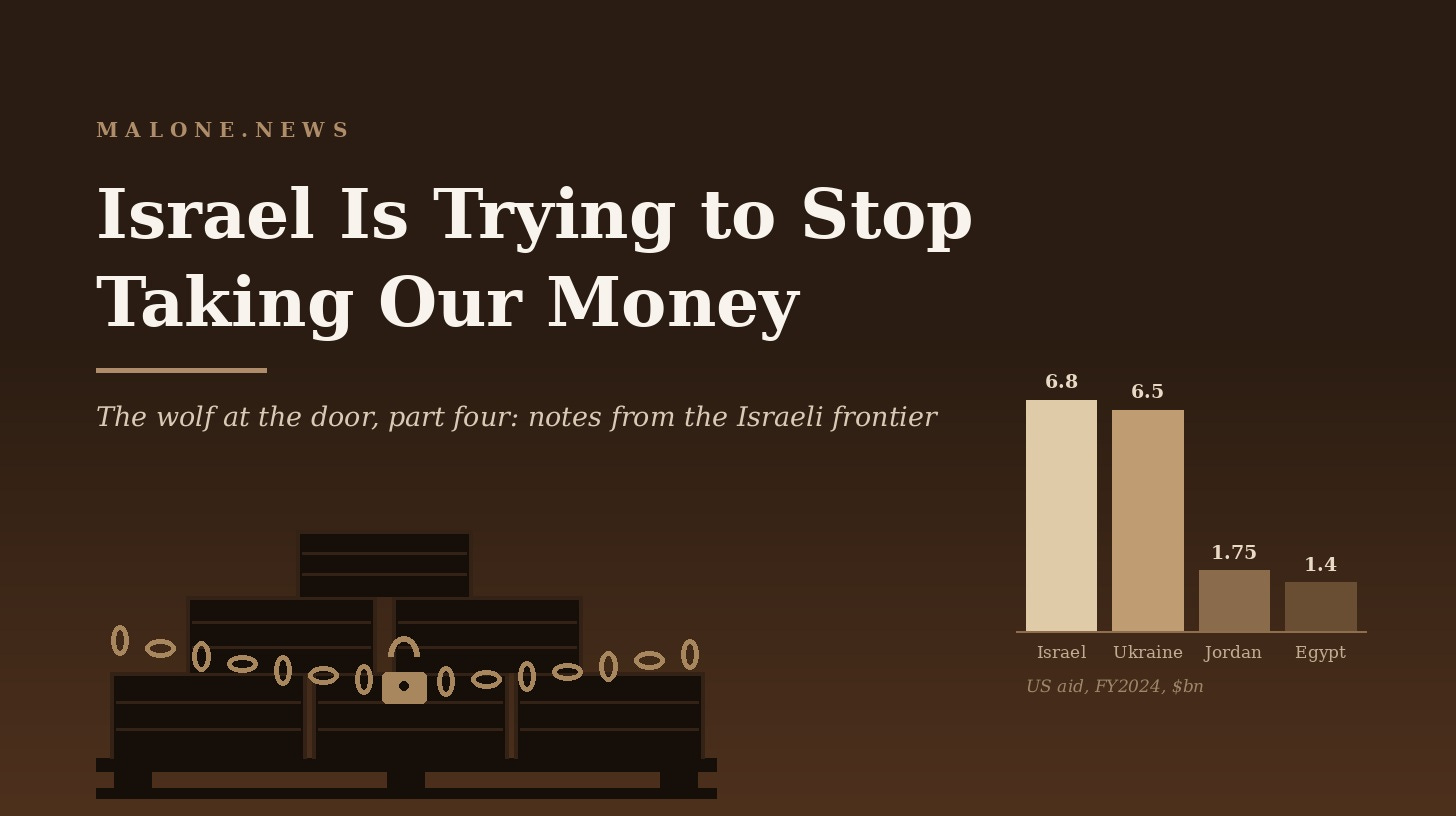
FY2024 was an exceptional year because of the war that followed October 7. Israel received approximately $6.8 billion in U.S. foreign assistance, temporarily pushing the annual figure far above the normal MOU level. By FY2025, disbursements had fallen back to roughly $3.3 billion. Ukraine, by comparison, received about $6.7 billion in FY2025, making it the largest recipient of American foreign assistance that year, with Israel second.
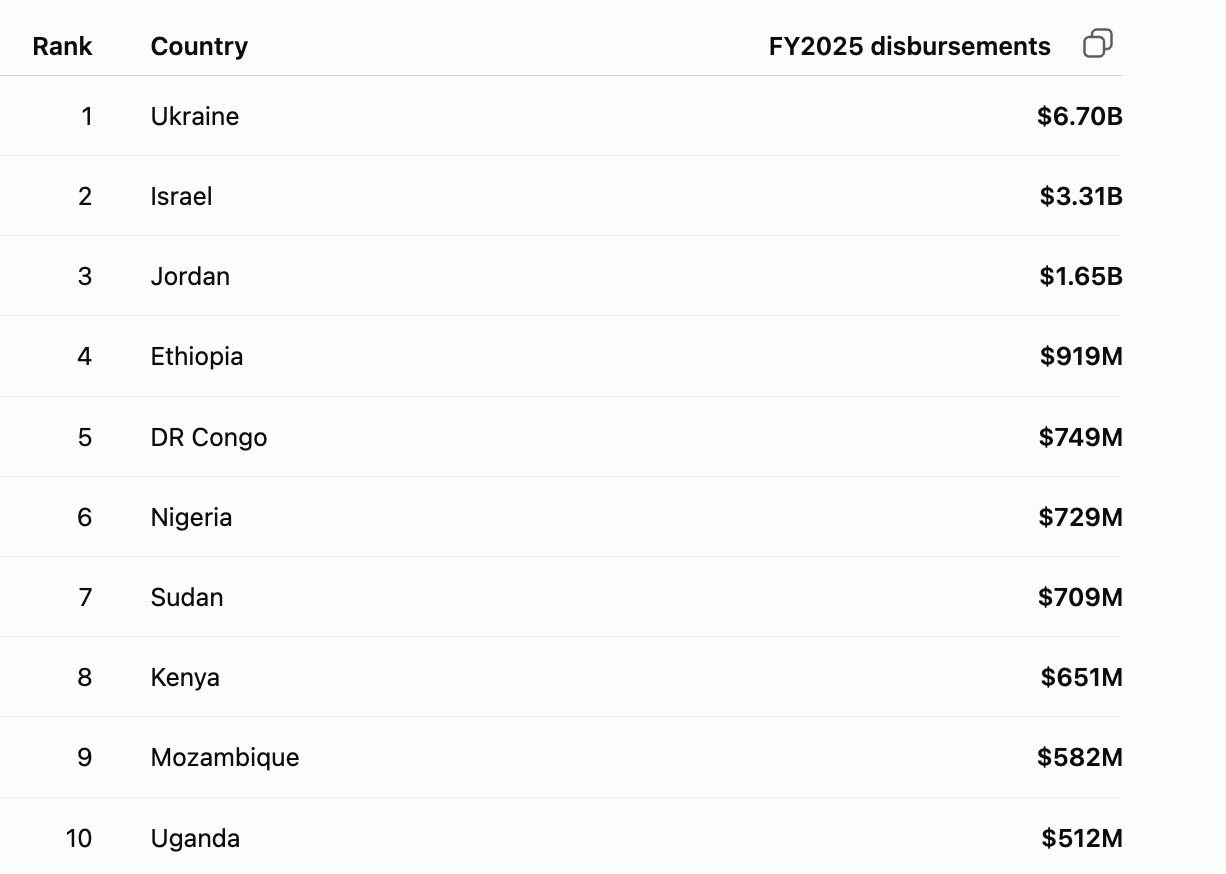
The comparison becomes more striking when the entire period since Russia’s 2022 invasion is considered. Congress has appropriated roughly $174 billion to $183 billion for the Ukraine response, depending on which programs and regional expenditures are included in the calculation. Direct American military assistance committed to Ukraine has exceeded $65 billion. Israel also received substantial emergency military assistance following October 7, but the scale and speed of the Ukrainian effort were of a different order. In only a few years, Washington committed military assistance to Ukraine equivalent to decades of Israel’s normal annual FMF allocation.
Other major recipients provide some perspective. Egypt has received approximately $1.3 billion a year in FMF for decades as part of the security architecture that followed the Camp David accords. Jordan receives several hundred million dollars annually in military assistance within a broader American assistance package of roughly $1.5 billion to $1.75 billion. These are significant sums, but simply ranking countries by dollars obscures the more important question.
The number that matters is the size of American assistance relative to the recipient country’s own ability to finance its defense. American FMF currently represents roughly 15 to 16 percent of Israel’s defense spending, depending on the year and which expenditures are included (Congressional Research Service 2026b). Israel pays for the large majority of its own military, maintains a sophisticated domestic defense industry, exports advanced weapons systems, and possesses the economic capacity to replace at least some American assistance with its own spending.
Ukraine has occupied a fundamentally different position. Since 2022, American and allied assistance has not merely supplemented an otherwise self-sufficient Ukrainian defense budget. It has supplied a substantial portion of the weapons, ammunition, air defense, intelligence support, and financial capacity required to sustain the war. When American assistance stalled during the congressional appropriations fight of 2023 and 2024, Ukraine could not simply replace the missing supply from domestic production. Ammunition was rationed and shortages appeared at the front.
Israel watched that happen.
Then, in May 2024, Washington demonstrated that the same basic mechanism could be used against Israel. The circumstances were different and Israel was far less dependent, but the lesson was impossible to miss. If another government controls an important part of your weapons supply, that government possesses leverage over the decisions you make with those weapons.
This is why the raw dollar figure is such a poor measure of dependency. Israel may be the largest cumulative recipient of American foreign assistance in modern history, but the United States finances only a minority share of Israel’s defense establishment. More importantly, Israel has the industrial base, technological capacity, and national wealth to reduce that share further.
Ukraine demonstrated what extreme wartime dependence on foreign military supply looks like. Israel appears to have drawn the obvious conclusion: do not wait until you are in the middle of a war to discover who controls your ammunition.The choke points
The vulnerability is structural, not partisan, and the Israeli analysis I heard treats it that way.
Three separate actors can interrupt the flow. The executive can slow-walk obligation, notification, or delivery. Appropriators can attach conditions or decline to fund. And the coalition politics of either party can shift within a single cycle, which the Arab Center notes is already making routine appropriation more uncomfortable for members (Arab Center Washington DC 2026).
Congress appropriated $3.5 billion in FMF in the Israel Security Supplemental Appropriations Act and then spent months disputing whether the executive was obligating and notifying it (Congressional Research Service 2024). The money was voted. Delivery was a separate question, decided elsewhere.
From Aid to Joint Venture
The Israeli position going into the FY2029 negotiation is considerably more interesting than most of the coverage suggests, because Israel is not asking for more American money. It is discussing how to need less of it.
Netanyahu has publicly argued that Israel has reached the point where it should begin phasing out American military aid, and has even raised the possibility of forgoing assistance already committed for FY2027 and FY2028. In January, he argued that Israel’s economy could reach $1 trillion within a decade and that the country’s growing defense industry could support the transition (American Jewish Committee 2026). Israel is also reportedly seeking a much longer framework, potentially twenty years and extending to 2048, centered not on annual grants but on joint research and development, defense technology, artificial intelligence, and Israeli participation in Golden Dome (Congressional Research Service 2026a; Quincy Institute 2026).
The right way to understand this is not as an aid reduction. It is a change in the business model.
FMF is fundamentally a donor-recipient arrangement. The United States appropriates the money, Israel receives the purchasing authority, and most of that money is then spent with American defense manufacturers. Because Washington supplies the money and controls the program through which it moves, Washington also retains considerable control over the terms.
What Israel is proposing would move the relationship toward co-investment. Both countries would contribute capital and technology to programs in which both have a direct interest. The important negotiations would increasingly concern intellectual property, production rights, cost sharing, technology transfer, export rights, and where the resulting systems are manufactured. The relationship would move away from grant administration and toward joint program management.
This is not an entirely new model. Pieces of it already exist inside the U.S.-Israel defense relationship. Iron Dome, David’s Sling, and Arrow have all involved combinations of American funding, Israeli technology, cooperative development, and American production. RTX, through Raytheon, has long participated in Iron Dome production with Israel’s Rafael, and the two companies have expanded American manufacturing capacity for the system. What Israel is proposing, in effect, is to take a model previously used for selected weapons programs and make something much closer to it the foundation of the relationship.
For Washington, the practical consequences are substantial. Cost sharing begins to replace grants. Intellectual property and production rights become as important as the size of the appropriation. The question shifts from how much money Congress will give Israel each year to how much each country will invest, what each contributes, what gets built, where it gets built, and who owns the technology that emerges.
None of this would eliminate American leverage. The United States would still control American technology, export licenses, components manufactured in the United States, and whatever money Congress continued to appropriate. But it would change the nature of that leverage. With FMF, Washington can impose a cost on Israel by withholding something Washington is giving it. In a genuinely co-funded program, withholding cooperation can impose costs on both countries because American money, American companies, American technology, and American military requirements are tied to the same project.
That is a very different negotiating position.
Israel is not proposing to end its defense relationship with the United States. Quite the opposite. It is proposing to make the relationship more transactional while making the dependency smaller.
The distinction matters because the exchange runs in both directions. Israel wants access to American technology, manufacturing capacity, and the enormous scale of the American defense industry. But the United States also wants Israeli technology, battlefield experience, research, innovation, and weapons systems that Israel has become exceptionally good at developing. The proposed relationship recognizes that reality. Instead of one country writing the check and the other receiving it, both countries bring something valuable to the table, both invest, and both have something to lose if the relationship is disrupted.
That does not eliminate American leverage. It does something more important. It makes the leverage mutual.
The Mechanism Nobody is Discussing in Public
The Congressional Research Service describes the most consequential part of the proposed change in characteristically dry language. If the next agreement phases down Foreign Military Financing and replaces it with jointly funded Defense Department programs, the money does not simply move between accounts. The rules and congressional oversight move with it.
FMF is foreign assistance, putting much of the relationship under the State Department and congressional foreign affairs committees, where conditions on aid are traditionally attached and enforced. Joint defense programs fall increasingly under the armed services committees and defense appropriators, whose focus is procurement, weapons development, military readiness, and whether the program works.
The legal consequences may be even more important. CRS notes that, under the executive branch’s interpretation, Leahy restrictions may not apply to certain transactions financed entirely with the purchasing country’s own money (Congressional Research Service 2026a). If Israel pays with Israeli funds, or jointly develops a system with the United States rather than receiving an American grant to purchase it, some of the existing human-rights conditions may no longer attach in the same way.
In Washington budget language, this is partly a shift from the 150 account, which covers international affairs and foreign assistance, toward the 050 account, which covers national defense. Congress does not lose its authority. It can still impose restrictions, and American export controls and arms-transfer laws remain. But the existing machinery of conditionality was built around foreign assistance. Change the funding structure and some of those legal hooks change with it.
Whether you see that as Israel securing greater freedom of action or shedding legitimate American restraint depends on your view of Israel. But the mechanism is the same. Israel is trying to replace a relationship in which Washington supplies the money and therefore writes many of the conditions with one in which both countries invest and both expect to benefit.
The argument in Washington is about how much aid Israel should receive. The more consequential question may be whether the next agreement is “aid” at all.
The Constraint Israel Cannot Wish Away
The rhetoric of Israeli self-reliance runs ahead of the balance sheet, and CRS has identified the problem. Israel and the United States have agreed to tens of billions of dollars in arms sales since October 2023, much of it financed through cash-flow financing, which allows Israel to commit future FMF payments against contracts signed today. Some of those payment schedules extend beyond the current MOU.
That means Israel cannot simply reach 2028, refuse another MOU, and walk away. Without continued FMF or some replacement arrangement, Israel would have to pay existing obligations with national funds, arrange alternative financing, renegotiate contracts, or terminate them, potentially creating liabilities for both governments (Congressional Research Service 2026b). That gives Washington considerable leverage over the transition. Israel may want out of the existing aid structure, but it first has to unwind obligations built around it.
Nor does paying with Israeli money remove Washington from the relationship. The Qualitative Military Edge requirement remains in law, requiring the administration to consider Israel’s military advantage when approving certain arms sales to other Middle Eastern countries. The Arms Export Control Act also continues to subject major American weapons sales to congressional notification and review regardless of who pays for them.
So the proposed transition does not eliminate American leverage. It narrows it. Washington would still control the sale and export of American weapons and technology. What Israel is trying to eliminate is the additional leverage that comes from Washington also supplying the money used to buy them.
Israel can stop depending on the American check. It cannot keep buying American weapons and stop depending on American permission.
What Washington trades away
This cuts against both standard positions, which may explain why neither camp talks about it very much.
If you regard American conditionality as an essential brake on Israeli governments, the same problem runs in reverse. Israel is trying to reduce the power of that brake, and the 2024 weapons pause is part of the reason why. Using leverage does more than influence the immediate decision. It reminds the other party that the leverage exists and gives it a reason to reduce its exposure to it.
There is also an American industrial consequence. FMF has functioned for decades as a subsidy to American defense manufacturers, paid through a foreign aid program. As Israel’s ability to spend FMF domestically disappears, nearly all of the $3.3 billion annual grant returns to American companies. Replace that system with greater Israeli self-financing and domestic production, and some of those American orders disappear with it. That argument will matter in areas where weapons are made, such as Fort Worth and Camden, long before most Americans notice it, because defense contracts mean factories, jobs, and congressional districts.
The Foundation for Defense of Democracies has proposed one plausible middle ground: a Strategic Partnership Agreement under which Israel commits to sustained defense spending of roughly 4.5 to 5 percent of GDP and a specified level of American procurement in exchange for a longer and more predictable framework (Foundation for Defense of Democracies 2025). It would preserve much of the industrial and strategic relationship while gradually retiring the donor-recipient model.
Something along those lines may be where this ends. Washington keeps a major defense customer and strategic partner. Israel keeps access to the American defense industry. What disappears, or at least diminishes, is the part both sides are increasingly uncomfortable admitting exists: dependency.
The Cost of Using Leverage
A relationship built partly on dependence remains stable only while both sides believe the arrangement is worth preserving. Once the dependent party concludes that the dependency itself has become a strategic risk, it begins looking for a way out.
That is what changed in May 2024. Before the weapons pause, Israeli planners could reasonably treat American resupply as a dependable feature of the strategic environment. Afterward, they could not. Washington had demonstrated that weapons already in the American pipeline could be withheld in an attempt to change an Israeli military decision. No subsequent assurance can erase the fact that it happened.
The United States spent decades and roughly $318 billion building a defense relationship that gave Washington considerable influence over Israeli decision-making. In 2024, it exercised that influence in a way that gave Israel a powerful reason to reduce it. Whether withholding those weapons was justified is a separate question. The larger question is whether influencing one Israeli operation in Rafah was worth changing Israel’s calculation about a military relationship both countries expect to continue for decades.
I doubt anyone in Washington consciously made that trade. The administration was trying to affect an immediate decision in an immediate war. But governments rarely get to choose only the immediate consequences of the tools they use. Israel learned that American military assistance could be withheld when Washington and Jerusalem disagreed over how Israel should fight a war.
Now it is trying to make sure that the next time they disagree, Washington has less to withhold.
RWM/JGM
References
Al Majalla. 2025. “Israel and Ukraine Top US Foreign Aid Recipient List.” London.
American Jewish Committee. 2026. What Every American Should Know About U.S. Aid to Israel. New York.
Arab Center Washington DC. 2026. “Section 224: US-Israel Defense Integration Beyond Military Aid.” Washington, DC.
Congressional Research Service. 2024. U.S. Review of an Arms Sale to Israel: Issues for Congress. IN12359. Washington, DC.
Congressional Research Service. 2026a. Possible Changes in U.S. Military Aid to Israel: Considerations for Congress. IN12695. Washington, DC, June 4.
Congressional Research Service. 2026b. U.S. Foreign Aid to Israel: Overview and Developments since October 7, 2023. RL33222. Washington, DC.
Foundation for Defense of Democracies. 2025. Beyond the U.S.-Israel MOU: The Case for a Strategic Partnership Agreement. Washington, DC, December 19.
Jerusalem Post. 2026. “The Sixth Eye: Reframing US Security Assistance to Israel.” July 2.
Kiel Institute for the World Economy. 2026. Ukraine Support Tracker. Kiel.
Quincy Institute for Responsible Statecraft. 2026. The Disappearing Aid Check: The Future of US-Israel Defense Support. Washington, DC, June 5.
United States and Israel. 2016. Memorandum of Understanding on U.S. Security Assistance. Washington, DC, September 14.
USAFacts. 2023. How Much Aid Does the US Give to Israel? Seattle.
Washington Institute for Near East Policy. 2016. Israel’s New MOU: The Money and the Message. Washington, DC.
Make no mistake! Islam is their and our most violent and barbarian foe.
Israel is the canary in the coal mine for the civilized world.
They need a free hand when it comes to their own self defense because if Islam is allowed to destroy Israel, the rest of the world may follow.
Extremely interesting analysis. Thank you for doing the heavy lifting! God bless you both!