

Israel’s Closing Frontier
The wolf at the door, part six: notes from the Israeli frontier
On the morning of Friday, July 24, 2026, six people were killed on the edge of the Palestinian village of Tell, southwest of Nablus.
There are two accounts of what happened, and they cannot be reconciled.
The Israeli military says a group of Israeli civilians hiking near the village came under attack. The civilian security coordinator from the nearby outpost of Havat Gilad drove to the scene, where, according to the IDF, a Palestinian seized his rifle and opened fire.
Palestinian residents and the village council tell a very different story. They say Israeli settlers entered Tell first and attacked homes on the eastern edge of the village. Residents drove them back, only for them to return accompanied by Israeli soldiers.
What both sides agree on is how it ended. Master Sergeant Benayahu Mellet, 32, and Major Yuval Ezra, 27, were killed. So were four members of the Ramadan family, two brothers and two cousins. Israeli forces sealed off Tell and Nablus, raided a hospital, and recovered the rifle. In the days that followed, settlers burned homes and vehicles in the nearby village of Sarra. Israeli newspapers also reported that army officers appealed to settler leaders to calm the situation, but were ignored.
Six people dead. Two irreconcilable accounts. No authority trusted by both sides to establish what actually happened.
That is not a border incident.
It is a frontier incident.
A Word About the Name
I have used West Bank throughout this essay. Israelis we met pointed out that the term is not neutral.
It is also relatively recent. Jordan captured the territory in 1948, formally annexed it in 1950, and called it the West Bank to distinguish the western bank of the Jordan River from the East Bank, which is Jordan proper. The land is named for its position relative to a country that controlled it for just nineteen years before renouncing all claims in 1988.
Israel’s official term is Judea and Samaria. Those names are far older. Judea derives from the Kingdom of Judah, and Samaria from the capital of the northern Kingdom of Israel. Both remained administrative names under Rome until Emperor Hadrian renamed the province Syria Palaestina after the Bar Kokhba revolt, a history discussed in Part Three of this series.
Those names are not neutral either. They embody the very historical claim they are meant to support. That is precisely why the Israeli government uses them, and why much of the rest of the world does not.
The United Nations generally uses Occupied Palestinian Territory. The legal conclusion is embedded in the very first word.
There is no politically neutral vocabulary here. Every name carries history, legal assumptions, and competing claims of sovereignty.
I use West Bank because it is the term most American readers immediately recognize. It is a matter of clarity, not endorsement. Anyone who insists that one of these names is simply the correct one is usually making a political argument while presenting it as an objective fact.
A second disclosure belongs alongside the first.
This delegation to Israel that we participated in was organized by the Combat Antisemitism Movement (CAM), an American nonprofit; the itinerary was theirs. The people we met were Israeli jews, Arabs, Bedouins, Palestinians, and Americans.
It means the observations in this essay may reflect a selection bias, while the documentary material does not. Where I describe what we saw and what we were told, the reader is getting the Israeli side of a frontier. Where I cite permit approval rates, demolition figures, court rulings, and the Ottoman land code, those come from published sources, including Israeli government data, Israeli courts, Israeli newspapers, United Nations reporting, and European Union policy documents. Those do not depend on who hosted our lunch.
Readers should weigh the two differently. One week is not enough time to develop a comprehensive personal understanding of a very complex cultural and political situation. Jill and I can only report our personal impressions during that brief window of time. We do have a way of asking pointed questions that get to the heart of key issues, and the cited facts are facts. We have tried to keep them visibly separate.
Bordered Land and Borderland
Historians Jeremy Adelman and Stephen Aron drew a distinction that is often lost in discussions of this conflict. A borderland is a place of overlapping and incomplete sovereignty, where multiple armed actors operate, populations intermingle, and no single authority holds an unquestioned monopoly on force. A bordered land is what emerges after that frontier hardens into an internationally recognized border, with one sovereign authority on each side (Adelman and Aron, 1999).
Before October 7, the Israel-Gaza boundary had largely ceased to be a frontier. It had become a bordered land. There was a fence, a clearly defined line, and a governing authority on each side that exercised effective control over organized armed force within its own territory. For one morning, that order collapsed. Gaza briefly became a frontier again, which is why the raid economics discussed in Part One explain October 7 far better than conventional political geography.
The West Bank is different. It has never really ceased being a frontier.
In the West Bank, Areas A, B, and C divide the same landscape among competing authorities. Israeli settlements and Palestinian villages often lie within sight of one another. The Palestinian Authority governs some places but not others. Israel retains overriding security authority throughout much of the territory, but exercises it unevenly. Armed civilians, local security forces, militants, and soldiers all operate within the resulting gaps.
This is the classic borderland condition. Sovereignty overlaps. Jurisdictions compete. Authority is contested. Force is dispersed rather than monopolized.
That is why comparisons with the historic American frontier are so illuminating here. They fit the West Bank in ways they never really fit Gaza.
The Jurisdiction Stack
Americans often picture the frontier as a line moving steadily westward. A more useful way to think about it is as a stack of overlapping legal authorities occupying the same ground at the same time.
A rancher in New Mexico Territory in 1885 might find himself subject to territorial law, federal law, military authority, tribal jurisdiction, and the lingering claims of Spanish or Mexican land grants still being contested in court. Which law applied often depended on who you were, exactly where you stood, and who had the power to enforce an answer.
The Oslo Accords built the same type of stack deliberately in the West Bank, as a transitional arrangement, and it has now lasted more than thirty years.
Areas A, B, and C divide the same landscape according to different allocations of civil and security authority.
Area A is nominally under Palestinian civil and security control, with Israelis barred from entering.
Area B combines Palestinian civil administration with Israeli overriding security authority.
Area C is Israeli for both civil and security. An Israeli civilian in the West Bank is tried under Israeli civil law. A Palestinian in the same territory is tried under military law. Two legal systems, one piece of ground, membership determined by nationality.
Beneath all of this lies an even older layer. The Ottoman Land Code of 1858 survived the British Mandate, survived Jordanian administration, and remains the foundation of much of the territory’s land law today. Palestinian land administration in Areas A and B still rests largely on Jordanian law, itself built upon the Ottoman code after decades of amendment.
What Areas A, B, and C divide is not the underlying property law so much as the machinery of government: who registers title, who issues building permits, who hears disputes, who enforces regulations, and who has the authority to declare land to be state land. Much of that authority ultimately resides in Area C, making it the center of the territory’s most consequential legal and political disputes.
None of this was intended to be permanent. The Oslo process, which was never ratified, envisioned a temporary arrangement that would give way to a negotiated final settlement. Instead, the interim system hardened into a decades-long reality. Neither Israelis nor Palestinians accept the present division as the final answer, although they profoundly disagree about what should replace it. The American frontier accumulated similar layers of overlapping jurisdiction until one sovereign authority finally displaced the others. Frontiers do not remain frontiers forever. Eventually they close.
Title, and Who Adjudicates It
The deepest parallel concerns paper, and almost nobody draws it.
When the United States acquired the northern half of Mexico in 1848, the Treaty of Guadalupe Hidalgo promised to respect existing property rights. Much of that land was held under Spanish and Mexican grants, some communal, many defined by landmarks rather than surveys, and a considerable amount never formally registered because registration had not been required.
Congress eventually created tribunals to adjudicate those claims, culminating in the Court of Private Land Claims in 1891. Those courts applied American evidentiary standards to documents produced under a very different legal tradition. Claimants had to prove ownership in a language many did not speak, before tribunals funded by the government that stood to gain the land, and at legal costs many could not afford. Enormous tracts ultimately passed out of the hands of the original grantees, much of it through procedures that were legally valid under American law (Ebright 1994).
That older layer is where the categories live. Among the several the Ottoman code recognises, two are especially important here. Miri land is owned by the state but cultivated by private users who hold rights of use. Mewat, literally “dead land,” is uncultivated and considered unclaimed.
The popular image of the West Bank is of a uniformly inhabited landscape. It is not. The central mountain cities, such as Nablus and Hebron, have been continuously populated for centuries. By contrast, much of what is now Area C, especially the Jordan Valley and Judean Desert, has historically been thinly settled, with permanent villages concentrated around water sources and large expanses used for seasonal grazing by Bedouin and other pastoral communities rather than intensive agriculture. Both characterisations come from organizations sharply critical of Israeli policy, which is worth knowing given what the Ottoman categories then do with uncultivated land (B’Tselem 2017; Institute for Palestine Studies 2020).
Since 1979, Israeli authorities have surveyed land, identified tracts considered uncultivated under the Ottoman standard, and declared them state land available for allocation. Palestinian claimants may challenge those declarations before Israeli military appeals bodies, often relying on evidence from a legal tradition based on continuous use rather than formal registered title.
Formal land settlement, the process that converts claims into registered title, began under the British Mandate and continued under Jordan. Israel suspended that process by military order in December 1968, when roughly one-third of the West Bank had been formally registered (Israel Defense Forces 1968). The remaining two-thirds were left with ownership unresolved, precisely the condition in which disputes over mewat status become possible because no registered deed exists to settle the question.
Eleven years later, the Israeli Supreme Court ruled in the Elon Moreh case that privately owned land could not be requisitioned for civilian settlements on grounds of military necessity (HCJ 390/79). State land declarations under the Ottoman categories quickly became the preferred legal mechanism because they did not depend on military necessity at all.
I am not arguing that these two histories are morally equivalent. They are not. I am arguing that they share the same institutional logic. In both cases, a conquering legal system inherited a property regime it was not designed to interpret, evaluated claims according to its own evidentiary rules, and adjudicated them in its own courts. The result need not be fraud or bad faith. It is a legal system functioning as designed while judging rights that originated in a very different legal tradition.
Israel’s February 2026 decision to resume systematic land registration across the West Bank employs the same kind of instrument that the United States used with the Court of Private Land Claims. Registration sounds like an administrative exercise.
On a frontier, it is one of the most consequential acts a government can undertake.
Water
Behind title, and ultimately more important than title, sits water.
Donald Worster argued that control of water, not ownership of land, determined who held power in the arid American West (Worster 1985). The comparison is immediately recognizable to anyone who has farmed in dry country. In places where rainfall is uncertain, land without water has little value. Whoever controls the water decides what the land is worth.
The mountain aquifer beneath the West Bank supplies both Israelis and Palestinians. The Oslo interim agreement allocated its use for what was supposed to be a five-year transition ending in 1999. That temporary arrangement still governs today. Israeli and Palestinian drilling permits pass through a joint committee in which each side holds a veto. Development, agriculture, and even the ability to remain on the land all begin with permission to drill.
The Ottoman Land Code had almost nothing to say about water. Water belonged to a different legal tradition, embodied in the Mecelle, the Ottoman civil code compiled between 1869 and 1876. Wells, irrigation, drinking rights, and protective zones around water sources were governed separately from ownership of the surrounding land.
That distinction disappeared almost immediately after 1967. Military Order 92 transferred authority over all water resources in the territory to the Israeli military commander. Military Order 158 required military permits for new Palestinian wells and water installations, with unauthorized works subject to confiscation. The land law remained. The water law did not.
America followed much the same sequence. The Treaty of Guadalupe Hidalgo promised to respect existing property rights, and courts spent decades construing those promises. Traditional Hispanic acequia systems gave way much more quickly to the American doctrine of prior appropriation: first in time, first in right. Whoever first diverted water and put it to productive use established a legal claim that often proved more valuable than the land itself (Rivera 1998). Land could wait. Water could not.
That is not an accident. Whoever controls the water determines who can cultivate the land.
I learned that long before I understood any of the politics behind it.
Jill and I both grew up in California, and we both worked her father’s avocado and lemon ranch on the Central Coast. It paid my way through two years of college. A well permit there was the difference between productive orchards and dead trees.
California has spent more than a century building institutions to fight over groundwater. Adjudicated basins. State agencies with authority to reduce pumping. Courts willing to hear disputes even when neither side is happy with the result.
None of that bureaucratic machinery exists in the West Bank.
The joint water committee gives each side a veto. In an overdrawn aquifer, paralysis favors whoever is already pumping.
Although between 80 and 90 percent of the aquifer’s recharge occurs beneath the West Bank, most extraction takes place on the Israeli side. Israel now produces most of its municipal water through Mediterranean desalination, reducing its dependence on the aquifer without changing who controls inland permits.
The Mediterranean is only about fifty kilometers away, and Israel now produces more desalinated water than it consumes. Why not simply pump it uphill into the West Bank?
The engineering is no longer the obstacle. Mekorot, Israel’s national water utility, spent four years and roughly a quarter of a billion dollars building a system that carries desalinated water from five Mediterranean plants across the watershed into the Sea of Galilee. Delivering water to Hebron would be technically straightforward by comparison. Pumping it uphill roughly doubles the cost of the water, making it economical for drinking and municipal use, though generally too expensive for most field crops. High-value orchards and vineyards can justify the cost. Wheat cannot.
So why not solve the problem that way? Because the dispute is no longer primarily about water. It is about control. An aquifer beneath your feet is a resource you possess. A pipeline is infrastructure controlled by someone else. Whoever owns the valves decides when water flows, how much it costs, and under what conditions it is delivered. The technology exists. The obstacle is not engineering. It is sovereignty.
The lesson is familiar to anyone who knows the American West.
The Newlands Act, Hoover Dam, and California’s Central Valley Project did not eliminate disputes over land. They made previously worthless land valuable, creating a century of litigation that continues today.
Water changes the value of land. It does not settle who controls it.
That matters because Ottoman land law rewards cultivation rather than mere possession.
Miri land belongs to the state. What the cultivator acquires is tasarruf: a possessory right that can be inherited, sold, mortgaged, and defended in court. To almost everyone standing on the ground, it looks exactly like ownership.
But it is not. The underlying title always remains with the state.
That right survives only while the land remains in productive use. Ten years of uncontested cultivation strengthens the claim. Three consecutive years without cultivation can return the land to the state.
Anyone who has owned an oil lease understands this principle.
Anyone who has owned a western water right understands it even better.
The right exists only while it is being exercised.
Water keeps the clock from running out.
You cannot leave an olive grove untended and unwatered for three years. Orchards and vineyards are twenty-year investments. Once planted, they require dependable water every year. Failure means losing decades rather than a single harvest.
The trees also become evidence of tasarruf, the right of usage. Under Ottoman law, cultivation strengthens a possessory claim. Mature trees are among the clearest evidence that cultivation has occurred continuously.
Planting an olive grove therefore does three things at once.
It is a water claim.
It is a title claim.
It is a real estate possession claim.
Executed through a single act that ripens over decades.
That is why olive groves and vineyards are contested far out of proportion to their economic value. A man planting olives on a disputed hillside is doing considerably more than farming.
By the time water arrives, the opportunity to establish cultivation, and therefore strengthen or register the legal claim, has already passed. The orchards that establish cultivation should already be standing. If they never had the water to plant them, the title has already been shaped.
Both sides understand that.
Nobody plants sentimentally here. Every olive tree is a crop, a water claim, a title claim, and a statement about who expects to be here when the frontier finally closes.
The Race to Possession
Every frontier eventually produces the same race.
American settlers occupied and improved public land long before they held legal title, betting that possession would eventually become ownership. They were usually right. Congress repeatedly rewarded occupation through preemption statutes culminating in the Preemption Act of 1841 and later the Homestead Act of 1862 (Gates 1968). On the American frontier, possession often came first. Title followed.
As Jill and I drove through Area C, we kept encountering something unexpected: substantial new buildings, basically high-rise, low-income housing, standing nearly empty in a landscape that otherwise felt more like a frontier than a settled country. To our eyes, these looked like vast housing complexes – unfinished and largely unlived in.
Large concrete apartment blocks stood on hillsides overlooking the valleys. Some appeared finished, others nearly so. Yet many seemed almost entirely empty. No laundry hung from balconies. Few cars were parked outside. Little suggested that anyone actually lived there.
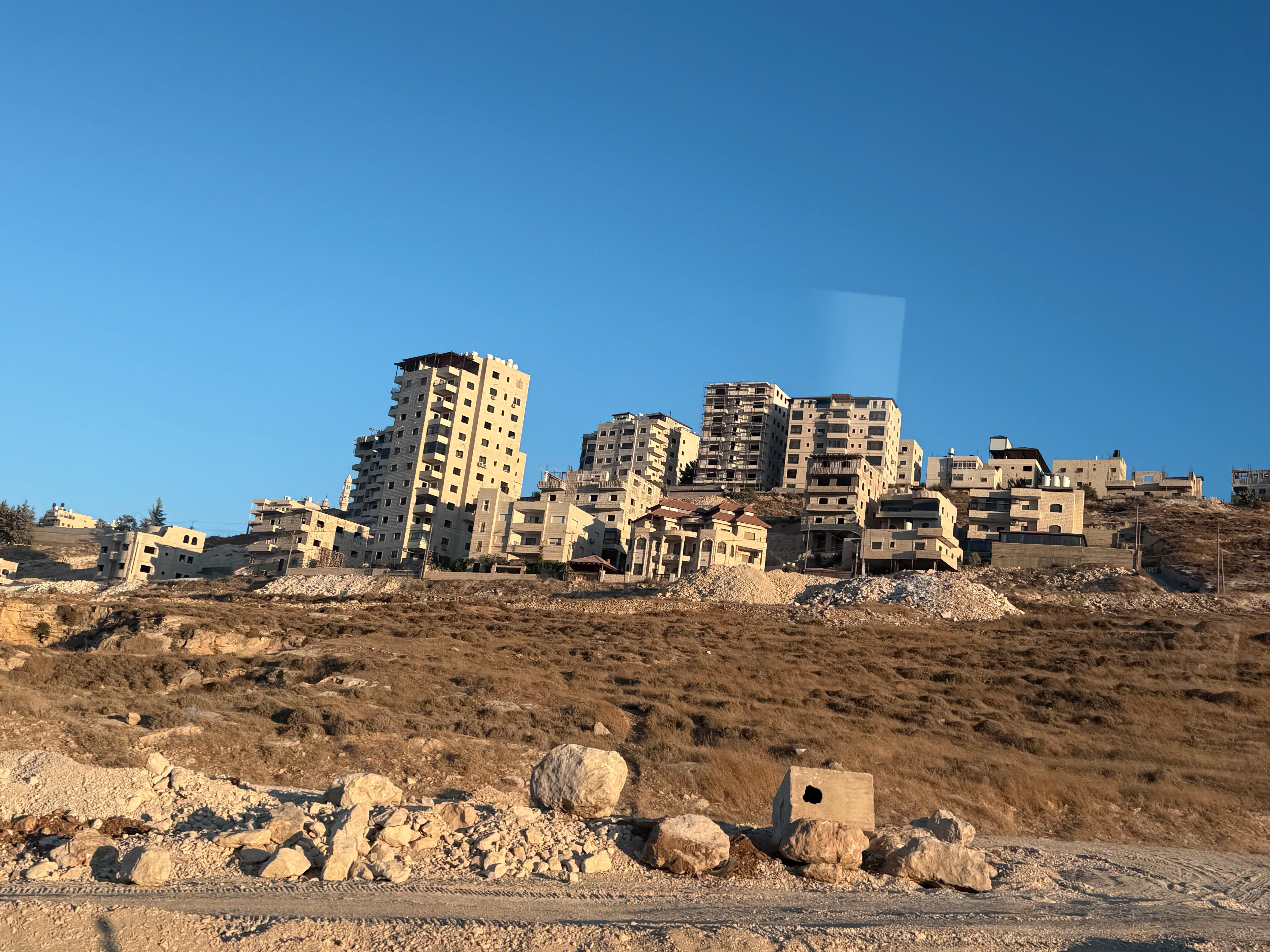
At first glance they looked like failed developments.
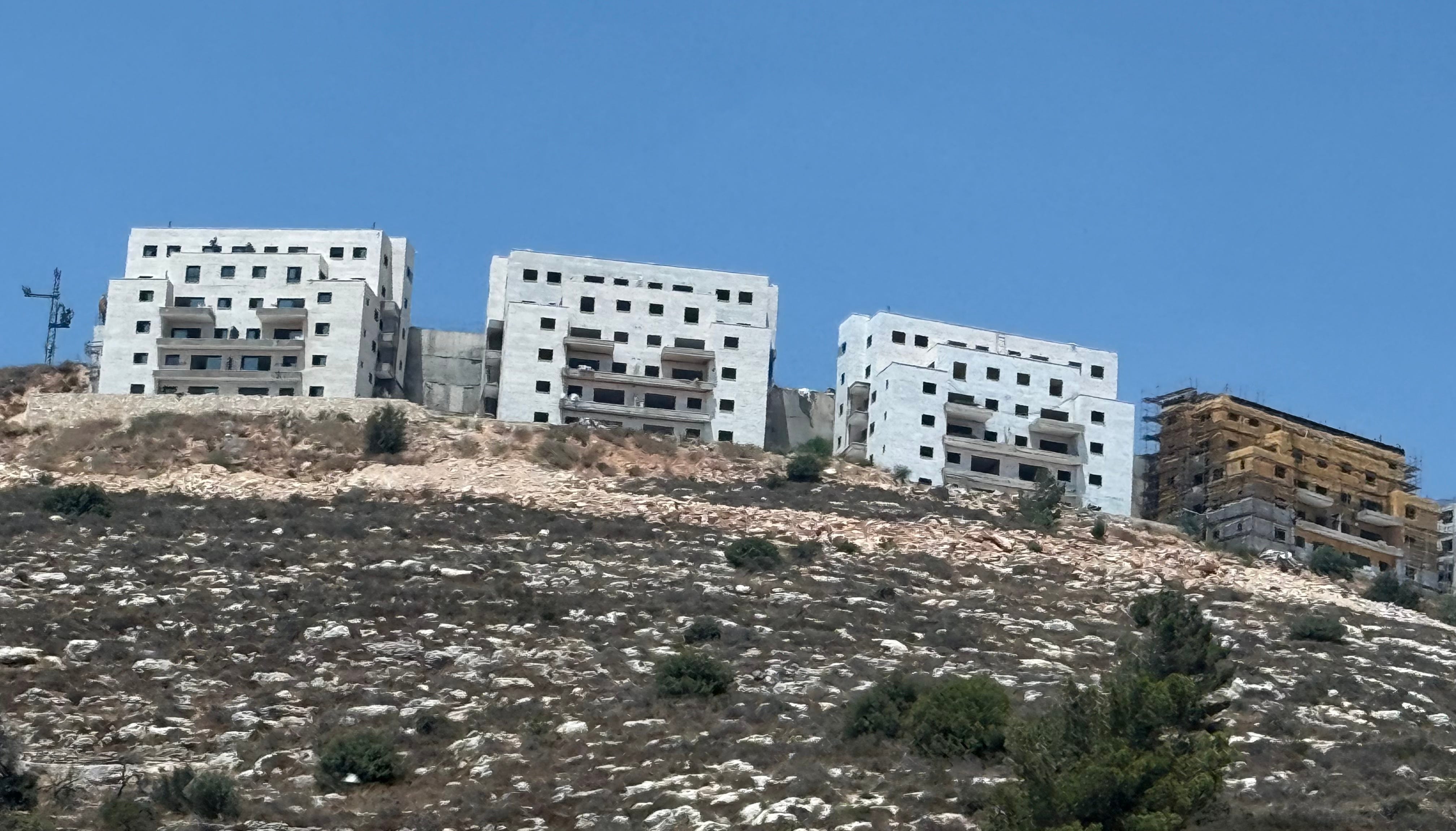
Then we began asking why.
One explanation is straightforward. Israeli approval for Palestinian construction in Area C is extremely rare. Between 2016 and 2021, Palestinians submitted 2,550 permit applications and twenty-four were approved. Since October 2023, hundreds more have been filed and none approved (Bimkom 2021; Norwegian Refugee Council 2025). Most Palestinian construction therefore proceeds without permits and carries the constant possibility of demolition. Moving a family into a building under a standing demolition order is a decision many people would postpone.
Emptiness may not be a failure of the project. It may be the design. American settlers understood this perfectly. The Homestead Act required residence and improvement, and an industry promptly developed in satisfying the requirement without meeting it. Claim shanties went up across the plains, some of them portable and hauled from one entry to the next. One story that entered the folklore has a claimant swearing his house measured twelve by fourteen and declining to specify inches. Paul Gates treated fraudulent and token entry as a structural feature of the federal land system rather than an aberration (Gates 1968). A building on a frontier does not have to shelter anyone to do its work. It has to be standing when the surveyor arrives.
Another explanation is more strategic.
In 2009, Palestinian Prime Minister Salam Fayyad proposed building the institutions of a future Palestinian state before any final peace agreement, creating facts on the ground rather than waiting for negotiations to succeed (Fayyad 2009). European governments and the UN embraced that approach. Through the West Bank Protection Consortium and other programs, they have funded planning and construction projects in Area C while arguing that Israeli restrictions threaten the viability of a future Palestinian state (Norwegian Refugee Council 2024). That objective is openly stated in European policy documents. It is not a conspiracy. It is declared policy.
This is not a symbolic effort. Over the past fifteen years, European governments and institutions have committed hundreds of millions of euros to planning, infrastructure, legal assistance, humanitarian projects, and construction in Area C through a web of EU programs, member-state initiatives, and international NGOs. The dedicated Area C development program itself has funded dozens of projects in scores of communities, while much larger humanitarian budgets have supported roads, water systems, schools, clinics, legal representation, and housing. The scale reflects a sustained strategic commitment rather than isolated aid projects.
The largest strategic funding for Area C development has come from the European Union and individual European governments (Germany, France, Sweden, Denmark, Belgium, the Netherlands, etc.). The UN’s role has generally been to implement, coordinate, map, and sometimes administer projects funded by those donors.
European governments supplied much of the money. The United Nations supplied much of the institutional legitimacy. Through its agencies, the UN has mapped, coordinated, implemented, and publicly documented many of these projects, embedding them within the broader framework of international humanitarian and development policy. That reflects the longstanding position of the United Nations, supported by influential Muslim and African voting blocs that together command a majority in the General Assembly, that Area C should become part of a future Palestinian state. Israel, however, increasingly operates from a different premise. After October 7, much of its political leadership no longer believes a negotiated two-state settlement is a realistic security outcome.
The consortium also makes little effort to disguise its legal position. It builds without Israeli permits because it considers the permit system fundamentally illegitimate. Israel takes the opposite view. Unpermitted construction remains unlawful regardless of who paid for it, and demolition orders follow accordingly.
The Israelis who hosted our visit interpreted those empty buildings differently from the European documents that helped finance some of them. Their argument was that construction itself changes the political landscape. A building does not have to be occupied to establish a presence. Enough buildings eventually alter the map, surround neighboring communities, and shape whatever political settlement ultimately emerges.
The Palestinian argument is different. It is that many of these buildings remain empty because families cannot safely move into structures living under the constant threat of demolition. On that account, the vacancy reflects legal uncertainty rather than political strategy.
Both explanations are probably true in different places. Neither can be confirmed from a car window. What struck me was not which explanation was correct.
It was that both sides were operating from exactly the same frontier logic.
On every frontier, possession comes before sovereignty.
Recognition
On a frontier, possession matters.
Recognition matters more.
An Israeli settlement is built with permits issued by the governing authority. Roads arrive. Water mains are connected. Power lines follow. Schools receive budgets. Municipal councils form. Addresses appear on maps. The settlement becomes part of the ordinary machinery of government.
A Palestinian building in Area C begins from a different legal position. Permit applications are approved only rarely, so much construction proceeds without them. Without a permit there is no occupancy certificate, no guaranteed utility connection, and often a demolition order waiting in a government file.
Any American who has fought a county planning board understands the difference. You are not looking at two kinds of builder. You are looking at one builder the sovereign recognizes and another it does not. Recognition is worth more than capital. It is worth more than determination. On a frontier, recognition eventually becomes title.
The American West followed the same pattern. Homesteaders who obtained legal recognition received roads, rail spurs, post offices, schools, and eventually counties. Mexican grantees whose claims failed in the land courts often received none of those things. Native American reservations developed under an entirely different legal framework. The difference in outcome was not a difference in character. It was a difference in which claims the government chose to recognize.
That is why Israel’s February 2026 decision to resume systematic land registration matters so much. A frontier exists because ownership remains contested. Registration is the process by which the state decides, parcel by parcel, whose claim becomes the official one. Once that process is complete, today’s possession becomes tomorrow’s title.
Registration is not simply bookkeeping. It transforms possession into recorded title. It records the landscape as it exists on the day the surveyor arrives, preserving decades of cultivation, permitting, infrastructure, and legal recognition in a form that becomes increasingly difficult to reverse.
The European strategy reveals the same understanding from the opposite direction. Long before the registration decision, European-funded programs emphasized mapping, planning, and documenting Palestinian communities throughout Area C. Both sides reached for the same instrument because both understand the same historical lesson.
Every frontier ends with a survey.
Only afterward does it become a map.
One final caution applies to every statistic in this debate. Advocacy organizations on both sides publish aggregate counts of the other side’s illegal structures, compiled according to their own methodologies and rarely subjected to independent audit. Those numbers circulate as though they were census data. They are not. Readers should approach advocacy statistics with the same degree of skepticism.
The frontier eventually closes.
When it does, the surveyor’s notebook often matters more than the soldier’s rifle.
What the Frontier Predicts
What the analogy predicts here is uncomfortable for Israelis.
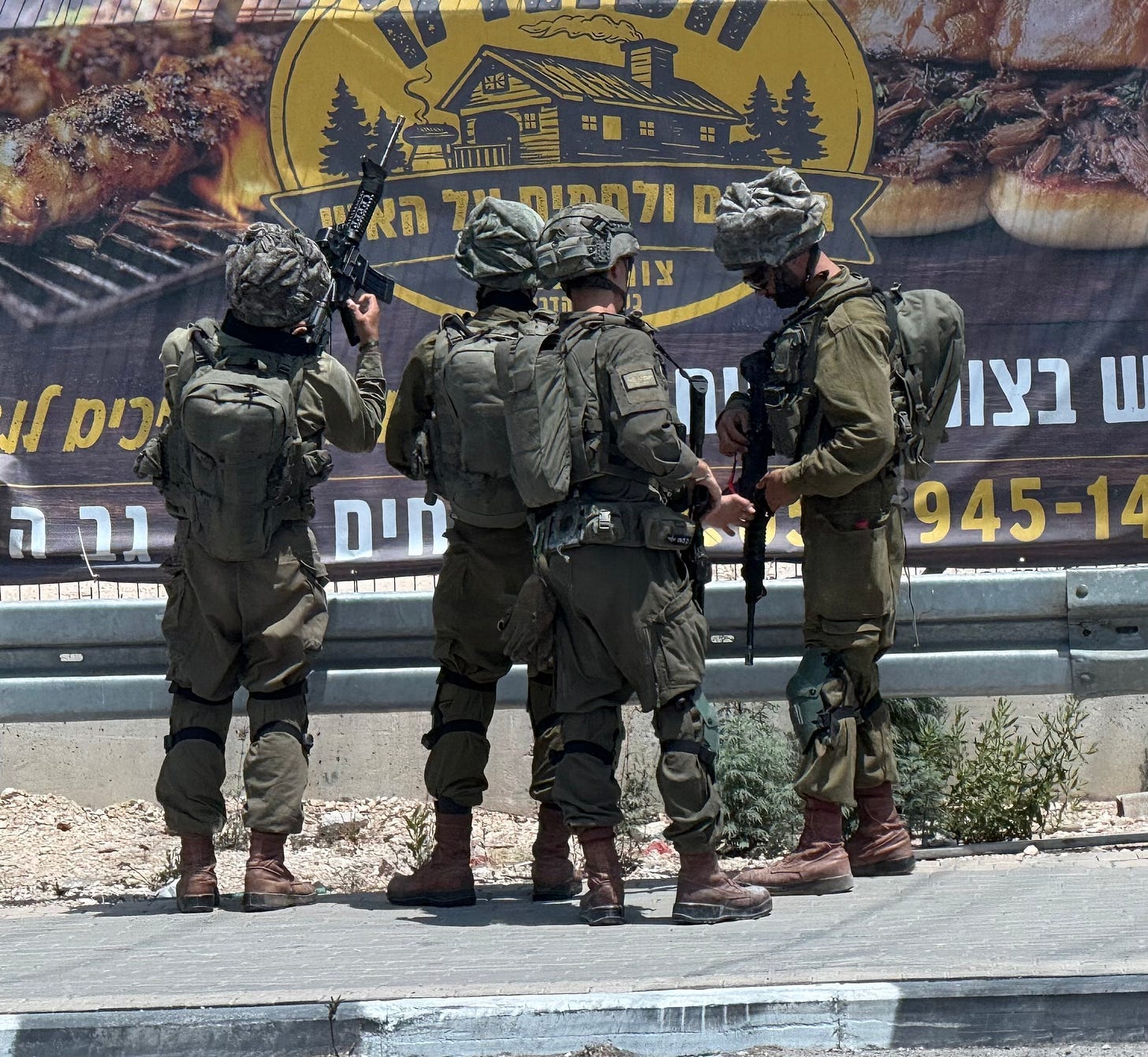
Weak-sovereignty zones reliably produce armed civilian violence. Not because the people are uniquely violent, but because the institutional incentives are different. When the state cannot provide security or resolve disputes quickly enough, private actors begin supplying both. Justice becomes private, and private justice is usually indistinguishable from vigilantism.
The American West produced this on schedule. The Texas fence-cutting wars of 1883 pitted open-range men against ranchers enclosing water and grass, and the state responded by criminalizing the cutting after the fact. The Johnson County War of 1892 saw the Wyoming Stock Growers Association hire fifty gunmen to kill men it accused of rustling, and it took federal cavalry to stop it (Davis 2010). Vigilance committees operated across the mining West with the tacit consent of communities that had no other law.
The pattern in every case is the same. Economic conflict over land and access, an enforcement vacuum, armed men on one side with the sympathy of local officials, and a legal system that arrives late and prosecutes little.
Israeli police data show cases opened over offenses by Israeli civilians against Palestinians in the West Bank rising from 139 in 2019 to 779 in 2025, with 6.6 percent producing an indictment, as reported by the Israeli daily Haaretz (Haaretz 2026). Those figures are the police force’s own, using its own categories.
The number gets used carelessly. Databases compiled by advocacy organizations aggregate physical assault, arson, trespass, stone-throwing, crop damage, and harassment into a single count, so a reader who sees a four-figure annual total pictures four figures of assaults. That is a fair criticism of how the figure gets deployed.
What survives the criticism is the prosecution rate, because it counts only cases Israeli police themselves decided to open. Critics read the gap as tolerance. The government’s answer is evidentiary difficulty where complainants will not testify. Both can be partly true. Neither side says the third thing. A low prosecution rate in a weak-sovereignty zone is the expected reading rather than an anomaly requiring malice to explain.
The same structure runs the other direction and gets less attention in the American press. Palestinian attacks on Israeli civilians in the West Bank are continuous, and the geography that makes settlements vulnerable is the same geography that makes villages vulnerable. Road ambush is the characteristic frontier crime, and Route 60 through the central highlands functions as such roads have always functioned.
Neither population can rely on a sheriff. Both arm themselves. That is not a moral observation about either of them. It is what the structure produces, and it is why part three’s argument about the absent sheriff lands hardest here rather than in Gaza.
The Frontier is Closing
If the frontier analogy holds, then it makes one final prediction.
Frontiers do not remain frontiers forever.
Eventually one sovereign authority prevails. The overlapping jurisdictions disappear. Competing legal systems give way to one. Surveyors replace soldiers. Registration replaces uncertainty. What had been a frontier becomes an ordinary part of the state.
Frederick Jackson Turner declared the American frontier closed in 1893 after the Census Bureau concluded there was no longer a continuous frontier line (Turner 1893). What disappeared was not empty land. It was legal ambiguity. The overlapping jurisdiction stack resolved into states, counties, courts, and citizens governed by a single sovereign.
Something remarkably similar now appears to be happening in the West Bank.
The changes are not dramatic. They are administrative.
In July 2025, the Knesset adopted a non-binding resolution declaring that Judea and Samaria are an inseparable part of the Land of Israel by a vote of 71 to 13. During 2025, Israel approved a record number of new settlements and advanced the long-frozen E1 corridor. Authority over planning and land administration has increasingly shifted from military to civilian ministries. In February 2026, the Security Cabinet extended Israeli administrative authority over construction, environmental regulation, water, and heritage beyond Area C into Areas A and B, while also approving systematic land registration (Crisis Group 2025; Israel Policy Forum 2026).
None of those decisions, considered individually, resolves the conflict.
Taken together, they point in one direction.
Roads are increasingly separated by license plate. Administrative systems that once differed only in Area C are extending into other parts of the West Bank. Registration is replacing uncertainty. Military administration is gradually giving way to civilian administration.
Whether one supports these changes or opposes them is a separate question.
Structurally, they are the markers of a frontier that is beginning to close.
Not through a declaration.
Through jurisdiction.
Through registration.
Through the slow replacement of overlapping authority with a single sovereign.
A Tomato Farmer and a Surfer
Jill and I spent part of an afternoon with three young Americans working in a vineyard in Samaria. That sentence would have made almost no sense to me a year ago. Why were Americans pruning grapevines on a contested hillside in the middle of the West Bank?
Their answer had very little to do with politics. It began with a verse from the Book of Jeremiah.
The three men worked for an American nonprofit called HaYovel. Its story begins with two people who, at first glance, had almost nothing in common.
One was Tommy Waller, a tomato farmer from rural Tennessee. He came from generations of Baptists. He and his wife, Sherri, raised eleven children, homeschooled them all, and for years lived in a self-supporting community without electricity. The other was Nir Lavi, an Israeli who had spent his younger years surfing and backpacking around the world before returning home to plant vineyards in the mountains of Samaria, where grapes had not been commercially grown for centuries. He would later establish the Har Bracha Winery.
The two met in the summer of 2004. Lavi walked Waller to the edge of the vineyard, opened a Bible, and read Jeremiah 31:5: “You shall again plant vineyards on the mountains of Samaria.” Waller later said that he realized he was standing inside the verse itself. He asked a simple question.
“What can I do to help?”
The following year the Waller family returned for the harvest. In 2007 they founded HaYovel so other Christians could do the same. Since then, more than three thousand volunteers from over thirty countries have worked alongside Israeli farmers throughout Judea and Samaria (The Israel Guys 2026). Joshua Waller, who met with us, was one of those eleven children. Today he leads the organization his father started.
His brother Nate told us how the story looked from a child’s perspective. He was nine years old, homeschooled, paging through an old Encyclopedia Britannica when he stopped at a photograph of the Dome of the Rock. He asked his mother what it was. She explained that it stood where Solomon’s Temple had once been, that the Temple had been destroyed and rebuilt and destroyed again, and that one day it would be rebuilt. He made his first trip to Israel the following year for the grape harvest and has been returning ever since.
Luke Hilton’s story follows much the same pattern. He grew up in Virginia Beach and first came to Israel at sixteen with his mother. His family eventually joined HaYovel, and today four Hilton brothers help lead the volunteer program. Their mother, Kathryn, died of cancer in 2023. The family now sponsors volunteers in her memory.
Listening to these stories, I noticed something they shared. Neither began with geopolitics. Neither began with Zionism. Both began with a child asking a question and a mother taking the time to answer it. Everything that followed grew out of that conversation.
These young men are unapologetic Christian Zionists. They believe they are participating in biblical prophecy. Gideon Elazar, the Israeli anthropologist who studied HaYovel, argues that they are better understood as part of the Hebrew Roots movement than as a conventional political organization. I think that is the more accurate description.
Politics found them anyway.
Nate carried a rifle. So did the other men working that hillside. They carried them the way another farmer might carry a chainsaw or wear a tool belt. Nobody remarked on them. Nobody posed with them. They were simply part of the day’s work.
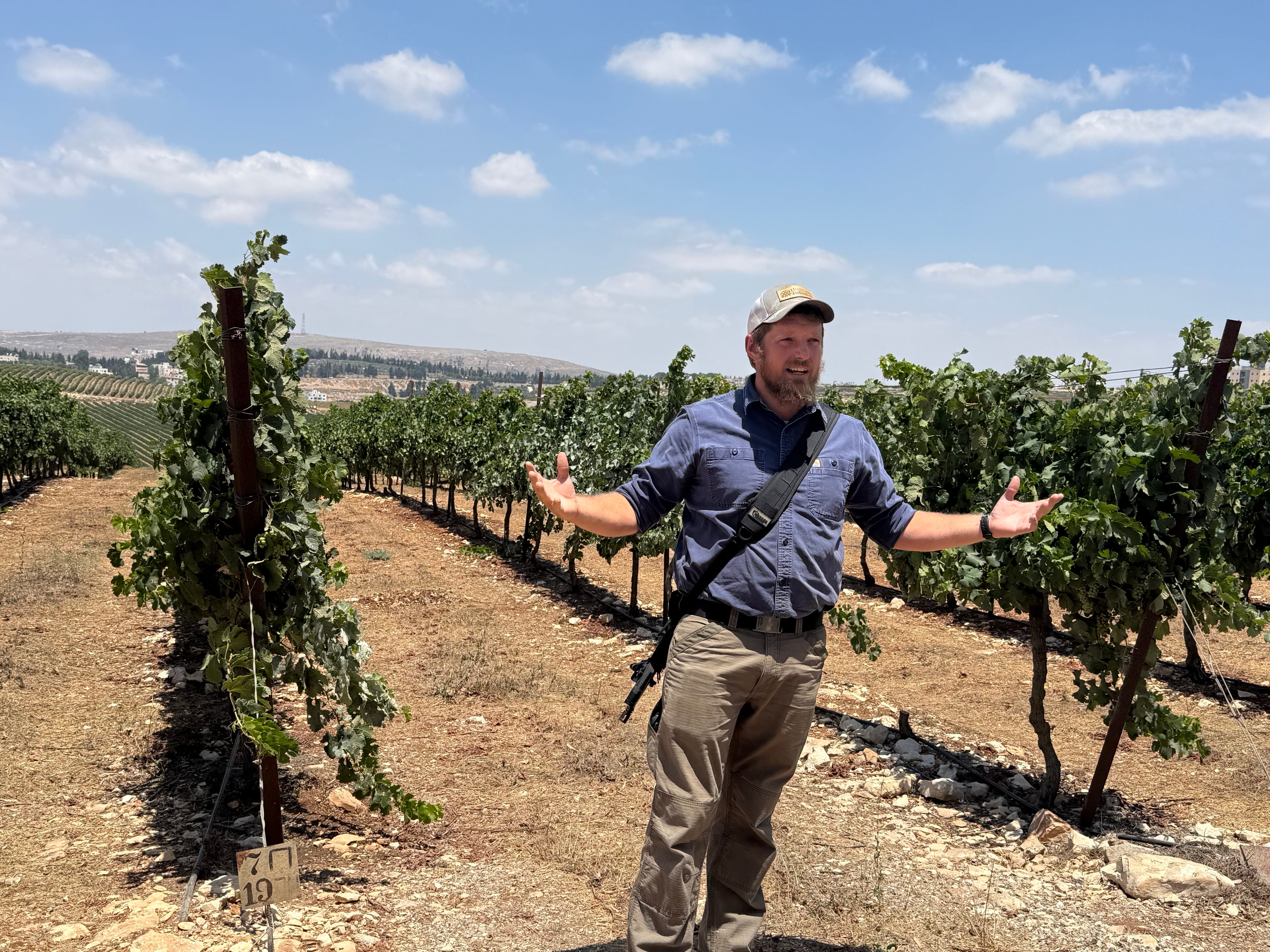
The rifle itself was familiar. It was an AR-pattern rifle, one that many Americans would recognize immediately. Everything else about it was different. It had been issued by the government rather than purchased over a counter. It came with a legal obligation to defend the community rather than simply a right to own it. Under Israeli law, even the ammunition issued with it is counted.
He wore it the way Israeli soldiers wear their rifles. The sling crossed his chest, the rifle rested across his back, muzzle down. That is not how a man expects to shoot quickly. He was not standing guard. He was pruning grapevines with a rifle on his back because, on that hillside, nobody leaves it in the truck.
The magazine told a different story. A second magazine was taped alongside the first, inverted for a rapid reload.
Those two details disagreed.
The way he carried the rifle said he expected never to use it.
The second magazine said that if he did, thirty rounds might not be enough.
An official in Israel’s firearms division later explained the decision to increase civilian ammunition allowances after October 7 by pointing to people who had fought with a single magazine and run dry. That lesson was hanging from Nate’s rifle.
He mentioned, almost in passing, that an improvised explosive device had recently been found near his home.
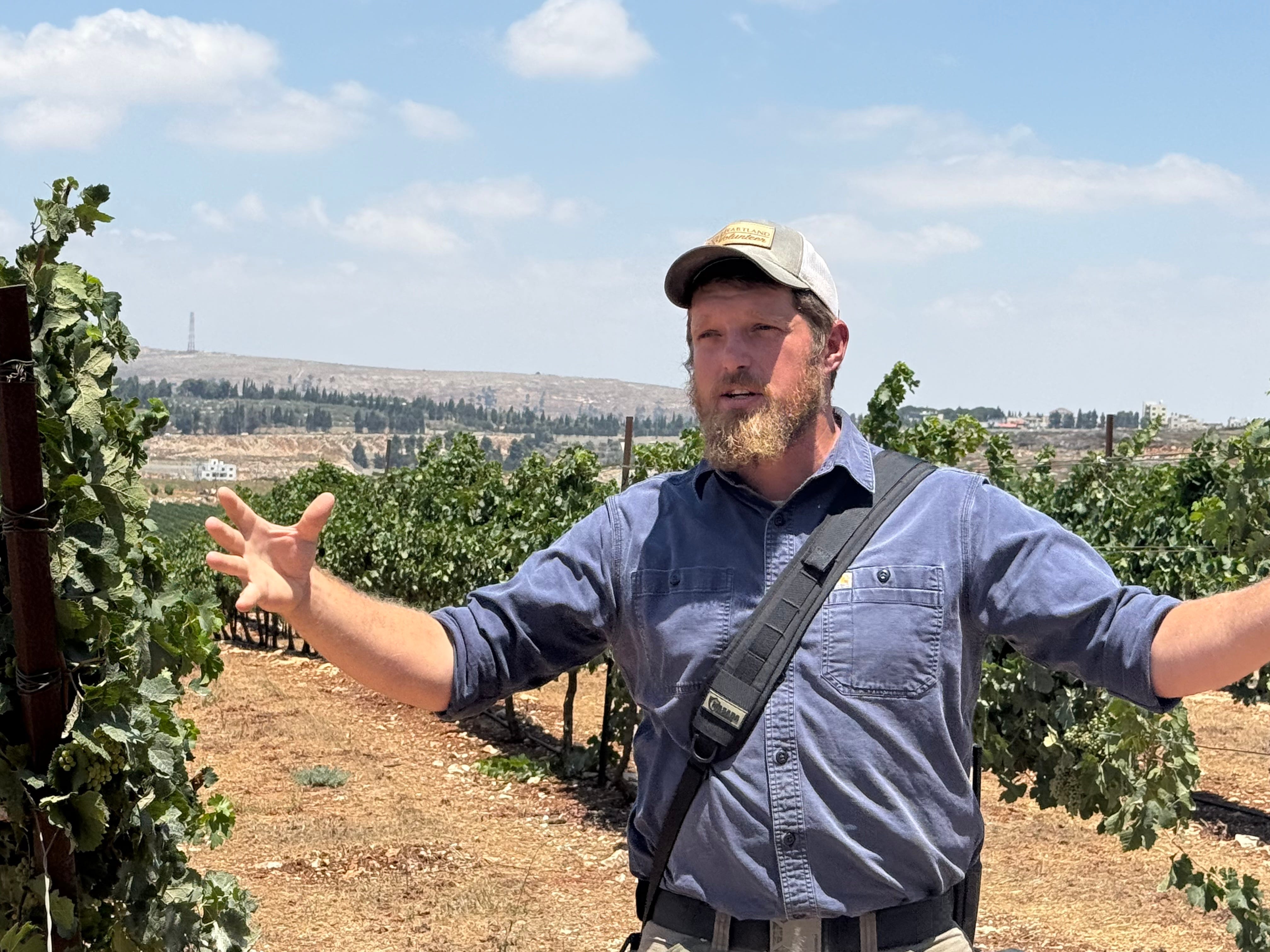
This single photograph, above, produces two entirely different stories.
A critic sees an armed foreign volunteer cultivating disputed land. It looks like the settler-colonial thesis brought to life.
A defender sees a farmer who recently found a bomb near his home and was handed a rifle by his government because nobody else would arrive in time.
Both are describing the same morning.
That is because this is still a frontier.
The sovereign arms one population and not the other. Israeli civilians living in the West Bank may carry rifles issued under Israeli law. Palestinian civilians generally may not possess firearms legally under the military legal regime governing the territory, apart from authorized Palestinian Authority security personnel operating under specific arrangements.
That is not a scandal. It is what sovereigns have historically done on frontiers they intend to control. The United States followed the same pattern. Federal policy armed settlers and disarmed tribes. The asymmetry was not an accident of frontier closure. It was one of the mechanisms by which the frontier closed.
These young Americans force an uncomfortable question.
An American reader who has known homeschooling families, attended conservative churches, or grown up in rural America will recognize them immediately. They are not exotic. A tomato farmer from Tennessee met a surfer on a hillside, heard a verse from Jeremiah, and spent the next twenty years bringing Christians to prune vineyards because he believed he was participating in biblical history.
They are also, in the plainest descriptive sense, foreign volunteers helping cultivate disputed land.
Both statements are true.
That is why I have become increasingly skeptical of explanations that rely on a single label.
Settler.
Colonizer.
Occupation.
Each captures part of the reality.
None captures enough.
Where the comparison breaks
No historical analogy is perfect, and this one breaks in important ways.
American territories eventually became states. Their residents became citizens, voted in the governments that ruled them, and ultimately stood under the same law as everyone else. That is what frontier closure meant in the United States.
Israel is different in one important respect. Roughly one-fifth of Israel’s citizens are Arab, and they vote, serve in the Knesset, sit on the Supreme Court, practice medicine, teach at universities, and participate in every level of Israeli civic life. That is not the question here.
The question is the West Bank.
No comparable path to citizenship is currently on offer for most Palestinians living there. On that point, the Israeli government and many of its critics agree, even if they disagree about almost everything else. A frontier that closes without extending political membership leaves behind a permanent population living under the authority of a state in which it cannot vote. That is where the American analogy begins to break down.
The people living on this land also refuse to fit neatly into America’s historical categories. Both Israelis and Palestinians claim to be indigenous, and both claims have substance. Jewish continuity on this ground stretches back three millennia and is supported by an extraordinary archaeological record. Palestinian families can point to centuries of continuous residence in the same towns and villages. The American frontier presented a much clearer distinction between settlers and native peoples. Importing that binary here explains neither side particularly well.
There is another irony.
The frontier analogy itself was largely developed by scholars arguing the opposite of the point I am making. Patrick Wolfe’s influential 2006 essay, famous for describing invasion as “a structure, not an event,” used the American West as the template for understanding Israel as a settler-colonial society (Wolfe 2006). Anyone reaching for the American frontier is therefore borrowing a framework that many advocates use to reach precisely the opposite conclusion.
I think the comparison survives, but for a narrower reason.
The settler-colonial literature uses the American frontier primarily to establish moral categories and historical intent. I am using it to understand institutional mechanisms. Overlapping jurisdictions, contested title, competing water rights, uncertain sovereignty, and private violence where the state cannot reliably enforce the law are recurring structural features. They appear whenever those conditions exist, regardless of the motives of the people involved. Explaining a pattern as the consequence of institutions is not the same thing as excusing it, nor does it answer the moral questions that inevitably follow.
Historian Patricia Nelson Limerick revised Frederick Jackson Turner’s frontier thesis in much the same spirit. She argued that the American frontier is better understood as conquest carried out through a legal apparatus than as peaceful settlement, and that the traditional American story had itself become a political narrative (Limerick 1987).
That insight cuts both ways.
It challenges comforting versions of American history.
It also challenges comforting versions of this one.
What Closure Cost, and What it Bought
The American frontier closed. It produced a country governed by a single legal order, and it did so at a price paid overwhelmingly by people who had little or no political voice in the process. Removal, reservation, and the destruction of indigenous economies were among the mechanisms by which that legal order was established. Nobody is proposing to repeat that history, and nobody serious argues that Israel is attempting to do so.
What the American experience does demonstrate is something simpler.
Frontiers do not remain frontiers forever.
Eventually the overlapping jurisdictions disappear. One legal system prevails. The survey is completed. The maps stop changing.
The West Bank increasingly appears to be moving in that direction. The instruments are different. Registration instead of homesteading. Administrative law instead of cavalry. Roads, permits, and jurisdiction instead of land offices and railroads. Less dramatic, perhaps. Almost certainly more durable.
History, however, leaves one question unanswered.
Every frontier I have examined ultimately produced one of three outcomes.
The resident population became full members of the sovereign political order.
The resident population remained inside that order without equal political membership.
Or the resident population left.
The American frontier produced all three, in different places and at different times.
Israelis we met understood this dilemma better than many Americans writing about it. After October 7, the security argument for controlling the Jordan Valley and the central highlands is neither abstract nor difficult to understand. What I did not hear, from anyone, was a convincing description of the political end state that avoided the same arithmetic history presents.
That is not uniquely an Israeli problem.
It is the problem every closing frontier eventually confronts.
History explains remarkably well how frontiers close. It is much less helpful in explaining how democracies reconcile frontier closure with a permanent population that remains outside full political membership.
That is the question the frontier analogy cannot answer.
RWM/JGM
References
Adelman, Jeremy, and Stephen Aron. 1999. “From Borderlands to Borders: Empires, Nation-States, and the Peoples in Between in North American History.” American Historical Review 104 (3): 814 to 841.
B’Tselem. 2017. The Jordan Valley. Jerusalem.
Bimkom. 2021. Building Permits in Area C: Data on Palestinian Applications 2016 to 2021. Jerusalem.
Crisis Group. 2025. Sovereignty in All but Name: Israel’s Quickening Annexation of the West Bank. Middle East Report 252. Brussels, October 9.
Davis, John W. 2010. Wyoming Range War: The Infamous Invasion of Johnson County. Norman: University of Oklahoma Press.
Ebright, Malcolm. 1994. Land Grants and Lawsuits in Northern New Mexico. Albuquerque: University of New Mexico Press.
Elazar, Gideon. 2020. “Plowmen and Vine-trimmers: Hebrew Roots and Jewish Restoration in Samaria.” The Christian Nation Project.
Fayyad, Salam. 2009. Palestine: Ending the Occupation, Establishing the State. Ramallah: Palestinian National Authority.
Gates, Paul W. 1968. History of Public Land Law Development. Washington, DC: Public Land Law Review Commission.
Institute for Palestine Studies. 2020. “Bedouin Communities in Greater Jerusalem: Planning or Forced Displacement?” Washington, DC.
Haaretz. 2026. “Jewish Nationalist Crime in West Bank Up by 560 Percent Since 2019, Police Data Shows.” July 8.
HCJ 390/79. Dweikat v. Government of Israel (Elon Moreh). Israeli Supreme Court, October 22, 1979.
Israel Defense Forces. 1967a. Military Order 92: Concerning Powers for the Purpose of the Water Provisions. West Bank Area, August 15.
Israel Defense Forces. 1967b. Military Order 158: Amendment to the Law Concerning Supervision over Water. West Bank Area, November 19.
Israel Defense Forces. 1968. Military Order 291: Concerning Settlement of Disputes over Land and Water. West Bank Area, December 19.
The Israel Guys. 2026. Our Story. Har Bracha: HaYovel Inc. theisraelguys.com/our-story.
Israel Policy Forum. 2026. “Israel’s New Escalation of West Bank Annexation.” February 11.
Limerick, Patricia Nelson. 1987. The Legacy of Conquest: The Unbroken Past of the American West. New York: W. W. Norton.
The Mecelle (Ottoman Civil Code). 1869 to 1876. Translated by C. R. Tyser et al. Nicosia: Government Printing Office, 1901.
Norwegian Refugee Council. 2024. West Bank Protection Consortium. Oslo.
Norwegian Refugee Council. 2025. “West Bank: Record Number of Demolitions over Building Permits.” October 1.
United Nations Office for the Coordination of Humanitarian Affairs. 2025. Demolitions and Displacement in the West Bank. Jerusalem.
Ottoman Land Code of 1858. Translated by F. Ongley. London: William Clowes and Sons, 1892.
Rivera, Jose A. 1998. Acequia Culture: Water, Land, and Community in the Southwest. Albuquerque: University of New Mexico Press.
Turner, Frederick Jackson. 1893. “The Significance of the Frontier in American History.” Proceedings of the State Historical Society of Wisconsin: 79 to 112.
Wolfe, Patrick. 2006. “Settler Colonialism and the Elimination of the Native.” Journal of Genocide Research 8 (4): 387 to 409.
Worster, Donald. 1985. Rivers of Empire: Water, Aridity, and the Growth of the American West. New York: Pantheon.
Morning Doc's.
Exceptional series, thoroughly enjoyed it and am better educated because of it.
Seems that if all the foreign meddling and money stopped that the people living there would settle this much more quickly. Probably be blood shed but, in my opinion, there would be less blood spilled.
Amazing body of work! You have been able to break down a very complicated subject and help educate those of us who only listen to news accounts. Thank you!