

By Dr. Jill Glasspool Malone and Robert W. Malone
Last September 30, Robert and I published an exposé titled Operation Stork Stall, revealing something rather astonishing about American infant formula.
The FDA does not require manufacturers to disclose how many grams of Total Sugars or Added Sugars are in infant formula. Some products even list corn syrup as their first ingredient. Yet parents cannot look at the nutritional panel and determine how much sugar their babies are consuming.
Think about that. A jar of baby food must disclose its sugar content, but infant formula, which may provide virtually every calorie a newborn consumes for months, is exempt.
We also documented how Operation Stork Speed, announced by Secretary Kennedy in March 2025 with promises of “radical transparency,” had accomplished relatively little in changing the actual formula being sold to American families.
Now, here is where the story gets interesting.
At the time, Calley Means was still communicating with Robert. Since leaving his HHS position, however, Means has essentially cut off communication, as have others associated with the MAHA political organizations.
We have been told that Secretary Kennedy is, as one person described it, “big mad” at Robert.
My impression is that certain elements of the MAHA establishment have become increasingly interested in controlling the narrative and ostracizing those who independently investigate and report on what is happening. Activists who promote the movement are welcome. Independent journalists asking uncomfortable questions? Apparently, not so much.
But before that breakdown in communication, we made certain that our infant formula investigation reached Calley Means.
He told us that he, Secretary Kennedy, and senior HHS leadership had been unaware of the specific sugar-labeling exemption we documented. He promised to circulate our article to FDA Commissioner Heidi Overton and other FDA officials.
We hoped he would follow through.
Fast-forward to October 29.
Secretary Kennedy announced that the FDA is moving forward with its first comprehensive review of infant formula nutrient requirements in nearly 30 years.
As Kennedy explained, the science has evolved, and the agency is now comparing American infant formula standards with more recent research and European standards.
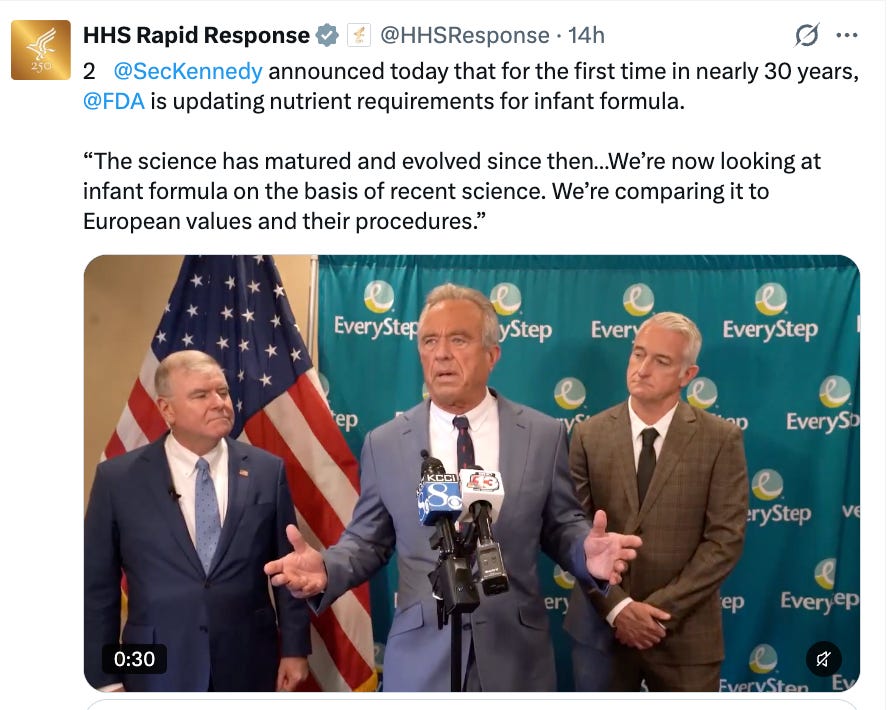
Those words, “European values,” are particularly significant. As we had documented, European infant formula regulations impose tighter restrictions on certain carbohydrate sources, including glucose syrup, sucrose, and other sugars. The European Union also maintains detailed standards governing ingredients, additives, and nutritional composition. These differences go directly to the heart of our September investigation, which exposed the use of corn syrup-derived ingredients in American infant formula and the FDA’s extraordinary exemption allowing manufacturers to omit Total Sugars and Added Sugars from nutrition labels.
Kennedy’s reference to European standards suggests that the administration may finally be examining the very regulatory differences we brought to HHS leadership’s attention.
The FDA has now proposed changes affecting eight nutrients, including iodine, manganese, and vitamins A and D. Additional reviews are planned, including an examination of carbohydrate sources.
That is welcome progress, and credit should be given where it is due.
However, the FDA initiated its comprehensive nutrient review before our September investigation. What we specifically brought to MAHA leadership’s attention was the longstanding regulatory exemption that allows infant formula manufacturers to withhold basic sugar-content information from parents.
And that problem remains unresolved.
The current proposal does not eliminate the sugar-labeling exemption. Carbohydrate sources are scheduled for examination in a later phase, but there is no guarantee that the FDA will ultimately require manufacturers to disclose Total Sugars and Added Sugars.
We cannot know whether our investigation helped bring additional attention to this issue within HHS or FDA. What we do know is that we documented the problem, delivered our findings to someone with direct access to senior leadership, and received assurances that the information would be circulated.
Perhaps our reporting helped move the conversation forward. We certainly hope so.
But the fundamental question remains: Why should American parents have to wait years for the FDA to require infant formula manufacturers to disclose information they already possess?
And there is a larger issue here, one that goes well beyond infant formula.
Independent journalism is not supposed to function as the public relations department for politicians, government agencies, or political movements. We support reforms that improve American health, regardless of who implements them, and we will give credit when meaningful progress is made.
But supporting the goals of MAHA does not mean surrendering our independence to its political leadership, remaining silent when promises go unfulfilled, or overlooking failures simply because the people responsible happen to be on our side.
Accountability cannot be reserved exclusively for political opponents.
Our job is to investigate, document, and ask difficult questions, including those that make people in positions of power uncomfortable.
And that is exactly what we intend to keep doing.
What Happens to MAHA if Democrats Take Congress?
The future of the MAGA-MAHA alliance, the emergence of an independent MAHA political movement, and Robert F. Kennedy Jr.’s uncertain political future.
By: Dr Robert Malone
The following analysis is for paid subscribers only.
