

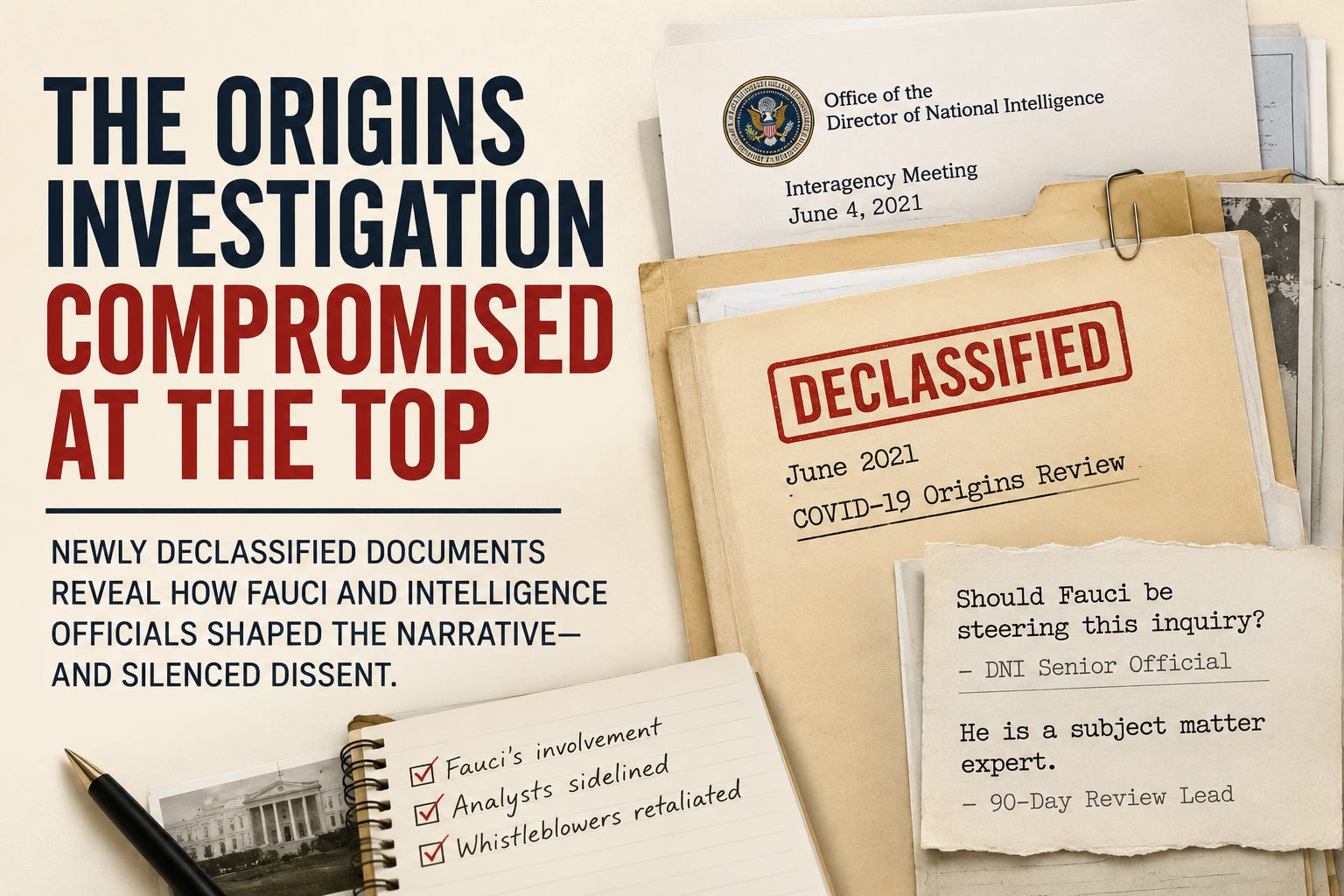
On her way out the door, Tulsi Gabbard declassified the record of how Anthony Fauci helped build the very intelligence that cleared him. The comprehensive read.
Executive summary
The controversy can be summarized in a single line: Fauci funded the Wuhan research, then helped steer the intelligence that absolved it. What the declassified documents add is the mechanism. They show a man who occupied multiple positions of authority simultaneously, who placed trusted associates inside the intelligence review process, and who then helped present the resulting conclusions to the public as independent scientific judgment. They show sworn testimony that contradicts the record, in fact documenting that Fauci lied under oath. And they show what was done to the analysts who refused to go along.
This is not a new intelligence assessment. It is something more useful, which is the raw material. In her final days as Director of National Intelligence, Tulsi Gabbard declassified the correspondence, the briefing readouts, and the whistleblower complaints that the cover-up was built to keep buried (1). She did it at the close of the week, on her way out of office, knowing that the man arriving to replace her has been asked to shrink the agency rather than to keep opening its files (2).
The central issue is no longer whether credible analysts raised concerns about a laboratory origin. They did. What these documents address is something different. They raise serious questions about whether the intelligence process itself was influenced by officials with a direct stake and a conflict of interest in the conclusions being reached.
One fact stands out from these documents, and it has received remarkably little attention. Five weeks before this release, a CIA whistleblower testified before Congress under oath that a cover-up had occurred and described how it operated. The documents released by Gabbard are consistent with that testimony and provide independent support for his account.
A Friday, on the way out the door
Timing matters. Washington has long used Friday afternoons to release information it hopes will disappear into the weekend news cycle. Gabbard used the same timing for the opposite purpose. In the final days of her tenure, she released documents that powerful people had spent years trying to keep out of public view.
She is leaving office at the end of the month, and her successor arrives with instructions to shrink the agency rather than continue opening its files. That makes the timing more significant, not less. A declassification effort of this scale does not simply drift to completion. Someone has to push it through.
The COVID documents were not a one-off release. They were the culmination of a year-long effort to declassify records across the intelligence community. Only days earlier, Gabbard’s office released information concerning more than one hundred federally funded laboratories operating overseas, including facilities working with dangerous pathogens.
Taken together, the releases point to the same underlying problem: a vast biological research enterprise funded with American tax dollars, shielded by American institutions, and largely hidden from the public that pays for it. Some of these disclosures were required by law. The difference is that Gabbard appears to have treated those requirements as a starting point rather than a limit.
The entanglement
The core issue is the conflict of interest.
Before and during the pandemic, Anthony Fauci directed NIAID. NIAID funding reached the Wuhan Institute of Virology through EcoHealth Alliance to support coronavirus research involving bats. When SARS-CoV-2 emerged, and the intelligence community began examining the virus’s origins, Fauci was not a bystander. He was one of the government’s most influential scientific advisers. At the same time, he was the public face of the COVID response, repeatedly dismissing the lab-leak hypothesis as implausible and characterizing many of its proponents as conspiracy theorists.
Those roles should never have been combined.
The official whose agency helped fund the research was also advising the government as it examined whether that research might have contributed to the pandemic. Simultaneously, he was reassuring the public that there was little reason to suspect a laboratory accident.
That is not a question of motive. It is a question of structure. Systems designed to manage conflicts of interest are built on a simple principle: no individual should be placed in a position to influence the investigation of matters in which they have a direct professional, institutional, or reputational stake. Yet that is precisely what happened here. The conflict was not avoided. It was embedded in the process from the beginning.
How the consensus was manufactured
Fauci did not need to dictate the outcome. He only needed direct influence and control over who advised the investigators and which evidence they were allowed to see and consider most persuasive.
The documents show Fauci providing the intelligence community with names of scientists to consult, many of whom had received funding through NIAID. They also show intelligence officials accepting those recommendations. One senior official explained the reasoning in straightforward terms, describing Fauci as the person who “knows better than most who the real Coronavirus experts are” (3).
The consequence is obvious. Fauci’s experts helped inform the assessment. That assessment was then presented to the public as the independent judgment of the intelligence community and cited as evidence against a laboratory origin.
Gabbard’s office describes this as a self-serving circular reporting loop. The description fits. The same network of experts helped shape the analysis, and the resulting analysis was then invoked as independent confirmation of the experts’ conclusions.
The same pattern appears in the scientific literature. In February 2020, Fauci participated in the now-famous teleconference with a group of virologists who, weeks later, published “The Proximal Origin of SARS-CoV-2” in Nature Medicine (4). The paper became the most influential scientific argument for a natural origin and was repeatedly cited by government officials, journalists, and social media companies as authoritative evidence against a laboratory accident. To this day, despite multiple scientists and biosafety advocates calling for its retraction, arguing that private communications released after publication reveal doubts and concerns that were absent from the paper's confident dismissal of a laboratory origin, Nature Medicine has declined those requests.
Yet private communications obtained through public-records requests and congressional investigations tell a more nefarious story. Several of the authors expressed concerns to one another and to Fauci that aspects of the virus “(potentially) look engineered,” even as they worked toward a public statement dismissing that possibility (5).
The paper went on to play a central role in the origins debate. Fauci promoted it as authoritative. Intelligence officials cited it. Journalists relied on it. Years later, it remains part of the documentary record released as part of this declassification.
One detail from the newly released files is particularly revealing. During a June 2021 briefing with intelligence analysts, Fauci did not simply answer questions. He argued for evidence that he believed supported a natural origin while also pressing analysts about why Chinese authorities had been permitted to sanitize the Wuhan market before investigators could properly examine it. He was not merely receiving information. He was participating in the discussion about which evidence should carry the most weight.
The misrepresentation, under oath
There is another problem for Fauci.
During his 2024 testimony before the House Select Subcommittee on the Coronavirus Pandemic, Fauci was asked whether he had spoken with the FBI, CIA, DIA, or other intelligence agencies regarding viral research and COVID origins. After several exchanges, he answered, “not to my knowledge about COVID (1).”
The documents released by Gabbard include records of those interactions. They are dated. One of them describes a June 2021 briefing with Fauci concerning the origins of SARS-CoV-2. So his testimony was untrue.
The issue is not what Fauci may have intended by the phrase “not to my knowledge.” The issue is that the declassified record documents conversations that he appeared to deny having had. The briefing records exist. The conversations happened. The dates are established. The meetings took place.
The cost of dissent
The most troubling material in the release may be about what happened to the analysts who reached conclusions that conflicted with the preferred narrative.
According to whistleblower testimony that Gabbard has referred to the Intelligence Community Inspector General, a contractor was terminated within days of raising concerns.
Analysts who supported a laboratory-origin assessment were reminded that promotions and career advancement ultimately depend on leadership. In some cases, the anonymity normally afforded to whistleblowers was reportedly compromised when managers and attorneys were included in meetings that were supposed to remain confidential (1).
The significance of these allegations becomes clearer when viewed alongside the intelligence assessments themselves. The intelligence community never reached a consensus. When the findings were eventually released, four agencies and the National Intelligence Council favored a natural-origin hypothesis with low confidence, while another intelligence element assessed a laboratory-associated incident with moderate confidence (6). By 2023, both the FBI and the Department of Energy had concluded that a laboratory origin was the most likely explanation (7). By early 2025, the CIA had reached the same judgment (8), as had a congressional investigation that spent two years reviewing the evidence.
This is what makes the whistleblower allegations so consequential. The analysts whose views were reportedly marginalized were not advancing a fringe theory. They advanced a conclusion that was ultimately adopted by multiple intelligence agencies and Congress, and supported by a growing body of evidence. The dispute was never between serious analysis and conspiracy theory. It was between competing assessments, one of which became increasingly difficult to dismiss, even as it was suppressed by the likes of Fauci and his team.
The witness who got there first
Tulsi Gabbard’s ONDI release did not emerge in a vacuum.
Five weeks earlier, on May 13, 2026, James Erdman III, a decorated CIA officer who led ODNI’s investigation into COVID-19 origins, testified before the Senate Homeland Security and Governmental Affairs Committee under subpoena and against the wishes of his own agency (9). He described a process in which Fauci helped shape which scientific experts intelligence analysts were permitted to consult, and alleged that analysts favoring a laboratory-origin assessment faced institutional resistance.
The significance of Erdman’s testimony is that the newly declassified documents describe many of the same events.
Erdman pointed to a June 4, 2021, interagency meeting in which Fauci provided guidance regarding scientific outreach. He described an internal exchange in which a senior DNI official questioned whether Fauci should be involved in steering the inquiry, only to be overruled by the officer leading the ninety-day review, who treated Fauci as a subject-matter expert (10). He also testified that analysts who supported a laboratory-origin assessment had their conclusions sidelined and that a contractor was terminated shortly after cooperating with investigators (11).
The documents released by Gabbard contain records of those same events. The June 2021 meeting appears in the files. So does the correspondence concerning Fauci’s role. The contractor allegations are reflected in whistleblower complaints included in the release.
The importance of this is straightforward. Erdman described these events under oath weeks before the documents became public. The documentary record now supports key elements of his account.
The CIA did not welcome his testimony. Agency officials criticized the hearing and argued that Erdman had been compelled to appear without adequate notice (11). Yet the agency now assesses a laboratory-associated origin as the most likely explanation for the pandemic, a position much closer to Erdman’s conclusions than to the views that dominated the early years of the debate.
One part of Erdman’s testimony remains separate from the Gabbard release. He alleged that CIA officials obstructed declassification efforts, withheld records, retaliated against cooperating personnel, and monitored communications involving investigators and whistleblowers. Those allegations are serious, but they are not addressed by the documents released this week. For now, they rest on Erdman’s sworn testimony alone.
That distinction matters. The declassified record corroborates important parts of Erdman’s account. It does not yet establish all of it. But if future evidence supports those additional allegations, the story becomes much larger than Fauci or the origins debate. It becomes a question of whether elements of the intelligence apparatus obstructed an investigation into one of the most consequential events of the modern era.
Conclusion
The files establish how the origins investigation was conducted. They show that officials with a direct institutional and personal stake in the outcome were involved in shaping the process, influencing the experts consulted, and participating in the evaluation of the evidence. They also document allegations that analysts and whistleblowers who challenged the preferred narrative faced professional consequences.
That is the significance of this release. The issue is no longer simply whether the virus emerged from a laboratory or through natural spillover. The issue is whether the institutions charged with finding the answer allowed conflicts of interest to influence the search for it.
The documents also lend substantial support to the testimony of James Erdman III, who described many of these events under oath weeks before the records became public. The testimony came first. The documents followed.
This essay is the second half of our two-part coverage and accompanies the press release published earlier today (12). The primary source material is provided below.
Read it for yourself. After years of speculation, accusation, and denial, the public can finally examine a significant portion of the record directly.
RWM / JGM
References
1. Office of the Director of National Intelligence. “Fauci Funded Wuhan Lab Research That Sparked COVID: New Evidence Fauci Manipulated Intelligence and Lied to Congress.” News Release No. 11-26, June 18, 2026. odni.gov.
2. Office of the Director of National Intelligence. “COVID-19 Release” (DNI Tulsi Gabbard, June 18, 2026): Document Index, Part 1, Part 2, Part 3, and Part 4.
3. Email chain, “RE: Covid origins - Dr. Fauci recommendations,” July 13-14, 2021, in ODNI COVID-19 Release, Part 1.
4. Andersen, Kristian G., Andrew Rambaut, W. Ian Lipkin, Edward C. Holmes, and Robert F. Garry. “The Proximal Origin of SARS-CoV-2.” Nature Medicine 26, no. 4 (2020): 450–452. doi.org/10.1038/s41591-020-0820-9.
5. U.S. House Select Subcommittee on the Coronavirus Pandemic. After Action Review of the COVID-19 Pandemic: The Lessons Learned and a Path Forward. Final report, December 2024. oversight.house.gov. (Authors’ private “Proximal Origin” communications were released through this investigation and prior public-records requests.)
6. Office of the Director of National Intelligence and National Intelligence Council. “Updated Assessment on COVID-19 Origins.” October 29, 2021. dni.gov.
7. “US Intelligence Agency Releases Declassified Wuhan SARS-CoV-2 Lab Leak Assessments.” CIDRAP, University of Minnesota, June 26, 2023. cidrap.umn.edu.
8. “CIA Says COVID More Likely to Have Leaked from Lab.” Agence France-Presse, January 26, 2025. via Malay Mail.
9. U.S. Senate Committee on Homeland Security and Governmental Affairs. Hearing on the Multi-Agency Cover-Up of COVID-19 and Gain-of-Function Research (testimony of James Erdman III), May 13, 2026. hsgac.senate.gov.
10. “CIA Whistleblower Alleges COVID Lab-Leak Findings Were Suppressed.” U.S. Right to Know, 2026. usrtk.org.
11. Britschgi, Christian. “Whistleblower Tells Congress the CIA Illegally Spied on White House Officials Investigating COVID Origins.” Reason, May 13, 2026. reason.com.
12. Malone, Robert W. “DNI Press Release: Never-Before-Seen Communications and Documents Exposing How Dr. Fauci and the Deep State Lied.” Malone News, June 19, 2026. malone.news.
A note on scope. This assessment rests on a direct reading of Part 1 of the release and the full document index, with Parts 2 through 4 reviewed at the index level, and on the prior public products referenced above. Claude was used to extract information out of the ODNI primary documents. Characterizations attributed to the Director’s office are hers, and allegations drawn from Mr. Erdman’s testimony are his; the underlying documents are linked so that readers can weigh them for themselves.
It is now abundantly clear that Fauci, Daszak and others are guilty of treason and murder and should be swinging from the end of a rope.
This is all wonderful - the truth finally coming out - he's guilty as we all knew he was. But now what? How does his pardon get overturned? Will he ever pay for his crimes? What about all the harm, deaths, and consequences faced by those who were compliant by taking the shot and those who weren't and were punished for it. What does all this amount to if its nothing more than "told you!"