

MALONE.NEWS
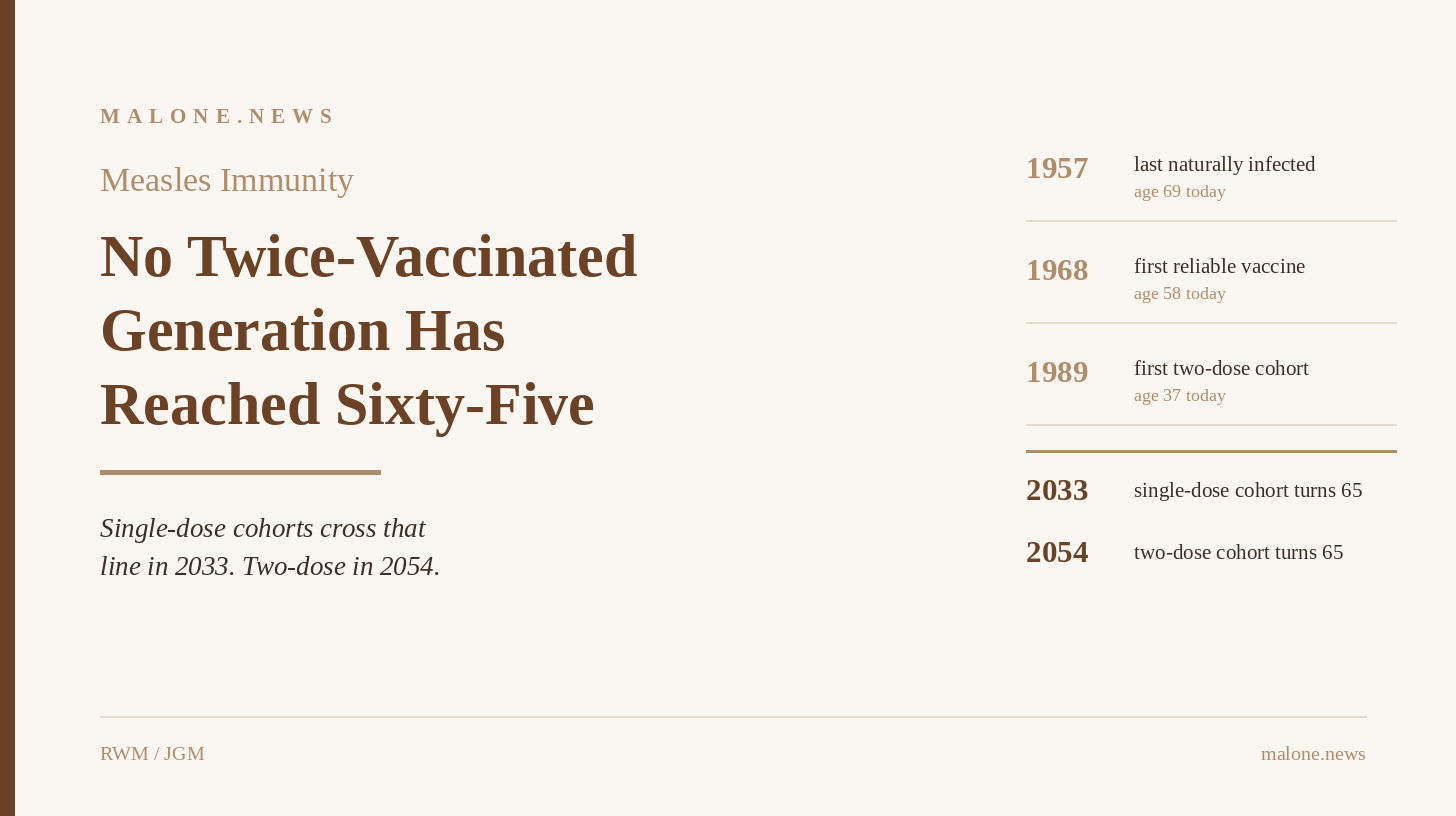
Measles Immunity: No Twice-Vaccinated Generation Has Reached Sixty-Five
Single-dose cohorts cross that line in 2033. Two-dose cohorts in 2054.
Summary
Every American now over the age of sixty-nine was almost certainly infected with wild measles as a child. Every American under fifty-eight was born into the era of further-attenuated measles vaccination and has probably never been infected with the wild virus. The boundary between those two populations is currently passing through the seventh decade of life.
The consequence is that measles in the elderly has never been observed in a substantial population whose immunity derives primarily from childhood vaccination, because until now no such elderly population has existed. Before vaccination, the question could not be studied either, since nearly everyone was infected by adolescence. We therefore have almost no direct evidence of what measles susceptibility, disease severity, or mortality will look like when vaccine-derived immunity reaches old age.
There are already reasons to ask what happens as vaccine-derived immunity ages along with the immune systems of the people who carry it. A systematic review and meta-analysis found that, in elimination settings, measles antibody levels decline after vaccination but do not show the same pattern after natural infection. For decades, that decline may have been partly obscured by subclinical boosting when vaccinated people encountered circulating wild virus without developing clinical measles. Elimination largely removed that source of exposure.
Measles itself raises a second question. Infection can erase a substantial portion of the pre-existing antibody repertoire, a phenomenon known as immune amnesia. In the principal study, children lost between 11 and 73 percent of their pre-existing antibody repertoire following infection. That work was conducted in children, whose accumulated immune histories were relatively short and whose capacity to rebuild immune responses was greater than it is in old age. What immune amnesia for other diseases after a measles infection would mean in a seventy- or eighty-year-old with a lifetime of accumulated immunity has not been studied.
There is another major uncertainty. The serological threshold commonly used to define measles protection rests on remarkably limited evidence, beginning with a 1990 study in which only nine people had pre-exposure titers at or below the proposed threshold. A subsequent systematic review found the evidence supporting that threshold to be scant and concluded that it requires further characterization.
There is another major issue. The serological threshold used to define measles immunity is based on nine people studied in 1990, and the field has formally acknowledged that it needs to be recharacterized. None of this predicts a catastrophe. It identifies a gap that becomes measurable around 2033, when the first single-dose cohorts reach sixty-five, and around 2054 for the two-dose cohorts. We do not have to wait that long to begin finding out what happens to vaccine-derived measles immunity as people age. That research is not currently being done.
Public health officials and scientists have assumed that childhood measles vaccination provides protection throughout the human lifespan, even though no fully vaccinated generation has yet reached old age. Once again, an assumption has hardened into an article of faith without the evidence needed to support it.
A note to readers: This is a technical document written primarily for a scientific and medical audience. It examines the underlying studies, immunology, epidemiology, and limitations of the available evidence in considerable detail. For readers who do not need that level of detail, this summary contains the central argument and conclusions and may be all that is necessary to read.
The 1957 Line
The Centers for Disease Control accepts birth before 1957 as presumptive evidence of measles immunity. The reasoning has never been serological. It is that measles circulated so completely in the pre-vaccine United States that essentially everyone born before that year was infected, and that natural infection confers protection lasting the remainder of a normal life.
The CDC’s 1957 cutoff tells us why older Americans are presumed immune: they were almost certainly infected. It tells us nothing about how long vaccine-derived immunity will last in the generations born afterward.
Carried forward to August 2026, the arithmetic is unforgiving. A person born in 1957 is sixty-nine. The Edmonston B vaccine was licensed in 1963, placing the earliest vaccine-era cohort at sixty-three. The further attenuated Schwarz and Moraten strains, which became the more reliable products, arrived between 1965 and 1968. The 1968 cohort is now fifty-eight. The two-dose schedule was recommended in 1989, making the first generation born into that schedule thirty-seven.
No generation born into the modern vaccine era has yet reached sixty-five. The 1968 cohort crosses that line in 2033. The first generation born under the two-dose schedule crosses it in 2054.
A smaller group complicates the middle of that range. Between 1963 and 1967, a formalin-inactivated measles vaccine was distributed in the United States before being withdrawn. Recipients were later found to have developed atypical measles upon exposure to wild-type virus. Those people are now in their late fifties and early sixties. They sit inside the band that will age into this question first, and their immune history is neither straightforward natural infection nor modern vaccination.
Our understanding of measles in old age comes from a naturally immune population. The population now approaching old age is increasingly vaccine-immune. Whether measles behaves the same way in the two populations is a question we have never had the opportunity to answer.
What Waning Immunity Looks Like
The measles vaccine is not failing. Two doses prevent roughly ninety-seven percent of infections, and primary vaccine failure runs under five percent. The question is what happens to the remainder of people over fifty and sixty years.
Mossong, O’Callaghan, and Ratnam analyzed measles antibody data from 1141 vaccinated Canadian children in 2000. Controlling for the significant variables, they found titers declining at a mean of 5.6 percent per year, equivalent to a half life of twelve years (Mossong, O’Callaghan, and Ratnam 2000). Three years later Mossong and Muller built an age-structured transmission model to simulate the shift from a naturally immune population to a vaccine-immune one. The model projected that eighty percent of vaccinees would become susceptible again fifty years after vaccination (Mossong and Muller 2003).
More scientific evidence arrived in 2022, when Bolotin and twenty-three coauthors published a review and meta-analysis in the Journal of Infectious Diseases. They found that in elimination settings, measles antibodies wane after vaccination but do not wane after infection (Bolotin et al. 2022).
Among the authors are Orenstein, Moss, Rota, Severini, Durrheim, Hahne, Jit, Funk, and Crowcroft. None of these study authors are contrarians or anti-vaxxers. They are serious scientists. This is a finding from the scientists and institutions responsible in the field of vaccinology.
In 2024, scientists Robert, Suffel, and Kucharski fitted a model to every measles case reported in England between 2010 and 2019, stratified by age, region, and vaccination status. They compared scenarios with and without waning against the observed data. Only the scenarios that included waning immunity reproduced the number and age distribution of cases among twice-vaccinated people. The scenario without waning underestimated two-dose recipients among cases older than fifteen by roughly a factor of two and a half (Robert, Suffel, and Kucharski 2024).
The estimated waning rate was slow, at 0.039 percent per year of age. The authors are explicit that the vaccine remains highly protective for decades and that most transmission still traces to unvaccinated people. Their conclusion is narrower and more useful. Breakthrough infection becomes increasingly frequent above age fifteen in people who received two doses, and because measles is so infectious, even slow waning raises the burden of an outbreak.
One finding in that paper deserves more attention than it has received. Onward transmission from vaccinated cases ran at 83 percent of the rate from unvaccinated cases, with a credible interval of 72 to 91 percent. The standard reassurance about breakthrough measles is that it produces modified disease which does not transmit well. In this dataset it transmitted nearly as well.
In practical terms, waning immunity does not have to produce widespread vaccine failure to matter. It only has to gradually enlarge the pool of vaccinated people who can become infected and transmit the virus when measles is introduced. That is already visible in younger adults. What we do not know is whether the same slow erosion continues for another thirty, forty, or fifty years, because no twice-vaccinated population has yet reached those ages. The England data do not answer that question. They show that it is no longer reasonable to assume there is no question to answer.
The Boosting Problem
The measles literature has recognized for decades that exposure to circulating wild virus can boost immunity in vaccinated people without causing clinical disease, potentially masking the underlying decline in vaccine-derived antibodies.
In 1999, Mossong, Nokes, Edmunds, Cox, Ratnam, and Muller published a model of subclinical measles transmission in vaccinated populations with waning immunity. Their starting observation was that a substantial proportion of vaccine responders show an antibody boost, with mild or no symptoms, after exposure to wild virus (Mossong et al. 1999). Whittle and colleagues demonstrated the same effect in the field in West Africa, where subclinical infection boosted immunity in vaccinated children (Whittle et al. 1999).
The magnitude of that effect is larger than most clinicians assume. A Dutch cohort followed 91 once-vaccinated children through a measles exposure. Two seronegative children developed clinical measles. Another nineteen, twenty-three percent of the cohort, experienced subclinical infection detectable only by serology (Nic Lochlainn et al. 2019). Roughly one exposed vaccinated child in four was silently infected and silently boosted.
For four decades after licensure, vaccinated Americans lived among circulating measles and received repeated subclinical boosting. The antibody titers measured in seroprevalence surveys during that period reflected vaccination plus boosting. They were attributed to vaccination alone.
Elimination largely removed that source of exposure. The United States achieved elimination status in 2000, and the Region of the Americas was declared free of endemic measles in 2016. A generation has now been raised in a setting where exposure to wild virus is uncommon and can no longer be assumed to periodically boost vaccine-induced antibody levels. Robert and colleagues note this directly, observing that waning of vaccine-induced immunity may be related to the time since the end of endemic transmission (Robert, Suffel, and Kucharski 2024). Immunological studies from Canada, Japan, and Czechia have also found declining antibody levels in young adults vaccinated more than twenty years earlier, without a comparable decline among those who acquired immunity through natural infection.
This produces a result that is uncomfortable and, so far as I can determine, correct. Sustained measles circulation restores subclinical boosting in the vaccinated adult population. Antibody persistence observed when measles was still circulating cannot necessarily be attributed to vaccination alone, because some vaccinated people were periodically re-exposed and boosted. Once endemic transmission ended, that contribution largely disappeared. The durability of vaccine-induced immunity can therefore be observed more clearly now than it could when wild measles was still circulating.
Estimates of long-term vaccine immunity derived from populations that continued to encounter wild measles do not describe populations living for decades without that exposure. That distinction becomes increasingly important as the first vaccine-era generations grow older.
Immune Amnesia in an Aged Repertoire
Mina and colleagues studied seventy-seven unvaccinated children before and two months after natural measles infection, using VirScan to track antibodies against thousands of pathogen epitopes. Measles eliminated between 11 and 73 percent of the pre-existing antibody repertoire across individuals. Children with severe disease lost a median of 40 percent, those with mild disease a median of 33 percent. The effect appeared in measles-infected macaques and did not appear in MMR recipients. Antibody recovered following natural re-exposure to the relevant pathogens (Mina et al. 2019).
In practical terms, measles erased part of the immune memory those children had accumulated against other diseases, potentially leaving them susceptible again to pathogens their immune systems had previously learned to recognize.
Two features of that study population matter for the question at hand. The subjects were children with a mean age of nine, so the repertoire deleted held nine years of accumulated encounters. And recovery depended on re-exposure, which requires a functioning capacity to mount and store new responses.
The situation in a seventy-eight-year-old would be very different. The antibody repertoire represents a lifetime of infections and vaccinations, some of which will never be encountered again. The ability to rebuild that repertoire must also contend with immunosenescence and the broader decline in immune responsiveness that accompanies aging.
It is therefore reasonable to ask whether immune amnesia in an elderly person from a measles infection would result in greater losses and less complete recovery. But that has never been tested. Mina’s finding is from a pediatric population, and extending it to the elderly remains a hypothesis rather than a result. More importantly for this discussion, it has never been studied in elderly people whose measles immunity derives from childhood vaccination. That population is only now beginning to approach the ages at which the question becomes relevant.
What the Current Outbreaks Cannot Tell Us
The United States has confirmed more than 2,700 measles cases in 2026. Roughly 93 percent occurred in people who were unvaccinated or whose status was unknown, and about 84 percent occurred in people aged nineteen and under. Four percent occurred in two-dose recipients.
Those numbers will be offered as evidence that adult vaccine-derived immunity is holding. In fact, they are not evidence for or against that hypothesis.
Transmission in 2026 has been concentrated in undervaccinated pediatric communities. Vaccinated adults in their fifties and sixties are simply not being exposed at anything approaching the same rate. The absence of breakthrough disease in a population that is rarely exposed tells us very little about how susceptible that population would be if exposure increased.
The English analysis in the section above detected its signal only by examining a decade of national measles data stratified by age, region, and vaccination status. That is the kind of analysis required to separate waning immunity from differences in exposure.
Current U.S. surveillance is therefore poorly suited to answering the question. A small number of cases among older vaccinated adults could mean that their immunity remains strong, or simply that very few of them are encountering measles. Until exposure and vaccination history are accounted for together, the case counts cannot distinguish between the two.
What Can and Cannot Be Claimed
There are important limits to what can be inferred from declining antibody levels.
Antibody titer is not identical to protection. Memory B cells and measles-specific T cells can persist independently of circulating antibody, and Jacobson and colleagues found that measles-specific humoral and cellular responses were independent of one another after vaccination (Jacobson et al. 2012). Secondary vaccine failure also frequently produces modified disease rather than classical measles. And evidence from several datasets suggests that antibody decline slows over time rather than continuing at a constant rate toward zero.
There is also considerable uncertainty about the serological threshold used to define protection. The commonly cited figure of 120 traces to a single 1990 paper. A school blood drive shortly before a measles outbreak allowed Chen and colleagues to compare pre-exposure antibody titers with subsequent illness. Of nine donors with detectable pre-exposure plaque reduction neutralization titers at or below 120, eight met the clinical criteria for measles. None of the seventy-one above 120 did (Chen et al. 1990).
That small study became the basis for a threshold that has been used for decades. A 2020 systematic review screened 14,778 publications for studies that could support it and found only five that met the inclusion criteria. Chen remained the strongest of the five and the only one to reach statistical significance. The reviewers concluded that the evidence underlying the commonly used threshold is scant and that further work is needed to characterize it (Bolotin et al. 2020).
The number itself also requires explanation. Chen’s 120 was a reciprocal dilution, not an antibody concentration. It was later extrapolated to 200 mIU/mL against the first World Health Organization International Standard and to 120 mIU/mL against the second. Other laboratories report 210 mIU/mL as the equivalent, and at least one group has proposed 300 mIU/mL as a conservative threshold for protection against severe disease. A neutralization titer of 120 and an antibody concentration of 120 mIU/mL are therefore not the same measurement. The apparent numerical match results from the reference standard and conversion used.
There is a further limitation to what the threshold actually measures. Chen concluded that titers at or below 120 were not protective against clinical measles, but also observed that infection without rash could occur in people above that level. The threshold therefore does not establish a boundary between infection and complete immunity. Several of the studies reviewed by Bolotin identified symptomatic individuals whose pre-exposure titers exceeded it. A Dutch cohort placed the correlate below 345 mIU/mL and documented subclinical infection at substantially higher levels.
Taken together, these uncertainties leave several possible outcomes. Vaccinated cohorts may reach their seventies with lower circulating antibody levels but retain sufficient memory B-cell and T-cell responses to prevent infection or serious disease. They may become more susceptible to infection while remaining well protected against severe disease. Or susceptibility may increase more substantially with age. The existing evidence does not tell us which of these will occur.
We do not yet know how vaccine-derived measles immunity will perform after sixty or seventy years because the population needed to answer that question has not yet reached those ages. Beginning around 2033, the oldest cohorts from the modern vaccine era will enter the age range where that uncertainty becomes increasingly relevant. The answer may ultimately be reassuring. At present, however, it remains an unanswered empirical question.
What Would Answer It
The evidence gap could be narrowed well before these cohorts reach old age. None of the necessary studies requires new technology.
Recharacterize the correlate of protection in a post-elimination population. The 2020 systematic review called for exactly this, and it has not been done. Every serosurvey discussed below ultimately depends on knowing what a given antibody titer means. At present, the relationship between the commonly used threshold and actual protection is poorly defined.
Extend age-stratified measles serosurveys into the older vaccine-era cohorts. Most existing serosurveys do not adequately capture the ages that matter here. The 55-to-70 age band now spans the transition from predominantly natural immunity to predominantly vaccine-derived immunity, making it particularly informative. Measuring antibody levels across that boundary could show whether the two populations are aging differently.
Add IgG avidity testing to those surveys. Avidity can help distinguish primary vaccine failure from waning secondary immunity. The distinction matters because never developing a durable response and gradually losing one are biologically different problems and may have different implications for revaccination.
Measure cellular immunity, not only neutralizing antibody titers. If measles-specific T-cell and memory B-cell responses persist despite declining circulating antibody, the implications of waning titers change substantially. A serosurvey based on antibody alone cannot answer that question.
Follow the early vaccine-era birth cohorts prospectively as they age. People born during the 1963-to-1968 transition are identifiable now and are approaching sixty-five on a known schedule. Following them longitudinally would allow changes in antibody, cellular immunity, breakthrough infection, and disease severity to be measured within the same individuals rather than reconstructed decades later.
Link adult measles cases to subsequent morbidity using existing registries. Immune amnesia has been demonstrated directly in children but has not been adequately characterized in older adults. Linking confirmed adult measles cases to subsequent infections, hospitalizations, and other health outcomes could test whether the effect has measurable consequences later in life.
Several of these measurements could be incorporated into serosurveys already being conducted. The registry analysis could be done largely with data that already exist. The central limitation is not technology or even necessarily cost. It is that the questions have not been made a research priority.
The Deadline
Two dates govern this, each addressing a different aspect of the issue.
The early vaccine-era cohorts reach sixty-five beginning around 2028, with the 1968 cohort reaching that age in 2033. The first generation born under the routine two-dose schedule reaches sixty-five in 2054. The later date provides the more relevant test of the modern schedule, because two doses are the schedule now in use, and the 97% effectiveness estimate applies to it. The earlier date matters because it gives us the first opportunity to observe vaccine-derived measles immunity as a population enters old age.
Most people in the early vaccine-era cohorts received a single dose, with roughly 93% effectiveness, and many have now carried vaccine-derived immunity for close to six decades. Recipients of the killed vaccine used between 1963 and 1967 also fall within this age range, further complicating their immune histories. These cohorts will provide the first substantial evidence of what happens as vaccine-era measles immunity reaches older age. What is learned from them during the 2030s will also provide important evidence before the two-dose generations follow decades later.
The question of how measles behaves in an elderly population with vaccine-derived immunity will therefore become increasingly answerable during the next decade. But answering it requires measurements taken before the outcomes of interest occur. Without baseline measurements of antibody levels, avidity, cellular immunity, and vaccination history, later cases will be much harder to interpret. We will know who became infected, but we will have far less ability to determine why.
Much of that baseline could be established by expanding serosurveys already being conducted and linking data that already exist. Beginning now would allow researchers to follow the transition prospectively rather than reconstruct it after the fact.
There is still time to do that. By 2033, the first modern vaccine-era cohort will be sixty-five. Whether their immunity has persisted, waned, or changed in ways that matter clinically should be something we have measured before widespread exposure provides the answer for us.
RWM/JGM
References
Bolotin, Shelly, Stephanie L. Hughes, Nazish Gul, Sumaiya Khan, Paul A. Rota, Alberto Severini, Susan Hahne, et al. 2020. “What Is the Evidence to Support a Correlate of Protection for Measles? A Systematic Review.” Journal of Infectious Diseases 221 (10): 1576 to 1583.
Bolotin, Shelly, Selma Osman, Stephanie L. Hughes, Archchun Ariyarajah, Andrea C. Tricco, Sumaiya Khan, Lennon Li, et al. 2022. “In Elimination Settings, Measles Antibodies Wane after Vaccination but Not after Infection: A Systematic Review and Meta-Analysis.” Journal of Infectious Diseases 226 (7): 1127 to 1139.
Centers for Disease Control and Prevention. 2026. “Measles Vaccine Recommendations and Presumptive Evidence of Immunity.” Atlanta, GA.
Chen, Robert T., Lauri E. Markowitz, Paul Albrecht, John A. Stewart, Lynne M. Mofenson, Stephen R. Preblud, and Walter A. Orenstein. 1990. “Measles Antibody: Reevaluation of Protective Titers.” Journal of Infectious Diseases 162 (5): 1036 to 1042.
Jacobson, Robert M., Inna G. Ovsyannikova, Robert A. Vierkant, V. Shane Pankratz, and Gregory A. Poland. 2012. “Independence of Measles-Specific Humoral and Cellular Immune Responses to Vaccination.” Human Immunology 73 (5): 474 to 479.
Mina, Michael J., Tomasz Kula, Yumei Leng, Mamie Li, Rory D. de Vries, Mikael Knip, Heli Siljander, et al. 2019. “Measles Virus Infection Diminishes Preexisting Antibodies That Offer Protection from Other Pathogens.” Science 366 (6465): 599 to 606.
Mossong, Joël, D. James Nokes, W. John Edmunds, Martin J. Cox, Sam Ratnam, and Claude P. Muller. 1999. “Modeling the Impact of Subclinical Measles Transmission in Vaccinated Populations with Waning Immunity.” American Journal of Epidemiology 150 (11): 1238 to 1249.
Mossong, Joël, Chris J. O’Callaghan, and Sam Ratnam. 2000. “Modelling Antibody Response to Measles Vaccine and Subsequent Waning of Immunity in a Low Exposure Population.” Vaccine 19 (4 to 5): 523 to 529.
Mossong, Joël, and Claude P. Muller. 2003. “Modelling Measles Re-emergence as a Result of Waning of Immunity in Vaccinated Populations.” Vaccine 21 (31): 4597 to 4603.
Nic Lochlainn, Laura M., Brechje de Gier, Nicoline van der Maas, Rob van Binnendijk, Peter M. Strebel, Tracey Goodman, and Susan Hahne. 2019. “Additional Evidence on Serological Correlates of Protection against Measles: An Observational Cohort Study among Once Vaccinated Children Exposed to Measles.” Vaccines 7 (4): 158.
Pan American Health Organization. 2026. “Update on the Review of Measles Elimination Status.” Washington, DC, March 2.
Robert, Alexis, Anne M. Suffel, and Adam J. Kucharski. 2024. “Long-Term Waning of Vaccine-Induced Immunity to Measles in England: A Mathematical Modelling Study.” Lancet Public Health 9 (10): e766 to e775.
Whittle, Hilton C., Peter Aaby, Badara Samb, Henrik Jensen, John Bennett, and François Simondon. 1999. “Effect of Subclinical Infection on Maintaining Immunity against Measles in Vaccinated Children in West Africa.” Lancet 353 (9147): 98 to 102.
Health Secretary Robert F. Kennedy Jr. said on Wednesday that officials in Pennsylvania may have made up deaths that they described as associated with measles.
""The announcement appears to have been premature, and the deaths may even have been altogether fabricated by one of the Governor's hopeful staffers," Kennedy wrote in a post on X. "The Lancaster County Coroner says that it has no record of any measles deaths. State law requires that all measles deaths be reported to the coroner."
Lancaster County Coroner Steve Diamantoni told news outlets and a county commissioner that his office had not handled any deaths from measles. The office did see an infant who died shortly after birth from spleen laceration, and an autopsy determined that the primary cause of death was the laceration, Diamantoni told the Philadelphia Inquirer.
The pathologist who conducted the autopsy did not feel the death was related to measles, the coroner said. The office, which declined to comment to The Epoch Times, is still investigating the cause of the ruptured spleen.
Kennedy also told reporters in an unrelated press conference in Florida that Pennsylvania officials had not provided information about the deaths to the Centers for Disease Control and Prevention."
https://www.zerohedge.com/medical/rfk-jr-says-pennsylvania-officials-may-have-fabricated-measles-deaths
I got natural immunity. The only vaccine I took was smallpox, polio and Hepatitis when I went overseas. When I was a kid getting to miss school with measles, mumps and chickenpox was something to look forward too. Unfortunately I didn’t get chickenpox until I was grown and it wasn’t fun.