


Audio Version:
Policy Analysis / by Drs. Robert Malone and Jill Glasspool Malone
Washington, DC · October 20, 2026
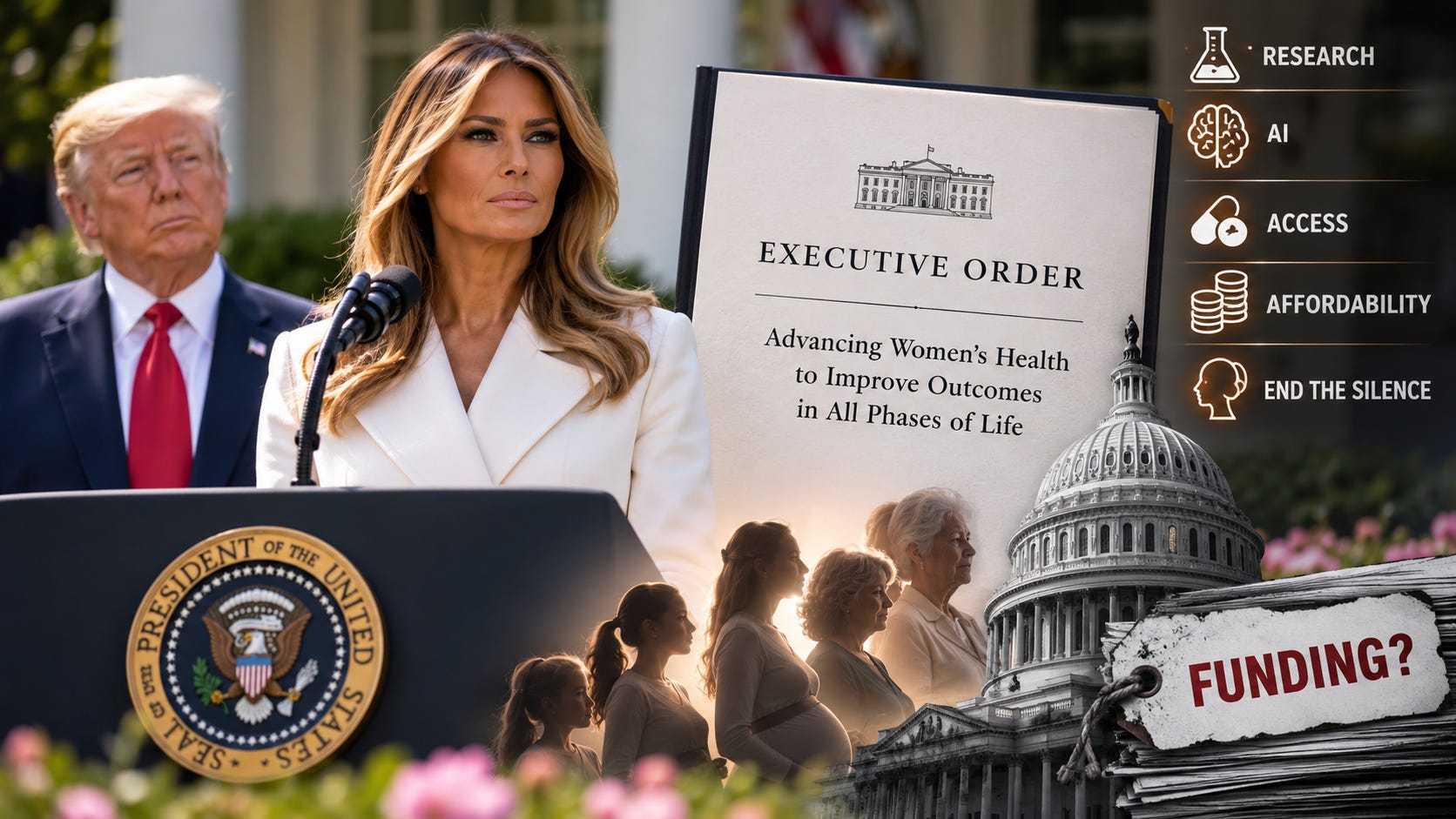
Monday’s Rose Garden ceremony looked like the launch of a major health initiative. First Lady Melania Trump stood beside the President as he signed an executive order promising a “new standard for women’s health in America.” Her office announced five goals: more research into cures, “super intelligence” to speed discovery, faster access to treatments, affordable care, and more open discussion of women’s health.
We read the six-section order, the accompanying White House materials, and the Biden-era directives it replaces. There is some good science here. There are also substantial gaps between the announcement and what Trump actually signed.
What Trump signed
The order, “Advancing Women’s Health to Improve Outcomes in All Phases of Life,” directs HHS to establish a Women’s Health Division at NIH within 90 days. It will sit inside an existing NIH institute or center, alongside the Office of Research on Women’s Health, and focus on neglected conditions, replication studies, sex differences in research, and getting findings into clinical care.
A new White House Women’s Health Task Force will be co-chaired by HHS Secretary Robert F. Kennedy Jr. and White House Chief of Staff Susie Wiles. Its membership spans major federal departments and health agencies, including DoW, FDA, CDC, NIH, EPA, USDA, and CMS. It may hold hearings, consult outside experts, and recommend pilot programs.
Trump also revoked Biden’s March 2024 women’s health executive order and a November 2023 memorandum establishing a women’s health research initiative in the Office of the First Lady. Jill Biden did not personally chair that initiative, but her office had a formal role. Melania Trump championed its replacement, yet she has no formal oversight role under the new order. Kennedy and Wiles are responsible for administration.
HHS will cover the task force’s administrative costs. The order provides no new research funding.
The science gets some things right
The best provisions address persistent problems in biomedical research. The new division is charged with supporting replication studies, something badly needed when published findings often fail to hold up in independent laboratories. It also must strengthen accountability for NIH’s requirement that researchers consider sex as a biological variable. That policy dates to 2016, but studies still too often rely on male animals or combine male and female results without adequate analysis.
The order also calls for getting research into clinical practice. Women with endometriosis can wait years for a diagnosis. Menopause treatment was shaped for decades by interpretations of the 2002 Women’s Health Initiative hormone therapy findings, even as later analyses showed that risks varied considerably with age and time since menopause. The FDA began removing broad boxed warnings on menopausal hormone therapy in November 2025. Better research matters little if clinical practice fails to catch up.
The initiative looks beyond pregnancy and reproductive health to adolescence, menopause, and aging. It even uses the newer term “polyendocrine metabolic ovary syndrome” for what was called polycystic ovary syndrome, reflecting the condition’s metabolic and hormonal features rather than ovarian cysts that many patients do not have.
These are worthwhile priorities. The question is whether the new division will have the staff, authority, and resources to carry them out.
Five promises, and what the order actually says
The First Lady’s five pillars make a useful test of the announcement.
Research funding: The order prioritizes research into conditions affecting women and calls for more attention to prevention and long-term health. It identifies no new money.
“Super intelligence”: Trump’s September directive replaced “artificial intelligence” with “Super Intelligence” in federal terminology. Whatever the label, the technology is not named in this order. The closest provision refers generally to advanced research technologies.
Faster treatments: The task force is asked to accelerate therapies and cures, and the FDA Commissioner has a seat at the table. There are no specific FDA instructions or deadlines for speeding access.
Affordability: The White House points to existing drug-pricing and fertility-drug discount programs. The order itself contains no provisions on treatment prices, insurance coverage, or patients’ out-of-pocket costs.
Education and openness: The order calls for updated clinical education and consultation with community and faith-based groups, but establishes no public education campaign.
The task force has no required report, performance targets, or meeting schedule. The Biden order it replaces included 30- and 90-day deliverables and directed a review of unmet research funding needs. This order gives NIH 90 days to create the division but says little about what the task force must accomplish afterward.
We discussed the administration’s new terminology for artificial intelligence, and what it means for this women’s health initiative, during an interview last night. Here is that clip:
There is also a question of influence. The existing Office of Research on Women’s Health operates from the NIH Director’s office, with reach across the agency’s institutes and centers. The new division will be placed inside one of them. That could limit its authority, depending on how NIH structures it.
Kennedy has been through this before. The Make America Healthy Again Commission issued 128 recommendations in September 2025, without individual cost estimates or implementation deadlines. In July 2026, nutrition scholar Marion Nestle reviewed 16 food-related commitments and found four accomplished, eight in progress, and four with no action. Some of the completed measures were voluntary or disputed.
Wiles’s role may make a difference. As White House Chief of Staff, she can press agencies for answers in a way an HHS-led commission cannot. Whether she does so will matter more than another round of announcements.
One omission is particularly striking: although EPA is represented, the order gives it no specific work on environmental exposures. Biden’s order did. For an administration that emphasizes endocrine disruptors, food additives, and chronic disease, that deserves an explanation.
And what about men?
Women were excluded from much clinical research for decades, and there are sound reasons for correcting that history. But men have serious health problems of their own. In 2024, U.S. life expectancy was 81.4 years for women and 76.5 for men. Male suicide rates have been three to four times female rates.
NIH has had an Office of Research on Women’s Health since 1990, but neither NIH nor HHS has a comparable office for men. A bipartisan bill introduced in February 2026, the State of Men’s Health Act, would establish one at HHS without taking money appropriated for women’s health. It remains in committee.
Research that takes biological sex seriously should help both sexes. The administration could support that bill while moving forward with the women’s health initiative.
Follow the money
The administration’s fiscal year 2026 budget request proposed cutting NIH funding by roughly 40 percent and reducing funding for the HHS Office on Women’s Health. Congress rejected those proposals, increased NIH funding, and raised the Office of Research on Women’s Health budget by nearly 30 percent, to $106.48 million.
But congressional appropriations do not guarantee that agencies will release the money. In October 2026, the Government Accountability Office concluded that HHS had improperly withheld more than $78 million in research funding at the Agency for Healthcare Research and Quality. GAO had previously found improper withholding of NIH grant funds as well. These findings concerned existing programs, not the new women’s health initiative, but they show why spending decisions matter as much as budget announcements.
Women’s health research had already suffered disruptions in 2025, including canceled grants and an NIH move to end contracts with regional centers of the landmark Women’s Health Initiative, which cost approximately $10 million annually.
The administration may be able to start meaningful work using funds NIH already has. But HHS should identify those funds and show how much will actually reach researchers. A new office does not, by itself, produce new research. The applicable DC insider phrase is “unfunded mandate”, which is fancy bureaucratic language for window dressing or lipstick on a pig.
There is another unanswered budget question. In December 2024, the Biden White House said its women’s health initiative had mobilized nearly $1 billion across agencies, including the $100 million ARPA-H Sprint for Women’s Health. That was a cumulative figure, not a billion-dollar account waiting to be transferred. Revoking Biden’s executive order does not automatically cancel existing appropriations or grants. HHS should explain what remains available, what has already been committed, and whether any of it will support the new division.
The political timing
The order comes three weeks before the midterm elections, when health care costs are a major voter concern. A September KFF poll found six in ten voters worried about affording care. On health care costs, voters trusted Democrats over Republicans by 42 to 22 percent, with an even wider gap among independents.
Polls commissioned by groups on both sides also point to affordability as a concern, although they ask different questions. A conservative-sponsored July survey found substantial support for policies helping mothers stay home with young children, while a majority of its respondents opposed linking U.S. drug prices to prices set abroad. That sits awkwardly beside the White House’s promotion of most-favored-nation drug pricing.
None of these polls tells us whether the new initiative will affect votes. They do explain why affordability featured so prominently in the announcement, even though the order itself omits it.
What happens next
By mid-January 2027, NIH must establish the new division. Its location, leadership, staffing, and budget will reveal whether it has meaningful authority or is largely a reshuffling of existing personnel. The fiscal year 2027 budget request will provide another test: will the administration propose dedicated research funding while explaining how existing appropriations are being used?
The task force should also publish its priorities, deadlines, and results. Without that, the public cannot judge whether the promised coordination accomplished anything.
Melania Trump and President Trump have brought welcome attention to women’s health, and parts of this order address real scientific weaknesses. But a Rose Garden announcement cannot replace research grants, competent administration, affordability, and better patient care. And NIH typically takes up to six years to award grants for a new initiative. Only then does the work start. Kennedy and Wiles now have the responsibility to turn the promises into something measurable. We hope for their success, but we have seen this movie too many times before.
Independent Journalism Depends on You
At Malone News, we don’t believe our job is to applaud every decision made by people we support, or to criticize everything done by those we oppose. Our job is to examine the evidence, ask difficult questions, and tell you what we find.
That means giving credit where it is due, but also pointing out where promises fall short, even when those promises come from an administration whose goals we may share.
This kind of independent reporting takes time, research, and resources. We don’t have corporate sponsors or political organizations paying us to reach predetermined conclusions. We depend on our readers.
If you value independent journalism that takes science seriously and refuses to pull its punches, please consider becoming a paid subscriber to Malone News. Your support makes this work possible, and we are grateful for it.
References
ACT (Association for Clinical and Translational Science). 2025. “News from the Hill: May 27, 2025.” https://www.actscience.org/AMP_EDN/455/News-from-the-Hill-May-27-2025-217.amp.html.
AIBM (American Institute for Boys and Men). 2026. “State of Men’s Health Act (2026): A Quick Explainer.” https://aibm.org/?p=7549.
ARPA-H (Advanced Research Projects Agency for Health). 2024. “ARPA-H Announces Sprint for Women’s Health.” https://arpa-h.gov/news-and-events/arpa-h-announces-sprint-womens-health.
Becker’s Behavioral Health. n.d. “The CDC’s Latest Suicide Data: 10 Numbers to Know.” https://www.beckersbehavioralhealth.com/?p=2874.
Biden, Joseph R. 2024. “Executive Order 14120: Advancing Women’s Health Research and Innovation.” March 18. https://bidenwhitehouse.archives.gov/briefing-room/presidential-actions/2024/03/18/executive-order-on-advancing-womens-health-research-and-innovation/.
Concerned Women for America. 2026. “New CWA Poll on Midterm Issues Finds Major Support for Women’s Issues.” July 27. Zogby Analytics, fielded July 1 to 4. https://concernedwomen.org/new-cwa-poll-on-midterm-issues-finds-major-support-for-womens-issues/.
Contemporary OB/GYN. 2025. “NIH to Cut Funding for Landmark Women’s Health Study.” April 23. https://www.contemporaryobgyn.net/view/nih-to-cut-funding-for-landmark-women-s-health-study.
Covington & Burling. 2025. “The White House Issues an Executive Order to Establish a Make America Healthy Again Commission.” February. https://www.cov.com/en/news-and-insights/insights/2025/02/the-white-house-issues-an-executive-order-to-establish-a-make-america-healthy-again-commission.
Endometriosis UK. 2026. “PCOS Officially Renamed to Polyendocrine Metabolic Ovarian Syndrome (PMOS).” May. https://www.endometriosis-uk.org/news/pcos-officially-renamed-polyendocrine-metabolic-ovarian-syndrome-pmos.
Fierce Healthcare. 2025. “MAHA Commission’s 128 Recommendations on Kids’ Health Include More Research on Vaccines, Antidepressants.” September 9. https://www.fiercehealthcare.com/providers/maha-commissions-128-recommendations-kids-health-include-more-research-vaccines.
Fortune. 2026. “Trump Plans New Women’s Health Research Division at NIH after Push from First Lady Melania Trump.” October 19. https://fortune.com/2026/10/19/melania-trump-womens-health-research-nih-executive-order/.
Fox Business. 2026. “Trump Signs Executive Order Rebranding AI as ‘Super Intelligence’ as Tech Titans Ink Separate SI Accord.” September 29. https://www.foxbusiness.com/politics/trump-signs-executive-order-rebranding-ai-super-intelligence-tech-titans-ink-separate-accord.
Healio. 2026. “CDC Report Shows US Life Expectancy Rose in 2024.” February 2. https://www.healio.com/news/primary-care/20260202/cdc-report-shows-us-life-expectancy-rose-in-2024.
KFF. 2026. “KFF Health Tracking Poll: Health Care Issues in the Lead-Up to the 2026 Midterm Election.” Fielded September 16 to 21. https://www.kff.org/public-opinion/kff-health-tracking-poll-health-care-issues-in-the-lead-up-to-the-2026-midterm-election/.
Nestle, Marion. 2026. “What Has MAHA Accomplished to Date?” Food Politics, July. https://www.foodpolitics.com/2026/07/what-has-maha-accomplished-to-date/.
SSTI (State Science and Technology Institute). 2026. Mark Skinner, analysis of FY 2026 NIH appropriations. https://ssti.org/node/90274.
The Hill. 2026. “Watch Live: Trump, First Lady Unveil New Women’s Health Initiative.” October 19. https://thehill.com/video-clips/6157675-trump-melania-womens-health-initiative/.
UPI. 2026. “Trump, First Lady Announce Women’s Health Initiative.” October 19. https://www.upi.com/Top_News/US/2026/10/19/melania-trump-womens-health-division-executive-order/8271792428494.
White House. 2024. “ICYMI: The White House Hosts First-Ever Women’s Health Research Conference.” December 12. American Presidency Project. https://www.presidency.ucsb.edu/documents/icymi-the-white-house-hosts-first-ever-womens-health-research-conference.
White House. 2026a. “Advancing Women’s Health to Improve Outcomes in All Phases of Life.” Executive Order, October 19. https://www.whitehouse.gov/presidential-actions/2026/10/advancing-womens-health-to-improve-outcomes-in-all-phases-of-life/.
White House. 2026b. “Fact Sheet: President Donald J. Trump and First Lady Melania Trump Advance Women’s Health to Improve Outcomes in All Phases of Life.” October 19. https://www.whitehouse.gov/fact-sheets/2026/10/fact-sheet-president-donald-j-trump-and-first-lady-melania-trump-advance-womens-health-to-improve-outcomes-in-all-phases-of-life/.
White House. 2026c. “First Lady Melania Trump Champions New U.S. Women’s Health Initiative.” October 19. https://www.whitehouse.gov/briefings-statements/2026/10/first-lady-melania-trump-champions-new-u-s-womens-health-initiative/.
WXPR. 2026. “Affordability Crisis Changing Voters’ Views on ‘Women’s Issues.’” September 18. https://www.wxpr.org/election/2026-09-18/affordability-crisis-changing-voters-views-on-womens-issues.
We are from the gov. and are here to help...yeah. I think we would all have had a much better medical care apparatus if the gov. had kept the hell out of it
Perhaps one of the 10000 government funded NGOs can help….
If there is anything left after salaries, bonuses, and political contributions