

Audio Version:
Three months after licensure, the first safety reports on mFLUSIVA are in. What do they add to the clinical trial record?
By: Drs. Robert Malone and Jill Glasspool Malone
Original Reporting / Washington, DC
In Brief:
Moderna’s new modified-mRNA influenza vaccine, mFLUSIVA, received FDA approval on August 5, 2026, for adults 50 and older. It is now being administered to Americans, including elderly people who may be especially vulnerable to severe vaccine reactions. Three months after approval, the clinical trial record and the first adverse-event reports raise serious questions about whether this new product offers enough benefit to justify its additional risks.
For adults aged 50–64, the clinical benefit was modest. Compared with a standard-dose influenza vaccine, mFLUSIVA prevented approximately seven additional cases of laboratory-confirmed influenza per 1,000 people vaccinated. But approximately 46 additional people per 1,000 experienced severe systemic reactions that prevented normal daily activities. That is roughly six additional severe reactions for every additional case of influenza prevented. For otherwise healthy, working adults, losing the ability to function normally because of a vaccine reaction is hardly an insignificant consequence.
For adults 65 and older, the evidence is even less convincing. FDA granted accelerated approval based on higher antibody levels, not clinical proof that mFLUSIVA prevents more influenza, hospitalizations, or deaths than the established high-dose, adjuvanted, or recombinant vaccines already recommended for seniors. In a direct comparison with Fluzone High-Dose, severe systemic reactions occurred in 6.7% of mFLUSIVA recipients versus 1.7% of those receiving the established vaccine, approximately four times the rate.
The clinical trials also revealed a troubling imbalance in deaths classified as unexplained, sudden, or sudden cardiac: 29 among mFLUSIVA recipients versus 12 in the comparison groups. Overall deaths were nearly balanced, 102 versus 97, and these findings do not establish that the vaccine caused the unexplained deaths. But none of the 29 mFLUSIVA recipients underwent an autopsy, leaving important questions about causation unresolved. The trials also failed to demonstrate that mFLUSIVA prevents influenza-related deaths.
Our examination of the first 78 VAERS reports, released through October 30, identified accounts of fainting, falls, severe weakness, dizziness, and temporary inability to walk, many involving older adults. These reports do not prove causation, and none reported a death. Nevertheless, the events described warrant prompt investigation, particularly because a fall or sudden loss of mobility can have devastating consequences for a frail senior.
There are also serious questions about the regulatory process. FDA initially refused to accept Moderna’s application because its pivotal trial used an inadequate comparator for older adults. The agency reversed that decision within weeks, ultimately approving the vaccine for seniors without requiring evidence of superior clinical protection against the enhanced influenza vaccines already available. A large confirmatory trial is planned, but meaningful results may not arrive until 2029.
So, should you or your parents choose mFLUSIVA this winter? Based on the evidence reviewed here, there is no compelling reason to prefer it over established influenza vaccine alternatives. For healthy adults aged 50–64, the small additional reduction in influenza illness must be weighed against a substantially greater likelihood of severe short-term reactions. For seniors, Moderna has not demonstrated superior clinical protection over the enhanced vaccines already available, despite documenting more severe reactions.
Most importantly, we still do not know how many lives mFLUSIVA might save or how many, if any, it might cost. FDA approved this product without resolving that fundamental mortality question.
There is another important point that gets lost in discussions of vaccine effectiveness: Most people do not get influenza in any given year, whether vaccinated or not. Yet every person receiving mFLUSIVA faces the possibility of an adverse reaction. In the clinical trial comparing mFLUSIVA with Fluzone High-Dose, 6.7% of Moderna recipients experienced severe systemic reactions that prevented normal daily activities. That means approximately one in every 15 mFLUSIVA recipients experienced a severe reaction, even though the overwhelming majority would not have developed influenza that season regardless of which vaccine they received. This is why absolute risk matters. We should be comparing the likelihood of actually preventing an illness against the likelihood of making an otherwise healthy person sick from the intervention intended to protect them.
Patients should not be expected to accept additional adverse reactions and unresolved safety concerns simply because FDA has approved another mRNA vaccine. The burden is on Moderna and federal regulators to demonstrate a meaningful clinical advantage over existing products. Until they do, there is no compelling evidence-based reason to choose mFLUSIVA over established alternatives. But in fact, there are many reasons not to.
The Technical Details:
An 89-year-old woman, a pharmacy, and an ambulance
An 89-year-old woman received Moderna’s new mRNA flu shot at a pharmacy this fall. Shortly afterward, she fainted and fell. Emergency medical services took her to a hospital emergency department. The incident appears in the federal Vaccine Adverse Event Reporting System as report 2915704.
We do not know whether the vaccine caused her fainting episode. A VAERS report is not proof of causation. But an elderly woman collapsing after vaccination is not an event that should be waved away, either. A broken hip, head injury, or prolonged hospitalization can end an older person’s independence. The consequences of a fall at 89 are not comparable to those of a younger adult feeling ill for a day.
Her report is one of 78 naming mFLUSIVA in the public VAERS data through October 30. FDA licensed the product on August 5, 2026, and we examined the clinical trial record at the time. Now that the vaccine is being administered outside controlled trials, the question is whether regulators are paying attention to the problems that matter most to elderly recipients.
What Moderna’s pivotal trial actually demonstrated
Moderna’s pivotal P304 trial randomized 40,805 adults aged 50 and older across 11 countries during the 2024–2025 flu season. Participants received either mFLUSIVA or a standard-dose inactivated influenza vaccine manufactured by GSK. The trial measured PCR-confirmed influenza-like illness.
Confirmed influenza occurred in 2.0% of mFLUSIVA recipients and 2.8% of standard-dose recipients. Moderna describes the result as 26.6% relative vaccine efficacy. That sounds impressive until the absolute numbers are examined. The difference was about 0.73 percentage points, or approximately seven fewer cases of confirmed influenza per 1,000 people vaccinated over the season. Roughly 137 people needed to receive mFLUSIVA instead of the standard shot to prevent one confirmed case.
That is a measurable result, and the trial met its prespecified superiority criterion. It is not evidence that the new vaccine prevents more deaths or serious illness. There were only four influenza hospitalizations in the mFLUSIVA arm and eight in the comparator arm, far too few to draw a reliable conclusion. Under a stricter CDC definition of influenza-like illness, the absolute benefit was less than half as large.
The uncertainty becomes especially important in the oldest participants. Among those 75 and older, the confidence interval ranged from a possible 10% disadvantage to a possible 50% advantage. The study could not establish that these participants benefited more than they would have from the standard shot. People with high-risk medical conditions also showed a smaller relative benefit than healthier participants. And because influenza A accounted for 94% of confirmed cases, the trial provides limited information about protection in an influenza B-heavy season.
There is another critical comparison missing. The pivotal trial used a standard-dose flu vaccine, not the enhanced products CDC has preferred for seniors for years. A result against a standard-dose comparator does not tell us whether mFLUSIVA is better than the vaccines many older Americans already receive.
The FDA initially recognized the bait and switch problem. In February 2026, Dr. Vinay Prasad, then director of the FDA’s Center for Biologics Evaluation and Research (CBER), refused to accept Moderna’s application because the pivotal trial compared mFLUSIVA against a standard-dose influenza vaccine rather than the enhanced vaccines recommended for seniors. This was a fundamental objection to the adequacy of the clinical evidence.
But Prasad faced opposition from within his own agency. According to reporting by STAT, Dr. David Kaslow, director of the FDA’s Office of Vaccines Research and Review and Prasad’s direct subordinate, wrote a detailed memorandum arguing that Moderna’s application should proceed to review. Prasad overruled him.
Within two weeks, following Moderna’s public objections and negotiations with FDA, the agency reversed course. Moderna was allowed to pursue accelerated approval for seniors based on antibody measurements, with a confirmatory clinical trial to follow. Prasad departed FDA in April.
On August 5, Kaslow signed the approval for mFLUSIVA. Kaslow, who previously served as chief scientific officer at Vical, Inc. from 2001 to 2006 (in between leadership positions with Merck vaccines), had opposed his superior’s initial decision to reject the application. He subsequently signed the license authorizing the vaccine for Americans 50 and older, including accelerated approval for seniors without clinical evidence demonstrating superiority to the enhanced influenza vaccines already recommended for that population.
And where was HHS leadership? Robert F. Kennedy Jr.’s department had publicly defended the original refusal, arguing that Moderna had used an inadequate comparator for elderly trial participants. Yet the application proceeded, the vaccine was approved, and Kaslow remained in charge of FDA’s vaccine review office. There has been no publicly documented disciplinary action against Kaslow over his role in this controversy.
The FDA identified a fundamental weakness in Moderna’s application. Kaslow reportedly opposed his own superior’s decision to reject it. The agency reversed course without Prasad’s permission, Prasad departed, and Kaslow ultimately signed the approval without requiring Moderna to demonstrate better clinical protection for seniors than the vaccines already available. The question for Secretary Kennedy is why the agency abandoned its original regulatory objection and who was accountable for that decision.
The change in White House leadership now presents an opportunity to revisit this decision. With Stephen Miller assuming the chief of staff position and Robert F. Kennedy Jr. continuing to lead HHS, the administration has the authority to demand a full accounting of how Moderna’s application was handled, why Prasad’s original objection was set aside, and whether the evidence supporting approval for seniors is adequate.
Kennedy can direct a renewed examination of the regulatory record and insist that FDA investigate the emerging safety reports. If the evidence establishes grounds for suspension or withdrawal, FDA has legal procedures to act. The administration does not have to wait until 2029 to begin asking these questions.
The question is whether the new White House leadership and Secretary Kennedy are prepared to revisit a decision their own FDA initially challenged, or whether Moderna’s approval will simply be allowed to stand without further scrutiny.
The side effects were not a small difference
In the trial’s safety subset, 58% of mFLUSIVA recipients experienced a systemic reaction such as fatigue, chills, headache, or muscle aches, compared with 32% of standard-dose recipients. Severe Grade 3 systemic reactions occurred in 5.5% versus 0.9%. FDA defines a Grade 3 reaction as one severe enough to prevent normal daily activity.
Put the trial’s benefit and its immediate costs side by side. For every 1,000 adults switched from a standard flu shot to mFLUSIVA, approximately seven fewer developed confirmed influenza, while about 46 additional people experienced a severe systemic reaction. That works out to roughly six extra severe reactions for each case of flu prevented.
These are not equivalent outcomes. A severe reaction lasting a day or two is not the same as influenza that can last a week or cause serious complications. But the distinction cuts both ways. A high fever, profound weakness, or dizziness may be manageable for a healthy 55-year-old. In a frail 85-year-old with heart disease, Parkinson’s disease, or poor balance, the same symptoms can precipitate a medical emergency.
The separate study in seniors compared mFLUSIVA with Fluzone High-Dose, a vaccine already preferred for older adults. Severe systemic reactions occurred in 6.7% of mFLUSIVA recipients versus 1.7% of those given Fluzone High-Dose. That is approximately four times the rate. Before recommending the newer product to elderly patients, physicians should be able to point to a demonstrated clinical benefit that justifies that difference. The available comparison does not provide one.
The unexplained deaths deserve an explanation
Across the licensure trial populations, overall deaths were nearly balanced: 102 among mFLUSIVA recipients and 97 among comparison recipients. That matters and should not be omitted.
What deserves closer examination is how the deaths were classified. Twenty-three deaths in the mFLUSIVA group were recorded without a specified cause, versus nine in the comparator group. Including deaths coded as sudden or sudden cardiac death brings the totals to 29 versus 12. According to the reviewed record, none of the 29 mFLUSIVA cases had an autopsy.
FDA reviewers considered a causal relationship unlikely but did not fully exclude one. The imbalance could reflect differences in how causes of death were documented. It could be chance. It could also point to something requiring further investigation. Without adequate cause-of-death information, neither Moderna nor FDA can convincingly settle the question.
This is precisely why postmarketing surveillance exists. The appropriate response is not to declare that the vaccine caused 29 deaths. It is to demand complete, transparent adjudication of the deaths, including when they occurred, what medical records were available, and why the causes remained unknown.
Furthermore, there is another reason these unexplained deaths deserve serious investigation. Moderna’s mFLUSIVA uses the same underlying modified-mRNA and lipid nanoparticle (LNP) delivery technology employed in its COVID-19 vaccines. And the safety questions surrounding that platform did not begin with this influenza trial.
During the COVID-19 vaccine rollout, VAERS received thousands of reports of deaths following vaccination. Those reports raise questions that required rigorous investigation. Equally troubling is the quality of the original preclinical safety work. In 2022, I (Dr. Robert Malone), and many other scientists raised detailed objections to the Pfizer and Moderna nonclinical submissions, arguing that the studies were inadequate and fell short of established regulatory expectations. These were not simply complaints about insufficient long-term follow-up.
They concerned the adequacy of the original toxicology packages, the characterization of the lipid delivery systems, and the failure to investigate important biological consequences of the modified RNA. N1-methylpseudouridine is incorporated to alter RNA stability and innate immune recognition, while lipid nanoparticles carry the RNA into cells and can distribute beyond the injection site. Questions about tissue distribution, persistence, inflammatory toxicity, and repeated exposure deserve product-specific answers, not assurances based on prior regulatory approvals. Now FDA has licensed another vaccine using this technology for older Americans, despite unresolved questions about the causes of death in its clinical trials.
Before asking seniors to accept another modified-mRNA product, FDA should demonstrate that the original platform safety concerns have been thoroughly investigated. Instead, the agency appears to be using safety assessments conducted under the less demanding Emergency Use Authorization (EUA) framework during COVID-19 to justify full regulatory approval of new products, without requiring the additional preclinical and clinical safety studies that should accompany that transition.
How many lives could mFLUSIVA actually save?
Moderna’s clinical trials did not demonstrate that mFLUSIVA prevents influenza-related deaths. More importantly, for adults 65 and older, Moderna has not demonstrated that its vaccine prevents more influenza illness, hospitalizations, or deaths than Fluzone High-Dose. That is the comparison that matters, because CDC already recommends enhanced influenza vaccines for seniors. Comparing Moderna’s product against an ordinary standard-dose vaccine exaggerates the relevance of its claimed advantage for older Americans.
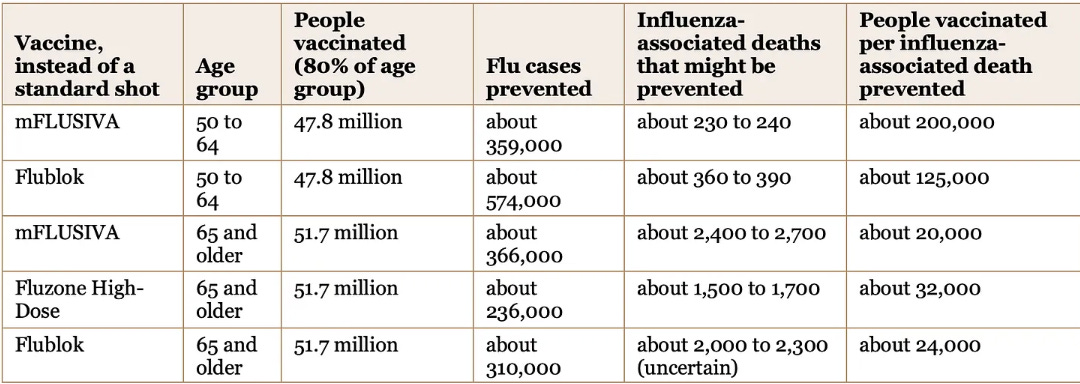
CDC estimates that approximately one in every 1,500 to 1,600 influenza illnesses among adults aged 50–64 is associated with a death. Among adults 65 and older, that figure rises to approximately one in 140 to 150. During the 2023–2024 influenza season, CDC estimated approximately 28,000 influenza-associated deaths, with 68% occurring among adults 65 and older and another 20% among adults aged 50–64. The proportions were similar during the severe 2024–2025 season.
These figures require context. CDC does not directly count every influenza death. It uses mathematical models incorporating hospitalizations, surveillance data, and estimated deaths occurring outside hospitals. Moreover, the overwhelming majority of older adults hospitalized with influenza have serious underlying medical conditions. During the 2024–2025 season, 95% of hospitalized patients aged 65–74 and 96% of those 75 and older had at least one underlying condition. Influenza can certainly contribute to a fatal decline, but these estimates cannot establish precisely how many deaths would have been prevented by avoiding influenza.
Now consider what happens when seniors switch from Fluzone High-Dose to mFLUSIVA. In Moderna’s head-to-head study, severe systemic reactions occurred in 6.7% of mFLUSIVA recipients versus 1.7% receiving Fluzone High-Dose. That means 50 additional severe reactions for every 1,000 people vaccinated. These reactions were serious enough to prevent normal daily activities.
If 80% of Americans aged 65 and older switched from Fluzone High-Dose to mFLUSIVA, approximately 51.7 million people would receive the new product. Applying the clinical trial rates produces an estimated 2.58 million additional severe systemic reactions. And how many additional influenza deaths would that switch prevent? We do not know. Moderna has not demonstrated an additional mortality benefit over Fluzone High-Dose.
For adults aged 50–64, the comparison against a standard-dose vaccine is more relevant. Moderna’s trial demonstrated approximately seven fewer cases of laboratory-confirmed influenza per 1,000 people vaccinated. Using CDC’s influenza mortality estimates, our earlier model projected that switching 80% of this age group to mFLUSIVA might prevent approximately 230–240 total influenza-associated deaths annually. But applying the overall pivotal trial’s severe-reaction rates produces approximately 2.2 million additional severe reactions. That is roughly 9,000 additional severe reactions for every influenza-associated death potentially prevented. This is an illustrative projection, not an observed mortality benefit or an age-specific estimate of reactions. And again, we don’t know how many deaths this vaccine will cause because the studies and the data are not done or are unavailable.
There is another basic consideration. Most people do not contract influenza in any given year, but everyone receiving a vaccine accepts the possibility of an adverse reaction. In Moderna’s pivotal trial, only 2.8% of standard-dose recipients developed laboratory-confirmed influenza, compared with 2.0% receiving mFLUSIVA. More than 97% in both groups did not develop the trial-defined illness. Yet in the separate senior study, approximately one in every 15 mFLUSIVA recipients experienced a severe systemic reaction, compared with one in 59 receiving Fluzone High-Dose.
The additional reactions are documented in the clinical trials, while the additional mortality benefit remains unproven. For seniors, we have evidence of substantially more severe reactions without evidence that switching to Moderna’s vaccine prevents more hospitalizations or saves more lives.
Finally, Moderna’s clinical program recorded 29 deaths classified as unexplained, sudden, or sudden cardiac among mFLUSIVA recipients, compared with 12 in the comparison groups. And the cause of these deaths remains insufficiently explained.
The central question remains unanswered: How many additional lives will mFLUSIVA save compared with established influenza vaccines, and how many, if any, might it cost? FDA approved the product without establishing that mortality balance. Until Moderna demonstrates a meaningful clinical advantage, there is no compelling evidence-based reason for seniors to prefer mFLUSIVA over established enhanced influenza vaccines.
Why seniors received a different kind of approval
Since the 2022–2023 season, CDC has preferentially recommended high-dose, adjuvanted, or recombinant influenza vaccines for adults 65 and older. Yet as discussed earlier, Moderna’s large efficacy trial compared mFLUSIVA with a standard-dose product. In February 2026, FDA’s biologics center initially refused to file the application on that basis, then accepted it under a revised approach.
The resulting approval was divided by age. Adults 50–64 received traditional approval based on clinical efficacy data. Adults 65 and older received accelerated approval based on antibody responses in a separate study involving approximately 3,000 seniors. In that study, mFLUSIVA generated antibody levels roughly 10%–30% higher than Fluzone High-Dose, depending on the influenza strain.
But higher antibody levels are not the same as fewer hospitalizations or deaths. FDA acknowledged that no antibody threshold has been established that predicts protection for this particular product. Its review also raised questions about the assay, which used cell-grown virus matched to the mRNA sequence. Moreover, the senior study tested a four-strain formulation, not the three-strain vaccine being sold today.
The distinction should be made clear to every senior offered mFLUSIVA at a pharmacy. Its approval for that age group rests on a laboratory surrogate. It has not been shown in a head-to-head clinical trial to prevent more influenza, hospitalizations, or deaths than Fluzone High-Dose, Fluad, or Flublok. It has, however, produced substantially more severe systemic reactions than Fluzone High-Dose.
What the first VAERS reports show
We downloaded and reviewed the 2026 VAERS files and identified 78 reports naming mFLUSIVA through the October 30 data release. They were received between September 23 and October 27. Moderna submitted 44. Two met the regulatory definition of serious, one involving hospitalization and another disability; three additional reports involved emergency department visits. None reported a death.
Of 71 reports providing an age, 52 involved adults 65 or older. The median age was 70. Among 60 reports with an onset interval, 54 described symptoms beginning on the day of vaccination or the following day.
Several reports described an alarming loss of mobility. A 71-year-old man reportedly could not stand or walk approximately 17 hours after vaccination and spent about an hour on the floor. A caregiver reported that a woman temporarily lost the use of her legs. A 74-year-old man developed confusion, severe dizziness, and an unsteady gait. A 73-year-old man reported vertigo, vomiting, and difficulty walking for roughly two days.
Other reports described fainting and cardiovascular symptoms. Alongside the 89-year-old woman transported from the pharmacy, there was a 69-year-old man who reportedly fainted three times, a 71-year-old man who collapsed with a blood pressure of 72/46 and breathing difficulties, and a 72-year-old man with newly documented atrial fibrillation. Neurological complaints included partial vision loss with severe headache and weakness, worsening tremors in a man with Parkinson’s disease, and hallucinations around sleep onset.
These are reports, not verified diagnoses attributable to the vaccine. Nevertheless, the descriptions matter because they involve the same general problems one would worry about when an older person experiences severe fever, weakness, or dizziness: falls, loss of mobility, confusion, and possible cardiovascular stress.
A safety system should be designed to investigate those outcomes, especially in the first 48 hours after vaccination. Waiting for a large number of hospitalizations or deaths before asking questions would defeat the purpose of early surveillance.
There is historical precedent for federal health officials taking action when serious vaccine safety concerns emerge. In December 1976, the government suspended its national swine flu vaccination campaign after investigators identified an increased incidence of Guillain-Barré syndrome, a potentially paralyzing neurological disorder. Approximately 42 million Americans had already been vaccinated. The precise biological mechanism was unknown, but officials considered the evidence sufficient to halt the program while investigating.
In 1999, just 15 reports to VAERS of a serious intestinal obstruction among infants who had received the newly licensed RotaShield vaccine prompted CDC to recommend suspending its use. The manufacturer halted distribution in consultation with FDA. Subsequent investigations confirmed an increased risk, and the vaccine was withdrawn from the market.
These cases demonstrate that federal health authorities have previously acted on credible safety signals before every question about causation was answered.
FDA should explain what investigation has been conducted, whether the serious adverse events have been independently adjudicated, and what findings would trigger additional regulatory action. Americans should not have to wait for another vaccine safety scandal before federal regulators provide those answers.
What VAERS cannot tell us, and what it can
VAERS is a passive reporting system. Reports can be submitted by patients, families, healthcare professionals, or manufacturers. They are not independently verified before publication. Many adverse events are never reported, while newly introduced or controversial products may receive more attention than familiar vaccines. For these reasons, VAERS counts cannot establish that a vaccine caused a condition, and comparisons of report percentages cannot establish comparative incidence.
We also do not know how many mFLUSIVA doses have been administered. Moderna characterized sales through September 30 as immaterial and has not publicly supplied a dose denominator. Seventy-eight reports could represent very different reporting rates depending on the number of doses given. Claims that these 78 reports alone prove the vaccine is unusually dangerous go beyond what the data support.
One viral claim is plainly incorrect. Some commentators divided 78 by 5,805 and asserted that mFLUSIVA already accounts for more than 1% of all influenza-vaccine reports since 1990. Our independent, objective review of the entire body of U.S. VAERS files found 235,268 reports naming an influenza vaccine from 1990 through October 2026. The 78 mFLUSIVA reports amount to approximately 0.03% of that total, not more than 1%.
That error should be corrected, but it does not make the legitimate signals disappear. In reports involving adults 65 and older, fatigue, malaise, or weakness appeared in 47% of mFLUSIVA reports versus 12% for Fluzone High-Dose and 13% for Fluad. Among reports without a co-administered COVID-19 vaccine, fainting, falls, or inability to walk appeared in 22% of mFLUSIVA reports versus 7% for Fluzone High-Dose. Dizziness or vertigo showed the same 22%-versus-7% split.
Comparisons with the first seasons of other newer influenza vaccines also found that fever and chills were not unusual for mFLUSIVA, while reports mentioning fainting, falls, or inability to walk were proportionally more frequent, 16% versus 5%. These are disproportionality findings, not estimates of the chance that a vaccinated person will experience an event. Serious outcomes were not more frequent in the early mFLUSIVA reports.
There is an important complication: 37 of the 78 mFLUSIVA reports also listed acceptance of a concurrent COVID-19 vaccine, and 35 of those listed Moderna’s mNEXSPIKE. Among reports involving other influenza vaccines in the same period, roughly one in four also listed a COVID-19 vaccine. Moderna did not submit clinical co-administration data for mFLUSIVA given with COVID-19, RSV, or pneumococcal vaccines. The VAERS records cannot tell us which injection, if either, contributed to a reported reaction.
The responsible conclusion is that neither of these reports identify a specific, testable concern: are older mFLUSIVA recipients experiencing more falls, fainting episodes, severe weakness, or acute cardiovascular events than comparable recipients of established influenza vaccines? FDA and CDC have access to the linked vaccination and medical data needed to investigate that question.
Why FDA’s follow-up plan is not enough
FDA attached several postmarketing obligations and commitments to the license. The accelerated approval for seniors requires a confirmatory trial, envisioned as a pragmatic study involving approximately 800,000 adults 65 and older over the 2027–2028 and 2028–2029 influenza seasons. Clinics would alternate between mFLUSIVA and a preferred influenza vaccine. As of the June advisory committee meeting, important details were still under discussion. The resulting evidence would not be available until years after seniors began receiving the product.
FDA also called for surveillance of all-cause and unexplained deaths, myocarditis, pericarditis, and Guillain-Barré syndrome. Moderna’s pharmacovigilance plan lists additional rare neurological, immune, and cardiac events. These are appropriate subjects for surveillance, but the early reports point to a more immediate set of concerns: falls, fainting, acute loss of mobility, confusion, and new arrhythmias. Those outcomes deserve explicit, active monitoring, not merely the hope that they will be noticed among routine adverse-event reports.
There is a second concern involving the time periods used to evaluate safety. In Moderna’s trials, solicited reactions were recorded for seven days and unsolicited adverse events for 28 days, while serious adverse events were monitored for approximately six months. FDA also relied on a 42-day risk window when evaluating certain neurological and cardiac conditions.
Across the pooled clinical trials, ten cases of myocarditis, pericarditis, or myopericarditis occurred among mRNA-1010 recipients, compared with seven in the comparator group. All occurred after day 42. An independent cardiac adjudication committee confirmed four cases in each group. One recipient also developed Guillain-Barré syndrome on day 134.
FDA reviewers concluded that these events were unlikely to be vaccine-related, citing their timing, alternative medical explanations, and the adjudication findings. But this raises an important question: How adequately can regulators assess delayed adverse reactions when the primary risk window used to evaluate causation is considerably shorter than the period during which serious events were actually observed? The absence of events within 42 days does not, by itself, establish that events occurring later were unrelated to vaccination.
An mRNA vaccine does not behave identically to a conventional protein vaccine. It delivers genetic instructions that lead the recipient’s cells to produce an antigen, rather than simply supplying a fixed quantity of antigen. Research on COVID-19 mRNA vaccines has documented persistence of vaccine-related material in certain tissues beyond the immediate post-injection period. This justifies examining whether surveillance windows designed around older vaccine platforms are adequate for this new platform technology.
Regulators should publish time-to-event data for serious outcomes and investigate events beyond the usual short windows. The 29-versus-12 imbalance in unexplained or sudden deaths makes that request especially reasonable. The absence of proof of causation is not an argument against looking.
Regulatory questions that cannot wait until 2029
The leadership responsible for evaluating these data has changed. Dr. Vinay Prasad, who signed the initial refusal-to-file letter, departed FDA at the end of April. CBER is now led by Karim Mikhail, a former pharmaceutical executive who spent more than two decades at Merck. Mikhail’s permanent appointment was announced by HHS on September 8, 2026, with the public endorsement of Secretary Robert F. Kennedy Jr. Meanwhile, FDA’s Office of Vaccines Research and Review remains under the leadership of Dr. David Kaslow, whose career includes senior positions at Merck and service as chief scientific officer of Vical, a biotechnology company specializing in DNA vaccines. Kaslow reports directly to Mikhail, just as he previously reported to Prasad.
These professional backgrounds make transparency important, particularly when the agency reverses an initial objection and licenses a product for seniors on surrogate evidence while unresolved safety questions remain.
The CDC recommendation process adds another complication. As described in the regulatory record reviewed for this article, the Advisory Committee on Immunization Practices has not met since a federal court stayed member appointments in March 2026, and CDC’s September interim influenza guidance does not mention mFLUSIVA. That uncertainty has practical implications for insurance coverage and potentially for vaccine-injury compensation. Patients should not have to discover those questions only after receiving a new product.
The larger issue is accountability. FDA and CDC should not need another two or three influenza seasons to begin examining falls, emergency visits, hospitalizations, and new cardiac diagnoses in older adults who have already received mFLUSIVA. They should publish a clear surveillance plan and report the results promptly.
Are older influenza vaccines a better choice?
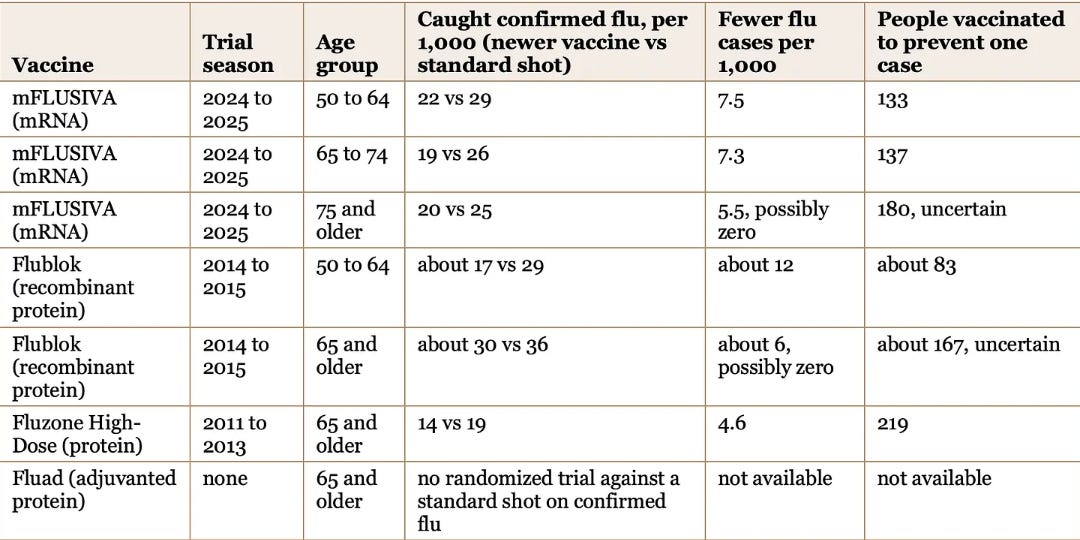
Moderna’s 26.6% relative efficacy figure comes from comparing mFLUSIVA with a standard-dose vaccine. Expressed as absolute risk, the benefit was about seven fewer confirmed influenza cases per 1,000 vaccinated. Other enhanced influenza vaccines have also demonstrated benefits over standard-dose products, although trials conducted in different seasons against different circulating strains cannot be ranked as if they were head-to-head comparisons.
In a randomized trial during the 2014–2015 season, the recombinant protein vaccine Flublok reduced confirmed influenza by approximately 30% relative to a standard-dose comparator in adults 50 and older. Across that trial, the absolute difference was about ten cases per 1,000, corresponding to approximately 102 people vaccinated to prevent one case. The mFLUSIVA trial’s benefit falls in a similar general range. In the oldest mFLUSIVA participants, added protection could not be established.
Fluzone High-Dose has also been studied in very large randomized trials that examined hospitalization. In the Spanish GALFLU trial involving 103,169 adults aged 65–79, hospitalization for influenza or pneumonia was 0.25% with high-dose vaccine versus 0.34% with standard-dose vaccine. In the Danish DANFLU-2 trial involving 332,438 adults 65 and older, the corresponding rates were 0.68% and 0.73%, a difference that was not statistically significant. The mFLUSIVA trial had too few influenza hospitalizations to make a comparable claim.
This is the comparison that matters when someone asks whether an elderly parent should receive mFLUSIVA. The relevant alternative is not the ordinary standard-dose flu shot. A more relevant alternative is the high-dose, adjuvanted, or recombinant vaccine with an established history of use and clinical evidence that mFLUSIVA has not yet matched.
What about lives saved?
The licensure trials did not establish a reduction in deaths. Any estimate of lives saved by switching vaccines is therefore a model-based projection, not an observed trial outcome.
Using CDC estimates of influenza illness and mortality for the 2023–2024 and 2024–2025 seasons, and assuming 80% uptake, our projections suggest that switching adults 50–64 from a standard-dose shot to mFLUSIVA might avert approximately 230–240 influenza-associated deaths annually. That is roughly one projected death averted for every 200,000 people vaccinated. The same scenario would produce an estimated 2.2 million additional severe systemic reactions, based on trial rates.
Those projections have substantial limitations. They assume that cases prevented by the vaccine carry the average risk of death, although the trial did not establish that. They apply efficacy measured in an unusually severe influenza season. They also rely on CDC estimates of influenza-associated deaths, which include modeled contributions from influenza to deaths among people with serious underlying conditions. These estimates are not direct counts of deaths that a vaccine could certainly prevent.
For seniors, the comparison is even less favorable to a claim of added benefit. Many already receive enhanced influenza vaccines. Switching from Fluzone High-Dose to mFLUSIVA has no demonstrated reduction in influenza deaths to put on the benefit side of the ledger. Applying the observed severe-reaction difference at 80% uptake would yield approximately 2.6 million additional severe reactions among older adults. A projected benefit against a standard-dose vaccine cannot be used as proof of benefit over the high-dose product they would actually be replacing.
FDA concluded that Moderna’s mFLUSIVA has a favorable benefit-risk profile, a judgment repeated by news organizations reporting on the approval. But the clinical trials did not demonstrate that mFLUSIVA prevents influenza-related deaths. Nor did they establish how many deaths, if any, were caused by the vaccine. Yet the FDA acknowledges an unresolved imbalance in deaths classified as unexplained or sudden in the clinical trial.
The central mortality question remains unanswered: How many lives will mFLUSIVA save, and how many, if any, will it cost? FDA’s favorable benefit-risk determination should not be confused with evidence that the vaccine has been demonstrated to save more lives than it takes.
Until the number of deaths caused by the vaccine is established, we cannot reliably compare how many lives mFLUSIVA might save against how many lives it might cost.
What families should ask before vaccination?
An older adult deserves to know exactly which influenza vaccine is being offered and why. For someone 65 or older, ask what clinical evidence supports choosing mFLUSIVA over a high-dose, adjuvanted, or recombinant alternative. Higher antibody levels alone are not an answer to the question of whether a vaccine prevents more hospitalizations or deaths.
Medical history matters. A person with cardiovascular disease, neurological illness, limited mobility, or a history of falls may be particularly vulnerable to the consequences of fever, dizziness, and weakness. Ask what reactions to expect, whether someone should check on the person afterward, and whether separate appointments for influenza and COVID-19 vaccination would be sensible given the absence of mFLUSIVA co-administration studies.
For those who will have this product administered, consider remaining seated for the recommended observation period after vaccination, especially if there is a history of fainting. If a significant event occurs afterward, seek appropriate medical care and make sure the vaccine name, lot number, timing, symptoms, and outcome are documented. Patients and clinicians can submit reports at vaers.hhs.gov.
What FDA, CDC, and Congress should demand
First, publish the number of mFLUSIVA doses distributed and, where available, administered. Without a denominator, public discussion of VAERS reporting rates is largely speculation.
Second, use active surveillance systems, including FDA’s Biologics Effectiveness and Safety program and CDC’s Vaccine Safety Datalink, to compare fainting, falls, emergency visits, hospitalizations, acute mobility loss, and newly diagnosed atrial fibrillation after mFLUSIVA with the same outcomes after established vaccines. Start with the first 48 hours, then examine longer intervals.
Third, require a proper co-administration study with COVID-19 mRNA vaccines. People are already receiving both injections at the same appointment. Regulators should not treat that widespread practice as a substitute for evidence.
Fourth, make cause-of-death adjudication and detailed time-to-event reporting part of the confirmatory trial. Where families consent, and it is medically appropriate, autopsy information should be sought. The unresolved unexplained-death imbalance from the original trials should not be repeated without a serious effort to determine causes.
Finally, publish the confirmatory trial design before enrollment and include clinically meaningful safety and efficacy outcomes. A trial that alternates vaccines by clinic-week needs transparent methods for following individual patients and accounting for differences between clinics and recipients. The public should not have to wait until 2029 to learn whether the design can answer the most important questions.
So, Should You or Your Parents Get mFLUSIVA This Winter?
After reviewing the clinical trial data, FDA’s own assessments, and the first postmarketing safety reports, I see little or no reason to choose Moderna’s new modified-mRNA influenza vaccine over established alternatives. To be blunt, don’t do it.
For adults 65 and older, Moderna has not demonstrated that mFLUSIVA prevents more influenza illness, hospitalizations, or deaths than the established high-dose, adjuvanted, or recombinant influenza vaccines. Yet its clinical trials documented substantially higher rates of severe systemic reactions than Fluzone High-Dose. These reactions are not necessarily trivial. Severe fatigue, weakness, fever, and muscle pain can leave an older person unable to carry out normal activities. There are also unresolved questions about the high number of sudden deaths in the vaccine trial. For someone who is frail, lives alone, or is already at risk of falling, even a temporary episode of profound weakness can have serious consequences.
The early adverse-event reports describing fainting, falls, and severe weakness deserve prompt investigation. They do not establish causation, but they raise questions that should be answered before this product is promoted as an improvement over existing vaccines.
For adults aged 50–64, particularly those who are otherwise healthy, the benefit-risk calculation is even less persuasive. Moderna’s pivotal trial demonstrated a modest reduction in laboratory-confirmed influenza compared with a standard-dose vaccine. The absolute difference was less than one percentage point. In practical terms, approximately 130 to 140 people would need to receive mFLUSIVA instead of the standard-dose comparator to prevent one additional case of confirmed influenza during the trial.
Meanwhile, the increase in severe systemic reactions was substantial. These are reactions serious enough to interfere with normal daily activities, including work. For a healthy, working adult, losing a day or two to debilitating fatigue, fever, or muscle pain is a meaningful cost, particularly when the additional benefit is preventing a relatively small number of influenza illnesses, many of which would have been uncomplicated.
We should not pretend that preventing one additional laboratory-confirmed case of influenza is equivalent to preventing a hospitalization or saving a life. Those are different outcomes, and Moderna has not demonstrated a mortality advantage for mFLUSIVA.
Nor is the choice limited to Moderna’s vaccine or no vaccine at all. Established non-mRNA influenza vaccines are available, including recombinant protein vaccines. Adults who want influenza vaccination can discuss those alternatives with their physicians without assuming that the newest technology is necessarily the safest or most effective.
Then there is the question of deaths. In Moderna’s clinical trials, 29 vaccine recipients died suddenly or from unexplained causes, compared with 12 in the control groups. FDA could not determine whether the vaccine contributed to these deaths. And Moderna has not demonstrated that mFLUSIVA prevents influenza-related deaths. So we are left with a fundamental question: How many lives will this vaccine save, and how many might it cost? FDA approved the product without being able to answer this very basic question.
And that brings us back to the 89-year-old woman who reportedly fainted and fell after receiving mFLUSIVA. We do not know whether the vaccine caused her collapse or what happened afterward. But her report illustrates why these questions matter. For an elderly person, a fall can mean a broken hip, hospitalization, permanent loss of independence, or worse.
FDA and CDC have the resources to investigate whether recipients of mFLUSIVA experience more fainting, falls, severe weakness, cardiac events, or other serious outcomes than comparable recipients of established influenza vaccines. They should conduct those analyses promptly and make the findings public.
My advice is straightforward: If you are considering influenza vaccination this winter, ask what measurable advantage mFLUSIVA offers you over the established alternatives. If the answer is a small reduction in laboratory-confirmed influenza, accompanied by substantially more severe short-term reactions and no demonstrated advantage in preventing hospitalization or death, that is not a compelling case for choosing this product.
For older adults, especially those who are frail, the burden of proof should be higher, not lower. A vaccine intended to protect vulnerable people should have a clearly demonstrated advantage before they are asked to accept additional reactogenicity and unresolved safety questions.
Moderna has brought another modified-mRNA vaccine to market. FDA has approved it. Neither fact obligates patients to choose it.
There is one final point worth remembering: Most people will not get influenza in any given year, but everyone who receives a flu vaccine accepts the possibility of an adverse reaction. In Moderna’s trial, 6.7% of mFLUSIVA recipients experienced severe systemic reactions that interfered with normal daily activities. That is approximately one in every 15 people vaccinated.
For the overwhelming majority who would not have contracted influenza anyway, the vaccine prevents no illness that season, but it still exposes them to the risk of a reaction. Before choosing mFLUSIVA, patients deserve to know whether its small additional benefit is worth that very real possibility of being made ill by the vaccine itself, particularly when established alternatives produce substantially fewer severe reactions.
The burden is on Moderna and FDA to demonstrate that this product offers a meaningful clinical advantage, not on patients to assume one exists. Until that evidence is available, there is no compelling reason to prefer mFLUSIVA over established influenza vaccine alternatives.
If you value this kind of independent research, please consider becoming a paid subscriber to Malone.News.
Articles like a lot of work. We dig through FDA regulatory documents, clinical trial data, adverse-event reports, and government statistics to ask questions that too often go unanswered. We do the calculations, examine the evidence, and challenge the conclusions, even when those conclusions come from powerful pharmaceutical companies or federal regulators.
We make much of our work freely available because we believe the public deserves access to this information. But independent journalism isn’t free to produce.
If you’re reading Malone.News on a free subscription, please consider upgrading to paid today. Your support allows us to keep investigating, keep publishing, and keep asking the difficult questions.
And if a paid subscription isn’t possible right now, please share this article with friends and family. Help us get this information into the hands of people making decisions about their health.
We don’t answer to pharmaceutical advertisers. We answer to our readers. Help us keep it that way.
References
U.S. Food and Drug Administration. FDA Briefing Document, BLA 125869/0, Influenza Vaccine, mRNA (mFLUSIVA). Vaccines and Related Biological Products Advisory Committee (VRBPAC), June 18, 2026.
U.S. Food and Drug Administration. FDA Review of Efficacy, Immunogenicity, and Safety of mFLUSIVA (mRNA-1010). VRBPAC presentation, June 18, 2026.
U.S. Food and Drug Administration. Clinical Review, MFLUSIVA, STN 125869. August 5, 2026.
U.S. Food and Drug Administration. MFLUSIVA Prescribing Information, 2026–2027 Formula. Revised August 2026.
Moderna, Inc. Form 10-Q for the Quarter Ended September 30, 2026. U.S. Securities and Exchange Commission, 2026.
The Defender. “Risk Far Exceeds the Benefit”: Experts Call for Suspension of Moderna’s mRNA Flu Shot After Reports of Serious Injuries. November 13, 2026.
Hulscher N. Reports of Serious Injuries and Disabilities with Moderna’s mRNA Flu Shot Have Begun to Flood VAERS. The Focal Points, November 2026.
Closed VAERS. The mRNA Flu Shot Has Finally Hit VAERS! November 10, 2026.
Grohskopf LA, et al. Prevention and Control of Seasonal Influenza with Vaccines: Recommendations of the Advisory Committee on Immunization Practices, United States, 2022–2023 Influenza Season. MMWR Recommendations and Reports. 2022;71(1).
Immunize.org. Ask the Experts: Influenza. Includes CDC 2026–2027 interim clinical considerations.
Contagion Live. FDA Refuses to Review Moderna’s Influenza Vaccine for Potential Approval. February 11, 2026.
Malone RW. Moderna’s mRNA Flu Shot: FDA Refused It, Then Reversed Itself in Two Weeks. MALONE.NEWS, August 24, 2026.
U.S. Food and Drug Administration. CBER Key Staff Directory.
AABB. Szarama Departs CBER; Karim Mikhail Named Acting Director. May 20, 2026.
BioPharma Dive. FDA Names David Kaslow to Lead Vaccine Review Office. 2022.
MarketScreener. David C. Kaslow: Career History (Vical, Inc. and Merck).
Dunkle LM, et al. Efficacy of Recombinant Influenza Vaccine in Adults 50 Years of Age or Older. New England Journal of Medicine. 2017;376:2427–2436.
DiazGranados CA, et al. Efficacy of High-Dose versus Standard-Dose Influenza Vaccine in Older Adults. New England Journal of Medicine. 2014;371:635–645.
Pardo-Seco J, et al. GALFLU Trial of High-Dose versus Standard-Dose Influenza Vaccine. New England Journal of Medicine. 2025. doi:10.1056/NEJMoa2509834.
Johansen ND, et al. DANFLU-2 Trial of High-Dose versus Standard-Dose Influenza Vaccine. New England Journal of Medicine. 2025. doi:10.1056/NEJMoa2509907.
Centers for Disease Control and Prevention. Estimated Flu Disease Burden, 2023–2024 Flu Season.
Centers for Disease Control and Prevention. 2024–2025 Influenza Season Summary: Severity, Disease Burden, and Burden Prevented.
Dugan V. 2024–2025 Influenza Season Update: Preliminary Burden by Age. ACIP meeting presentation, June 25–26, 2025.
U.S. Census Bureau. QuickFacts: United States, Population Estimates, July 1, 2025.
IBISWorld. Number of Adults Aged 50 and Older in the United States. 2025. Cites U.S. Census Bureau data estimating 124.4 million adults aged 50 and older; the population aged 50–64 was calculated by subtracting the estimated 64.6 million adults aged 65 and older.
Centers for Disease Control and Prevention. How CDC Estimates the Burden of Seasonal Flu in the United States.
Centers for Disease Control and Prevention. Influenza-Associated Hospitalizations During a High-Severity Season: Influenza Hospitalization Surveillance Network, United States, 2024–2025 Influenza Season. MMWR. 2025;74(34).
Röltgen K, et al. Immune Imprinting, Breadth of Variant Recognition, and Germinal Center Response in Human SARS-CoV-2 Infection and Vaccination. Cell. 2022;185(6):1025–1040.
European Medicines Agency. COVID-19 Vaccine Moderna (Spikevax): European Public Assessment Report. EMA/15689/2021, January 20, 2021. Nonclinical pharmacology, toxicology, lipid nanoparticle composition, and biodistribution.
European Medicines Agency. Spikevax: Product Information. Section 5.3, Preclinical Safety Data. Repeated-dose toxicity, reproductive and developmental toxicity, SM-102 genotoxicity testing, and carcinogenicity study information.
Malone RW. TrialSite News Truthbombs Pfizer and Moderna: Evidence of Scientific and Regulatory Fraud, HHS Administrative State Collusion. MALONE.NEWS, July 21, 2022. Discussion of Sasha Latypova’s critiques of Pfizer’s and Moderna’s nonclinical regulatory submissions.
U.S. Food and Drug Administration. Clinical Review Memorandum: SPIKEVAX (mRNA-1273), STN 125752. January 28, 2022. FDA licensing review of Moderna’s COVID-19 mRNA vaccine.
European Medicines Agency. mNEXSPIKE: European Public Assessment Report. EMA/6890/2026. Nonclinical assessments of Moderna’s modified-mRNA platform, references to previous platform studies, and animal biodistribution findings.
U.S. Food and Drug Administration. FDA Approves Required Updated Warning in Labeling of mRNA COVID-19 Vaccines Regarding Myocarditis and Pericarditis Following Vaccination. June 25, 2025.
Centers for Disease Control and Prevention. Historical Vaccine Safety Concerns. Historical investigations of the 1976 swine influenza vaccination campaign and the 1999 RotaShield withdrawal.
Centers for Disease Control and Prevention. Suspension of Rotavirus Vaccine After Reports of Intussusception: United States, 1999. MMWR. 2004;53(34):786–789. VAERS reports, suspension of vaccination, and subsequent epidemiological investigations.
International Council for Harmonisation. ICH E6(R3): Guideline for Good Clinical Practice. Final guideline, January 2025, with October 2025 corrections. Section 2.7.2 addresses serious adverse-event reporting and available autopsy and terminal medical reports.
“After reviewing the clinical trial data, FDA’s own assessments, and the first postmarketing safety reports, I see little or no reason to choose Moderna’s new modified-mRNA influenza vaccine over established alternatives. To be blunt, don’t do it.” —- To be Blunt, don’t do it! Love this.
Also love this piece here as well: “Most people will not get influenza in any given year, but everyone who receives a flu vaccine accepts the possibility of an adverse reaction.”
That’s the problem here. Every flu vaccine has a risk. We can expand this to all vaccines. All contain a risk. Rarely has it been shown to show any benefit; but plenty of harm that is covered up: https://unorthodoxy.substack.com/p/the-complete-vaccine-harm-profile
I ask myself: James, are you super-duper smart, or just well trained and informed by Malone News? Cuz I knew the answer to the title question without even reading the article.