

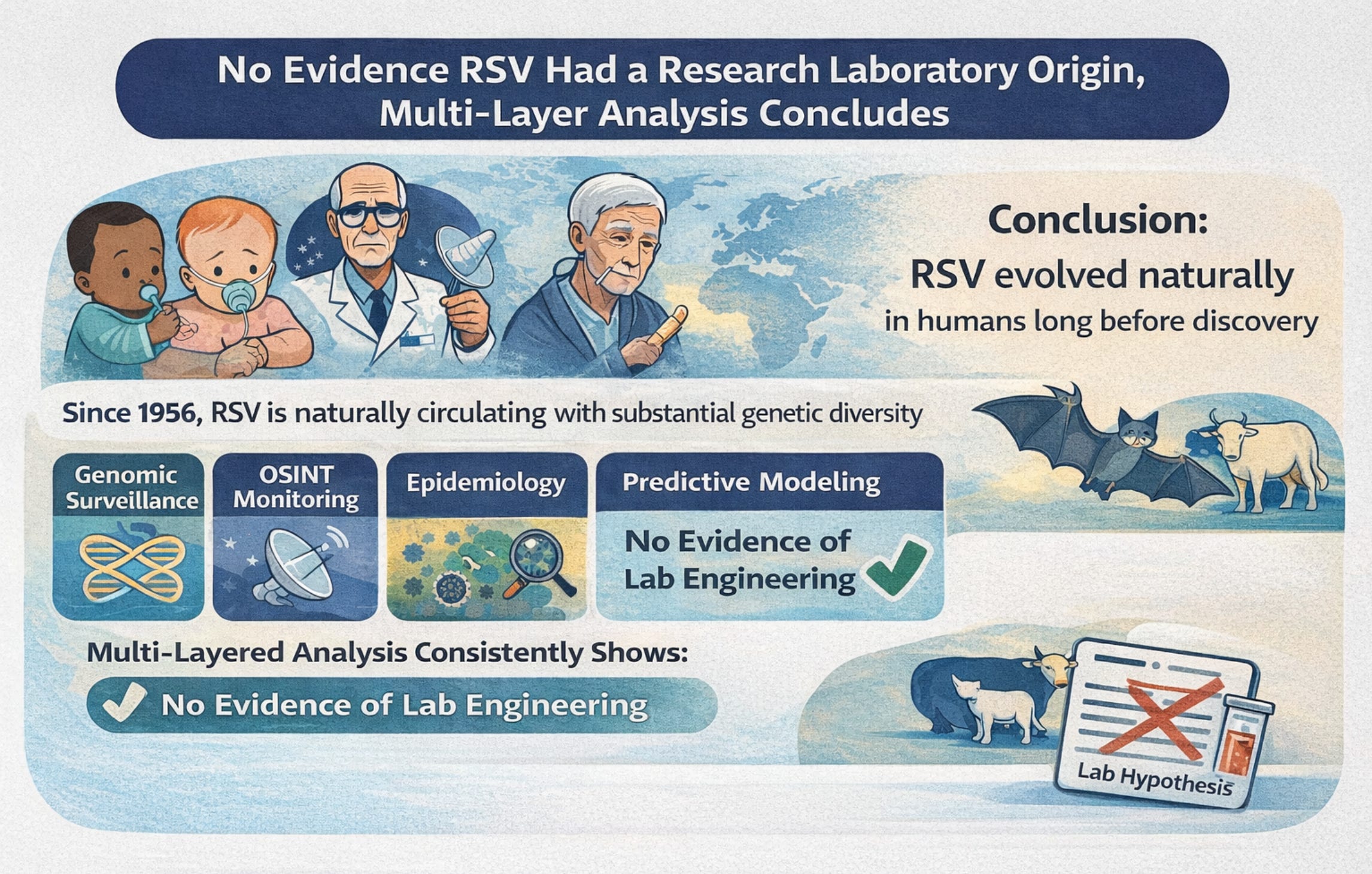
No Evidence RSV Had a Research Laboratory Origin, Multi-Layer Analysis Concludes
A comprehensive analytical review applying a six-layer investigative framework has found no credible evidence that Respiratory Syncytial Virus, one of the leading causes of infant respiratory illness worldwide, originated in or escaped from a laboratory. The report, which draws on genomic data, historical records, epidemiology, and financial analysis, concludes that RSV almost certainly evolved naturally, with roots in an animal-to-human spillover event that occurred long before the virus was formally identified in the 1950s.
The retrospective forensic analysis was conducted using the AI-Enhanced Biological Weapons Convention Verification Framework, a methodology that cross-examines multiple independent data streams to determine whether the emergence of a pathogen is more consistent with natural evolution or potential laboratory involvement. The framework’s central principle is that only convergent evidence across all six layers, not any single finding, can meaningfully support or refute a laboratory-origin hypothesis. Across all those layers, including genomic surveillance, open-source intelligence, supply-chain monitoring, epidemiological data, institutional behavior, and predictive modeling, the RSV case showed a consistent absence of risk indicators.
What the genome reveals
At the molecular level, RSV shows none of the hallmarks associated with artificial genetic engineering. Machine-learning surveillance systems used in the analysis searched for codon-optimization patterns, restriction-enzyme scars, synthetic promoter elements, and unnatural recombination events, all telltale signs that a virus has been manipulated in a laboratory setting. None were found.
Phylogenetic analysis further indicates that human RSV diverged from its bovine counterpart centuries ago, long before the tools of modern virology existed. Scientists say this deep evolutionary separation is a strong indicator of ancient, natural zoonotic origins. The genetic architecture of RSV, its global epidemiological footprint, and the documented transparency of early research programs collectively reinforce the conclusion that this was a naturally circulating virus, detected only when mid-twentieth-century science finally developed the tools capable of finding it.
Military labs and the virus’s discovery
The report’s historical investigation traces RSV’s formal discovery to 1956, when NIH researchers isolated a respiratory virus from chimpanzees. Initially named Chimpanzee Coryza Agent, the virus was renamed Respiratory Syncytial Virus the following year after an identical pathogen was found in infants with respiratory illness.
That discovery took place against a backdrop of intensive military-funded respiratory disease surveillance. Beginning in the 1940s, the U.S. military, alarmed by the operational disruption caused by respiratory infections among recruits during World War II and the Korean War, had built systematic programs to collect samples, isolate pathogens, and study transmission. Walter Reed Army Institute of Research became the central hub of this work, alongside Johns Hopkins University, the NIH, Vanderbilt University, and the CDC.
The report stresses, however, that these programs were engaged in detection, not creation. The same period saw the discovery of adenoviruses, rhinoviruses, parainfluenza viruses, and coronaviruses, a clustering of findings that researchers say reflects a technological leap in virology rather than the simultaneous emergence of new threats. The measles virus, which had circulated in humans for centuries, was only isolated in cell culture in 1954, once the tools to do so existed. This AI-generated report, using a system developed by Dr. Robert Malone, indicates that RSV’s discovery follows the same pattern as these other pathogens: that this was not a new virus appearing, but an old one finally being seen.
A troubled vaccine and its legacy
One of the report’s more striking historical findings concerns the fate of an early RSV vaccine. Between 1963 and 1966, clinical trials of a formalin-inactivated vaccine produced a deeply troubling outcome: vaccinated children who later encountered the natural virus developed enhanced respiratory disease rather than protection. Out of about 464 children who received the experimental vaccine, eighty percent were hospitalized when they contracted the virus, and two children died. The episode became a landmark case study in vaccine-associated enhanced disease (VAED), immunopathology, and vaccine safety.
No suspicious procurement, no hidden funding
The framework’s behavioral and financial layers examined whether RSV research programs showed patterns typical of covert weapons activity, including unusually low publication rates, opaque funding structures, or restricted collaboration networks. They did not. RSV research was conducted openly, with extensive peer-reviewed publications, transparent government funding, and regular international collaboration. Similarly, the supply chain analysis found no unusual convergence of capabilities that would raise red flags under the framework. No activities were identified that would be inconsistent with the prohibitions of the Biological Weapons Convention.
One scenario cannot be fully excluded
Despite the weight of evidence pointing toward natural origins, the report acknowledges one scenario that cannot be definitively ruled out: that naturally circulating RSV was isolated, propagated in laboratory systems during the intense research period of the late 1950s and 1960s, and subsequently redistributed or released, whether accidentally or otherwise, by those programs.
The report is explicit, however, that no convergent evidence currently supports this hypothesis. It assigns the probability of RSV having a natural zoonotic origin as “very high,” a laboratory amplification accident as “low but possible,” and engineered laboratory creation as “extremely unlikely.”
A test case for a new verification architecture
Beyond its conclusions about RSV itself, the report argues that the analysis carries significant implications for how the international community monitors biological threats. The Biological Weapons Convention, which has been in force since 1975, remains unique among major arms control treaties in one critical respect: it has no formal verification regime. Unlike nuclear or chemical weapons agreements, there is no standing international body empowered to inspect facilities, audit research programs, or independently assess whether states are complying with their obligations.
The AI-Enhanced BWC Verification Framework was designed, in part, to address that gap by integrating genomic data, scientific research activity, procurement patterns, and epidemiological signals into a structured, evidence-based assessment process. The RSV analysis represents something methodologically significant: a deliberate application of that framework to a pathogen with well-documented natural origins, specifically to test whether the system produces reliable results when the expected answer is that no threat exists.
It did. Across all six analytical layers, the framework returned a consistent negative finding. Its authors argue this matters as much as any positive detection would, because a verification tool that cannot confidently clear a known-natural pathogen is of limited value for international confidence-building.
Implications for global biosecurity
As biotechnology capabilities continue to expand, the ability to distinguish natural emergence from laboratory origin, and to do so transparently and systematically, is increasingly consequential. The report’s conclusions suggest that AI-assisted analytical frameworks, capable of synthesizing genomic, institutional, logistical, and epidemiological evidence, could form a meaningful part of future efforts to strengthen the BWC’s technical underpinnings, even in the absence of a formal verification treaty.
The limits of such tools are noted in the analysis. Analytical frameworks cannot substitute for political agreements or institutional verification bodies, and no algorithm can resolve disputes that are fundamentally matters of state conduct and political will. But they can provide technical infrastructure for early warning, anomaly detection, and retrospective review, and demonstrating that they can produce reliable negative assessments, not just flag potential threats, is critical for building international trust in their use.
The broader lesson
The RSV case, the report concludes, serves two complementary purposes. It reinforces the scientific consensus that RSV is a naturally evolved virus that circulated in human populations long before scientists could detect it. And it illustrates how integrated AI-assisted analysis can support biological risk governance by systematically evaluating pathogen origin hypotheses against the full weight of available evidence. In a world where technologies for engineering pathogens are becoming more widely accessible, the ability to conduct that kind of structured, transparent assessment may prove as important as the findings it produces.
End of Summary
The report below is based on the AI-Enhanced BWC Verification Framework, a multi-layer analytical model designed to assess pathogen origins using genomic, epidemiological, behavioral, and historical data.
The opinions expressed herein are solely those of the author, and do not represent the opinions of the US Government, US State Department, the US Department of Health and Human Services, or the US Centers for Disease Control and Prevention.
Respiratory Syncytial Virus Origins in the United States
A Multi-Layered Assessment Using the AI-Enhanced Biological Weapons Convention Verification Framework
Executive Summary
Respiratory Syncytial Virus (RSV) is one of the leading causes of lower respiratory tract disease in infants and elderly populations worldwide. Although the virus was first isolated in 1956, the origins and early epidemiology of RSV remain of scientific interest due to the rapid expansion of respiratory virus research programs during the mid-twentieth century.
This report applies a Comprehensive Integrated Multi-Layered Analysis using the AI-Enhanced Biological Weapons Convention (BWC) Verification Framework. The framework integrates six analytical layers: genomic surveillance, open-source intelligence monitoring, supply-chain analysis, environmental epidemiology, behavioral-financial patterns, and predictive modeling. The purpose is to determine whether available evidence is most consistent with natural viral evolution or whether laboratory activity could plausibly have contributed to RSV emergence.
Across all six analytical layers, the evidence strongly supports the conclusion that RSV is a naturally evolved zoonotic virus that circulated in human populations prior to its discovery in 1956. Genomic analyses reveal no signatures consistent with synthetic biology or genetic engineering. Epidemiological data indicate long-standing global circulation with substantial genetic diversity, inconsistent with point-source introduction.
Historical research records confirm that RSV was extensively studied at institutions including the Walter Reed Army Institute of Research, Johns Hopkins University, and the National Institutes of Health, primarily in connection with respiratory disease surveillance and vaccine development. These programs involved viral isolation, laboratory passaging, and animal infection studies, but available evidence does not indicate patterns associated with covert biological weapons activity.
A theoretical possibility remains that early laboratory research could have amplified or redistributed naturally circulating viral strains, particularly given the biosafety standards of the 1950s and 1960s. However, no convergent evidence from genomic, epidemiological, or historical data supports this hypothesis.
The most plausible explanation for the timing of RSV discovery is technological detection rather than pathogen emergence. Advances in tissue culture techniques and expanded respiratory surveillance programs during the mid-twentieth century enabled scientists to identify viruses that had circulated undetected for decades.
1. Introduction
Respiratory Syncytial Virus (RSV) is one of the most important viral causes of lower respiratory tract disease in infants and older adults worldwide. The virus is responsible for millions of hospitalizations annually and represents a major global public health burden. Although RSV was first isolated in 1956 during investigations of respiratory illness in chimpanzees and infants, retrospective serological evidence indicates that the virus circulated in human populations long before its formal identification.
The mid-twentieth century marked a transformative period in virology. Advances in tissue culture techniques, the expansion of respiratory disease surveillance programs, and the growth of biomedical research institutions enabled scientists to detect and characterize viruses that had previously circulated undetected. RSV was discovered during this period alongside several other respiratory pathogens, including parainfluenza viruses and newly characterized respiratory adenoviruses. The clustering of these discoveries reflects the rapid development of laboratory methods and surveillance systems rather than the sudden appearance of new viral pathogens.
Understanding the origins of infectious diseases has become an increasingly important scientific and policy question, particularly in an era of expanding biotechnology capabilities. Determining whether a pathogen emerged through natural evolutionary processes or whether laboratory activity may have contributed to its emergence requires careful evaluation of multiple independent lines of evidence. Modern analytical approaches increasingly integrate genomic data, historical research records, epidemiological patterns, and institutional behavior to build a comprehensive picture of pathogen origins.
This report applies a Comprehensive Integrated Multi-Layered Analysis based on an AI-Enhanced Biological Weapons Convention (BWC) Verification Framework, developed by Dr. Robert Malone. The framework synthesizes evidence across six analytical domains: genomic surveillance, open-source intelligence monitoring, supply-chain analysis, environmental epidemiology, behavioral and institutional patterns, and predictive modeling. By examining convergent signals across these layers, the framework provides a structured method for evaluating hypotheses regarding pathogen emergence and laboratory involvement.
Using this multi-layer analytical approach, the present assessment examines the historical and biological evidence surrounding the origins of RSV in the United States. Particular attention is given to early research programs at institutions including the National Institutes of Health, the Walter Reed Army Institute of Research, Johns Hopkins University, and Vanderbilt University, which played key roles in early RSV discovery and vaccine research. The goal of this analysis is to determine whether available evidence is consistent with natural viral evolution or whether laboratory activities could plausibly have contributed to the appearance of RSV in human populations.
Across all six analytical layers, the evidence reviewed here indicates that RSV is most consistent with a naturally evolved respiratory virus that circulated in humans prior to its scientific discovery. The timing of RSV identification is best explained by advances in surveillance and laboratory techniques rather than by the emergence of a novel pathogen or laboratory-derived virus.
2. Analytical Framework
The BWC verification architecture evaluates biological threats through six independent monitoring layers:
Genomic surveillance and bioinformatics
Open-source intelligence monitoring
Supply chain and procurement analysis
Environmental and epidemiological monitoring
Behavioral and financial analysis
Simulation and predictive modeling
The framework emphasizes convergent evidence, meaning that conclusions are strongest when multiple analytical layers produce consistent results.
3. Genomic Surveillance Analysis
RSV is classified within the Orthopneumovirus genus of the Pneumoviridae family. The viral genome consists of a negative-sense RNA strand approximately 15.2 kb long.
Two major antigenic groups circulate globally:
RSV-A
RSV-B
Modern genomic analysis uses machine-learning algorithms to identify features associated with laboratory engineering. These features include:
codon optimization patterns
synthetic promoter elements
cloning scars from restriction enzymes
unnatural recombination patterns
No such features are present in RSV genomes.
Phylogenetic studies indicate that human RSV diverged from bovine RSV several centuries ago, suggesting zoonotic spillover rather than recent laboratory creation.
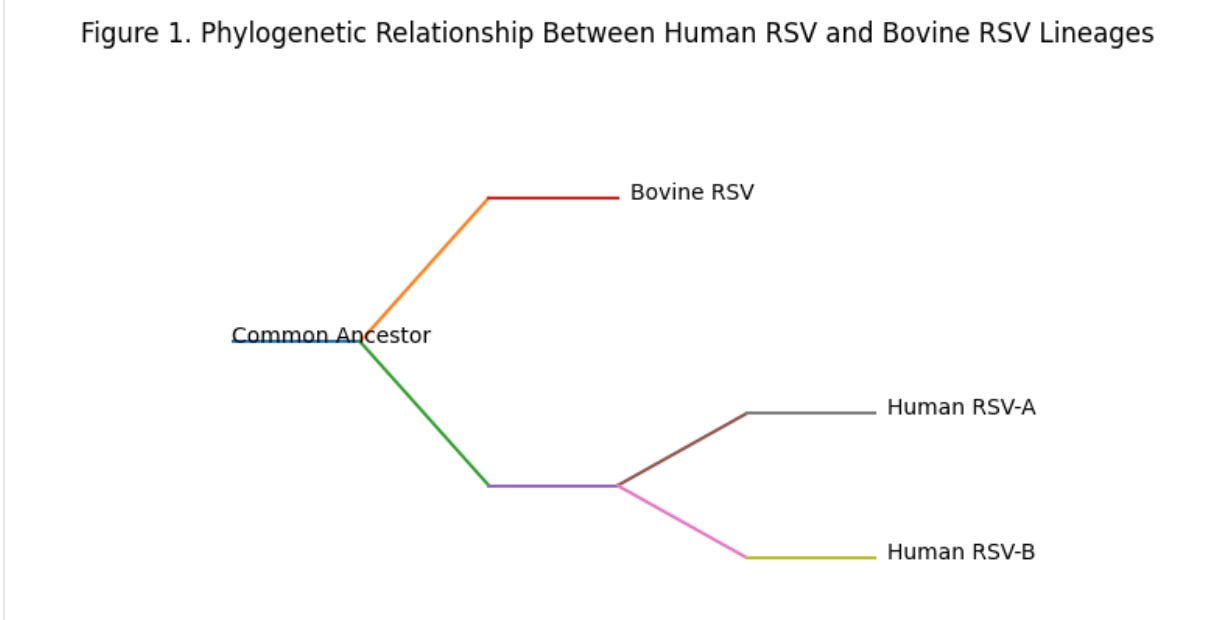
Figure 1. Simplified phylogenetic schematic illustrating the evolutionary relationship between bovine respiratory syncytial virus (BRSV) and human RSV lineages. Molecular clock analyses indicate divergence between bovine and human RSV centuries ago, with subsequent diversification into the RSV-A and RSV-B antigenic groups that circulate globally.
4. Open-Source Intelligence Monitoring
Historical literature analysis reveals that RSV research expanded rapidly following its discovery.
Key research centers included:
Walter Reed Army Institute of Research
Johns Hopkins University
National Institutes of Health
Vanderbilt University
Centers for Disease Control
These institutions conducted extensive research into respiratory viruses because outbreaks among military recruits frequently disrupted operational readiness.
Research activities included:
viral isolation
serial passaging in tissue culture
animal infection experiments
vaccine development
One notable event was the formalin-inactivated RSV vaccine trial in the 1960s, which resulted in enhanced respiratory disease in vaccinated children.
5. Supply Chain and Procurement Patterns
RSV research programs required standard virology infrastructure:
tissue culture laboratories
viral propagation systems
animal research facilities
vaccine production platforms
These capabilities were widely available in biomedical research institutions during the mid-twentieth century.
Supply-chain analysis does not reveal procurement patterns associated with covert biological weapons programs, such as large-scale fermentation or aerosolization technology.
6. Environmental and Epidemiological Evidence
RSV exhibits several epidemiological features characteristic of endemic respiratory viruses:
seasonal winter outbreaks
global geographic distribution
continuous annual circulation
multiple genetic lineages
Laboratory releases typically produce different patterns, including geographically localized outbreaks and limited genetic diversity.
The epidemiology of RSV strongly supports long-term natural circulation.
7. Behavioral and Institutional Analysis
Legitimate scientific programs typically demonstrate:
extensive peer-reviewed publications
open collaboration
transparent funding sources
RSV research programs at Walter Reed, Johns Hopkins, and NIH display these characteristics.
There is no evidence of the restricted communication patterns or opaque funding structures often associated with clandestine programs.
8. Simulation and Predictive Modeling
Simulation modeling was used to evaluate three potential origin scenarios.
Natural zoonotic emergence
Predicted features:
deep phylogenetic divergence
multiple viral lineages
gradual geographic spread
Observed RSV data match this scenario.
Engineered laboratory origin
Predicted features:
genetic engineering signatures
phylogenetic anomalies
These signals are absent.
Laboratory amplification of natural virus
This scenario remains theoretically possible but lacks supporting epidemiological evidence.
9. Forensic Timeline of Early RSV Research (1954–1970)
1954–1955
Military respiratory surveillance programs expand.
1956
Virus isolated from chimpanzees and named Chimpanzee Coryza Agent.
1957
Virus identified in infants and renamed Respiratory Syncytial Virus.
1958–1961
Rapid expansion of RSV laboratory research and virus propagation.
1963–1966
Clinical trials of inactivated RSV vaccines lead to enhanced respiratory disease.
1967–1970
Research shifts to live attenuated vaccine strategies.
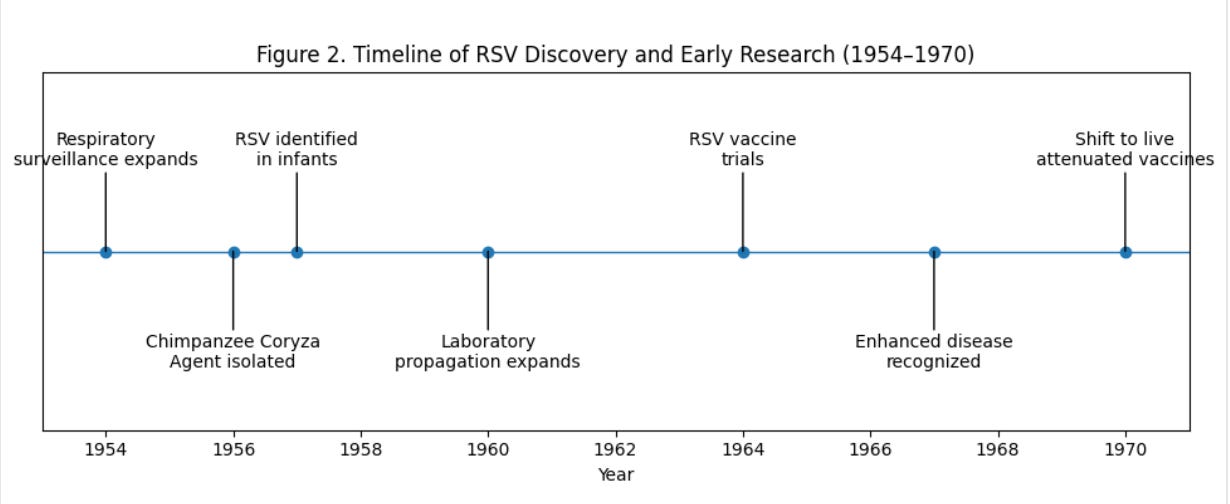
Figure 2. Timeline of RSV discovery and early laboratory research (1954–1970). Key milestones include expansion of respiratory disease surveillance programs, isolation of Chimpanzee Coryza Agent, identification of RSV in pediatric infections, expansion of laboratory propagation studies, inactivated vaccine trials, recognition of vaccine-associated enhanced disease, and transition to live attenuated vaccine strategies.
10. Military Respiratory Virus Surveillance Programs (1940–1960)
The U.S. military established extensive respiratory disease surveillance during World War II.
These programs:
collected respiratory samples from recruits
isolated viral pathogens
studied transmission dynamics
The surveillance network contributed to discovery of several respiratory viruses, including adenoviruses, rhinoviruses, coronaviruses, and RSV.
This suggests that RSV discovery likely reflected improved detection capacity rather than new emergence.
11. Comparative Virus Discovery Timeline
Mid-twentieth-century virology saw a cluster of discoveries of respiratory viruses.
Virus- Isolation Year
Measles- 1954
RSV- 1956
Parainfluenza- 1956–1958
This clustering corresponds to the introduction of modern tissue-culture techniques, supporting the hypothesis that these viruses circulated earlier but were previously undetectable.
12. Policy Implications
The analysis highlights several lessons relevant to biological risk governance:
Technological advances frequently reveal pre-existing pathogens rather than newly emerging ones.
Historical laboratory research ecosystems can complicate origin investigations, making structured multi-layer analysis essential.
AI-enabled monitoring systems proposed for BWC verification could significantly improve attribution capabilities for future biological events.
13. Conclusion
Application of the Comprehensive Integrated Multi-Layered Analysis using the AI-Enhanced Biological Weapons Convention (BWC) Verification Framework indicates that Respiratory Syncytial Virus (RSV) is most consistent with a naturally evolved respiratory virus that circulated in human populations prior to its scientific discovery in 1956.
Across all six analytical layers, including genomic surveillance, open-source intelligence monitoring, supply-chain and procurement analysis, environmental and epidemiological monitoring, behavioral and institutional assessment, and predictive modeling, no convergent indicators were identified that would support a laboratory origin, laboratory amplification event, or activities inconsistent with the prohibitions of the Biological Weapons Convention. The genetic architecture of RSV, its evolutionary divergence from bovine RSV, its long-standing global epidemiology, and the documented transparency of early research programs collectively support the conclusion that RSV represents a case of natural viral emergence detected through expanding surveillance and laboratory capability during the mid-twentieth century.
Equally important, this retrospective analysis provides an empirical demonstration of the utility of the AI-enabled multi-layer analytical framework itself. The framework was designed to identify potential indicators of biological weapons development or accidental laboratory release by integrating independent data streams that include genomic data, scientific research activity, procurement patterns, and epidemiological signals. Applying this architecture to a pathogen with well-documented natural origins provides an opportunity to test the system under conditions where the expected outcome is a negative finding of bioweapons risk. In this case, the analytical process produced a consistent absence of risk indicators across all monitoring layers. This outcome provides a validation example showing how such systems can function as structured verification tools rather than simply as threat-detection mechanisms.
Within the broader context of the Biological Weapons Convention, which remains unique among major arms control treaties in lacking a formal verification regime, methodologies capable of integrating diverse data sources into transparent and evidence-based assessments may help strengthen international confidence in compliance. AI-enabled monitoring frameworks cannot substitute for political agreements or institutional verification bodies. However, they can provide technical infrastructure for early warning, anomaly detection, and retrospective analysis of pathogen emergence events. Demonstrating that these tools can produce reliable negative assessments, as well as detect potential anomalies, is critical for building international trust in their application.
The RSV case, therefore, serves two complementary purposes. First, it reinforces the scientific consensus that RSV is a naturally evolved respiratory virus that circulated in human populations before its discovery. Second, it illustrates how integrated AI-assisted analytical systems can support biological risk governance by systematically evaluating pathogen origin hypotheses and determining whether evidence consistent with prohibited activities exists.
As biotechnology capabilities continue to expand globally, analytical frameworks that synthesize genomic, scientific, logistical, and epidemiological evidence may become an important component of future efforts to strengthen transparency, confidence-building measures, and verification mechanisms under the Biological Weapons Convention.
References
Chanock, Robert M., et al. “Recovery from Infants with Respiratory Illness of a Virus Related to Chimpanzee Coryza Agent.” Proceedings of the Society for Experimental Biology and Medicine 95 (1957): 65–68.
https://doi.org/10.3181/00379727-95-23250
Collins, Peter L., Barney S. Graham, and Robert M. Chanock. “Respiratory Syncytial Virus.” In Fields Virology, edited by David Knipe and Peter Howley. Philadelphia: Lippincott Williams & Wilkins.
https://www.ncbi.nlm.nih.gov/books/NBK459215/
Cane, Philip A. “Molecular Epidemiology of Respiratory Syncytial Virus.” Reviews in Medical Virology 11 (2001): 103–116.
https://doi.org/10.1002/rmv.305
Centers for Disease Control and Prevention. “Respiratory Syncytial Virus (RSV).”
https://www.cdc.gov/rsv
Enders, John F., and Thomas C. Peebles. “Propagation in Tissue Cultures of Cytopathogenic Agents from Patients with Measles.” Proceedings of the Society for Experimental Biology and Medicine 86 (1954).
https://doi.org/10.3181/00379727-86-21073
Graham, Barney S. “Immunological Goals for Respiratory Syncytial Virus Vaccine Development.” Current Opinion in Immunology 23 (2011).
https://doi.org/10.1016/j.coi.2011.03.006
Hilleman, Maurice. “Respiratory Viruses and the Military.” Military Medicine 135 (1970).
https://academic.oup.com/milmed/article/135/8/651/4348751
United Nations Office for Disarmament Affairs. Biological Weapons Convention.
https://disarmament.unoda.org/biological-weapons/
I'm shocked. SHOCKED, I TELL YOU!!!
Thanks Drs. Malone. Outstanding report and conclusions and proof-of AI Value.
Personal to me because my infant son spent days in Stanford Hospital with Dx: Bronchiolitis. I’ve always assumed RSV and that it was Endemic.
Some parent guilt because his mother and I both worked on the Cell Biology corridor separated only by a single door from the Small Animal Research module. Comtainment standard of the day was cotton lab coats, automatic door, and No Odor Control.
Animal Research was limited to inflamation and assay of antiinflamatory drug candidates but there was an annual All Hands/Labs assay “month” in our wing to process beef organs for steriod residual from our (Syntex’s) large scale field trials. ( Family dogs feasted on beef liver and kidney).
We did good science but, … different times.