


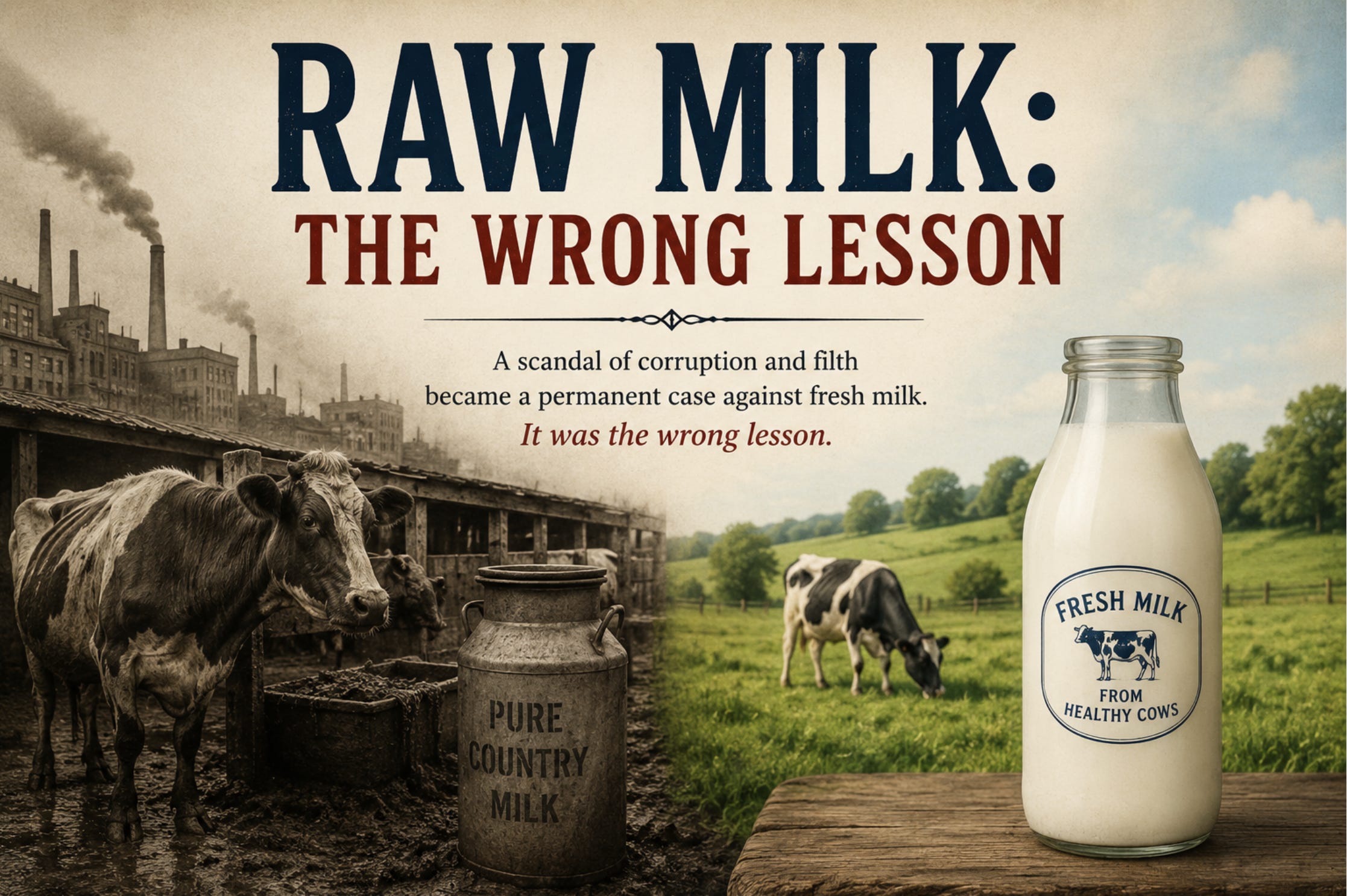
Raw Milk: The Wrong Lesson
A scandal of corruption and filth became a permanent case against fresh milk. It was the wrong lesson.
New York distillers poisoned thousands of infants with filthy milk, and the politicians paid to stop them took bribes instead. Then the government drew exactly the wrong lesson. Rather than remove the conditions that caused the disaster, it treated the symptom, protected the system, and taught generations of Americans that the cow was the problem.
She was not.
In the spring of 1858, a New York publisher named Frank Leslie received milk at his door that was blue, watery, and contaminated with pus. He ordered an analysis, disliked what he found, and sent reporters and illustrators to trace the milk to its source. What they uncovered was not a quality control failure. It was an industrial scandal that had become a business model.
The distilleries of Manhattan and Brooklyn produced enormous quantities of spent grain mash. Disposing of it cost money. Feeding it to cattle produced profit. Distillers built cow sheds against their whiskey operations and packed them with animals standing in filth, tethered over troughs and fed steaming waste from the stills. The diet destroyed the animals. Teeth loosened. Sores opened. Udders became diseased. Cows too weak to stand were suspended in slings and milked until they died.
That milk was sold to the public.
Because it was thin and blue, it was adulterated first. Chalk and plaster for color. Flour and starch for body. Molasses for appearance. Water for volume. Wagons labeled “Pure Country Milk” carried it through the city while families believed they were buying fresh milk from the country. Contemporary estimates attributed thousands of infant deaths a year to it.
The corruption that protected the trade should sound familiar.
When public outrage forced an investigation, inspectors warned the operators before arriving. The barns were cleaned. The conditions were staged. The committee toured the sanitized sheds, declared the danger exaggerated, and recommended better ventilation. One member, Charles Haswell, filed a dissent describing the fraud and warning that children were dying. He was ignored. Years of pressure passed before the state acted.
The story is usually told backward.
Nothing about the swill milk scandal shows that milk was inherently dangerous. The deaths came from confinement, diseased animals, contaminated feed, adulteration, and political corruption. The milk was dangerous because the system producing it was dangerous.
There were two ways to respond.
One was to fix the source. Take the cattle out of the distillery sheds. Clean up the conditions. Test the animals. Keep the herds healthy. Produce milk under conditions that do not cause disease.
The other was to leave the industrial system in place and try to neutralize the result after the fact.
The second path won.
Pasteurization was not the choice made in 1858. It did not yet exist as a practical milk intervention. Pasteur’s early work was on wine; milk pasteurization did not take hold in the United States until decades later. The officials who inspected the swill dairies were not choosing heat over reform. They were choosing corruption over reform.
That distinction matters.
Decades later, when the federal government did push pasteurization, it conceded that the method was not ideal, only practical under existing conditions. In plain terms, restructuring the production system was harder than heating the final product. The industry was already large, centralized, and politically connected. Heating the milk was easier than fixing the barn.
There is another part of this history that deserves the same scrutiny, and it cuts against the regulators as much as against anyone else.
There was a genuine disease that traveled in milk. It was tuberculosis. But the historical record blurred two organisms. Mycobacterium tuberculosis is primarily a human pathogen, spread person-to-person. Mycobacterium bovis is primarily a cattle pathogen that can infect people, most often through raw milk.
The two diseases can look identical, and for most of this history, physicians could not tell them apart. Species-level identification was usually impossible. Cases were classified by symptoms, by age, and by the site of disease rather than by direct proof. Extrapulmonary tuberculosis in a child was often assumed to be milk-borne and therefore bovine. That assumption is not the same as demonstrating M. bovis, and the reasoning frequently ran in a circle.
This is why the old body counts should be read with caution. The round figures still quoted today, such as fifteen thousand American deaths in 1917, are contemporaneous official estimates, copied forward for a century with little hard counting beneath them. The confidence with which they are repeated now exceeds the evidence that produced them.
None of that makes bovine tuberculosis imaginary. Where investigators actually typed the organism, by culture and animal inoculation, they found it. Park and Krumwiede did this work in New York in 1910. Fraser showed in 1912 that much of the bone and joint tuberculosis in Edinburgh children was bovine. Three British Royal Commissions, working between 1890 and 1911, settled that the cattle organism does infect people. In those studies, the bovine type accounted for roughly a quarter of childhood tuberculosis cases and about half of tuberculous neck gland cases before milk was made safe. The honest reading is that the disease was real and laboratory confirmed in children and in the non-pulmonary forms, while the sweeping national totals were not.
Modern data argues for the same restraint. Across much of the world, raw milk and informal dairy remain common, yet zoonotic tuberculosis is generally estimated to be a small share of human tuberculosis, often one to two percent, and likely undercounted in some regions. WHO-linked figures put it at near 140,000 human cases per year, out of millions of total cases. That is real. It is not nothing. It is also not the blanket case against fresh milk that regulators imply.
So the honest statement is narrow. M. bovis was a real risk where infected cattle were present, and milk was drunk untreated, and it was most dangerous to children. The remedy was not to heat all milk and restrict the alternative. The remedy was to clean up the herds, and where that was done thoroughly, the disease collapsed. The United States tested and removed infected cattle and largely eliminated it. Countries that relied on pasteurization alone and left their herds infected kept the problem for decades.
The lesson is not that raw milk causes tuberculosis. The lesson is that diseased herds are dangerous.
Test the animals. Remove infected cattle. Document herd health. Maintain clean production.
Raw milk from a tested, healthy herd is a different product from milk drawn from animals of unknown disease status. The deciding factor is not temperature. It is the health of the animal. Tuberculosis testing. Brucellosis testing. Clean conditions. Real surveillance, proven rather than assumed.
The real lesson of the swill milk scandal is not that milk is dangerous. It is that any system, industrial or otherwise, becomes dangerous when corruption, convenience, and profit replace accountability.
The cow was never the central problem.
The conditions were.
The fraud was.
The corruption was.
Citations
1. “Exposure of the Milk Trade,” Frank Leslie’s Illustrated Newspaper, May 8 and May 15, 1858. The Henry Ford Digital Collections. https://www.thehenryford.org/collections-and-research/digital-collections/artifact/87141
2. “The 19th-century milk scandal that killed thousands of babies.” Big Think, 2023. Source for the contemporary New York Times estimate of thousands of infant deaths a year and historian Catherine McNeur on the committee’s better-ventilation recommendation. https://bigthink.com/the-past/swill-milk-scandal/
3. “The Swill Milk Scandal That Poisoned Thousands of Babies in 19th-Century New York City.” Atlas Obscura, 2025. Source for the milk-and-pus origin, the tipped-off inspectors, and the staged inspection. https://www.atlasobscura.com/articles/swill-milk-scandal-new-york-city
4. “Swill Milk: When Distilleries Defiled Dairy.” The Saturday Evening Post, 2025. Source for the cow suspended in a sling and milked until death and the shed conditions. https://www.saturdayeveningpost.com/2025/07/swill-milk-when-distilleries-defiled-dairy/
5. “The Surprisingly Intolerant History of Milk.” Smithsonian Magazine, 2018. Source for the 1908 federal report stating pasteurization was “forced upon us by present conditions.” https://www.smithsonianmag.com/history/surprisingly-intolerant-history-milk-180969056/
6. Bradish Johnson, Wikipedia. Corroborating source for the chalk and flour adulteration, the slings, and the “Orange County” pushcart branding, citing contemporary New York Times reporting. https://en.wikipedia.org/wiki/Bradish_Johnson
7. “The Swill Milk Scandal of 1858.” Stuff You Missed in History Class (transcript). Source for Councilman Charles Haswell’s dissenting minority report and the staged inspection. https://www.iheart.com/podcast/105-stuff-you-missed-in-histor-21124503/episode/the-swill-milk-scandal-of-1858-85039095/
8. “The Fight for Safe Milk: Pasteurization.” Neatorama, 2011. Source for Pasteur’s early work on wine and the late arrival of milk pasteurization in the United States. https://www.neatorama.com/2011/01/24/the-fight-for-safe-milk-pasteurization/
9. “The Crusade for ’Pure’ Milk.” Postcard History, 2021. Source for the slow adoption of pasteurization in New York. https://postcardhistory.net/2021/12/the-crusade-for-pure-milk/
10. “A 100-Year Review: A century of dairy processing advancements.” Journal of Dairy Science, 2017. Source for the timeline of US compulsory pasteurization laws and Koch’s linkage of cow health to milk-borne disease. https://www.sciencedirect.com/science/article/pii/S0022030217310573
11. “Pasteurize or Certify: Two Solutions to ’The Milk Problem.’” A Campaign for Real Milk. Source for the period debate over pasteurization versus certified clean milk. https://www.realmilk.com/pasteurize-or-certify/
12. Park, W. H. and Krumwiede, C. (1910). “The Relative Importance of the Bovine and Human Types of Tubercle Bacilli in Different Forms of Human Tuberculosis.” Journal of Medical Research 23: 205-268. The foundational US study typing the organism in human cases by culture and animal inoculation; indexed in PubMed.
13. Fraser, J. (1912). “The Relative Prevalence of Human and Bovine Types of Tubercle Bacilli in Bone and Joint Tuberculosis Occurring in Children.” Journal of Experimental Medicine 16(4): 432-442. Found a large proportion of childhood bone and joint TB in Edinburgh to be bovine in origin, introduced through cow’s milk. https://rupress.org/jem/article/16/4/432/6823/
14. Royal Commission on Tuberculosis, Final Report (Griffith, A. S., 1911), with contemporaneous coverage of the Commission’s experimental program of 1890 to 1911. The Commission’s own animal experiments established that the bovine bacillus infects humans, overturning Koch’s 1901 claim that it did not. https://www.ncbi.nlm.nih.gov/pmc/articles/PMC5205861/
15. “The History of In Vivo Tuberculin Testing in Bovines: Tuberculosis, a One Health Issue.” Frontiers in Veterinary Science, 2018 (via PMC). Source for the New York neck-gland data, about half bovine before pasteurization and only a handful after, nearly all in raw-milk drinkers, and for the observation that cattle economics rather than the human toll primarily drove British eradication. https://www.ncbi.nlm.nih.gov/pmc/articles/PMC5900347/
16. “Milk and Tuberculosis.” PMC. Source for the high tuberculous-lesion rates among cows slaughtered in London in 1901 and continued high cattle infection into the 1940s. https://www.ncbi.nlm.nih.gov/pmc/articles/PMC5068040/
17. Olmstead, A. L. and Rhode, P. W. “An Impossible Undertaking: The Eradication of Bovine Tuberculosis in the United States.” Journal of Economic History, 2004; and the 2012 comparative chapter. Source for the estimate that probably 10 percent or more of US TB sufferers had the bovine form, concentrated in non-pulmonary cases and in children, and for the United States leading Europe in controlling the disease through test and slaughter. https://faculty.econ.ucdavis.edu/faculty/alolmstead/Recent_Publications/Impossible_Undertaking.pdf
18. “Bovine tuberculosis in India: The need for One Health approach.” PMC. Corroborating source for the 1917 US test-and-slaughter policy and the scale of cattle testing and culling. https://pmc.ncbi.nlm.nih.gov/articles/PMC9932178/
19. de la Rua-Domenech, R. “Human Mycobacterium bovis infection in the United Kingdom.” Tuberculosis, 2006. Source for M. bovis as a distinct organism transmitted chiefly through raw milk and for its small share of modern TB cases in industrialized countries. https://www.sciencedirect.com/science/article/abs/pii/S1472979205000478
20. The older aggregate death tolls. The estimate of roughly 15,000 US bovine TB deaths in 1917 is an official estimate of the era, repeated in later reviews such as Waters et al., “Bovine tuberculosis vaccine research,” Vaccine, 2012, and is best read as a contemporaneous estimate rather than a measured count. https://www.sciencedirect.com/science/article/abs/pii/S0264410X12001831
21. “About Bovine Tuberculosis in Humans.” US Centers for Disease Control and Prevention, 2025. Source for pasteurization eliminating M. bovis from milk and for the national eradication program. https://www.cdc.gov/tb/about/m-bovis.html
22. “Bovine Tuberculosis in Cattle.” US Department of Agriculture, APHIS. Source for the National Tuberculosis Eradication Program (begun 1917) and the fact that infected cattle are typically asymptomatic. https://www.aphis.usda.gov/livestock-poultry-disease/cattle/bovine-tuberculosis-cattle
23. “Zoonotic tuberculosis in human beings caused by Mycobacterium bovis: a call for action.” Lancet Infectious Diseases, 2017. Source for the modern position that the human burden of M. bovis is uncertain and likely underestimated, because routine laboratories cannot distinguish it from M. tuberculosis and surveillance is largely absent in endemic regions. https://www.sciencedirect.com/science/article/abs/pii/S1473309916301396
24. “Mycobacterium bovis and its impact on human and animal tuberculosis.” Journal of Medical Microbiology. Source for the modern estimate of roughly 140,000 human zoonotic TB cases a year, about 1 to 2 percent of human TB, with a reported range across studies of 1 to 28 percent. https://www.microbiologyresearch.org/content/journal/jmm/10.1099/jmm.0.001769
Note on the evidence. Before the 1930s, clinical diagnosis could not distinguish M. bovis from M. tuberculosis, so the pre-typing death tolls are contemporaneous estimates rather than measured counts, and the swill-era infant deaths of the 1850s were generally acute deaths from contaminated milk, not tuberculosis. The firm historical evidence comes from the laboratory-typing studies, Park and Krumwiede in 1910, Fraser in 1912, and the Royal Commissions of 1890 to 1911, and it is specific to childhood and non-pulmonary disease rather than to total tuberculosis.
I read the book "The Germ in the Dairy Pail" which explains this whole scenario. It's unreal how afraid people are. I tried to give away some of our raw milk (7 gallons a day from one Jersey cow!) and people freaked out, telling me I was trying to send people to the ER and that it was illegal. In the meantime, I'm making cheese and yogurt as fast as I can. It's the best thing we've ever eaten!
I live among a large Amish community from whom I have learned a lot. I’ve known them for 40 years. They all drink raw milk straight from their cows. They are farmers. Their barns are typical which is to say not spick and span. There is plenty of hay and cow manure and lots of flies. I have never heard of a single case of cow born disease among them. So, I get my raw milk from my neighbors who need me to buy an annual cow share so we don’t run foul of the FDA. I think there are lots of reasons for the robust health of their babies and children. But I suspect that one of them is raw milk with its mighty micro flora that pampers the gut with its many beneficial microbes.