



Audio Version:
Health Policy & Reform / By: Dr.s Jill Glasspool Malone and Robert W. Malone
American medicine does not have to remain trapped between government bureaucracy and corporate control. There is another model, rooted in the traditional American principles of independent businesses, professional responsibility, competition, and individual choice. For generations, physicians operated their own practices, established relationships with patients, and made clinical decisions without consulting corporate administrators or insurance-company utilization-review departments. They were medical professionals and small-business owners, responsible for their employees, expenses, and the financial survival of their practices.
In the first essay of this series, The Failure of Modern American Medicine, we examined how hospital corporations, insurance companies, private equity, and government regulation have transformed the practice of medicine.
Independent physicians are disappearing, administrative costs continue to rise, and patients increasingly find themselves navigating a system in which medical decisions are influenced by organizations far removed from the examining room. According to the American Medical Association, the percentage of physicians working in private practice declined from 60.1 percent in 2012 to 42.2 percent in 2024. The percentage holding an ownership stake fell even further, from 53.2 percent to 35.4 percent.
This transformation was not inevitable. It resulted from decades of economic incentives, government policies, and corporate decisions that increasingly favor large institutions over independent practitioners. Fiscal conservatism should not mean defending big business simply because it is privately owned. A competitive economy requires independent businesses, opportunities for entrepreneurs, transparent prices, and consumers who can make meaningful choices. An economy dominated by a handful of enormous corporations, particularly those whose financial advantages depend on government policy, is something quite different. If Americans want independent physicians, the first step is to make it economically possible for them to operate independent practices again.
Put Patients and Physicians Back in Charge
Former Congressman Dr. Ron Paul, himself an obstetrician-gynecologist, spent decades arguing that American health care had become distorted by government intervention and third-party payment systems. His approach emphasized the physician-patient relationship, individual responsibility, market competition, and reducing bureaucratic interference in medical decisions. The central principle is straightforward: insurance should primarily protect people against major financial losses, while ordinary medical care should, wherever practical, involve direct transactions between patients and physicians.
Do not dismiss Paul’s ideas as old-fashioned or representative of the boomer generation. His popularity among college students and young voters was one of the more remarkable political phenomena of the 2008 and 2012 presidential campaigns. While the Republican establishment largely dismissed his libertarian ideas, Paul drew enthusiastic crowds on college campuses and inspired a grassroots movement among young people skeptical of government power, corporate favoritism, endless foreign wars, and the political establishment. His message of individual liberty, fiscal responsibility, free markets, and personal autonomy crossed traditional partisan boundaries.
In the 2012 Iowa Republican caucuses, entrance polling showed Paul winning approximately 48 percent of voters under 30, far ahead of his competitors. His appeal was not simply youthful rebellion. He offered a coherent philosophy that challenged the concentration of political and economic power, whether exercised by Washington or corporations benefiting from government intervention. Those concerns remain relevant to younger Americans confronting rising living costs, institutional distrust, and limited economic independence. The enduring relevance of Paul’s message is that genuine free markets require competition and individual choice, not government policies that protect powerful corporations from smaller competitors.
Nowhere is the contradiction between those principles and government-supported corporate control more apparent than in the way Americans pay for medical care. The third-party payment system has become so entrenched that patients often cannot discover the price of even routine medical services without consulting an insurance company. Insurers negotiate reimbursement rates, establish provider networks, impose prior authorization requirements, and determine which treatments they will cover. Physicians hire billing specialists to navigate these requirements, while patients pay premiums, deductibles, copayments, and coinsurance, often without knowing the final cost of treatment. With ACA deductibles rising sharply over the past year, patients can face substantial bills weeks after what seemed like a routine doctor’s appointment.
A system intended to protect people against financial catastrophe has become a financial catastrophe. Cancer treatment, emergency surgery, expensive medications, and chronic illnesses can overwhelm personal savings, and any serious alternative must protect patients against those risks. But there is little reason to assume that every routine physician visit requires an elaborate insurance transaction. The objective should be to restore direct financial relationships between patients, physicians, and other medical providers wherever practical, while preserving meaningful protection against substantial medical expenses.
Achieving that goal requires reforms that make independent medical practice financially viable again.
Teach Physicians How to Run a Business
One of the simplest reforms could begin in medical school. Physicians spend years studying anatomy, physiology, pharmacology, pathology, and clinical medicine, yet many graduate with little practical knowledge of how to establish and operate a medical practice. They may understand how to diagnose a complicated disease (or access protocols or compute tools for doing so) but know very little about accounting, payroll, business financing, commercial leases, employee management, or negotiating contracts. This is an extraordinary omission for a profession that historically included thousands of independent small-business owners.
Much of today’s medical training prepares physicians to become good employees. They learn how to report to attending physicians, interact professionally with hospital staff, complete required documentation, comply with institutional policies, and navigate the hospital hierarchy. These may be important professional skills for surviving in the corporate world, but they are very different from learning to establish, manage, and sustain an independent medical practice.
Medical schools should teach basic business accounting, practice management, entrepreneurship, and health care economics. Students should learn how to prepare a business plan, understand cash flow, establish prices, purchase equipment, hire employees, and evaluate insurance contracts. Residency programs should expose young physicians to successful independent practices rather than training them almost exclusively within large institutional systems. The objective is not to require every physician to become a business owner, but to ensure that physicians have the knowledge needed to pursue independence if they choose.
The same principle applies to veterinary medicine, where independent practitioners increasingly compete against corporate hospital networks and private-equity-backed consolidators. Teaching young professionals how to run a business is a relatively inexpensive reform.
If we don't address this soon, we'll likely see even greater reliance on foreign medical graduates to staff American corporatized medicine. Those doctors often benefit from fully state-subsidized medical training, and so do not have to cover the debt burden typically associated with American medical school training. Hospital corporations do not care about these matters or how they affect either patient care or the broader society. They are primarily motivated by reducing costs, increasing profit, and maximizing return on investment. The long-term social impacts of their decisions find no place in their accounting systems.
Meanwhile, the federal government is consumed with trying to reduce the explosion of costs associated with the hybrid socialized medicine system that Congress and the Executive branch incrementally created in a misguided attempt to do good, and couldn’t care less about the long-term impact of its decisions on the overall quality and culture of American medical providers, who are typically painted as a parasitic, privileged, self-serving caste that should be subjected to struggle sessions so that they will get up to speed with DEI-compliant cultural reprogramming.
The next challenge is helping newly trained independent medical practitioners obtain the capital needed to start a practice.
Help Physicians Finance Independent Practices
The federal government already operates a substantial infrastructure for helping Americans establish and purchase small businesses through the Small Business Administration. The SBA’s 7(a) loan program can provide up to $5 million in financing for qualifying businesses, including equipment, real estate, working capital, and purchasing an existing business. The 504 program provides financing for qualifying fixed assets. Physicians can already apply for these loans, but existing programs could be made more accessible to those seeking to establish or acquire independent practices. Young physicians emerging from a decade or more of medical education and residency may have substantial student debt, limited credit histories, or less-than-ideal credit scores. Targeted lending programs that recognize these circumstances could help newly trained physicians establish independent practices rather than enter corporate employment simply because they lack access to startup capital.
There is another federal model worth examining. The USDA has long recognized that beginning farmers face significant barriers to entering agriculture, particularly the high cost of land, equipment, and establishing a financially viable operation. Through its Farm Service Agency, USDA offers Beginning Farmer and Rancher programs, including targeted farm ownership and operating loans, down payment assistance, and lending opportunities for applicants who have difficulty obtaining conventional financing. These programs help individuals enter farming and maintain independently operated agricultural businesses.
Why shouldn’t HHS explore a similar initiative for independent physicians? Working with the SBA and community banks, HHS could help develop a Beginning Physician Practice Program modeled on USDA’s approach. Such an initiative could offer targeted lending, down payment assistance for practice acquisitions, financial counseling, and business-planning support. It could serve physicians establishing their first practices, doctors leaving corporate employment, and younger physicians seeking to purchase established practices from retiring colleagues. The objective would not be to create another permanent subsidy program, but to provide qualified professionals with the financing and business support needed to become independent owners.
Consider a physician who has spent fifteen years working for a hospital corporation. She has an established reputation, clinical experience, and patients who would prefer to continue seeing her. She wants to leave corporate employment and open her own office, but needs financing for office space, equipment, insurance, staff, electronic records, and operating expenses while building the practice. A targeted lending program could help finance that transition. Similarly, many retiring physicians sell their practices to hospital corporations because younger physicians cannot afford to purchase them or lack the business knowledge needed to operate them. Helping younger physicians acquire these practices could preserve continuity of care, local ownership, and competition.
The same approach could help veterinarians acquire established clinics rather than see them absorbed into corporate veterinary chains. Partnerships among USDA, community banks, professional associations, medical and veterinary schools, and federal lending agencies could provide practical assistance without creating another large bureaucracy. Borrowers would remain responsible for repayment, and lenders would still evaluate whether the businesses were financially viable.
Physicians leaving corporate employment may also face restrictive contracts, patient nonsolicitation provisions, or other legal complications. State laws governing these arrangements deserve examination as part of any serious effort to restore physician independence. Financing alone cannot solve every obstacle, but combining access to capital, business education, and more competitive reimbursement policies could make independent ownership realistic again.
Reward Physicians Who Choose Independent Practice
Another existing federal program offers an interesting precedent. The National Health Service Corps provides educational loan repayment for eligible physicians and other clinicians who agree to serve in designated shortage areas. Qualifying primary care clinicians can receive up to $75,000 in educational loan repayment for a two-year service commitment. The federal government has therefore already accepted the principle that reducing medical-school debt can encourage physicians to enter certain types of practice.
Why not apply a similar principle to restoring independent medicine? The objective should be to encourage independent practice across America, not merely in government-designated shortage areas or among physicians willing to accept another set of bureaucratic conditions. Assistance could be available to qualified physicians regardless of specialty or geographic location, whether establishing their first practice, purchasing an existing one, or leaving corporate employment. Eligibility should focus on professional credentials, independent ownership, and financial viability rather than government-imposed requirements governing patient populations, fees, or business operations. The purpose is to remove obstacles to independence, not replace corporate administrators with government administrators.
Young physicians and experienced doctors leaving corporate employment also face different financial challenges. Recent graduates may need help repaying educational loans, while midcareer physicians who have already repaid their debts may instead need startup capital or assistance purchasing a practice. A carefully designed program could address these different needs without creating another permanent system of operating subsidies.
Stop Penalizing Independent Physicians Through Reimbursement Policies
Providing financing will accomplish little if government reimbursement policies continue placing independent practices at an economic disadvantage. One obvious problem involves differences in payment between hospital-owned facilities and independent physician offices. Depending on the service and billing arrangements, Medicare and private insurers may pay more when care is delivered through a hospital outpatient department than when substantially similar care is provided in an independent office.
This is precisely the kind of government-created economic distortion that fiscal conservatives should question. If two qualified physicians provide the same service to comparable patients, why should ownership by a hospital corporation justify a higher payment? Site-neutral payment reform, where clinically appropriate, could reduce incentives for consolidation while preserving reimbursement for services that genuinely require hospital-level resources.
Other reforms should address excessive prior authorization, unnecessary documentation, complicated credentialing requirements, and regulations whose compliance costs disproportionately burden small practices. The objective should not be eliminating patient protections, but removing administrative requirements that impose substantial costs without demonstrating corresponding benefits.
Regulatory capture must also be confronted. Large corporations have the financial resources to influence the rules governing their industries, and complicated regulations can become barriers to entry for smaller competitors. A genuinely competitive medical marketplace cannot exist if government policies systematically favor the largest organizations.
How Government Regulations Drove Laboratory Testing Out of Physicians’ Offices
There was a time when many family physicians operated small laboratories in their own offices, performing routine blood counts, urinalyses, and other tests while patients waited. The Clinical Laboratory Improvement Amendments of 1988 changed that arrangement by imposing federal certification, quality-control, personnel, and compliance requirements on physician-office laboratories. A 1998 study found that more than 64 percent of surveyed physicians cited these regulations as a reason for reducing or eliminating in-office testing, with particularly pronounced effects in rural and pediatric practices. Many began sending patients or specimens to outside laboratories instead, introducing additional appointments, delays, and inconvenience. Larger practices were better equipped to absorb the regulatory costs, while smaller offices struggled.
The regulations were intended to improve laboratory accuracy, and there is evidence that testing quality improved. But where is the evidence that driving routine testing out of independent physicians’ offices made patients healthier or their medical care less expensive? This is another example of how well-intentioned federal rules can favor large institutions while reducing the services independent physicians can economically offer their patients. Congress should revisit these requirements, preserving essential quality standards while making routine office-based testing practical again.
How Corporate Medicine Drives Up the Cost of Care
Americans spend more on health care than citizens of any other wealthy nation, yet higher spending has not translated into consistently better outcomes. Much of the debate focuses on insurance premiums, deductibles, and government subsidies, while paying less attention to the enormous corporations collecting the money. Hospital systems, insurance companies, pharmacy benefit managers, and consolidated physician networks operate within a complicated payment structure in which prices are negotiated behind closed doors, patients rarely know what services actually cost, and the bill is passed along to employers, taxpayers, and families.
Consolidation makes this system particularly expensive. When a hospital corporation acquires competing hospitals and independent physician practices it gains leverage in negotiations with insurance companies and creates regional monopolies. Insurers need access to major hospital networks to offer marketable coverage, giving dominant hospital systems considerable power to demand higher reimbursement rates. Research has repeatedly associated hospital mergers and market concentration with higher commercial insurance prices, without consistently demonstrating improvements in quality. Those higher payments become increased insurance premiums, employer expenses, and costs for patients.
Hospital ownership can also change how medical services are billed. A physician performing essentially the same procedure in the same community may generate a larger total insurance payment after the practice is acquired by a hospital system, particularly when additional facility charges become permissible. The patient has not received better care, but the corporate owner may collect more revenue.
Meanwhile, large insurance companies and their affiliated businesses generate revenue from administering premiums, processing claims, managing pharmacy benefits, and controlling access to services.
The scale of these price differences is extraordinary. A RAND Corporation study found that in 2022, employers and private insurers paid hospitals an average of 254 percent of what Medicare would have paid for the same services at the same facilities. In some states, commercial payments exceeded 300 percent of Medicare rates. These higher prices are reflected in insurance premiums, employer health care expenses, and patients’ out-of-pocket costs. RAND also found that hospitals facing little competition were generally able to charge higher prices, and that this had a greater influence on prices than the percentage of patients covered by Medicare or Medicaid.
Private equity introduces another set of financial pressures. Investment firms may acquire medical practices, consolidate them into larger networks, increase charges, reduce operating expenses, or sell valuable real estate to generate returns. Not every acquisition follows this pattern, but documented cases demonstrate how financial engineering can divert resources away from patient care. The collapse of Steward Health Care, discussed in detail in a later section of this essay, illustrates the consequences when hospitals become entangled in complicated ownership structures, debt obligations, and real estate transactions. Patients and communities can ultimately bear the consequences of decisions made primarily to satisfy investors and creditors.
The fundamental problem is that the American health care system often rewards the ability to extract higher payments rather than the ability to deliver better care at a lower cost. Profit is more important than quality. No balance sheet ledger entry reflects cost-effective quality of care. Large corporations can use negotiating leverage, ownership structures, and regulatory advantages to increase revenue, while independent physicians lack comparable bargaining power. These costs are dispersed across insurance premiums, employer contributions, Medicare and Medicaid spending, and patients’ out-of-pocket expenses, making it difficult for Americans to see where their money goes. Again and again, the federal government response to this cost spiral is to introduce more regulation, more subsidies, more programs, more compute. There is never any serious consideration of reducing federal intervention and enabling more competitive, decentralized, free-market solutions.
Restoring meaningful competition requires more than subsidizing insurance premiums. It requires confronting the financial incentives that allow consolidated health care corporations to charge more without necessarily delivering better medicine.
Give Physicians Their Time Back
Regarding the expanding reliance on compute to solve this enormous problem of spiraling costs, electronic medical records were supposed to make medicine more efficient. Instead, they have created an expensive administrative burden that increasingly serves insurers, regulators, and hospital corporations alongside physicians and patients. Independent practices must pay for software, cybersecurity, training, and compliance, while large hospital systems spread those costs across thousands of employees. Washington helped create this environment through the HITECH Act, Medicare reimbursement and reporting requirements, and HIPAA’s separate privacy and security obligations.
Electronic records have also introduced serious privacy risks. Stealing paper charts generally required physical access; today, hackers can obtain millions of medical records in a single attack. The 2024 Change Healthcare breach compromised information belonging to approximately 193 million Americans, exposing sensitive data to potential fraud, identity theft, and scams. Patients were never given a meaningful choice about exposing their private medical information to these risks.
There is another vulnerability in allowing a handful of corporations to control the electronic medical records of hundreds of millions of Americans. Their concentrated control over critical medical infrastructure creates economic and national-security concerns.
Epic Systems, whose software includes MyChart, serves health care organizations treating more than 280 million Americans and is now facing federal antitrust scrutiny over allegations involving restrictions on access to medical data.
Other electronic-record companies are publicly traded or owned by private-equity firms, creating the possibility of changes in ownership, including foreign investment. Concentrating sensitive medical information and the systems needed to access it in a few corporate networks creates enormous dependencies. Physicians and patients may technically own or control their medical records, but that means little if they cannot readily transfer those records, or operate outside the dominant technology platforms.
What many physicians may not realize is that federal law does not universally require electronic medical records. Physicians can generally maintain paper charts, but Washington has created financial incentives and penalties that make avoiding electronic systems increasingly difficult. Medicare reimbursement rules, electronic prescribing requirements, and insurance contracts add further pressure. The government may not explicitly mandate electronic records for everyone, but its policies can make opting out almost impossible, leaving consumers with no choice. A patient cannot request only paper records.
Congress should simplify these requirements and allow physicians to choose affordable electronic systems or paper records where appropriate. Medical records should document diagnoses, treatments, medications, and other essential clinical information, not require endless billing templates and redundant reporting. Patients must still be able to obtain and transfer their records, receive paper copies upon service or by request, and physicians must protect patient privacy. Common standards can allow electronic systems to communicate without requiring a centralized government database or oligarchies, often foreign-owned, controlling patient records.
The goal should be simple: give physicians control over their record-keeping, protect patient information, and eliminate unnecessary bureaucracy that makes independent medical practice increasingly expensive.
Give Patients a Practical Way Out
Restoring independent physicians will mean little unless patients can afford to use them. Fortunately, alternatives already exist. Direct primary care practices charge patients a recurring fee for an agreed range of primary care services, often offering longer appointments, easier communication, and transparent pricing without submitting routine visits to insurance companies. Concierge medicine offers another model. Some practices charge membership fees while continuing to bill insurance, while others rely more heavily on direct payment.
Health Savings Accounts offer another way for patients to regain control over their medical spending. Established in 2003, HSAs allow eligible Americans to set aside tax-advantaged funds for medical expenses, with unused money carrying forward from year to year. Changes effective in 2026 expanded their usefulness. Qualifying direct primary care arrangements can coexist with HSA eligibility, and certain Bronze and catastrophic insurance plans also qualify. Combined with transparent cash prices and independent physicians, these accounts offer a way to reduce reliance on insurance companies for routine medical care while retaining protection against major expenses.
For many patients, a practical approach may involve combining primary care paid for independently with appropriate high-deductible or catastrophic coverage, using an HSA where eligible, and seeking independent providers for routine services. Patients can compare cash prices for laboratory testing, imaging, outpatient procedures, and prescriptions. Sometimes direct-payment prices are lower than the amounts patients would owe through insurance.
The objective is not to persuade Americans to abandon insurance indiscriminately. It is to give them meaningful choices and reduce unnecessary dependence on third-party payment for routine care. Patients should be able to choose a physician based on competence, trust, accessibility, and price rather than simply selecting someone from an insurance company’s approved network.
What About People Who Cannot Afford Direct Care?
Any serious reform must address patients who cannot afford medical care. The older American medical system included independent physicians, religious charities, and community hospitals that provided free or reduced-cost treatment. Catholic hospitals and other nonprofit institutions played an important role in this tradition, operating under charitable missions rather than shareholder expectations. Physicians also frequently provided charity care themselves.
That system had shortcomings. Charitable care was unevenly available, and many patients still faced serious financial barriers. A modern independent-care model must preserve protection for people facing catastrophic illness, disability, or poverty. Public assistance, targeted subsidies, charitable care, and insurance against major medical expenses can coexist with independent medical practices and direct payment for routine services.
The Dangers of Corporate Oligopolies
A greater danger lies in allowing essential industries to concentrate in the hands of a few corporations. As competition disappears, the public loses choices, small businesses struggle to survive, and government itself can become dependent on the very companies it is supposed to regulate. Dominant corporations have the financial resources to influence legislation, shape regulations, drive up prices, and lobby for policies that create barriers to smaller competitors. This is the danger of regulatory capture. Its consequences extend beyond higher prices: when an essential industry depends on a handful of companies, the financial failure or withdrawal of one can threaten services across entire regions.
The collapse of Steward Health Care provides a disturbing example. After years of private-equity ownership and complicated financial arrangements involving hospital real estate, Steward filed for bankruptcy in 2024. Two Massachusetts hospitals closed, while state officials scrambled to preserve medical services at others. Communities that depended on these hospitals suddenly faced the consequences of financial decisions made far from the patients they served. Hospitals and physicians’ offices are not ordinary retail businesses. When one disappears, patients cannot necessarily drive a few miles to another location, particularly in rural communities or during medical emergencies. Corporate consolidation can turn the financial failure of one organization into a regional health care crisis.
The vaccine industry provides another example of how market concentration can weaken the government’s negotiating position. By the 1980s, manufacturers were leaving portions of the childhood vaccine market, citing litigation expenses, liability exposure, and poor financial returns. Congress responded with the National Childhood Vaccine Injury Act of 1986, establishing a federal compensation system and limiting certain forms of manufacturer liability. The legislation was intended to protect vaccine supplies, but it also demonstrated the leverage that a shrinking group of essential manufacturers could exercise over public policy. When government depends on a small number of companies to supply products it considers indispensable, the threat of withdrawal becomes a powerful negotiating tool (thereby enabling a form of blackmail). The public can end up bearing financial risks that would otherwise remain with manufacturers.
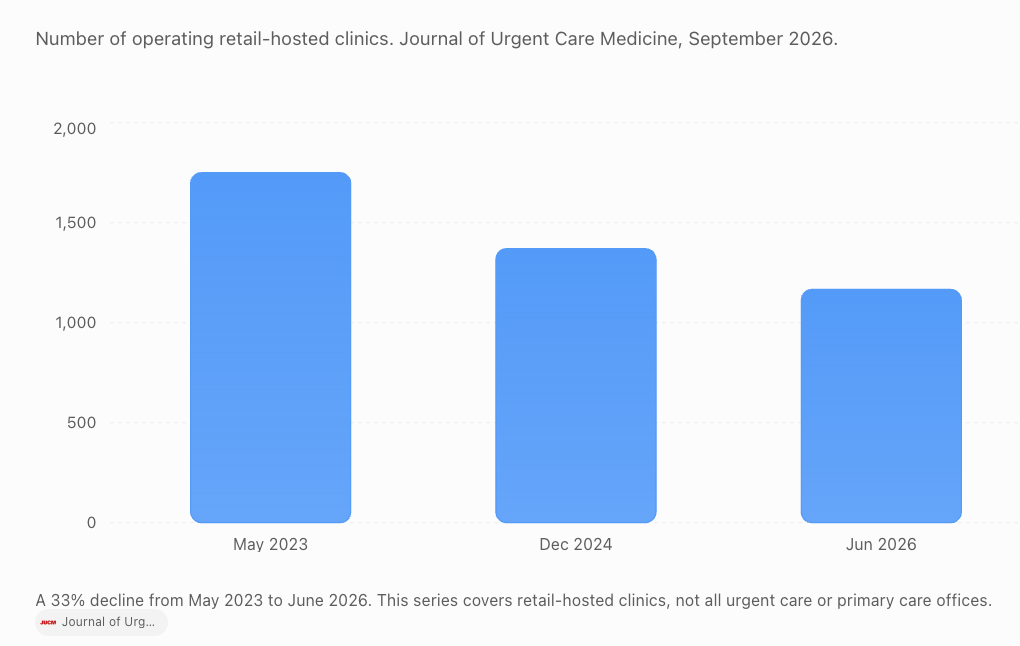
The risks of corporate consolidation are already visible in America’s walk-in medical clinics. In 2024, Walmart abruptly abandoned its health care business, closing all 51 Walmart Health centers across five states. Walgreens, after investing billions in VillageMD, began closing clinics and withdrawing from regional markets, while Carbon Health entered bankruptcy in 2026 with more than $100 million in debt. These closures left millions of patients without viable options for healthcare.
According to the Journal of Urgent Care Medicine, the number of retail-based medical clinics in the United States declined by 33 percent between 2023 and 2026. These corporations entered medicine promising greater convenience, efficiency, and affordable care, only to discover that operating medical practices did not necessarily deliver the financial returns investors expected. When a national corporation decides to exit a market, dozens of clinics can disappear almost simultaneously, leaving patients scrambling for alternatives. Medical care is an essential community service, not simply another corporate investment that can be abandoned when quarterly financial results disappoint.
For consumers, concentrated markets can mean higher prices, fewer choices, diminished service, and little bargaining power. Companies do not need to engage in illegal price fixing to exercise substantial pricing power when meaningful competition has disappeared. For government, the danger can be even greater. A corporation controlling essential regional services gains considerable leverage when regulators confront the prospect of its closure. Public officials may face pressure to provide financial assistance, approve transactions, or accommodate corporate demands simply to prevent communities from losing services they depend upon.
Preserving independent businesses is therefore more than an economic preference. It is a safeguard against concentrated power. Thousands of independently owned medical practices provide competition, distribute financial risk, and reduce the likelihood that one corporation’s failure will disrupt an entire region’s access to care. Government should not be writing regulations that make it increasingly difficult for small businesses to operate while helping large corporations become too important to fail.
That is not free-market capitalism. It is a form of corporatism, in which government power and concentrated corporate interests reinforce one another, protecting established institutions from competition while leaving taxpayers, patients, and independent professionals to bear the consequences.
The Choice Is Not Between Big Government and Big Business
For too long, Americans have been told that health care reform means choosing between expanding government programs and preserving the existing corporate insurance system. Both approaches can concentrate enormous power in bureaucracies and corporations while leaving physicians and patients with progressively less control over medical decisions. The American tradition of independent medical practices, charitable hospitals, and community-based care has increasingly given way to a system that rewards consolidation, administrative complexity, and corporate influence over government policy. Public confidence in the medical system has fallen dramatically during this transformation.
There are signs that Washington is beginning to reconsider parts of the existing insurance-centered model. In January 2026, President Trump proposed directing more federal health care assistance to individuals through health savings accounts rather than routing it through insurance companies. In October, HHS finalized stronger health care price-transparency requirements and announced an initiative to streamline prior authorization. CMS has also expanded flexibility for catastrophic insurance plans. These developments address some of the problems identified here, but they remain a mixture of proposals, new regulations, and implementation efforts whose effects have yet to be demonstrated. None constitutes a comprehensive program to restore independent physician ownership, eliminate reimbursement advantages favoring hospital corporations, or make it substantially easier for physicians to establish their own practices.
Yet Washington already has many of the tools needed to accomplish these goals. Health Savings Accounts already exist. The Small Business Administration helps entrepreneurs establish independent businesses. Federal loan-repayment programs provide financial incentives for physicians, while USDA programs offer a model for helping younger professionals enter industries increasingly dominated by large corporations. These existing mechanisms could be adapted to help physicians establish or purchase independent practices without creating another massive federal program. Congress and HHS could also address reimbursement policies that favor hospital ownership, simplify electronic-record requirements, and remove unnecessary regulatory obstacles that make independent practice financially difficult.
Americans should be able to choose physicians who answer to their patients (and are tied to their communities) rather than corporate administrators. Physicians should be able to establish independent practices without navigating an obstacle course of government regulations and financial disadvantages designed around the needs of large institutions.
Fiscal conservatism is not about protecting corporate monopolies or shifting private business risks onto taxpayers. It is about competition, individual responsibility, limited government, and the freedom to build and operate independent businesses. Those principles protect patients as much as physicians, because a medical system with thousands of independent providers is less vulnerable to corporate financial failures, political pressure, and the demands of powerful institutional interests.
Restoring independent medicine is not a nostalgic attempt to turn back the clock. It is an opportunity to break the growing dependence between government and corporate health care, restore competition, and return medical decisions to the physicians and patients who must live with their consequences.
End.
Independent Medicine. Independent Journalism.
Both Are Worth Defending.
This essay is about restoring independence to American medicine, but the same principles apply to journalism. When a handful of powerful corporations dominate an industry, independent voices struggle to survive, and the public loses something valuable: genuine competition, accountability, and the freedom to challenge established interests.
Malone News operates outside the corporate media system. We investigate issues that others overlook, challenge government and corporate power, and offer analysis grounded in science, medicine, and independent research. We do this without a corporate parent, institutional funding, or a wealthy benefactor underwriting our work.
If you value this kind of journalism and are reading for free, please consider becoming a paid subscriber. Your support pays for the research, reporting, writing, and publishing that make Malone News possible. It also allows us to keep much of our investigative reporting freely available, reaching readers who cannot afford a subscription.
We cannot argue for the survival of independent professionals and small businesses while expecting independent journalism to survive without financial support.
If this work matters to you, please help sustain it. Become a paid subscriber today.
References:
American Medical Association. (2025). Physician Practice Characteristics in 2024: Private Practices Account for Less Than Half of Physicians in Most Specialties. AMA Policy Research Perspective. Documents declining private-practice employment, physician ownership, hospital acquisitions, and administrative pressures.
U.S. Government Accountability Office. (2025). Health Care Consolidation: Published Estimates of the Extent and Effects of Physician Consolidation. GAO-25-107450. Reviews hospital and corporate acquisitions of physician practices and their effects on competition and costs.
RAND Corporation. (2025). Prices Paid to Hospitals by Private Health Plans: Findings from Round 5.1 of an Employer-Led Transparency Initiative. Reports that private insurers paid hospitals an average of 254% of Medicare rates for comparable services in 2022.
Internal Revenue Service. (2025). Treasury, IRS Provide Guidance on New Tax Benefits for Health Savings Account Participants. Explains the 2026 expansion of HSA eligibility to qualifying direct primary care arrangements and certain Bronze and catastrophic insurance plans.
U.S. Small Business Administration. 7(a) Loan Program. Federal loan guarantees for qualifying small businesses, including business acquisitions, equipment, and working capital.
U.S. Small Business Administration. 504 Loan Program. Long-term financing for eligible real estate and major fixed assets.
U.S. Department of Agriculture, Farm Service Agency. Beginning Farmers and Ranchers. Federal lending and financial assistance programs designed to help beginning farmers establish and acquire agricultural businesses.
Health Resources and Services Administration. National Health Service Corps Loan Repayment Program. Educational loan repayment for eligible clinicians serving in designated shortage areas.
Centers for Medicare & Medicaid Services. Quality Payment Program: Merit-based Incentive Payment System (MIPS). Federal physician payment and reporting requirements, including electronic health record interoperability measures.
U.S. Congress. (2009). Health Information Technology for Economic and Clinical Health (HITECH) Act. Federal legislation establishing incentives and requirements that accelerated electronic medical record adoption.
U.S. Congress. (2016). 21st Century Cures Act. Public Law 114-255. Includes provisions concerning electronic health information exchange, interoperability, and information blocking.
U.S. Department of Health and Human Services, Office for Civil Rights. HIPAA for Professionals. Federal privacy and security requirements for protected health information.
Massachusetts Department of Public Health. (2024–2025). Steward Health Care Transitions. Official documentation of Steward’s bankruptcy-related hospital closures and transfers to new operators.
U.S. Congress. (1986). National Childhood Vaccine Injury Act of 1986. Legislative history of the federal vaccine injury compensation framework and specified manufacturer liability protections.
Health Resources and Services Administration. National Vaccine Injury Compensation Program. Federal program documentation concerning vaccine injury compensation and the statutory framework.
U.S. Federal Trade Commission. Competition in Health Care. Federal antitrust enforcement and research concerning health care consolidation, mergers, and competition.
U.S. Department of Health and Human Services. Change Healthcare Cybersecurity Incident. Federal information concerning the 2024 cyberattack and its effects on protected health information.
Born, P. H., & Thran, S. L. (1998). The Influence of CLIA ‘88 on Physician Office Laboratories. Journal of Family Practice, 46(4), 319–327. Documents how federal laboratory regulations contributed to the reduction or elimination of in-office testing, particularly among small, rural, and pediatric practices.
U.S. Congress. (1988). Clinical Laboratory Improvement Amendments of 1988. Public Law 100-578. Establishes federal standards governing laboratory testing, including physician-office laboratories.
Walmart Inc. (April 30, 2024). Walmart Health Is Closing. Official announcement confirming the closure of all 51 Walmart Health centers across five states and its virtual-care business.
Centers for Medicare & Medicaid Services. (May 15, 2026). HHS Notice of Benefit and Payment Parameters for 2027 Final Rule. Expands catastrophic insurance flexibility, adjusts marketplace requirements, and provides for new non-network plan options beginning in 2028.
The White House. (January 2026). The Great Healthcare Plan. Outlines proposals for directing health care assistance toward individuals, reducing prescription drug prices, and expanding price transparency.
U.S. Department of Health and Human Services. (October 5, 2026). New Regulations Make It Easier to Find, Compare, and Report Healthcare Pricing and Coverage Information. Announces finalized federal price-transparency regulations intended to improve access to negotiated prices and consumer cost estimates.
U.S. Department of Health and Human Services. (October 5, 2026). Transparency in Coverage Final Rules (CMS-9882-F). Technical summary of the new insurer price-transparency requirements.
Centers for Medicare & Medicaid Services. (2026). Marketplace Regulations and Guidance. Official regulatory documents concerning ACA marketplace rules, plan design, enrollment, and insurance oversight.
Well researched and well written. But I think everything you’re aiming for can be summed up in one phrase: separate medicine and state, for the same reasons we separate church and state. Free minds and free markets would put physicians and patients back in charge, in a relationship that benefits both. Government’s only role should be to prosecute fraud and violence.
Your readers need to understand that the quality of healthcare and positive health outcomes will continue to deteriorate with the path medicine is on in the 21st century in the USA. The fundamental issue is that corporate interests in all segments of the medical system have the goal of return on invested capital which is priority number one. The White House is painfully aware of this because on their website they have a chart comparing cost of healthcare and longevity with other nations around the world and the US has a system twice as expensive and longevity is minimal in comparison to many other countries. The impediments to fixing the healthcare system are many.
First, the chemical industry drives the agricultural and food industry and the beneficiary is the healthcare system which is given the task of treating the victims exposed to chemical exposure driving cancer rates and much more. Second, the medical curriculum is managed to drive drug treatment as the focus and is expensive and limited in student enrollment. In addition education on how good nutrition plays a central role in maintaining good health is lacking. In turn, medical corporations are importing personnel from other countries that are creating communication barriers and under skilled healthcare workers. Detrimental to the quality of healthcare. I have personal experienced this in the last several years when hospitalized.
The task RFK Jr. has is formidable and the NIH mindset that has been shaped by those who are suppose to be regulated, but have created a system of regulatory capture. It is painfully apparent in the continued push to inject with experimental RNA injections that have not been proven to be safe and effective.
On a personal note I have twin grandson who are in the medical profession and are working for corporations. It is apparent they are maximizing the work loads of their medical professionals to
maximize the bottom line which in turn raises the risk of medical errors that harm. Death by Medicine is for real and needs to be addressed rather than left in the closet. The fact the eliminating C-Diff that kills over 30,000 patients annually is not addressed and the focus is on injecting our children with MMR where the risk of dying is negligible speaks volumes of where the medical priorities are and why.
Finally, the ultimate gate keepers are the Congressional leadership in DC, which is around 600 politicians that are supposed to be representing the interests of their constituents, but in turn are serving as facilitators for the corporations that actually shape the medical system we have today.
Senator Ron Paul was a outlier, as well as a few of our current Congressman, but most remain silent so they are not targeted for elimination from DC by the corporations. I became aware of this in 2011, when I went to DC to ask why they are not addressing the autism crisis. Answer: Our hands are tied. Transalation, I will be targeted for elimination from DC if I spoke out on this issue.
For those interested in more of my views on healthcare, go to my website. seveninnocents . com