

AUDIO:
The Absurdity of Public Health
The United States medical system, combined with the industrial food complex, kill and maim people on a colossal scale every single year.
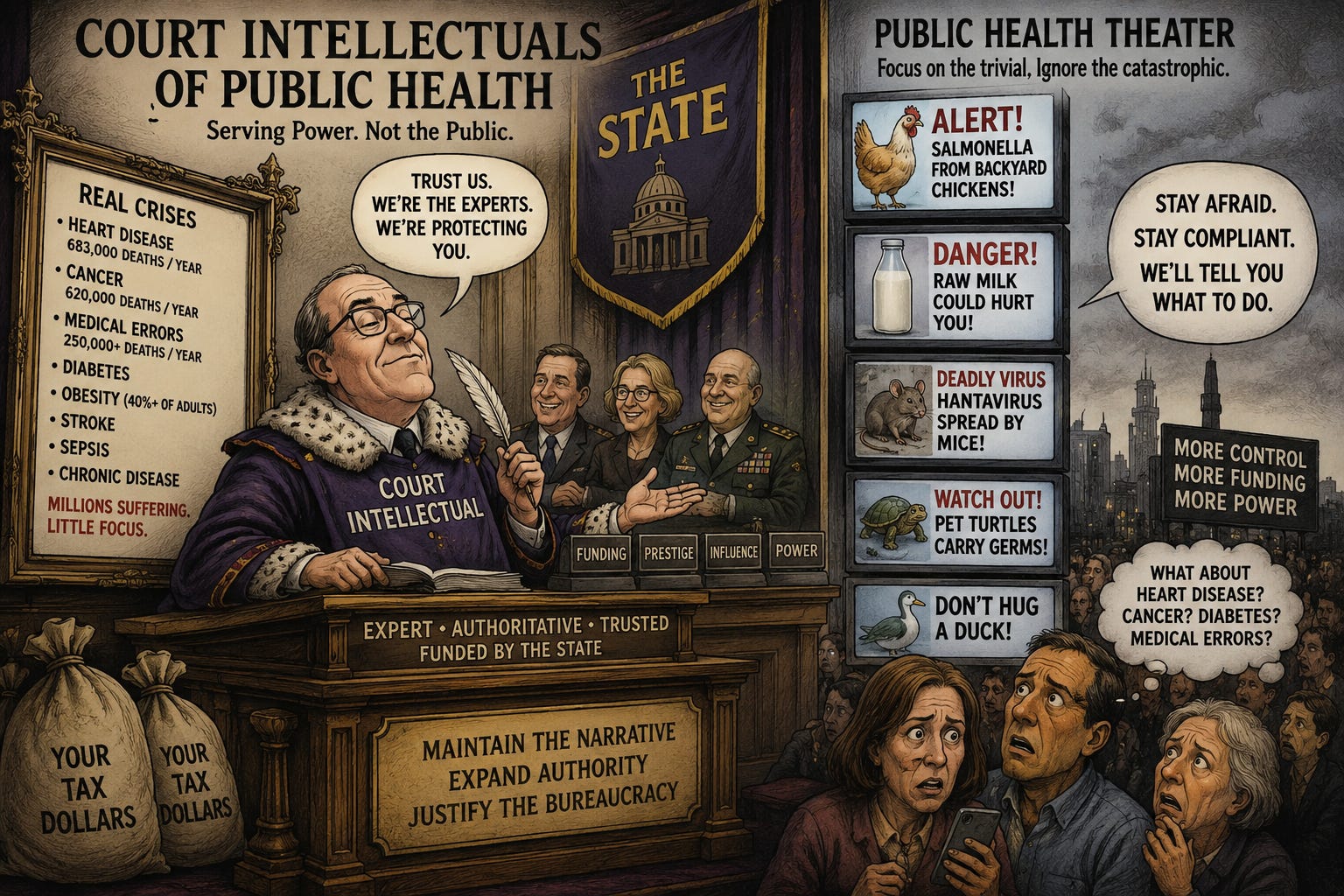
Heart disease kills over 683,000 Americans annually. Cancer kills another 620,000. Stroke, diabetes, chronic lung disease, sepsis, obesity-related metabolic disease, opioid overdoses, and preventable medical errors collectively account for millions of deaths, disabilities, and shattered families.
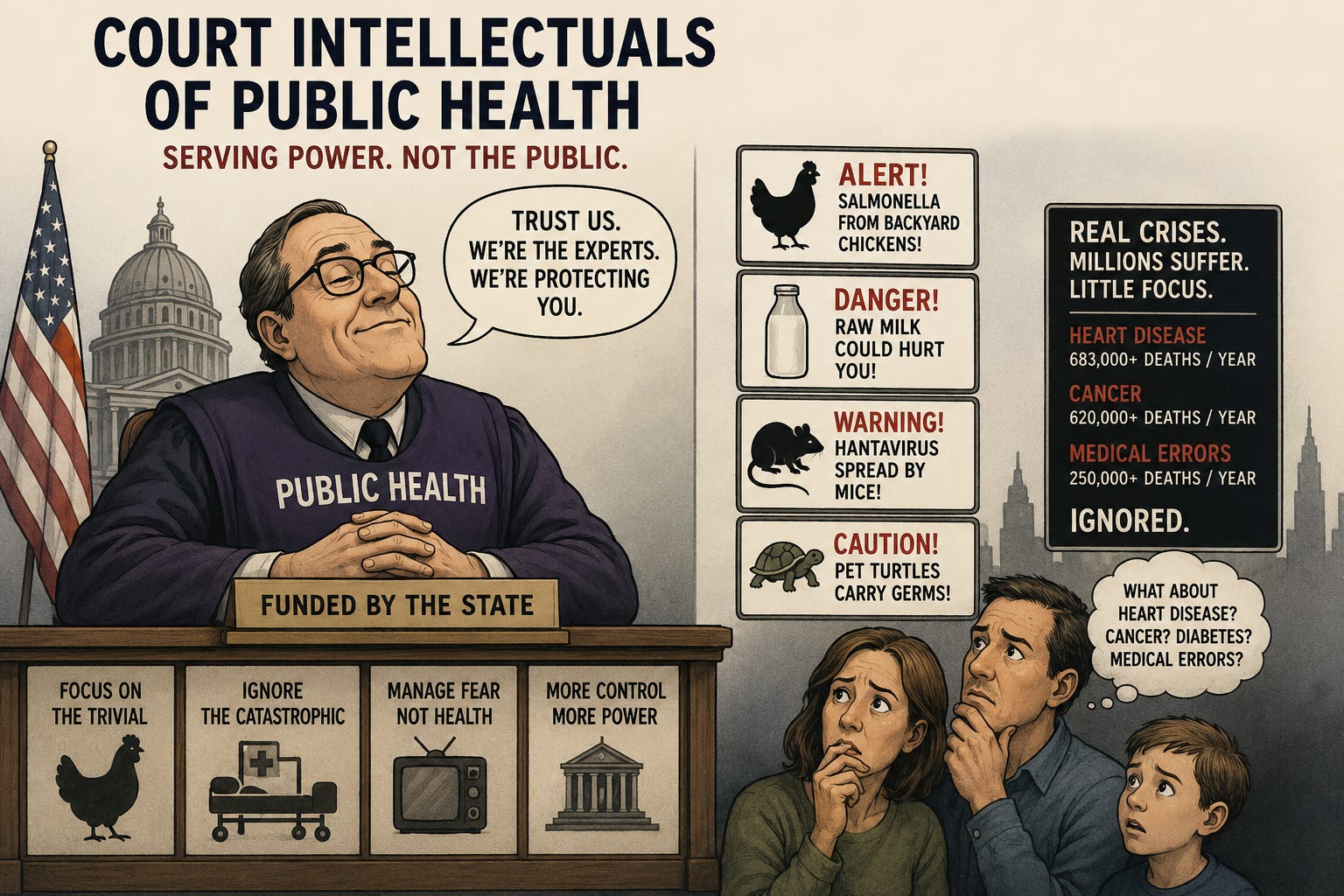
And yet, if you browse the front page of the CDC website on any given week, there is a decent chance you will find public health officials issuing urgent alerts about backyard chickens, raw milk, pet turtles, or someone hugging a duck too enthusiastically.
Seriously.
At the very moment when roughly 1,870 Americans are dying every day from heart disease and another 1,700 from cancer, federal public health agencies are sounding alarms about salmonella from backyard poultry.
The contrast has become almost surreal.
One recent CDC warning involved 34 reported salmonella cases linked to backyard poultry across 13 states. Thirteen hospitalizations were reported. No deaths. Another CDC investigation from 2024 linked backyard poultry exposure to 470 salmonella cases and one death nationwide.
To be clear, salmonella infections are unpleasant. Severe cases can absolutely happen, particularly in small children or immunocompromised individuals. Basic hygiene around animals and food handling matters. But the sheer disproportion between the magnitude of America’s actual health catastrophes and the obsessive messaging priorities of modern public health is impossible to ignore.
Americans are drowning in chronic disease.
Over 40 percent of U.S. adults are now obese. Diabetes continues to explode. Cardiovascular disease remains the nation’s leading killer. Cancer rates in younger adults continue to rise. Meanwhile, researchers from Johns Hopkins estimated that medical errors themselves may contribute to more than 250,000 deaths per year, potentially making preventable medical harm the third leading cause of death in America.
Yet somehow the institutional energy of public health repeatedly gravitates toward regulating raw milk farmers, warning people not to kiss chickens, and issuing carefully branded panic messaging campaigns over statistically tiny risks.
Why?
Because modern public health increasingly behaves less like a system designed to improve population health and more like a managerial communications apparatus. The goal is no longer primarily to build a healthier citizenry. The goal is to demonstrate vigilance, maintain bureaucratic relevance, manage narratives, and continuously remind the public that experts are monitoring every conceivable risk, no matter how trivial.
And triviality matters here.
A civilization that cannot seriously confront ultra-processed food, metabolic collapse, sedentary lifestyles, pharmaceutical overuse, hospital-acquired infections, or iatrogenic injury, but can mobilize nationwide media campaigns over backyard chickens, is not practicing rational public health prioritization.
It is practicing theater.
And now we are watching the same cycle unfold yet again with hantavirus.
Every few years, the media rediscovers hantavirus and suddenly the headlines become cinematic. “Deadly virus.” “Mystery illness.” “Experts warn.” Cable news panels light up. Social media algorithms amplify fear. Reporters begin breathlessly discussing deer mice as if civilization itself is teetering on the edge of collapse.
Never mind that hantavirus remains extraordinarily rare in the United States.
Since surveillance began in 1993, the CDC has confirmed roughly 850 total cases of hantavirus pulmonary syndrome in the entire country over more than three decades. That averages to fewer than 30 confirmed cases annually in a nation of over 330 million people. Yes, severe cases can be deadly. Yes, rodent infestations should be taken seriously. But the actual statistical risk to the average American remains microscopic. Meanwhile, heart disease kills that many Americans in less than twenty minutes.
Yet the machinery of public health communication treats these events as prime opportunities for fear-based messaging campaigns. The public is encouraged to scan their bodies for symptoms, obsess over remote threats, and remain psychologically tethered to a permanent state of low-grade biological anxiety.
This is not accidental.
Fear is one of the few things modern institutions still know how to manufacture efficiently.
A calm, healthy, self-confident population is difficult to manage. But a population conditioned to perceive invisible threats everywhere becomes highly responsive to authority, guidance, expert interpretation, and centralized control. Every new scare reinforces the same behavioral conditioning. Stay alert. Stay afraid. Wait for instructions.
And importantly, these fear campaigns almost always focus on risks that are visually dramatic but statistically tiny. Rare viruses. Backyard animals. Isolated outbreaks. Consumer products. Individual behaviors.
Why?
Because confronting the real drivers of chronic illness would require confronting the institutions themselves.
It would require asking difficult questions about the American food system, pharmaceutical incentives, environmental toxicity, regulatory capture, hospital-acquired injury, sedentary lifestyles, collapsing metabolic health, and the financial architecture of modern medicine.
That is dangerous territory for bureaucracies.
Warning people not to pet chickens is much safer.
The economist and political philosopher Murray Rothbard had a phrase for the experts, academics, media figures, policy advisors, and institutional scientists who attach themselves to centers of political power and provide intellectual cover for the expansion of bureaucratic authority: “court intellectuals.”
The role of court intellectuals throughout history was not to challenge power, but to rationalize it. Kings had them. Empires had them. Modern bureaucracies have them too. The United States Federal government is full of court intellectuals. Their job is to provide the appearance of expertise, moral legitimacy, and scientific authority for whatever the governing apparatus already wishes to do.
In Rothbard’s formulation, court intellectuals are rewarded not necessarily for being correct, but for being useful to the institutions that sustain them. They translate state priorities into moral imperatives. They reassure the public that the people in charge are wise, necessary, and acting in everyone’s best interest.
Once you see this dynamic, modern public health messaging begins to make much more sense.
The fixation on backyard chickens, raw milk, masking rituals, playground closures, or endlessly sanitized consumer guidance is not primarily about reducing the largest drivers of disease and death. If it were, public health agencies would spend far more time confronting the catastrophic consequences of ultra-processed food, metabolic dysfunction, pharmaceutical overprescribing, hospital-acquired infections, sedentary lifestyles, environmental toxicity, and the economic incentives that quietly fuel chronic disease.
But those are structurally difficult problems. They implicate large institutions, politically connected industries, government policy failures, and decades of bureaucratic complicity.
It is far safer to lecture homesteaders about egg handling.
Far safer to issue ominous press releases about raw milk.
Far safer to warn parents not to let children snuggle baby chicks.
Those campaigns create the appearance of vigilance without threatening the underlying machinery of modern industrial health policy. They allow agencies to perform authority while avoiding confrontation with the systems that are actually making Americans progressively sicker.
This is where the absurdity becomes impossible to ignore.
A nation where hundreds of thousands die annually from preventable chronic illness, medical injury, metabolic disease, and institutional failure is being governed by public health officials who increasingly behave like risk-management public relations consultants. The messaging often feels less like medicine and more like a permanent liability warning label attached to human existence itself.
The result is a public conditioned to fear tiny, highly visible risks while becoming almost numb to the massive, slow-moving epidemics unfolding all around them.
That is not an accident.
It is the natural outcome of a system where court intellectuals serve institutions first, and the public second.
They are serving Power. Not the Public.
JGM/RWM
The only big win for the reduction of disease in the past 50 years -has had nothing to do with medicine.
It has been that people have stopped smoking, which has reduced heart disease, strokes, and cancer.
-legislation that altered incentives, public messaging, litigation exposure, and advertising access rather than by banning cigarettes outright.
-Massive cultural change
-Litigation against tobacco companies
-Workplace smoking bans
-Insurance incentives
-State and local restrictions
-Social stigmatization
-The gradual disappearance of smoking from elite culture and media
Many of us born before 1954 remember a very different America. We were raised before every headline became an emergency, before every disagreement became a crisis, and before fear became one of the most profitable industries in the world. We grew up in a time when people solved problems face to face, trusted their instincts, worked hard, raised families, and understood that life itself always carried risk. Yet somehow society was stronger, not weaker.
Today, many governments, corporations, and media organizations have discovered that fear creates obedience. A frightened population is easier to control, easier to divide, and easier to profit from. Fear sells pharmaceuticals, fear wins elections, fear grows bureaucracies, and fear convinces free people to surrender freedoms little by little while believing it is for their own protection.
The older generation remembers something important: human beings are far more resilient than modern systems want us to believe. We survived without being told to panic every hour of the day. We understood that common sense, family, faith, community, and personal responsibility mattered more than endless regulations created by people far removed from everyday life.
The great awakening happening today is not about politics alone. It is about people beginning to recognize how often fear has been used as a tool. Younger generations are starting to ask questions. They are realizing that constant anxiety is not normal, and that freedom requires courage. The path forward is not hatred or violence, but awareness, education, critical thinking, and refusing to surrender independent thought.
We must teach younger generations to question narratives respectfully, to value truth over propaganda, and to understand that governments should serve the people — not rule through fear. Real power returns to the people when citizens stop reacting emotionally to every manufactured crisis and start thinking calmly, independently, and courageously.
Fear loses its power the moment people recognize it for what it is.