

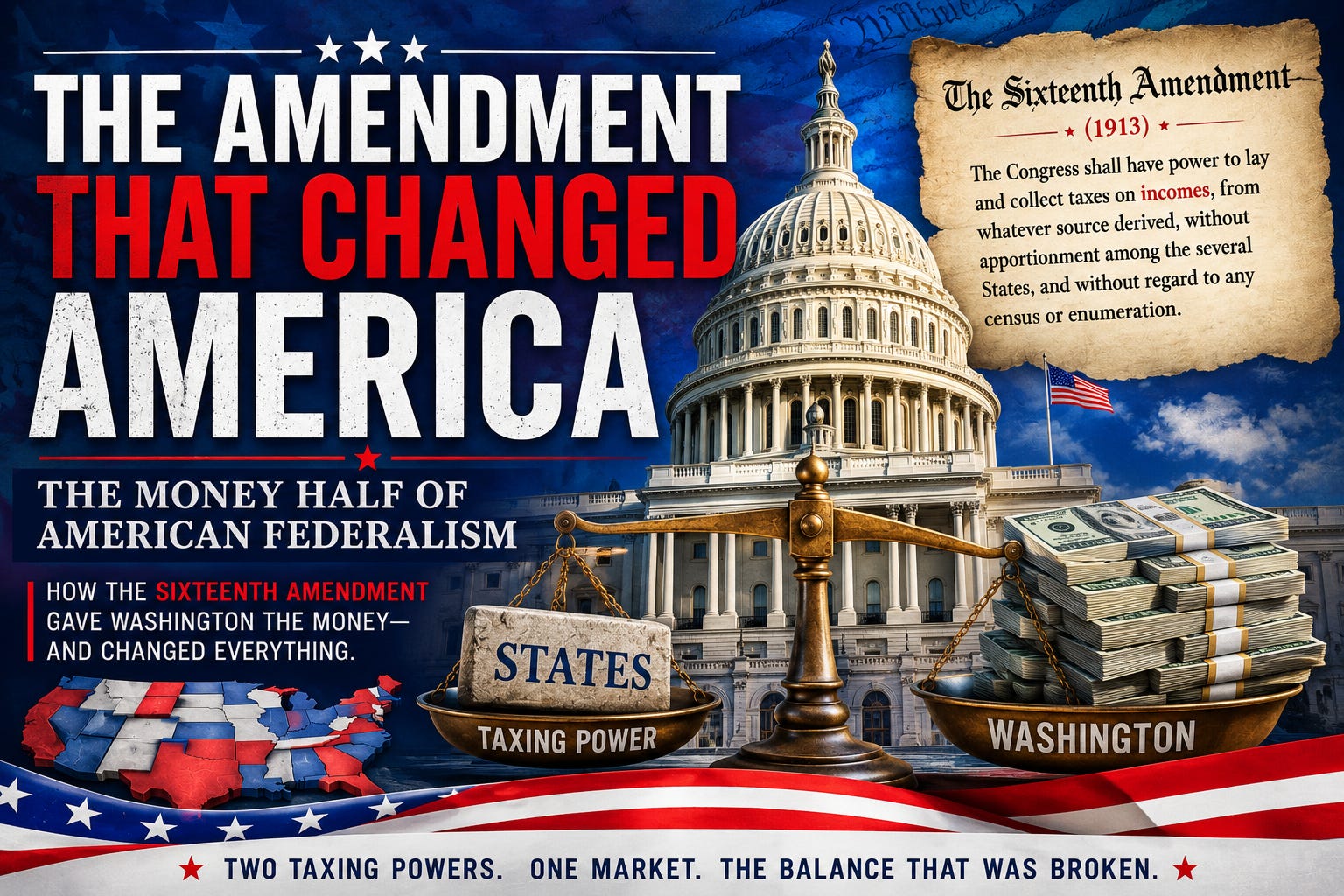
The Amendment That Changed America
How the Sixteenth Amendment Broke the Constitution
Audio Version:
The Story in Brief: The Missing Half of Federalism
A companion essay to this one, published earlier this week, showed how the founders restrained government by dividing power, and how those restraints were dismantled between 1868 and 1913.
This essay expounds on one thread from that: The story of money and taxation.
The founders expected each state to raise its own taxes. They also understood that a state that taxed too aggressively would lose people, businesses, and investment to its neighbors. Competition among the states was not a flaw in the system. It was one of its safeguards.
That principle runs through the American founding. Adam Smith explained it in The Wealth of Nations, published the same year as the Declaration of Independence. Brutus saw where it led and warned what would happen if the federal government ever gained the upper hand. Economists spent the twentieth century proving what Smith had observed and Brutus had predicted.
The Constitution gave both the states and the federal government the power to tax within a single national market where Americans, their businesses, and their capital could move freely. Then came 1913. The Seventeenth Amendment stripped the states of their direct voice in the Senate. The Sixteenth Amendment gave Washington an unlimited claim on Americans’ incomes. The political half of American federalism and the financial half were dismantled in the same year.
This is the story of the money half. It is also the story of one forgotten Anti-Federalist who predicted almost exactly how it would end.
Federalists vs. Anti-Federalists in Plain English
The Federalists wanted a stronger national government. They believed the Articles of Confederation had left Congress too weak to govern effectively.
The Anti-Federalists agreed the Articles had problems but worried about something else: that a stronger federal government, once created, would never stop growing. They argued that Washington would eventually drain power, money, and authority away from the states.
The Constitution was largely the Federalists’ victory. The last two centuries have been, in many ways, a test of the Anti-Federalists’ prediction.
The idea itself was hardly revolutionary in 1776. Adam Smith observed that land cannot move, so governments can tax it almost at will. Money is different. The owner of capital, he wrote, is “properly a citizen of the world, and is not necessarily attached to any particular country.” Tax him too heavily and “he would remove his stock to some other country” where he could conduct his business in peace.
That is the entire principle in two sentences. Governments tax what cannot escape. They bargain with what can.
The founders did not invent that insight. They built a constitutional system that put it to work. Fifty states competing for citizens and businesses would discipline one another in ways no law or politician ever could.
The Citizen of the World
The principle is simple. What limits a tax is not the wording of the law. It is whether the thing being taxed can leave.
Land cannot move. Buildings cannot move. Governments can tax them almost at will.
People can move. Businesses can move. Investment can move even faster. Tax them too heavily, and they begin looking for the exit.
That possibility alone disciplines government. Every business owner understands the principle. Raise prices too much and customers walk across the street. Governments are no different. Raise taxes too much, and taxpayers walk across a state line.
What the Founders Built
The founders built a system that put this principle to work.
First, the states kept their own power to tax. The Constitution gave the new federal government a taxing power, but it did not take that authority away from the states. As Hamilton explained in Federalist No. 32, taxation remained “a concurrent and coequal authority” shared by both governments. The states retained that authority “in the most absolute and unqualified sense.”
Think of it this way. Two tax collectors stood beside the same taxpayer. Both reached into the same wallet. Neither could ignore what the other was doing.
One point is often misunderstood. The founders did not want Washington living on money handed up by the states. They had already tried that under the Articles of Confederation, the nation's first constitution, which took effect in 1781. Congress had no independent power to tax. It passed the hat, and the states decided whether to contribute. Too often they did not. The result was a national government that was chronically broke, unable to pay its debts, and too weak to carry out many of its basic responsibilities. Fixing that failure was one of the principal reasons delegates met in Philadelphia in 1787. They were sent to amend the Articles, but they ended up writing an entirely new Constitution.
The solution was not dependence. It was competition. Each government would raise its own revenue from the same citizens, forcing both to remain accountable to the same taxpayers.
Second, the founders tied Washington’s hands on the most dangerous tax of all. The Constitution required any “direct” tax to be apportioned among the states by population, a rule so cumbersome that a national income or wealth tax was practically impossible. For more than a century, the federal government lived mostly on tariffs and excise taxes on goods such as whiskey.
The one tax that could grow almost without limit, a direct claim on what Americans earned, was deliberately kept out of Washington’s reach. That constitutional ceiling held until 1913.
Finally, the founders made sure Americans could vote with their feet. Citizens and businesses were free to cross state lines, taking their property, investments, and livelihoods with them. A tax you cannot escape disciplines no one. A tax you can escape by moving to the next state disciplines every legislature - each state was in competition with the other states, to keep businesses in their state by maintaining a low tax rate.
Whether the founders fully appreciated the economic consequences is impossible to know. But they built a constitutional system in which governments competed for citizens instead of citizens competing for the favor of government.
Brutus Saw Where It Led
The clearest warning came from the men who lost the fight over the Constitution.
Writing under the name Brutus, most likely New York judge Robert Yates, one Anti-Federalist focused on a danger almost everyone else overlooked: the federal power to tax. Once Washington could tax “in all its parts,” he warned, the states would “find it impossible to raise monies to support their governments.” Deprived of revenue, their powers would eventually be “absorbed in that of the general government.”
His point was simple. Governments without money are governments without power. If Washington collected most of the revenue, the states would eventually become dependent on Washington to survive.
Brutus matters not because he opposed the Constitution. He matters because he described the system exactly as it was built, then predicted how it would fail.
Two governments would reach into the same taxpayer’s wallet. One of them would eventually win.
Hamilton never really disputed the danger. In Federalist No. 31, he openly acknowledged that an unlimited federal taxing power “might, and probably would in time,” strip the states of the resources needed to govern themselves and leave them “entirely at the mercy of the national legislature.”
Hamilton did not dispute the danger. He disputed the outcome. He believed Congress would answer to the same voters as the states, and Americans would remain loyal enough to their state governments that Washington would never push matters that far. It was a political solution rather than a structural one. In effect, he bet that political restraint would succeed where constitutional restraint did not.
Brutus was not convinced. He believed power would follow the money, regardless of anyone's intentions.
Brutus made the opposite bet. Everything after 1913 is simply evidence that Brutus was right. I think that's the line readers should remember.
One hundred and twenty-five years later, history declared a winner (hint: and it wasn’t the people).
The Founders Built It. Economists Explained It.
They gave the states their own taxing power. They created a single national market where Americans, businesses, and investment could move freely. What they did not do was sit down and write a formal theory explaining why that arrangement would restrain government. Later generations would do that for them.
Adam Smith supplied the first piece in 1776. In The Wealth of Nations, he observed that governments can easily tax what cannot move. They have far less power over people, businesses, and capital that can simply leave. He called the owner of capital "a citizen of the world" because money has no permanent home. It flows toward places where it is treated well and away from places where it is punished.
Capital can move. Governments that tax it too aggressively lose it. More than a century later, the economist Friedrich Hayek explained why the principle worked inside a federal system. Where people, businesses, and money are free to move, no state can tax too heavily or regulate too aggressively without paying a price. Its taxpayers simply leave.
Ludwig von Mises carried the idea even further. The freedom to walk away, he argued, is one of the strongest checks on government ever devised. It is difficult to abuse people who always have another place to go.
Then came Murray Rothbard. He tied the economics back to the Constitution. Government, he argued, is a monopoly on force, and taxation is its principal means of exercising that force. Like any monopoly, it expands until something stops it. The strongest restraint is competition. If citizens and their money can leave, government has to behave.
In his history Conceived in Liberty, Rothbard also reached a conclusion that would have pleased Brutus. The Anti-Federalists, he argued, had correctly foreseen the long-term danger of an expanding national government.
The economists who followed simply put equations around the same idea. James Buchanan and Geoffrey Brennan described governments as institutions that naturally seek more revenue unless checked by competition. Charles Tiebout showed how people “vote with their feet,” choosing communities based on taxes and services. Barry Weingast called the arrangement “market-preserving federalism,” a system in which governments compete instead of simply extracting wealth from captive taxpayers.
None of these economists invented the principle. Smith conceived of what was to come. The founders built it. Brutus warned what would happen if it failed. The economists simply explained why the system worked, and why dismantling it changed the balance of power in America.
1913: The Year the Balance Broke
In the end, every government is limited by one thing: how much money it can collect.
For more than a century, Washington lived under two financial restraints. The Constitution made a federal income tax so difficult that it was practically impossible, and tariffs could only be pushed so far before they became politically and economically self-defeating.
Then, in 1913, Congress and the states ratified the Sixteenth Amendment.
The Sixteenth Amendment (1913)
‘The Congress shall have power to lay and collect taxes on incomes, from whatever source derived, without apportionment among the several States, and without regard to any census or enumeration.”
Twenty-seven words fundamentally changed American federalism.
Before 1913, the Constitution required any direct tax to be apportioned among the states according to population. That made a national income tax so cumbersome that it could never become the federal government’s principal source of revenue.
The Sixteenth Amendment swept away that obstacle. Washington could now tax income directly, from whatever source it came. As the economy grew, so did the federal government’s revenue. The amendment did far more than authorize an income tax. It opened the largest and fastest-growing tax base in the country to the federal government and permanently shifted the financial balance between Washington and the states.
The founders had deliberately kept that power out of Washington’s hands. With a single constitutional amendment, that restraint disappeared.
The Sixteenth Amendment is usually taught as a tax story. The Seventeenth Amendment is usually taught as an election story.
They are really the same story.
One gave Washington the money.
The other took the states’ seats away from the table.
One removed the financial restraint on federal power.
The other weakened one of the Constitution’s principal political restraints.
Together, they changed the balance the founders had built.
What followed looked remarkably like Brutus’s prediction.
Federal revenues eventually dwarfed those of the states, and money became the lever by which Washington expanded its authority. It rarely needed to command the states. It simply offered money, attached conditions to it, and waited. States that depended on federal dollars gradually found themselves carrying out federal priorities instead of their own.
Hamilton expected the states and the federal government to compete as equal taxing partners, each collecting its own revenue and neither dependent on the other. By the twentieth century, that relationship had largely been turned on its head. Instead of competing with Washington, the states increasingly administered programs that Washington designed, funded, and often dictated.
Brutus had predicted that two governments drawing from the same taxpayers could not remain equals forever. One would eventually dominate the other.
He was wrong about only one thing.
It did not happen immediately.
It took one hundred and twenty-five years.
Switzerland: The System That Survived
If America wants to see what this system looks like today, it need only look at Switzerland.
The Swiss never abandoned the financial half of federalism. Their cantons still collect most taxes, and they compete openly for residents, businesses, and investment. A canton that taxes too heavily or regulates too aggressively risks watching taxpayers move to the next canton.
Adam Smith would have recognized the system immediately. His “citizen of the world” is alive and well in Switzerland. Competition still disciplines government because governments know taxpayers have real choices. It is the same competitive pressure Hamilton described, the same force Brutus feared Washington would eventually destroy, and the same constitutional balance America began dismantling in 1913.
That does not mean every Swiss canton is left to fend for itself. Wealthier cantons, together with the federal government, help support poorer ones through a system of fiscal equalization. But the goal is not to make every canton financially dependent on Bern. It is to ensure that every canton can remain self-governing while preserving competition among them.
That is the crucial difference.
Switzerland uses cooperation to preserve federalism. America increasingly used federal money to weaken it.
The founders wanted states that could stand on their own feet, compete for citizens and businesses, and answer primarily to their own taxpayers. Switzerland largely kept that model. America gradually replaced it with one in which states became increasingly dependent on programs designed, funded, and often directed from Washington.
Brutus Was Right
The companion essay ended with politics. America steadily removed the institutions that could check Washington, while Switzerland added more and locked them into place. This essay tells the same story through money.
The founders created two sovereign taxing authorities operating within a single national market. Citizens, businesses, and capital were free to move, forcing both state and federal governments to compete for the same taxpayers. Adam Smith explained why that competition would restrain government. Brutus warned that if Washington ever gained the financial upper hand, the states would slowly lose both their revenue and their independence. Hamilton believed political restraint and Americans’ loyalty to their states would prevent it.
In 1913, the Sixteenth Amendment removed the founders’ financial restraint on federal power. In the same year, the Seventeenth Amendment weakened one of the principal political restraints. Together, they altered the balance that the founders had carefully constructed. Washington gained both the money and, over time, the leverage that money inevitably brings.
What followed was not inevitable because it was planned. It was inevitable because incentives changed. Money flowed to Washington. Power followed the money.
That does not mean the story is over. The states still possess broad taxing authority. They can still compete for citizens, businesses, and investment. They can still resist becoming mere administrators of federal programs. Federalism is not dead. It has been weakened, and what has been weakened can be strengthened.
The first step is simply to recognize what was lost.
In 1787, a New York judge named Robert Yates, who wrote under the alias “Brutus,” saw it coming. His prediction took 125 years to come true.
It arrived, fittingly enough, as a constitutional amendment.
End.
RWM / JGM
MALONE.NEWS
A Supporting Bibliography
Founding-era sources
Smith, Adam. An Inquiry into the Nature and Causes of the Wealth of Nations. 1776. Book V, Chapter II. The owner of capital as a “citizen of the world” who moves his money away from a heavy tax. The idea at the center of this essay, stated the year of the Declaration.
Hamilton, Alexander. The Federalist, Numbers 31 and 32. 1788. The founders’ own account of the taxing power the states kept, and Hamilton’s admission that an unlimited federal tax might in time leave the states unable to fund themselves.
Brutus [Robert Yates, attributed]. Essays I and VI. 1787. The Anti-Federalist warning that the federal taxing power would leave the states broke and absorb them into the national government. The prediction at the center of this essay.
United States Constitution. Article I, on the shared taxing power and the rule for direct taxes, and Article IV, on the right of citizens to move freely among the states. The structure the founders built: two taxing powers, a deliberately hobbled federal income tax, and a mobile people.
Theory and history
Hayek, F. A. “The Economic Conditions of Interstate Federalism.” 1939. Free movement of goods, money, and people within a country sharply limits how heavily any one government can tax. The modern version of Smith’s point.
Mises, Ludwig von. Liberalism. 1927. The freedom to leave, down to the smallest community, as one of the deepest checks on government.
Rothbard, Murray N. Power and Market: Government and the Economy. 1970. Government as a monopoly on force whose main business is taxation, held in check only by competition and by people’s freedom to leave.
Rothbard, Murray N. Conceived in Liberty. Arlington House, 1975. Treats the Anti-Federalists as the ones who got it right, and Brutus as the most accurate forecaster in the whole debate.
Brennan, Geoffrey, and James M. Buchanan. The Power to Tax: Analytical Foundations of a Fiscal Constitution. Cambridge University Press, 1980. Government pictured as a revenue-grabbing machine, held back mainly by competition among jurisdictions.
Tiebout, Charles M. “A Pure Theory of Local Expenditures.” Journal of Political Economy, 1956. People sorting themselves among places by the mix of taxes and services each offers. Voting with your feet, written as math.
Weingast, Barry R. “The Economic Role of Political Institutions: Market-Preserving Federalism and Economic Development.” Journal of Law, Economics, and Organization, 1995. Federalism as a competitive order that keeps a government from preying on its own economy.
Somin, Ilya. Free to Move: Foot Voting, Migration, and Political Freedom. Oxford University Press, 2020. The present-day case for the freedom to move as a check on government, and the direct heir of Smith’s citizen of the world.
The federalist papers should be required reading for every kid in school. The worst decision our enlightened educators ever made was getting rid of civics in schools. If you ask just about anyone under the age of 35 they have no idea about our govt. How it works or even the branches of it. It is a joke that isn’t funny. Great piece Doc.
In my view, when Congress voted to view corporations as citizens and gave them the same rights as an individual the damage was complete! Corporations should be subservient to the citizens of the US. The great harm that has been done and is being done and will accelerate needs to be stopped. The future of this republic should be guided by the needs of the citizens and not the corporations goals which are detrimental to that end. The scales are unbalanced in the halls of justice.