

A note before the reckoning
I have been asked many times what to read to understand how American biomedical science was captured. People expect me to recommend a virology textbook, or perhaps a regulatory primer. I do not. I tell them to read Murray Rothbard.
Rothbard, the late Austrian-school economist and libertarian theorist, never wrote about Anthony Fauci. He died in 1995, when Dr. Fauci had been director of the National Institute of Allergy and Infectious Diseases for only eleven years and was still mostly known to those of us inside the AIDS-research community. But Rothbard had spent his career describing, with unusual analytical clarity, the precise machinery that would, over the following three decades, produce the figure of Fauci, and the catastrophe of 2020. He gave us the diagnostic vocabulary before we knew we needed it.
I write this essay as a participant-observer. I was there at the Salk Institute in the late 1980s. I conceived of the underlying mRNA platform technology that was eventually deployed, against my warnings, in the Operation Warp Speed countermeasures. I sat in NIH working groups during the early COVID response. I watched colleagues I had known for decades reinvent themselves as compliance officers for a narrative. And I watched, as Robert F. Kennedy Jr. has documented exhaustively in The Real Anthony Fauci and The Wuhan Cover-Up, the deliberate construction of a pharmaceutical-biosecurity apparatus that has now metastasized through every organ of the federal research enterprise.
Rothbard would not have been surprised. He would have been grim, but not surprised. What follows is my attempt to read these two manuscripts (the public record they assemble, and the half-century of institutional decay they describe) through the lens he handed us.
I. Scientism is not science
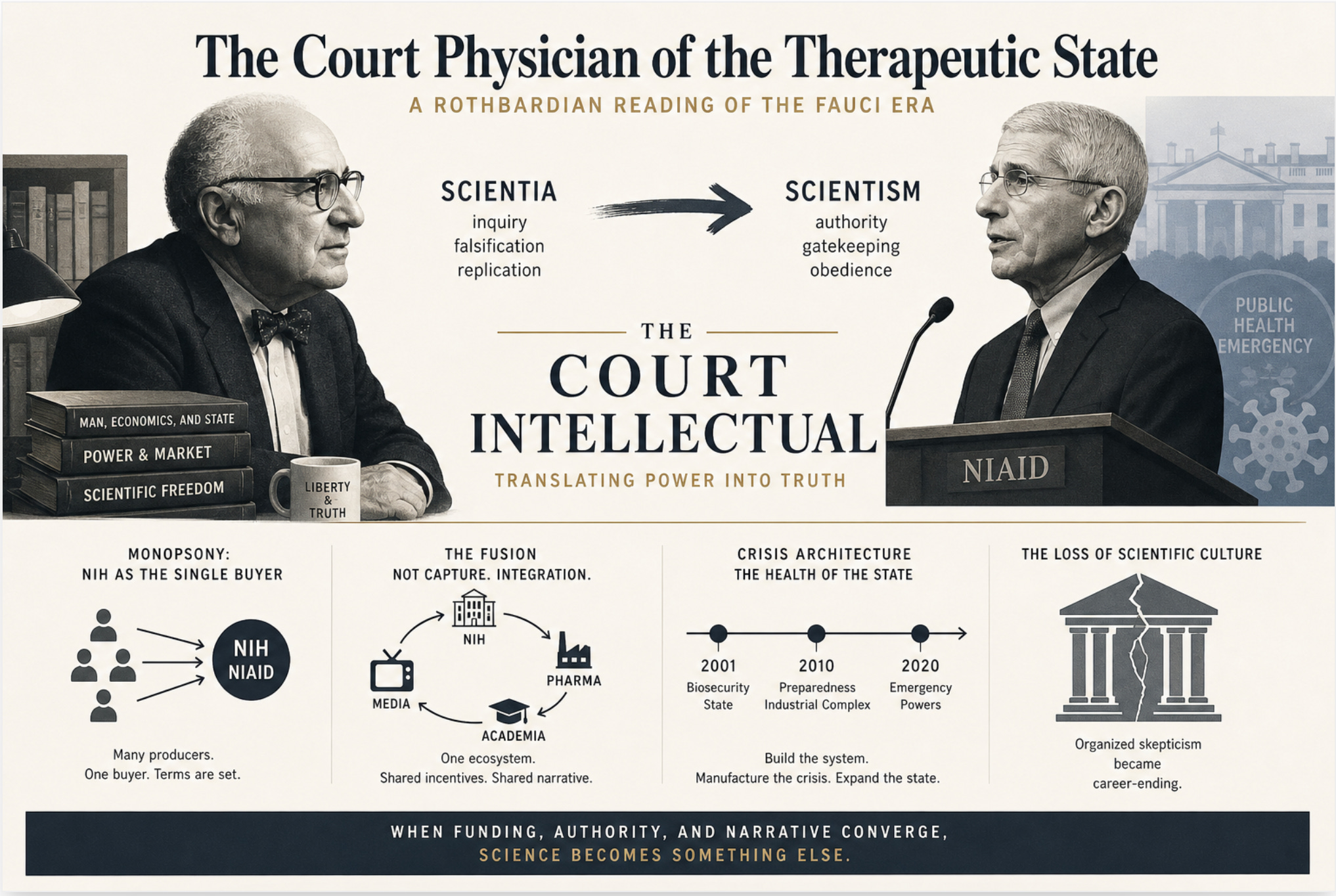
Rothbard drew a distinction that almost no one in our public conversation can hold in their head for more than a sentence at a time. Science, in the older sense of scientia, correct knowledge, is the human activity of inquiring honestly into the structure of reality. Scientism is the use of the prestige of science to compel obedience. The first is a method. The second is a posture. The first proceeds by conjecture, falsification, and replication. The second proceeds by accreditation, gatekeeping, and excommunication.
For most of his career, Dr. Fauci was the most powerful working practitioner of scientism in the world. I want to be precise about this charge. I am not saying he was uneducated, or that he never did legitimate science as a young clinician. I am saying that the role he occupied for thirty-eight years at NIAID, and the manner in which he occupied it, was structurally incompatible with science as a free inquiry. The role was a priestly one. The famous formulation, “attacks on me are really attacks on science,” was not a slip of the tongue. It was a precise statement of his self-understanding, and an unintentionally perfect illustration of Rothbard’s distinction. A scientist welcomes attacks; that is what a scientist is. Only a priest of scientism can find a personal critique to be a sacrilege.
The Kennedy manuscripts document this priestly posture in extraordinary granularity: the suppression of repurposed therapeutics during the COVID period; the campaign against any clinician (Kory, McCullough, Risch, Bhattacharya, Kulldorff, and yes, myself among many others) who proposed alternative hypotheses; the orchestration of the Lancet and Nature Medicine statements on the origins of SARS-CoV-2 to short-circuit a debate that had not yet happened. This is not how science behaves. This is how a magisterium behaves.
Rothbard’s contribution was to insist that scientism is the natural product of a particular institutional arrangement. Wherever you place a single bureaucracy in charge of allocating research funding for an entire scientific field, you will, eventually, get scientism. You will not get it because the bureaucrat is wicked. You will get it because the incentive gradients of the position itself reward conformity, public-relations management, and the suppression of paradigm-threatening lines of inquiry. The institution selects for the disposition. Fauci is what the chair he sat in produces.
II. The political economy of NIAID
Here is the part of Rothbard that mainstream commentators have never been able to absorb, and that Kennedy’s books finally make legible to a broader public: the National Institutes of Health is not a neutral funder of the scientific community. It is a monopsony. It is the dominant (in many subfields, the only) buyer of biomedical research labor in the United States. And like all monopsonies, it sets the terms.
A word on the term, because it is unfamiliar to most readers and indispensable to what follows. Monopoly is the condition in which a single seller controls a market and can therefore set the price at which goods are sold. Monopsony is its mirror image: a single buyer controls the market and can therefore set the price at which goods, services, or labor are purchased. The word comes from the Greek monos (single) and opsōnia (purchasing of provisions). The classical examples are a coal-mining town with one mining company that hires every available miner, or a defense ministry that is the only legal buyer of fighter jets. In each case the buyer is not constrained by competition, because there is no competition; the seller, whether a worker or a manufacturer, must accept the buyer’s terms or exit the field entirely. NIH, and within NIH the NIAID Fauci built, occupies precisely this structural position with respect to American biomedical researchers. There is, for most subfields and most career stages, no realistic alternative funder. A young virologist who wishes to do virology in the United States either receives an NIH grant or finds another line of work. The buyer dictates not only price but the substantive direction of inquiry: what may be studied, what may be published, and what conclusions may be safely reached.
Rothbard’s analysis of state R&D was elementary: when the price system is replaced by political allocation, you do not get a better outcome than the market would have produced. You get a different outcome: one that reflects the preferences of the political allocator rather than the preferences of the patients, clinicians, and curious investigators who would have constituted the market. State science does not fail because bureaucrats are stupid. It fails because their feedback signal is wrong. They are graded by Congress, by the press, by the pharmaceutical lobby, and by their own professional networks. They are not graded by whether the research they fund actually heals anyone.
Run this analysis through the Fauci-era NIAID and the picture is devastating. Kennedy documents (and the inventories of NIH grants confirm) that under Fauci’s tenure the agency’s portfolio shifted decisively toward two priorities: vaccines (especially novel-platform vaccines with patent protections) and “biodefense” (especially gain-of-function work on potential pandemic pathogens). It shifted away from chronic-disease etiology, toxicology, environmental medicine, nutrition, and the hard work of asking why the post-1986 American child is so much sicker than the pre-1986 American child. Kennedy’s marshalling of the data on this point is unanswerable: the explosion of allergic, autoimmune, neurodevelopmental, and metabolic disease in the cohort that grew up under Fauci’s NIAID is a public-health catastrophe whose causes the responsible agency has shown no interest in investigating. Rothbard would have predicted this exactly. The chronic-disease question has no patentable answer; therefore the institution has no incentive to ask it.
The shift toward biodefense is the more sinister half of the story, and Kennedy’s Wuhan Cover-Up is the indispensable text. After the 2001 anthrax letters (a domestic event whose attribution remains contested, and whose immediate political effect was to install the biosecurity faction at the commanding heights of public-health policy) Project BioShield (2004) and the subsequent Biodefense and Pandemic Vaccine and Drug Development Act (2006) re-routed roughly a third of NIAID’s annual budget into work that was, for all functional purposes, a continuation of the offensive bioweapons program that Richard Nixon had ordered shuttered in 1969. The fig leaf was that this work was now “defensive”: that one builds enhanced pandemic pathogens in order to study how to defeat them. Rothbard would have laughed bitterly at this. He understood, as anyone who has studied the history of arms races understands, that there is no operational distinction between an offensive and a defensive bioweapons program. The molecular biology is identical. The distinction lives entirely in the press release.
What we got, in exchange for the abandonment of the chronic-disease research mission, was the construction of a sprawling network of BSL-3 and BSL-4 facilities; a research pipeline that (as the Kennedy manuscript shows in painful detail) funneled American taxpayer money through EcoHealth Alliance to coronavirus gain-of-function work at the Wuhan Institute of Virology; and a single man, sitting at the top of a chain of command no one had ever explicitly authorized, with personal decision-making authority over the trajectory of a globally consequential research program.
This is what Rothbard meant by the partnership of state and corporate power. Not a conspiracy, not a smoke-filled room, but the slow accretion of overlapping interests until the regulator and the regulated and the funder and the contractor and the journal editor and the press officer have become, functionally, a single organism with a single appetite.
III. Agency capture, inverted
Rothbard’s most-cited contribution to the political economy of regulation is the observation that regulatory agencies, over time, almost always come to serve the industries they were created to constrain. The classic case is the Interstate Commerce Commission, captured by the railroads it was built to regulate. The mechanism is straightforward: the regulated industry has concentrated, intense, persistent interest in the agency’s decisions; the public has diffuse, episodic, weak interest. The industry hires the staff, supplies the expertise, funds the conferences, and offers the post-government employment. Capture is not a moral failure. It is a thermodynamic inevitability of the institutional design.
What Kennedy documents (and what I can confirm from the inside of the system) is that NIAID under Fauci represented a particularly advanced form of capture. The agency captured the industry as much as the industry captured the agency. The traffic of personnel, intellectual property, and money among NIH, the major pharmaceutical houses, the Gates philanthropies, the academic medical centers, and the rotating Defense-Department-adjacent biosecurity consultancies was so dense and so reciprocal that the language of “capture” almost understates the case. There was no longer an agency and an industry; there was a single ecosystem with multiple feeding stations.
The royalty arrangements alone would have ended Rothbard’s patience with the entire arrangement. The 1980 Bayh-Dole Act, and the subsequent Federal Technology Transfer Act of 1986, created the legal infrastructure by which federal scientists, including those at NIH, could collect royalty payments on patents derived from research conducted on the public dime. By the COVID era, dozens of NIH scientists were named on patents associated with vaccine technologies their own agency was simultaneously evaluating and promoting. Fauci himself, according to the documentation Kennedy assembles, was a co-inventor on multiple HIV-related patents and stood as the most highly compensated employee of the entire United States federal government: better paid than the President, the Chief Justice, and any general officer of the armed forces. None of this is hidden. None of it is illegal. All of it is exactly what Rothbard described: the formal apparatus of the state being repurposed, lawfully and transparently, into a private rent-extraction mechanism for a credentialed elite.
IV. The court intellectual
Rothbard inherited from Bertrand de Jouvenel and Albert Jay Nock a piece of vocabulary that is indispensable for understanding the Fauci phenomenon: the court intellectual. Every regime, throughout history, requires a class of credentialed apologists whose social function is to translate the regime’s interests into the language of disinterested truth. In feudal Europe these were the scholastics; under absolutism they were the royal historians; under Soviet Marxism they were Lysenko and his peers; in the contemporary American imperium they are, predominantly, certain figures within the public-health bureaucracy, the major-university health-policy faculties, and the prestige science press.
Anthony Fauci is the apex specimen of this archetype. He was not, let us be honest, a serious bench scientist for most of the period of his greatest cultural authority. His function was to incarnate the prestige of science in service of the state’s preferred narrative, and to deploy that prestige against any dissenter who threatened to disrupt the narrative. Consider the fifty-eight honorary degrees, the named buildings, the Saturday Night Live impersonations, the bobblehead dolls. None of these are the trappings of a research scientist. They are the regalia of a court intellectual. Even his post-government appointment to a distinguished professorship at Georgetown, with a joint posting in a school of public policy, makes the role transparent: he is being installed where court intellectuals are properly housed, in an institution that produces the next generation of regime explainers.
This matters because court intellectuals are not, in the relevant sense, replaceable. Once installed, they become load-bearing. Their displacement requires more than the election of a new administration; it requires what Thomas Kuhn called a paradigm shift, and what Rothbard, drawing on his own historical study, called a de-legitimation. Whether one is underway right now (in the small but growing number of state attorneys general willing to sue, the federal indictments of former Fauci advisers for concealment of communications, the rescission of his personal security detail, the slow erosion of public trust in the institutions he came to symbolize) is for the historians to judge in twenty years. I am not optimistic. The court intellectual class is deep and self-reproducing. Replacing one Fauci produces another.
V. Crisis is the health of the state
Randolph Bourne’s line (“war is the health of the state”) was absorbed by Rothbard and updated for the modern security era. Rothbard understood that the state’s natural condition is to seek out, and where necessary manufacture, crises that justify emergency expansions of its authority. The Cold War filled this role for half a century. The War on Terror filled it from 2001 to roughly 2015. The biosecurity paradigm, formalized at the international level by the Obama administration and the WHO in 2009-2010 and retrospectively ratified by the COVID emergency, is the third great post-war crisis architecture.
Kennedy’s Wuhan Cover-Up is most clarifying when it is read as the chronicle of how the biosecurity faction, beginning with the post-anthrax-letters environment of 2001-2002, built, over twenty years, a system of legal pre-authorizations (the Emergency Use Authorization, the PREP Act liability shields, the centralized declaration of “public health emergencies”) that allowed almost every constitutional and pharmaceutical-safety norm to be suspended on the say-so of a small number of officials, the most powerful of whom was Anthony Fauci.
I want to be careful to distinguish two claims here. The first claim, which I do not make, is that the COVID pandemic was itself deliberately engineered as a pretext for an authoritarian power grab. The evidence I have seen is consistent with a research accident at the Wuhan Institute of Virology, of a kind whose probability was raised (perhaps to near-certainty) by the funding and structure of the gain-of-function research program that Fauci and Peter Daszak collaboratively built. That is a serious enough indictment without inflating it.
The second claim, which I do make, and which Rothbard’s framework makes available to us: once the crisis arrived (by accident or design) the system that had been pre-built to exploit it executed exactly as designed. The countermeasures were ready before the pathogen. The communications strategy was ready before the science. The censorship infrastructure, jointly operated by federal agencies and the major social-media platforms, was ready before the dissent. The mass vaccination campaign was ready before the safety data. None of this had to be conspired by anybody in 2020. It had been conspired, in the proper Rothbardian sense, over the preceding two decades, by the slow co-evolution of every institution involved.
This is what makes the Fauci role so consequential and so generalizable. He was not the architect of the crisis; he was the most visible administrator of a crisis-management apparatus that had been waiting, fully provisioned, for a sufficient occasion. When such a system exists, an occasion will eventually arise. That is the Rothbardian point.
VI. What was destroyed
I want to close on the cost, because this is the part where my participation in events compels me to write rather than analyze.
The American scientific enterprise, as I encountered it in the 1980s, when I was working at Salk, and in the early 1990s, when I held my first faculty positions, was an imperfect but serious thing. Its failure modes were known and discussed. Peer review was clubby and conservative. Funding favored the well-connected. Fashions in research methodology came and went with cycles of grant-program priorities. None of this was admirable, but it was tolerable, because the underlying culture still held: a culture in which a young investigator could, in principle, falsify a senior figure’s hypothesis, publish the result, and be respected for it. The orthodox term for this culture was organized skepticism, and it was the only thing standing between the scientific community and its conversion into a clerisy.
What Fauci did, which the institutional pressures of his role forced him to do, and which his particular temperament made him exceptionally effective at doing, was to dismantle organized skepticism within the biomedical sciences. The dismantling proceeded by means that Rothbard would have recognized perfectly: control of grant money, control of publication venues, informal coordination with credentialing bodies, deployment of the press, mobilization of social-media platforms in the COVID period, and, most importantly, the creation of a culture in which young investigators learned, very early, that certain questions were career-ending and certain answers were career-protecting.
We will be a generation rebuilding what was destroyed. The next mRNA controversy, the next gain-of-function debate, the next pandemic-response decision will be made by clinicians and researchers who came of age under the Fauci regime, who absorbed its norms, and who learned from its enforcers what happens to those who dissent. The damage is in the bones of the profession.
Rothbard, writing in the 1960s about an analogous capture of the social sciences, observed that the way out is neither reform nor reorganization but the slow, patient cultivation of independent institutions outside the captured apparatus. I believe he was correct. I believe the only way back to genuine biomedical science is through independent journals, independent funding, independent clinical-research networks, and independent training programs for the next generation. None of this is romantic. All of it is necessary.
The Fauci era ended, as a matter of personnel, in December 2022. The Fauci system did not end then and has not ended now. It is still funded. It is still credentialed. It is still in the chairs. The most useful thing one can do for a person who wants to understand why this is so is hand them Murray Rothbard and Robert F. Kennedy Jr. and ask them to read the two together.
They illuminate each other. They illuminate, between them, what happened to us.
Bibliography
A note on this bibliography. The essay is structured around two bodies of source material: (1) the two Kennedy manuscripts that supply most of its empirical claims, and (2) the Rothbardian intellectual tradition that supplies its analytical framework. The bibliography is organized accordingly. A third section lists primary documents and contemporary news coverage relevant to specific claims; a fourth lists representative counter-sources.
I. The Kennedy manuscripts (primary source material for the essay)
Kennedy, Robert F., Jr. The Real Anthony Fauci: Bill Gates, Big Pharma, and the Global War on Democracy and Public Health. New York: Skyhorse Publishing, 2021. ISBN 978-1-5107-6680-8.
Kennedy, Robert F., Jr. The Wuhan Cover-Up: And the Terrifying Bioweapons Arms Race. New York: Skyhorse Publishing, 2023. ISBN 978-1-5107-7398-1.
II. The Rothbardian framework
Rothbard, Murray N. “The Mantle of Science.” In Scientism and Values, edited by Helmut Schoeck and James W. Wiggins, 159–180. Princeton, N.J.: D. Van Nostrand, 1960. The locus classicus of the Rothbardian distinction between science and scientism. Cited in Section I of the essay.
Rothbard, Murray N. Science, Technology, and Government. Auburn, Ala.: Mises Institute, 2015 (manuscript composed circa 1959, published posthumously). Rothbard’s sustained critique of state R&D allocation. Cited in Sections II and VI.
Rothbard, Murray N. Anatomy of the State. Auburn, Ala.: Ludwig von Mises Institute, 2009 (essay first published 1965). Source for Rothbard’s adaptation of the Bourne thesis on crisis and state power. Cited in Section V.
Rothbard, Murray N. For a New Liberty: The Libertarian Manifesto. New York: Macmillan, 1973; revised edition, Auburn, Ala.: Mises Institute, 2006. Contains Rothbard’s general theory of regulatory capture.
Bourne, Randolph S. “The State.” Unfinished essay, 1918. Reprinted in War and the Intellectuals: Collected Essays, 1915–1919, edited by Carl Resek. New York: Harper Torchbooks, 1964. Source of the “war is the health of the state” formulation. Cited in Section V.
Nock, Albert Jay. Our Enemy, the State. New York: William Morrow, 1935. The intermediate source through which Rothbard inherited the court-intellectual concept. Cited in Section IV.
de Jouvenel, Bertrand. On Power: The Natural History of Its Growth. Translated by J. F. Huntington. New York: Viking, 1949 (French original 1945). The deepest historical treatment of the court-intellectual function in Western political thought.
Hayek, F. A. The Counter-Revolution of Science: Studies on the Abuse of Reason. Glencoe, Ill.: The Free Press, 1952. The complementary Austrian-school analysis of scientism that Rothbard drew on directly.
Kuhn, Thomas S. The Structure of Scientific Revolutions. Chicago: University of Chicago Press, 1962. Source for the paradigm-shift concept invoked in Section IV.
Merton, Robert K. “The Normative Structure of Science.” In The Sociology of Science: Theoretical and Empirical Investigations, edited by Norman W. Storer, 267–278. Chicago: University of Chicago Press, 1973 (essay first published 1942). The classical statement of the “organized skepticism” norm invoked in Section VI.
Stigler, George J. “The Theory of Economic Regulation.” Bell Journal of Economics and Management Science 2, no. 1 (1971): 3–21. The Chicago-school formalization of regulatory capture, parallel to Rothbard’s. Cited in Section III.
III. Primary documents, statutes, and contemporary reporting
Statutes and federal directives
Bayh-Dole Act, Pub. L. No. 96-517, 94 Stat. 3015 (1980), codified at 35 U.S.C. §§ 200–212. Established the framework permitting federal grantees to retain title to inventions developed with federal funds. Cited in Section III.
Federal Technology Transfer Act of 1986, Pub. L. No. 99-502, 100 Stat. 1785, codified at 15 U.S.C. § 3710. Authorized royalty payments to federal scientist-inventors. Cited in Section III.
Project BioShield Act of 2004, Pub. L. No. 108-276, 118 Stat. 835. Created the Emergency Use Authorization framework and authorized $5 billion over ten years for stockpiled medical countermeasures. Cited in Section II.
Pandemic and All-Hazards Preparedness Act, Pub. L. No. 109-417, 120 Stat. 2831 (2006). Successor legislation that further consolidated federal pandemic-response authorities.
Public Readiness and Emergency Preparedness (PREP) Act, Pub. L. No. 109-148, div. C, 119 Stat. 2818 (2005), codified at 42 U.S.C. § 247d-6d. Source of the liability-shield mechanism invoked in Section V.
Homeland Security Presidential Directive 10 / National Security Presidential Directive 33: Biodefense for the 21st Century. The White House, April 28, 2004. Available via the George W. Bush Presidential Library archive. Cited in Section II.
Origin-of-COVID statements referenced in Section I
Calisher, Charles, Dennis Carroll, Rita Colwell, et al. “Statement in Support of the Scientists, Public Health Professionals, and Medical Professionals of China Combatting COVID-19.” The Lancet 395, no. 10226 (March 7, 2020): e42–e43. doi:10.1016/S0140-6736(20)30418-9. The 27-signatory letter, organized by Peter Daszak, that characterized lab-leak hypotheses as “conspiracy theories.”
Andersen, Kristian G., Andrew Rambaut, W. Ian Lipkin, Edward C. Holmes, and Robert F. Garry. “The Proximal Origin of SARS-CoV-2.” Nature Medicine 26 (March 17, 2020): 450–452. doi:10.1038/s41591-020-0820-9.
“Addendum: Competing Interests and the Origins of SARS-CoV-2.” The Lancet 397, no. 10293 (June 21, 2021): 2449–2450. The journal’s subsequent disclosure of Daszak’s undisclosed EcoHealth/Wuhan Institute of Virology relationships.
Bloom, Jesse D., Yujia A. Chan, Ralph S. Baric, et al. “Investigate the Origins of COVID-19.” Science 372, no. 6543 (May 14, 2021): 694. doi:10.1126/science.abj0016. The 18-signatory letter that called for re-opening the origins inquiry.
Gain-of-function debate
Fauci, Anthony S. “Research on Highly Pathogenic H5N1 Influenza Virus: The Way Forward.” mBio 3, no. 5 (2012): e00359-12. doi:10.1128/mBio.00359-12. Fauci’s defense of gain-of-function research, including the “hypothetical scenario” passage cited in Kennedy, Wuhan Cover-Up, ch. 17.
Inglesby, Thomas V. Statement before the National Science Advisory Board for Biosecurity (NSABB), Bethesda, Md., January 7–8, 2016. Available via the NIH Office of Science Policy archive.
Lipsitch, Marc, and Alison P. Galvani. “Ethical Alternatives to Experiments with Novel Potential Pandemic Pathogens.” PLOS Medicine 11, no. 5 (2014): e1001646. The leading peer-reviewed challenge to the GOF research agenda.
Investigations and indictments cited in Section IV
United States Department of Justice. “Former Senior NIAID Official Indicted for Concealing Federal Records During COVID-19 Pandemic.” Office of Public Affairs press release, April 28, 2026. Indictment of Dr. David M. Morens. Cited in Section IV.
U.S. House of Representatives, Select Subcommittee on the Coronavirus Pandemic. After Action Review of the COVID-19 Pandemic: The Lessons Learned and a Path Forward. Final report. Washington, D.C., December 2024. Source for the Morens email correspondence and the EcoHealth/NIAID grant trail.
Compensation, patents, and post-government appointments
Andrzejewski, Adam. “Dr. Anthony Fauci: The Highest Paid Employee in the Entire U.S. Federal Government.” Forbes, January 25, 2021. Source for the salary claim in Section III.
Georgetown University. “Dr. Anthony Fauci to Join Georgetown Faculty as Distinguished University Professor.” Press release, June 2023. Source for the post-government appointment cited in Section IV.
IV. Counter-sources and contrary perspectives
Fauci, Anthony S. On Call: A Doctor’s Journey in Public Service. New York: Viking, 2024. Fauci’s own memoir; the most comprehensive first-person rejoinder to the Kennedy / Malone account.
Specter, Michael. “How Anthony Fauci Became America’s Doctor.” The New Yorker, April 10, 2020. The most-cited mainstream profile, sympathetic to Fauci.
Hotez, Peter J. “Mounting Antiscience Aggression in the United States.” PLOS Biology 19, no. 7 (2021): e3001369. A systematic argument that critics in the Kennedy / Malone tradition are a public-health threat. Direct opposition to the essay’s thesis.
Goodman, Jack, and Flora Carmichael. “Coronavirus: The Misleading Claims about Anthony Fauci.” BBC Reality Check, December 2021. Representative of the mainstream fact-checking response to the Kennedy book.
Office of the Director of National Intelligence. Updated Assessment on COVID-19 Origins. Washington, D.C., October 2021; updated June 2023. The Intelligence Community’s formal position: insufficient evidence to confirm either zoonotic or laboratory origin. The single most important counter-data point for any strong claim about the Wuhan Institute’s role.
Carpenter, Daniel, and David A. Moss, eds. Preventing Regulatory Capture: Special Interest Influence and How to Limit It. New York: Cambridge University Press, 2014. The leading recent academic volume on regulatory capture; argues against the strong Rothbard/Stigler thesis on empirical grounds.
I continually learn new, unexpected things about you, Dr. Malone! I never thought I'd see Murray Rothbard and the Austrian School of Economics mentioned in your Substack. I stand (happily) corrected.
I often listen to Bret Weinstein and Heather Heying (Darkhorse podcast) and they have been extremely vocal about what science is and is not, and how the scientific method has been all but overthrown For this, of course, they are attacked and vilified. No matter, they're all about truth and especially truth in science.
I have long believed that the government does not belong in the funding business, not for science, not for the arts. We've seen how it turns out: government picks winners and losers, often to the detriment of the public. I've heard arguments that it's better than funding by the private sector (the history is rich in the Florentine era) because being "public money", it's actually funded by the public (taxpayers). It is not. It is funded by the bureaucrats who wield the money, and as pointed out, it's doomed to corruption.
"Rothbard understood that the state’s natural condition is to seek out, and where necessary manufacture, crises that justify emergency expansions of its authority." Oh, how well we've seen this over the past many decades! And we're seeing it again in Iran. What is the next crisis? And what is it being manufactured to hide? Central banks were formed to serve the state's wars, and they've done a smashing job of that, selling arms to both sides, selling each state into poverty, taking the citizenry with them.
There's a reason--many reasons--that our founders wanted a limited federal government. Unfortunately, we've ignored them, both the founders and the reasons, and ended up where they told us we should not go.
Dr. Malone
An anecdote if I may.
When COVID hit in early 2020, I was seeing an elderly hospice patient in her son's home. He advised me, with a severe countenance, that what was happening was related to the "deep state". I didn't even know what that was, and as you can imagine, I looked at him like he was a bit crazy. He told me that in his past life, he had been an event planner who had sometimes organized meetings for them throughout the world (often on remote islands) for planning sessions related to the things like we were then experiencing. At the time I took what he said with a grain of salt (whatever that means), but within a year or two, with what I learned from listening to you, Dr. Peter McCullough, RFK Jr, and many others, I slowly came to realize that he really knew what he was talking about. I have to admit that if the underlying secular humanistic "ethics" I imbibed from my training, the one that currently pervades medicine and our culture (that often justifies the killing of the innocent through abortion and euthanasia), does not return to the natural law contained within an authentic Christian ethics, the one that was proclaimed in the Declaration of Independence, "that all men are created equal, that they are endowed by their Creator with certain rights..." (see a recent book by John G. West, called The Bible, Science, and the Battle for America's Soul) then I am very pessimistic about what can be done to truly remedy the situation, but applaud your efforts. Being a hospice physician, who's had to review the situation of patients and advise them on their prognosis and viable options, the only way forward that I can see is that we need a sincere revival in Christ!