

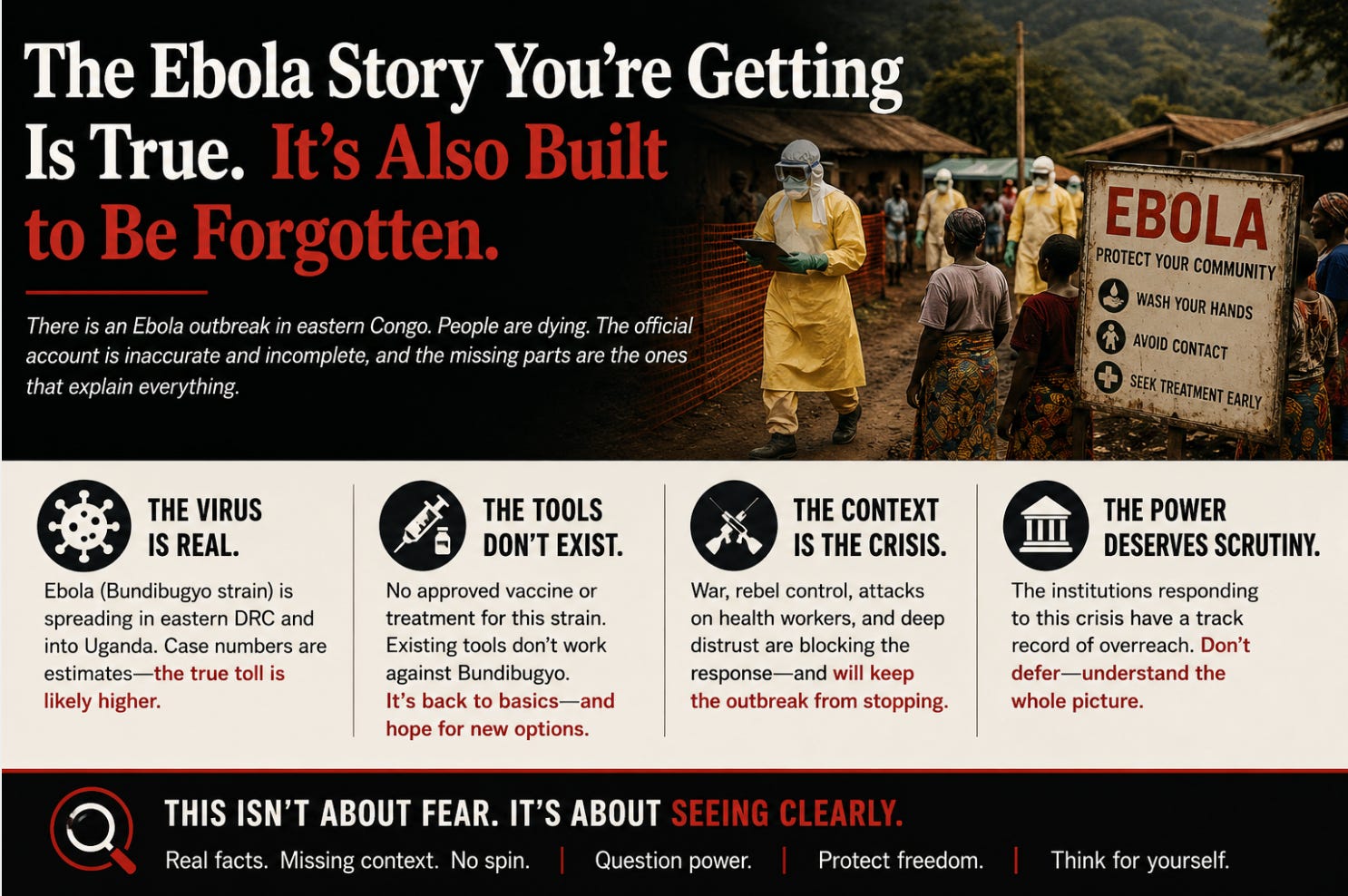
The version in circulation goes like this. There is an outbreak of Ebola in central Africa. Case numbers are climbing. The World Health Organization has declared an emergency. The risk to Western readers is low.
Each of those statements is accurate. Assembled, they form a story shaped to be skimmed and set down. The reporting that fills it in is harder to set down, and it is available to anyone who looks past the wire summary.
The numbers are estimates, and the people producing them say so
A strain of Ebola called Bundibugyo is spreading through eastern Democratic Republic of Congo and has crossed into Uganda. As of late May the combined count runs past a thousand suspected and confirmed cases and more than 230 deaths.
Those figures are estimates, and the institutions issuing them describe them as such. The WHO’s director-general says responders are “playing catch-up” because the outbreak ran undetected for weeks before it was declared. In DRC there are roughly 900 suspected cases against about 105 confirmed. Health workers put the true total higher than either.
The direction of the error matters. This is not authorities inflating a threat. The official count almost certainly runs low, because surveillance in an active war zone barely functions. The operative fact about the numbers is that they are soft, and a precise tally drawn from a region with no working surveillance system reflects confidence rather than measurement.
The reassurance rests on tools that do not work on this strain
After the 2014 West Africa epidemic, the world produced an Ebola vaccine and two approved antibody treatments. That is the institutional success story that underwrites every appeal to defer to the experts.
None of those tools are approved for this strain. The vaccine and the antibody drugs target the Zaire strain. This outbreak is Bundibugyo. The existing antibody treatments were tested against it and did not improve survival. There is no approved vaccine and no approved treatment for the disease now spreading.
Bundibugyo is rare, with only two prior outbreaks ever, in 2007 and 2012, which is why no countermeasure was developed for it. The current options are experimental: an antibody cocktail with strong results in monkeys and no proof in humans, and the antiviral remdesivir, the COVID drug, both being moved toward clinical trials that have not yet begun. Frontline care consists of managing fever, administering fluids, and supportive therapy.
The implication for anyone inclined to defer to the apparatus is direct. The proven tools do not apply to this disease. The WHO is not claiming otherwise. Its director-general said the outbreak “will get worse before it gets better,” which is relevant to the question of whether this institution is overreaching or simply outmatched.
The war is not context for the outbreak. It is the reason it continues.
The sanitized framing fails most clearly here, and the cost of the failure is the explanation itself.
The outbreak is centered in Ituri and the Kivu provinces, among the most violent regions in the world, where scores of armed groups operate. The largest, the M23 rebels, backed by Rwanda, seized the major cities of Goma and Bukavu this year. Several of the cities now reporting Ebola cases are under rebel administration rather than government control. The Congolese health system cannot operate freely in the areas where transmission is highest. That constraint, not any failure of medical technique, is the central reason the outbreak is not being contained.
The population also resists the response, and the resistance is not simple ignorance. Treatment centers have been burned twice in a single recent week. Health workers have been attacked. Families have fought burial teams for their dead. Officials and much of the coverage classify this as “misinformation,” a framing that obscures more than it explains. The affected communities have been exploited for generations, are currently living under a foreign-backed rebel occupation, and are being instructed by outsiders to surrender their dead and trust unfamiliar health teams. Their distrust of institutional authority tracks their experience rather than contradicting it.
The government issuing the instructions is itself compromised. President Tshisekedi is maneuvering toward a third term. His predecessor, an eighteen-year ruler stripped of immunity and accused of treason, is openly backing the rebels. A government in that position has limited standing to demand public compliance, which weakened the centralized response from the start.
The minerals deal is the buried motive
The element most often missing from short-form coverage is the economic and geopolitical one, and it reframes the entire event.
Eastern Congo holds enormous reserves of cobalt, copper, lithium, tantalum, and gold, the critical minerals in demand for batteries and electronics. The war is, in large part, a contest over that wealth. In December 2025 the United States, the DRC, and Rwanda signed a set of agreements in Washington that traded mineral access for security guarantees. The American president stated the terms openly: the United States gets “a lot of the mineral rights from the Congo as part of it.” Human Rights Watch, not a marginal source, characterized the arrangement as “a mineral deal first, an opportunity for peace second.”
The Congolese calculation was explicit. Hand over resource access in exchange for protection against Rwanda and M23. A Congolese critic described his own government as choosing “to give away its mining resources without restraint in exchange for American protection.” Congolese lawyers filed a constitutional challenge against the deal domestically.
The protection did not materialize. Within a week of the December signing, M23 advanced toward another city. Fighting spread to new provinces. The rebels who hold the contested ground were never party to the negotiations, so the agreement bound the actors who could not stop the war and left the war itself untouched.
The failure of the agreement to halt fighting was not necessarily due to American diplomacy itself, but rather to the fact that the principal armed actor driving the conflict, M23, was not a party to the agreement and therefore was not obligated to abide by its terms.
The connection to the virus is concrete, not figurative. The gold-mining economy moved infected people around the region before the outbreak was identified. It began in a mining hub. The mobility that spreads the disease and the extraction that drives the war are the same economy. This is a resource conflict with a virus moving through it, and the governments with the most leverage have treated that conflict primarily as a procurement opportunity. Scrutiny directed at Washington, Kinshasa, and Kigali is at least as warranted as scrutiny directed at Geneva.
The overreach question, tested rather than assumed
Distrust of the WHO and its emergency authority is reasonable given the record of the past five years, and any expansion of an unaccountable body’s power during a crisis warrants scrutiny. The case is worth examining on its specifics rather than by analogy.
The “public health emergency of international concern” is genuine institutional power. It triggers coordination, recommendations to governments, and the movement of funds. Concern about how that lever was used during COVID is documented and legitimate. Three facts distinguish this situation from that one.
1. The recommendations are not binding. The framework issues temporary recommendations, and sovereign governments decide whether to act on them. The most aggressive measures on the ground, including Uganda suspending transport links to DRC and conducting border screening, are national governments exercising their own authority rather than directives imposed from Geneva.
2. The lead actor is African. Africa’s own CDC declared a continental emergency and is running the cross-border coordination, convening the affected nations’ health ministers directly. Its director-general called the outbreak “not a DRC issue” but “a regional issue.” That is a regional institution asserting ownership, which sits closer to decentralization than to centralized global control.
3. The apparatus is behind, not ascendant. The COVID-era objection was that institutions claimed more control than the situation justified. Here they are openly conceding they cannot keep pace: no vaccine for this strain, trials not started, “playing catch-up.” This is not a bureaucracy exercising surplus power. It is one unable to deliver what it is tasked with coordinating.
A specific target does remain. Africa CDC has cited a need for roughly $264 million for operations and an additional $54 million for “preparedness” in neighboring countries that currently have no cases. Preparedness budgets for places with zero infections are the line items that justify itemized accounting, because that is where emergency spending tends to harden into permanent institutional structure that outlasts the emergency. Scrutiny of how the money flows and which structures survive the outbreak is better aimed than scrutiny of whether the outbreak is real.
The personal-risk question, answered plainly
For a typical Western reader the personal health risk is low, and that is worth stating without qualification. Ebola spreads through direct contact with bodily fluids, not through the air, and is not comparable to an airborne pandemic in transmissibility. The US has imposed travel screening and recorded no cases. Two suspected cases recently surfaced in Italy in travelers from Uganda, which confirms that air travel is the relevant export route, but isolated imported cases in countries with functioning hospitals are containable rather than a repeat of 2020.
The populations at serious risk are in eastern Congo and its ten neighbors, where weak health systems coincide with open borders and active conflict.
The bottom line
Skepticism is most useful when it is aimed precisely.
The clean numbers warrant skepticism. They are estimates from a place where counting barely works, and they likely run low rather than high.
The “we have this handled” tone warrants skepticism. There is no vaccine for this strain and the trials have not started.
The sanitized framing warrants skepticism. It reduces a war-traumatized population’s resistance to “misinformation.”
The minerals-for-security deal warrants skepticism. The powerful signed it and short-form coverage largely omitted it.
The “preparedness” budgets for countries with no cases warrant skepticism. The relevant question is where that money ends up.
Two conclusions the evidence does not support are worth ruling out. This is not COVID: different disease, different transmission, and an institution conceding it is behind rather than claiming control it does not need. And the outbreak is not invented: Red Cross volunteers are among the first known dead.
The accurate summary is neither “trust the experts” nor “it is all a power grab.” A lethal virus is moving through a region the most powerful governments on earth have chosen to treat as a mine, and the health apparatus responding to it is, in this instance, more overmatched than overreaching. The discipline is not in declining to look. It is in declining to look only where the official account points.
A note on sourcing: case figures and clinical detail come from the WHO, the US and Africa CDCs, Médecins Sans Frontières, and on-the-ground reporting (NPR, CNN, Reuters, France 24, Al Jazeera). The minerals-deal reporting and analysis draw on Human Rights Watch, CSIS, the Atlantic Council, the Oakland Institute, and Public Citizen, sources that disagree sharply on whether these deals could ever work. Where the facts are solid, this piece says so. Where serious people are still arguing, it says that as well.
Reasonable take on the story, but I have a question: You write that "the antiviral remdesivir, the COVID drug, (is) being moved toward clinical trials that have not yet begun."
I thought that drug, also known as "run death is near", was completely disgraced and discredited during the scamdemic. And wasn't it previously discredited as an AIDS drug as well?
How is it still out there other than the usual greed of Big Pharma?
Indonesia, Ukraine and Congo all rich in mineral resources. Fighting over who will own them is on going in Ukraine and the Congo. Indonesia was settled years ago against the wishes of JFK and the CIA run by John Dulles settled it for the Rockefeller Foundation and Freeport Mc Moran by electing a puppet president in Indonesia. . Caused and effect is never identified and corrected. Band-Aid solutions apply.