

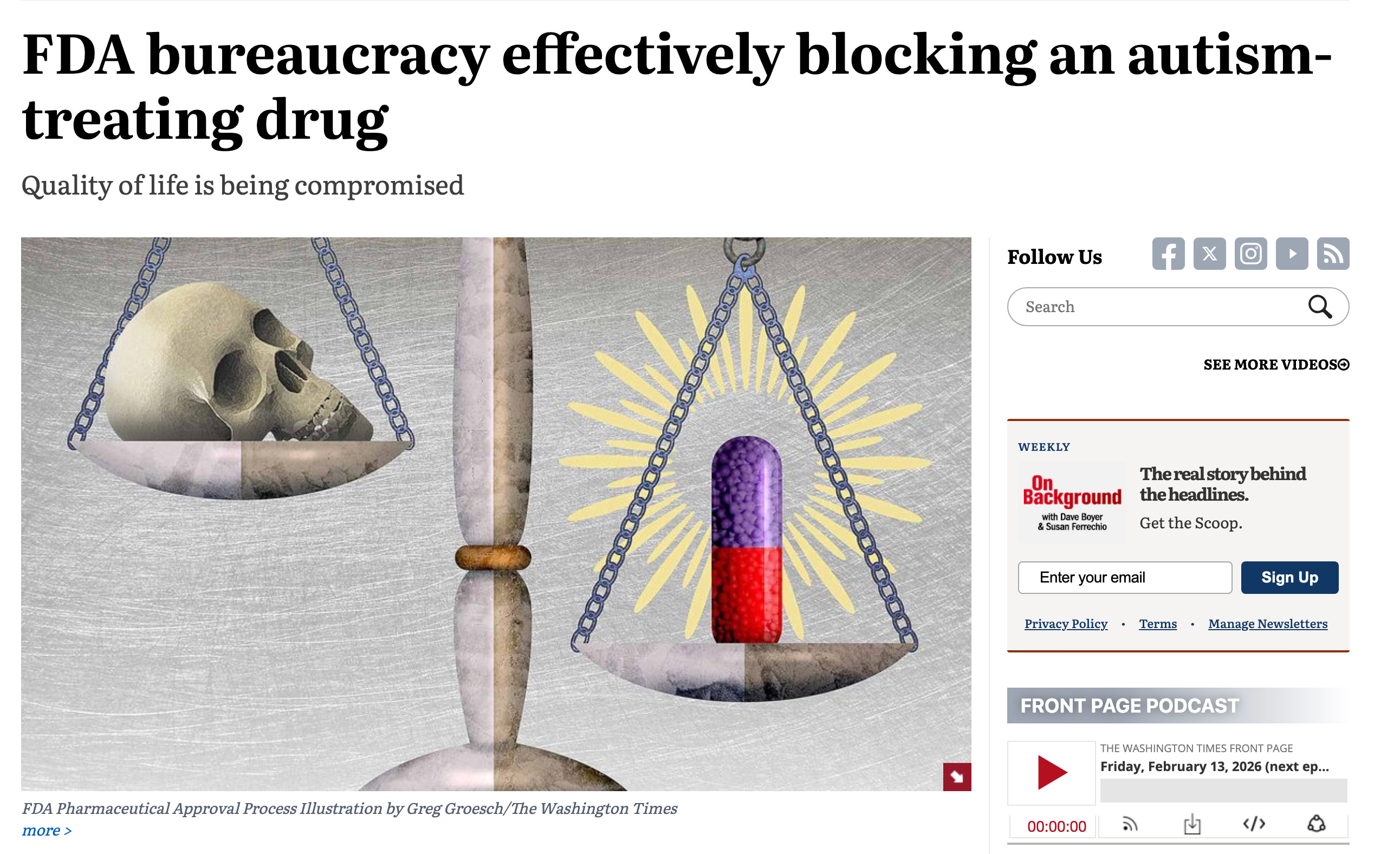
The FDA Drug Review Paradox: Why American Innovation Is Moving Offshore
Across the political spectrum, there’s a growing consensus that the FDA’s drug review process fails American patients. The evidence? Congress has spent two decades creating workarounds—Fast Track designation, Priority Review Vouchers, and Emergency Use Authorization—each attempting to circumvent the same fundamental problem: a bureaucracy that stifles innovation while failing to guarantee safety.
When “Fixes” Become Part of the Problem
Fast Track (1997) was meant to accelerate drugs for life-threatening conditions. Instead, critics argue it prioritizes pharmaceutical industry interests over rigorous safety evaluation.
Priority Review Vouchers (2007) were intended to incentivize the development of drugs for neglected diseases. Today, they’re tradable regulatory shortcuts that large pharmaceutical companies buy and sell, abandoning their humanitarian purpose.
Emergency Use Authorization (2004) enabled rapid deployment during crises. COVID-19 exposed how that speed came at the cost of rigor, transparency, and public trust.
All three programs share a damning reality: they’ve been captured by the interests they were meant to regulate. Each has become another tool for Big Pharma to navigate—or bypass—a regulatory landscape that small innovators cannot afford to traverse.
The Innovation Tax Only Large Companies Can Pay
Complex, time-consuming regulations don’t protect patients equally—they protect market incumbents. Large pharmaceutical companies possess the capital and specialized staff to navigate arbitrary requirements and bureaucratic fiefdoms. Small innovators don’t.
The predictable result? American pharmaceutical innovators face two bleak choices:
Sell early and cheap to large pharma before navigating the Byzantine regulatory maze—often seeing their innovations shelved through “catch and kill” acquisitions that preserve market share rather than advance patient care.
Go offshore to countries with more flexible regulators and smaller markets—transferring risks to non-US populations while denying American patients the benefits of American innovation.
Meanwhile, the large pharmaceutical companies acquiring these innovations rarely develop breakthrough therapies themselves. Their recent strategy centers on patentable copycat drugs offering marginal patient benefits while hedging against generic competition.
The Emperor Has No Clothes
Current FDA processes don’t just hinder innovation—they fail at their core mission. Despite expensive, multi-year reviews, market authorization provides poor assurance of safety and efficacy. American patients lose access to innovative treatments while gaining questionable quality and utility.
A common industry saying captures the absurdity: “FDA review practices only improve when someone retires.”
Two Cases, One Broken System
After consulting with small pharmaceutical innovators for decades, I’m seeing this crisis play out in real time. Two companies developing products aligned with the Make America Healthy Again agenda illustrate the problem:
LI-76 (Yamo Pharmaceuticals) addresses Autism Spectrum Disorder symptoms by regulating overactive catecholamine production in the brain. Parents report that adolescents locked in their own minds begin emerging from that cage. Clinical data shows meaningful improvement in social function—potentially life-changing for patients and families devastated by ASD.
Despite earning FDA “Breakthrough Therapy” designation and developing impressive clinical data, Yamo was recently told it must also conduct trials in young children before approval for adolescents, adding over $100 million in costs. Investors are balking, knowing that clearing this hurdle offers no guarantee that the FDA won’t raise another hurdle.
ARINA-1, developed by a scientist with Cystic Fibrosis, is a simple formulation that enables clearance of pulmonary mucus—addressing a core MAHA priority through patient-centered symptom relief.
Neither product is a cure. Both provide significant improvement in patient-reported symptoms. Both face expensive, shifting regulatory obstacles. Both are now considering offshore options or selling to Big Pharma.
What Patients Actually Need
Patients seek relief from symptoms, not improved laboratory values. The FDA must refocus on a simple principle: drugs and biologicals must provide clinically meaningful benefits that greatly exceed risks. Patient-centered outcomes—not bureaucratic process metrics—must drive drug development and approval.
This requires recognizing that all drugs carry some risk for some patients. The question isn’t whether risks exist, but whether benefits justify them for those suffering without alternatives.
The Path Forward
Reforming a massive bureaucracy carries risk, but maintaining the status quo guarantees continued failure. We cannot wait for key personnel to retire. This cannot remain a partisan issue.
Change requires:
Risk-taking by agency leadership willing to challenge entrenched practices
Empowering individual FDA managers with flexibility for creative problem-solving
Prioritizing patient outcomes over process compliance
Adapting to advances in genomics, biologics manufacturing, and computational technologies
The stakes are clear: American pharmaceutical innovation is endangered, investment capital flows elsewhere, and a core American industry has moved offshore. Meanwhile, American patients suffer without access to potentially life-saving treatments developed in their own country.
Lost in partisan warfare over MAHA initiatives is this fundamental truth: the current system compromises the quality of American patients’ lives. Our citizens, our children, and our patients deserve better.
It’s time to dial back the rhetoric and focus on solving problems that have plagued the FDA for decades. The choice is ours: reform a broken system, or watch American innovation—and American patients—continue paying the price.
My take after working with federal agencies like osha or hud is that results take a back door to proceedure. Neither incentive nor reward for finding a better way. Instead, every single aberration or misjudgment results in more rules and layers of bureaucracy. Idiots in the ranks aren’t fired and removed. They are cocooned away with new legal hurdles
One big step would be to disallow gov employees moving into pharma jobs by imposing a 5yr minimum period before they can be employed by pharma. Of course this may impede the retiring of gov employees that badly need to be retired.