

By: Robert W. Malone, MD, MS, and Jill Glasspool Malone, PhD
Last week’s essay followed Virginia's fight over religious liberty from jailed Baptist preachers and compulsory church taxes to the Madison-Monroe debate at Hebron in January 1789. This is part II and the final essay on the history of religious liberties in America.
Part I can be read here:

Audio Version:
The Cornerstone
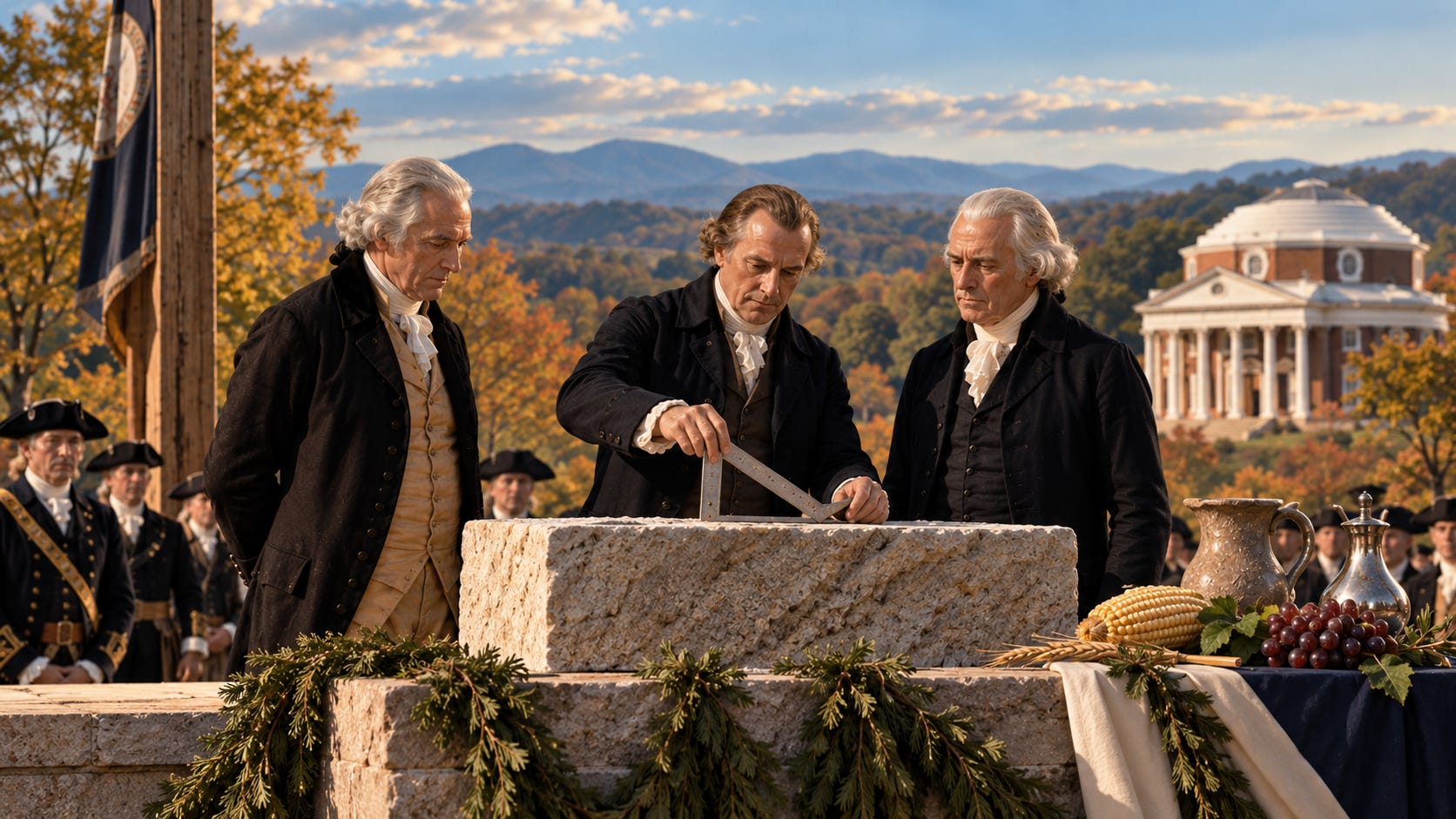
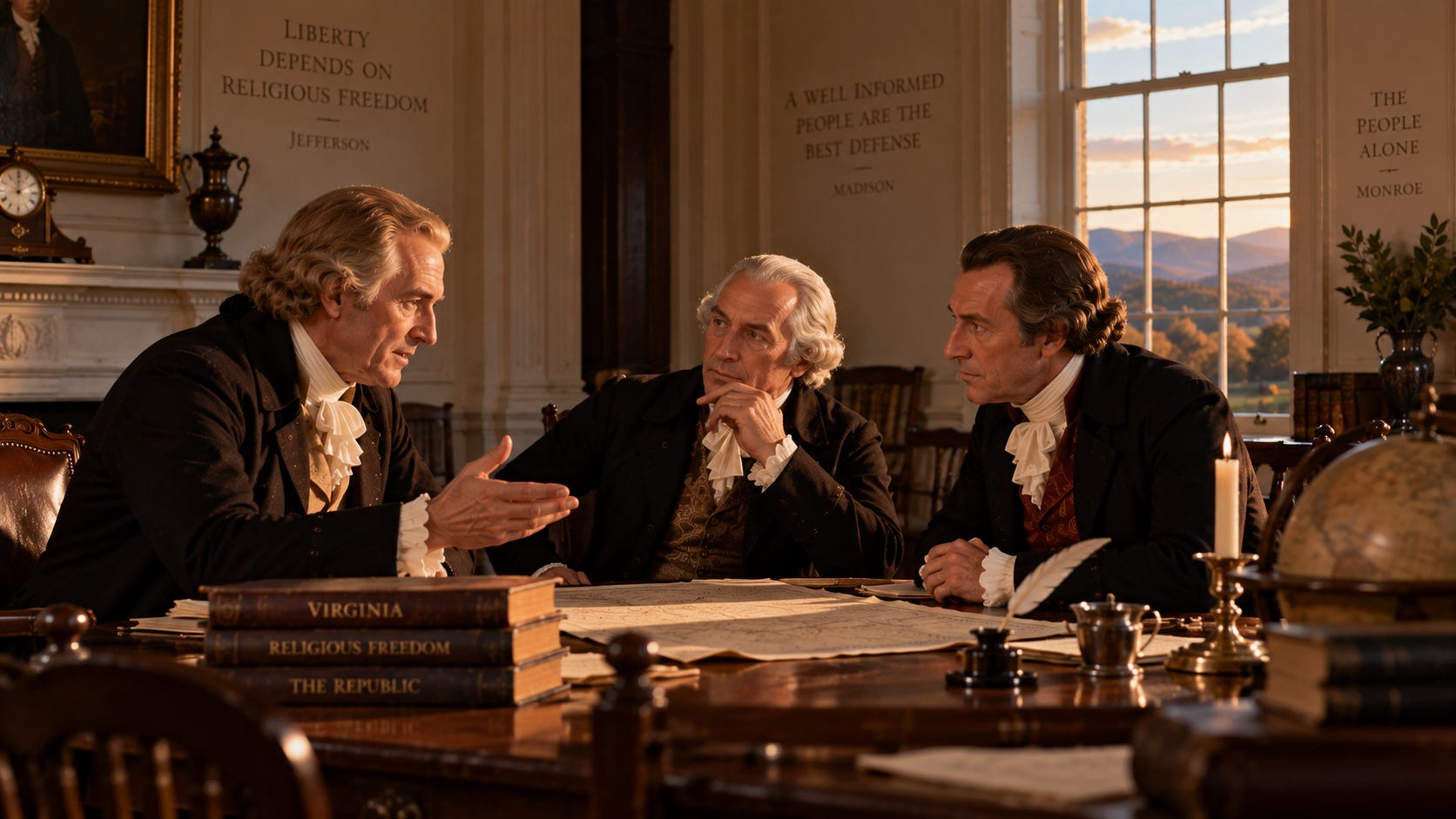
On October 6, 1817, Thomas Jefferson, James Madison, and James Monroe walked together across a worn-out field west of Charlottesville. Jefferson was seventy-four. Madison was sixty-six. Monroe was the sitting President of the United States.
They had come to lay the cornerstone of what would become the University of Virginia. The land had once been part of Monroe’s farm. Monticello was only a few miles away. Montpelier was about a day’s ride to the northeast. Three presidents, neighbors in the Virginia Piedmont, stood together that morning at the beginning of Jefferson’s last great project.
Twenty-eight years earlier, Madison and Monroe had been opponents.
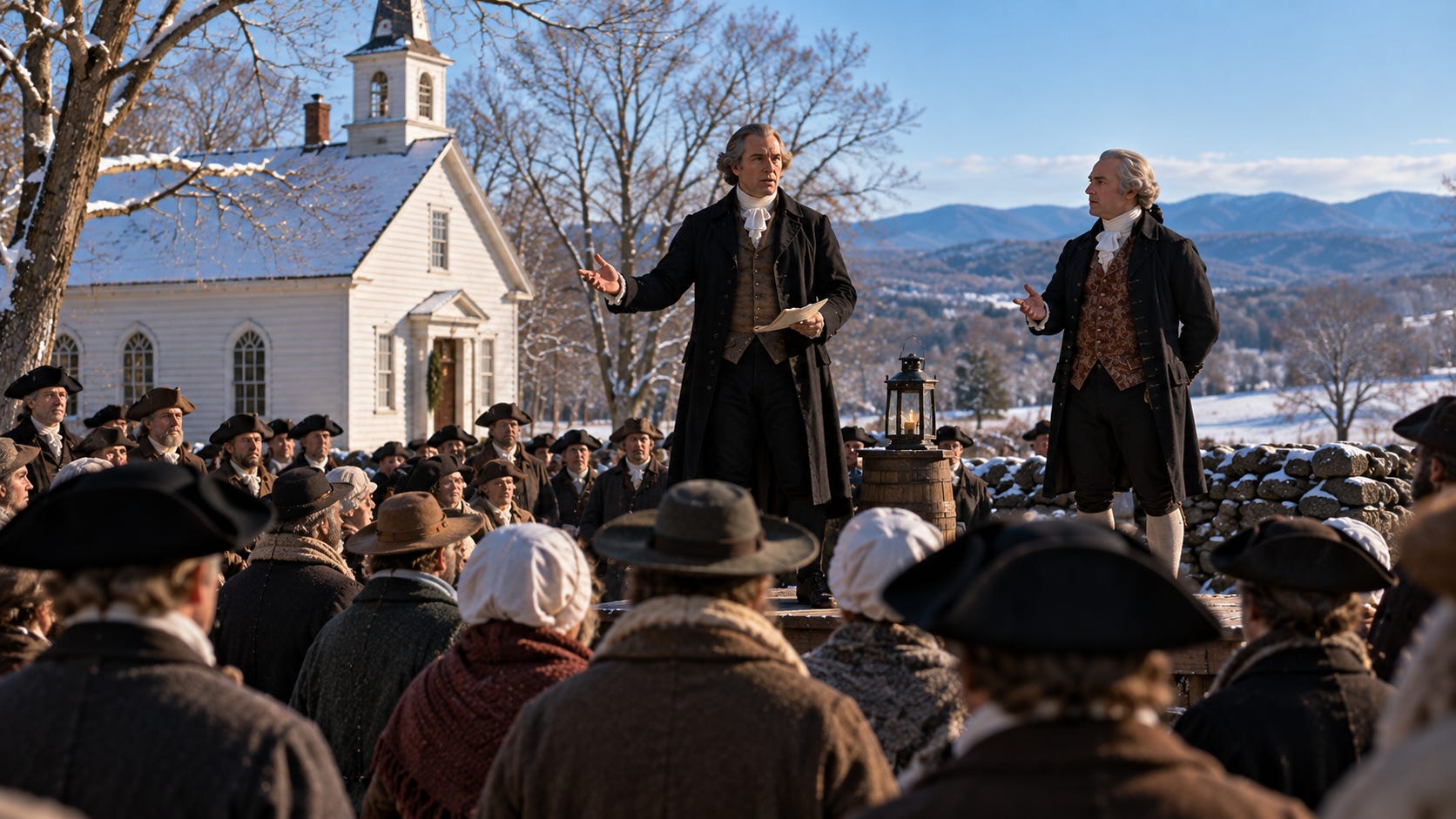
In January 1789, almost thirty years ago from this day, they had met at Hebron Lutheran Church during a bitterly cold congressional campaign. Patrick Henry and his allies had drawn the district map to favor Monroe. Baptists and other religious dissenters were an important constituency, and Madison had taken the unusual step of campaigning in person to answer charges that he opposed adding protections for individual rights to the new Constitution.
The last essay ended there, with Madison and Monroe debating at Hebron and Madison winning the election by 336 votes.
Five months later, on June 8, 1789, Madison stood in the House of Representatives and proposed the amendments that became the Bill of Rights.
The jailed preachers, the petitions from Virginia’s dissenting churches, the fight over compulsory religious taxes, and Madison’s insistence that religious belief was a right rather than something government could merely tolerate had brought Virginia to this point. Now Madison had to write those protections into federal law.
The Dissenters Had the Votes
Madison knew exactly which voters he needed to convince to get those protections written into the Bill of Rights.
The congressional district created by Patrick Henry’s allies joined Orange County to Albemarle, Amherst, Culpeper, Fluvanna, Goochland, Louisa, and Spotsylvania. Five of those seven counties had voted against ratification of the Constitution. Madison had helped write that Constitution, and during the Virginia ratifying convention he had resisted demands that a declaration of rights be added before it took effect. His opponents now used that against him.
Religious dissenters were particularly important. The Baptists had spent years petitioning the Virginia legislature against religious taxes and the privileges of the established church. They had supported Madison during the fight over Patrick Henry’s proposed religious assessment, but they were not prepared simply to trust him now. They wanted protections for religious liberty written into the new federal Constitution.
Culpeper mattered most. At the time, Culpeper County included what is now Madison County, including the Robinson River and Hebron valleys. Charles F. James counted six and a half Baptist churches there in 1789, more than in any other county in the congressional district. Madison later called Culpeper “the critical county.”
For us, this is local history. Madison was not coming into unfamiliar territory to court strangers. He had grown up just across the county line at Montpelier in Orange County. The Robinson River valley was only a short ride from his own home. These were neighboring counties, connected by roads, churches, farms, families, and decades of arguments over religion and government. This was Madison’s home turf.
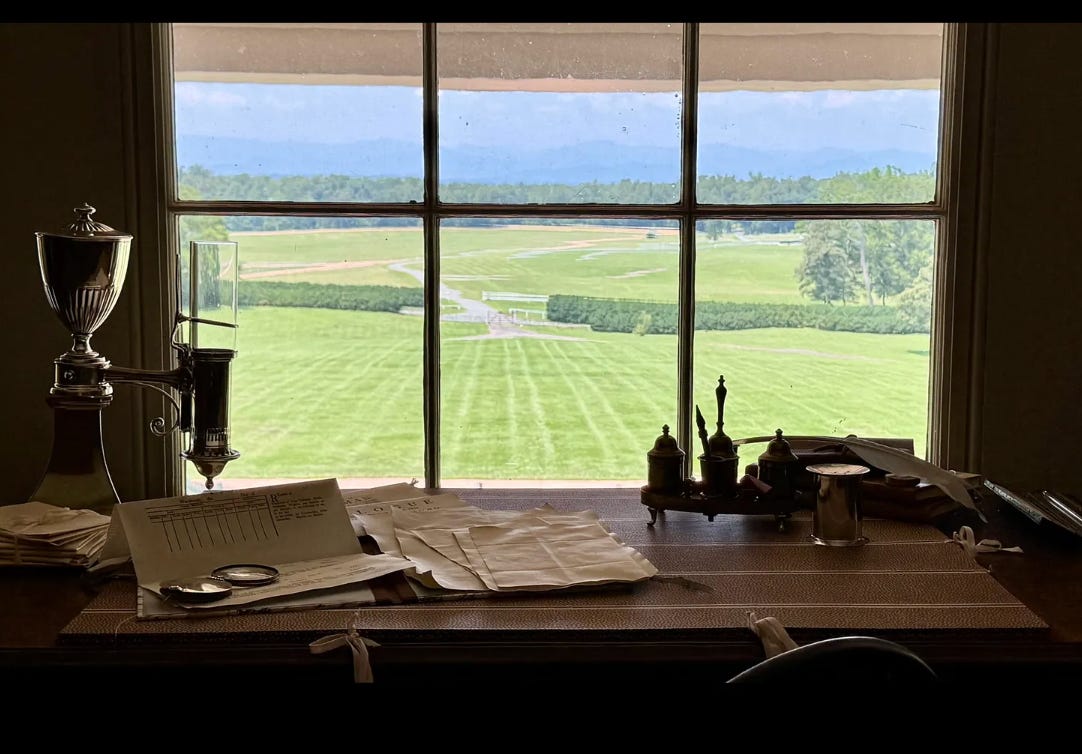
In July 2025, we stood in Madison’s home at Montpelier, looking at the desk where he did much of the work that became the Virginia Plan. Written largely by Madison and presented at the Constitutional Convention by Virginia Governor Edmund Randolph, the Virginia Plan became the working blueprint for much of the US Constitution that followed. The National Archives agrees with this assessment and says that Madison’s Constitution proposed a strong national government with legislative, executive, and judicial branches and “traced the broad outlines of what would become the U.S. Constitution. So, we have always felt that Madison has never gotten the credit he deserves as really the father of the American Constitution.
To this day, Madison’s desk still sits in Montpelier, and from Madison’s desk at Montpelier, his family’s homeplace, the Blue Ridge Mountains fill the western horizon. This was where he lived, read, studied governments that had come before, and worked through his ideas about what the new American republic should become.
And yet he could not take these voters for granted.
In January 1789, Madison wrote George Washington that he had taken the unusual step of campaigning personally in Culpeper and Louisa. He was trying to answer reports that he opposed amendments to the Constitution. At Hebron Lutheran Church, he met Monroe before a congregation whose own history was bound up with the same fight. The German Lutherans of the Robinson River valley had petitioned the Virginia legislature against compulsory religious support years before.
Madison won Culpeper. He won the election by 336 votes.
Those votes mattered for far more than deciding whether Madison or Monroe would represent the district in Congress. The people Madison had spoken to that winter had spent decades petitioning the Virginia legislature over religious taxes, the privileges of the established church and how that wronged other religions, and the right to worship without government interference. They had supported the new nation, but many remained deeply suspicious of a federal Constitution that contained no declaration of individual rights and no explicit protection for religious liberty. Madison had now assured them that he supported amendments to address those concerns.
When Madison left Virginia for New York in the spring of 1789, he was going to the temporary seat of the new federal government, where the First Congress of the United States had convened at Federal Hall. He arrived not simply as one of Virginia’s new representatives, but as a principal author and defender of the Constitution who had just won a difficult election in a district where demands for amendments had helped determine the outcome.
The religious dissenters of Virginia had spent years pressing their state government to recognize that freedom of conscience was a right the government could neither grant nor take away. Now Madison was in Congress, and the Constitution they had challenged for failing to protect that right could still be amended.
On June 8, 1789, Madison introduced a series of amendments in the House of Representatives that would become the Bill of Rights.
From Virginia to the First Congress
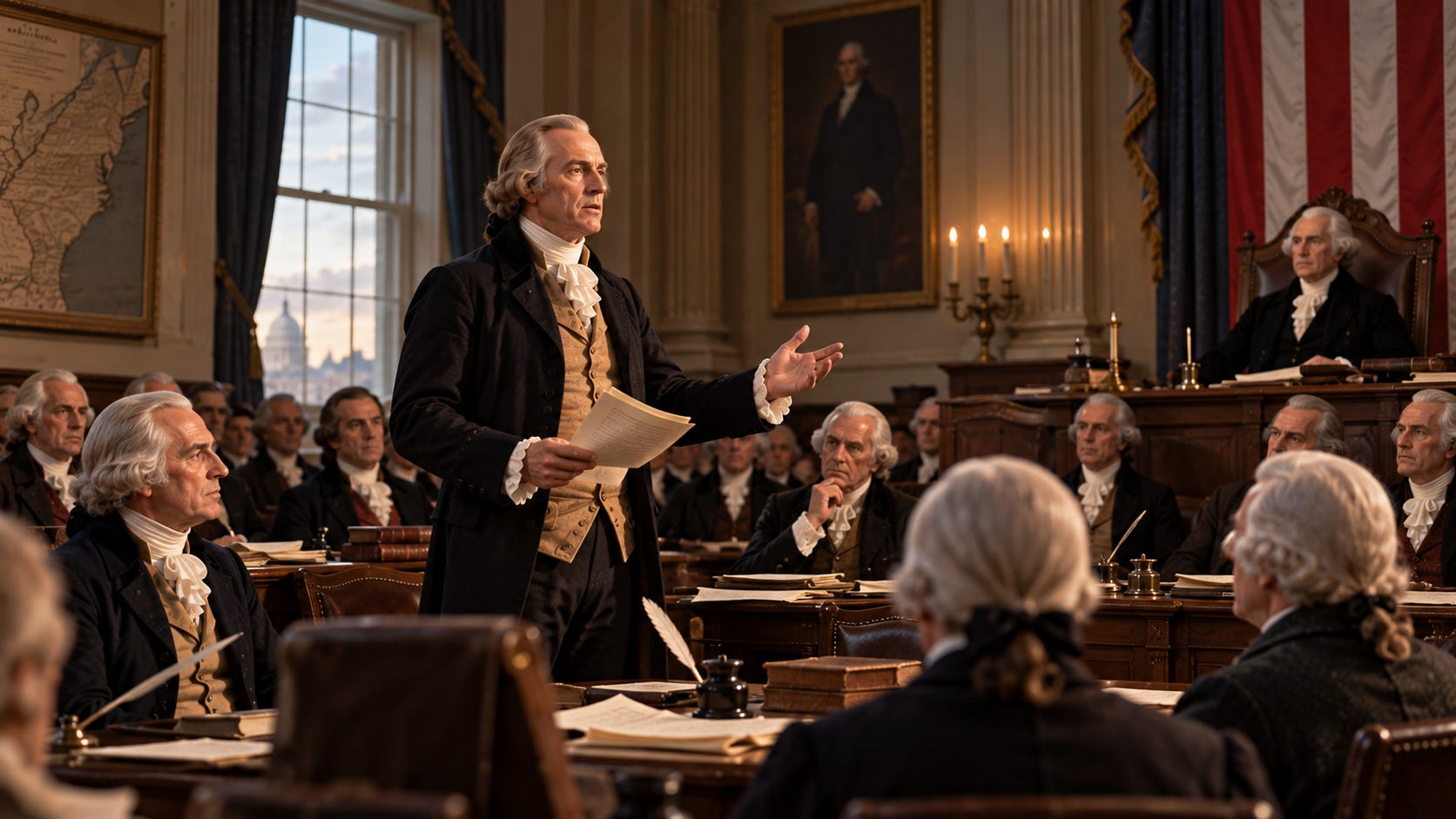
Madison had not originally believed that the Constitution needed a bill of rights. When George Mason proposed adding one during the Constitutional Convention in Philadelphia, the delegates rejected the idea. Madison believed the federal government had only the powers specifically given to it by the Constitution and questioned how much additional protection a written list of rights would provide.
But that position became increasingly difficult to defend back home. Virginia had spent years fighting over religious liberty, and many Virginians were not willing to trust the new federal government without explicit protections. The state had ratified the Constitution by a narrow vote and recommended amendments. Jefferson, writing from France, also pressed Madison about the missing bill of rights. Then Madison heard the same concerns directly from voters during his congressional campaign.
By the time Madison arrived in New York for the First Congress, he had promised to support amendments.
On June 8, 1789, he did.
Madison addressed the House of Representatives and proposed a series of amendments protecting individual rights. His original language on religion was broader than the First Amendment we know today. It protected religious belief and worship, prohibited a national religion, and declared that the “full and equal rights of conscience” could not be infringed.
Those words had a history for Madison. Virginia had spent more than a decade arguing over exactly what government could and could not do to a person’s religious conscience. Madison had been part of that fight almost from the beginning.
Now the question was what language Congress would actually put into the Constitution.
The First Amendment
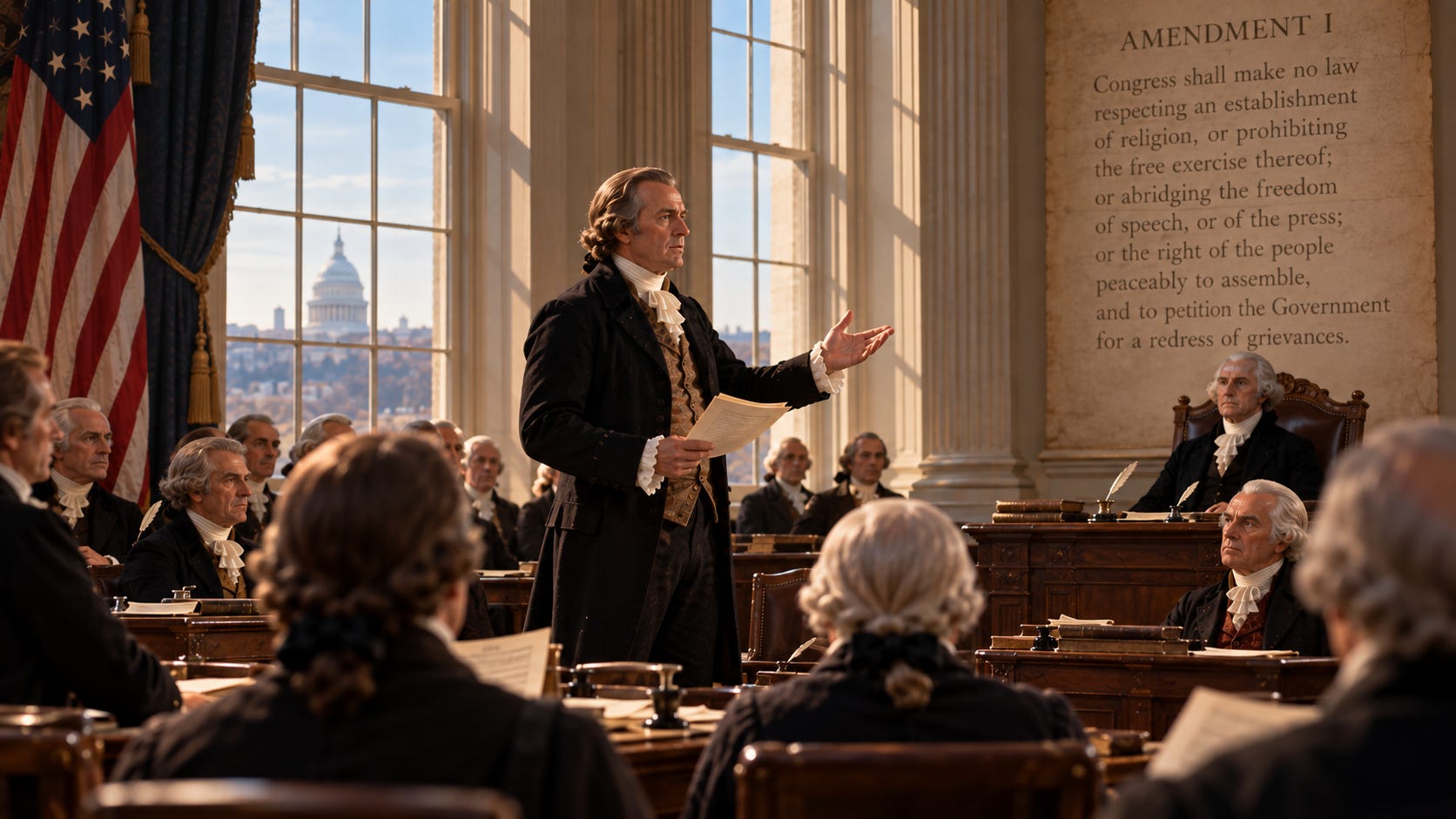
Madison’s proposal was not the language that ultimately became the First Amendment. The House debated it, committees revised it, the Senate changed it again, and the final wording emerged from negotiations between the two chambers.
What survived was much shorter:
“Congress shall make no law respecting an establishment of religion, or prohibiting the free exercise thereof.”
For Virginia, there was something remarkable in those words. “Free exercise” was the language Madison had fought for thirteen years earlier.
In 1776, when George Mason drafted Virginia’s Declaration of Rights, he wrote that all men should enjoy the “fullest toleration in the exercise of religion.” Madison objected. Toleration meant that government had the authority to decide which religious beliefs and practices it would permit. Madison changed the language to declare that all men were “equally entitled to the free exercise of religion, according to the dictates of conscience.”
That distinction had become the heart of Virginia’s long fight over religious freedom. Baptists and other dissenters were not asking the government to be more generous toward them. They were arguing that religious conscience was beyond the government’s authority in the first place.
Thirteen years later, “free exercise” appeared again, this time in the Constitution of the United States.
Virginia ratified the amendments on December 15, 1791. Its vote supplied the last of the three-fourths of the states required, and the Bill of Rights became part of the Constitution.
The fight over religious freedom in Virginia was not finished. But the principle that had begun with a dispute over “toleration” was now written into the First Amendment.
Finishing the Job in Virginia
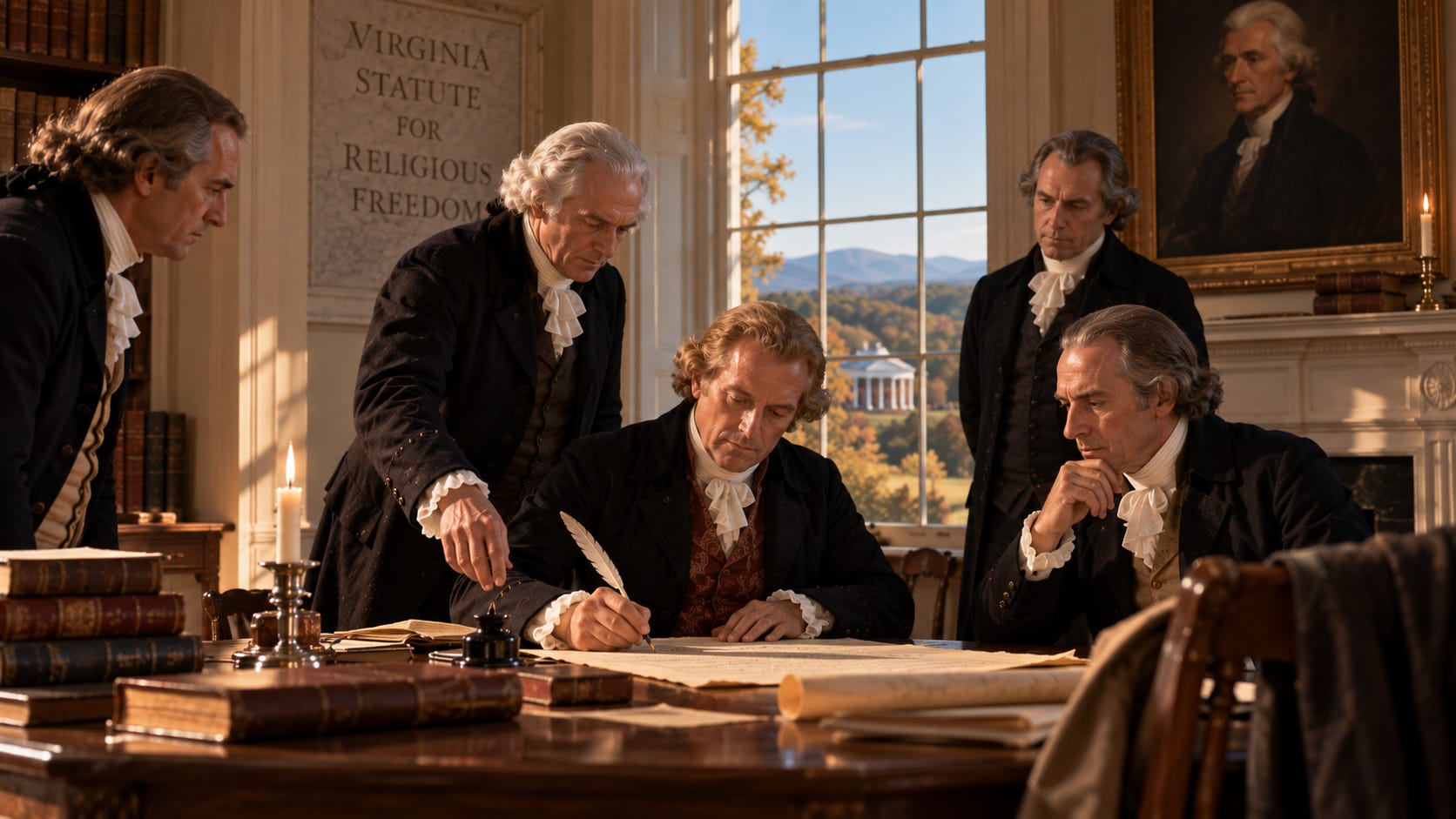
The First Amendment settled what Congress could do about religion. It did not settle what Virginia would do with the remains of its own established church.
One of the largest unresolved issues was the glebes. Under the colonial system, Anglican parishes had acquired farms and other property, supported in part through public taxation, to provide income and housing for their ministers. When Virginia ended the established church, those lands did not simply disappear. Those houses and farms remained property of the Episcopal Church.
The Baptists objected. They had spent years fighting compulsory support for another denomination, and they saw the glebes as property left over from the same system. In 1786, the Baptist General Committee considered whether the glebes should be treated as public property. By a margin of a single vote, it decided they should.
The fight continued for years. In 1799, the Virginia legislature declared that the former established church no longer had a legal claim to special treatment from the state. In 1802, Virginia authorized the sale of glebe lands when the remaining parish interests in them expired.
It was an important final step in a fight that had begun decades earlier. Virginia had stopped jailing dissenting preachers. It had ended compulsory religious assessments. Jefferson’s Statute for Religious Freedom had established that no Virginian could be forced to support a religious ministry. The First Amendment now prohibited Congress from establishing religion or interfering with its free exercise. And finally, the property inherited from Virginia’s colonial church system was being dismantled as well.
Disestablishment: The formal ending of a government-supported or officially recognized church. In Virginia, it meant ending the Church of England’s special legal status, taxpayer support, and other privileges, and establishing that government could neither favor nor require support for a particular religion.
The established church was gone not only in law, but increasingly from the institutions and property the colonial government had created to sustain it.
What Separation Meant in Practice
On New Year’s Day 1802, President Thomas Jefferson received an unusual gift at the White House: a 1,200-pound cheese made by Baptist farmers in Cheshire, Massachusetts. The Baptists had long regarded Jefferson as an ally in their fight for religious liberty, and the enormous cheese was intended as a public expression of their support.
As an aside, the 1,200-pound cheese is a reminder that the early republic operated under somewhat different rules. Deliver a half-ton gift to a sitting president today and, before anyone found a large enough cheese knife, White House lawyers and ethics officials would be asking who paid for it, who organized it, what it was worth, and whether the president was legally permitted to accept it. In 1802, the Baptists simply hauled their enormous cheese to Washington and gave it to Thomas Jefferson.
That same day, Jefferson answered a letter from another group of Baptists, the Danbury Baptist Association of Connecticut. They had written to him about religious liberty and their concern that in Connecticut it was treated not as an inherent right, but as something granted by government.
Jefferson’s reply contained a phrase that would become one of the most famous descriptions of the relationship between religion and government in American history. The First Amendment, he wrote, had built “a wall of separation between Church & State.”
Those words do not appear in the Constitution. They were Jefferson’s explanation of what the First Amendment meant.
Madison would later have the opportunity to show what that separation meant when he was the one sitting in the White House.
The Presidents - Together Again
Let us return now to that field outside Charlottesville on October 6, 1817.
Twenty-eight years had passed since Madison and Monroe faced one another in the congressional election that sent Madison to the First Congress. Jefferson had served two terms as president, Madison two terms after him, and Monroe was now in the first year of his own presidency. Political disagreements had strained their friendships more than once, sometimes badly. But on this October morning, the three Virginians, close enough to be considered neighbors, were together again.
They had come to lay the cornerstone of the University of Virginia.
Monroe tested the stone with a square, a plumb, and a level. The presiding Mason asked a blessing on “this and every other work undertaken for the benefit of the republic.” Jefferson and Madison stood beside him.
An aside on the Masonic ceremony: The square, plumb and level were not simply construction tools. In Masonic tradition, these tools carried moral meaning: the square represented upright conduct, the plumb moral rectitude, and the level equality.
Cornerstone ceremonies were common public events in early America, with Masonic lodges often called upon to dedicate important civic buildings. At the University of Virginia ceremony, Monroe tested the stone with the traditional instruments, and corn, wine, and oil were used in the ritual.
In traditional Masonic cornerstone ceremonies, the three substances symbolized basic blessings of life:
Corn represented plenty or abundance, particularly the necessities of life.
Wine represented joy, refreshment, and happiness.
Oil represented peace, comfort, and healing.
There is also a historical trap here. Monroe was a Freemason, but Jefferson almost certainly was not, despite generations of claims that he was. Monticello has found no evidence that Jefferson ever belonged to a Masonic lodge. His appearance amid all the Masonic ceremony at the University cornerstone laying may actually have helped create the legend.
For men of that generation, however, the symbolism of the ceremony required no secret membership to understand it. They were laying a literal foundation for a university intended to help preserve the republic they had created. A stone tested for whether it was square, level and true was an unusually appropriate symbol for the occasion.
There is something remarkable about the scene after knowing what had happened among these men. Madison and Monroe had once competed for the same seat in Congress, in an election shaped in part by the demand for a Bill of Rights. Jefferson and Madison had spent decades exchanging ideas about religious liberty and the limits of government. All three had disagreed, competed, fallen out, and reconciled.
And now they were old men standing together on land that had once belonged to Monroe, laying the first stone of the university Jefferson had spent years trying to create.
Jefferson died nine years later, on July 4, 1826. He had written his own epitaph and instructed that it identify him as the author of the Declaration of American Independence, the Virginia Statute for Religious Freedom, and the father of the University of Virginia.
He did not include President of the United States.
Back to the Beginning: Hebron Valley
And that brings the story back home for us.
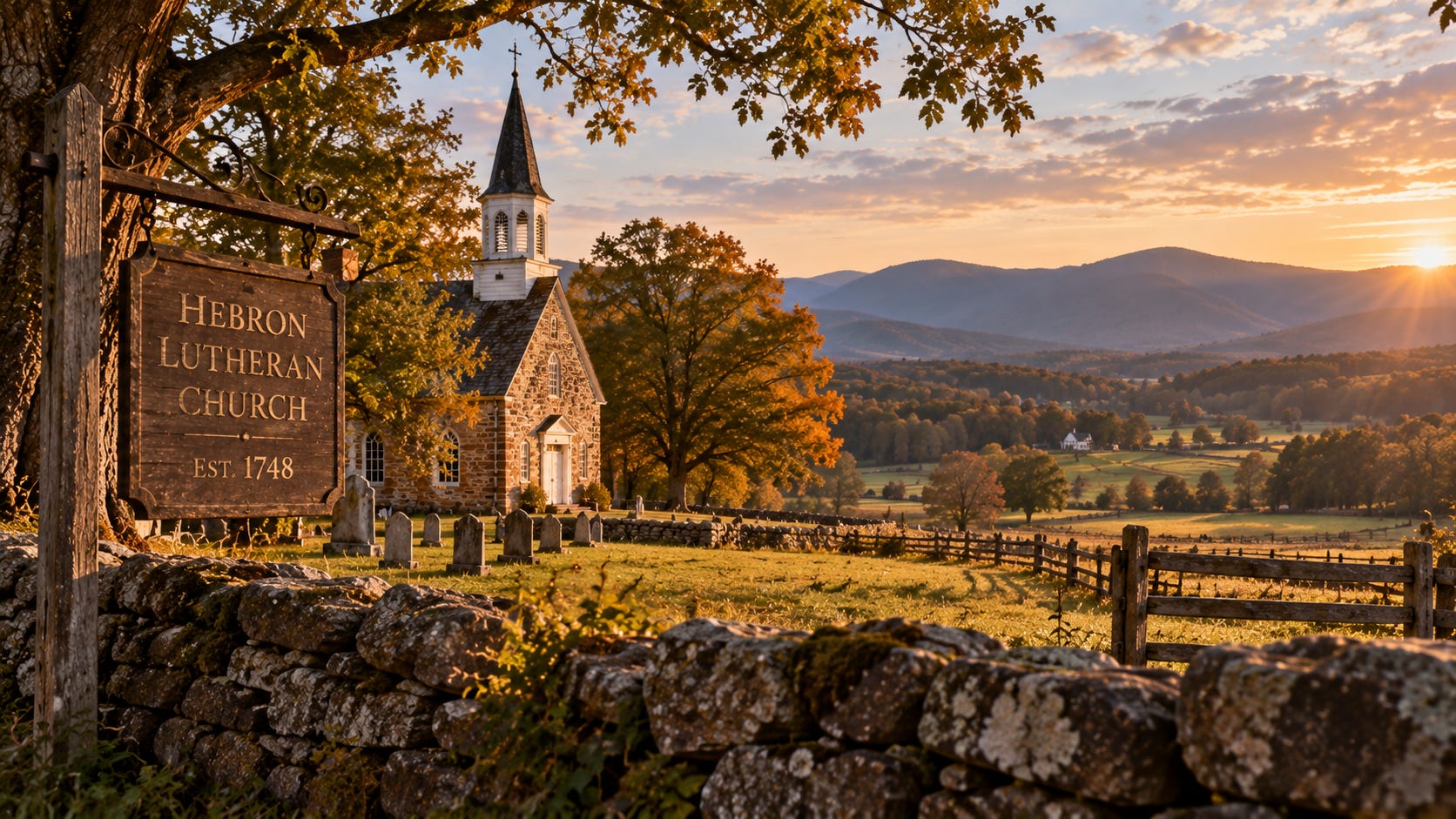
Stand in Hebron Valley and look toward the Blue Ridge. These are the same mountains Madison saw from Montpelier as he read, wrote, and worked through his ideas about the government the new nation would need. Montpelier lies just across the county line in Orange. Beyond it, to the south, are Jefferson’s Monticello and Monroe’s Highland. All three men lived within a day’s ride of this valley.
But the history of religious liberty here does not belong only to three presidents.
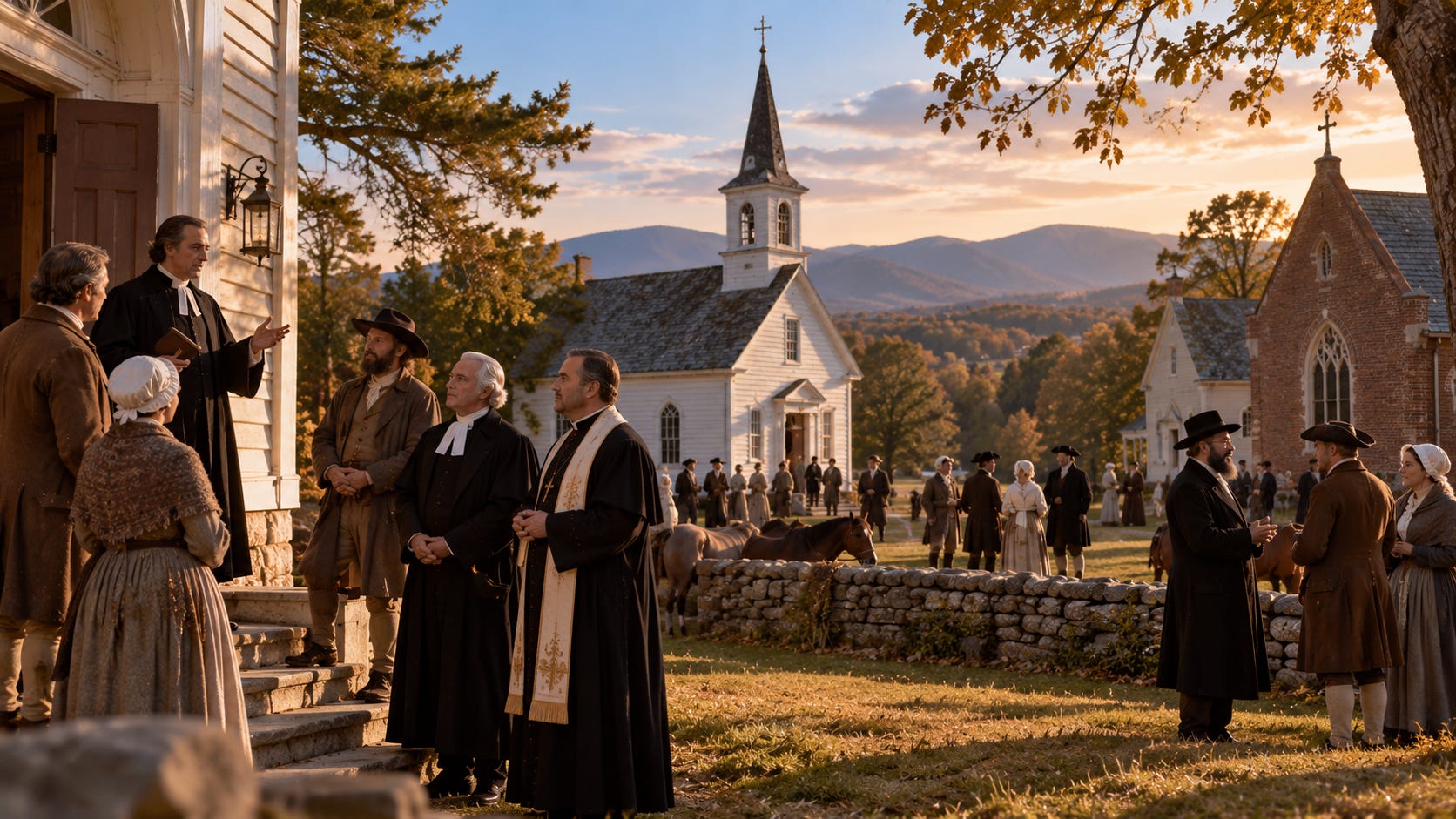
It belongs to the Baptist preachers who were jailed for preaching without permission, some of them in Culpeper.
It belongs to the congregations that petitioned the Virginia legislature rather than accept compulsory support for another church.
It belongs to the German Lutherans who settled along the Robinson River and eventually stood outside Hebron Lutheran Church on a bitter January day in 1789 while Madison and Monroe argued for their votes.
And it belongs to the Virginians who refused to accept that religious belief was something government had the authority merely to tolerate.
That last distinction may be the most important one in this entire story. Virginia began with an established church supported by law and taxation. Dissenters first fought to be tolerated. Then they demanded something fundamentally different: the free exercise of religion as a right, not a favor granted by government.
Madison helped put those words into Virginia’s Declaration of Rights in 1776. Jefferson wrote the Statute for Religious Freedom. Virginia’s Baptists and other dissenters kept pressure on the legislature. Madison won his congressional seat here in a campaign in which amendments to the new Constitution were very much at issue. Five months later, he proposed those amendments in Congress. And in 1791, Virginia became the final state needed to ratify the Bill of Rights.
“Free exercise” was now part of the Constitution of the United States.
Today, it is easy to encounter this history as a collection of famous names and documents: Jefferson. Madison. Monroe. The Virginia Declaration of Rights. The Statute for Religious Freedom. The First Amendment.
Living here makes it harder to see it that way. The famous men wrote the words, debated the laws, and held the offices. But ordinary Virginians kept forcing the question. They preached when they were told they could not preach. They went to jail. They refused to pay for churches they did not attend. They signed petitions. They organized their congregations. And when the new Constitution failed to protect their rights explicitly, they demanded amendments.
These were roads people traveled. These were churches where they worshipped and argued. These were neighbors, farms, county lines, and elections. Montpelier is just over the hill. Hebron Lutheran Church is still here. The Robinson River still runs through the valley. The Blue Ridge still fills the western horizon. And Monticello is less than an hour away.
The national story of the First Amendment happened here.
The Lesson Here: Our Current Fight for Liberty
Medical freedom should not depend upon whether a person can produce a religious objection acceptable to the government. The right to decide what is done to one’s own body is more fundamental than any exemption the government chooses to grant.
That distinction should sound familiar by now. The people of Hebron Valley and the religious dissenters of Virginia eventually rejected the idea that government should decide which beliefs it would tolerate. They demanded recognition of a right that existed independent of government permission. Medical freedom raises a similar question today. If bodily autonomy is a right, then government does not create that right by granting an exemption from a mandate.
This is why the fight over medical mandates is not over. Congress and state legislatures continue to wrestle with where government authority ends, and individual medical decision-making begins. Those of us who believe that medical decisions belong to individuals and families cannot treat a religious exemption as an adequate substitute for that principle. Medical freedom is a civil liberty.
The people who lived in this valley did not secure religious liberty by accepting toleration and asking government to be generous with exemptions. They kept demanding recognition of the right itself.
More than two centuries later, that may be the most important lesson they left us. There is a profound difference between a right and an exemption. One belongs to you. The other exists only so long as the government agrees to grant it.
Essays like this take time. They require digging through old records, reading the original letters and petitions, visiting the places where the history happened, and then trying to tell the story in a way that makes clear why it still matters.
Malone News is supported by its readers, not by corporate advertisers or institutional sponsors. If you value independent research, long-form writing, and our willingness to keep asking difficult questions about liberty, government power, and the rights that belong to us, please consider becoming a paid subscriber.
Your subscription makes this work possible. And as the people of Hebron Valley understood more than two centuries ago, preserving liberty requires people willing to defend it.
A final note:
Please also consider sharing these essays with your children and grandchildren. And on your next trip through the Virginia Piedmont, consider visiting Montpelier and Monticello. This part of Virginia is steeped in the history of our nation’s founding, with lessons that remain every bit as important today.
RWM/JGM
References
American Battlefield Trust. n.d. “James Monroe.” https://www.battlefields.org/learn/biographies/james-monroe.
Charlottesville Historic Resources Committee (HRC). n.d. “James Monroe’s First Farm.” Historical marker text. https://weblink.charlottesville.org/public/0/edoc/793338/James%20Monroe%20First%20Farm%20Marker%20Text_HRC.pdf.
Cocke, John Hartwell. 1817. “John H. Cocke’s Account of the Central College Cornerstone Laying, 5 and 6 October 1817.” Founders Online, National Archives. https://founders.archives.gov/documents/Jefferson/03-12-02-0057-0002.
Highland. n.d. “A Brief Biography of James Monroe.” James Monroe’s Highland, William and Mary. https://highland.org/discover-monroe/.
James, Charles F. 1900. Documentary History of the Struggle for Religious Liberty in Virginia. Lynchburg, VA: J. P. Bell Company. Digitized by Cornell University Library, Internet Archive. http://www.archive.org/details/cu31924029255169. Full PDF also available at [INSERT MALONE.NEWS LINK].
James Monroe Museum. n.d. “Prelude to the Presidency.” University of Mary Washington. https://jamesmonroemuseum.umw.edu/exhibitions/prelude-to-the-presidency/.
Madison, James. 1811. Veto Message to the House of Representatives, February 21. Founders Online, National Archives.
Magnet, Myron. 2014. “Montpelier Restored.” City Journal, March. https://www.city-journal.org/article/montpelier-restored.
Masonic Report. 1817. “Masonic Report on the Central College Cornerstone Laying, 1 December 1817.” Founders Online, National Archives. https://founders.archives.gov/documents/Jefferson/03-12-02-0057-0004.
Monticello. n.d.a. “Visitors to Monticello.” Thomas Jefferson Foundation. https://monticello.org/thomas-jefferson/a-day-in-the-life-of-jefferson/museum-in-the-entrance-of-the-house/visitors-to-monticello.
Monticello. n.d.b. “James Monroe.” Thomas Jefferson Encyclopedia. https://www.monticello.org/encyclopedia/james-monroe.
Monticello. n.d.c. “Highland.” Thomas Jefferson Encyclopedia. https://www.monticello.org/research-education/thomas-jefferson-encyclopedia/highland/.
Monticello. n.d.d. “James Madison and Thomas Jefferson.” Thomas Jefferson Encyclopedia. https://monticello.org/tje/4101.
Montpelier. 2021. “The Congressional Election of 1789.” James Madison’s Montpelier. https://www.montpelier.org/the-congressional-election-of-1789/.
NPS (National Park Service). n.d. “Ash Lawn-Highland.” Journey Through Hallowed Ground Travel Itinerary. https://www.nps.gov/nr/travel/Journey/hig.htm.
Wolfe, Brendan. 2020. “Ambrose Madison (ca. 1696 to 1732).” Encyclopedia Virginia. Virginia Humanities. https://encyclopediavirginia.org/entries/madison-ambrose-ca-1696-1732/.
I only wish citizens of today would be one one hundredth as passionate about their liberties and freedoms as the citizens were in the years following the revolution. Today we take so much for granted. It seems far to many today are interested more in what they will get than what their children will end up with in the future.
Wonderful. Sadly, our schools are not teaching Civics and American history well. Only dwelling on the negatives and not the positives.