

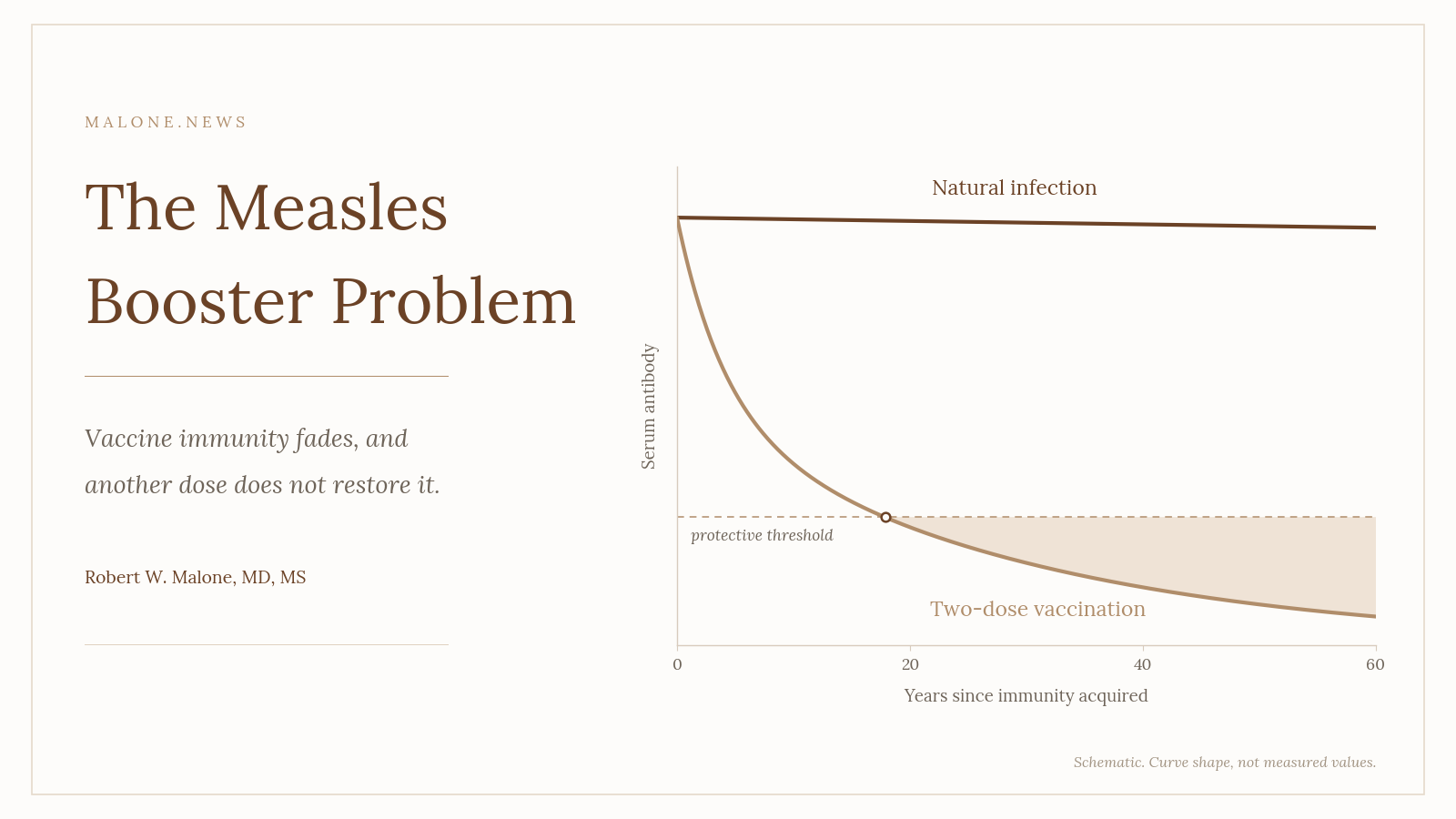
Two decay curves
Peter Panum sailed to the Faroe Islands in 1846 to investigate an epidemic that infected some six thousand of the islands’ seven thousand eight hundred residents. The exceptions were the elderly who had survived the epidemic of 1781. Not one of them was reinfected sixty-five years later (Panum 1847).
Influenza changes its surface proteins continuously, which is why last year’s antibodies stop fitting this year’s virus. Measles does not do this. It carries a single serotype and does not drift, so an antibody response raised against the wild virus of 1781 still fitted the virus of 1846 exactly. The durability question for measles is a question about the human immune system alone, uncomplicated by any change in the target.
Vaccine-induced immunity behaves differently from what Panum found among the Faroese. Bianchi and colleagues tested 611 Italian students and hospital residents. Twenty percent of the twice vaccinated had no detectable protective IgG, against six percent of those reporting natural infection, with geometric mean antibody levels of 92.2 and 213.3, respectively (Bianchi et al. 2021). A 2022 systematic review in the Journal of Infectious Diseases put the general finding in its title: in elimination settings, measles antibodies wane after vaccination but not after infection. Kennedy and colleagues at Mayo reached a parallel conclusion on the differential durability of the measles and mumps components of MMR (Kennedy et al. 2019).
How the body decides how long to remember
A B cell is a white blood cell carrying a single antibody design on its surface, generated by a random shuffling of gene segments before the cell ever meets anything. Each of us carries billions of them, and collectively they hold an enormous library of possible shapes. When a virus arrives, the small subset whose antibodies happen to fit some piece of that virus structure (a viral antigen) gets activated.
Those cells do not begin producing antibody straight away. They migrate into a temporary structure called a germinal center, which forms inside lymph nodes, tonsils, and the spleen during an infection and dissolves afterward. Inside it, B cells introduce mutations into the genes encoding their own antibodies at a rate a million times higher than ordinary genetic mutation. They then compete for limited access to the virus antigen and for survival signals from helper T cells. A cell whose mutation improved the fit captures more antigen, receives more help, survives, and divides. A cell whose mutation worsened the fit dies. The cycle repeats for weeks, and immunity gradually improves over the course of an infection rather than appearing fully formed at the start. The antibody a patient carries in week four grips its target far more tightly than the one they carried in week one. Immunologists call that grip strength avidity, and it matters as much or more than the quantity of antibody present. Antibody quantity is measured as titer and is easy to measure, which is why titer is what gets reported. Antibody avidity is much harder to measure, and so is rarely reported except in academic studies and a few clinical trials.
The germinal center produces two surviving antibody-associated B cell types, and the difference between them determines everything that follows.
Memory B cells leave the germinal center and go quiet. They circulate for decades doing nothing measurable, carrying their refined antibody design on the surface, waiting. On re-exposure to the antigen they are primed to recognize, they activate, divide rapidly, and begin manufacturing antibody in quantity, a process taking three to seven days. In vaccine terms, this is called a recall response.
Long-lived plasma cells do something else. They abandon surface antibody production, migrate to the bone marrow, and settle into specialized niches where supporting cells keep them alive. There they secrete antibody continuously into the bloodstream for decades, neither dividing nor requiring further contact with the virus. A plasma cell seeded in a Faroese child in 1781 was still pumping measles antibody into that person’s blood in 1846.
When a laboratory reports a “resting” measles antibody level (titer), it is measuring the output of that bone marrow population. Memory B cells contribute nothing to a resting titer because they are secreting nothing. Every seroprevalence study on this subject inherits the resulting ambiguity. A low number establishes that the plasma cell pool has thinned, and says nothing directly about whether the memory cells remain.
How large a plasma cell pool a person ends up with depends on how much antigen the germinal centers processed and for how long during the period when this germinal center B cell “education” process occurs, which is the key characteristic that separates disease from vaccination. This helps explain why “natural immunity” from an infection usually works better than vaccination for producing durable, long-lasting immunity. Basically, like a lot of things, good B cell education takes time and experience.
Why the vaccine cannot match the disease
Wild measles is a systemic infection. The virus replicates for days to enormous titers, spreads through every lymph node in the body, and feeds antigen to germinal centers across the whole lymphoid system for two weeks or more. The plasma cell pool that processes produces is very large, and because those cells persist without further stimulation, so does the antibody they produce.
Attenuated vaccine strains are crippled on purpose. They were passaged repeatedly in cell culture until they lost the ability to replicate efficiently in humans, which is also what makes them safe. An attenuated vaccine strain (like what is used in the measles vaccines) produces a brief, limited, largely local infection. The germinal centers it drives are smaller and shorter lived, and the plasma cell population they seed into marrow is smaller in proportion. Antibody from a smaller pool falls below detection sooner as individual plasma cells die off.
The vaccine's safety and its shorter durability are basically the same property viewed from two angles. That fact is uncomfortable for those who take the simplistic view of all vaccines being “safe and effective”. It argues for a better product rather than against vaccination, but it does mean that vaccine-induced and “natural” immunity achieved through actual infection should not be described as equivalent. They are not equivalent. Naturally acquired immunity from measles is clearly superior, but it comes with a cost: the risks associated with a primary live measles infection.
Two further consequences follow that typical oversimplified “public health” messaging tends to skip past. Until elimination, vaccinated people were regularly re-exposed to circulating wild virus. Those exposures were usually silent, producing no illness, but they restimulated memory cells and topped up antibody levels. Eliminating measles removed that free, silent booster, and universal vaccination program success unmasked the gradually waning memory-cell immunity that endemic circulation had been correcting for decades. Separately, infants of vaccinated mothers receive lower antibody levels across the placenta than infants of naturally immune mothers, widening the window of infant vulnerability before the first dose. Both effects are permanent features of the transition away from a naturally immune population. Vaccination also has a “public health” cost, one that is never tallied in the approved pro-vaccination messaging narratives.
Where the susceptibility accumulates
Measles mortality does not track age in a straight line. It traces a U. Infants under one year carry the highest risk (particularly infants born of vaccinated mothers relative to mothers with naturally acquired immunity). The curve falls through early childhood, bottoms out between ages five and nine, then climbs again through adult life. The World Health Organization places the bottom of this U-shaped curve (adult inflection point) near age thirty (WHO 2026).
Set that curve against the serology. Seropositivity is defined by measuring total circulating anti-measles antibodies. Recent Czech survey data put seropositivity at 61.5 percent in the 30 to 39 cohort, the lowest of any age stratum, while those fifty and older who were infected in the pre-vaccine era sat at 96 percent and above. The population accumulating antibody gaps is the same population moving onto the steeper arm of the severity curve. In other words, the consequences of waning vaccine-induced immunity in the elderly are currently masked because they have natural immunity from being infected as children. But over time, as the global elderly population will become dominated by those who were vaccinated rather than infected, the problems and risks associated with the relative lack of durable protection from measles vaccines will become more prevalent.
Adult measles is a different disease from the pediatric version. Hospitalization runs several fold higher, and pneumonia dominates the mortality. Hepatic involvement has been reported in the large majority of adult cases. Encephalitis holds roughly flat by age at about one per thousand, but a patient with reduced physiologic reserve tolerates it far worse.
Older adults are almost absent from current case counts, and that absence is immunity rather than resistance. Americans born before 1957 nearly all contracted measles as children. Whatever we know about measles in a seventy-year-old comes from scattered case reports, because no susceptible elderly cohort exists to study. That naturally immune generation is dying off, and what replaces it is a population whose protection decays on a schedule.
The obvious remedy
The intuitive policy response to all of this is another dose. Serological modelers in Thailand proposed a third measles-containing dose at age eighteen to twenty, calculated to close the young adult gap. Korea is weighing a third MMR dose for young healthcare workers. Occupational health programs in most countries already do a version of this, screening staff and revaccinating the seronegative regardless of documented history.
Extend that logic, and you arrive at the proposal worth examining. Give a third dose in late adolescence. Give a fourth somewhere between forty-five and fifty-five, when the serological data say a vaccinated cohort has spent decades decaying without natural boosting. The reasoning is coherent, the target population is real, and the delivery infrastructure already exists. Inconveniently, it also does not work.
Why the boost fails
Anichini and colleagues followed twenty-four individuals who remained seronegative for measles years after completing the two-dose schedule. Eleven seroconverted after a single booster, and thirteen required a second. Antibody levels were then tracked at one and three years. Booster doses in subjects with waning antibodies produced low IgG levels that declined significantly over three years, and neutralizing antibody stayed low in single- and double-booster recipients alike (Anichini et al. 2024). The paper’s title states the conclusion without hedging: seronegative vaccinees may not benefit from multiple booster doses in restoring immunity.
Fiebelkorn and colleagues had reported the same shape in young adults given a third MMR dose, measuring neutralizing antibody, cell-mediated immunity, and antibody avidity before and after (Fiebelkorn et al. 2016). Levels rise and then return toward where they started. Korean investigators following seronegative healthcare workers two years after one or two booster doses found fewer than half retaining a medium or high neutralizing titer.
The explanation lies in what a live attenuated vaccine has to do in order to work. It must replicate. A dose of MMR contains a small quantity of weakened virus, and the response it provokes depends on that virus multiplying enough to generate a meaningful quantity of antigen over a sustained period. Only sustained presentation drives germinal centers hard enough to seed new plasma cells.
In a partially immune person, whatever antibody remains, even at levels a laboratory calls negative, binds the incoming vaccine virus and neutralizes it. The particles are cleared before they can establish an infection, and the germinal center machinery never fully engages. What happens instead is a recall response. Existing memory B cells recognize the antigen, wake, divide, and secrete antibody, which raises the measured level for a period of months to a couple of years. Immunologists call this an anamnestic response, and it is real protection while it lasts. But memory cells doing a temporary job is a different thing from construction of a new bone marrow plasma cell population, and when the recall response subsides the person returns to where they began.
The result runs backward from what the policy intends. Boosting works best in people carrying no residual antibody, meaning those who never responded properly in the first place, and works worst in people with partial immunity, who are the population the exercise means to protect. A dose at fifty buys a few years of elevated antibody in some fraction of recipients. It cannot restore the durability that natural infection confers, because the mechanism generating that durability is structurally unavailable to an attenuated virus meeting pre-existing antibody.
Clearly a better vaccine is needed. One that immunologically acts more like an attenuated measles virus, but does not require viral replication. That is precisely the rationale that I developed in the late 1980s for using nucleic acid-based gene therapy (DNA or mRNA) for vaccination purposes. The challenge both then and now is how to do this safely.
The seroprevalence numbers also overstate the gap
The twenty percent figure predicts something we ought to be able to see. If a fifth of two-dose adults were genuinely susceptible, outbreaks would generate adult attack rates that nobody observes. Measles is among the most transmissible pathogens known, and a susceptible fifth of the adult population would show up in outbreak data immediately.
The gap between plasma cells and memory cells explains the discrepancy. As previously discussed, serum antibody levels measure the first population and are blind to the second. Someone whose measured antibody has fallen below the laboratory threshold may still carry an intact memory compartment holding the high-avidity antibody designs refined during their original germinal center response.
Timing decides whether that matters. Measles has an incubation period of ten to fourteen days between exposure and illness, and a memory recall response begins producing antibody within three to seven days. Someone with no circulating antibody but functional memory can therefore mount a defense before the virus completes its expansion, and will often experience either nothing at all or a mild, modified illness. This is why the Advisory Committee on Immunization Practices declines to recommend routine antibody screening of documented two-dose recipients, a position defensible on the biology rather than merely being conservative or cost-driven.
The threshold itself is also thin. The currently accepted working correlate of protection near 120 mIU/mL descends largely from a single college outbreak investigation, where investigators compared pre-exposure antibody levels against those who subsequently fell ill, and used that correlation to derive a number (Chen et al. 1990). An entire architecture of screening, revaccination, and occupational policy rests on that one study. Nobody has re-derived it in an elimination-era population (ergo, the current situation rather than a population with many who had natural immunity), and every argument about waning, this one included, inherits its uncertainty.
What re-dosing can reasonably accomplish
Some of the case survives. Targeted revaccination has defensible indications, though not the ones a fixed-age schedule would capture.
As if all of this were not complicated enough, birth cohort is more important than chronological age in this case. The American two-dose schedule did not become universal until 1989, so people born between 1957 and 1985 may have received a single dose, and single-dose recipients carry documented secondary failure risk that twice-vaccinated recipients largely do not.
Occupational, travel, and outbreak-response revaccination all remain sensible for this birth cohort based on the same reasoning that supports post-exposure prophylaxis. A transient antibody elevation is worth having when you can predict the exposure window, and worth much less when you cannot.
One population no dosing schedule reaches. Adults on rituximab (a monoclonal antibody indicated for the treatment of B-cell malignancies and autoimmune disorders) or other B-cell depleting therapy, on methotrexate, on chronic corticosteroids, or with active malignancy face the highest measles risk among adults, and they cannot receive a live attenuated vaccine at all. Rituximab destroys the B cell compartment outright, erasing both memory cells and the capacity to respond to a new dose. Their protection depends on the immunity of the people around them and on post-exposure immune globulin. Any honest discussion of adult measles policy has to account for the group the policy structurally cannot help.
The one cohort worth actually finding
An argument about waning immunity in the general population is a diagnosis. A narrower group in this country has a concrete policy ask that already exists, sits on the books, and goes almost entirely ignored and unexecuted by “public health” guidance and practice.
Two measles vaccines were licensed in the United States in 1963. One was a live attenuated Edmonston B product. The other was a formalin-inactivated killed vaccine, marketed as Pfizer-Vax Measles-K. The killed Pfizer product did not protect, and it was withdrawn in 1967. Fewer than one million American children received it (CDC 2026c).
Failure to protect was the smaller problem. Fulginiti and colleagues described what happened when those children met wild measles years later. They developed atypical measles syndrome: high fever, a rash beginning peripherally on the palms and soles and spreading inward, nodular pulmonary infiltrates, pleural effusions, and very high antibody levels (Fulginiti et al. 1967).
The immunology behind that syndrome is worth spelling out. Killing a virus with formalin cross-links its surface proteins and distorts their shape, so the immune system builds antibodies against a deformed template. Those antibodies bind the real virus, but they bind it in the wrong places and with poor grip, failing to block it from entering cells. Antibody that attaches without neutralizing causes harm. Virus and antibody form clumps called immune complexes, which lodge in small blood vessels and in lung tissue and recruit inflammatory cells to attack them. Much of the lung damage in atypical measles is the patient’s own immune system reacting to those deposits. The helper T cell response was also skewed toward supporting antibody production rather than destroying infected cells, leaving the patient with the wrong tool for the job. This is an example of vaccine-induced disease enhancement, one of many.
Clinically the syndrome runs backward from ordinary measles, which produces a rash starting on the face and moving down and out. Atypical measles starts at the extremities and moves inward, so a physician pattern-matching on the classic description will not recognize it.
ACIP has recommended revaccinating this group for decades. Anyone who received killed measles vaccine, or measles vaccine of unknown type, between 1963 and 1967 should be considered unvaccinated and given at least one dose of live attenuated vaccine (CDC 2026c). Documented receipt of live vaccine in that window remains valid and needs nothing further. But finding documentation of which vaccine was given to whom decades ago is essentially impossible.
Children vaccinated between 1963 and 1967 were born between 1953 and 1966. Those born before 1957 are presumed immune from natural infection anyway, which leaves a birth cohort of 1957 to 1966. In 2026, they are approximately sixty to seventy years old.
They now sit on the climbing arm of the severity curve. Reduced pulmonary reserve and comorbid disease are common at that age, and so is immunosuppressive therapy for rheumatologic or oncologic indications. They are young enough that the pre-vaccine natural immunity of their older siblings does not cover them, and they would present, if infected, with a syndrome almost no practicing American physician has seen.
Practically nobody holds a 1963 vaccination card. That is not an obstacle to the recommendation. It is the reason for it. Without documentation that the dose was live, the guidance directs revaccination, and one dose of MMR in an immunocompetent sixty-five-year-old is a cheap, well-characterized intervention. The screening question fits in a sentence, belongs in every adult primary care visit for that birth cohort, and is not being asked. A rational public health response would be to make monovalent measles vaccine available for these people, so that they were not forced to receive unnecessary mumps and rubella vaccine products.
This is the version of a re-dosing recommendation I would defend before a policy committee. It targets a defined cohort rather than a chronological band, and rests on a documented product failure rather than a modeled seroprevalence curve. No new guidance is required, because the guidance was written decades ago and has simply stopped being executed.
What happens when the virus meets a susceptible host
Clemens von Pirquet reported in 1908 that children with measles lost their reactivity to the tuberculin skin test (von Pirquet 1908). That test works by injecting a tuberculosis protein under the skin and looking for a raised area two days later, which appears only if the person carries T cells already primed against tuberculosis. Children who had that reaction before measles stopped having it afterward, for weeks. Their T cell memory had been damaged, and physicians of that era also watched tuberculosis itself re-appear after measles.
Michael Mina and colleagues put numbers on the consequence a century later. They compared measles incidence against subsequent deaths from other infectious diseases in England and Wales, the United States, and Denmark, testing how long a delay best explained the relationship. The best fit corresponded to twenty-seven months, implicating measles in a large share of the pre-vaccine childhood mortality that had been attributed to other organisms (Mina et al. 2015). In other words, live measles infection produces a short-term (approximately 27-month) acquired immunodeficiency syndrome. Just so that Wikipedia editors and corporate media shills are clear, I am not saying that measles causes the AIDS disease classically associated with HIV infection. I am saying that primary live measles infection in children causes a different form of an acquired immunodeficiency syndrome.
The same group (Mina et al.) later measured the damage directly. Their assay, VirScan, uses a library of engineered viruses displaying short fragments of thousands of human pathogens on their surfaces. Serum is washed over the library and whatever antibodies the patient carries stick to their matching fragments. Sequencing the captured fragments produces an inventory of everything a person’s antibodies recognize. Applied to seventy-seven unvaccinated Dutch children before and after natural measles, it showed elimination of between eleven and seventy-three percent of that inventory (Mina et al. 2019). Petrova and colleagues sequenced the antibody genes of B cells in a subset of the same children. They documented loss of previously expanded memory clones alongside incomplete rebuilding of the naive pool, which returned in an immature state (Petrova et al. 2019). Read that last part again. What that means is that recovery from this type of acquired immunodeficiency syndrome did not result in recovery of the lost “educated” memory B cells. “Recovery” in this case means getting back to a population of B cells that are in a pre-educated, pre-immune state
Repertoire loss unfolds across two to three years. A separate and much faster failure accounts for the deaths.
How does this happen? Measles virus enters cells by latching onto a specific surface protein, in the way a key fits a lock. Its principal lock on immune cells is a molecule called CD150, also known as SLAM. Distribution of that molecule determines what the virus can infect, and CD150 is displayed on activated and memory T and B cells, on dendritic cells, and on macrophages. These are the cells that get killed by measles virus. Resting naive cells carry little of it. By the accident of receptor choice, the virus targets the cells that hold a person’s accumulated immunological memory.
Acute measles produces a profound drop in circulating lymphocytes that resolves within one to two weeks, and the speed of that recovery is why the damage went underestimated for a century. Macaque work from de Vries and colleagues showed why the recovery misleads (de Vries et al. 2012). Lymphocytes repopulating the blood are overwhelmingly new cells generated during the response to measles itself, specific for measles and little else. A complete blood count reports how many lymphocytes a patient has, and cannot report what those lymphocytes recognize. The count normalizes while the range of things the immune system can answer does not.
Simultaneously, the virus destroys the ciliated cells lining the airway. Those cells beat in coordinated waves to sweep mucus, debris, and inhaled bacteria upward and out. With them gone, bacteria that would ordinarily be cleared settle into the lower airway instead.
So the patient with measles pneumonitis has an injured airway with no clearance mechanism, a hollowed-out immune memory compartment, and a complete blood count that reads reassuringly normal- which is what physicians are trained to focus on. Secondary bacterial pneumonia is the modal mechanism by which measles causes death, rather than an alternative diagnosis to it. Which is why physicians must be hyper-alert to the onset and treatment of bacterial pneumonia after measles infection, instead of relying on the old clinical saw of not treating a viral infection with antibiotics.
West Texas as the demonstration
CDC reviewed medical records for 54 of the 60 patients hospitalized during the first two months of the Gaines County outbreak. Forty-nine were under eighteen, and forty-eight had no underlying condition. All were unvaccinated or of unknown status. Seventy-two percent developed pneumonia, and seventy percent required supplemental oxygen (CDC 2026b).
Thirty-one and a half percent carried a documented co-infecting pathogen. Mycoplasma pneumoniae accounted for five, influenza four, respiratory syncytial virus three, and group A Streptococcus three, with further organisms recovered from sputum and blood cultures. Just over half received antibiotics (CDC 2026b). Infection and disease from those organisms are what an emptied memory B-cell compartment and a stripped airway produce.
Two previously healthy unvaccinated children died in Lubbock hospitals, in February and April of 2025. A third death occurred in an unvaccinated New Mexico adult. Pierre Kory reviewed records released by the families and argued that both children died of bacterial pneumonia that was mismanaged (Kory 2025). He faults the antibiotic selection and the discontinuation of antibiotics on a readmission days after ICU discharge. He also faults a late sputum culture and the failure to consider hospital-acquired organisms until day six of eight. Those records have not been published in full, and no independent panel has adjudicated the reading, so the criticisms stand as hypothesis rather than finding.
If the hypothesis is correct, what it claims is that the treating teams anchored on the viral diagnosis and were slow to pursue the bacterial one. That would confirm rather than contradict measles as the cause of death. Post-measles bacterial superinfection is the specific pathway measles uses, and a clinician misses it because measles occupies the diagnostic frame physicians are typically focused on. Most American pediatricians practicing in 2025 had worked their entire careers without seeing a measles case.
The United States has now confirmed 2,566 measles cases in 2026, exceeding the 2,289 recorded in all of 2025 and standing as the highest annual count since 1991 (CDC 2026a). No one has died. Three deaths across 2,289 cases in 2025 works out near 1.3 per thousand, which predicts roughly three deaths this year, and observing zero carries a probability near four percent under a simple Poisson assumption. The hospitalization rate moved further and more convincingly, from eleven percent to seven percent (CDC 2026a). Ascertainment differences and community differences deserve a hearing, and the year is not over. My own reading is that clinicians changed, because the Lubbock deaths generated more argument about post-measles bacterial pneumonia than any American measles case in thirty years. Unfortunately, three died; those deaths probably could have been avoided if the clinicians involved had promptly recognized the threat of secondary bacterial pneumonia, but the resulting widespread coverage in media (although predominantly misinformed) alerted virtually every US physician of the threat posed by post-measles bacterial pneumonia.
The product, not the schedule
The current vaccine cannot generate the bone marrow plasma cell population that wild infection generates, and repetition cannot make it do so, because pre-existing antibody neutralizes each subsequent dose before it can replicate.
A better product would have to clear a specific bar. It must seed durable plasma cell memory without inflicting the lymphocyte depletion and memory loss that produce that durability in natural infection. It must remain immunogenic in the presence of residual antibody, which a replication-dependent platform cannot do by definition.
A non-replicating platform sidesteps that problem. Because it does not need to multiply, neutralization of the inoculum does not defeat it. Deliver enough antigen in the dose itself, with an adjuvant to drive germinal center activity, and you can immunize someone who already carries antibody. Candidate approaches include adjuvanted subunit protein directed at the two measles surface glycoproteins, viral vectors, and nucleic acid platforms.
Every one of those carries the shadow of Pfizer-Vax Measles-K. Atypical measles arose from exactly this design category: a non-replicating measles antigen generating binding antibody without neutralizing capacity, which skewed the helper T cell response the wrong way. Modern adjuvants and modern antigen design address that failure mode directly, and the immunology is far better understood than it was in 1963. The burden of proof still sits with the challenger. Any non-replicating measles immunogen must demonstrate high-avidity neutralizing antibody and appropriate helper polarization before it approaches a pediatric population, and must be followed for years afterward. It will take many years to responsibly demonstrate “safety and effectiveness”.
Live attenuated vaccine carries a warning from the opposite direction. WHO recommended high-titer Edmonston-Zagreb vaccine for infants in 1989 and withdrew the recommendation in 1992, after prospective African cohorts showed increased mortality among vaccinated girls (Garenne et al. 1991). In the case of measles, increasing the antigen dose is not a safe default with live-attenuated virus technology.
None of it can be evaluated without a defensible correlate of protection. Developing against a threshold derived from one 1985 outbreak means developing against a number nobody has interrogated in forty years, while ignoring the memory compartment that appears to do much of the actual protecting. Re-deriving that correlate in an elimination-era population, with cell-mediated and avidity endpoints alongside neutralization, is the prerequisite work, and it will be expensive, but still cheap relative to what it would inform and the consequences of just continuing to ignore the problem.
Why it will not get built
The scientific case for a better measles vaccine is straightforward. The economic case against building one is stronger.
MMR is off patent, manufactured at very low unit cost, and carries a headline effectiveness figure of ninety-seven percent after two doses. A challenger would need to demonstrate superiority against that incumbent, in an elimination setting where clinical endpoints are nearly unobtainable, across a trial population large enough to detect durability differences that take twenty years to manifest. No sponsor will fund that. No regulator has a pathway for it. The people who would benefit are forty years downstream and cannot express a preference today.
This is a market that cannot price a benefit deferred past the planning horizon of every participant. Public health agencies respond to the incentive structure the same way manufacturers do. Acknowledging that vaccine-induced immunity wanes invites an argument they would rather not have, so the durability question stays unfunded and largely unasked. The result is a population trading a permanent, durable immunity for a decaying one, with no serious program underway to close the difference.
The two-dose schedule remains the right recommendation for a child today, and the ninety-three percent of current American cases occurring in unvaccinated people is where the marginal dose does the most good. Both statements hold at once, alongside the observation that we have built an entire elimination strategy on a product whose central limitation we decline to study.
While that argument waits, work is available that requires no new science, no new authorization, and no new money. The cohort is identifiable. Americans born between 1957 and 1966 are now sixty to seventy years old, and any of them vaccinated against measles before 1968 may have received the inactivated product. ACIP has directed for decades that such a person be treated as unvaccinated.
I am in this cohort. I turn sixty-seven this year; my wife and partner Jill Glasspool Malone turns sixty-six, and neither of us can produce a vaccination record from the 1960s. Almost no one our age can. Under the guidance as written, both of us count as unvaccinated against measles. Were either of us to meet the wild virus, we would be candidates for a syndrome that no physician now in practice has seen outside a textbook.
The question at the physician’s visit takes one sentence. Were you vaccinated against measles before 1968, and is there any record of which vaccine you got? Almost no one will have the record. That absence settles the question rather than complicating it. The existing recommendation turns on documentation of a live dose, and revaccination is the default when none exists. One dose of MMR suffices for most, two for anyone with elevated exposure risk through occupation or travel. Ideally, the physician would offer a monovalent measles vaccine, but those have been taken off the market for convenience in the childhood vaccination schedule.
Ordering serology first is tempting, but it answers the wrong question. An antibody level in a sixty-five-year-old cannot distinguish childhood infection from a live vaccine dose from an inactivated one. The problem in this cohort is a response that was defective from the beginning, not one that decayed. Presumptive revaccination costs a single dose of an off-patent product with sixty years of safety data behind it. Screening costs a blood draw, a return visit, and a result that will not tell the clinician what to do.
One exception carries over from the discussion of immunosuppression. Live attenuated vaccine cannot be given to a patient on B cell depleting therapy, on chronic corticosteroids, or with active malignancy, and those patients sit inside this same age band. Their protection runs through exposure avoidance, post-exposure immune globulin, and the immunity of the people around them, which argues for vaccinating their household rather than leaving the cohort alone.
Every year this group ages further onto the climbing arm of the severity curve, and every year more of them acquire the comorbidities and the immunosuppressive prescriptions that would close the option. Adult primary care already sees them. Medicare annual wellness visits already provide the encounter. Nothing stands between the recommendation and its execution except the fact that nobody is doing it. The last time this country distributed a measles vaccine that did not work, it wrote a correction and then stopped looking for the people who needed it.
Nothing here constitutes medical advice for any individual patient. Clinical and vaccination decisions belong to patients and the physicians who examine them.
RWM
References
Anichini, Gabriele, et al. 2024. “Seronegative Vaccinees May Not Benefit From Multiple Booster Doses of MMR Vaccine in Restoring Immunity.” Journal of Medical Virology 96 (12): e70135.
Bianchi, Francesco Paolo, Simona Mascipinto, Pasquale Stefanizzi, Sara De Nitto, Cinzia Germinario, and Silvio Tafuri. 2021. “Long-Term Immunogenicity After Measles Vaccine vs. Wild Infection: An Italian Retrospective Cohort Study.” Human Vaccines and Immunotherapeutics 17 (7): 2078-2084.
Centers for Disease Control and Prevention. 2026a. “Measles Cases and Outbreaks.” Data as of August 13, 2026. https://www.cdc.gov/measles/data-research/index.html.
Centers for Disease Control and Prevention. 2026b. “Characteristics of Patients Hospitalized with Measles During an Outbreak: West Texas, January to March 2025.” Morbidity and Mortality Weekly Report 75 (20).
Centers for Disease Control and Prevention. 2026c. “Chapter 13: Measles.” In Epidemiology and Prevention of Vaccine-Preventable Diseases (Pink Book). Also “Measles Vaccination for Specific Groups,” https://www.cdc.gov/measles/hcp/vaccine-considerations/specific-groups.html.
Chen, Robert T., Lauri E. Markowitz, Paul Albrecht, et al. 1990. “Measles Antibody: Reevaluation of Protective Titers.” Journal of Infectious Diseases 162 (5): 1036-1042.
de Vries, Rory D., Rik L. de Swart, et al. 2012. “Measles Immune Suppression: Lessons from the Macaque Model.” PLoS Pathogens 8 (8): e1002885.
Fiebelkorn, Amy Parker, Laura A. Coleman, Edward A. Belongia, et al. 2016. “Measles Virus Neutralizing Antibody Response, Cell-Mediated Immunity, and Immunoglobulin G Antibody Avidity Before and After Receipt of a Third Dose of Measles, Mumps, and Rubella Vaccine in Young Adults.” Journal of Infectious Diseases 213 (7): 1115-1123.
Fulginiti, Vincent A., Joseph J. Eller, Allan W. Downie, and C. Henry Kempe. 1967. “Altered Reactivity to Measles Virus: Atypical Measles in Children Previously Immunized with Inactivated Measles Virus Vaccines.” JAMA 202 (12): 1075-1080.
Garenne, Michel, Odile Leroy, Jean-Pierre Beau, and Ibrahima Sene. 1991. “Child Mortality After High-Titre Measles Vaccines: Prospective Study in Senegal.” Lancet 338 (8772): 903-907.
“In Elimination Settings, Measles Antibodies Wane After Vaccination but Not After Infection: A Systematic Review and Meta-Analysis.” 2022. Journal of Infectious Diseases 226 (7): 1127-1139.
Kennedy, Richard B., Inna G. Ovsyannikova, Amber Thomas, Beth R. Larrabee, Steven Rubin, and Gregory A. Poland. 2019. “Differential Durability of Immune Responses to Measles and Mumps Following MMR Vaccination.” Vaccine 37 (13): 1775-1784.
Kory, Pierre. 2025. “My Expert Review of the Medical Records of the Two Girls in Texas Who Purportedly Died of Measles.” Pierre Kory’s Medical Musings, April 11.
Mina, Michael J., C. Jessica E. Metcalf, Rik L. de Swart, Albert D. M. E. Osterhaus, and Bryan T. Grenfell. 2015. “Long-Term Measles-Induced Immunomodulation Increases Overall Childhood Infectious Disease Mortality.” Science 348 (6235): 694-699.
Mina, Michael J., Tomasz Kula, Yumei Leng, Mamie Li, Rory D. de Vries, Mikael Knip, et al. 2019. “Measles Virus Infection Diminishes Preexisting Antibodies That Offer Protection from Other Pathogens.” Science 366 (6465): 599-606.
Panum, Peter Ludvig. 1847. Observations Made During the Epidemic of Measles on the Faroe Islands in the Year 1846. Copenhagen.
Petrova, Velislava N., Rory D. de Vries, Colin A. Russell, et al. 2019. “Incomplete Genetic Reconstitution of B Cell Pools Contributes to Prolonged Immunosuppression After Measles.” Science Immunology 4 (41): eaay6125.
von Pirquet, Clemens. 1908. “Das Verhalten der kutanen Tuberkulinreaktion wahrend der Masern.” Deutsche Medizinische Wochenschrift 34: 1297-1300.
World Health Organization. 2026. “Measles.” Fact sheet, July 15.
I wrote about this in my Substack essay, but when I was pregnant with my first child in 1975, I had a Rubella titer. It was positive. I likely had Rubella when my brother entered first grade in 1958. When the "experts" pronounced that the Covid shot would produce antibodies superior to natural immunity, I didn't buy it. As usual, we need to measure all information against what we see with our eyes and hear with our ears.
Incredibly the people who blame Trump for measles outbreaks are the same people that were perfectly fine with letting 20 million unvetted unvaccinated people into America, very idiotic. Just had to get that out of the way!
The human body is amazing. It’s no wonder that a God produced immune response is 1000 times better and more lasting than a man made vaccine. I was born in the years you mentioned where people may benefit from a 2nd dose but I’ve been so turned off by a lifetime of the medical establishment failures, killing my brother, certainly hastened my mother death, and sickened my two remaining siblings. I will never take another shot without serious contemplation, or they tie me down with restraints and physically force me. This is the result of being lied to over and over and over again. Truth attracts people, lies push people away.
I’ll always be dumbfounded that no one has been held accountable for the tens of millions of deaths caused by Fauci’s covid virus and Fauci’s and all his cohorts vaccine he pushed through. Maybe if these butchers start to pay the price for what they did, I’ll gain some trust back.