

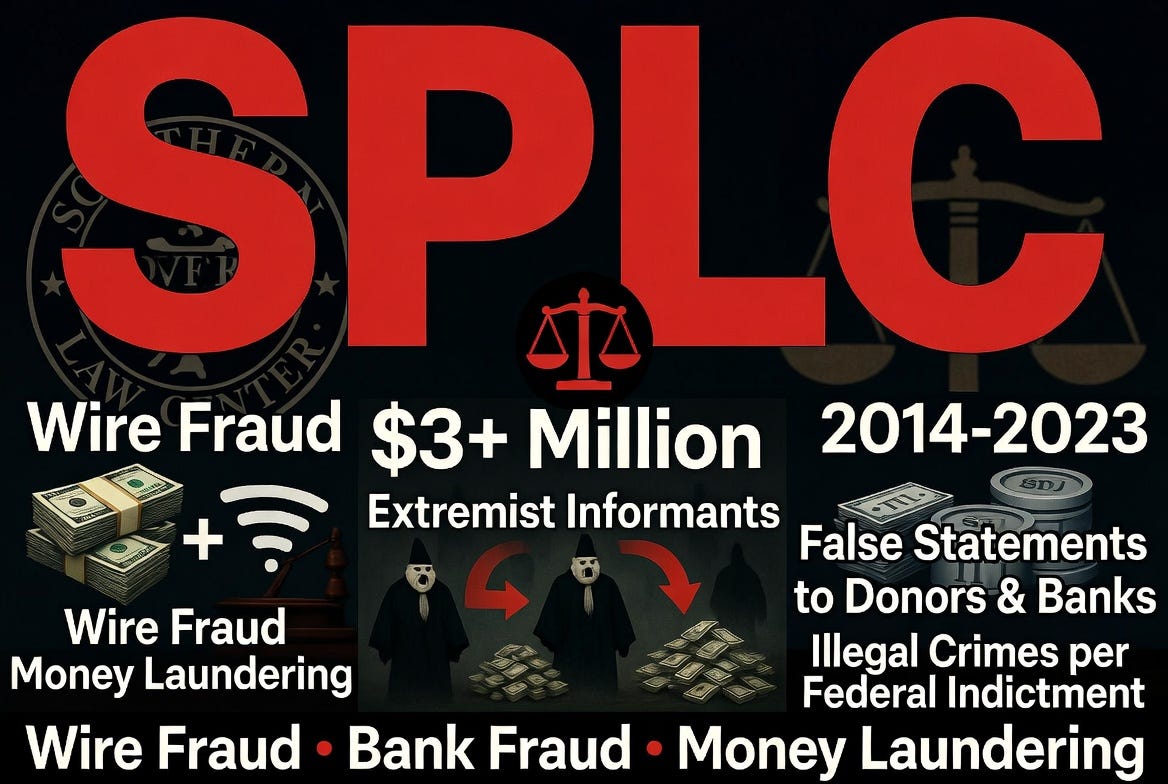
The latest chapter in the ongoing Southern Poverty Law Center saga reads less like a civil rights success story and more like a screenplay rejected by Hollywood for being too implausible.
According to a New York Post report based on a federal superseding indictment, Heidi Beirich, who served as director of the SPLC’s Intelligence Project, allegedly directed approximately $1.2 million in donor funds to a confidential source deeply embedded within the neo-Nazi National Alliance organization.
The twist? Prosecutors allege that the neo-Nazi informant was also her lover, with the two sharing a home and joint bank accounts. Roughly $140,000 of SPLC money allegedly flowed into those accounts and was used for their personal expenses. Ergo: this woman paid a neo-Nazi informant, who was also her boyfriend, and then pocketed the money for her own expenses. That would be called theft or money laundering. The question remains: Was SPLC aware of the fraud?
Did you read that right? Yes, you did. A senior official at SPLC had (has) a “neo-Nazi” boyfriend- who was/is a neo-Nazi and was embedded in a neo-Nazi hate group. She paid him money, which was deposited into a joint bank account, and then helped spend it…

The indictment alleges that the neo-Nazi source remained active within the organization while receiving payments and that the arrangement continued for years.
The broader federal case is even more remarkable. The Department of Justice has accused the SPLC of paying millions of dollars to informants inside various extremist organizations while simultaneously using those same organizations as fundraising targets. Prosecutors allege that more than $4 million ultimately flowed to members and leaders of white supremacist and Klan-affiliated groups.
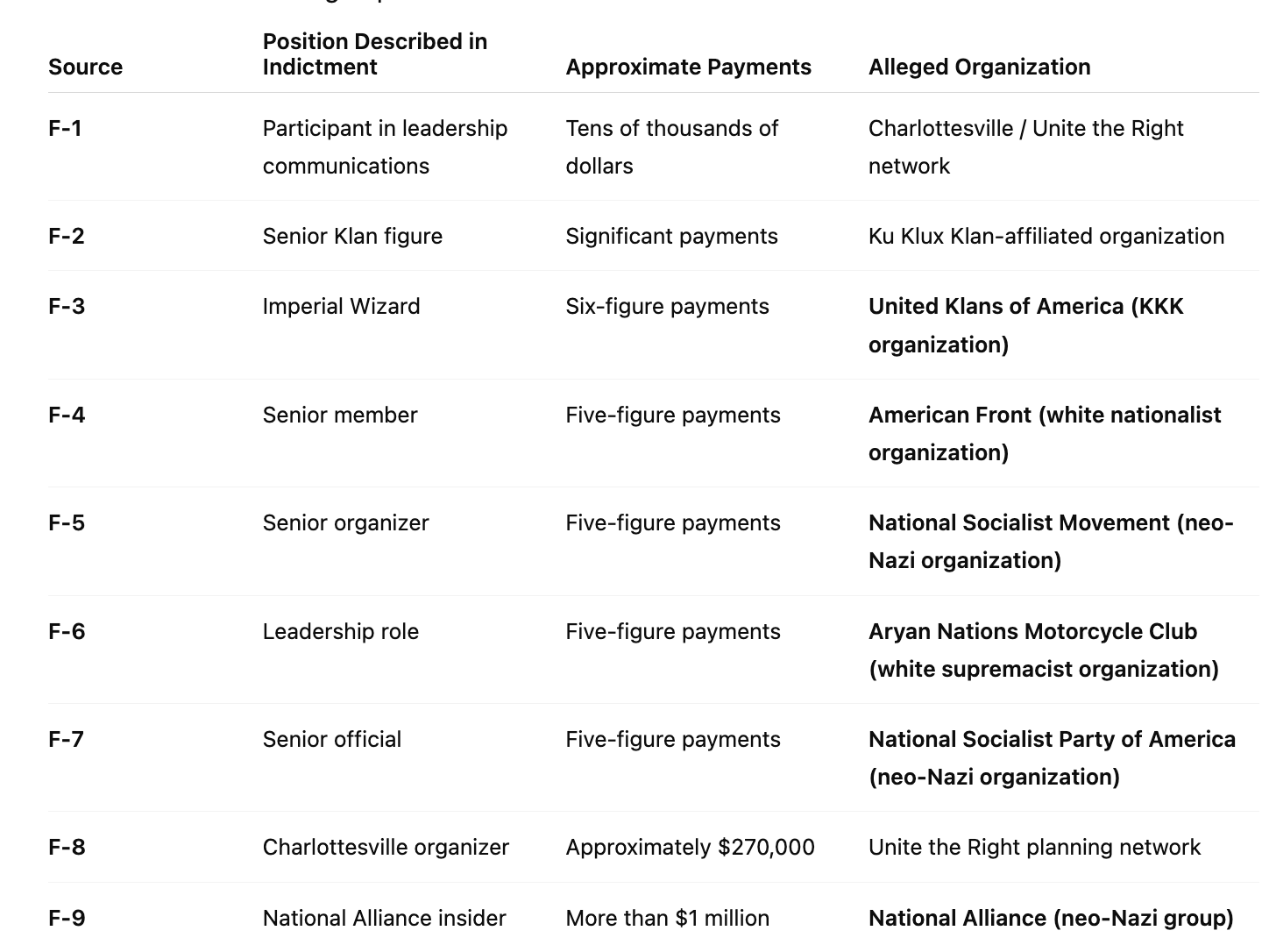
The irony is almost too perfect. Imagine donating money to fight neo-Nazis only to discover your contribution may have helped pay the mortgage of one.
And according to the indictment, it wasn't always some low-level skinhead handing out flyers at a county fair. One of the alleged recipients, identified as F-3, was reportedly an Imperial Wizard of the United Klans of America. That is roughly equivalent to discovering that your anti-smoking charity had secretly put the Marlboro Man on retainer.
Donors likely assumed their checks were funding investigations, research, and exposés. They probably did not envision helping a Klan leader make his truck payment. If these allegations prove true, the SPLC may have stumbled upon the most innovative diversity and inclusion program in nonprofit history: bringing extremists and anti-extremists together through the healing power of shared financial interests. I mean, what could possibly go wrong?
Could the SPLC lose its nonprofit status? Yes. Will it happen automatically because of an indictment? No. The real question is whether prosecutors can prove that what the SPLC calls "intelligence gathering" was actually donor fraud, private benefit, or something inconsistent with a charitable mission. If the government's indictment holds up, the IRS may eventually have to answer a rather awkward question: how much money can a nonprofit funnel to Klan leaders, neo-Nazis, and extremist insiders before it stops looking like a charity and starts looking like a very confusing venture capital fund for extremist organizations?
For decades, the SPLC has built its reputation as America’s premier watchdog of hate groups. The government’s case now raises an uncomfortable question: At what point does infiltrating an organization become subsidizing it? Cause it sure seems like SPLC crossed that line a long time ago.
The story also highlights a problem that extends beyond the SPLC. Entire industries can emerge around identifying threats, monitoring threats, fundraising against threats, and publicizing threats. The temptation is obvious. If your business model depends on finding monsters under the bed, there is always an incentive to make sure the monsters never completely disappear or to even create monsters that you can then expose. Another self-licking ice cream cone.
One thing is already clear: if this were a conservative organization accused of funneling donor money through a romantic relationship to a neo-Nazi operative, the media would be running twenty-four-hour special coverage.
We may have witnessed the emergence of a curious new institution: a privately funded domestic intelligence operation with no badge, no warrant authority, no public oversight, and a marketing department.
At a minimum, Americans should be asking why a nonprofit organization was conducting activities that seem increasingly difficult to distinguish from those of a government informant network. If the SPLC wishes to function as an intelligence service, then perhaps it should be prepared to accept the scrutiny that comes with that role.
The upcoming federal trial is not simply about informants, donor funds, or accounting practices. It is about accountability. According to prosecutors, donor money from a tax-exempt nonprofit may have flowed to Klan leaders, neo-Nazi organizers, and other extremists through a network of paid sources.
Regardless of the outcome, the discovery process is likely to be full of twists, turns, and revelations that even Netflix might reject as unrealistic. And Americans may finally get answers to questions that have gone unasked for decades: How does the SPLC operate? Who does it work with? Who does it answer to? And how much power should any private organization have to monitor, label, and influence the political lives of others?
The bigger question remains: if SPLC-funded individuals were involved in criminal activity, does the organization's responsibility end when the check clears? Informants are one thing. Financially supporting people who commit crimes is another. Somewhere between intelligence gathering and underwriting bad behavior lies a line, and this case may force a jury to decide where that line is.
For years, the SPLC acted as investigator, prosecutor, judge, and jury.
Because somewhere along the way, “monitoring extremism” appears to have evolved into running a small spy agency.
Then there is the case of Heidi Beirich, who did not just creep under a rock after SPLC
After leaving the Southern Poverty Law Center in 2020, Heidi Beirich co-founded the Global Project Against Hate and Extremism (GPAHE), an organization that has effectively continued much of the same anti-extremism work under a new banner. A left-wing extremist group that is collecting large donations to expose “right-wing” extremism.
According to the organization’s most recent IRS filings, annual revenue for fiscal year 2025 was approximately $965,000, almost entirely derived from grants and charitable contributions. The organization reported roughly $1.07 million in net assets.
What is notable is not the size of the organization, but who funds it. Public records indicate support from a collection of well-known philanthropic foundations, including Rockefeller Philanthropy Advisors, Democracy Fund, Wellspring Philanthropic Fund, the Annie E. Casey Foundation, and others. The usual round-up of well-funded, liberal foundations, nonprofits, advocacy groups, and grant-makers that often support similar causes, attend the same conferences, and cite one another's work, and move money through many of the same institutional channels.
In other words, GPAHE is not primarily supported by thousands of small-dollar donors. It appears to operate largely on foundation money.
That may become relevant as the federal case involving the SPLC unfolds.
One of the more interesting questions is whether any of the facts developed during discovery will spill over into public scrutiny of organizations that grew out of the SPLC ecosystem. Discovery has a funny way of doing that. Lawyers start asking questions. Documents get produced. Emails surface. Depositions are taken. People who have spent years asking questions of others suddenly find themselves answering questions instead.
To be clear, GPAHE has not been charged with any crime, nor has Heidi Beirich been charged in connection with the federal case. But given her prominent role in both organizations, it is difficult to imagine that journalists, donors, and investigators will not be paying close attention. And that the DoJ isn’t investigating her as well.
The discovery process alone may prove fascinating. After all, when the people who built careers investigating everyone else suddenly become the subject of investigation themselves, surprises are almost guaranteed.
And as taxpayers have learned repeatedly over the years, intelligence operations have a tendency to grow, expand, and justify their own existence. Apparently, that principle may apply to nonprofits as well.
Yet, much of the liberal press seems oddly uninterested.
Apparently, some hate groups are more special than others.
Most Non-Profits are a money making schemes and have NO REDEEMING VALUE! They just suck the money out of caring uninformed Americans that have empathy for those in need. Unfortunately, those in need received little of the benefits. Time our Congressman in DC wake up.
Most in the medical field fit the bill!
Funny how often those organizations supposedly combating hate seem to sponsor it by attracting hate-filled people. “Hope not Hate” in the UK being one of the worst.