


Audio Version:
When we talk about respiratory infections, we tend to talk about where the disease eventually causes trouble. Influenza can cause pneumonia. RSV can infect the lower respiratory tract. COVID-19 can involve the lungs. Bacterial infections can cause pneumonia and serious systemic illness. But this way of thinking skips one of the most important parts of the story. For many respiratory pathogens, the lungs are not where the infection begins. The first encounter happens considerably farther north, in the nose, nasal passages, throat, and connected sinuses.
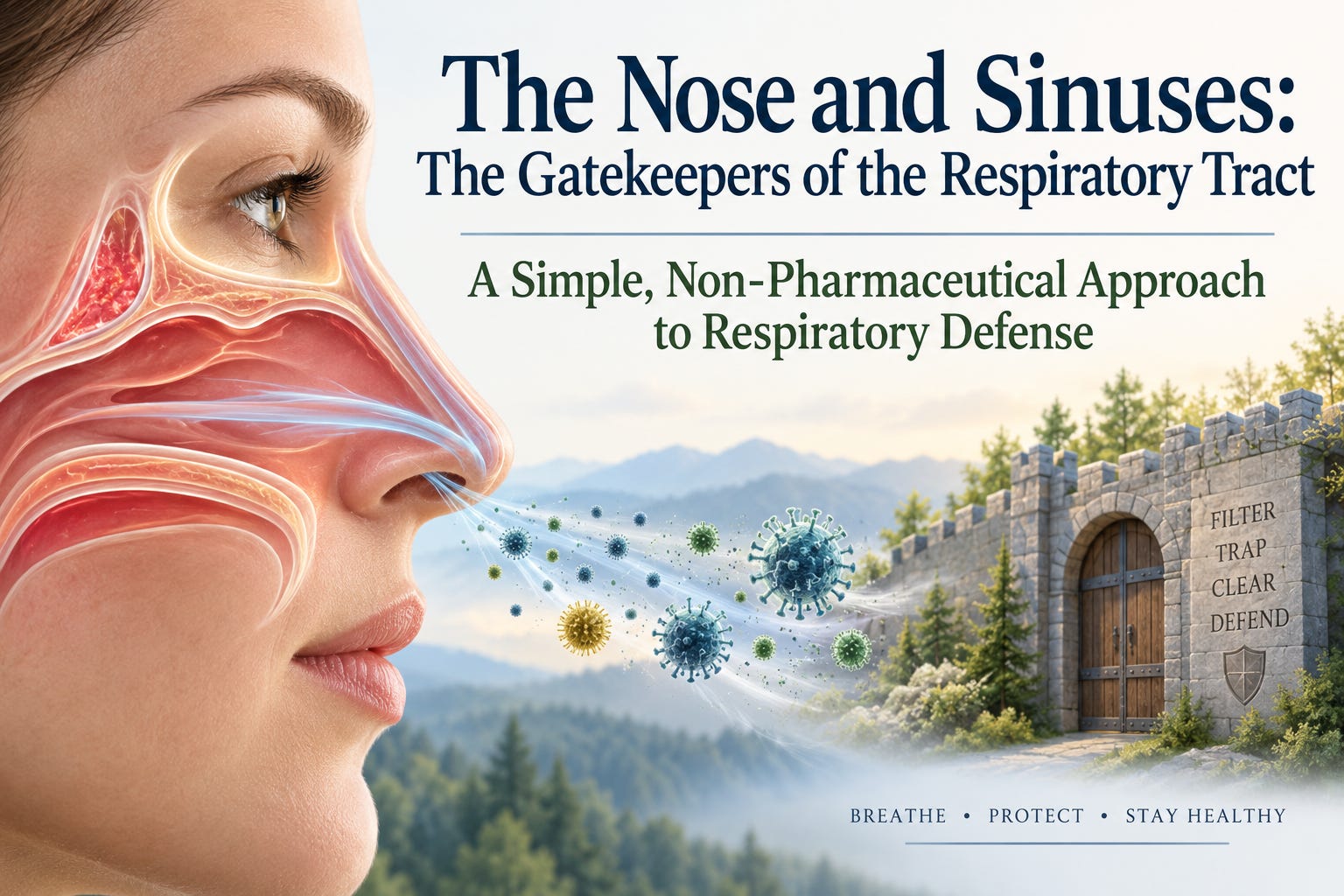
The nose is the primary portal of entry into the respiratory tract, but it is also one of its most important gatekeepers. Every day we inhale thousands upon thousands of particles: dust, pollen, fungal spores, bacteria, viruses and all sorts of microscopic debris. Yet relatively few of these succeed in causing disease. That is because the nose is not simply an open pipe leading to the lungs. It is a remarkably sophisticated biological barrier designed to trap, disable and remove potential invaders before they can establish themselves.
Imagine standing in a room with someone who has influenza. They cough, laugh or simply breathe, releasing virus-containing droplets and tiny aerosols into the air. You inhale some of them. The virus does not magically appear in your lungs or bloodstream. Much of what you inhale first encounters the warm, moist surfaces lining your nose and upper airway. Immediately, a contest begins. The outcome of that contest may determine whether you ever know that encounter occurred.
The first obstacle is surprisingly simple: mucus. We tend to notice mucus only when we have too much of it, but a thin layer covers the nasal passages all the time. It is sticky for a reason. Viruses, bacteria, and particles entering the nose can become trapped in it rather than continuing deeper into the respiratory tract. Underneath this mucus are specialized cells equipped with microscopic hair-like structures called cilia. The cilia beat in coordinated waves, continuously moving mucus and the material trapped within it toward the throat, where it can be swallowed and ultimately destroyed or eliminated. This is called mucociliary clearance, but I prefer to think of it as the respiratory tract’s conveyor belt.
The system is considerably more sophisticated than a sticky filter and a conveyor belt. The cells lining the nose are themselves active participants in immunity. They can recognize molecular signs that a virus or bacterium has arrived and respond by producing interferons and other chemical signals. These signals warn neighboring cells, activate antiviral defenses, and recruit immune cells to the site. Antimicrobial substances are present in nasal secretions, and antibodies, particularly secretory IgA, patrol the mucosal surface where respiratory pathogens first arrive.
This is mucosal immunity, and it is critically important. During COVID-19, enormous attention was focused on antibodies circulating in the blood. Those antibodies matter, particularly in preventing severe systemic disease, but they are not the whole immune system. A respiratory virus generally does not begin by jumping directly into the bloodstream. It lands on a mucosal surface. If we want to understand whether infection becomes established, we have to pay attention to the immunity waiting at the actual front door.
The sinuses are part of this same system. They are air-filled spaces within the bones of the face and skull, lined with respiratory mucosa and connected to the nasal passages through relatively small openings. They produce mucus, have ciliated cells, and participate in the same system of filtration, clearance, and immune surveillance. Under normal circumstances, mucus continuously moves through these spaces and drains into the nasal cavity. The nose and sinuses therefore should not really be thought of as separate organs. They form an interconnected mucosal environment guarding the entrance to the respiratory tract.
But every gatekeeper has vulnerabilities. Suppose a virus succeeds in reaching a susceptible nasal cell and entering it. That one infected cell can become a miniature virus factory, producing new viral particles that infect neighboring cells. The infection begins spreading across the nasal mucosa. Inflammation follows. Blood vessels dilate, tissues swell, and mucus production increases. Suddenly that elegant drainage system does not work quite as efficiently. The small openings connecting the sinuses to the nose can narrow or become obstructed, mucus becomes trapped, and the environment changes.
This is one reason a seemingly ordinary viral cold can sometimes turn into something more complicated. The original infection may be viral, but inflammation and impaired drainage can create conditions in which bacteria that normally inhabit the nose and throat gain an advantage. The viral infection has damaged the gate and disrupted the guards. A secondary bacterial infection can then follow. The same general principle applies farther down the respiratory tract. Influenza, for example, can damage respiratory defenses and make subsequent bacterial pneumonia considerably more likely.
Temperature and humidity also affect these defenses. The nasal passages are cooler than the body's core, which can favor replication of some respiratory viruses while also weakening local antiviral responses. Dry air can further impair the mucus and cilia that normally trap and sweep pathogens away. This may help explain why respiratory infections flourish during winter, when cold outdoor air and indoor heating create particularly dry conditions. Grandma may not have understood interferons or mucociliary clearance, but telling you to keep warm and avoid getting dried out wasn't such bad advice after all.
What is remarkable is how often this system succeeds. We constantly encounter microorganisms that never cause recognizable illness. A virus may become trapped in mucus and swept away. An antibody may bind it before it enters a cell. An infected cell may trigger a rapid interferon response that prevents the infection from spreading. We never count these events because there is nothing to count. Nobody goes to the doctor to report the influenza infection they almost had.
This changes how we should think about respiratory disease. There is an enormous difference between exposure, infection, and disease. Exposure means the pathogen reached you. Infection means it successfully entered cells and began replicating. Disease means that process progressed far enough to produce symptoms or tissue damage. The nose and sinuses sit at the critical boundary between those stages. They are where exposure can either be stopped or allowed to become established infection.
Modern medicine understandably becomes most interested when things go badly. We study pneumonia, respiratory failure, systemic inflammation, and hospitalization because these are the events that kill people. But by concentrating on the end stages of disease, we can lose sight of the biology that determines whether many respiratory infections ever get that far. Before there is pneumonia, there is often a battle in the upper airway. Before a virus reaches the lungs, it frequently must establish itself in the nose or throat. Before the adaptive immune system mobilizes its full response, mucus, cilia, epithelial cells, interferons, antimicrobial molecules and local antibodies are already at work.
The nose and sinuses therefore occupy a rather extraordinary position. They are simultaneously the respiratory system’s most important portal of entry and one of its most important defensive barriers. The same doorway that gives viruses and bacteria access to us is guarded by an elaborate system evolved to keep them out. For most of our lives, that gatekeeping system quietly does its job and we never give it a thought. We tend to notice the nose only when it fails.
Perhaps we should pay considerably more attention to what keeps it working.
Can We Wash the Invaders Away?
Once we understand the nose and sinuses as both portal and gatekeeper, an obvious question follows: can we help that defensive system do its job?
One of the oldest and simplest approaches is nasal lavage. The idea is hardly sophisticated: put saline into the nasal passages and physically wash away mucus, particles, allergens, and at least some of the microorganisms sitting on the mucosal surface. At the same time, saline can help maintain the physical properties of mucus and support the cilia that continuously move material out of the respiratory tract.
For years, nasal irrigation was generally relegated to the category of “probably makes you feel better.” But the evidence has become more interesting. Recent randomized trials suggest that saline nasal sprays or irrigation can modestly shorten respiratory illnesses, reduce nasal symptoms and, in some studies, accelerate the decline in viral load. One very large randomized trial involving almost 14,000 people found that those assigned to use saline nasal spray at the first sign of a respiratory infection or after likely exposure experienced substantially fewer days of illness over the following six months.
This does not mean that you can wash your nose and magically prevent influenza, COVID or RSV. The studies are heterogeneous, not all trials have been positive, and once a virus has entered large numbers of cells, simply washing the surface cannot remove an intracellular infection. But timing may matter enormously. There is a considerable biological difference between trying to reduce the number of viral particles sitting on the nasal surface shortly after exposure and attempting the same thing three days later, after the virus has already replicated millions of times.
Think of it as washing mud off the porch before everyone has tracked it through the house.
There is also growing interest in adding antimicrobial substances to saline. One of the more intriguing is performing nasal washing using a very dilute mixture of saline and hypochlorous acid, or HOCl. Despite the chemical-sounding name, HOCl is not foreign to human biology. Our own neutrophils manufacture it as part of the innate immune response to microorganisms. It is one of the chemical weapons our immune system itself uses against invading organisms. At appropriately low concentrations, HOCl has broad antimicrobial activity against bacteria, fungi, and viruses.
Laboratory experiments using human nasal epithelial cells have found that low concentrations of HOCl can kill or inactivate multiple microorganisms, including influenza A virus, without detectable toxicity to the nasal cells under the conditions tested.
HOCl Has Moved Well Beyond the Laboratory
Hypochlorous acid is not some obscure experimental compound supported by a few laboratory studies. It has accumulated a substantial scientific and clinical literature involving antimicrobial activity, antisepsis, wound care, mucosal use and direct application to human tissues. In 2025, the World Health Organization added an explicit listing for hypochlorous acid solution as an environmental disinfectant to its Model Lists of Essential Medicines for adults and children, importantly distinguishing HOCl from hypochlorite, or bleach.
The clinical literature is substantial. The WHO submission itself summarized 25 publications, including 13 randomized controlled trials, involving applications ranging from infected wounds and diabetic ulcers to surgical infections and direct application to human tissues. The larger literature cited in that submission includes thousands of publications addressing HOCl antimicrobial activity, safety and wound healing.
There is also a US regulatory history that brings this much closer to home. Curativa Bay has an FDA-listed medical device for wound and burn care, intended for both over-the-counter and prescription use. Its indications include minor cuts, lacerations, abrasions and minor burns, including sunburn, and the federal device record classifies it as an “antimicrobial wound irrigation solution.”
In other words, we are not talking about a chemical whose established use is limited to disinfecting countertops. Properly formulated HOCl products are already regulated for application directly to injured human tissue.
But perhaps most relevant to our discussion, HOCl has also been put directly into human noses and studied in randomized clinical trials. A randomized placebo-controlled study of adults with chronic rhinosinusitis that had failed conventional medical therapy compared low-concentration HOCl nasal irrigation with saline for eight weeks. HOCl produced significantly greater improvement in sinus symptoms than saline at several early time points.
Researchers have also studied children with chronic sinusitis. In a prospective randomized trial, both saline and low-concentration HOCl irrigation improved symptoms, but improvement on sinus X-rays was significantly greater with HOCl. The authors concluded that HOCl nasal irrigation was an effective adjunctive treatment for pediatric chronic sinusitis. A separate multicenter, randomized, double-blind trial enrolled 139 patients with perennial allergic rhinitis. Both saline and HOCl irrigation significantly improved symptoms, although HOCl did not outperform saline. Just as importantly for the question of putting HOCl into the nose, investigators reported no clinical side effects attributable to the HOCl irrigation. HOCl nasal spray has also been investigated as an adjunct after functional endoscopic sinus surgery in patients with chronic rhinosinusitis.
So the question is no longer whether dilute HOCl can be used in the human nose. It has been. Nor are we relying solely upon laboratory experiments to argue that nasal exposure is tolerable. We have controlled human studies involving direct nasal irrigation, including adults, children, and patients with chronic inflammatory sinonasal disease.
What we do not yet have is something much more specific: a large randomized trial demonstrating that routine use of dilute HOCl nasal cleansing prevents influenza, COVID-19, RSV or the common cold better than saline alone.
But the data we have also changes the question. We know that the nose is a major portal of entry for respiratory pathogens. We know that saline nasal cleansing can improve mucociliary clearance and has clinical evidence in respiratory illness. We know that HOCl is produced naturally by our own neutrophils as part of innate immunity. We know that properly formulated HOCl has broad antimicrobial activity against bacteria, fungi and viruses. And we now know from randomized human studies that dilute HOCl can be used directly in the nasal passages and has shown clinical benefit in some chronic sinonasal conditions.
So we are no longer starting at square one.
The unanswered question is whether adding HOCl to routine nasal cleansing can help the gatekeepers do something even more important: stop or reduce an acute respiratory infection near the place where it begins.
That study should be relatively easy and inexpensive to do. Which raises an interesting question: given the enormous amounts of money spent developing drugs and vaccines against respiratory viruses, why has comparatively little serious research been devoted to inexpensive interventions aimed directly at the portal where many of these infections first become established?
Why did the government not fund or develop such studies during COVID?
Of course, HOCL is made by our own neutrophils. It is not a drug. It can not be patented. Big pharma has no big interest in the product. So, for some reason, the government has also not been interested in funding such a study. Coincidence? But given what we now understand about the nasal mucosa's role in establishing respiratory infection, I think conducting such a study should be a research priority.
Give the Gatekeepers a Hand
This brings me to something that has become part of our own routine. We brush our teeth because we understand that the mouth is constantly exposed to bacteria. We wash our hands because we understand that our hands pick up microorganisms from the environment. Yet we inhale thousands of liters of air every day, carrying dust, pollen, bacteria, viruses and countless other particles across the mucosal surfaces of our noses, and most of us never give those surfaces another thought.
Given what we now know about nasal cleansing, mucociliary clearance and HOCl, the next question seems rather obvious: why not combine the mechanical benefits of saline nasal cleansing with a very dilute HOCl solution specifically formulated for the nose?
That is the idea behind the Gentle Nose Cleanser made by Curativa Bay, which we use and keep around ourselves. The nasal formulation contains saline and HOCl at approximately 40 ppm, substantially lower than the company’s 200 ppm HOCl skin formulation. It is designed to cleanse and hydrate the nasal passages while adding a low concentration of an antimicrobial molecule that our own immune system produces.
Saline nasal cleansing has clinical evidence behind it. HOCl has an extensive antimicrobial and human safety literature. HOCl nasal irrigation itself has been tested in randomized human trials, including patients with chronic sinusitis and allergic rhinitis. And laboratory studies demonstrate antimicrobial activity against respiratory viruses.
Put those pieces together, and I think HOCL deserves considerably more attention than it receives.
This is also where I part company with the idea that every useful intervention in medicine must begin with an expensive pharmaceutical product. Sometimes biology points us toward much simpler interventions. Supporting the physical and immunological barrier at the place where infection often begins is not particularly glamorous. There is no billion-dollar drug involved. Nobody needs an infusion center. You are simply helping the gatekeeper at the gate.
When we travel, spend time in crowded airports and airplanes, attend large events, or know that respiratory infections are circulating, nasal cleansing has become one of the simple measures we use. I cannot tell you that doing so guarantees that you will not become infected. It doesn’t. Nor should anyone selling a nasal cleanser make that promise.
What I can say is that the scientific case is considerably more developed than “it seems like a good idea.” The nose is a major portal of respiratory infection. Nasal cleansing has a clinical literature behind it. Dilute HOCl has actually been studied in the human nose, including in randomized trials. And HOCl itself has broad antimicrobial activity and an extensive history of human medical use.
That is enough evidence for me to use it routinely, and I do.
The nose is the front door to the respiratory tract. We spend enormous amounts of money dealing with what happens after an invader gets through that door.
Perhaps we should spend a little more effort taking care of the door.
For those interested, the product we use is Curativa Bay’s Gentle Nose Cleanser.

By: RWM
If you find essays like this useful, please consider becoming a paid subscriber. Malone News is reader-supported, and subscriptions allow us to spend the time digging into the scientific literature and asking questions that receive too little attention.
Full disclosure: I am the Chief Medical Officer at Curativa Bay. No, they did not pay me to write this article. I wrote it because I believe in the product. Sometimes a conflict of interest is simply an interest.
References
Little P, Vennik J, Rumsby K, et al. Nasal sprays and behavioural interventions compared with usual care for acute respiratory illness in primary care: a randomised, controlled, open-label, parallel-group trial. Lancet Respir Med. 2024;12(8):619-632. doi:10.1016/S2213-2600(24)00140-1. This large trial provides particularly useful evidence for the saline-nasal-spray portion of the article.
Ramalingam S, Graham C, Dove J, Morrice L, Sheikh A. A pilot, open labelled, randomised controlled trial of hypertonic saline nasal irrigation and gargling for the common cold (ELVIS). Sci Rep. 2019;9:1015. doi:10.1038/s41598-018-37703-3.
Kim HJ, Lee JG, Kang JW, Cho HJ, Kim HS, Byeon HK, Yoon JH. Effects of a low concentration hypochlorous acid nasal irrigation solution on bacteria, fungi, and virus. Laryngoscope. 2008;118(10):1862-1867. doi:10.1097/MLG.0b013e31817f4d34. PMID: 18677274. This in-vitro study used primary human nasal epithelial cells and found no detectable cytotoxicity after exposure to 3.5 ppm HOCl under the experimental conditions. HOCl demonstrated greater than 99% bactericidal or fungicidal activity against most organisms tested and produced a 3.2-log10 reduction in influenza A virus.
Cho HJ, Min HJ, Chung HJ, et al. Improved outcomes after low-concentration hypochlorous acid nasal irrigation in pediatric chronic sinusitis. Laryngoscope. 2016;126(4):791-795. doi:10.1002/lary.25605. This was a prospective randomized trial; both saline and HOCl improved symptoms, while radiographic improvement was greater with HOCl.
Yu MS, Kim BH, Kang SH, Lim DJ. Low-concentration hypochlorous acid nasal irrigation for chronic sinonasal symptoms: a prospective randomized placebo-controlled study. Eur Arch Otorhinolaryngol. 2017;274(3):1527-1533. doi:10.1007/s00405-016-4387-5. PMID: 27853946. Forty-three adults with chronic rhinosinusitis refractory to medical therapy were randomized to HOCl or saline irrigation for eight weeks. The HOCl group showed greater improvement in CRS symptoms than saline, although endoscopic scores and bacterial culture results did not differ significantly.
Kim HC, Kim DK, Kim JS, et al. Hypochlorous Acid Versus Saline Nasal Irrigation in Allergic Rhinitis: A Multicenter, Randomized, Double-Blind, Placebo-controlled Study. Am J Rhinol Allergy. 2022;36(1):129-134. doi:10.1177/19458924211029428. Both groups improved; HOCl was well tolerated but did not significantly outperform saline.
Gutiérrez-García R, De La Cerda-Ángeles JC, Cabrera-Licona A, et al. Nasopharyngeal and oropharyngeal rinses with neutral electrolyzed water prevents COVID-19 in front-line health professionals: A randomized, open-label, controlled trial in a general hospital in Mexico City. Biomed Rep. 2022;16(2):11. doi:10.3892/br.2021.1494. The trial randomized 170 frontline health-care workers; COVID-19 occurred in 1.2% of the rinse group versus 12.7% of controls. The study was open-label and several authors were employees of the product manufacturer, so those limitations should accompany the striking result.
Wang L, Bassiri M, Najafi R, et al. Hypochlorous acid as a potential wound care agent: Part I. Stabilized hypochlorous acid: a component of the inorganic armamentarium of innate immunity. J Burns Wounds. 2007;6:e5. This is a useful foundational paper for explaining that HOCl is part of our own innate antimicrobial defenses rather than simply an industrial disinfectant.
Weiss SJ, Klein R, Slivka A, Wei M. Chlorination of taurine by human neutrophils: evidence for hypochlorous acid generation. J Clin Invest. 1982;70(3):598-607. doi:10.1172/JCI110652. This is one of the classic mechanistic papers establishing production of HOCl by human neutrophils.
Guan H, Nuth M, Weiss SR, et al. HOCl rapidly kills Corona, Flu, and Herpes to prevent aerosol spread. J Dent Res. 2023;102(9):1031-1037. doi:10.1177/00220345231169434.
Dianty R, Hirano J, Anzai I, et al. Electrolyzed hypochlorous acid water exhibits potent disinfectant activity against various viruses through irreversible protein aggregation. Front Microbiol. 2023;14:1284274. doi:10.3389/fmicb.2023.1284274.
Block MS, Rowan BG. Hypochlorous acid: a review. J Oral Maxillofac Surg. 2020;78(9):1461-1466. doi:10.1016/j.joms.2020.06.029.
Del Rosso JQ, Bhatia N. Status report on topical hypochlorous acid: clinical relevance of specific formulations, potential modes of action, and study outcomes. J Clin Aesthet Dermatol. 2018;11(11):36-39.
Burian EA, Sabah L, Kirketerp-Møller K, Gundersen G, Agren MS. Effect of stabilized hypochlorous acid on re-epithelialization and bacterial bioburden in acute wounds: a randomized controlled trial in healthy volunteers. Acta Derm Venereol. 2022;102:adv00727. doi:10.2340/actadv.v102.1624.
Fazli MM, Kirketerp-Møller K, Sonne DP, et al. A first-in-human randomized clinical study investigating the safety and tolerability of stabilized hypochlorous acid in patients with chronic leg ulcers. Adv Wound Care. 2024. doi:10.1089/wound.2024.0040. The broader WHO submission contains numerous additional randomized and prospective human studies of HOCl in wound and tissue applications.
World Health Organization. Hypochlorous acid: antisepsis, disinfection, and wound care. Application to the 2025 WHO Model List of Essential Medicines and Model List of Essential Medicines for Children. The application assembled the extensive HOCl antimicrobial, safety, wound-care and clinical literature discussed in this article.
World Health Organization Expert Committee on Selection and Use of Essential Medicines. The Selection and Use of Essential Medicines, 2025. WHO added aqueous hypochlorous acid at ≥150 ppm to the core Model Lists of Essential Medicines for adults and children as an environmental disinfectant, explicitly distinguishing HOCl from hypochlorite products.
I love Curative Bay products and the skin care has done wonders for me. Based on that I ordered the nasal cleanser as soon as it was available. Love it also. I have no medical background but at 82, I try to avoid prescription meds as much as possible!
My wife and I have been using Xlear in this way for about 5 years when we travel or are out in crowds. I have not gotten anything except Covid once since doing this. My wife has maybe been mildly sick once with a respiratory thing and also gotten Covid. However, neither of us got it from the other when we had it, which was amazing. Neither of us is vaxxed and we treated with IVM & HQ that worked great. I can't be sure but it seems to work.