

Audio Version:
By Dr’s Robert W. Malone and Jill G. Malone
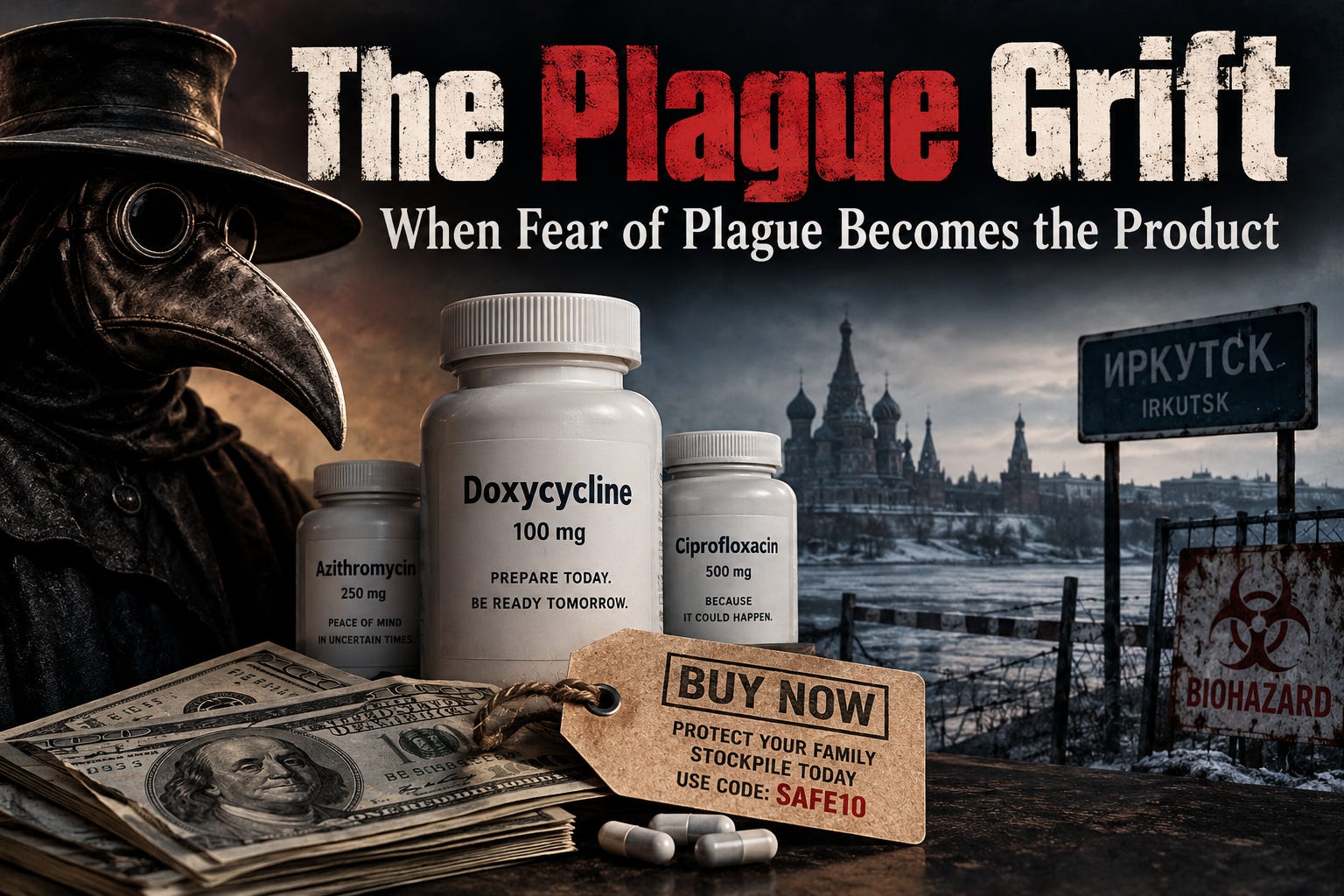
One unconfirmed plague death in Russia. No outbreak. No spread. But the fear merchants in the United States and elsewhere are already selling antibiotics.
A young laboratory worker died in Siberia following a reported laboratory accident. Russian authorities have refused to identify the organism responsible. There has been no confirmed plague diagnosis, no confirmed secondary case, and no evidence of an outbreak spreading beyond the laboratory incident. That is what we know.
What we have instead is a growing national and international panic about engineered plague, biological weapons, and the next pandemic. And wherever there is fear, there are people ready to make money from it. In fact, that panic is even being fueled by some in the conservative media for financial gain.
The death of Darya Shipilova at the Irkutsk Anti-Plague Institute deserves a serious investigation. Reports describe a broken laboratory tube, a delayed diagnosis, and a twenty-eight-year-old woman who died after developing severe pneumonia. Nearly two hundred people were reportedly isolated or monitored. Russian authorities insist the situation is under control but have not disclosed what killed her.
That secrecy has consequences. Inside Russia, people are buying antibiotics. Outside Russia, commentators and companies are turning one unexplained death into a marketing campaign.
The pathogen has not been identified. The sales pitch has.
First, the panic
On October 1, Yandex recorded roughly 14,500 searches for чума, the Russian word for plague. By October 3, that number had reached nearly 685,000, a forty-seven-fold increase in two days. Google Trends showed searches for plague rising approximately 3,200 percent over the previous week. Residents of the Irkutsk region were among the most concerned.
The fear quickly translated into purchases. On October 3, journalists surveyed pharmacies in Irkutsk and nearby Shelekhov and found residents buying antibiotics used to treat plague. Some pharmacies had exhausted their supplies. Others could not obtain replacements. In Shelekhov, pharmacies reported selling out, with no resupply expected before October 5.
There was, and still is, no confirmed outbreak.
People were buying antibiotics because they were frightened, and they were frightened because their government would not tell them what happened. Moscow’s silence had created the very public anxiety its reassurances were supposed to prevent.
But the Russian government is not the only institution taking advantage of uncertainty.
Then came the American salesmen
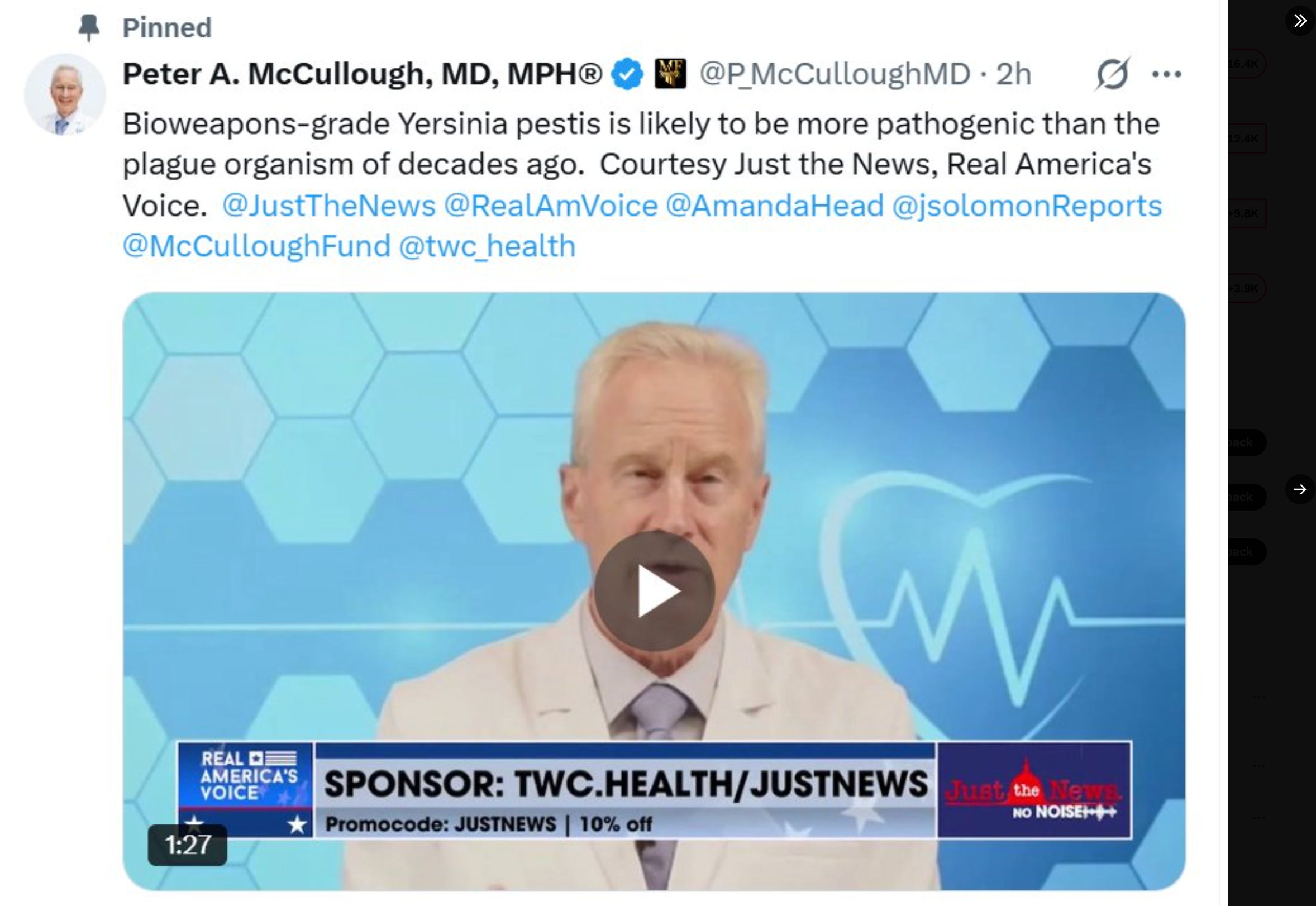
On October 7, Dr. Peter McCullough posted a video stating that “Bioweapons-grade Yersinia pestis is likely to be more pathogenic than the plague organism of decades ago.” His accompanying Substack commentary carried the headline Bioweapons-Grade Pneumonic Plague.
The historical existence of biological weapons research involving plague is not in dispute. What is missing is evidence that the organism involved in Shipilova’s death was engineered, unusually virulent, antibiotic-resistant, or even confirmed to be Yersinia pestis.
No isolate has been publicly identified. No genomic sequence has been released. No evidence of genetic manipulation has been presented.
Yet the words bioweapons-grade pneumonic plague were already in the headline.
There is a commercial connection worth examining. The video appeared on Just the News and Real America’s Voice with a sponsorship banner for The Wellness Company, including a promotional discount. McCullough serves as the company’s chief scientific officer. The Wellness Company sells emergency medication kits containing prescription antibiotics, including doxycycline.
This creates an obvious financial conflict that audiences deserve to understand.
On October 6, CDM Press published an article titled The Plague? A Reminder The Next Pandemic Is Just One Accident Away. The article used the Russian incident to introduce the supposed need to stockpile antibiotics, then directed readers to The Wellness Company’s Medical Emergency Kit.
Two days later, on October 8, Breitbart published an explicitly sponsored article titled The Plague? One Accident Could Spark the Next Pandemic. It promoted the same company’s emergency medication kit, offering readers a $30 discount with a promotional code.
Conservative commentator Grant Stinchfield also released an episode titled Plague Before the Polls?, accompanied by promotion for The Wellness Company’s emergency kit and a personalized discount code.
The company’s kit has been advertised at approximately $300. Its marketing identifies doxycycline as useful for plague exposure, among other conditions.
So, hypothetically, what would one expect to pay for a prescription of doxycycline at a pharmacy?:

There is nothing inherently improper about selling legitimate emergency medical supplies. Antibiotics can save lives when appropriately prescribed, and preparedness is a reasonable subject for public discussion.
But consider the sequence.
One death in a Russian laboratory. No confirmed plague diagnosis. No confirmed spread. No demonstrated threat to Americans.
Within days, American media personalities and commercial outlets were using that incident to promote prescription antibiotic kits.
A woman died in Siberia. Americans are being offered discount codes.
The science doesn’t support the scare
The suggestion that respiratory transmission or antibiotic resistance establishes the biological weapons engineering occurred is scientifically unsound.
In 2013, a naturally occurring pneumonic plague outbreak in Madagascar infected twenty-two people. The responsible strain was resistant to streptomycin through a spontaneous chromosomal mutation. Researchers documented similar mutations arising independently in other natural plague strains. All nineteen patients who received antibiotic treatment recovered; the three who died had not been treated.
Multidrug-resistant Yersinia pestis has also been documented in naturally occurring Madagascar isolates, including strains carrying transferable resistance plasmids.
Antibiotic resistance is not proof of engineering. Neither is pneumonic transmission. And neither characteristic has been established in the Irkutsk incident.
There is a legitimate scientific investigation to conduct. Whole-genome sequencing, examination of resistance determinants, plasmid characterization, and comparison with known natural lineages could help establish what organism was involved and whether anything unusual had occurred.
Russia has not released the information necessary to perform that assessment.
That should be the story. Instead, speculation about weaponized plague is being packaged for an audience already conditioned to expect the next pandemic. Unfortunately, this is coming from conservative media.
The technique is familiar. The headline makes an alarming assertion. The article retreats into possible, consistent with, and cannot be ruled out. The qualifications provide protection when challenged, while the frightening headline does the work of attracting attention and garnering fear.
And sometimes, conveniently, there is a product to buy.
Fear is the product. Antibiotics are the upsell.
There is a difference between warning the public about a demonstrated threat and manufacturing certainty where the evidence supports none. There is also a difference between selling preparedness supplies and using an unexplained death in a foreign country to frighten consumers into purchasing them.
The Irkutsk incident may ultimately prove to be an accidental exposure to a naturally occurring plague organism. It may involve another dangerous pathogen entirely. The Russian government has not provided sufficient evidence to settle the question.
But the uncertainty itself has become commercially useful.
The Wellness Company’s appearance across multiple plague-themed promotions, including explicitly sponsored advertising and personalized discount codes, is not an imaginary connection. It is visible marketing of fear. Whether individual commentators were paid, received affiliate commissions, or simply promoted a company with which they were affiliated is a separate question that deserves disclosure.
The broader pattern is unmistakable. A frightening headline creates urgency. The urgency creates demand. The advertisement offers a solution.
This is not a new business model. Fear has always been profitable. What has changed is the speed with which an isolated incident halfway around the world can be converted into an American sales campaign.
There is one dead laboratory worker in Siberia, no confirmed plague outbreak, and no evidence of an engineered biological weapon. Yet the antibiotic kits are already being advertised with discount codes.
Russia owes the public an explanation of what killed Darya Shipilova. Those alleging biological weapons owe the public evidence. And those exploiting her death to frighten Americans into buying prescription medications need to stop. Disclosure does not excuse the practice. Turning an unconfirmed outbreak into a sales campaign is not public health, not medical preparedness, and certainly not science. It is fear-based marketing, and it is grifting.
So, let’s call it what it is.
Grifting.
Support Independent Investigative Journalism
One unexplained death in Russia, and within days American media outlets were promoting $300 antibiotic kits with discount codes.
That story deserved scrutiny, particularly when the people raising the alarm have commercial relationships with the companies selling the supposed solution.
This is why Jill and I do this work. We follow the evidence, examine the scientific literature, identify the financial interests, and ask questions that others would rather leave unanswered. Even if it sets us up for personal attacks.
If you value independent reporting that follows the evidence and is willing to challenge the fear merchants, including those on our own side of the political divide, please consider becoming a paid subscriber.
The grifters have products to sell. We have questions to answer. Your support keeps us asking them.
References
Echo. (October 2026). “Russians Have Begun Searching for Information About Plague More Frequently.” Russian-language reporting on Yandex search activity following the Irkutsk laboratory incident. https://echofm.online/news/rossiyane-stali-chashhe-iskat-informacziyu-o-chume-v-internete
The Insider. (October 2026). Reporting on antibiotic purchases and pharmacy shortages in Irkutsk and Shelekhov following the reported laboratory death. https://theins.ru/news/297860
McCullough, P. (October 7, 2026). Video commentary concerning alleged bioweapons-grade Yersinia pestis. X.
McCullough, P. (October 2026). “Bioweapons-Grade Pneumonic Plague.” The Focal Points, Substack.
CDM Press. (October 6, 2026). “The Plague? A Reminder The Next Pandemic Is Just One Accident Away.” Article promoting The Wellness Company’s Medical Emergency Kit. https://cdm.press/news/health-freedom/2026/10/06/the-plague-a-reminder-the-next-pandemic-is-just-one-accident-away/
Breitbart News. (October 8, 2026). “The Plague? One Accident Could Spark the Next Pandemic.” Sponsored content promoting The Wellness Company’s emergency medication kit. https://www.breitbart.com/politics/2026/10/08/the-plague-one-accident-could-spark-the-next-pandemic/
Stinchfield, G. (October 2026). “Plague Before the Polls?” Stinchfield with Grant Stinchfield. Podcast episode with promotional messaging for The Wellness Company’s Medical Emergency Kit. https://podscan.fm/player/stinchfield-with-grant-stinchfield/plague-before-the-polls
The Wellness Company. (2026). “Medical Emergency Kit.” Product information describing prescription antibiotics, including doxycycline, and emergency preparedness applications. https://www.twc.health/products/emergency-preparedness-kit
Andrianaivoarimanana, V., et al. (2022). “Pneumonic Plague Caused by Streptomycin-Resistant Yersinia pestis, Madagascar, 2013.” Clinical Infectious Diseases. https://doi.org/10.1093/cid/ciab606
Guiyoule, A., et al. (2001). “Transferable Plasmid-Mediated Resistance to Streptomycin in a Clinical Isolate of Yersinia pestis.” Emerging Infectious Diseases, 7(1). https://wwwnc.cdc.gov/eid/article/7/1/70-0043-t1
Galimand, M., et al. (2006). “Multidrug Resistance in Yersinia pestis Mediated by a Transferable Plasmid.” Research concerning antibiotic-resistance plasmids in naturally occurring plague isolates. https://pmc.ncbi.nlm.nih.gov/articles/PMC1610074/
I noticed The Wellness Company ads immediately and had the same thought. Nothing wrong with their product or availability but the fear mongering to increase sales is so obvious. It has the opposite effect on me…I don’t want to buy anything from them when they do that. I immediately think I don’t need what they’re selling!
It’s sad that every time there’s an accident in a lab, or a virus crawls out of a wet market, or a severe flu season is expected, the first thing we think is an underlying nefarious motive. Not that it isn’t deserved, there’s just a constant reminder how far the American medical establishment has fallen by its own evil deceiving hand.