


The Protein Panic
How a Review Paper Became a Dietary Guideline in Three Days
Within hours of publication, headlines around the world confidently declared that eating less protein could help people live longer:
“Protein Restriction Improves Metabolism and Longevity”
“Rethinking Protein: Less may be more…”
“Eating less protein could slow aging.”
“Less protein may be more for healthy aging.”
“Eat less protein, age better, live longer.”
“Eating too much protein could age you faster.”
“Protein Restriction May Promote Healthy Aging and Longevity”
The news aggregator, Ground.News tracked more than fifty news organizations carrying some version of the story, with many of the top headlines, even in scientific magazines, making outrageous claims. To the average reader, the message was unmistakable. Science had spoken. The advice was simple: eat less protein.
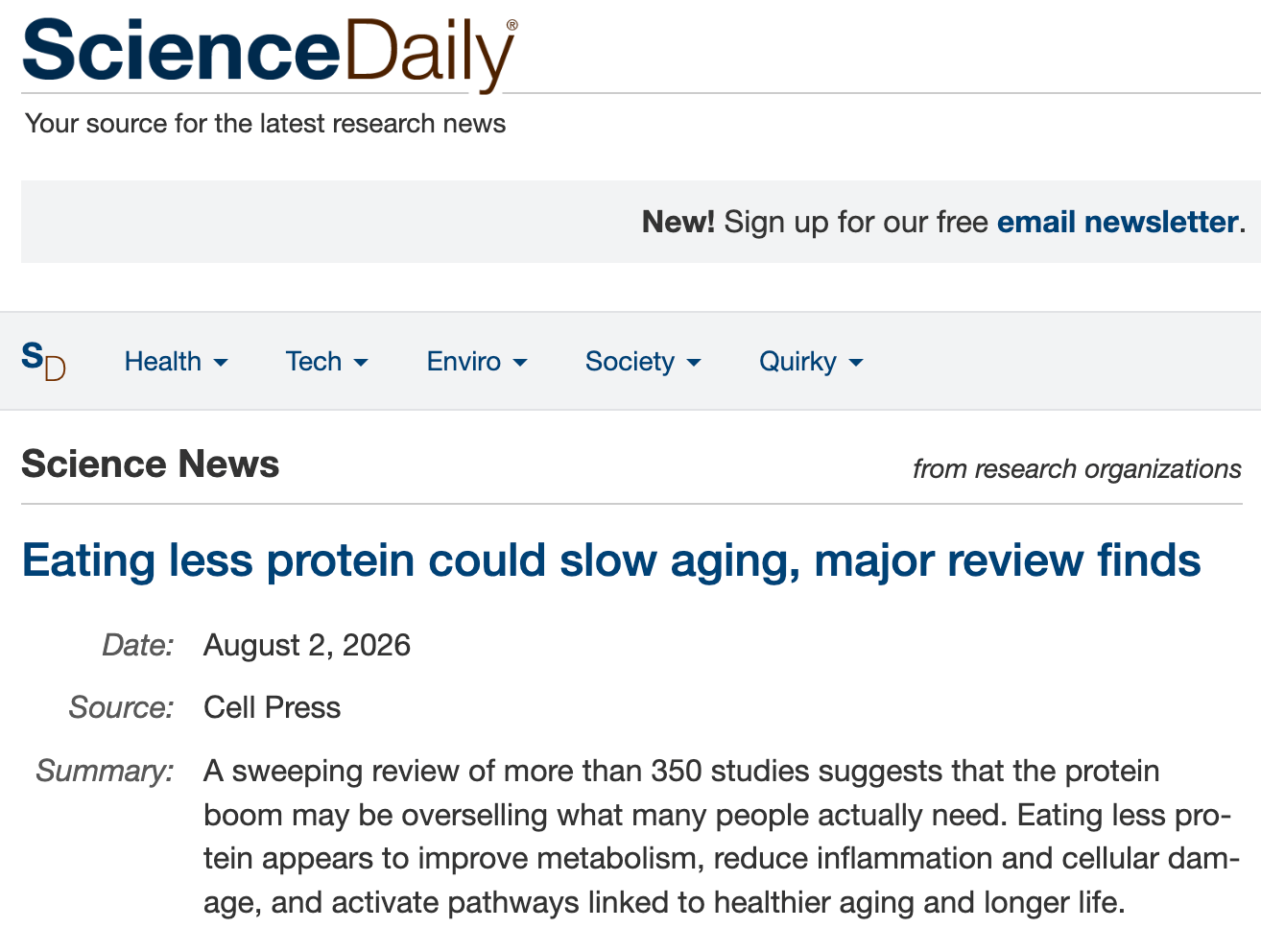
There was only one problem. That is not what the paper actually demonstrated.
The publication was neither a clinical trial, a systematic review, nor a meta-analysis. It presented no new human outcome data. Instead, it was a narrative review, one that assembled existing research into a proposed biological framework the authors called the “hallmarks of protein restriction.”
That distinction matters.
Narrative reviews are designed to generate hypotheses, organize emerging evidence, and stimulate further research. They do not establish clinical practice. Yet within days, an interesting scientific hypothesis had been transformed into what sounded like a new dietary guideline. A guideline that became an article in almost every major news organization in America.
The review contains no long-term randomized human trial showing that reducing protein intake increases lifespan, prevents dementia, reduces fractures, lowers all-cause mortality, or preserves independence in old age. Most of the human studies discussed lasted only a few weeks and measured metabolic biomarkers rather than the outcomes people actually care about: living longer, remaining stronger, and staying healthy.
Even the review itself acknowledges that we still do not know the optimal protein intake for humans across different ages, lifestyles, and health conditions. Yet the lead scientist, Dudley Lamming, stated: “…many people are likely consuming more protein than they actually need, which probably has negative health consequences.”
So that uncertainty virtually disappeared from the headlines. Readers were left with a far simpler message.
“Eat less protein. Live longer.”
Scientific papers do not exist in a political vacuum. They are published into ongoing policy debates, and timing often shapes how they are received. These headlines appeared just as Secretary Robert F. Kennedy Jr.’s new Dietary Guidelines placed renewed emphasis on consuming adequate amounts of high-quality protein, particularly for maintaining muscle mass and metabolic health. While the administration was rolling out these new guidelines, the headlines rapidly turned a speculative scientific hypothesis into what could understandably be interpreted as a rebuttal of the administration’s new nutrition policy.
Whether by coincidence or not, a review suggesting that eating less protein might also increase longevity fits neatly into existing climate and sustainability narratives that encourage reducing consumption of animal-source foods. That context almost certainly made the paper more newsworthy. It also helps explain why a hypothesis-generating review received far more attention than dozens of studies emphasizing the importance of adequate protein intake in older adults.
The truth is that this is hardly the first time the mainstream media has mistaken scientific consensus for scientific certainty. Over the decades, readers have been confidently told to avoid eggs because of cholesterol, to embrace low-fat, high-carbohydrate diets built around the food pyramid, and that statins represented an almost universal solution to cardiovascular risk. During COVID, the same pattern repeated itself as masking, lockdowns, school closures, and other public health interventions were frequently reported with far greater certainty than the underlying evidence justified. In each case, the science continued to evolve while the headlines projected confidence that often exceeded what the data could actually support.
That does not mean every recommendation was wrong. It means the public was repeatedly presented with provisional scientific judgments as though they were settled fact. The lesson from those episodes should have been humility. Instead, we continue to see the same pattern repeated. A provocative hypothesis becomes a confident headline, and the caveats that define good science quietly disappear along the way.
That should concern all of us.
This is how nutritional myths are often born. An intriguing biological hypothesis becomes a review article. The review becomes a press release. The press release becomes dozens of nearly identical news stories. Many such stories are being promoted and paid for by big pharma (ref). At every step, the caveats shrink while the certainty grows. By the time the story reaches the public, a scientific question has become settled wisdom.
That is not how science is supposed to work.
The irony is that the review itself ends on a note of scientific humility. The authors acknowledge that we still do not know the optimal protein intake for humans and that considerably more research is needed. That may be the paper’s most important conclusion.
Unfortunately, it was also the one almost nobody read.
Digging Into What the Paper Actually Proves
Once I sat down and actually read the paper, the disconnect between the headlines and the science became obvious.
The authors are not presenting new clinical evidence. They are proposing a biological framework for thinking about protein restriction and aging. That is a perfectly legitimate scientific exercise. New ideas have to begin somewhere. But a framework is not proof, and a hypothesis is not a clinical recommendation.
The first thing that stands out is where most of the evidence comes from.
Again and again, the review returns to experiments in flies, worms, mice, and rats. Those studies are fascinating. Laboratory animals allow scientists to manipulate individual nutrients, alter specific metabolic pathways, and observe the effects over an entire lifespan. Much of what we know about aging biology began in exactly this way.
But laboratory animals are not people. In fact, rodents have a completely different digestive physiology. They rely heavily on hindgut fermentation, derive more nutrition from microbial metabolism, have dramatically faster metabolic rates, and possess different nutrient-sensing responses.
As a result, a protein-restricted diet that is well tolerated by a mouse cannot simply be assumed to have the same effects in humans, particularly older adults, for whom adequate dietary protein is essential to preserve muscle mass, strength, immune function, and recovery. This is one reason findings from rodent studies should be interpreted cautiously when making dietary recommendations for people.
Nor are they eating anything remotely resembling a human diet.
Many of these experiments rely on highly purified laboratory feeds in which protein or individual amino acids are manipulated to extremes that bear little resemblance to how free-living humans eat. Demonstrating that a genetically homogeneous strain of mice lives longer on one artificial diet than another does not establish that a seventy-year-old woman should eat less fish, eggs, or chicken.
When the discussion turns to humans, the evidence becomes much less convincing.
Most of the intervention studies lasted only a few weeks. They measured fasting glucose, insulin sensitivity, body composition, circulating growth factors, or other metabolic markers. Those are useful biological measurements, but they are surrogate endpoints. They do not tell us whether people actually live longer, remain independent, avoid dementia, suffer fewer fractures, or reduce their overall risk of death.
Modern medicine is filled with treatments that improved laboratory measurements while ultimately failing to improve patients’ lives. Sometimes they even made outcomes worse. Biomarkers help us understand biology. They do not, by themselves, establish clinical benefit.
Another subtle but important problem is that the review often treats several very different interventions as though they were interchangeable.
Reducing total dietary protein is not the same thing as restricting methionine. Restricting methionine is not the same thing as restricting isoleucine or valine. Changing the ratio of amino acids is different again. Comparing plant and animal proteins introduces another entirely separate set of variables. Each of these interventions may influence metabolism differently. Yet by the time the findings are summarized, they frequently become compressed into a single public message: eat less protein.
That is a much broader conclusion than the underlying evidence supports.
There is another issue that receives surprisingly little attention.
Protein never simply disappears from the diet. If calories remain constant, eating less protein means eating more of something else, usually carbohydrate or fat. Any observed benefit could therefore reflect the replacement nutrient as much as the reduction in protein itself. Untangling those effects is one of the central challenges in nutritional science, yet it receives relatively little discussion in the review.
This paper uses observational studies, such as the protein restriction diet of the Okinawa people in Japan, as primary evidence that protein restriction increases lifespan. From the paper:
A quote from the paper: “The hallmarks of protein and amino acid restriction in aging and longevity”:
“…it has been hypothesized that the long lifespan of the Japanese population of Okinawa is due to their diet, which contains about 9% protein and is strikingly similar to that of protein restriction laboratory studies. The Okinawan diet also derives 80% of its calories from plant sources, and individuals generally consume fewer calories overall, making it difficult to assign all of the benefits to the lower protein intake. Nevertheless, these observations support the possibility that protein restriction may promote healthy aging in humans.”
The Okinawan story has often been simplified into “eat very little protein and you’ll live longer.” But the evidence does not support such a straightforward conclusion.
Rather, Okinawan longevity appears to have resulted from an entire lifestyle: remaining lean without chronic undernutrition, being physically active every day, maintaining close social ties, eating mostly minimally processed foods, and benefiting from favorable genetics. Protein intake was one feature of that lifestyle directly after WWII, but there is little evidence it was the primary reason Okinawans live so long. Indeed, the balance of evidence today suggests that adequate protein becomes increasingly important as people age to preserve muscle and function, rather than being something older adults should deliberately restrict
The same caution applies to other observational studies.
People who consume higher-protein diets differ from those who do not in many other ways. They exercise differently, smoke at different rates, have different body compositions, eat different foods, and often differ in socioeconomic status and underlying health. Statistical adjustment can account for some of those differences, but it cannot eliminate them all. Observational studies are valuable for generating hypotheses. They are much less reliable for proving causation.
Perhaps the paper’s greatest weakness, however, is not what it includes, but what it largely leaves in the background.
Protein is not simply another source of calories. For older adults, it is the primary nutritional defense against the progressive loss of lean muscle mass.
That matters because sarcopenia is far more than a cosmetic problem. Loss of muscle increases the risk of falls, fractures, frailty, hospitalization, disability, and death. Muscle also serves as a critical metabolic reserve during illness, surgery, and recovery. Any recommendation encouraging older adults to broadly reduce protein intake must confront those risks directly. This review largely does not.
None of this means the paper lacks value. On the contrary, it highlights several genuinely important questions. Protein quality matters. Individual amino acids may influence aging differently. Nutrient-sensing pathways such as mTOR, IGF-1, and FGF21 deserve continued investigation. The optimal protein intake may well differ according to age, activity level, metabolic health, and disease.
Those are worthwhile scientific questions.
They are simply not the same thing as demonstrating that reducing protein intake will help humans live longer.
That remains a completely unanswered question.
The Bigger Failure
There is nothing inherently wrong with publishing a provocative hypothesis.
Science advances by asking difficult questions, challenging established assumptions, and proposing new ways of thinking about old problems. If this review encourages more rigorous research into how specific amino acids influence aging, then it will have made a valuable contribution.
The failure came afterward.
Somewhere between peer review and the evening news, a hypothesis became a conclusion.
The review became a journal press release. The press release became dozens of nearly identical news stories. At each stage, uncertainty diminished while confidence increased. Caveats quietly disappeared. By the time the story reached millions of readers, a paper exploring biological mechanisms had become what sounded like a new clinical guideline.
Prestigious journals occupy a unique position in public life. Their influence extends well beyond the scientific community. That influence carries responsibility. Publishing an interesting hypothesis is one thing. Allowing it to be promoted as though it had rewritten clinical nutrition is something else entirely.
Authors share that responsibility. Scientists should be enthusiastic about their work, but they also have an obligation to distinguish between what their research demonstrates and what it merely suggests. The review itself is appropriately cautious in its conclusions. The public messaging surrounding it was considerably less so.
The media completed the transformation.
Modern science reporting has increasingly become an exercise in amplifying press releases rather than critically evaluating evidence. The hierarchy of evidence quietly disappears. A narrative review becomes “new research.” Animal experiments become dietary advice. Biomarkers become clinical outcomes. Before long, an interesting biological hypothesis is presented as though it had already rewritten clinical practice.
We have seen this before.
During COVID, mechanistic studies, observational analyses, computer models, and laboratory experiments were repeatedly reported as though they carried the same weight as randomized clinical trials. The distinction between generating a hypothesis and proving one gradually disappeared. We were promised that the scientific community would learn from that experience.
Instead, here we are again.
Different topic.
Same pattern.
A review article proposes an intriguing hypothesis.
A journal press office emphasizes the most provocative interpretation.
Dozens of news organizations repeat it with little independent scrutiny.
Within days, the public is told that “science says” something the underlying paper never actually demonstrated.
The timing makes this story even more consequential. Only days earlier, Secretary Robert F. Kennedy Jr. had unveiled one of the most significant revisions to federal dietary guidance in decades, placing renewed emphasis on consuming adequate amounts of high-quality protein, particularly for preserving muscle mass and metabolic health as Americans age.
Against that backdrop, headlines proclaiming that eating less protein could help people live longer can be interpreted as mainstream media’s rebuttal to the administration’s new nutritional guidance. Is this due to journalists and editors having an extreme case of TDS, which has morphed into a hatred of Secretary Kennedy and MAHA? Or is it due to the influence of Big Ag and Big Pharma on mainstream media? You decide.
Ironically, the paper’s most important conclusion was the one almost nobody read. Near the end, the authors acknowledge that we still do not know the optimal protein intake for humans across different ages, lifestyles, and health conditions. More research is needed. That is exactly the kind of scientific humility readers should expect from a review article.
Unfortunately, humility does not generate clicks.
The real lesson here has very little to do with protein. Next month it will be another nutrient. Next year it will be another supplement, another observational study, another review article. The pattern remains remarkably consistent. A hypothesis becomes a press release. The press release becomes headlines. The headlines become conventional wisdom, even scientific “fact.” Only years later, after better evidence accumulates, does the public discover that the original story was never nearly as certain as it sounded. We should have learned that lesson during COVID. Apparently, we are still learning it.
That should concern every scientist.
It should concern every physician.
And it should concern every person who still believes medicine ought to be guided by evidence rather than headlines.
JGM
If you’ve made it this far, thank you.
One of the reasons we started writing on Substack was because we became convinced that the most important stories are often not the headlines themselves, but what lies beneath them. Reading the original papers, checking the references, separating evidence from interpretation, and following the science wherever it leads takes time. It is work that many newsrooms no longer have the resources, or sometimes the inclination, to do.
That is what we try to provide here.
If you value independent analysis that goes beyond the press release, please consider becoming a paid subscriber. Paid subscriptions make this work possible. They allow us to spend days digging into the primary literature, filing FOIA requests, traveling to interview the people at the center of these stories, and publishing without advertisers or corporate sponsors dictating what can and cannot be covered.
Independent journalism survives only because readers decide it is worth supporting.
If you believe careful analysis still matters, I hope you’ll join us.
JGM/RWM
My direct ancestors, who lived on a farm in Virginia, ate beef, drank whole milk (that tasted like garlic in the spring when the cow was eating wild onions), smoked hams with saltpeter, canned vegetables for the winter and only had fresh fruit in-season. They almost exclusively lived into their nineties. Not a single one of them had a mammogram, a colonoscopy, or a PSA test. Nor did they have a clue about their cholesterol level or A1C. Basically, they just tried to survive and were thankful they had food. I'm so weary of being bullied into altering my diet because of some scientist's agenda that most certainly involves financial incentives. I believed the lie about the food pyramid when I was in nursing school in the 70's but after the last six years, I am suspicious of everything coming out today with the narrative "studies show."
“Whether by coincidence or not, a review suggesting that eating less protein might also increase longevity fits neatly into existing climate and sustainability narratives that encourage reducing consumption of animal-source foods.” Doc you are being too kind. When it comes to establishment narratives, there are no coincidences. For example when heuristic evidence indicated Ivermectin and Hydroxychloroquine were observed to be effective treatments against Covid, that didn’t support the establishment narrative, so the media ignored reporting on that and promoted lies that led in the opposite direction. Let’s just say they intentionally twisted this paper to fit their narrative…again. It’s what they always do.