

Every so often, a paper comes along that does more than add another data point. It forces you to reconsider the assumptions sitting quietly underneath modern medical practice. This newly published study in Molecular Psychiatry is one of those papers.
This large U.S. study of over 6 million pregnancies found that commonly prescribed medications that interfere with cholesterol synthesis during pregnancy were associated with a roughly 47 percent increased risk of autism in offspring.
Roughly 11 percent of pregnant women were prescribed at least one of these drugs found to be linked to Autism.
Autism was diagnosed in 3.8 percent of children overall
That rate rose to about 5 percent in exposed pregnancies
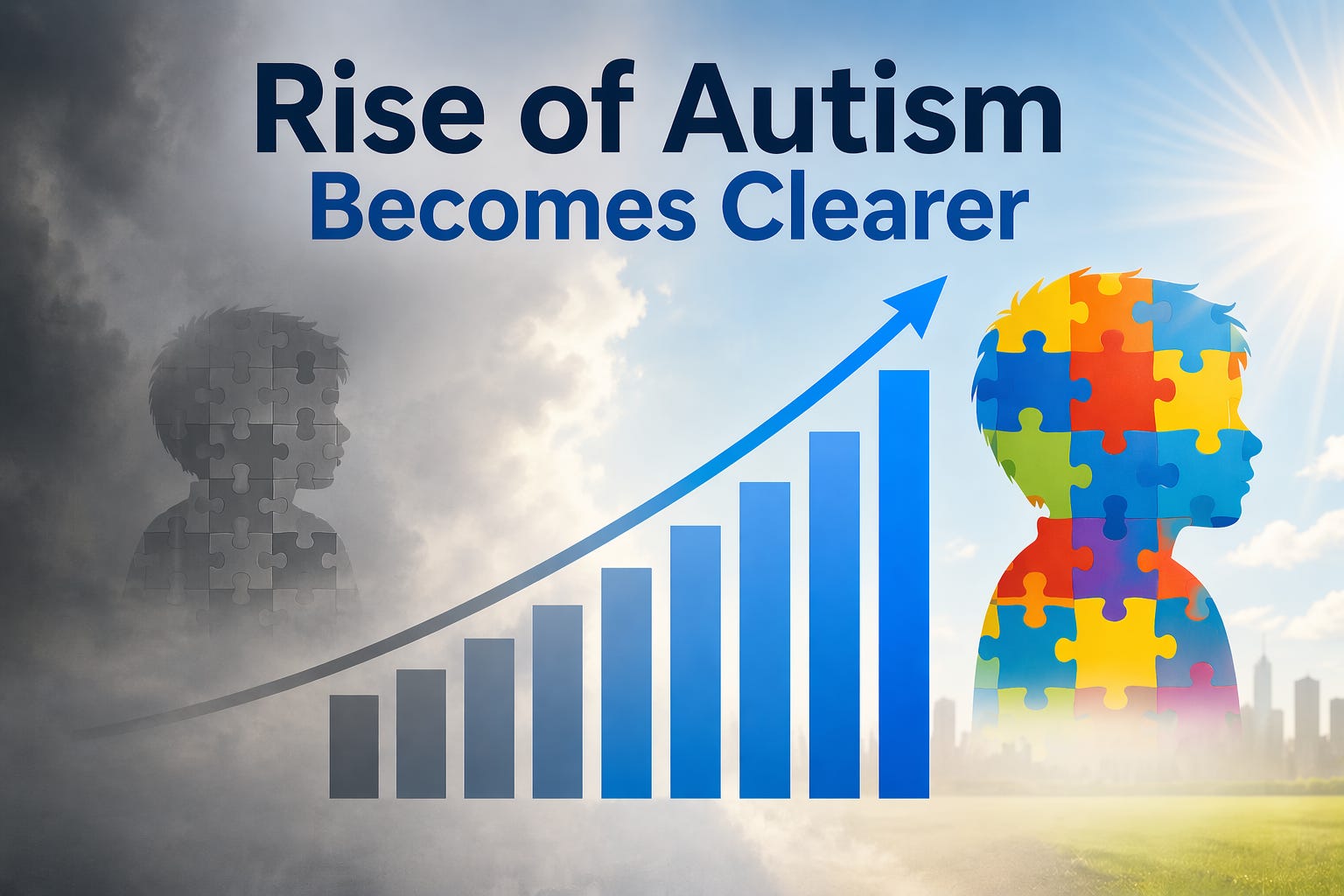
Use of these medications increased from 4.6 percent of pregnancies in 2014 to 16.8 percent in 2023
And importantly, this is not a niche exposure.
If you take the findings at face value and run the numbers, the scale becomes harder to ignore. In this dataset of 6.1 million pregnancies, about 11 percent of women were exposed to these drugs, and the autism rate rose from roughly 3.7 percent in unexposed pregnancies to about 5 percent in exposed pregnancies. That difference of about 1.3 percentage points translates into roughly 9,000 to 9,500 additional autism cases within the study cohort alone.
Because this dataset represents about one third of U.S. births over the same time period, a simple extrapolation suggests on the order of 25,000 to 30,000 additional autism cases nationally over the past decade, or roughly 2,500 to 3,000 per year.
These drugs have been on the market for much longer, and most have been prescribed during pregnancy for decades. This increase in autism cases in this study only documents the rise seen during the last decade, as these drugs have increased in use.
The drugs involved are among the most commonly prescribed in medicine:
SSRIs: fluoxetine, sertraline
Antipsychotics: aripiprazole, haloperidol
Beta blockers: metoprolol, propranolol, nebivolol
Statins: atorvastatin, simvastatin, rosuvastatin, pravastatin
Others: trazodone, bupropion, buspirone
Roughly 11 percent of pregnant women were prescribed at least one of these drugs.
Different purposes. Different specialties. Same underlying biochemical effect.
They interfere with cholesterol synthesis.
At first glance, the question seems almost too simple. What happens when pregnant women are prescribed medications that interfere with cholesterol synthesis? It is the kind of question that should have been asked long ago. Instead, it has largely been ignored.
Cholesterol has spent decades cast as the villain in modern medicine. Lower it. Block it. Suppress it. That messaging has become so ingrained that it is rarely questioned. But that framing collapses when you look at fetal development. Cholesterol is not optional. It is fundamental. It is required for cell membranes, myelination, synapse formation, and the signaling pathways that guide brain development. The developing brain is one of the most cholesterol-dependent systems in biology.
We already know what happens when that system is disrupted. Genetic disorders that impair cholesterol synthesis provide a clear window. In Smith-Lemli-Opitz syndrome, where the final step of cholesterol production is impaired, developmental abnormalities are common, and autism is frequently part of the picture. Roughly three quarters of affected individuals meet criteria for autism spectrum disorder. That is not a subtle signal. It is a strong biological precedent.
What this new paper proposes is uncomfortable in its simplicity. What if we have been recreating a version of that same disruption, not through genetics, but through routine pharmacology?
The authors examined a class of medications that share a common effect. They interfere with sterol biosynthesis. These are not obscure or rarely used drugs. They include SSRIs such as fluoxetine and sertraline, antipsychotics such as aripiprazole, beta blockers such as metoprolol and propranolol, and statins such as atorvastatin and simvastatin. They are among the most commonly prescribed medications in the United States. They are part of everyday clinical practice.
The scale of the study matters. More than six million pregnancies were analyzed, spanning all fifty states over nearly a decade. This is not a narrow or selective dataset. If a consistent pattern appears here, it is unlikely to be dismissed as statistical noise.
And a pattern does appear. Exposure to at least one of these medications during pregnancy was associated with a forty-seven percent increase in autism diagnoses in the offspring. That alone would draw attention. What makes the finding more difficult to ignore is what comes next. The risk increases as more of these medications are used together. By the time four or more are prescribed concurrently, the signal more than doubles.
That is not random variation. It is a dose response pattern. The more the pathway is disrupted, the stronger the signal becomes.
At the same time, prescribing patterns have been moving steadily in the opposite direction of caution. The proportion of pregnant women receiving at least one of these medications increased from 4.6 percent in 2014 to 16.8 percent in 2023. That is a profound shift in how pregnancy is managed. What was once approached with restraint is now approached with increasing pharmacologic intervention.
What makes this study particularly compelling is the convergence of its findings. These medications differ in their primary purpose.
Some treat depression.
Some manage blood pressure.
Some target lipid metabolism.
They are chemically distinct and clinically unrelated. Yet they share one biochemical effect. They interfere with cholesterol synthesis. The signal tracks with that shared mechanism.
That raises a difficult question. Are we looking at a collection of unrelated associations, or are we seeing the imprint of a single disrupted pathway?
The standard response is to invoke confounding. Maternal depression, anxiety, metabolic disease, and other underlying conditions are all associated with developmental outcomes. That is true, and it must be considered. But those conditions do not all converge on a single biochemical pathway. These drugs do. The consistency of the signal across different drug classes suggests that something more fundamental may be at work.
This paper identifies a biologically plausible mechanism, demonstrates a large-scale population signal, and shows that the signal strengthens with increasing exposure.
There is also a quieter point embedded in the paper. Many of these medications already carry warnings regarding pregnancy. Those warnings exist, but they are often buried in dense labeling and rarely translated into clear discussions about developmental biology. For many of these drugs, there is no warning label about ingesting them during pregnancy. The conversation is usually reduced to a simple phrase. The benefits outweigh the risks. Sometimes that is true. But that statement is not the same as saying there is no risk. And as it turns out, the benefits of these drugs most likely do not outweigh the risks, and tens of thousands of our children are paying the price for that bad advice.
Who is responsible for that bad advice? Who will make it right for these kids and their families? Certainly not the pharmaceutical companies, which profited from prescription sales of these drugs during pregnancy. Profits that amount to billions of dollars for Big Pharma.
What this study ultimately does is reopen a question that should never have been closed. If you interfere with one of the most fundamental building blocks of human development, why would you expect there to be no downstream consequences?
Medicine has seen this pattern before. A widely accepted practice persists for years, sometimes decades, before its risks are fully understood. Because modern medicine is often not as benign as physicians and large pharmaceutical corporations like to pretend it is.
What happens next depends on whether we are willing to follow the answer wherever it leads.
JGM/RWM
The one thing that I didn't see accounted for was vaccine record. If this study was able to account for vaccine records of either child or mother, we could then see if these drugs are still associated with autism or not. The only reason vaccines are called out is because they're the one procedure every child gets, so it could also play a factor in ASD: https://unorthodoxy.substack.com/p/stop-calling-it-autism-start-calling
It seems we live in a world where Big Pharmaceutical is perfectly allowed to treat human life as test subjects in their human trials. How do you go up against these massive companies and prove they harmed your new born? With nearly full immunity to any and all liability, and companies that mainly just seek profit, what other result could be possible. As we see Big Pharma is not alone in getting away with killing, harming or robbing people or children, this is the world we live in. It seems there are multiple tiers of justice depending on a persons wealth, status or just who they know. I think it’s way overdue that Big Pharma loses its immunity. Delegating justice to people and businesses that harm others, especially infants and families, is the first step in fixing this broken system.
This is a heartbreaking true video of Big Pharma harming infants, killing a family, with no consequence.
https://www.facebook.com/share/v/18JDbSsiRp/?mibextid=wwXIfr