

Audio Version:
By: Dr.s Jill Glasspool Malone and Robert W. Malone
“In fourteen hundred ninety-two, Columbus sailed the ocean blue.”
In the 1960s, when I was a child in elementary school, California was enjoying its golden years. Agriculture was thriving, vast cattle ranches still dotted the arid landscape, and the aerospace industry was reaching extraordinary heights. Hollywood was the undisputed capital of American moviemaking, and the state’s population and economy were growing by leaps and bounds. Brand new, uncrowded freeways made it easy to get around. California represented the best and brightest of America, a place of opportunity, innovation, ambition, and seemingly limitless possibilities. People from around the world looked to California as a symbol of what America could accomplish. There was a palpable sense of optimism about the future, a belief that hard work, ingenuity, and determination could make almost anything possible.
I grew up in Goleta, on California’s Central Coast, where Spanish heritage was woven into the landscape, the architecture, the place names, and the history we learned in school. We studied the Spanish missions, the California vaqueros, the great ranchos, and the Chumash Indians who had inhabited the region long before Europeans arrived. We learned about the hardships and injustices experienced by the Chumash, but we also learned about the explorers, missionaries, ranchers, and settlers who shaped California. I remember reading Richard Henry Dana Jr.’s Two Years Before the Mast, with its vivid descriptions of life aboard a sailing ship and the California coast in the 1830s. These stories brought our local history to life. They gave us an appreciation for the people who came before us, the hardships they endured, and the extraordinary changes that had transformed California into the place we called home.
And, of course, we learned American history. We learned about Christopher Columbus and his three small ships, the Niña, the Pinta, and the Santa María, sailing across the vast Atlantic in 1492. We learned about Spain’s role in the voyages of discovery, the European settlement of the Americas, the thirteen colonies, the American Revolution, and the founding of the United States. These stories were taught with a sense of wonder and pride. We were encouraged to admire the courage of explorers, the determination of pioneers, and the extraordinary accomplishments of the men and women who helped build this nation. We learned that America was a land of opportunity, a country founded on the ideals of liberty and self-government, and a place where ordinary people could aspire to extraordinary things.
That education gave us something important. It gave us a connection to our history, a sense of belonging, and pride in the country we had inherited. It taught us that America was worth appreciating, worth defending, and worth improving. It gave us patriotism, not as a political slogan or an obligation imposed from above, but as something that grew naturally from learning about the people, events, sacrifices, and achievements that had made our country possible.
The Columbus I learned about in elementary school was a navigator who crossed an immense ocean in three small wooden ships, undertaking a voyage whose outcome was anything but certain. We memorized the familiar rhyme, learned the names of the ships, and imagined what it must have been like to sail westward into waters that few Europeans had ever crossed. We were also taught about the people who already inhabited the Americas, the Spanish missions, and the hardships and injustices of colonization. We were instructed to read “Ishi in two worlds,” the heartrending story of one of the last remaining Native Californians to grow up outside the surrounding Anglo-Spanish-American culture. Learning about those darker chapters did not prevent us from appreciating the extraordinary accomplishments that had shaped the world we inherited.
Today, the educational emphasis is quite different. The Pulitzer Center distributes classroom materials that explicitly seek to reframe American history around 1619 and the institution of slavery.
Launched by The New York Times in 2019, the 1619 Project seeks to reframe American history around the arrival of enslaved Africans in colonial Virginia rather than the founding of the United States in 1776. Its central premise is that slavery and its legacy are fundamental to understanding virtually every aspect of American society. What began as a magazine publication has grown into a substantial educational enterprise, supported by the Pulitzer Center, with more than 100 curricular resources, a national network of more than 400 educators across 30 states, professional-development conferences, and classroom materials extending from elementary school through law school. Its original educational guides reportedly received more than one million accesses during their first five years.
The American Federation of Teachers (AFT), led by Randi Weingarten, has actively promoted the project through its Share My Lesson platform and partnered with the Pulitzer Center to distribute teaching resources. This is no longer simply a controversial interpretation of American history. It is an organized effort to influence how American history is taught, supported by educational institutions, philanthropic funding, and a major national teachers’ union. The concern is not that children are learning about slavery, which is an essential part of American history, but that a contested interpretation placing racial oppression at the center of America’s origins is being promoted as a foundational framework for understanding the country and its institutions.
The Pulitzer Center identifies Meta, Open Society Foundations, Rockefeller Brothers Fund, and several other philanthropic organizations among supporters of its 1619 education initiative
California’s own Ethnic Studies Model Curriculum directs attention toward colonialism, systemic oppression, and social transformation. Educational organizations publish elementary-school lessons encouraging children to reconsider the celebration of Columbus. These are not imaginary controversies invented by political commentators. The materials are publicly available, and their authors openly describe the changes in historical interpretation they seek to promote.
There is an important difference between teaching children that Columbus and America’s founders were imperfect men, sometimes responsible for grave injustices, and teaching American history through an interpretive framework in which exploitation and oppression occupy the center of the national story. The first expands historical understanding. The second raises legitimate questions about how the nation’s achievements, founding ideals, and historical failures are weighed against one another. What children learn to admire, what they learn to condemn, and what they learn to regard as their national inheritance will influence how they understand the country in which they live.
And what are the results of this re-educational programming?
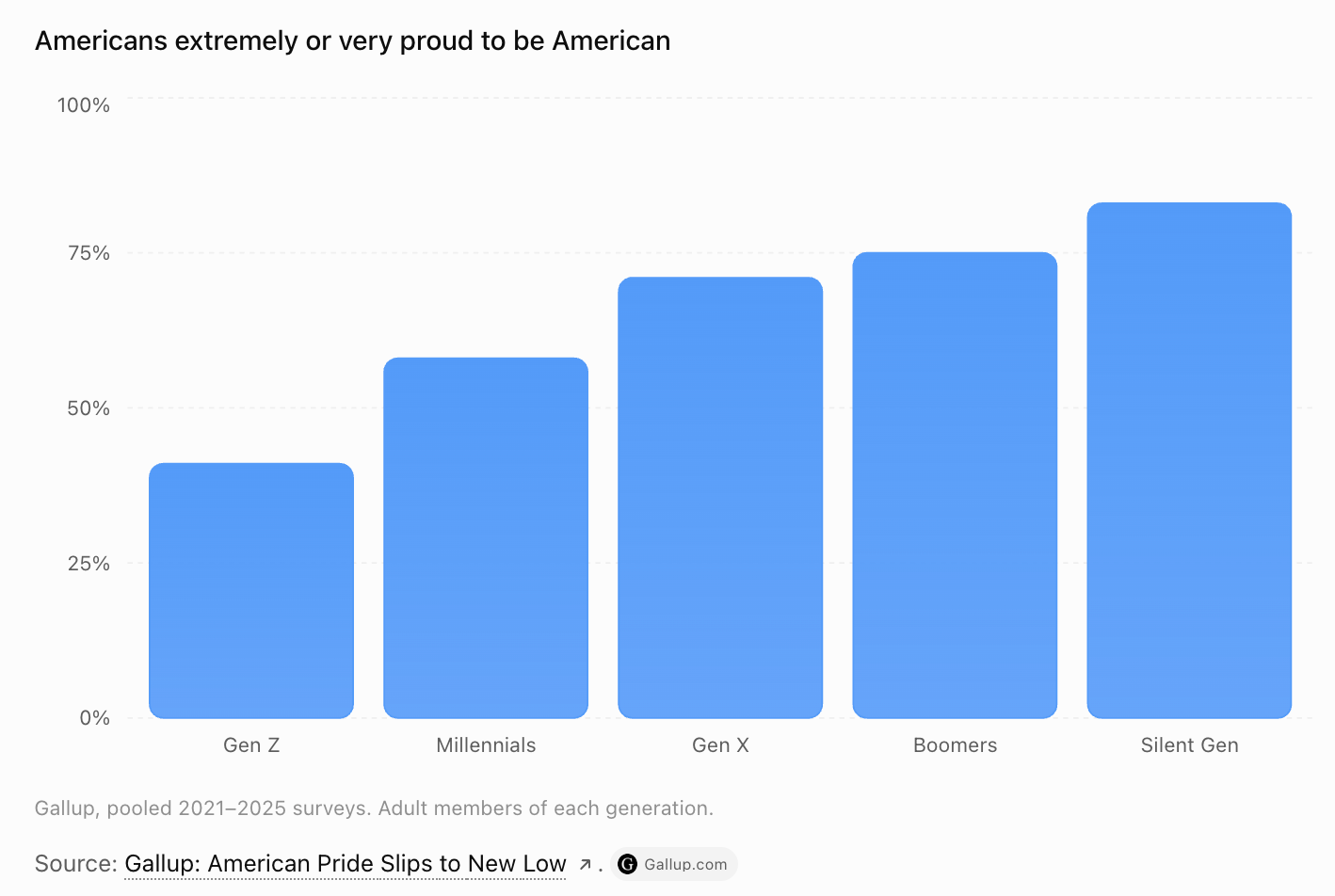
The generational divide is striking. According to Gallup’s analysis of surveys conducted between 2021 and 2025, only 41 percent of Generation Z adults described themselves as extremely or very proud to be American, compared with 75 percent of Baby Boomers and 83 percent of the Silent Generation. These numbers raise an important question about the relationship between what children are taught and how they eventually regard their country. For generations, American schools emphasized the nation’s founding ideals, its achievements, and the responsibilities of citizenship, alongside its historical failures. American schools taught Americanism, a belief in the greatness of America.
The change extends beyond national pride. A September 2020 Pew Research Center survey found that 86 percent of Black adults believed America had not done enough to secure racial equality, up from 78 percent just a year earlier. Nearly two-thirds reported recently educating themselves about the history of racial inequality.
In 2020, 86% of black and Hispanic adults said that the country hasn’t done enough to address racial inequality.
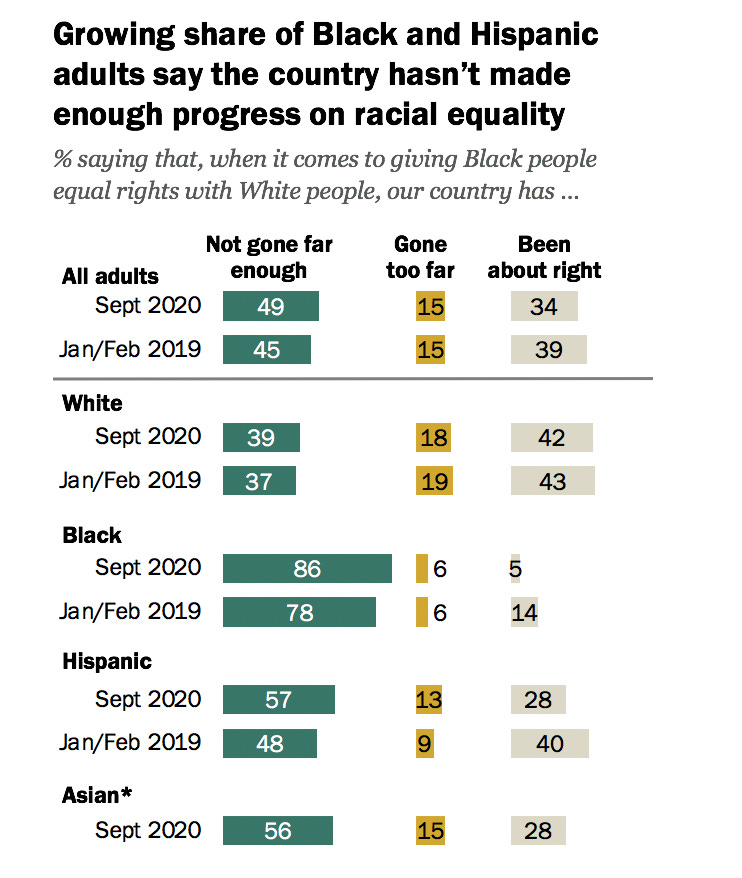
These findings emerged during a period of intense national conflict over race and reflect a growing emphasis on racial identity and historical injustice. They also raise a question worth examining: whether educational approaches that increasingly organize American history around racial divisions help students understand and overcome those divisions, or risk reinforcing them.
Today, most educational programs place considerably greater emphasis on systemic oppression, racial injustice, and the shortcomings of American institutions. There is no question that the shift has contributed to the growing generational divide in national pride.
The generational divide is unmistakable. Gallup found that only 41 percent of Generation Z adults are extremely or very proud to be American, compared with 75 percent of Baby Boomers. YouGov polling also shows that younger Americans are far more likely to view Christopher Columbus unfavorably than their grandparents. These surveys reveal a profound shift in how younger generations regard their country and its historical figures. When schools change the way American history is taught, it is reasonable to ask whether they are also changing how children understand what it means to be American.
Children begin forming attitudes about race, identity, and belonging long before they are capable of critically evaluating complicated historical arguments. Developmental research shows that racial attitudes emerge in early childhood and are shaped by the messages children receive from adults, peers, and institutions. This places an enormous responsibility on schools. Teaching any child to judge classmates through inherited categories of racial guilt or victimhood will reinforce the very prejudices education should help overcome.
When Racial Justice Became an Industry
The death of George Floyd in May 2020 ignited a wave of anger that swept across the United States. The demonstrations, riots, destruction of property, and demands for institutional change did not emerge in an organizational vacuum. Long before Floyd’s death, major philanthropic foundations had been financing an extensive network of racial-justice organizations, activist training programs, and political advocacy groups. The Ford Foundation helped establish the Black-Led Movement Fund in 2016, while George Soros’s Open Society Foundations contributed to the network through the Borealis Philanthropy.
The money supported grassroots organizing, direct-action training, leadership development, and campaigns to transform public institutions. Following Floyd’s death, the funding expanded dramatically. In July 2020, Open Society announced $220 million in commitments to Black-led organizations and racial-justice initiatives. What began as public outrage over a death in police custody rapidly became a nationwide political and institutional movement backed by substantial financial resources.
The nationwide protests and riots following George Floyd’s death in 2020 came at an enormous human and economic cost. According to the Armed Conflict Location and Event Data Project (ACLED), at least 25 people were killed in demonstrations and incidents connected to the broader political unrest. The Major Cities Chiefs Association documented more than 2,000 police officers injured between May and July, while the total number of civilian injuries remains unknown.
Rioting, arson, vandalism, and looting spread across more than 140 American cities. According to the Insurance Information Institute, the destruction resulted in more than $2 billion in insured losses, making the unrest the costliest civil disorder event in American insurance history. The violence accompanying the movement left communities devastated, businesses destroyed, and a financial burden extending well beyond the insured losses.
The infrastructure for mobilizing protests, amplifying political messages, and pressing institutions for change had been built over years. Organized advocacy and spontaneous public anger reinforced one another. The result was a period in which race became an organizing principle for political debate, corporate policy, university administration, and educational “reform.”
The timing coincided with a troubling change in racial attitudes. In the American National Election Studies data, the average favorability rating that Black Americans ages 18–29 gave white Americans fell from approximately 64 in 2016 to 47 in 2020, before partially recovering to 56 in 2024. The pattern documents that the extraordinary emphasis and money spent on amplifying racial division during 2020 had the desired effect: it reinforced racial tension.
The relationship between the protest movement and education is especially relevant. The 1619 Project had launched in 2019, before Floyd’s death, and was already promoting an interpretation of American history centered on slavery being the foremost catalyst for the founding of America, with continuing consequences that last until now.
There is an intellectual connection worth examining as well. Marxist and neo-Marxist traditions have long emphasized the relationship between social institutions, power, economic inequality, and political change.
The educational philosophy known as critical pedagogy was heavily influenced by Paulo Freire, a Brazilian socialist educator whose work drew extensively on Marxist theories of oppression and class struggle. Freire believed schools should do more than teach facts and practical skills. Education should encourage students to question established institutions, identify perceived systems of oppression, and become agents of social and political change. His ideas have become influential in American universities and schools of education and helped shape approaches to teaching that emphasize social justice and political consciousness. Basically, these ideas have woven Marxist theories into educational curricula
The events of 2020 therefore deserve examination not only as a protest movement but as a turning point in institutional approaches to race and Marxist theory. The documented funding networks, rapid expansion of racial-justice programs, and contemporaneous deterioration in some measures of interracial attitudes are related. The resulting institutional changes have deepened the divisions they sought to address.
From Columbus to the Classroom
The controversy over Christopher Columbus is no longer simply about a fifteenth-century explorer. It is part of a much larger struggle over how American history is interpreted and transmitted to the next generation. Consider how differently children can encounter the same historical figure. One lesson introduces Columbus through navigation, maritime exploration, the dangers of the Atlantic crossing, and the extraordinary consequences of 1492.
Another begins by asking students to reconsider whether Columbus deserves to be celebrated or even remembered, emphasizing conquest, enslavement, and the experiences of Indigenous peoples. Both subjects belong in a serious history curriculum, but the choice of emphasis matters, particularly for young children who are still developing their understanding of history, identity, and national belonging.
The movement to reshape historical education is neither imaginary nor confined to individual classrooms. The Pulitzer Center’s 1619 Project Education Network has offered grants to educators developing curricula centered on slavery, racial inequality, and their contemporary consequences. Its supporters have included George Soros’s Open Society Foundations, alongside Meta and other major philanthropic organizations. The initiative has also reached university schools of education, where future teachers are trained. Its published grant objectives go beyond historical instruction to include preparing students to participate in social change.
The more immediate concern is whether students are learning to understand the constitutional republic, including its remarkable achievements, or being encouraged to view its institutions primarily through the lens of historical oppression.
The American founders understood the dangers of concentrated political power and unchecked majority rule. They established a representative republic with divided powers, constitutional limitations, and protections for individual liberty. These institutions were imperfectly applied from the beginning, but they also provided mechanisms through which later generations fought to abolish slavery, expand citizenship, and secure civil rights. Students deserve to understand that history alongside the injustices that made those struggles necessary. The enduring question is whether contemporary historical education gives them the knowledge to evaluate and preserve their constitutional inheritance, or teaches them to regard that inheritance chiefly as a problem to be overcome.
From Education to Ideological Transformation
The influence of critical theory and Marxist-inspired approaches to education extends well beyond elementary and secondary schools. American universities now offer degrees, certificates, and professional training in diversity, equity, and inclusion (DEI), social justice, and environmental, social, and governance (ESG) principles.
At Penn State, a Social Justice certificate examines how unequal power relationships shape society. Northwestern University teaches students to analyze intersectionality and develop approaches to social change. More explicitly, the University of Massachusetts Amherst offers graduate courses titled Liberatory Pedagogies for Social Transformation and Confronting Oppression in Education. These are not fringe pamphlets circulating among student radicals. They are formal academic programs, including programs designed to train future educators.
Author James Lindsay, in The Marxification of Education (2022), traces these developments to the influence of Marxist and neo-Marxist thinkers, particularly the above-mentioned Brazilian Marxist and educator Paulo Freire. Lindsay argues that critical pedagogy transforms education from the transmission of knowledge into a means of developing political consciousness and promoting institutional change. These types of university programs explicitly describe social transformation as an educational objective.
And that brings us back to Christopher Columbus.
What our universities teach future educators, and what those educators pass on to our children, will determine how the next generation understands America’s history and its founding institutions. Children deserve to learn about the courage, determination, and extraordinary navigational achievement of a man who crossed the Atlantic in three small wooden ships more than five centuries ago, changing the course of human history. They deserve an education that inspires curiosity, ambition, and an appreciation for the achievements of those who came before them, not one that reduces every historical figure to a catalog of moral failures.
The Campaign to Remove Columbus from Public Life
The attack on Columbus has not been confined to textbooks, academic conferences, or political rhetoric. It has been carried into America’s public squares. A 2021 Washington Post and MIT analysis documented at least 40 Columbus monuments removed since 2018, with most removals occurring during the racial unrest of 2020 and 2021. Statues were toppled, vandalized, removed by municipal governments, or placed in storage. In Baltimore, demonstrators pulled down a Columbus statue and threw it into the harbor. Elsewhere, cities removed monuments that had stood for generations, sometimes over the objections of Italian-American communities that regarded Columbus as a symbol of their own immigrant heritage. The campaign represents something larger than a disagreement over one historical figure. It raises the question of whether Americans should confront the complexities of their history through education and debate, or whether political activists and public officials should decide which parts of that history are permitted to remain visible
Trump Draws a Line on Columbus Day
President Donald Trump has made the defense of Christopher Columbus and Columbus Day a direct challenge to the political left. In his October 11 Truth Social message, Trump condemned Democrats, socialists, and communists for tearing down Columbus statues, declaring that the “days of plunder are over.” His October 7 presidential proclamation went further, celebrating Columbus for his courage and contributions to the historical developments that eventually produced the United States.
Trump also highlighted the installation of a replica Columbus statue on the White House grounds, replacing a monument that rioters had destroyed in Baltimore on July 4, 2020. The symbolism is unmistakable. At a time when universities, activist organizations, and progressive politicians increasingly portray America’s historical inheritance as something to apologize for, the president is insisting that the nation’s history, heroes, and cultural foundations deserve to be honored rather than erased.
Columbus Day is an opportunity to celebrate the spirit of exploration and discovery, our nation’s historical inheritance, and the remarkable constitutional republic that eventually emerged in the New World. Christopher Columbus deserves to be remembered and celebrated.
Happy Columbus Day.
A Note to Our Free Readers and Subscribers
If you value independent journalism that asks difficult questions, challenges prevailing narratives, and examines the political and ideological forces shaping our country, please consider becoming a paid subscriber to Malone News. Researching and writing essays like this takes considerable time and effort. We do not have corporate sponsors, university grants, or wealthy foundations underwriting our work. We depend on readers who believe that honest inquiry, intellectual independence, and the freedom to challenge powerful institutions are worth supporting.
Our nation’s history, educational institutions, and cultural heritage deserve serious examination, not political indoctrination. Your paid subscription helps us continue that work, remain independent, and keep much of our reporting freely available to everyone. If you are already reading for free and find value in what we publish, please consider supporting us with a paid subscription.
Independent journalism survives because readers choose to support it. Thank you for being one of them.
Columbus, American History, and Monument Removal
The White House. (2026, October 7). Columbus Day, 2026: A Proclamation by the President of the United States. https://www.whitehouse.gov/presidential-actions/2026/10/columbus-day-2026/
Shin, Y., Kirkpatrick, N., D’Ignazio, C., & So, W. (2021, October 11; updated October 26). Columbus monuments are coming down, but he’s still honored in 6,000 places across the U.S. Here’s where. The Washington Post. https://www.washingtonpost.com/history/interactive/2021/christopher-columbus-monuments-america-map/
The Washington Post. (2026, October 8). Inside Trump’s push to bring Christopher Columbus to the White House. https://www.washingtonpost.com/politics/2026/10/08/trump-hopes-voters-will-take-note-his-support-christopher-columbus/
Morison, S. E. (1942). Admiral of the Ocean Sea: A Life of Christopher Columbus. Little, Brown and Company.
The 1619 Project and American Education
Hannah-Jones, N. (2019, August 14). The 1619 Project. The New York Times Magazine. https://www.nytimes.com/interactive/2019/08/14/magazine/1619-america-slavery.html
Pulitzer Center. The 1619 Project Education Network. https://1619education.org/1619-community/1619-education-network
Pulitzer Center. The 1619 Project for Educators: Curricular Resources and Teaching Materials.
https://1619education.org/
Pulitzer Center. Meet the 2021 Cohort: The 1619 Project Education Network. https://1619education.org/1619-community/1619-education-network/meet-2021-cohort
Pulitzer Center. Meet the 2022 Cohort: The 1619 Project Education Network. https://1619education.org/1619-community/1619-education-network/meet-2022-cohort
Wood, G. S., McPherson, J. M., Oakes, J., Bynum, V., & Wilentz, S. (2019, December 20). We Respond to the Historians Who Critiqued The 1619 Project. The New York Times Magazine. https://www.nytimes.com/2019/12/20/magazine/we-respond-to-the-historians-who-critiqued-the-1619-project.html
Critical Pedagogy, Marxism, and Social Justice Education
Freire, P. (1970). Pedagogy of the Oppressed. Herder and Herder.
Freire, P. (1973). Education for Critical Consciousness. Seabury Press.
Giroux, H. A. (1983). Theory and Resistance in Education: A Pedagogy for the Opposition. Bergin & Garvey.
Lindsay, J. (2022). Race Marxism: The Truth About Critical Race Theory and Praxis. New Discourses.
Lindsay, J. (2020). The Marxification of Education. New Discourses.
https://newdiscourses.com/
Pluckrose, H., & Lindsay, J. (2020). Cynical Theories: How Activist Scholarship Made Everything About Race, Gender, and Identity, and Why This Harms Everybody. Pitchstone Publishing.
Black Lives Matter, Civil Unrest, and Economic Damage
Armed Conflict Location & Event Data Project (ACLED). (2020). Demonstrations and Political Violence in America: New Data for Summer 2020. https://acleddata.com/report/demonstrations-and-political-violence-america-new-data-summer-2020
Armed Conflict Location & Event Data Project (ACLED). (2020). US Crisis Monitor Releases Full Data for Summer 2020. https://acleddata.com/press/us-crisis-monitor-releases-full-data-summer-2020
Insurance Information Institute. Facts + Statistics: Civil Disorders. https://www.iii.org/fact-statistic/facts-statistics-civil-disorders
Major Cities Chiefs Association. (2020). Report on the 2020 Protests and Civil Unrest. Major Cities Chiefs Association.
Corporate Activism, ESG, and DEI
Friedman, M. (1970, September 13). The Social Responsibility of Business Is to Increase Its Profits. The New York Times Magazine.
Ramaswamy, V. (2021). Woke, Inc.: Inside Corporate America’s Social Justice Scam. Center Street.
Sowell, T. (2018). Discrimination and Disparities. Basic Books.
Thegeorge floyd b.s. was not rage..it was orchestrated sedition and should have been so treated. A cop lived across from us quit and went into trucking business with his brother because of his disgust with the attitude that crap generated with John Q and the cowardly administrations who caved to the race baiting mobs
I’ll never forget on the July 4th weekend in 2020 a mob that wound up in Nancy Pelosi’s hometown of Baltimore’s little Italy tore down a 14 foot marble statue of Christopher Columbus, dragged it to the inner harbor, and rolled into the water. Pelosi said communities should decide which statues they want displayed. And said well people will do what people do. How utterly criminal that the leader of The House of Representatives would be so dismissive of mob rule, lawlessness and vandalism. This was the discontent for America displayed that allowed city blocks to be burnt across America. There was no one in that community that wanted that statue torn down, how out of touch can you be. This is what you get with communism. This is what we’ll all get if the democrats win. One of the first things communists do is erase a countries history. God help America should these people ever come back to power!