

Audio Version:
The Wolf at the Door, The Safe Room, and the Building Code
Notes from the Israeli frontier, part one
Israeli building code has required a reinforced concrete room in every new residence since 1992. It is called a mamad. Steel door, blast shutter, filtered air, poured walls. Americans pay extra for this and call it a storm shelter. Israelis get it standard, the way we get a smoke detector in the hallway.
The mamad was designed for rockets. Rockets give you fifteen seconds, and then the danger passes. Nothing in that threat model calls for a lock or a barricade on the inside, so most units have neither. The handle is held by hand, or it is not held at all.
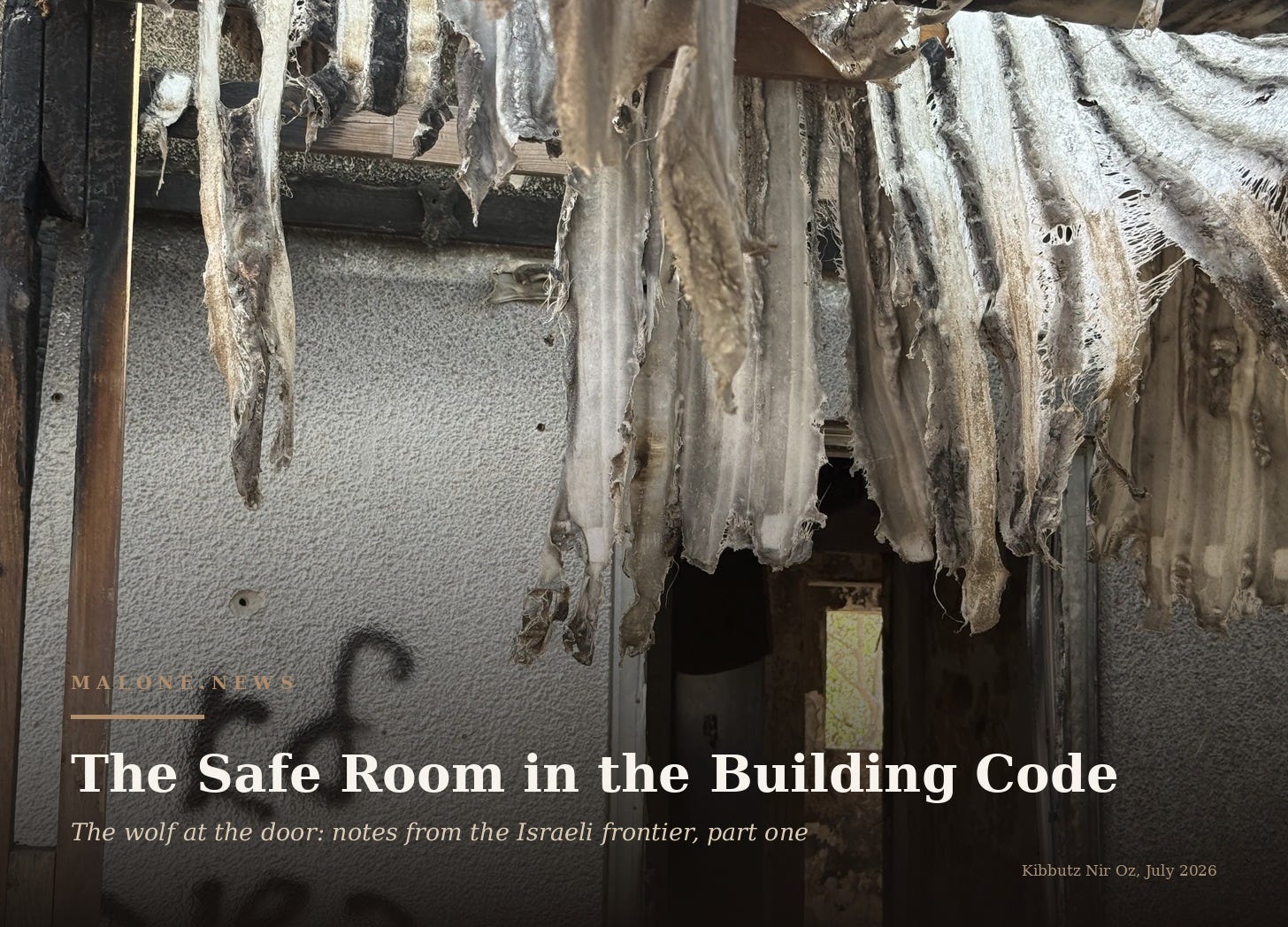
On the morning of October 7, 2023, families in the kibbutzim of Be’eri, Kfar Aza, and Nir Oz held those handles while heavily armed terrorists on the other side pulled. Some held for six hours. Some held while the house burned around them. When pulling failed, the murderers fired through the door at the handle, working to destroy the hands holding it. After the parents died, so did the twin five-year-old girls of smoke inhalation - as they had been tucked away in the safe room. Only the family dog survived. Once painted white, the black walls tell the tale of death and destruction.
Jill and I went to Nir Oz in Israel and stood in one of those doorways and that safe room this week. The steel around the handle is riddled with bullet holes. They were shooting at hands.
When the door held, they burned the house. Fire is what defeated the mamad. A room built to keep you alive for fifteen seconds becomes an oven once the building around it is alight, and its air filter was designed for a chemical agent rather than for smoke. The attackers carried accelerant and threw Molotov cocktails through windows, using fire to drive families out of shelters they could not otherwise breach. More than seventy percent of the homes at Nir Oz burned. Six houses in the entire kibbutz were left untouched. Elderly residents who could not walk died in their beds.
A wealthy and technically superb country wrote one threat into its building code. A different threat arrived.
What a raiding economy is
For roughly a century and a half, the southwestern plains of North America ran on a raiding and captive economy. Hämäläinen (2008) makes the case that Comanchería, that is, the vast region of the Southwestern United States occupied by the Comanche people before the 1860s, functioned as an imperial system rather than a collection of war parties, and that raiding was its productive sector. Brooks (2002) documents the captive exchange in the Southwest borderlands as a working market with prices, brokers, and repeat participants.
The arithmetic comes first. A raider chooses the time and place. A defender must guard them all. No amount of virtue, vigilance, or wealth changes that equation.No amount of virtue or vigilance changes that ratio, and wealth does not improve it. A frontier settlement in 1840 and a kibbutz in 2023 faced the same problem, except that the kibbutz faced it on a shorter clock, because the raid arrived by paraglider.
The strategy, tactics, and economics of captives were also remarkably similar. Comanche raiders killed adult men and took women and children. The selection was deliberate, and both sides knew it. Ransom followed, funded on the Spanish and Mexican side through the rescate system and by the Church.
A reliable buyer creates a standing bid, and a standing bid raises the expected return on acquisition. Every individual redemption was a mercy. The aggregate of those mercies was a price signal that manufactured more captives. Any reader who understands why price controls produce shortages already understands why organized ransom produces abductions.
Terror belonged to the same system. Deliberate atrocity and the display of bodies by native populations in the southwest made pursuit unattractive and resistance more expensive than accommodation. It also emptied territory.
Through the 1830s and 1840s, Comanche and Kiowa raiding hollowed out the northern Mexican states, and whole districts were abandoned. Raiding by the light of the full moon became a calendar of dread that Texans later called the Comanche Moon. DeLay (2008) argues that this depopulation created the conditions for the American conquest of northern Mexico in 1846. The thousand deserts of his title are those abandoned settlements. The haunting images of deserted Southwestern churches and settlements so often portrayed in popular films have their basis in this history. I was struck by how much the burned-out, bullet-riddled kibbutzim along the Gaza border resembled those cinematic archetypes.
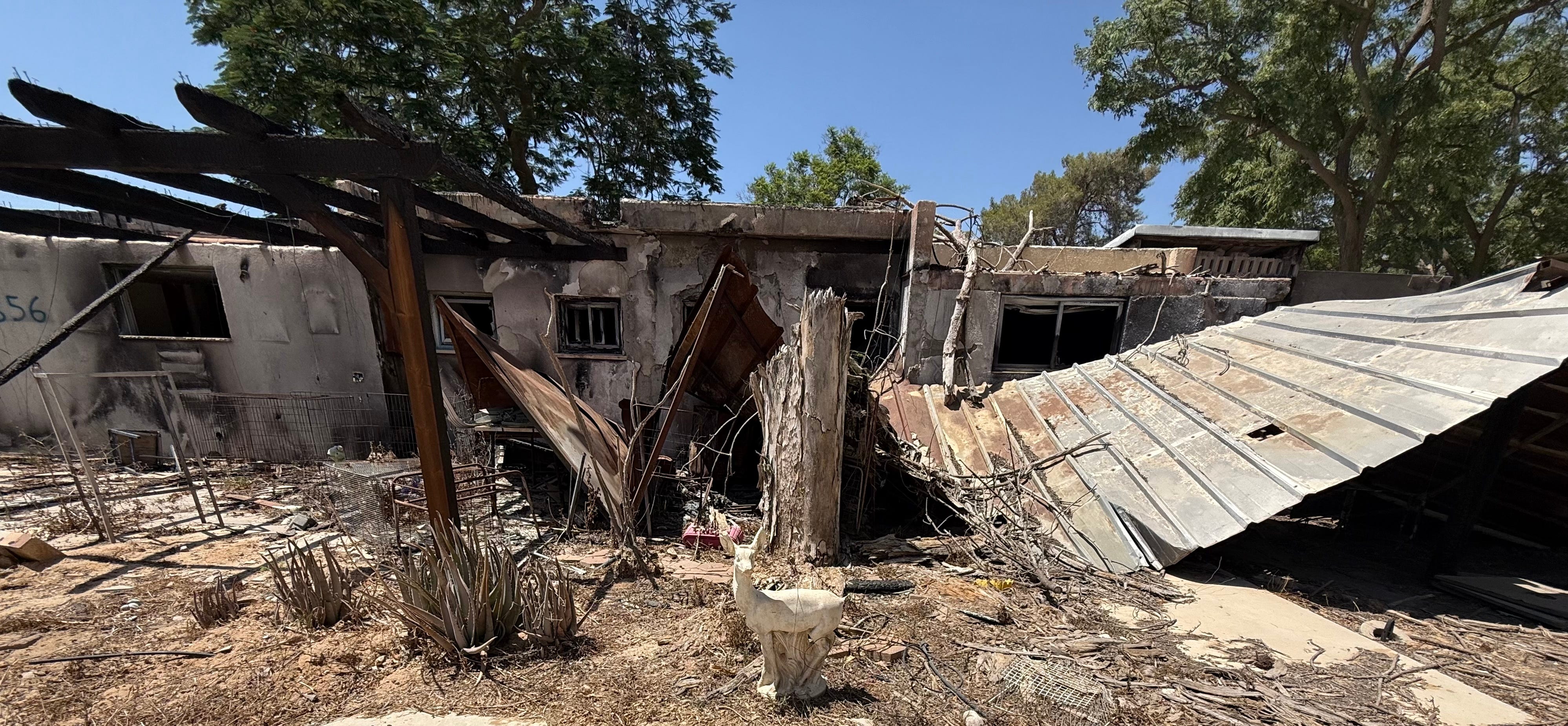
Terror was the production technology for Comanche and Kiowa raiders. A defender who will not pursue is cheaper to raid next season.
Carl Menger founded the Austrian School of Economics in 1871 by explaining where prices come from. Value is not a property inherent in a good. It is imputed by the people who desire it, and the resulting price tells producers what to make more of. Pay above the market rate for something, and you have effectively placed an order for more of it.
The rabbis arrived at the same insight seventeen centuries earlier, without the formal economics. Redemption of captives, pidyon shvuyim, ranks in Maimonides as the highest form of charity a Jew can perform. Yet Mishnah Gittin 4:6 immediately places a limit on it: captives are not to be redeemed for more than their worth, mipnei tikkun ha’olam, “for the good order of the world.” A tradition that elevated redeeming captives to a supreme obligation also imposed a ceiling on the price, because the sages understood what an unlimited bid does to supply.
The ceiling has not held. In 1985, Israel exchanged roughly 1,150 prisoners for three Israeli soldiers. In 2011, it traded 1,027 prisoners for a single soldier, Gilad Shalit. Among those released was Yahya Sinwar, who would later mastermind the October 7 attack. The market cleared. The price was published. The buyer came back.
On October 7, Hamas took 251 hostages. Securing their return consumed Israeli politics for the next two years, as the country wrestled with the same dilemma its sages had recognized nearly two millennia ago: how to save the captives without ensuring there would be more captives to save.
Americans had their own version in 1676. Raiders struck the frontier town of Lancaster, Massachusetts, at dawn on February 10 during King Philip’s War. They killed more than a dozen settlers and carried off twenty-four, among them Mary Rowlandson, the wife of the town’s minister, and her three children. Joseph Rowlandson was in Boston that morning, petitioning the colonial government for troops to defend Lancaster. He did not get them.
Her six-year-old daughter, Sarah, was wounded during the attack and died in her mother’s arms nine days later. Rowlandson walked more than 150 miles over eleven weeks and five days, moving between camps in what she called “removes.” When her captors opened negotiations, they asked her to name her own price, and she set it at twenty pounds in goods. They released her on May 2, 1676. Lancaster had been burned, and there was nothing to return to.
She published her account six years later under the title The Soveraignty and Goodness of God. It is generally regarded as the first American bestseller and established the captivity narrative as a genre that endured for the next two centuries. Colonists who would never have read a casualty report read Rowlandson, because readers identify with a captive in a way that a body count never can.
Israel built the modern version of that in a city plaza. Within days of the attack, the open space outside the Tel Aviv Museum of Art became Kikar HaHatufim: Hostages Square. Families of the captives moved in, and some slept in tents there for weeks at a time. Survivors from the attacked kibbutzim staffed booths and told visitors about their missing neighbors. A digital clock counted every second since the morning of October 7. On Friday evenings, crowds gathered for Kabbalat Shabbat, many dressed in yellow.
The last twenty living hostages came home in October 2025, a year after the attack. The body of Ran Gvili, a police officer killed that morning, was returned on January 26, 2026, and the clock went dark the following evening after 843 days, 12 hours, and 6 minutes. The Hostages and Missing Families Forum held its final Shabbat service that Friday, marking the first Sabbath since July 2014 with no Israeli held in Gaza. Most of the installations have since been removed, and the municipality is now deciding what the plaza should become.
Rowlandson’s readers and the people who stood in that square were doing the same work, separated by three and a half centuries. A society can absorb casualties. It cannot absorb its people being held captive.
Who came through the fence
The attack came in three waves.
It began with a massive barrage of rockets across Israel, announcing the assault.
The Nukhba came first, Hamas’s elite assault force. Roughly 1,500 fighters crossed in the opening hours against assigned objectives, including the Gaza Division headquarters, the surrounding communities, and the Nova music festival near Re’im. They carried mission orders, and those orders included taking captives alive.
Behind them came Hamas’s broader military wing and other armed factions, including Palestinian Islamic Jihad, moving through breaches the Nukhba had already opened.
Then the fence stood open, and civilians walked through it. These people had no formal orders and no assigned objectives. Looting was widespread. Some killed. Some took captives.
Although the massacre is remembered as a border attack, it was not confined to the immediate frontier. Hamas and allied forces fought across more than forty locations and penetrated as far as roughly thirty kilometers into Israel before the attack was finally contained.
Hamas and its allies killed roughly 1,200 people in this attack, including more than 800 civilians and over 300 members of Israel's security forces, while taking 251 hostages into Gaza.
I heard two seemingly contradictory explanations for the hostage-taking. One described abduction for profit. The other insisted it was an act of terror with no commercial motive. Both were correct. They were describing different layers of the same morning.
Hamas’s leadership had political objectives. They wanted a large pool of captives to force another exchange like the one in 2011, which had secured Sinwar’s own release. They also wanted to shatter Israel’s deterrence, derail the Saudi normalization process, and ignite a wider regional conflict. Money appears nowhere on that list of objectives.
Ransom in the Israeli case is not monetary. Israel does not pay cash for hostages. The currency has long been prisoner releases, negotiated between a state and an armed organization. A Gazan civilian holding a captive therefore had no direct counterparty in Israel and no practical way to sell that captive to the party seeking their return. What he held was an asset with exactly one buyer. Only Hamas and Palestinian Islamic Jihad could convert a captive into prisoner releases. The primary market created a derived demand, and that derived demand created a spot market inside Gaza among people who had never been part of the original plan.
Brooks (2002) describes the same structure on the Rio Grande. The rescate system did not merely fund the redemption of captives already taken. It established what a captive was worth, and people with no connection to the original raiding economy began taking captives because a buyer existed.
Released hostages have described being held in family homes rather than by organized units, which supports the civilian-captor account. The mechanism by which captives were transferred to Hamas is less well documented.
The parallel breaks at the audience. Comanche terror spoke to the local defender about his own conduct: abandon the district and stop pursuing us. October 7 spoke to people thousands of miles away. The attackers filmed the atrocities and broadcast them, in some cases through the victims’ own phones and social media accounts, so that families watched in real time. No nineteenth-century raider could do that, and it changed the purpose of terror itself. The target was not only the communities of the Negev, but Israeli domestic politics and Western public opinion. On the second count, it worked.
The economics are ancient. The distribution is new. That is what makes this version more dangerous than the one that emptied northern Mexico.
How a superb intelligence service went blind
Israel spent roughly a billion dollars on the Gaza barrier, completing it in 2021. It combined sophisticated sensors, remote weapon stations, and an underground wall designed to block tunnels. As confidence in the barrier grew, however, the manpower behind it thinned, and military units were redeployed to the West Bank.
Hamas studied the system and struck the cameras first. The barrier was breached in roughly thirty places within the first hour.
The failure began long before the concrete. Israeli intelligence possessed a Hamas planning document, later reported as Jericho Wall, describing an operation remarkably similar in scale and method to the one that unfolded. Senior officers judged it to be aspirational. Young women serving as border observers, the tatzpitaniyot, repeatedly reported rehearsals at mock Israeli compounds and drone reconnaissance along the fence. They were told to stop filing the reports.
Hayek (1945) named the problem. Knowledge relevant to a decision exists in dispersed, local, and particular form, held by people on the spot who cannot fully articulate what they know. A central authority cannot simply aggregate that knowledge, because compressing it for transmission destroys the part that mattered. The women at the observation posts possessed that kind of knowledge. The officers reading their reports possessed a model instead, and they trusted the model.
Israelis call it HaConceptzia, the Conception. Hamas had been deterred. Hamas had become a governing authority with something to lose. Both propositions were defensible when they were first formulated. Over time, they hardened into filters that dismissed contradictory evidence as noise.
Israel had done this before. In 1973, the Conception held that Egypt would not attack without the ability to strike Israeli airfields deep inside the country, and that Syria would not attack without Egypt. Egyptian divisions massed along the Suez Canal, and the model absorbed the warning. The Agranat Commission diagnosed the failure in 1974 and prescribed institutional dissent, including a permanent devil’s advocate office within military intelligence whose job was to produce the opposing assessment.
That office still existed on October 7, 2023. I would put that fact before anyone who believes a well-designed process can substitute for judgment. The reform survived on paper for half a century, yet it did not prevent the same failure when it mattered most. Wohlstetter (1962) reached a similar conclusion in her study of Pearl Harbor. Betts (1978) went further, arguing that intelligence failures persist because the real constraint is not information but the decision maker’s willingness to hear unwelcome conclusions, something no procedural reform can guarantee.
There is a colder lesson here for anyone who keeps a bag packed.
A threat that is present every night eventually stops seeming exceptional; it becomes normalized. Constant hostility erodes the ability to recognize the one night the wolf actually comes. Any human system living under permanent low-grade alarm does this. Readiness decays fastest in the places that need it most.
Eight hours
Sderot lies eight miles from Gaza. Before October 7, its residents were generally not eligible for a private firearms license. Eligibility in Israel is determined by locality, and the licensing map reflected the same threat assessment that guided Israeli intelligence.
Where communities had armed civilians, those civilians became the first line of defense. The kitat konenut, the local ready squad, is a chartered volunteer unit that maintains weapons for precisely this contingency. The squads at Be’eri and Kfar Aza fought through the opening hours. Off-duty soldiers drove south on their own initiative, and police units improvised as they could. The Gaza Division headquarters at Re’im was itself overrun, leaving divisional command largely nonfunctional for most of the day.
Nir Oz sits under two miles from the Gaza border, with no military outpost between it and Gaza. Between 400 and 500 attackers entered a community of 385 people that morning. The IDF’s own investigation found that the first security forces reached the kibbutz forty minutes after the last of the attackers had already walked back into Gaza. About a quarter of its people were murdered or taken.
Israeli law at the time permitted civilians to hold handguns but not rifles. The ready squads met men with assault rifles and RPGs while carrying pistols. Afterward, the state purchased rifles and issued them to rural squads, then expanded the squads into municipal areas. Ben Gvir’s ministry claimed roughly 700 new civilian security teams within weeks.
Storage decided more of that morning than firepower did. Squad weapons belonged to the state, and the state kept them in a communal armory rather than in the members’ homes. Northern squads had generally moved their rifles home. Most southern squads had not. A man in Be’eri or Nir Oz woke to gunfire and had to cross open ground to reach a locked room before he could fight at all. In several communities, he never reached it.
Nir Oz fielded nine ready squad members that morning, according to an IDF report aired by Kan. Four were killed. Irit Pauker, who walked us through the devastation of Nir Oz, knew every one of them and told us their stories. It was almost impossible not to be moved by their courage. They faced an estimated 450 attackers. The kibbutz lost 69 people and had another 76 taken into Gaza.
Israel had licensed those men, trained them, and issued them rifles. It had not trusted them with the keys to the room where the rifles were kept. That is the difference between an armed population and a ready one, and it likely cost more lives on October 7 than any limit on ammunition ever could. In December 2025, the IDF began allowing thousands of reservists to keep their rifles at home, explicitly citing the delays that morning and the ready squads that could not reach their weapons.
People often repeat the saying that when seconds count, the police are only minutes away. On October 7, the answer was closer to eight hours. This happened in a country the size of New Jersey, with universal conscription and one of the finest militaries on earth. The gap between a raid and the arrival of the state is a matter of geometry before it is a matter of competence.
Sixty-nine is a number. Gideon Pauker was one of them.
Pauker was seventy-nine, a week short of his eightieth birthday, and one of the founders of Nir Oz. Late in life, he planted a vineyard on the kibbutz and brought in its first harvest in 2008.
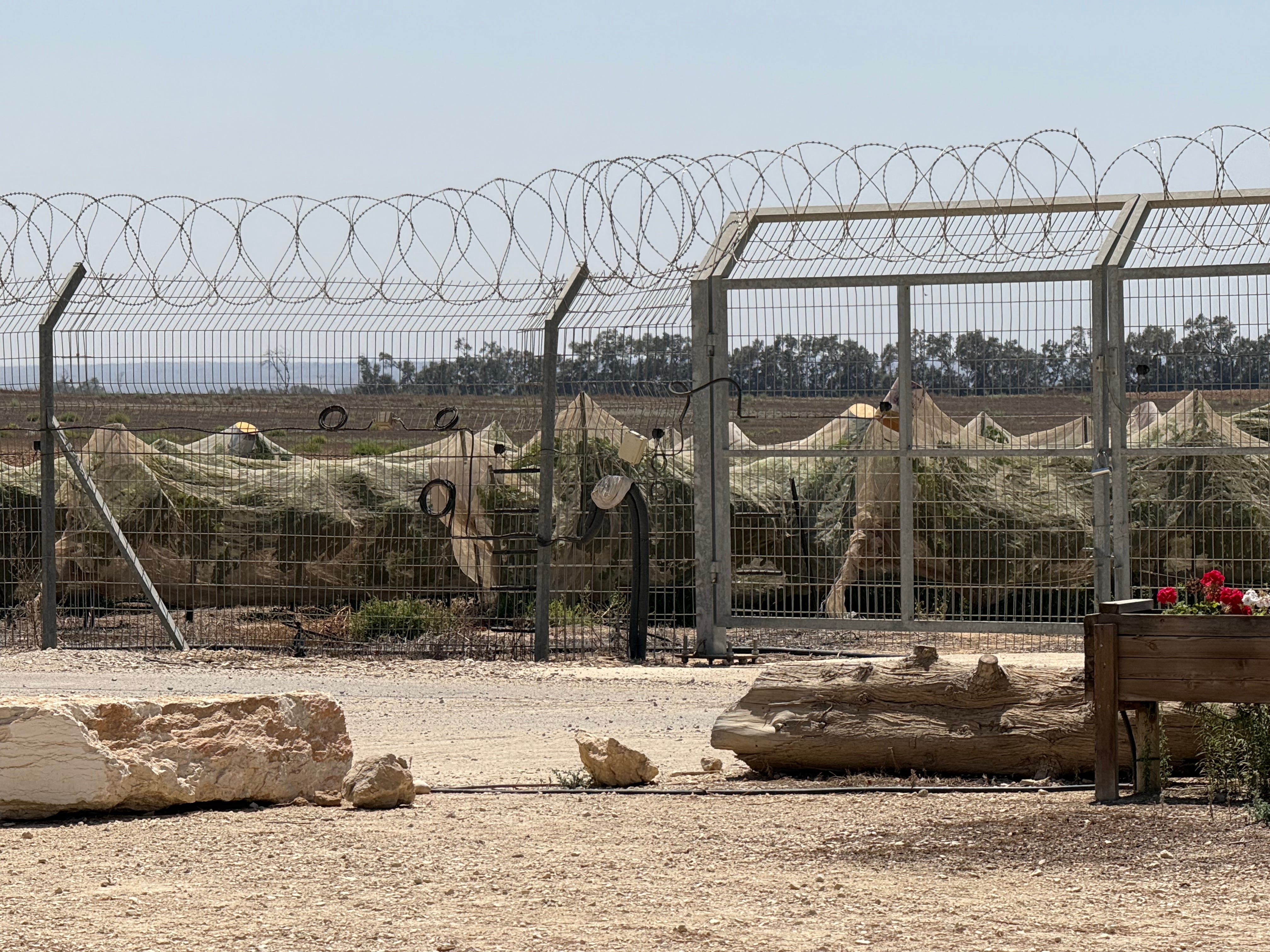
We stood among those vines this week. You can see the Gaza border from them. He made the wine with three lifelong friends who had helped found the kibbutz: Gadi Mozes, Chaim Peri, and Yoram Metzger. Together they produced about a thousand bottles each year, giving nearly all of them to family and neighbors. The 2022 vintage was aging in the kibbutz’s underground shelter, built during the Yom Kippur War.
The seventeenth harvest came in just days before the attack.
On the morning of October 7, Pauker and his wife, Orna, were inside their safe room when the gunmen reached their home. They fired through the door and killed him. His daughter told us he bled to death. Mozes, Peri, and Metzger were all taken alive into Gaza. Only Mozes came home, after 480 days, at the age of eighty. When he returned, he learned that Gideon was dead. The other two were murdered in captivity.
At the funeral three weeks later, someone placed a bottle of his wine on the coffin.
His daughter, Irit Pauker, told us about him and his dream of making wine, as she calmly poured glasses from the vines he had planted and tended. She had grown up on that kibbutz among the people whose names now appear on its casualty list. She walked us through Nir Oz house by house, remembering the children she had played with, then telling us how many died defending their families and neighbors, and how many were taken. She did not need to embellish the story. The empty homes did that for her.
Most Israelis are not armed
I was told repeatedly on this trip that most Israelis now carry a sidearm. That is not true, and anyone repeating it will be dismantled by the first hostile fact-checker who looks.
The Small Arms Survey estimated Israel at 6.7 civilian firearms per 100 people in 2017, compared with 120.5 in the United States. Israel had 147,248 active firearms licenses in early 2023, below its 2009 peak. Since October 7, Israelis have submitted more than 403,000 new applications, and the National Security Ministry says it had issued more than 240,000 additional licenses by March 2026. Add those to the existing base, and you arrive at roughly 400,000 licensed carriers in a country of ten million. About four percent, in a nation at war, after three years of the most aggressive firearms licensing liberalization in its history.
What looks like general armament to a visitor is mostly conscription. The rifles you see on buses are issued service weapons carried by soldiers who are required to keep them. The guards at every mall entrance are a separately licensed occupational category. Eligibility also varies by residence, so Jerusalem, the border communities, and the settlements have far higher rates of licensed carry than the national average. A delegation itinerary samples the top of that distribution and mistakes it for the middle.
Israeli law draws no distinction between open and concealed carry because there is no distinction for it to attach to. There is no ownership license with a separate carry permit layered on top. The private firearms license is a carry license. It covers one handgun, requires periodic range qualification, and says nothing about how it must be carried.
Then there is the ammunition. A private firearms license originally allowed possession of just fifty rounds. Fifty in total, and most American readers will assume that number is a misprint. New licensees were allowed one hundred rounds after the war began, while those already licensed remained capped at fifty until January 2025, when the ministry finally doubled the allowance across the board. An official in the Firearms Division explained the change as a direct lesson from October 7, citing civilians who fought with a single magazine and exhausted their ammunition.
Nor is firearm ownership treated as a right. An applicant must satisfy a residence criterion, pass background checks, and submit a physician’s declaration of physical and mental fitness. The state grants permission for security reasons and may deny it. No natural-rights doctrine underlies the system, and no constitutional guarantee of self-defense stands between the citizen and the government.
Israelis embraced much of the practice we say we want but never adopted the principle. Americans enshrined the principle and, across much of the country, increasingly neglect the practice. Neither side has much reason for self-congratulation.
The deeper reason Israel resists anything resembling an American Second Amendment tradition lies in 1948, and it has little to do with squeamishness. The Yishuv (the organized Jewish community residing in Palestine prior to the establishment of the State of Israel in 1948) included competing armed factions under independent commands. Ben-Gurion ordered the shelling of the Altalena off Tel Aviv in June 1948 rather than allow the Irgun (National Military Organization in the Land of Israel) to land arms it alone would control, and five months later he dissolved the Palmach (the main paramilitary organization of the Jewish community in Mandatory Palestine). Israel’s commitment to a single chain of command was forged at the cost of Jews shooting Jews within weeks of independence. A country founded that way hears the word militia and thinks of Beirut, not Lexington. That history deserves more from us than a lecture.
The man at the gate
My wife, Jill, and I sat with two men at the Nova music festival massacre site on Thursday. One of them ran five miles across open ground on October 7. The other lied to save his life, and the lives of everyone hiding beneath his house.
Shalev Biton, a musician and recent member of the IDF who had completed his tour of duty, was twenty-five and at the Nova music festival near Re’im, trying to sleep in his tent when the rockets began. Three hundred sixty-four people were murdered there, and forty were carried into Gaza. Biton escaped with a friend and ran east into the fields. Others joined them as they fled. One young woman had lost her shoes and arrived with her feet bleeding.
Five miles away, they found a farm worked by twenty-four Thai laborers and managed by a Bedouin Israeli named Yunis Alkarnawi. They hesitated at first. Men in head coverings standing in a field that morning could have been anything. Alkarnawi waved them in, gave them food and water, let them charge their phones, and told them to rest.
The Thai workers saw the motorcycles first. Alkarnawi quietly told everyone to hide as best they could, then walked alone towards the gate, taking refuge behind a John Deere tractor. While he spoke to the gunmen in Arabic, everyone slipped out of the dining room and crawled beneath the house, which stood just high enough off the ground to conceal them.
He told the gunmen there were no Jews on his farm. The man at the gate argued with him, consulted three others positioned behind the house, and eventually rode away. Eight festivalgoers and twenty-four Thai workers lay beneath the floorboards for hours, listening to a conversation in a language none of them understood, knowing their lives depended on its outcome.
Other Arab citizens of Israel tried talking to Hamas that day and were murdered anyway. When asked why he survived, Alkarnawi simply points to the sky.
Like most Bedouin Israelis, Yunis Alkarnawi is an Israeli citizen and part of the fabric of the country. Many Arabic-speaking Bedouin Israelis serve in the Israel Defense Forces.
Hold that against the claim that Israel is a colonial project and all its citizens are settlers. A Muslim Bedouin farmer hid Jewish young people and Thai migrant workers beneath his kitchen floor, then lied to armed Hamas gunmen in his own language to keep them alive. That story has no place in the framework. It cannot process the sentence.
It complicates my argument too. I have written about ready squads, firearms licensing, and where the rifles were kept, and all of those things mattered on October 7. But the man who saved thirty-two lives near Re’im that morning was unarmed. All he had was Arabic, extraordinary courage, and the determination to save his fellow human beings.
What this has to do with the argument you are having online
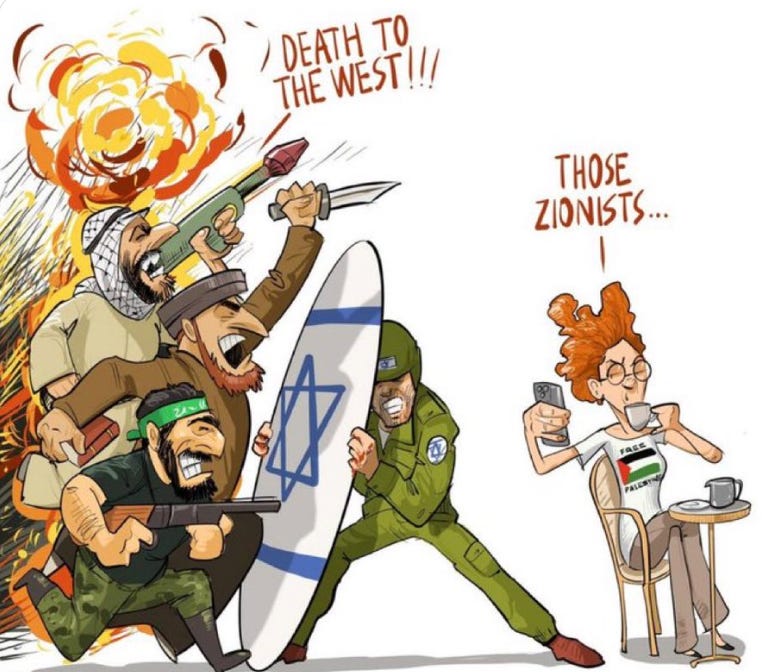
The people who hate Jews have upgraded their vocabulary. The old themes about international finance and dual loyalty still circulate. Today they often arrive dressed as anticolonial analysis, or as a “knowing” snide anonymous remark about who really wanted the last war. They circulate on parts of the American right as well as the left, and pretending otherwise helps no one.
Every version of that narrative, built on foundations laid by decades of Soviet propaganda and, before that, Nazi propaganda, requires the Israeli to remain an abstraction: a settler, a colonizer, an outpost of somebody else’s empire. It works by reducing individuals to a category. The abstraction collapses the moment the Israeli becomes a specific person doing a specific thing, because the specific thing is almost always holding a safe-room door shut to protect a family while terrorists try to shoot their way through it.
You cannot stand in Be’eri, count the bullet holes around a safe-room handle, and still retain the abstraction. That is why Jill and I went. It is why I am writing this down.
Americans who think seriously about self-reliance keep discovering that Israelis have been living the subject we merely study. Local knowledge lost to centralized assumptions. Ransom markets created incentives for more captives. Sophisticated intelligence and one of the world’s finest militaries failed to recognize the threat and respond in time. In community after community, a handful of lightly armed civilians with limited ammunition faced hundreds of attackers carrying automatic weapons, rocket-propelled grenades, and ample ammunition.
For Israelis, the wolf is always at the door. Their enemies have been explicit. Hamas’s charter and repeated public statements have left little doubt about its objective: the destruction of Israel and the killing of Jews.
And yet.
This week, we sat with Lieutenant Colonel Eyal Dror, who founded and commanded Operation Good Neighbor, the IDF program that carried wounded Syrians across the Golan border from 2016 until Assad’s forces reestablished control in 2018. Over those years, Israel treated roughly 4,900 Syrians in its hospitals, about 1,300 of them children. It helped establish a maternity ward inside Syria where more than a thousand babies were delivered. It also sent some 1,500 tons of food, fuel, medicine, and infant formula to people in a country that remained formally at war with it.
We also met the leadership of Save a Child’s Heart, which has operated from Wolfson Medical Center in Holon since 1995. My friends Drs. Kirk and Kimberly Milhoan have both volunteered there. Kirk later served as chair of the CDC’s Advisory Committee on Immunization Practices. Save a Child’s Heart has brought more than 8,000 children from seventy-five countries to Israel for life-saving cardiac surgery, including many from countries that do not recognize the State of Israel. More than 3,000 of those patients have been Palestinian children from Gaza and the West Bank, seen through a weekly clinic. The organization is now training a Palestinian surgeon who intends to return home as the first fully qualified Palestinian pediatric cardiac surgeon and establish a department in Ramallah.
Israel is a nation with every reason to harden its heart. Yet it has repeatedly found ways to value the lives of its neighbors alongside its own. As I look into my own heart, I do not know if I would retain my humanity under the same conditions.
They have already run the experiment. We should pay attention to the results before conducting our own.
Radical Islamist movements will either be contained or neutralized, or they will expand and threaten all of western civilization including the United States. The key questions are where, when, by whom, and at what cost. The terrible alternative is that of Scipio Aemilianus, who commanded the final destruction of Carthage in 146 BC. Those are the options.
RWM/JGM
Some of you will disagree with this essay. A few may even unsubscribe because of it.
That’s your right, and I hold no ill will toward anyone who reaches a different conclusion.
But Malone News has never existed to tell people what they already believe. It exists to follow evidence, ask uncomfortable questions, travel to places where the story is more complicated than the headlines suggest, and report what we actually find.
That kind of work takes time, travel, and the willingness to risk being wrong in public. It also depends entirely on readers who value independent reporting enough to support it.
If you believe journalism should still involve seeing things firsthand instead of commenting from a thousand miles away, please consider becoming a paid subscriber. You’re not just supporting this essay. You’re making the next one possible.
References
Betts, Richard K. 1978. “Analysis, War, and Decision: Why Intelligence Failures Are Inevitable.” World Politics 31 (1): 61 to 89.
Brooks, James F. 2002. Captives and Cousins: Slavery, Kinship, and Community in the Southwest Borderlands. Chapel Hill: University of North Carolina Press.
DeLay, Brian. 2008. War of a Thousand Deserts: Indian Raids and the U.S.-Mexican War. New Haven: Yale University Press.
Hämäläinen, Pekka. 2008. The Comanche Empire. New Haven: Yale University Press.
Hayek, F. A. 1945. “The Use of Knowledge in Society.” American Economic Review 35 (4): 519 to 530.
The Jerusalem Post. 2026. “Nir Oz volunteers train to defend Israel’s frontlines after Oct. 7.” May 30.
Jewish Insider. 2025. “Parents of Nova survivor meet their son’s savior, a Bedouin Israeli, for first time.” January 27.
The Jewish Press. 2025. “Ben Gvir Doubles Ammunition Allowance for Licensed Gun Owners.” January 12.
Maimonides. Mishneh Torah, Hilkhot Matnot Aniyim 8:10.
Menger, Carl. 1871. Grundsätze der Volkswirtschaftslehre. Vienna: Wilhelm Braumüller.
Mishnah Gittin 4:6.
Rowlandson, Mary. 1682. The Soveraignty and Goodness of God, Together with the Faithfulness of His Promises Displayed: Being a Narrative of the Captivity and Restauration of Mrs. Mary Rowlandson. Cambridge, MA: Samuel Green.
Save a Child’s Heart. 2026. “Our Impact.” Holon, Israel.
Small Arms Survey. 2018. Estimating Global Civilian-Held Firearms Numbers. Geneva: Graduate Institute of International and Development Studies.
State of Israel. 1974. Agranat Commission of Inquiry, Interim Report. Jerusalem.
The Times of Israel. 2018. “As war nears end, IDF shutters ‘Good Neighbor’ Syrian aid program.” September 13.
The Times of Israel. 2025. “To life: Grandson revives wines of vintner killed October 7 in Kibbutz Nir Oz.” July 2.
The Times of Israel. 2025. “Residents of 5 more localities to be eligible for gun permits, Ben Gvir announces.” September 1.
The Times of Israel. 2026. “After 843 days, 12 hours, 6 minutes, Hostages Square clock goes dark with Ran Gvili’s return.” January 27.
The Times of Israel. 2026. “Ben Gvir significantly widens gun license eligibility for Jewish Jerusalemites.” March 9.
Wohlstetter, Roberta. 1962. Pearl Harbor: Warning and Decision. Stanford: Stanford University Press.
Ynet. 2025. “’40 minutes too late’: IDF report details Hamas’ attack on Nir Oz and systematic failures.” March 14.
Ynet. 2025. “IDF to allow thousands of reservists to keep rifles at home after October 7 failures.” December 21.
Most Americans, including our current president, have no understanding of what the Jewish Nation has endured throughout it's history which dates back to the time of Abraham. We live in a land of chocolate milkshakes and multi million dollar weddings in Madison Square Garden. The men who wrote the Declaration of Independence and the Constitution understood. Some say that the United States is Israel's only friend. It's the other way around. Israel is the United States only friend. Yet the arrogance continues. And we send a pacifist to talk to a man who has been wounded in combat. The wolf is not at the door. The wolf is among us.
The hatred for Jews is widespread, and I’ve personally seen it on this site by receiving a response on Sunday’s article that said Jews are the Antichrist—I almost posted his name and his response here, but decided not to—I refused to answer him.
Thank you for this article, but I’m concerned that Hamas and the civilian population in Gaza and surrounding areas will continue the hatred and murder against the Hebrew people.
I also believe that Islamist ideology is spreading throughout America and within our political system, by design, and is positioning itself for attacks within our nation similar to October 7, against “The Big and Little Satan.” It’s only a matter of time, but I hope our government AND civilian populace are prepared when it happens, and refuse the propaganda to counter its insurgency.
Thank you for the article. Though somber in nature, truth is always welcome—it’s why I subscribe to your Substack.