

Audio Version:
Drs. Jill Glasspool Malone and Robert Malone
Analysis and Policy Recommendations / Washington, DC, November 4, 2026
Madison County voted overwhelmingly against Virginia’s Amendment 1, with 58 percent voting no. Statewide, however, more than 61 percent voted yes. Come January 1, the same constitutional protections for abortion will apply throughout Virginia, regardless of how individual counties voted.
The amendment establishes a constitutional right to abortion through the second trimester, with exceptions extending into the third trimester for the mother’s life, physical or mental health, or fetal nonviability. We believe this is a grave moral error. The right to life should not be determined by a majority vote, whether at the county or state level.
But the voters have spoken. And now we must decide what that means for us.
We spent this morning exchanging increasingly emotional messages with friends. For nearly a decade, we have poured our hearts, souls, time, physical labor, and financial resources into building this farm. This is our home, our life’s work, and the place we intended to spend the rest of our years.
And yet, this morning, we also found ourselves asking a question we never expected to confront.
What do we do now?
The national results were worse. Democrats took the House and the Senate, flipping Senate seats in Texas, Kansas, Iowa, Ohio, Maine, North Carolina, and South Carolina. Early this morning, Democrats held 54 Senate seats to 44 for Republicans, with Alaska and Mississippi uncalled. Dozens of House races were also still open. Florida stood out as the exception, electing Byron Donalds governor and returning Ashley Moody to the Senate.
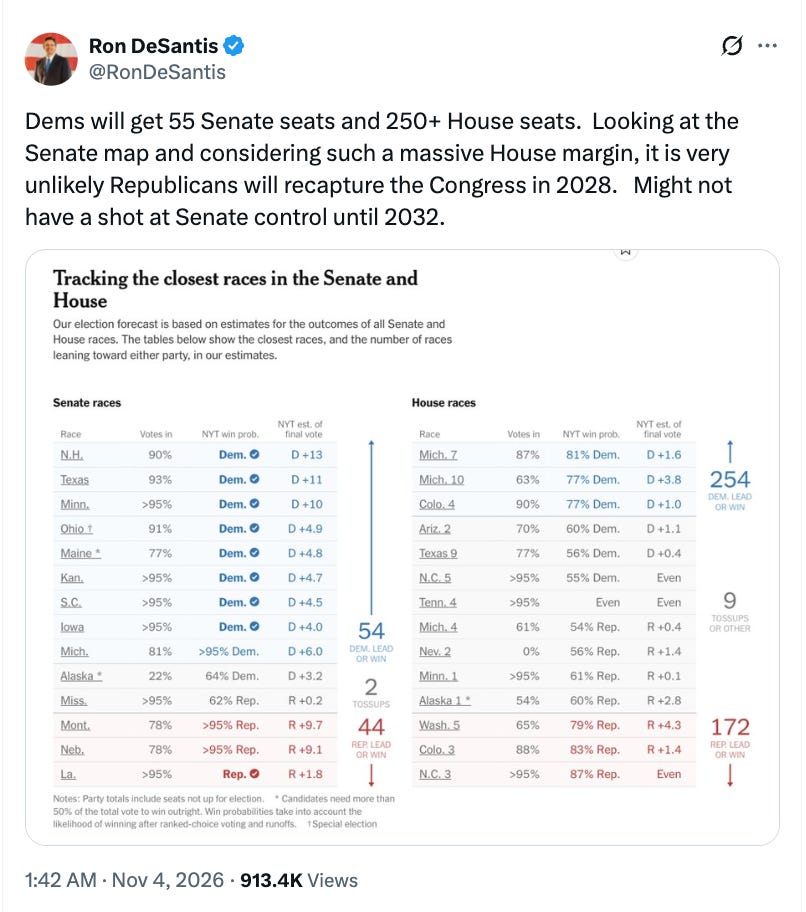
Ron DeSantis, the outgoing governor of Florida, posted his forecast at 1:42 this morning. He projected 55 Democratic Senate seats and more than 250 in the House. He judged it very unlikely that Republicans will recapture Congress in 2028, and said they might not have a shot at the Senate until 2032. We will both be in our seventies by then. We may spend much of what remains of our working lives under a government moving steadily toward what we consider creeping socialism, and away from the constitutional conservatism we had hoped to see.
It’s the Economy, Stupid!
Trump promised to fix the economy. In our view, he failed. CBS News exit polls put his approval at just 38 percent, lower than exit polls recorded for him or any of the three previous presidents at their midterms. Three-quarters of voters told CNN that economic conditions were bad, and most blamed Trump’s policies for higher prices. Despite the propaganda CNN routinely puts out, its analysis may be spot on this time.
Tariffs are one example. When the government taxes imported goods, American importers pay the tax and pass much of the cost along to consumers. Free-market conservatives have understood this for generations. Had Trump first rebuilt America’s manufacturing base, creating jobs and expanding domestic production, he might have made the case for higher tariffs. Instead, he put the cart before the horse. In Maine, 69 percent of voters said tariffs had hurt their local economy. Susan Collins, a thirty-year Senate veteran, lost her seat.
Then came the wars. Trump promised to end the war in Ukraine. It continues. Does anything more need to be said here?
On February 28, he launched a new war with Iran, predicting it would last four to five weeks. More than eight months later, Iran’s navy and much of its missile force have been badly damaged, but the fate of approximately 970 pounds of enriched uranium remains unresolved. Preventing an Iranian nuclear weapon was the original objective. Reopening the Strait of Hormuz became another only after Iran closed it.
And the fighting continued right up to Election Day. On Monday, Trump told voters, “I don’t know if you even call it a war.” That same day, Iran’s Revolutionary Guard claimed to have captured two American drones and destroyed a third. Iranian forces reportedly fired on a U.S. aircraft in the Strait of Hormuz, prompting American retaliatory strikes. Washington reportedly sought to keep the exchange quiet to avoid signaling a return to major combat. This raises troubling questions about government efforts to manage what Americans are allowed to know. Once again, we are left with the unsettling sense that we are living in a manufactured reality, carefully constructed to serve Washington’s political interests rather than inform the American public.
Meanwhile, the Associated Press reported that October saw the most attacks on commercial shipping in the strait since March. The war has already cost taxpayers at least $47 billion, another aircraft carrier is being deployed, and Iran continues to condition reopening the strait on American concessions.
Washington has yet to acknowledge the failure of its apparent decapitation strategy: eliminate Iran’s leadership, encourage a popular uprising, and arm the opposition, which never materialized. Iran is not simply a religious state dependent on a handful of powerful clerics. It is also an Islamic republic with established institutions and mechanisms for replacing its leadership. Removing individual leaders does not automatically dismantle the government or produce regime change. The Trump White House appears to have underestimated that institutional resilience before launching its initial strikes, a potentially disastrous miscalculation whose consequences Americans are still paying for.
Vice President Vance remains optimistic about negotiations, but a resolution remains elusive. For Vance, widely discussed as a potential 2028 presidential candidate, the political dilemma is considerable. Having once opposed another costly American war in the Middle East, he must now reconcile that position with his defense of Trump’s policies, even as voters register their dissatisfaction with the administration.
Earlier this morning, Vance wrote on X: “The reason we lost is the war. The president himself said so last night.” As he is actually on record telling President Trump that he opposed going into Iran, this is a very safe spot for him to land, going into the 2028 elections.
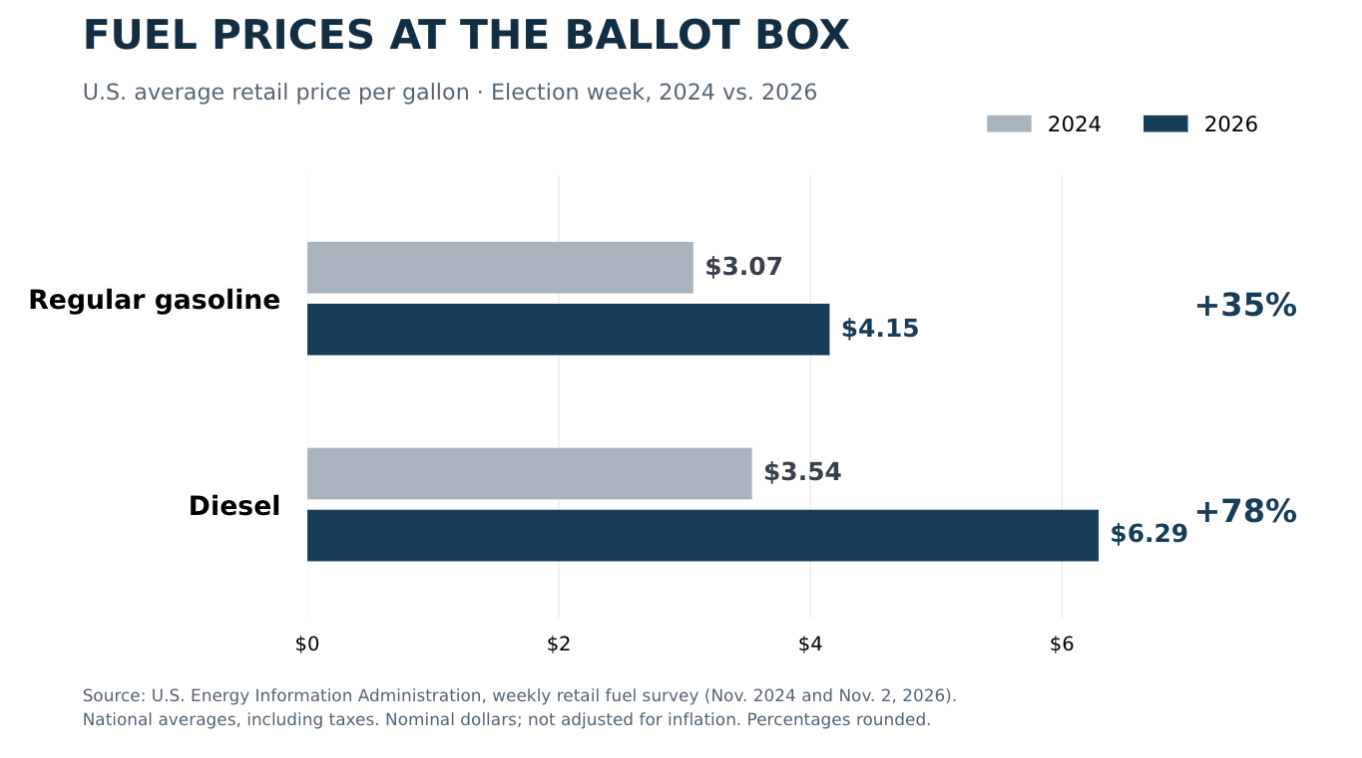
American families paid for this at the pump. On Election Day, gasoline averaged $4.15 per gallon, compared with $3.10 in 2024. Diesel prices have climbed even more dramatically, hitting farmers and truckers particularly hard. Those of us who farm are also paying more for fertilizer and other essential supplies. But the consequences extend far beyond agriculture. Nearly everything Americans purchase, from groceries to household goods, depends on transportation. Higher diesel costs are passed along through the supply chain, driving up consumer prices long after the initial increase at the pump. And those costs rarely come back down as quickly as they went up, and most likely they never do. When was the last time prices of goods decreased?
Meanwhile, ordinary Americans watch Trump appear to be more interested in enriching himself and his family than fulfilling his most important campaign promise. Nearly six in ten voters told the Associated Press that Trump puts his personal interests ahead of the country’s.
But Trump’s economic failures should not be confused with a failure of conservative economic principles. Free markets, limited government, lower taxes, and less regulatory interference were not what Americans experienced these past two years. Instead, they got tariffs, more forever war in Ukraine, an expensive and, in our view, poorly planned war, and industries increasingly dominated by politically connected corporations. Crony capitalism, in which private firms use government power to protect their market positions, continues to flourish.
Perhaps unsurprisingly, approximately 70 percent of voters told the AP they wanted Congress to impose greater checks on presidential power. James Madison, who grew up at Montpelier in the next county over from ours, would have recognized that instinct. Constitutional conservatives should, too.
The political damage extended well beyond suburban America. Rural Iowa shifted toward Democrats, and the head of the Iowa Farmers Union told CBS News that his members voted as though Trump himself were on the ballot. In Kansas, Adam Hamilton won a U.S. Senate seat with Republican crossover support, becoming the first Democrat to win that seat since 1932.
Hispanic voters also shifted sharply toward Democrats, supporting them by approximately 60 to 35 percent. Nearly seven in ten said Trump’s policies had worsened the economy. Immigration enforcement compounded the problem. A pre-election Cook Political Report/Univision poll found that nearly two-thirds of Hispanic voters in Texas were less likely to support candidates backing Trump’s deportation policies. Yet economic concerns still outweighed immigration and ICE enforcement combined by roughly two to one.
Some Republicans will blame the Texas results on Hispanic voters. Their shift mattered, but it cannot fully explain how both Ken Paxton and Governor Greg Abbott lost statewide in a state Trump carried by 14 points just two years earlier.
And this is where the Republican Party’s failure becomes especially dangerous.
When government fails to deliver prosperity, promises of greater economic security through expanded government programs become more appealing to some. Voters are increasingly judging conservatism by the record of an administration that, in critical respects, abandoned its principles.
The danger is that Americans will reject free-market conservatism for the failures of crony capitalism, and embrace more government as the solution to problems government helped create.
The Crumbling Republican Southern Stronghold
For decades, Republicans have counted on the South as their political fortress. Alabama, Tennessee, South Carolina, Florida, and Texas have been reliable sources of Republican votes, congressional seats, and political power. North Carolina has been more competitive, but it too voted for Trump in 2024.
The 2026 midterms should alarm Republican leadership.
Just two years ago, Trump carried Alabama and Tennessee by approximately 30 percentage points, South Carolina by 18, Florida by 13, and Texas by 14. Yet on Tuesday, Republican gubernatorial candidates barely held on in Alabama, Tennessee, South Carolina, and Florida. In North Carolina, Democrat Roy Cooper won the Senate race decisively. South Carolina elected a Democratic senator for the first time since 1998.
Texas delivered an even more consequential result. Democrats captured both the governorship and a U.S. Senate seat, ending decades of Republican dominance in statewide elections.
These results cannot simply be dismissed as a handful of bad candidates. The Republican decline extended across multiple states and offices. Nor does it necessarily mean Southern voters have embraced socialism or abandoned conservative principles. Candidate quality, turnout, economic dissatisfaction, and disillusionment with Washington all deserve consideration.
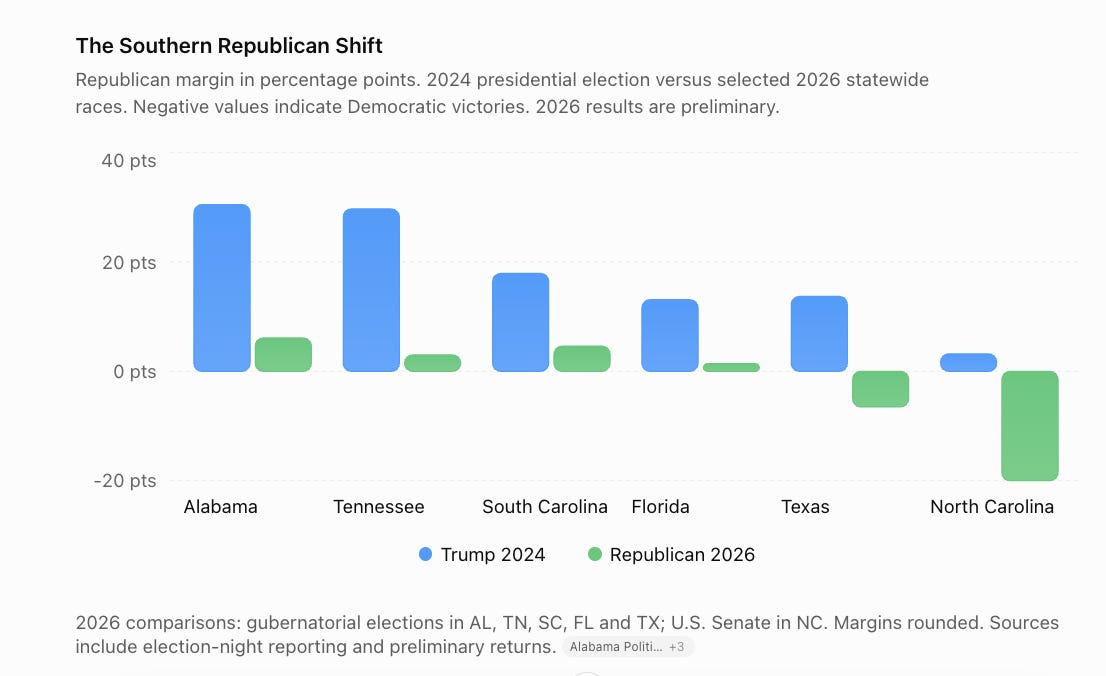
But the warning is unmistakable: The Republican Party can no longer assume that the voters who delivered Trump’s 2024 victory will continue supporting Republican candidates simply because they have an R beside their names.
The Southern Republican stronghold has not disappeared. But its foundations have been shaken.
Trust Is Hard to Rebuild
Voters under 30 split about evenly between Trump and Kamala Harris in 2024. On Tuesday, the NBC News exit poll had them backing Democrats 72 percent to 25 percent. They were only about one in ten voters, which limits their effect on any single election. But they will be voting for many more years to come.
Zoomers abandoned Trump and the Republican Party because they felt betrayed. Prices did not come down. Regulatory capture of entire industries only worsened. The job market did not improve. Healthcare and America’s health were not fixed. A major new war began with Iran, the war in Ukraine did not end, and major questions surrounding Epstein remain unanswered.
To understand why they may not come back soon or ever, think about a personal betrayal in your own life. How easy was it to forgive that person and rebuild the relationship? Of course, a group that moved this far in two years can move again. We doubt it will move back toward anyone in the current Republican tent.
So when the Democratic Party fails them, perhaps within the next two years, where do they turn? CNN found that about one voter in five trusts neither party on the economy, and those voters largely chose Democrats anyway. That looks to us like next time around, they could switch candidates and parties again if things don’t greatly improve. We suspect a new independent voice will emerge, a maverick from either the progressive left or the conservative and libertarian right, perhaps from a new party. It will not be easy. Dan Osborn, a former union leader running as an independent, lost in Nebraska for the second time.
One such effort is already underway. Bret Weinstein, the former Evergreen State College professor and podcaster, announced this week that he is working with the Libertarian Party’s Mises Caucus on what he calls a “friendly takeover” of the party. The goal is to rebrand it as the American Liberty Party and recruit former Republican Congressman Thomas Massie of Kentucky to run for president in 2028. Weinstein says Massie is aware of the effort and supportive, although Massie has not committed to running.
But there is a significant obstacle. The Mises Caucus is a faction within the Libertarian Party, not its governing authority. The party has its own elected leadership, bylaws, state affiliates, and national convention delegates who select its presidential nominee. Weinstein and his allies cannot simply rename the party or claim its established ballot access without winning the necessary internal support. In fact, the Mises Caucus failed to secure its preferred presidential nominee at the 2024 convention.
Whether this becomes a genuine new political movement or another internal Libertarian Party power struggle remains to be seen. The larger question is whether it can attract younger voters disillusioned with both major parties, or primarily draw Republicans dissatisfied with Trump and the direction of their own party.
Two Years of Hearings, Then the Real Test
We expect Democrats to pursue two strategies. The first is investigation. Rep. Robert Garcia, the top Democrat on the House Oversight Committee, gave his preview in two words on election night: “Lawyer up.” Expect subpoenas, public hearings, allegations of corruption, criminal referrals, and perhaps renewed impeachment efforts aimed at Trump, his family, and his allies.
The second is benefits. Improving the underlying economy is difficult, and any real recovery would let Trump claim credit. Chuck Schumer’s election night message was that relief is on the way. Expect proposals to restore and expand ACA subsidies, reverse Medicaid cuts, increase SNAP, expand child tax credits, subsidize housing and childcare, relieve student loans, and raise the minimum wage. Hamilton, the new Kansas senator, put ending the Iran war and addressing tariffs at the top of his list, along with health costs and SNAP.
Much of the Democrats’ expanded benefits agenda will likely stop at the Resolute Desk through January 2029. Budget reconciliation allows the Senate to pass qualifying tax and spending legislation with a simple majority, but the Byrd Rule limits what can be included. In 2021, for example, the Senate parliamentarian ruled that a minimum wage increase could not be passed through reconciliation. Trump can still veto legislation that reaches his desk, and he told CBS News he welcomes the nickname “Mr. Veto.” Overriding a presidential veto requires a two-thirds majority in both chambers, which Democrats do not have.
But these legislative battles will also provide campaign ammunition for 2028, forcing Republicans to defend their opposition to expanded government benefits. Some Republicans, particularly those facing competitive reelection campaigns, may break ranks and vote with Democrats rather than risk alienating voters.
The real test comes in 2029 if Democrats win the White House and retain control of Congress. That is where DeSantis’s arithmetic matters, because it could leave Republicans with little power to stop an ambitious legislative agenda.
And that is how a nation can move toward socialism without ever voting for a socialist revolution. The transformation happens incrementally, one popular government program, one new entitlement, and one expansion of state authority at a time. Each step becomes politically difficult to reverse, and over time, the cumulative changes fundamentally alter the relationship between citizens and their government.
This gradual approach has a name: Fabian socialism. Rather than pursuing revolution, Fabian socialists seek to advance their goals through legislation, influence over academic and cultural institutions, and incremental social change. Such policies can appear sustainable for a generation, particularly in a prosperous, high-trust society with a strong work ethic. But as successive generations become increasingly dependent on government benefits, incentives to work, save, and remain self-reliant weaken. Taxes rise to finance expanding commitments, while governments increasingly turn to imported labor to fill jobs their own citizens are reluctant to take. In our view, Great Britain and Canada offer particularly revealing examples of this trajectory.
Benefits are also very hard to take back once granted. Republicans held Congress and the White House in 2017 and still could not repeal the Affordable Care Act. Republicans did curtail SNAP in the last Congress, and Democrats are already promising to restore it. Republican Congresses have also run large deficits of their own, so neither party can claim clean hands on the growth of government. Congress failed to make DOGE's spending cuts permanent, undermining Republican promises to rein in federal spending. Another broken promise.
Even blue states have limits. California voters appeared headed on Tuesday to reject Proposition 40, a one-time 5 percent tax on the wealth of the state’s billionaires, which was trailing with about 57 percent voting no in early returns. Gov. Gavin Newsom, widely believed to be preparing a 2028 run, opposed it, and opponents warned that billionaires would leave the state and take their income tax with them. Of course, billionaires and business interests also spent more than $316 million to defeat it. Newsom’s alternative is a national wealth tax, which no one can escape by moving to Texas.
The economic hardship driving these votes is real. People are struggling to afford housing, groceries, and energy. Government benefits may provide temporary relief, but we worry about the long-term costs: greater dependence on government, a growing national debt, and an economy that becomes increasingly difficult to repair. Even more concerning are political changes that could prove difficult to reverse, such as eliminating the Senate filibuster, admitting new states, or expanding the Supreme Court. These changes could reshape the balance of political power for generations.
What Happens to MAHA?
We are not neutral observers here. Robert was a compensated Medical Advisor to MAHA Action until June 2026, and we have both publicly criticized how the movement has been led.
Tuesday was a very bad night for the politicians most closely tied to Robert F. Kennedy Jr. Sen. Roger Marshall of Kansas, who founded the MAHA Caucus, lost his seat. In Iowa, Kennedy-backed candidates Zach Lahn, Mariannette Miller-Meeks, Zach Nunn, and Joe Mitchell all lost.
Kennedy had called Lahn’s race the most important election in the country. In March, Tony Lyons, president of the MAHA PAC, called the midterms “existential” for the movement while launching a $100 million fundraising campaign. In South Carolina, Dr. Annie Andrews, a pediatrician who made impeaching Kennedy a campaign pledge, defeated Sen. Darline Graham.
Those losses do not prove that voters rejected MAHA. These candidates lost in a wave that took down many other Republicans, and we have seen no post-election data on how MAHA voters actually voted. A March poll found that only 19 percent of Americans ranked healthcare access as their top issue.
MAHA voters had reasons for disappointment well before Tuesday. Trump created the MAHA Commission, with Kennedy as chair, and many supporters read its first report in May 2025 as a promise. That report mentioned ultra-processed foods more than 40 times and said pesticides were found at alarming levels in American children. The strategy that followed in September 2025 offered 128 ideas, but it mentioned ultra-processed foods only once, in a pledge to define them. On pesticides and food, it mainly advised more research and voluntary action by industry.
Then, in February 2026, Trump invoked the Defense Production Act to secure the domestic supply of glyphosate, calling it crucial to national security. Kennedy, who had previously identified glyphosate as a likely contributor to the chronic disease epidemic, defended the order.
Worse, the Trump Justice Department and EPA voluntarily intervened on Bayer/Monsanto’s side in a Supreme Court case concerning cancer warnings on Roundup. The administration argued that federal pesticide labeling law overrode state failure-to-warn claims. In June, the Supreme Court agreed, ruling in Monsanto’s favor and limiting consumers’ ability to sue over missing cancer warnings. The DOJ was not required to take Bayer’s side. It chose to do so.
Kennedy also promised to rein in mRNA vaccines, raising concerns about their safety, effectiveness, and inadequate investigation of adverse events. In August 2025, HHS canceled 22 mRNA vaccine development projects worth nearly $500 million, a significant step. Yet mRNA vaccines remain on the market, and in June 2026, the CDC awarded Pfizer two contracts for adult and pediatric COVID-19 vaccines with a combined maximum value of $1.24 billion. Kennedy defended the contracts, arguing that they established purchasing arrangements rather than actual expenditures. However, the CDC also awarded Moderna a separate vaccine contract, with more than $6 million obligated by late October. While the administration has restricted some vaccine recommendations and research funding, its continued federal contracting for mRNA vaccines raises serious questions about how much of Kennedy’s promised overhaul of vaccine policy has actually been delivered.
The administration did deliver new dietary guidelines and encouraged state SNAP restrictions on items such as soda and candy. As of July, however, nutrition professor Marion Nestle’s review found no action on limiting the marketing of ultra-processed foods to children. She also found that the promises most likely to improve children’s health were held up, ignored, or awaiting rulemaking.
For now, Kennedy appears likely to remain at HHS. Trump said on election night that he has no plans to change his Cabinet, and Axios reported before the election that Kennedy had no intention of stepping down. But with Democrats gaining power in Congress, Kennedy faces a different political environment. His department can still pursue changes to vaccine and food policy without new legislation, but congressional oversight, subpoenas, hearings, and battles over funding could make those efforts increasingly difficult. Impeachment is theoretically possible, but removal would require a two-thirds vote in the Senate, making it a remote prospect. The more immediate challenge is whether Kennedy can deliver meaningful reforms while defending his record before a more hostile Congress.
Durability is the larger problem. Whatever one secretary does by executive action, a later secretary can undo. Some MAHA activists already complain that Kennedy has not done enough to make the food dye restrictions last beyond this administration. Calley Means, a leading MAHA advocate, resigned from HHS on October 22, and the Wall Street Journal reported that he was frustrated by the lack of progress on food. With Democrats holding Congress, a statute codifying the MAHA agenda on Republican terms is now out of reach until at least 2029.
We expect the coalition to split along an existing line. Democrats, including Rep. Alexandria Ocasio-Cortez and Michigan’s new senator-elect, Abdul El-Sayed, are courting voters worried about corporate influence over food and pesticides. Center for American Progress polling found that 37 percent of Trump voters are open to a Democrat running on core MAHA issues. Questioning the safety of certain vaccines remains a nonstarter for many Democrats, and Annenberg polling found those priorities far less popular than the food agenda. So the food voters may have two parties bidding for their votes, while the medical freedom voters may have none.
That should worry anyone who cares about informed consent. It also shows the cost of tying a movement’s future to one party and one cabinet secretary. As Jill argued in “The Kennedy Exception,” loyalty replaced scrutiny once Kennedy ran HHS. A former HHS official told Semafor that MAHA voters are becoming independent again and will vote for whoever advocates for them. We hope so.
We also expect MAHA’s leaders, Kennedy and his closest adviser Stefanie Spear, to return to their roots in environmentalism and liberal politics. Kennedy built his career as an environmental lawyer with the Natural Resources Defense Council and Hudson Riverkeeper, founded Waterkeeper Alliance, and began his presidential campaign as a Democrat. Spear, who became a senior Kennedy aide at HHS, founded the environmental publication EcoWatch, where Kennedy served on the advisory board. Both have longstanding ties to environmental activism that predate their alliance with Trump. With Republicans losing control of Congress and Democrats increasingly focused on pesticides, food safety, and corporate influence, Kennedy and Spear may find more common ground with their former political allies. But much of the MAHA coalition comes from a different background, including conservatives, homesteaders, and medical freedom advocates whose political priorities may not align with those of the movement’s leadership.
In our opinion, the deeper issue was never a particular appointee. MAHA has always been about autonomy: who decides what goes into your child’s arm, your food, and your medical record. Those questions extend naturally to data centers, Flock cameras, and the surveillance state, and they cross party lines. A movement built on those questions can outlast Kennedy. It can also do much of its work in state legislatures and county meetings, and on farms, where the next HHS secretary has less reach.
What Now?
We have spent much of our political lives believing that America could return to its constitutional foundations: limited government, individual liberty, personal responsibility, and an economy that rewards hard work over political connections. We built our farm around those same principles, investing years of hard work and much of our resources into creating a life grounded in independence and self-reliance. Tuesday’s election results do not change those principles, nor do they diminish our commitment to living by them.
The principle we keep coming back to is subsidiarity: decisions should be made at the most local level capable of addressing them effectively. Local communities understand their own needs, priorities, and circumstances far better than distant government bureaucracies, and they should retain the authority to govern themselves whenever possible. It is to this model we return in our own lives.
Opposition to the rapid expansion of data centers became a significant issue in Tuesday’s elections, with voters demanding greater local control over decisions affecting their communities. The Washington Post reported that voters in at least 29 jurisdictions approved bans or restrictions on data centers. In Ohio, where 125 local moratoriums were already in place, Fortune counted at least 14 municipalities adopting additional limits. An NBC exit poll found that 56 percent of voters considered data centers a crucial or major factor in their vote.
Democrats were the main political beneficiaries of this opposition. In Texas, Governor-elect Gina Hinojosa campaigned on maintaining a moratorium on new data center construction until the state addresses concerns about water supplies, electricity, air quality, and property rights. Texas accounts for 41 percent of the new data center capacity projected nationwide for 2028, according to research firm SemiAnalysis. Even outgoing Republican Governor Greg Abbott, who had previously promoted Texas as a national center for AI data centers, ordered a temporary pause in August amid growing public opposition.
Trump, meanwhile, openly criticized Americans opposing data center expansion. In August, he suggested that communities rejecting these developments wanted to remain “backwards and poor,” and warned that China was benefiting from the opposition. In September, he went further, suggesting that the growing resistance might be a Chinese public-relations campaign. Rather than acknowledging legitimate local concerns about electricity, water, and property rights, the president portrayed opposition as economically foolish and potentially serving a foreign adversary.
The issue illustrates the principle of subsidiarity in practice. Communities are demanding greater control over development decisions that directly affect their land, resources, and quality of life. Yet the Republican president, whose party has traditionally championed local control, has repeatedly dismissed their objections.
Axios reported that Democratic challengers ousted Republicans in Ohio, Wisconsin, Arizona, and Pennsylvania after making AI policy a campaign weapon. Democratic groups ran ads in those districts attacking Republican incumbents for a 2025 vote that would have gutted state AI laws. Conservatives who believe in federalism might have raised that objection first. In the Ohio Senate race, Sherrod Brown called Jon Husted “the face of data centers.” Axios also reported that nearly two-thirds of the data center capacity planned for 2028 could face delays in a buildout it put at $10 trillion, although most political analysts do not expect Democrats to block construction permanently. These candidates also ran in a year of high prices and an unpopular war, so we would not credit AI alone for their wins.
Property rights, water, the electric bill, and local control are conservative concerns, and a Democrat just campaigned on them and won the Texas governorship. Abbott had welcomed these companies with tax breaks, although his campaign noted that Hinojosa had voted for such incentives herself. There is a real tension here for those of us who defend private property, since a local ban can also stop a landowner from selling to a willing buyer. We would rather see that argument settled in county meetings than in corporate deals protected by nondisclosure agreements.
Subsidiarity has limits, and Tuesday showed one. Our 58 percent in Madison County did not stop Amendment 1, and we do not believe the right to life should turn on a county vote any more than a state vote. That argument rests on natural law, and we will keep making it. It also means that roughly four in ten of our neighbors disagree with us, and they remain our neighbors.
Many important decisions remain within our control, particularly at the local level: land use, education, local food production and processing, what we grow and preserve, and where we spend our money. For younger Americans dissatisfied with both political parties, greater involvement in their communities offers a practical alternative to waiting for another presidential candidate to deliver change. We intend to spend the next two years working toward greater local independence and self-reliance, while continuing to ask whether enough Americans still share those priorities.
Our Recommendations: Returning to Conservative Principles
The election results are a reminder that Republicans cannot simply campaign on conservative principles. They must actually govern by them. Restoring public trust requires more than new candidates, political movements, or another round of executive orders. It requires returning to the constitutional and economic principles that once defined American conservatism.
1. Restore constitutional limits on federal power.
Congress must reclaim its constitutional responsibilities, particularly over taxation, spending, and war. These powers should not be surrendered to the executive branch simply because a Republican occupies the White House. The same constitutional limits must apply regardless of which party controls Washington.
2. Defend the Senate filibuster and a nine-seat Supreme Court.
The Senate filibuster and the current nine-justice Supreme Court are important institutional safeguards against rapid changes in federal policy and judicial power. Democrats could seek to eliminate the legislative filibuster and expand the Supreme Court if they regain unified control of Washington. Conservatives should defend these institutional arrangements consistently, rather than supporting changes whenever their own party might benefit.
3. Restore fiscal discipline and free-market economics.
Stop expanding federal spending without identifying how it will be paid for. Demand honest accounting of entitlement obligations, meaningful reductions in wasteful spending, and a serious plan to address the national debt. End corporate subsidies, preferential treatment, and regulatory advantages that protect politically connected businesses at the expense of smaller competitors. Economic prosperity comes from productive work, investment, competition, and entrepreneurship, not government favoritism.
4. Restore competition and patient choice in healthcare.
America’s healthcare system has become increasingly expensive, bureaucratic, and dominated by large hospital systems, insurers, pharmaceutical companies, and government programs. Reform should focus on restoring independent medical practices, reducing unnecessary regulatory burdens, increasing price transparency, and allowing patients greater control over their healthcare spending and decisions. Expand opportunities for direct primary care, health savings accounts, and competition among providers. Protect informed consent and medical freedom while demanding independent, transparent evaluation of pharmaceutical products and medical interventions. The goal should be better, more affordable healthcare, not another expansion of government bureaucracy or corporate control.
5. Defend individual liberty and personal responsibility.
Medical freedom, informed consent, property rights, freedom of speech, and parental authority should not depend on which political party controls Washington. These principles must be defended consistently, even when doing so means opposing politicians or policies we otherwise support. Government should protect individual rights, not substitute its judgment for the decisions of competent adults and families.
6. Return power to states, counties, and communities.
The principle of subsidiarity should guide conservative governance. Decisions about land use, schools, agriculture, and local development should be made as close to the affected communities as practical. Reduce unnecessary barriers to small farms, local meat processing, home-based businesses, and affordable housing. Support legislation such as the PRIME Act that would expand opportunities for local food producers while maintaining appropriate food safety protections.
7. Demand accountability rather than political loyalty.
Judge candidates and elected officials by their actions, not their party affiliation, endorsements, or promises. Demand measurable results from government reform efforts, including MAHA, and insist that public officials explain what they have accomplished. Political movements lose their independence when loyalty to individual leaders becomes more important than the principles they were created to advance.
8. Rebuild civic participation from the local level.
Attend county meetings, participate in local elections, support independent businesses, and become involved in decisions affecting your community.
Encourage younger Americans to see self-reliance, entrepreneurship, homeownership, and local involvement as practical alternatives to increasing dependence on government. These are not substitutes for national reform, but they are areas where individuals can still exercise meaningful influence.
The Long Road Back
The Senate presents a particularly difficult challenge. Only about one-third of its seats come up for election every two years, and many Democratic seats are in states where Republicans have little recent history of winning statewide. As DeSantis’s analysis illustrates, the election calendar itself could leave Republicans facing many years without the congressional power needed to reverse Democratic legislation. Regaining that power may require multiple election cycles, potentially extending into 2032.
That makes the possibility of eliminating the filibuster or expanding the Supreme Court especially consequential. Unlike ordinary legislation, changes to these institutions could reshape the balance of power long after the next election. The Supreme Court has had nine justices since 1869, and expanding it for partisan advantage would establish a precedent that either party could exploit.
Healthcare illustrates the larger problem: Americans are increasingly dependent on institutions they cannot afford, cannot easily leave, and have little power to hold accountable.
Conservatism cannot survive as a collection of campaign slogans while government continues to expand, federal debt grows, and political connections determine economic opportunity. Its principles must be practiced consistently, whether Republicans hold power or not.
The next election will not solve these problems. Rebuilding the institutions, economic independence, and civic responsibility that make limited government possible will require a much longer commitment.
Robert and I have been up since 4 AM researching, writing, editing, and fact-checking this article. And this is just one of the many pieces we publish each week.
Independent journalism takes time, effort, and resources. We don’t have a corporate newsroom, wealthy investors, or government funding behind us. We do this because we believe honest analysis, independent thinking, and holding those in power accountable matter.
If you value our work, please consider becoming a paid subscriber to Malone News.
Your subscription helps us continue publishing the research, analysis, and commentary that we make available to everyone, including those who cannot afford to pay.
And if you’re already a paid subscriber, thank you. You make this work possible.
Please help us keep Malone News independent. Become a paid subscriber today.
References
2026 Midterm Elections and Voter Sentiment
Associated Press. “Democrats Win the U.S. House and Senate as Voters Deliver a Strong Rebuke to Trump and Republicans.” November 3, 2026.
Associated Press. “The Political Map Is Anyone’s Guess After a Democratic Wave in the Midterm Elections.” November 4, 2026.
CBS News. “2026 Senate Midterm Election Results.” November 4, 2026.
Fox News. “Democrats’ Historic Wins in Texas Highlight Taking Control of Congress in Midterm Blue Wave.” November 4, 2026.
South Carolina State Election Commission. “2026 General Election Results.” November 2026.
National Conference of State Legislatures. “2026 State Legislative Elections: The Results and What They Mean.” November 4, 2026.
Economy, Energy and the Iran War
U.S. Energy Information Administration. Weekly Retail Gasoline and Diesel Prices. November 2024 and November 2026.
Associated Press. November 2026 reporting on the Iran war, commercial shipping in the Strait of Hormuz, and U.S. military expenditures.
CBS News. 2026 election exit polling on economic conditions, presidential approval, and voter priorities.
CNN. 2026 national election exit polling on inflation, economic conditions, and presidential policies.
Constitutional Government and Political Reform
U.S. Constitution. Article I, Section 8; Article II; Article III.
U.S. Senate. The Byrd Rule and Budget Reconciliation. Senate institutional reference materials.
U.S. Senate. Classes of United States Senators. Senate historical and procedural reference materials.
U.S. Supreme Court. The Court as an Institution. Historical information on the number of justices.
Libertarian Party. National Bylaws and Convention Rules.
U.S. Congress. Processing Revival and Intrastate Meat Exemption (PRIME) Act. Legislative text and sponsorship records.
MAHA, Healthcare and Vaccine Policy
U.S. Department of Health and Human Services. August 2025 announcement concerning termination of mRNA vaccine-development projects.
U.S. Department of Health and Human Services. January 2025 announcement of additional Moderna pandemic influenza vaccine funding.
Centers for Disease Control and Prevention. FY2026–2027 Adult COVID-19 Vaccines. Federal procurement solicitation 75D30126R73405.
SAM.gov. Pfizer Adult COVID-19 Vaccine Contract. Award 75D30126D21004, June 1, 2026. Maximum contract value: $505,272,000.
Centers for Disease Control and Prevention. Pfizer Pediatric COVID-19 Vaccine Contract. June 2026. Reported maximum contract value: approximately $735.7 million.
USAspending.gov. Moderna US, Inc., Adult COVID-19 Vaccine Contract. Award 75D30126D21003, 2026.
U.S. Department of Agriculture and Department of Health and Human Services. Dietary Guidelines for Americans. Current administration guidelines and implementation materials.
Marion Nestle. Food Politics. July 2026 analysis of MAHA policy implementation and outstanding commitments.
Agriculture, Glyphosate and Local Control
The White House. February 2026 executive action invoking the Defense Production Act concerning domestic glyphosate production.
U.S. Supreme Court. Monsanto Co. v. Durnell. June 25, 2026.
U.S. Department of Justice. Brief concerning federal pesticide labeling requirements and state-law failure-to-warn claims in Monsanto Co. v. Durnell.
U.S. Environmental Protection Agency. Federal Insecticide, Fungicide, and Rodenticide Act pesticide registration and labeling requirements.
National Conference of State Legislatures. State legislation concerning food additives, agricultural regulation, and local land-use authority.
Data Centers and Local Government
The Washington Post. November 2026 reporting on local data-center restrictions and election results.
Fortune. November 2026 reporting on Ohio municipal data-center moratoriums.
SemiAnalysis. 2026 projections of U.S. data-center capacity and Texas development.
We literally started writing at 4:30 - up at 4:00. Much teeth gnashing, I wrote one version - that was probably "too powerful." I think Robert used the word "angry" and he wasn't wrong. He re-wrote it, I rewrote that -and we did that back and forth at least two times more.
My intent was a tiny essay - not a forensic post-mortem! Oh well, once we got going, we couldn't stop. Jill
TRUMP LOST. AMERICA LOST.
And the Ayatollahs Were Given a Lifeline.
Donald Trump had Iran on the ropes.
Not slightly weakened. Not merely inconvenienced. On the ropes.
The Iranian regime was facing what may have been the greatest threat to its survival in decades. Its military capabilities had been battered. Its leadership was vulnerable. Israel had demonstrated extraordinary resolve, and America possessed the power to help bring the confrontation to a decisive conclusion.
And then came the voices of hesitation.
JD Vance. Tucker Carlson. The apostles of restraint who seem incapable of understanding the difference between avoiding a war and refusing to finish one.
They preached against escalation. They warned about consequences. They advocated negotiations.
And Trump listened.
That was the mistake.
You cannot negotiate your way to lasting peace with a revolutionary regime that treats negotiations as another instrument of warfare.
For the Iranian leadership, diplomacy is not necessarily a pathway to surrender. It can be an opportunity to regroup, rearm, and survive.
Every day of hesitation is another day of opportunity for Tehran.
Trump understood something that much of Washington never understood: strength matters. Fear matters. Credibility matters. An adversary must believe that when America draws a line, crossing it has consequences.
But strength without resolve is little more than expensive theater.
America and Israel had already paid the price of confrontation. The question was whether they would obtain the strategic outcome that made those sacrifices worthwhile.
I believe they stopped short.
Imagine the alternative.
Imagine a Middle East in which the Iranian revolutionary regime no longer possessed the power to terrorize its neighbors, finance its proxies, or threaten Israel with destruction.
Imagine the opportunities for regional stability, investment, commerce, and energy markets.
Could gasoline have fallen to $1.80 a gallon? Perhaps. No one can guarantee an oil price. But the prospect of a Middle East liberated from decades of Iranian-sponsored instability was worth pursuing.
Instead, America was left with uncertainty, Israel with continuing threats, and Iran with something it desperately needed.
Time.
And time is not neutral.
Time allows enemies to recover. Time allows the public to forget why a confrontation began. Time allows an unfinished military victory to become a political liability.
Worse, the failure to achieve a decisive outcome handed Israel's enemies another opportunity.
The longer the conflict continued, the more its original purpose became obscured. The conversation shifted from confronting an extraordinarily dangerous regime to blaming Israel for the continuing instability.
And into that confusion stepped the antisemites.
They were handed another opportunity to portray Israel not as a nation fighting for its survival, but as the cause of the region's misery.
That is the bitter irony.
A decisive outcome might have spared countless people the costs of prolonged confrontation. Instead, hesitation risked extending the suffering while giving those hostile to Israel another platform from which to spread their hatred.
Trump promised strength. Americans expected results.
Instead, the philosophy of Vance and Carlson threatened to turn a rare strategic opportunity into another unfinished chapter of American foreign policy.
There is nothing courageous about beginning a confrontation and then becoming frightened of completing it.
There is nothing wise about offering an ideological regime repeated opportunities to survive while calling the process diplomacy.
And there is nothing peaceful about leaving the foundations of the next war intact.
Trump did not need another negotiation. He needed the resolve to finish what had been started.
History does not reward leaders merely for having the upper hand.
It judges what they do with it.
Trump had the upper hand.
He let the moment slip away.
And America, Israel, and the broader Middle East may pay the price for years to come.
Trump lost. America lost. And the Ayatollahs won the one thing they could not win on the battlefield: another chance.