

President Trump withdrew the Casey Means nomination yesterday afternoon, blamed Senator Cassidy, and within minutes named Dr. Nicole B. Saphier of Memorial Sloan Kettering Cancer Center as his third Surgeon General nominee in fifteen months. The first MAHA-base reaction I have seen, online and in my inbox, has been something between “who?” and “Fox News pick - sellout.” I want to push back on the second reaction before it hardens, because the documentary record on Saphier is genuinely more interesting than the press coverage has so far conveyed, and the right MAHA reading of her is not the obvious one.
This piece is a working assessment, not a verdict. The Senate confirmation process is going to surface more than the public record currently shows. What follows is what I have been able to learn in the twenty-four hours since the nomination, the parts of her record that bear directly on MAHA’s questions, and the things I think are worth watching as she goes through the committee.
The fact that reframes the rest
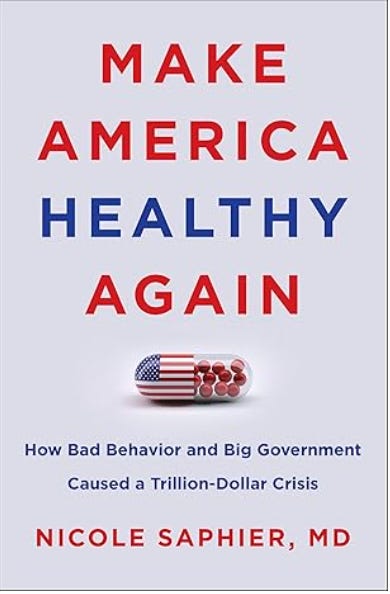
Saphier wrote a book called Make America Healthy Again in 2020.
That is not a typo, and it is not a coincidence. The full title is Make America Healthy Again: How Bad Behavior and Big Government Caused a Trillion-Dollar Crisis. It came out from HarperCollins’s Broadside Books imprint on April 21, 2020, and it was a national bestseller. The argument is that American healthcare spending has spiraled past seventeen percent of GDP because the system reimburses acute-care intervention rather than prevention, and because Americans themselves have allowed personal-responsibility habits: diet, alcohol, sedentary lifestyle, to drive the chronic-disease curve that the federal architecture is then asked to manage. Her data points include the figures the MAHA movement has been citing for two years: roughly eighty percent of cardiovascular disease and forty percent of all cancer cases preventable through lifestyle change; nearly one in five American deaths associated with poor diet; the federal government spending over a trillion dollars annually on healthcare. She makes those points five years before “Make America Healthy Again” was the political brand of an HHS Secretary.
The book is not Kennedy’s book. The causal emphasis is different. Saphier writes from a Fox-News-aligned conservative-health-policy register, and her policy targets are the Affordable Care Act, Medicare-for-all proposals, and third-party-payer fee-for-service incentives. Kennedy’s targets, when MAHA was forming, were environmental toxins, agricultural chemistry, pharmaceutical regulatory capture, and the autism epidemic. Both frameworks land on the same operational fact: that American chronic-disease costs are the principal public-health problem of the period and that the federal architecture is structurally mismatched to addressing it, but they get there through different doors.
Here is the thing that matters for MAHA. The vocabulary was already in the conservative-health-policy bloodstream before Kennedy took it up. There was a 2020 conservative-health-policy book using exactly that title, with exactly that diagnostic premise, and it was a bestseller. The MAHA movement did not invent the framing; it organized a much broader political coalition around a framing that was already partly there. Saphier was one of the people writing in that register before the political brand consolidated.
That is a fact worth sitting with.
Her clinical record, briefly
Before I get to vaccines and the question MAHA most cares about, the credential summary, because the press has not laid this out cleanly.
Saphier was born in Phoenix in 1982 and raised in Scottsdale. Her father is an attorney; her mother is a licensed counselor who worked with children who had experienced abuse and mental illness. She did her bachelor’s at Arizona State University, then went to Ross University School of Medicine in Dominica for her MD, graduating in 2008. From there she did a five-year diagnostic-radiology residency at Maricopa Integrated Health Systems in Arizona, then a subspecialty Oncologic Imaging Fellowship at Mayo Clinic Arizona with a focus in breast imaging. She is a diplomate of the American Board of Radiology.
Her current position is Director of Breast Imaging at Memorial Sloan Kettering Cancer Center’s Monmouth, New Jersey facility, with concurrent service as Interim Director of Breast Imaging at MSK Basking Ridge. She has a substantive peer-reviewed publication record, co-author on multiple papers in the radiology and oncologic-imaging literature, including recent work on artificial-intelligence applications in breast MRI, deep-learning approaches to breast-imaging triage, and image-guided localization techniques.
She also has the advisory-and-policy work that a serious Surgeon General nominee needs to have. She has served on the CDC’s Advisory Committee on Breast Cancer in Young Women. She sits on advisory committees to the New Jersey Department of Health. She is on the executive and legislative committees of the Radiological Society of New Jersey.
Some critics will note that Ross University is a Caribbean medical school and that this is “lower tier” than the Ivy League pipeline. I would urge MAHA readers not to make that argument. The Caribbean-medical-school path is one of the most common pathways into American medicine for first-generation and non-traditional students, and Saphier’s subsequent career: five-year residency, Mayo Clinic fellowship, MSK directorship, board certification, peer-reviewed publications, is the record of a serious cancer specialist. The Ross University detail will appear in critical coverage; the appropriate response is the documentary record of what she did after.
The personal-biography element that will recur in coverage is that she had her oldest son in high school, kept the pregnancy, and has framed the experience publicly as her own decision to choose life rather than abortion; a framing she has connected to her broader advocacy on patient autonomy and personal responsibility. She is married to Dr. Paul Saphier, an endovascular neurosurgeon. They have three sons together.
She has been a Fox News Channel medical contributor since 2018, with regular appearances on Fox & Friends, The Five, Outnumbered, and Mornings with Maria, and occasional commentary on Fox Business and MSNBC.
The vaccine question, told straight
This is the part MAHA readers care about most, and it is the part where Saphier’s record is most genuinely mixed. I want to lay it out as it is, not as either side of the coalition would prefer to read it.
In February 2021, Saphier wrote a Fox News opinion piece supporting the Pfizer and Moderna mRNA COVID-19 vaccines for elderly and high-risk populations. She cited the Israeli population-protection data, by then the Israeli health ministry was reporting that the mRNA vaccines were 98.9 percent effective at preventing COVID-19 death among elderly populations, and made the case that prioritizing the elderly and long-term-care populations was the right epidemiological allocation. She was not equivocating on the vaccines for those populations. She supported them.
In October 2022, when the Biden White House and CDC were pushing the bivalent COVID-19 booster as the answer for healthy children ages five and older, Saphier turned hard against the recommendation. She went on Fox News and called the booster rollout “a political stunt.” She argued that the safety and benefit data did not support universal pediatric administration, that ninety percent of children had already either had COVID or been previously vaccinated, that natural immunity was widespread, and that the demonstrated risk-benefit calculation for healthy young people did not support the recommendation. This was not a fringe position; it was substantially the same critique that came from Marty Makary, Vinay Prasad, and Jay Bhattacharya during the same period. But it is on the public record under her byline, in her own words, in 2022.
In February 2025, during the West Texas measles outbreak, Saphier did a Fox News Digital piece on MMR that is the single most relevant documentary item for understanding her current position. She endorsed the MMR vaccine as “important and lifesaving.” She also said that for parents who are concerned, it is acceptable to delay specific shots through the developmental window during which signs of autism would typically present, roughly ages one to three, so that parents can make their own decision with their pediatrician. She framed the conversation as one that should be between doctor and patient, and said that during COVID the CDC and many healthcare professionals “really took away” that conversation. And in the same piece, she expressed hope that the MAHA movement’s vaccine-safety-surveillance work would “give parents the confidence they need to continue with the vaccine programs.”
Read as a totality, the position is what I would call moderate-MAHA. She is pro-individual-vaccine on the merits. She is supportive of parental autonomy on schedule. She is critical of universal pediatric mandates absent benefit data. She is explicitly sympathetic to MAHA’s vaccine-safety-surveillance reform agenda. She is not, in any reading I can construct from the documentary record, an anti-vaccine voice in the medical-freedom register that, say, Children’s Health Defense operates in. She is also not, in any reading I can construct, a CDC-establishment-defending voice of the kind Cassidy is looking for.
Whether that is enough for Cassidy is the operative question. My honest answer is that I do not know. The COVID-pediatric-booster criticism is going to come up at her hearing. The “political stunt” line will come up. So will the autism-developmental-window framing. Cassidy is going to want to know whether she would, as Surgeon General, recommend MMR universally on the existing CDC schedule, and what she would say about a parent who chose the delay-through-the-autism-window path she has publicly endorsed. She has answers for those questions. Whether they are the answers Cassidy wants is what we are about to find out.
What the nomination signals
If you read the press coverage straight, the story is: MAHA’s Surgeon General pick failed; the administration retreated to a Fox News pick to get the seat filled. There is something to that reading, but it misses what is actually interesting.
The nomination does several things at once.
It preserves the chronic-disease-and-prevention framework that has been the most popular part of the MAHA agenda. Saphier wrote a book about it. Her appointment is a signal that the Surgeon General’s office, under this administration, is going to be organized around that framework regardless of who occupies it. That matters for the food-and-chemical regulatory work, for the medical-school nutrition-training initiative, for the Dietary Guidelines posture, and for the broader public-communications register the office sets.
It moves the vaccine question off the front of the Surgeon General’s portfolio. Casey Means’s nomination put vaccines at the center of the confirmation fight, and the Senate Republicans most committed to the existing vaccine paradigm — Cassidy, Murkowski, Collins — refused to advance her. Saphier’s record is mixed enough on vaccines that it is harder to organize a “this nominee will undermine American vaccination rates” objection around her. That is a tactical retreat, but it is also a recognition that the Surgeon General’s office is not, structurally, the right tool for the vaccine reform fight. Vaccine policy runs through ACIP, CDC, FDA, and the litigation in AAP v. Kennedy. The Surgeon General sets public-communications register. Putting a moderate-MAHA radiologist in that seat is not the loss the framing presents it as.
It also gives the administration a Surgeon General with a mainstream-credentialed cancer specialty, which is the kind of credential that travels well in mainstream press coverage and in physician-community engagement. The mainstream-medical community is not going to embrace this nomination — they will note the Ross University degree and the Fox News record, and the editorial pages will run their usual coverage. But Saphier’s clinical work at MSK is real, her peer-reviewed publication record is real, and her advisory-committee history is real. These are not small things. The press shop will be working with stronger material than they had on Means.
The hard question, on the MAHA side, is whether the chronic-disease-and-prevention framework Saphier brings, distinct from Kennedy’s environmental and pharmaceutical-capture framing in its specific causal emphases, counts as a continuation of the agenda or as a narrowing of it. The honest answer is that it is some of both. The food-and-chronic-disease half of MAHA is fully consistent with the framework Saphier was already articulating in 2020. The vaccine-policy half, the medical-freedom register, and the environmental-toxin and pharmaceutical-capture critiques are not her register. She will not, as Surgeon General, be the voice for those parts of the agenda. That work runs elsewhere in the department, and it has run elsewhere in the department for the entire fifteen months of this administration.
What I am watching
A few things are going to tell us, over the next sixty days, what this nomination actually means in practice.
The first is whether Cassidy schedules a hearing. He did not schedule a vote on Means; he scheduled a hearing and let it die. Whether he treats Saphier the same way will be the immediate signal. The Trump Truth Social attack on Cassidy was unusual in its directness, calling Cassidy “very disloyal,” referencing the 2021 impeachment vote, endorsing Cassidy’s primary challenger Julia Letlow, and Cassidy’s response will tell us whether he is willing to be the Republican senator who blocks a second consecutive Surgeon General nominee. The political math has changed since February. Cassidy is in a primary fight, and the calculation that protected him through the Means hearing may not protect him through the Saphier hearing.
The second is what Saphier says about MAHA at her hearing. She has been sympathetic in her published commentary, but the confirmation register is different from the Fox News register, and she has not been asked, on the record, the questions a Senate hearing will put to her. Will she defend the Kennedy ACIP reform record? Will she defend the AAP v. Kennedy injunction-stay litigation? Will she defend the September 22 acetaminophen and folinic-acid announcements? These are not the Surgeon General’s portfolio in the strict sense, but they are the questions the hearing will use to test her relationship to the rest of the department. Her answers will tell us how she will function alongside Kennedy.
The third is what happens with the AAP v. Kennedy appeal. The federal government filed its Notice of Appeal yesterday morning, sixteen days before the appellate window expired. The government’s posture toward the appeal — whether the administration treats the First Circuit as a serious recovery opportunity or as an institutional minimum required to preserve the record, will tell us how committed the administration remains to the original ACIP restructuring. Saphier’s nomination, on the same day, sits inside that broader administrative posture. If the administration is treating both the appeal and the Surgeon General nomination as commitments to be defended on the merits, that is one reading. If the administration is treating both as institutional housekeeping, that is a different reading. I do not know yet which it is.
A note on the register I am writing in
Some readers have asked me, on Substack and on X, why I do not write in the harder register some MAHA voices use. The answer is the one this piece embodies: the documentary record on Saphier is mixed in ways the harder register cannot accommodate. She is not the MAHA Warrior the administration nominated when it nominated Means. She is also not the establishment-physician sellout the harder register would have to make her in order to dismiss the nomination. She is a credentialed cancer specialist who wrote the MAHA case under the MAHA title five years before MAHA was a political brand, who has a mixed but defensible vaccine record, who is sympathetic to the parts of the MAHA agenda that have the broadest public support, and who is going to be the third Surgeon General nominee the administration tries to push through a Republican Senate that has already refused two.
That is the actual situation. The right MAHA response is to look at it clearly, support what is supportable, ask the right questions at the hearing, and reserve judgment until the record on the floor is fuller than the record we have today.
The chronic-disease epidemic in American children is not going to be solved by any Surgeon General. It is going to be solved by the broader political and cultural realignment that the MAHA movement is one part of. Saphier, on the documentary record, is part of that realignment. Whether she is the right person for this particular seat at this particular moment is the question her confirmation hearing is about to test.
I will be watching, and I will write more when there is more to say.
Really appreciate the balance of this piece. Thank you.
What really upsets is the POWER that Senator Cassidy has. This is just wrong -- even if we agreed with him 100%.
No single person in government should have this much power. Period.
Nice take, Dr. Malone. If you can't get someone through the process, you have to get someone who can get through it. I've heard her a lot on Fox. I disagreed with her some, but I think overall she's a much better choice than it might be. I hope people see that some of this is incremental steps and we are making headway on health. You don't cut off your nose to spite your face on the way there.