

Audio Version:
Who Is Spitting on Christians in Israel
The wolf at the door, part five: notes from the Israeli frontier
Earlier this month, a group of Israeli teenagers knocked on the door of the Armenian Apostolic Church headquarters in Jerusalem’s Old City. They asked whether there were Christians inside.
They wanted to spit on them.
The boys told a reporter that it was a mitzvah, a religious duty, to humiliate Christians, whom they called idol worshipers.
That account appeared in the Wall Street Journal on August 3 under the headline, “Spitting Attacks Show Rise of Anti-Christian Hate in Israel.” Israel’s Foreign Ministry called the piece a distortion of reality disguised as reporting, saying it had taken radical voices and extreme cases and turned them into the face of an entire country. The American ambassador, Mike Huckabee, said the paper should have called him.
The story is now being weaponized against the country it is about. But simply dismissing the reporting as distorted does not answer the underlying question.
Who is actually spitting on Christians in Israel?
What is Documented
The spitting is real, it is increasing, and the people counting it are Jews.
The Religious Freedom Data Center runs a hotline for Christians in Israel who have been harassed. It was founded and is directed by Yisca Harani, a Jewish Israeli scholar of Christianity, and is staffed by Jewish Israeli volunteers who provide documentation, accompaniment, and a protective presence for victims.
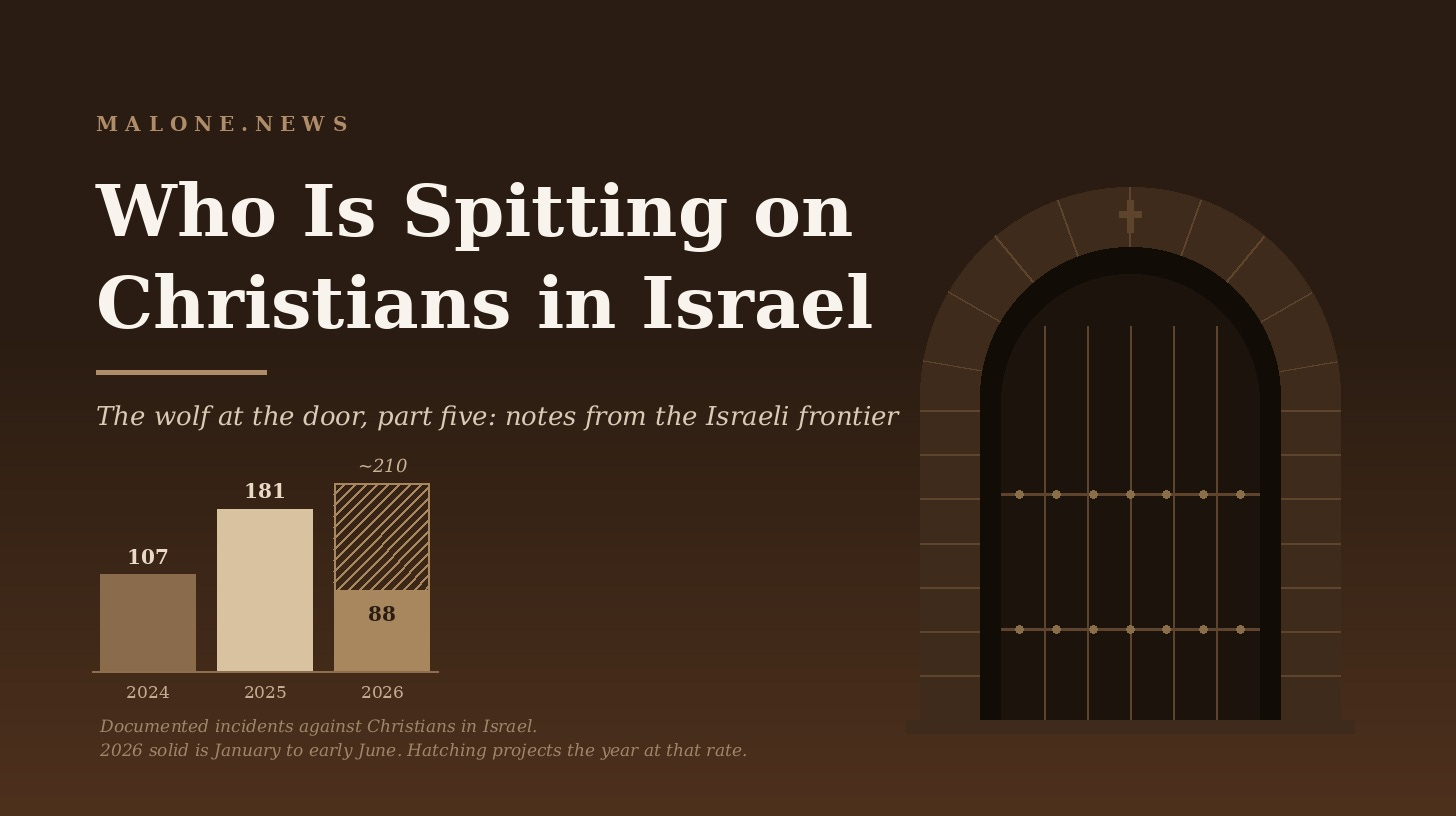
The center documented 107 incidents in 2024 and 181 in 2025. By early June 2026, it had logged more than 88 incidents, with 63 in the second quarter alone, putting this year on pace to exceed last year’s total (Religious Freedom Data Center 2026).
The incidents include spitting, verbal abuse, vandalism, desecration of graves, tombstones and crosses, stone-throwing, trespassing, garbage dumping, and arson. Most occur in the Old City, on Mount Zion, and along the route past the Armenian Patriarchate leading to the Jewish Quarter. Some have occurred at Christian sites in northern Israel.
A separate Israeli organization, the Rossing Center for Education and Dialogue, which works on relations among the country’s religious communities, documented 111 cases in its 2024 annual report, including 46 physical attacks and 35 attacks on church property (Rossing Center 2025).
These are two independent Israeli organizations, counting separately and documenting the same problem.
Datasets that combine unlike things into a single number and then circulate that number as though every incident were equivalent deserve skepticism. I have made that argument about other datasets, and the same standard applies here.
But it does not make this problem disappear. Throw out every ambiguous case, and the trend remains. Christians are still being spat on, harassed, and their churches and religious sites vandalized.
Who is Doing the Spitting
The reporting is more specific than the headlines, and two communities appear repeatedly. They are not the same community.
Most documented incidents involve Haredi youths and men. CNN obtained video of two young ultra-Orthodox men spitting at, swearing at, and kicking Father Nikodemus Schnabel near Zion Gate. One told bystanders he did it because Schnabel was a Christian (CNN 2024). The Times of Israel documented Haredi men and boys, some of them children, spitting at a Christian procession after watching an adult do it first. Channel 12 aired footage of young men in black hats and suits, several carrying prayer shawls.
One community inside the Old City comes up again and again. Participants at a forum on the problem placed much of the blame on the Zilbermans, a Lithuanian Haredi community of roughly three hundred families whose approach to Torah study incorporates right-wing Zionist ideas. Tammy Lavi of the Jerusalem Intercultural Center told the same forum that at least half of the Friday Armenian processions are disrupted by spitting, cursing, or people deliberately walking through the ceremony. A right-wing city councilor and a deputy mayor went to speak with the Zilberman rabbis about their students, apparently to little effect (Times of Israel 2023a).
But it is not only Haredim. The Jerusalem Post describes offenders as both ultra-Orthodox and National-Religious youths. The Religious Freedom Data Center’s surveillance footage attributes attacks to ultra-nationalist and ultra-Orthodox Jews. And when five people were arrested in October 2023, Channel 12 reported that some were students of Rabbi Natan Rothman, brother of Religious Zionism Knesset member Simcha Rothman. That is a Religious Zionist yeshiva, not a Haredi one (Times of Israel 2023b).
Two things need to be said immediately.
First, the numbers are small. Three hundred families and a scattering of yeshiva students are not a country. And the Christians being spat on are overwhelmingly Armenian and Arab, not American.
Second, the leadership of the Haredi world has not defended this behavior. When the October 2023 video circulated, Haredi politicians joined in condemning it and rejected the claim that spitting on Christians is either a Jewish tradition or a religious duty. Netanyahu condemned it as well.
The question is whether anyone will actually be charged.
The Minister Who Defended It
In 2017, when an earlier wave of harassment against Christians made the news, a settler activist and lawyer named Itamar Ben Gvir gave a radio interview defending the practice of spitting at Christian monks and churches. He called it an ancient Jewish tradition, said he did not think it constituted a violation, and asked why anyone would turn the matter into a criminal one (Washington Post 2026).
That has essentially remained his position for nearly a decade.
In 2015, Jewish extremists set fire to the Church of the Multiplication on the Sea of Galilee, where the Gospels place the feeding of the five thousand. Nikodemus Schnabel, now abbot of Dormition Abbey, attended the trial. What stayed with him was the attorney defending the arsonists.
The attorney was Ben Gvir.
Ben Gvir is now Israel’s Minister of National Security, and the police answer to him.
He has not revised his position since taking the portfolio. After five men were arrested in October 2023 for spitting at Christians and churches, the police minister said publicly that the offense was not criminal.
His own Jerusalem District contradicted him on the radio. Chief Superintendent Assaf Harel told Army Radio that spitting on somebody is certainly assault, and that seventeen such incidents had been reported in the preceding six months (Times of Israel 2023b).
A sitting police minister telling the country that an offense is not an offense, while his own district commander publicly says that it is, gets very close to the heart of the problem.
Nothing about this requires inference. A man who publicly defended the conduct in 2017 now holds the portfolio responsible for policing it. The record of enforcement is not encouraging.
The Israel Religious Action Center is the legal and advocacy arm of the Reform Jewish movement in Israel. Of twenty-five complaints it filed between 2012 and 2021, nineteen were closed because the suspect could not be found, no offense was deemed to have been committed, or the case was considered unsuitable for investigation (Israel Religious Action Center 2026).
Harani puts the consequence plainly. If there is no enforcement, it is a green light to do it again.
That distinction matters. A small number of people committing these acts is not evidence of some general Israeli hostility toward Christians. But when the state repeatedly fails to enforce its own laws, and the minister responsible for the police has himself defended the conduct, it becomes more than a story about the people doing the spitting.
It becomes a story about whether the government is willing to stop them.
Why Nobody Stops It
An American reader will reasonably ask why a government that condemns this behavior does not simply prosecute it. To understand the answer, you have to understand how Israeli coalition politics works.
Israel has 120 Knesset seats and no electoral districts. There are no constituencies, no primaries in the American sense, and no individual candidate whose name appears on the national ballot. Voters choose a party list, seats are allocated roughly in proportion to the national vote, and any party clearing the 3.25 percent threshold enters the Knesset. It takes sixty-one seats to form a government.
No party has ever won sixty-one. Not once in seventy-eight years. Every Israeli government has therefore been a coalition, which gives smaller parties enormous influence when neither major bloc can govern without them.
Two of those parties represent the Haredi world. United Torah Judaism is Ashkenazi, an alliance of the Hasidic Agudat Yisrael and the Lithuanian Degel HaTorah, and holds seven seats. Shas is Sephardi and Mizrahi, led by Aryeh Deri, and answers to a Council of Torah Sages. Together, the Haredi parties have typically controlled fifteen to eighteen seats.
Several things give those seats considerably more political weight than the numbers suggest.
Historically, Haredi parties have been willing to join governments of both the left and the right. They joined Ehud Barak’s government in 1999, for example, although United Torah Judaism later resigned over electrical work on the Sabbath and Shas left amid disputes with Barak’s government. The ability to negotiate with competing blocs gives a small party considerably more leverage than one permanently attached to a single side.
Their political demands are also relatively concentrated. Foreign policy and the peace process have traditionally mattered less to them than yeshiva funding, rabbinic authority over marriage and conversion, Sabbath observance, and, above all, exemption from military conscription. These are the issues on which their participation in a coalition is negotiated.
They are also remarkably disciplined voting blocs. Their Knesset members generally follow party and rabbinic leadership, which gives a prime minister a degree of certainty that is much harder to obtain from a less cohesive coalition partner.
And they are growing. Haredim make up roughly an eighth of Israel’s population and have a fertility rate substantially above the national average. Their political importance is therefore unlikely to diminish.
The Haredi exemption from military conscription dates back to the founding years of the Israeli state. Ben-Gurion granted exemptions in 1949 to about four hundred yeshiva students, partly out of concern for preserving a world of Torah scholarship nearly destroyed in Europe. What began as an accommodation for a few hundred men grew enormously over the following decades. Roughly sixty-three thousand young Haredi men are now eligible for conscription, and the exemption has become one of the most consequential disputes in Israeli coalition politics.
The nearest American comparison is imperfect, but useful. Imagine a religious voting bloc representing roughly an eighth of the country, represented by parties that vote with extraordinary discipline and can determine whether a governing coalition survives. Now imagine that the issue its leadership cares about most is an exemption that successive governments have struggled for decades to resolve.
That begins to explain the political leverage.
It also begins to explain why a problem everyone publicly condemns can remain remarkably difficult to stop.
The Last Two Years
In June 2024, all nine justices of Israel’s Supreme Court ruled that there was no legal basis for exempting yeshiva students from conscription, that the arrangement was unconstitutional, and that the state was gravely undermining the principle that all persons stand equal before the law. The court ordered conscription to begin and funding to be withdrawn from noncompliant yeshivas (Israel Supreme Court 2024).
The coalition has spent the two years since trying to legislate around that ruling.
In July 2025, United Torah Judaism resigned from the government over the delay, and Shas followed the next day, leaving Netanyahu with sixty-one seats. Both parties continued supporting him on critical votes, allowing them to distance themselves from the government without immediately bringing it down.
In January 2026, Shas announced that it would oppose the budget unless an exemption bill passed (Times of Israel 2026). In May, the spiritual head of Degel HaTorah said he had lost confidence in Netanyahu and instructed his members to work toward dissolving the Knesset (Al Jazeera 2026). In June, the party boycotted coalition votes altogether while police arrested draft evaders and Haredi protesters blocked roads in Bnei Brak (Jerusalem Post 2026). Israel votes in October.
This matters to the question of Christian harassment because the young men responsible for many of the documented incidents come from a community whose exemption from military service has consumed Israeli politics for the past two years and may yet bring down the government.
The ministry responsible for policing them belongs to a different partner in the same coalition, whose leader has said publicly that spitting on Christians is not a criminal offense.
That does not require a conspiracy or an explicit agreement to look the other way. It requires only a coalition government with almost no room to lose votes, dependent upon small religious parties whose support is necessary for its survival.
That is the political environment in which these cases are being handled. The prime minister condemns the behavior. Haredi leaders condemn it. Police officials acknowledge that spitting on someone can constitute assault. Yet complaints continue to be closed without suspects identified or charges brought.
The problem is not that Israel has decided spitting on Christians is acceptable. The problem is that condemnation has not been followed by consistent enforcement. This is the reason a country that condemns an offense at the level of the prime minister still has nineteen complaints out of twenty-five with no suspect found.
The Ambassador’s Letter
Huckabee wrote a letter a year ago that reads rather differently from his response to the Journal.
On July 16, he wrote to Israel’s Interior Minister, Moshe Arbel, about the treatment of Christian organizations by the Israeli visa department. The letter later leaked to the Israeli press. In it, Huckabee described discrimination against Christian ministries since the start of 2025, naming the Baptist Convention of Israel, the Christian and Missionary Alliance, and the Assemblies of God among the groups placed under investigation. He wrote that these organizations felt they were being treated as adversaries.
Huckabee went considerably further than expressing concern. He threatened to announce publicly throughout the United States that the State of Israel was no longer welcoming Christian organizations, to tell American Christians that their contributions were being met with hostility, to issue travel advisories, and to pursue reciprocal treatment of Israelis seeking American visas.
That is the same ambassador now saying the Journal should have called him.
I do not read that contradiction as dishonesty. I read it as the behavior of a friend who applies pressure privately and defends publicly, which is hardly unusual in diplomacy.
But the letter matters. Huckabee himself was sufficiently concerned about the treatment of Christians in Israel to threaten public criticism, travel advisories, and reciprocal visa restrictions. His criticism of the Journal does not erase what he wrote to the Israeli government a year earlier.
The Other Side of the Ledger
Everything above is true. So is everything below.
Israel’s Christian population stood at roughly 184,200 at the end of 2025, about 1.9 percent of the country, and it has grown from about 34,000 in 1948. The country counts around 300 churches, roughly double the number at independence (Israel Central Bureau of Statistics 2025; Fox News 2026).
The situation in the rest of the Middle East is the complete opposite. Christians were something on the order of twenty percent of the Middle East a century ago and are now under two percent. Iraq’s Christian community has been reduced to a remnant. Syria’s has collapsed. Lebanon’s has emigrated. Turkey’s was destroyed.
Against that history, Israel stands apart. Its Christian population has grown rather than disappeared.
In April 2026, Israel created a new post, Special Envoy to the Christian World, and Foreign Minister Gideon Sa’ar appointed George Deek to it. Deek is an Arab Christian from Jaffa, a veteran of eighteen years in the foreign service, and previously Israel’s first Christian ambassador, serving in Azerbaijan. His father chaired the Orthodox Christian community of Jaffa (Israel Ministry of Foreign Affairs 2026). No other country has created an equivalent diplomatic position.
Deek’s own summary of why the job exists is the regional one. He describes the ethnic cleansing of the Middle East of its Christians, and says the places that once held thriving Christian communities have been reduced to nothing.
And then there is the government’s response to the harassment described earlier. Israeli officials have repeatedly condemned these incidents when they occur. Police have made arrests, including after the recent incident at the Armenian church. When police blocked Pierbattista Pizzaballa, the Latin Patriarch of Jerusalem and the senior Roman Catholic authority in the Holy Land, along with other senior clergy, from a Palm Sunday service at the Church of the Holy Sepulcher under wartime restrictions, Netanyahu intervened personally to grant full and immediate access. When an Israeli soldier took a sledgehammer to a statue of Jesus in southern Lebanon, he and the soldier who filmed it were pulled from combat operations and jailed for thirty days.
None of that is the behavior of a state hostile to Christianity. It is the behavior of a state with a problem it is handling unevenly.
Both Things Can Be True
The Foreign Ministry’s response was that the Journal had distorted the situation, sought out Christians most willing to condemn Israel, and presented their experiences as representative of the country. It pointed to Israel’s nearly two hundred thousand Christians as evidence of a very different reality.
There is truth in that response. But it does not answer the teenagers at the door.
When documented harassment occurs, arguing about whether the reporting fairly represents Israel is not a substitute for dealing with the people responsible for it. The government can object to the framing of the Journal article and still acknowledge that enforcement has been inadequate.
The people using the story against Israel make the opposite error. They take the conduct of a small and identifiable group of extremists and present it as evidence of how Israelis, or Jews more broadly, treat Christians.
The evidence does not support that conclusion either.
What it does support is more specific. A relatively small number of religious extremists have repeatedly harassed Christians, particularly in and around Jerusalem’s Old City. Israeli political and religious leaders have condemned the behavior, but enforcement has been inconsistent. And the minister ultimately responsible for the police has himself publicly questioned whether spitting on Christians should be treated as a criminal offense.
That is a serious indictment of the way this problem has been handled, and particularly of the minister responsible for policing it.
It is not an indictment of Israelis as a people.
That distinction is largely missing from what is now circulating on American podcasts and social media.
Who is Actually Being Spat On
The people being harassed in the Old City are overwhelmingly Armenian and Greek Orthodox clergy, along with Arab Christians who are Israeli citizens. Seventy-nine percent of Israel’s Christians are Arabs. These are not American evangelicals.
American Christian Zionists are, if anything, among the most welcomed foreign Christians in Israel. Jill and I spent an afternoon this summer with young Americans who have been pruning vines in Samaria for twenty years. The state gave them rifles, and the Knesset gave their organization an award. I will have more to say about them on Monday.
So when an American Christian reads about Christians being spat on in Jerusalem and takes the hostility as directed toward Christians like themselves, an important distinction is being lost. The person on the receiving end is much more likely to be an Armenian monk whose community has been in that quarter for sixteen centuries, or an Arab Christian whose family has lived there for generations.
That does not make the harassment any less ugly. But it does matter if we are trying to understand who is doing it, who is being targeted, and why.
The Case Tucker Carlson is Making
Carlson has been building this argument for two years, and by now the specifics are on the record.
On April 9, 2024, he interviewed Munther Isaac, a Lutheran pastor in Bethlehem, in a conversation that attributed the collapse of Bethlehem’s Christian population largely to Israeli persecution. On February 4, 2026, Carlson interviewed Hosam Naoum, the Anglican Archbishop of Jerusalem, under the title “The Shocking Reality of the Treatment of Christians in the Holy Land by US-Funded Israel.” He has since interviewed a Palestinian-American minister from Beit Sahour, a largely Christian town beside Bethlehem, and pressed Ambassador Huckabee directly on Israel’s treatment of Palestinian Christians. In February, Carlson also said he had been detained at Ben Gurion Airport, an account Israeli officials disputed and which the Orthodox Jewish outlet Aish contested in detail (Aish 2026).
Some of what Carlson is reporting is true. Palestinian Christians in the West Bank face real hardships. Bethlehem’s Christian community has declined dramatically over decades. Huckabee’s own letter, quoted above, shows that the Israeli visa bureaucracy treated American Christian ministries badly enough for the American ambassador to threaten the Israeli government with travel advisories and reciprocal visa restrictions.
Carlson did not invent those facts.
The problem is what he does with them.
There are three problems with the case he is building, beginning with his method.
The February interview was filmed in Jordan. Carlson produced an hour-long program about the treatment of Christians in the Holy Land from another country. The Christians whose treatment was supposedly being investigated live in Jerusalem, Bethlehem, Beit Sahour, Ramallah, Nazareth and elsewhere in Israel and the West Bank. Yet the program was not reported from those communities.
That is an odd way to investigate a claim this serious.
The second problem is more consequential because it goes to the substance of Carlson’s argument. He repeatedly blurs the distinction between Palestinian Christians living under Israeli military occupation in the West Bank and Christian citizens of Israel. Those are two populations living under fundamentally different legal systems and political circumstances.
This criticism does not come only from defenders of Israel. Mondoweiss, the American news site founded by journalist Philip Weiss and explicitly hostile to Zionism, has made essentially the same point. Carlson frequently drops the word “Palestinian” and speaks instead about “Christians in Israel,” merging populations whose legal circumstances are profoundly different. The grievances he cites concerning Palestinian Christians are largely the same grievances made by Palestinian Muslims living in the same places, subject to the same checkpoints, permits and restrictions (Mondoweiss 2026).
That distinction changes the argument.
If Palestinian Christians are being subjected to the same restrictions as their Palestinian Muslim neighbors, then the discrimination at issue is based on nationality and territorial status, not Christianity. One can condemn the occupation, the checkpoints, the permit system, settlement policy, or Israeli control of the West Bank as harshly as one wishes. Those are legitimate subjects for argument.
But they are not evidence that Israel is persecuting Palestinians because they are Christians.
Carlson turns one argument into the other, and in doing so makes the issue personal for millions of American Christians. The message becomes: Israel is persecuting your fellow Christians.
The evidence he presents does not establish that.
The third problem is the population itself. If Israel were systematically persecuting Christians because they are Christians, one would expect some evidence of that persecution in the demographic trajectory of Christians who actually live as Israeli citizens.
Instead, Israel’s Christian population stands at roughly 184,000 and increased again in the most recent year. Meanwhile, the Christian share of the broader Middle East has fallen from roughly twenty percent a century ago to under two percent today.
Open Doors, an international Christian organization that publishes an annual ranking of the fifty countries where Christians face the most extreme persecution, placed eight Muslim-majority countries in its 2026 top ten. Israel does not appear on the list (Open Doors 2026; Media Line 2026).
None of this excuses the spitting in Jerusalem. It does not excuse Ben Gvir’s statements, failures of police enforcement, problems with visas for Christian organizations, or legitimate Palestinian Christian grievances. Those facts should be reported, and I have spent much of this essay reporting them.
But they do not establish the case Carlson is making.
He is taking documented abuses involving different people, different jurisdictions and different causes, combining them under the heading of Christian persecution, and presenting the resulting picture to an overwhelmingly American Christian audience.
A theory that predicts Israeli Christians should be fleeing, in a country where they are increasing, and that ignores the countries where Christians actually are fleeing, is not a theory about Christians.
Christian Antisemitism: When it Stops Being About Israel
On April 15, 2026, Carlson was criticizing the International Holocaust Remembrance Alliance’s definition of antisemitism when he came to its treatment of the ancient charge that Jews collectively killed Jesus.
“It also tells us that the suggestion that Jews killed Jesus is, quote, ‘classic antisemitism,’” Carlson said. “So there goes the New Testament. The whole New Testament is antisemitic too.”
He then added: “Read the Gospels and see if they fall under that definition. They do.”
The issue is not whether particular Jewish authorities appear in the Gospel accounts of the events leading to the crucifixion. They plainly do.
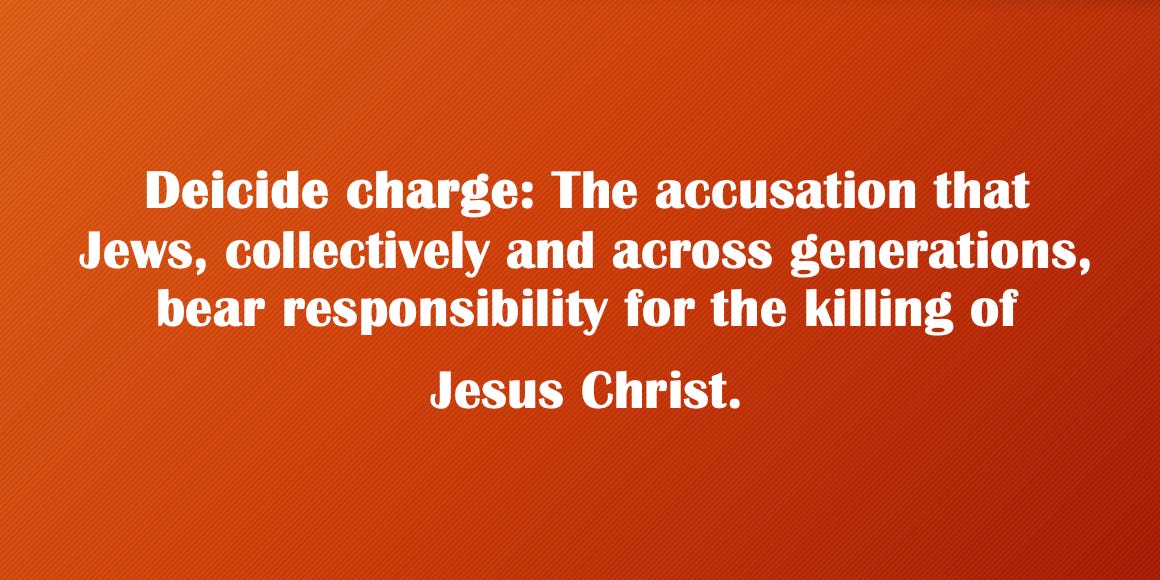
The deicide charge is something much broader: the claim that Jews collectively, as a people and across generations, bear responsibility for killing Christ.
That accusation has been used for centuries to justify persecution and violence against Jews. It is the oldest engine of Christian violence against Jews there is. Christian churches have spent decades repudiating collective Jewish guilt for the crucifixion. The Catholic Church did so formally in Nostra Aetate in 1965.
And this is where Carlson’s argument crosses a very different line. Criticizing the Israeli government, including its treatment of Palestinian Christians, is not antisemitic. Documenting harassment of Christians by religious Jews is not antisemitic. Neither is condemning Ben Gvir or the failure of Israeli police to prosecute offenders.
But invoking collective Jewish responsibility for the death of Christ belongs to a long history of Christian antisemitism. Whatever Carlson intended by the remark, that history does not disappear because the comment occurs in the middle of an argument about Israel.
I do not know whether Carlson understands the history of the claim he is repeating. His audience evidently includes a great many Christians who may not understand it either.
What Would Actually Fix It
Arrests, prosecutions, and a minister who wants them.
The Israeli organizations documenting this problem have been quite clear about what they need, and it is not another statement of sympathy. Harani and her volunteers want complaints filed, investigations opened, suspects identified, and charges brought. Without consistent enforcement, there is little reason for the people doing this to stop.
This is, ultimately, a police problem. And it is a problem Israel is entirely capable of solving.
The difficulty is political. Enforcing the law against members of a community whose political representatives can determine whether a government survives is considerably harder than condemning their behavior in a press release. That does not excuse the failure to enforce the law. It helps explain why the failure has persisted.
American Christians who care about this should demand enforcement. Ask the question publicly and in writing, as Huckabee did privately. Ask how many complaints were filed, how many investigations were opened, how many suspects were identified, and how many people were actually charged. Do not accept another statement about Israel’s respect for religious freedom as an answer to a question about whether someone who spits on a Christian monk will be prosecuted.
But American Christians who are being told that Jews hate them should also pay attention to who is documenting these attacks.
The most complete record of anti-Christian harassment in Israel is being compiled by a Jewish Israeli woman and Jewish Israeli volunteers who document the incidents, accompany victims, and provide a protective presence at Christian churches and processions.
They are Jews protecting Christians from other Jews.
That fact rarely makes it into the podcasts.
It may be the most important fact in this story.
RWM/JGM
References
Al Jazeera. 2026. “How Ultra-Orthodox Recruitment Could Unseat Netanyahu in Israeli Elections.” May 16.
Anti-Defamation League. 2026. Tucker Carlson. Backgrounder. New York, May 5.
Aish. 2026. “Tucker Carlson’s Lies About Jews and Israel.” February 19.
CNN. 2024. “Ultra-Orthodox Man Seen Spitting at Christian Priest in Jerusalem.” February 4.
Fox News. 2026. “Meet the Man Israel Chose to Be Its First-Ever Ambassador to the Christian World.” June 21.
Israel Central Bureau of Statistics. 2025. Christians in Israel: Selected Data on the Occasion of Christmas. Jerusalem, December.
Israel Ministry of Foreign Affairs. 2026. Appointment of Special Envoy to the Christian World. Jerusalem, April 23.
Israel Religious Action Center. 2026. Complaints Concerning Harassment of Christians, 2012 to 2021. Presented to the Religious Freedom Conference, Jerusalem, June 4.
The Media Line. 2026. “Fact-Checking Tucker Carlson’s Portrayal of Christians in the Holy Land.” February 12.
Mondoweiss. 2026. “Tucker Carlson’s Criticism of Israel Misses the Point.” February 27.
Israel Supreme Court. 2024. Judgment on the Conscription of Yeshiva Students. Jerusalem, June 25.
The Jerusalem Post. 2026. “Ultra-Orthodox Party Holds Knesset Hostage over Draft Exemption Bills.” June 29.
Open Doors. 2026. World Watch List. Santa Ana, CA.
Religious Freedom Data Center. 2026. Documented Incidents Against Christians in Israel. Jerusalem, June 4.
Rossing Center for Education and Dialogue. 2025. Annual Report on Attacks Against Christians, 2024. Jerusalem.
The Times of Israel. 2023a. “Old City Spitting Videos Underscore Troubling Reality for Christian Clergy.” April 17.
The Times of Israel. 2023b. “5 Arrested for Spitting at Christians in Jerusalem; Police Minister: It’s Not Criminal.” October 4.
The Times of Israel. 2026. “Israel Appoints First Special Envoy to Christian World After Scandals Strain Ties.” April 23.
The Times of Israel. 2026. “Shas Vows to Oppose 2026 Budget Unless Coalition Passes Haredi Draft Exemption Bill.” January 4.
The Wall Street Journal. 2026. “Spitting Attacks Show Rise of Anti-Christian Hate in Israel.” August 3.
The Washington Post. 2026. “As Christians Are Attacked in Israel, Government Shows Little Concern.” July 5.
Well, it sounds like our younger generation, no matter the religious background, is getting to be the epitome of the absurd. Both Jews and Christians are prime targets of Muslims and should be joining forces to fight the hate….but NOOOOOOO! Let’s start hating each other instead. :-( Now how STUPID is that?!? Good grief children! Stop wasting your lives on HATE.
If people read the Bible! Isiah 53:10, in the middle of the chapter which Christians agree points directly to Christ, are the words "yet it was the Lord's will to crush Him and cause Him to suffer, and though the Lord makes His life an offering for sin..."
The Jews didn't kill Christ. The Roman's didn't kill Christ. It was our sin. Yours and mine. Period.