

The European Union is advancing a sweeping rewrite of its seed laws under the banner of Plant Reproductive Material regulation (PRM). We are told this is about modernization, safety, and disease control. That sounds reasonable until you look at what the policy actually does and who it benefits.
What it does is shift control. What it benefits is scale. And what it tells us, if we are paying attention, is a great deal about how power now flows in the Western world.
The Heart of the Matter: Subsidiarity
There is a principle older than the European Union, older than the American republic, older even than the modern nation-state. It holds that decisions should be made as close to the individual as possible. Catholics call it subsidiarity. Americans express a similar instinct through federalism and a preference for local control, or just common sense. It rests on a simple observation. The people closest to a problem usually understand it best, live with its consequences most directly, and have the strongest reason to get it right.
Agriculture is the perfect example. A farmer in Provence knows his soil, his climate, his pests, and his market in ways no official in Brussels ever will. A gardener in Bavaria who has spent twenty years selecting a tomato variety for her specific plot knows things that cannot be captured in any database. A smallholder in Sicily adapting a wheat cultivar to drought conditions is doing real work, and doing it better than any centralized authority could direct.
For ten thousand years, people have saved, selected, traded, and improved seeds through networks of farmers, gardeners and local breeders. This is not a quaint hobby. It is the foundation of agricultural civilization. Nearly every crop we depend on came from this quiet, decentralized work. The diversity in our fields and on our plates exists because millions of ordinary people, without asking permission from anyone, did the patient work of selection and exchange.
The Plant Reproductive Material regulation turns this ancient order on its head. It presumes that seeds must be authorized from above before they can circulate below. It treats the default activity of human agriculture, the saving and sharing of seed, as something requiring a permission slip from a bureaucrat. This is not a minor tweak. It is a philosophical reversal. It moves the presumption of legitimacy from the grower to the regulator.
Conservatives understand why this matters. Power concentrated at a distance is power removed from accountability. A village that governs its own seed exchange answers to itself. A continent that governs seed exchange from Brussels answers to no one the farmer will ever meet. The regulation does not just impose costs, though it does that, and severely. It transfers authority. It takes what was local and makes it central. It takes what was free and makes it licensed. That transfer is the whole point, even when nobody says so out loud.
The Compliance Cost Trap
The way this transfer happens is clever in its indirection. The regulation does not ban seed saving. It does not send inspectors to kitchen gardens. What it does is set up a registration and certification regime whose fixed costs land with crushing weight on small actors.
A multinational seed company spreads compliance across global product lines and billion-dollar revenues. The paperwork, the testing, the legal departments, all of it becomes a rounding error on the balance sheet. For a small regional breeder, a farmer-owned cooperative, or an individual who has developed a locally adapted variety worth sharing, the same requirements are impossible. The rules apply equally. The burden does not.
This is how consolidation works in modern regulatory states. Not by decree. Not by nationalization. But by the steady piling on of compliance costs that quietly strangle everyone who cannot absorb them. The small operator is not forbidden from participating. He is simply priced out. The result looks like market forces but is actually the predictable outcome of rules designed to favor scale.
Bayer, having swallowed Monsanto, now controls one of the largest seed and trait portfolios on the planet. Corteva and Syngenta round out an oligopoly that increasingly decides what gets bred, what gets distributed, and what ends up in farmers’ fields. This is not what superior seeds winning in open competition looks like. It is what a regulatory environment looks like when it rewards the kind of operation these firms run and punishes the kind of operation small nurserymen run. The PRM regulation tightens that ratchet another turn.
The Disease Argument Deserves a Full Burial
Defenders of the regulation reach reflexively for the disease argument. Seeds, we are told, can carry pathogens. Therefore they must be tracked, certified, and controlled. This argument gets tossed around so casually that it often escapes scrutiny. It should not.
Seed-borne diseases are real. Nobody disputes this. Wheat bunt, loose smut, bacterial blight in beans, and certain viruses in tomatoes and peppers have been known for over a century. They are in every agronomy textbook. The question is not whether they exist. The question is whether they justify a sweeping expansion of centralized control over seed distribution across an entire continent.
They do not. And the evidence against the argument is overwhelming.
First, these diseases are already managed, and managed well, through targeted practices that have worked for generations. Hot water treatment for brassicas. Fungicidal treatment for cereals. Visual inspection and roguing. Certified disease-free stock where it matters most. Crop rotation. Resistant varieties. These methods work. They have worked for decades. They do not require a continental registration regime to function.
Second, and more damning, the big disease pressures in modern agriculture do not come from gardeners trading bean seeds at a village market. They come from globalized industrial supply chains moving plant material at enormous volume across enormous distances. Xylella fastidiosa did not arrive in European olive groves because a grandmother shared cuttings. Tomato brown rugose fruit virus did not spread through heirloom seed exchanges. These pathogens rode in on commercial shipments, through industrial nurseries, through exactly the channels the PRM regulation treats as trustworthy while it tightens the screws on the channels that have historically been the safest.
The science here is not ambiguous. Large, uniform, monocultural plantings are disease amplifiers. Genetically diverse, locally adapted, small-scale plantings are disease buffers. When a wheat blast outbreak hits a region where every field grows the same three varieties, the losses are catastrophic. When the same pathogen runs into a landscape of dozens of locally adapted cultivars with different resistance profiles, it burns out. Diversity is the immune system of agriculture. The PRM regulation, by privileging uniformity, weakens that immune system in the name of protecting it.
Third, the disease rationale proves too much. If seed exchange among small producers really posed the threat claimed, we would expect to see disease outbreaks traced back to farmer seed networks. We do not. Decades of epidemiological data across Europe show that seed-saving communities and regional breeders are not significant disease vectors. The history simply does not support the theory on which the regulation rests on.
Fourth, where seed-borne disease risk genuinely exists, it can be handled with proportionate measures. None of this requires a wholesale restructuring of European seed law. A scalpel is available. Brussels has chosen a sledgehammer.
When a stated rationale cannot carry the weight of the policy it supposedly justifies, honest observers should ask what the policy is actually for. The disease argument is not the reason for the PRM regulation. It is the cover for it.
The Commission’s Pattern of Overreach
The Plant Reproductive Material regulation (PRM) does not arrive in a vacuum. It arrives as the latest example of a governance pattern that has become impossible to miss for anyone paying attention.
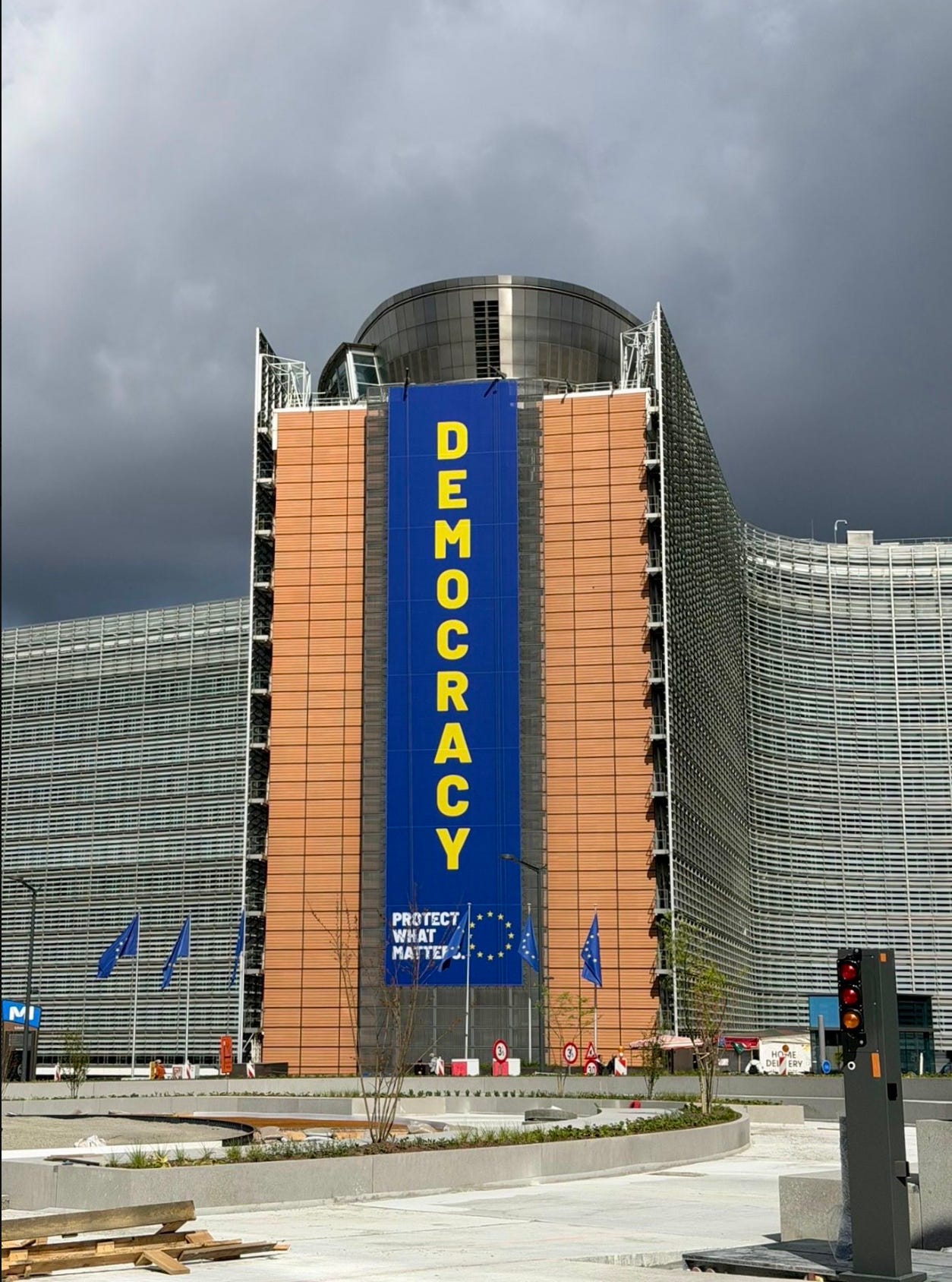
The European Commission is, by design, one of the most insulated major executive bodies in the democratic world. Its commissioners are nominated by national governments and confirmed by the European Parliament, which gives it a thin veneer of democratic legitimacy. But no European voter has ever cast a ballot for a Commission President. No citizen of any member state can remove a commissioner at the ballot box. The Commission proposes the legislation, shepherds it through passage, and then enforces it, all while sitting at a safe distance from the people whose lives it governs.
This setup was defensible when the European project stuck to coordinating trade and reducing tariffs. It becomes a lot harder to defend as the Commission’s reach expands into agriculture, energy, speech, finance, migration, public health, and now the contents of a gardener’s seed packet.
Consider the pattern.
During COVID, the Commission oversaw the rollout of digital health certificates that conditioned free movement, one of the founding rights of European citizenship, on medical compliance. The system was pitched as temporary and voluntary. In practice, it showed how fast centralized authority could gate fundamental freedoms behind bureaucratic credentials when institutions decided a crisis warranted it.
The Commission’s procurement of COVID vaccines, particularly the Pfizer contracts negotiated in part through text messages between Commission President von der Leyen and Pfizer’s CEO, remains shrouded in opacity. The European Ombudsman found maladministration in the refusal to release the communications. The European Court of Justice has since ruled against the Commission on transparency grounds. Billions of euros in public money, and the Commission fought to keep the paper trail hidden. This is not the conduct of an institution that sees itself as accountable to the public.
On migration, the Commission has pursued infringement proceedings against member states, Hungary and Poland most prominently, whose elected governments enacted border policies reflecting the clear preferences of their own citizens. The message was unmistakable. Democratic mandates at the national level would not be allowed to override directives from Brussels, and failure to comply incurs financial penalties. National electorates, the citizens of these nations, were told, in effect, that their votes could be overridden by an institution they did not elect. And in the typical wrap-up smear, those governments that rejected the Commission’s edicts got labeled “far-right” by the European mainstream media, with American outlets dutifully picking up the trope.
In speech, the Digital Services Act extends the Commission's authority over online content moderation across the entire bloc of nations, with censorship of political discourse, individual free speech, and press freedom that is only now coming into focus.
On energy, Commission mandates for “green energy” solutions have driven policies that have caused both industrial and household energy shortages and price rises in recent years, with costs borne by ordinary Europeans rather than the officials who designed the policies.
The PRM regulation fits this pattern precisely. An unelected executive body proposes detailed rules governing a domain that has historically been managed by farmers and local communities. The rules are dressed up in technical language that hides their practical effect. Compliance is enforced through penalties that fall hardest on those least able to absorb them. National parliaments have a limited ability to amend or reject regulations once they are adopted. The affected citizens, the farmers, gardeners, and small breeders, have essentially no direct recourse.
This is not democracy in any meaningful sense. It is not even the constitutional republicanism that served the Western tradition for centuries. It is administrative governance by a body that has slipped the leash of popular accountability. The seed regulation is just the latest territory this governance model has claimed.
Why Americans Should Be Watching Closely
It is tempting for American readers to look at all this as a European problem. It is not. It is a preview.
The regulatory architecture being built in Brussels does not stay in Brussels. It spreads through international harmonization efforts, through trade agreements, through the quiet coordination among agencies that increasingly defines global governance. When the EU sets a precedent for centralized seed control, that precedent becomes a reference point. When the EU shows that disease rhetoric can justify consolidation of agricultural authority, that playbook becomes available to regulators everywhere.
Americans who doubt this should look at the patterns already visible in their own country.
Raw milk, legal to produce and consume for all of human history until very recently, is now a prosecutable offense in many states, enforced through armed raids on small dairies. The justification is disease. The effect is consolidation.
Small-scale egg producers face escalating regulatory requirements that large industrial operations absorb with ease. The justification is disease. The effect is consolidation.
Independent slaughterhouses have collapsed from roughly fifteen hundred in the 1970s to a few hundred today, squeezed out by USDA regulations whose compliance costs are trivial for Tyson and Cargill and fatal for the local butcher. The justification is food safety. The effect is consolidation.
Cottage food laws vary wildly by state, with many jurisdictions restricting the sale of home-baked goods through byzantine licensing schemes. The justification is public health. The effect is consolidation.
Backyard poultry flocks have been culled by the millions under avian influenza protocols, with compensation structures that favor large commercial operations over small producers. The justification is disease. The effect is consolidation.
Furthermore, topical antibiotics for animal wound care have been removed from the market because the FDA needed to harmonize with the European Union. These U.S. regulators argued that export competitiveness and global alignment required these products to be banned from domestic sales.
The seed regulations have not yet arrived in the United States in the European form. Patent law, utility patents on seeds, licensing restrictions enforced by firms like Bayer, and the ongoing erosion of farmers’ traditional seed-saving rights through contract law have already done much of the same work through different mechanisms. The American path to seed consolidation has run through intellectual property rather than regulatory registration, but the destination is the same.
And when the Europeans finish building their apparatus, American regulators will have a ready-made template. They will cite European standards. They will invoke harmonization. They will talk about disease, safety, and modernization. The arguments will be familiar because they are always the same arguments. The outcome will be familiar because it is always the same outcome.
The American conservative instinct to defend local knowledge, local authority, and local self-sufficiency is not nostalgia. It is not a preference for the rustic over the modern. It is a recognition, grounded in hard experience, that when the capacity to feed yourself is surrendered to distant institutions, something essential about citizenship goes with it. A people who need permission to plant are not a free people. A nation whose seed stock is controlled by four corporations and a regulatory bureaucracy is not a sovereign nation, whatever its flag may say.
What Is Actually at Stake
The seed is the smallest unit of agricultural freedom. It is also the most fundamental. Everything else in the food system, the farm, the market, the table, flows from the question of who controls the seed.
For ten thousand years, the answer was simple. Whoever plants it. That answer built civilization. It sustained diversity. It produced the abundance we inherited. It let communities adapt to their particular conditions and survive shocks that uniform systems could not weather.
The answer the European Commission is now proposing is different. Whoever registers it, certifies it, and pays the fees. That answer will, over time, hollow out the agricultural diversity of an entire continent. It will transfer the productive capacity of European agriculture from the many to the few. It will wipe out, through economic gravity rather than outright prohibition, the small breeders and regional varieties that have been the quiet engine of agricultural resilience.
And it will establish the precedent, the legal architecture, and the rhetorical playbook for doing the same thing everywhere else.
The garden is not a hobby. The farm is not just a business. The seed is not just a commodity. They are the material foundation of a free people’s ability to feed itself without asking permission. When that foundation is regulated out of reach, the independence built on it goes with it.
If you think this will stay on foreign shores, I have a bridge in Brooklyn you might want to invest in. Americans watching this unfold in Europe are not looking at a foreign curiosity. They are watching a dress rehearsal. The question is whether they will recognize the performance when it opens on their own stage, and whether, by then, it will still be possible to close the show.
JGM/RWM
Excellent article. Shameful what the non-elected bureaucrats (on the take from major manufacturers) in tiny Belgium do everyday ordering EU members to bow down to them.
Decades ago, the EU mandated that the specification for all oil well tubulars used in lining and producing an oil or gas well would be developed in Germany instead of the UK. It so happened a major manufacturer of these tubulars, Mannesmann, was a German company. They tweaked the standards to meet their own specifications effectively squeezing out other manufacturers. The UK should never have joined the EU.
it's just communism at work = the globalist plan to control every one and every thing !